



The Structural Crisis of the Translation Profession in Thailand:
The Monopoly of Credibility by Translation Agencies and the Necessity of a Professional Certification System in the International Context
Author: Wanitcha Sumanat, President, Southeast Asian Association of Translators and Interpreters Professionals (SEAProTI), Arbitrator, Mediator, and Professional Forensic Linguist
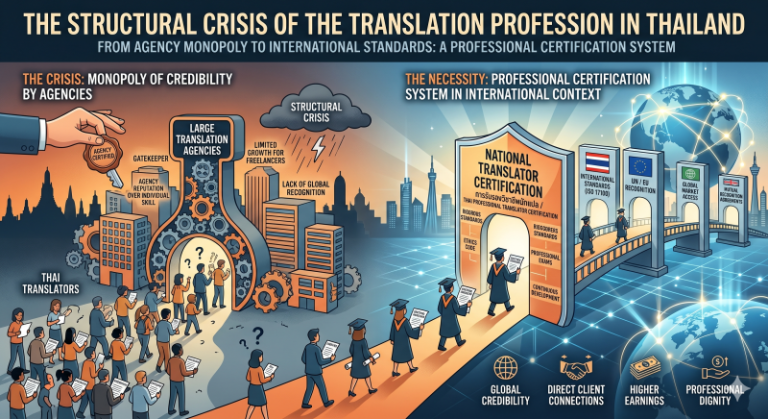
This article examines the structural problems facing the translation profession in Thailand, particularly the credibility issues faced by freelance translators in a market dominated by translation agencies and language service companies. The author argues that the credibility of translation work in Thailand is not fundamentally based on professional standards or translator competence, but rather on the business status of translation agencies that possess commercial registration and corporate seals. As a consequence, many highly qualified freelance translators remain marginalized and unable to access professional opportunities on an equal basis.
The article further analyzes the limitations of the Thai translation agency system in the international context, especially in cases where certain legal or official documents must be translated and certified exclusively by translators officially recognized in the country of origin, such as Certified Translators or Sworn Translators. In such circumstances, ordinary translation agencies are unable to substitute for legally accredited professionals. The article, therefore, proposes the establishment of a professional certification system through independent professional associations as a mechanism to elevate the standards and international recognition of Thai translators.
**Keywords:** freelance translators, translation agencies, translation profession, professional certification, Certified Translator, Sworn Translator
The translation profession constitutes a crucial component of modern global society. International communication in the fields of economics, law, education, medicine, diplomacy, and technology relies heavily upon accurate and effective cross-linguistic communication. Despite the increasingly important role of translators in facilitating global interaction, Thailand still lacks a formal professional regulatory framework or licensing system for translators. Consequently, professional standards and credibility within the Thai translation industry are shaped primarily by market mechanisms rather than by institutionalized professional evaluation.
Within this context, translation agencies and language service companies have emerged as the principal holders of “credibility authority” through the use of corporate seals, commercial registration, and business status. Although such mechanisms may create public confidence, they do not constitute formal proof of professional competence or adherence to professional standards. As a result, the credibility of translation work in Thailand has become associated more closely with business organizations than with translators themselves.
This phenomenon has produced significant consequences for freelance translators. Many independent translators possess specialized expertise, extensive experience, and internationally competitive translation quality; however, they are frequently perceived as less credible merely because they lack organizational affiliation, company seals, or institutional backing. Furthermore, the market structure in which translation agencies function as dominant intermediaries has significantly reduced opportunities for new translators to enter the profession.
This article aims to analyze these issues from the perspective of professional power structures while proposing the development of a professional certification system through independent professional organizations. Such a system could strengthen professional standards and align Thailand’s translation profession with international norms.
The Structure of Credibility in the Thai Translation Industry
The translation industry in Thailand has evolved largely under free-market mechanisms without a centralized institution responsible for certifying professional translation standards. Consequently, translation agencies have become substitute mechanisms for establishing trust among clients, government authorities, and institutions.
In practice, many clients place considerable importance on the seals and certifications issued by translation agencies because these are perceived as indicators of reliability, accountability, and document authenticity. However, such credibility is fundamentally commercial rather than professional in nature. Corporate registration and company seals do not verify whether translators possess professional qualifications, ethical standards, or certified translation competence.
This situation demonstrates that the Thai translation market has informally replaced professional accreditation with business legitimacy. As a result, freelance translators who lack the financial resources to establish companies or agencies are systematically deprived of credibility, regardless of their actual competence or expertise.
Moreover, many translation agencies operate as intermediaries that monopolize translation opportunities through established translator networks. Translation assignments are repeatedly distributed among the same groups of translators, limiting opportunities for newcomers and unaffiliated professionals. Such a structure contributes to professional inequality and shifts market priorities away from translator quality toward business relationships and organizational affiliation.
The Limitations of Translation Agencies in the International Context
Although translation agencies may establish credibility domestically, their limitations become increasingly evident in international contexts, particularly in relation to legal, immigration, educational, and governmental documentation.
Many countries require translated documents to be certified exclusively by professionally licensed translators, such as Certified Translators, Sworn Translators, or Official Translators. These professionals typically undergo formal examinations, registration procedures, ethical oversight, and continuous professional regulation by governmental authorities or professional associations.
Under such systems, the primary concern of foreign authorities is not the seal of a translation company but the legal and professional status of the translator as an individual. In other words, the translator must personally possess recognized professional credentials in accordance with the legal standards of the country concerned.
This requirement exposes a fundamental weakness in the Thai translation agency model. While agencies may possess commercial legitimacy, they generally lack the legal authority to certify translators as licensed professionals. Consequently, translated documents originating from Thailand may not always be accepted internationally, even when issued by reputable agencies.
The issue therefore extends beyond the struggles of freelance translators; it reflects a broader structural deficiency within Thailand’s translation system itself. In the absence of a nationally or internationally recognized certification framework, Thailand risks remaining disconnected from global professional translation standards.
The Need for a Professional Certification System
The problems discussed above reveal the existence of a professional regulatory vacuum within Thailand’s translation industry. Despite the critical role of translators in society and the economy, no formal professional certification or licensing structure currently exists.
In many countries, translation is recognized as a specialized profession requiring ethical standards, technical expertise, and professional accountability. Translators are therefore required to undergo professional examinations, licensing procedures, continuing education, and ethical regulation.
Such systems enable society to distinguish clearly between professional practitioners and general service providers while simultaneously enhancing public trust in translated documents both domestically and internationally.
For Thailand, the establishment of a professional certification system through independent professional organizations—such as the Southeast Asian Association of Translators and Interpreters Professionals (SEAProTI)—may represent a significant step toward resolving structural deficiencies within the industry. Such a system could include standardized professional training, competency examinations, ethical assessments, translator registration, and professional accreditation mechanisms.
If implemented effectively, this framework would allow freelance translators to establish credibility through professional competence rather than through business affiliation. Furthermore, it would contribute to the international recognition of Thai translation standards and improve Thailand’s competitiveness in global linguistic and legal communication.
Conclusion
The credibility crisis faced by freelance translators in Thailand is not the result of insufficient competence among translators themselves. Rather, it is the consequence of a market structure that associates credibility with translation agencies and commercial status rather than with professional qualifications.
Although translation agencies continue to play an important role in domestic markets, their limitations become increasingly apparent in the international arena, particularly where documents require certification by licensed professional translators recognized under foreign legal systems.
The establishment of a professional certification system for translators is therefore necessary not only for professional development but also for economic competitiveness and international integration. Ultimately, the credibility of translation work should be based upon the competence, ethics, and qualifications of translators themselves rather than solely upon the commercial seals of business organizations.
Only through the development of formal professional recognition can freelance translators attain equal standing as legitimate professionals within both national and international contexts.
References
- American Translators Association. (2023). *Certification program overview*. https://www.atanet.org
- Gouadec, D. (2007). *Translation as a profession*. John Benjamins Publishing Company.
- Pym, A., Grin, F., Sfreddo, C., & Chan, A. L. J. (2012). *The status of the translation profession in the European Union*. Anthem Press.
- Sela-Sheffy, R., & Shlesinger, M. (Eds.). (2011). *Identity and status in the translational professions*. John Benjamins Publishing Company.
- Witter-Merithew, A., & Johnson, L. (2004). Market disorder within the field of sign language interpreting: Professionalization implications. *Journal of Interpretation, 1*(1), 19–55.
For professional services, please visit https://www.seaproti.org/practitioners/
About certified translators, translation certifiers, and certified interpreters associated with SEAProTI. The Southeast Asian Association of Professional Translators and Interpreters (SEAProTI) has officially shared the qualifications and requirements for becoming certified translators, translation certification providers, and certified interpreters in Sections 9 and 10 of the Royal Gazette, which was published by the Prime Minister’s Office in Thailand on July 25, 2024. Certified Translators, Translation Certification Providers, and Certified Interpreters
The Council of State has proposed the enactment of a Royal Decree, granting registered translators and recognised translation certifiers from professional associations or accredited language institutions the authority to provide legally valid translation certification (Letter to SEAProTI dated April 28, 2025)
SEAProTI is the first professional association in Thailand and Southeast Asia to implement a comprehensive certification system for translators, certifiers, and interpreters.
Head Office: Baan Ratchakru Building, No. 33, Room 402, Soi Phahonyothin 5, Phahonyothin Road, Phaya Thai District, Bangkok 10400, Thailand
Email: hello@seaproti.com | Tel.: (+66) 2-114-3128 (Office hours: Mon–Fri, 09:00–17:00).
วิกฤตโครงสร้างวิชาชีพนักแปลไทย :
การผูกขาดความน่าเชื่อถือโดยร้านแปล และความจำเป็นของระบบรับรองวิชาชีพนักแปลในระดับสากล
ผู้แต่ง: วณิชชา สุมานัส นายกสมาคมวิชาชีพนักแปลและล่ามแห่งเอเชียตะวันออกเฉียงใต้ (SEAProTI) อนุญาโตตุลาการ ผู้ไกล่เกลี่ย และนักนิติภาษาศาสตร์วิชาชีพ
บทความนี้มุ่งวิเคราะห์ปัญหาเชิงโครงสร้างของวิชาชีพนักแปลในประเทศไทย โดยเฉพาะปัญหาความน่าเชื่อถือของนักแปลอิสระภายใต้ระบบตลาดที่ถูกครอบงำโดยร้านแปลและบริษัทแปลภาษา ผู้เขียนเสนอว่า ความน่าเชื่อถือของงานแปลในประเทศไทยมิได้ตั้งอยู่บนมาตรฐานวิชาชีพของนักแปล หากแต่ผูกติดกับสถานะทางธุรกิจของร้านแปลที่มีตราประทับและการจดทะเบียนทางพาณิชย์ ส่งผลให้นักแปลอิสระจำนวนมากแม้จะมีความสามารถสูงกลับไม่สามารถเข้าถึงโอกาสทางวิชาชีพได้อย่างเท่าเทียม บทความยังวิเคราะห์ข้อจำกัดของระบบร้านแปลไทยในบริบทสากล โดยเฉพาะกรณีที่เอกสารบางประเภทจำเป็นต้องใช้นักแปลที่ได้รับการรับรองจากประเทศต้นทางตามมาตรฐานสากล เช่น Certified Translator หรือ Sworn Translator ซึ่งร้านแปลทั่วไปไม่สามารถทดแทนได้ บทความจึงเสนอแนวทางในการพัฒนาระบบรับรองวิชาชีพนักแปลผ่านองค์กรวิชาชีพอิสระ เพื่อยกระดับมาตรฐานวิชาชีพนักแปลไทยให้สอดคล้องกับระบบสากล
คำสำคัญ: นักแปลอิสระ, ร้านแปล, วิชาชีพนักแปล, การรับรองวิชาชีพ, Certified Translator, Sworn Translator
วิชาชีพนักแปลถือเป็นองค์ประกอบสำคัญของสังคมโลกยุคใหม่ เนื่องจากการติดต่อระหว่างประเทศในด้านเศรษฐกิจ กฎหมาย การศึกษา การแพทย์ และเทคโนโลยี ล้วนต้องอาศัยการสื่อสารข้ามภาษาอย่างมีประสิทธิภาพ อย่างไรก็ตาม แม้วิชาชีพนักแปลจะมีบทบาทสำคัญต่อการขับเคลื่อนสังคมและเศรษฐกิจ แต่ในประเทศไทยกลับยังไม่มีระบบกำกับดูแลวิชาชีพหรือระบบใบอนุญาตวิชาชีพนักแปลอย่างเป็นทางการ ส่งผลให้มาตรฐานวิชาชีพและความน่าเชื่อถือของนักแปลขึ้นอยู่กับกลไกตลาดมากกว่าการประเมินคุณภาพทางวิชาชีพ
ในบริบทดังกล่าว ร้านแปลและบริษัทแปลภาษาจึงกลายเป็นผู้ถือครอง “อำนาจในการสร้างความน่าเชื่อถือ” ผ่านการใช้ตราประทับทางธุรกิจและสถานะการจดทะเบียนกับกรมพัฒนาธุรกิจการค้า แม้ว่าตราประทับดังกล่าวจะมิใช่หลักฐานการรับรองคุณภาพทางวิชาชีพก็ตาม สถานการณ์เช่นนี้ทำให้ความน่าเชื่อถือของงานแปลในประเทศไทยถูกเชื่อมโยงกับ “องค์กรธุรกิจ” มากกว่าตัวนักแปลโดยตรง
ผลกระทบที่ตามมาคือ นักแปลอิสระจำนวนมากแม้จะมีความเชี่ยวชาญเฉพาะทาง มีประสบการณ์ หรือมีคุณภาพงานในระดับสากล กลับไม่สามารถสร้างความน่าเชื่อถือได้เทียบเท่าร้านแปล เนื่องจากไม่มีสังกัด ไม่มีตราประทับองค์กร และไม่มีระบบรับรองวิชาชีพรองรับ นอกจากนี้ โครงสร้างตลาดที่ร้านแปลทำหน้าที่เป็นตัวกลางหลัก ยังทำให้โอกาสในการเข้าถึงงานของนักแปลรายใหม่ลดลงอย่างมีนัยสำคัญ
บทความนี้จึงมุ่งวิเคราะห์ปัญหาดังกล่าวในมิติของโครงสร้างอำนาจทางวิชาชีพ พร้อมทั้งเสนอแนวคิดเกี่ยวกับการพัฒนาระบบรับรองวิชาชีพนักแปลผ่านองค์กรวิชาชีพอิสระ เพื่อยกระดับมาตรฐานวิชาชีพนักแปลไทยให้สอดคล้องกับระบบสากล
โครงสร้างความน่าเชื่อถือของร้านแปลในประเทศไทย
ระบบงานแปลในประเทศไทยพัฒนาภายใต้กลไกตลาดเสรี โดยไม่มีหน่วยงานกลางที่ทำหน้าที่รับรองมาตรฐานวิชาชีพนักแปลอย่างเป็นทางการ ส่งผลให้ “ร้านแปล” กลายเป็นกลไกทดแทนในการสร้างความเชื่อมั่นให้แก่ลูกค้า หน่วยงานราชการ และสถาบันต่าง ๆ
ในทางปฏิบัติ ลูกค้าจำนวนมากมักให้ความสำคัญกับตราประทับของร้านแปลหรือบริษัทแปลภาษา เนื่องจากมองว่าเป็นหลักฐานที่สะท้อนถึงความน่าเชื่อถือ ความรับผิดชอบ และความถูกต้องของเอกสาร อย่างไรก็ตาม ความน่าเชื่อถือดังกล่าวเป็นเพียง “ความน่าเชื่อถือเชิงธุรกิจ” มิใช่ “ความน่าเชื่อถือเชิงวิชาชีพ” กล่าวคือ การจดทะเบียนบริษัทหรือการมีตราประทับมิได้เป็นหลักฐานยืนยันว่าผู้แปลมีคุณสมบัติทางวิชาชีพหรือผ่านการประเมินมาตรฐานด้านการแปลแต่อย่างใด
ปรากฏการณ์นี้สะท้อนให้เห็นว่า ตลาดงานแปลไทยกำลังใช้ “สถานะทางธุรกิจ” มาแทนที่ “ระบบรับรองวิชาชีพ” อย่างไม่เป็นทางการ ส่งผลให้นักแปลอิสระซึ่งไม่มีทุนในการจัดตั้งบริษัทหรือเปิดร้านแปล ถูกลดทอนความน่าเชื่อถือโดยปริยาย แม้ว่าจะมีความรู้ความสามารถสูงก็ตาม
ยิ่งไปกว่านั้น ร้านแปลจำนวนมากยังทำหน้าที่เป็น “ตัวกลางผูกขาดงานแปล” โดยอาศัยเครือข่ายนักแปลประจำของตนเอง งานแปลจำนวนมากจึงหมุนเวียนอยู่ภายในเครือข่ายเดิม ส่งผลให้นักแปลหน้าใหม่หรือผู้ไม่มีสังกัดมีโอกาสเข้าสู่ตลาดได้ยาก สถานการณ์เช่นนี้ก่อให้เกิดความไม่เท่าเทียมทางวิชาชีพ และทำให้ระบบตลาดให้ความสำคัญกับ “ความสัมพันธ์ทางธุรกิจ” มากกว่าคุณภาพของนักแปลรายบุคคล
ข้อจำกัดของร้านแปลในบริบทสากล
แม้ว่าร้านแปลจะสามารถสร้างความน่าเชื่อถือในระดับภายในประเทศได้ระดับหนึ่ง แต่ในบริบทสากล ระบบดังกล่าวกลับมีข้อจำกัดอย่างชัดเจน โดยเฉพาะกรณีของเอกสารที่ใช้ในกระบวนการทางกฎหมาย การย้ายถิ่นฐาน การขอสัญชาติ หรือการรับรองคุณวุฒิในต่างประเทศ
หลายประเทศกำหนดให้เอกสารแปลจะต้องได้รับการรับรองจาก “นักแปลที่ได้รับใบอนุญาตวิชาชีพ” เท่านั้น เช่น Certified Translator, Sworn Translator หรือ Official Translator ซึ่งต้องผ่านกระบวนการสอบ การขึ้นทะเบียน และการกำกับดูแลทางจรรยาบรรณโดยองค์กรวิชาชีพหรือหน่วยงานของรัฐ
ในกรณีดังกล่าว สิ่งที่หน่วยงานต่างประเทศให้ความสำคัญมิใช่ตราประทับของบริษัทแปลภาษา แต่คือสถานะทางวิชาชีพของผู้แปลโดยตรง กล่าวอีกนัยหนึ่งคือ “ตัวบุคคล” ต้องได้รับการรับรองตามกฎหมายหรือมาตรฐานวิชาชีพของประเทศต้นทาง
ข้อกำหนดเช่นนี้สะท้อนให้เห็นว่า ระบบร้านแปลแบบไทยไม่สามารถตอบสนองต่อมาตรฐานสากลได้อย่างสมบูรณ์ เนื่องจากร้านแปลมิได้ทำหน้าที่เป็นองค์กรรับรองวิชาชีพ และไม่มีอำนาจในการออกใบอนุญาตหรือรับรองสถานะทางวิชาชีพของนักแปล
ผลกระทบที่เกิดขึ้นคือ เอกสารแปลจากประเทศไทยจำนวนหนึ่งอาจไม่ได้รับการยอมรับในต่างประเทศ แม้จะผ่านร้านแปลที่มีชื่อเสียงภายในประเทศก็ตาม ปัญหานี้จึงมิใช่เพียงปัญหาของนักแปลอิสระ แต่เป็นข้อจำกัดเชิงโครงสร้างของระบบงานแปลไทยโดยรวม
ความจำเป็นของระบบรับรองวิชาชีพนักแปล
จากปัญหาข้างต้น จะเห็นได้ว่า ประเทศไทยกำลังเผชิญภาวะ “สุญญากาศทางวิชาชีพ” ในวงการแปล กล่าวคือ แม้วิชาชีพนักแปลจะมีบทบาทสำคัญในระดับสังคมและเศรษฐกิจ แต่กลับไม่มีระบบรับรองมาตรฐานวิชาชีพที่ชัดเจน
ในหลายประเทศ วิชาชีพนักแปลได้รับการยอมรับในฐานะวิชาชีพเฉพาะทางที่ต้องอาศัยมาตรฐานทางจริยธรรม ความรู้ และทักษะเฉพาะด้าน นักแปลจึงต้องผ่านกระบวนการรับรอง เช่น การสอบขึ้นทะเบียน การอบรมวิชาชีพ และการต่ออายุใบอนุญาตอย่างต่อเนื่อง
ระบบดังกล่าวช่วยให้สังคมสามารถแยกแยะระหว่าง “ผู้ประกอบวิชาชีพ” กับ “ผู้ให้บริการทั่วไป” ได้อย่างชัดเจน อีกทั้งยังช่วยสร้างความเชื่อมั่นให้แก่หน่วยงานทั้งในประเทศและต่างประเทศ
สำหรับประเทศไทย การพัฒนาระบบรับรองวิชาชีพนักแปลผ่านองค์กรวิชาชีพอิสระ เช่น สมาคมวิชาชีพนักแปลและล่ามแห่งเอเชียตะวันออกเฉียงใต้ อาจเป็นแนวทางสำคัญในการแก้ไขปัญหาเชิงโครงสร้างของวงการแปล ระบบดังกล่าวอาจประกอบด้วยการอบรมมาตรฐานวิชาชีพ การสอบวัดสมรรถนะ การประเมินจรรยาบรรณ และการขึ้นทะเบียนนักแปลวิชาชีพ
หากมีการพัฒนาระบบดังกล่าวอย่างจริงจัง จะช่วยให้นักแปลอิสระสามารถสร้างความน่าเชื่อถือได้จาก “ความสามารถทางวิชาชีพ” แทนที่จะต้องพึ่งพาสถานะทางธุรกิจของร้านแปล นอกจากนี้ ยังช่วยยกระดับมาตรฐานงานแปลไทยให้ได้รับการยอมรับในระดับนานาชาติ
บทสรุป
ปัญหาความน่าเชื่อถือของนักแปลอิสระในประเทศไทยมิได้เกิดจากการขาดความสามารถของนักแปล หากแต่เกิดจากโครงสร้างตลาดที่ผูกความน่าเชื่อถือไว้กับร้านแปลและสถานะทางธุรกิจมากกว่ามาตรฐานทางวิชาชีพ
แม้ร้านแปลจะมีบทบาทสำคัญในการสร้างความเชื่อมั่นภายในประเทศ แต่ระบบดังกล่าวกลับมีข้อจำกัดอย่างชัดเจนในบริบทสากล โดยเฉพาะในกรณีที่เอกสารจำเป็นต้องได้รับการรับรองจากนักแปลที่มีใบอนุญาตวิชาชีพตามมาตรฐานของประเทศปลายทาง
ดังนั้น การพัฒนาระบบรับรองวิชาชีพนักแปลจึงเป็นความจำเป็นทั้งในเชิงวิชาชีพ เศรษฐกิจ และความสามารถในการแข่งขันระหว่างประเทศ เพราะในท้ายที่สุด ความน่าเชื่อถือของงานแปลควรตั้งอยู่บนมาตรฐานของ “ผู้แปล” มิใช่เพียงตราประทับขององค์กรธุรกิจ
เอกสารอ้างอิง
- American Translators Association. (2023). *Certification program overview*. https://www.atanet.org
- Gouadec, D. (2007). *Translation as a profession*. John Benjamins Publishing Company.
- Pym, A., Grin, F., Sfreddo, C., & Chan, A. L. J. (2012). *The status of the translation profession in the European Union*. Anthem Press.
- Sela-Sheffy, R., & Shlesinger, M. (Eds.). (2011). *Identity and status in the translational professions*. John Benjamins Publishing Company.
- United Nations Educational, Scientific and Cultural Organization. (2018). *Recommendation on the protection and promotion of museums and collections*. UNESCO Publishing.
- Witter-Merithew, A., & Johnson, L. (2004). Market disorder within the field of sign language interpreting: Professionalization implications. *Journal of Interpretation, 1*(1), 19–55.
สมาคมวิชาชีพนักแปลและล่ามแห่งเอเชียตะวันออกเฉียงใต้ (SEAProTI) ได้ประกาศหลักเกณฑ์และคุณสมบัติของผู้ที่ขึ้นทะเบียนเป็น “นักแปลรับรอง (Certified Translators) และผู้รับรองการแปล (Translation Certification Providers) และล่ามรับรอง (Certified Interpreters)” ของสมาคม หมวดที่ 9 และหมวดที่ 10 ในราชกิจจานุเบกษา ของสำนักเลขาธิการคณะรัฐมนตรี ในสำนักนายกรัฐมนตรี แห่งราชอาณาจักรไทย ลงวันที่ 25 ก.ค. 2567 เล่มที่ 141 ตอนที่ 66 ง หน้า 100 อ่านฉบับเต็มได้ที่: นักแปลรับรอง ผู้รับรองการแปล และล่ามรับรอง
สำนักคณะกรรมการกฤษฎีกาเสนอให้ตราเป็นพระราชกฤษฎีกา โดยกำหนดให้นักแปลที่ขึ้นทะเบียน รวมถึงผู้รับรองการแปลจากสมาคมวิชาชีพหรือสถาบันสอนภาษาที่มีการอบรมและขึ้นทะเบียน สามารถรับรองคำแปลได้ (จดหมายถึงสมาคม SEAProTI ลงวันที่ 28 เม.ย. 2568)
สมาคมวิชาชีพนักแปลและล่ามแห่งเอเชียตะวันออกเฉียงใต้เป็นสมาคมวิชาชีพแห่งแรกและแห่งเดียวในประเทศไทยและภูมิภาคเอเชียตะวันออกเฉียงใต้ที่มีระบบรับรองนักแปลรับรอง ผู้รับรองการแปล และล่ามรับรอง
สำนักงานใหญ่: อาคารบ้านราชครู เลขที่ 33 ห้อง 402 ซอยพหลโยธิน 5 ถนนพหลโยธิน แขวงพญาไท เขตพญาไท กรุงเทพมหานคร 10400 ประเทศไทย