



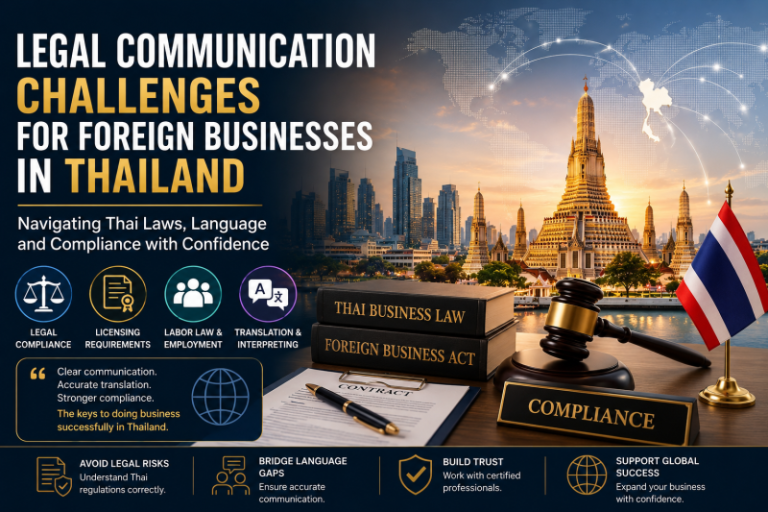
Legal Communication Challenges for Foreign Businesses in Thailand: The Role of Legal Compliance, Certified Translators, and Certified Interpreters in International Business Operations
Author: Phakaporn Tanjararak
28 May 2026, Bangkok – This article examines the major legal issues encountered by foreign businesses operating in Thailand, particularly under the framework of the Foreign Business Act (FBA), labor regulations, licensing requirements, and corporate compliance procedures. The study aims to analyze how legal restrictions on foreign ownership, employment regulations, and sector-specific licensing systems affect foreign investors and international corporations. Furthermore, the article discusses the increasingly important role of Thai corporate lawyers, certified translators, translation certification providers, and certified interpreters affiliated with professional translation and interpreting associations in Southeast Asia in facilitating legal compliance and cross-border business communication.
The findings demonstrate that linguistic accuracy and legally recognized translation and interpreting services are essential mechanisms for reducing legal risks, ensuring regulatory compliance, and supporting international business governance in Thailand. The article argues that professional legal-linguistic cooperation has become indispensable in the context of globalization and transnational commercial operations.
Introduction
Thailand has become one of the most significant destinations for foreign investment in Southeast Asia because of its strategic geographic location, expanding infrastructure, and growing economic integration within the Association of Southeast Asian Nations (ASEAN). Nevertheless, despite its investment opportunities, Thailand maintains a complex legal framework governing foreign business operations. Foreign companies entering the Thai market often encounter legal barriers associated with ownership limitations, licensing procedures, labor regulations, and administrative compliance requirements. These legal constraints are primarily regulated under the Foreign Business Act B.E. 2542 (1999), commonly referred to as the FBA, which imposes significant restrictions on foreign participation in various economic sectors (Foreign Business Act, 1999).
Foreign business regulation in Thailand reflects the government’s intention to protect domestic industries, preserve national interests, and regulate foreign economic influence. As a result, foreign investors must carefully navigate the legal system to avoid penalties, operational delays, or even dissolution of their businesses. According to Kittisak Prokati (2020), the Thai legal framework concerning foreign investment combines both protectionist and promotional approaches, allowing foreign participation while simultaneously imposing strict compliance obligations.
In addition to legal compliance, language and translation have emerged as central components of international business governance. Foreign investors frequently rely on translated contracts, corporate documents, licensing applications, and multilingual negotiations. Consequently, certified translators and certified interpreters play a critical role in ensuring the legal validity and accuracy of business communication across jurisdictions. In Southeast Asia, professional associations such as the Southeast Asian Association of Professional Translators and Interpreters contribute significantly to maintaining professional standards in legal translation and interpreting services for international business operations.
Foreign Ownership Restrictions under Thai Law
One of the most substantial legal challenges faced by foreign investors in Thailand concerns restrictions on foreign ownership. Under the Foreign Business Act (1999), foreign nationals are prohibited or restricted from participating in numerous sectors of the Thai economy. In general, foreign ownership in many industries cannot exceed 49 percent of company shares, while Thai nationals must retain majority ownership. Furthermore, the use of nominee shareholders to circumvent legal restrictions is prohibited and may result in severe legal consequences, including criminal liability and company dissolution (Nagai, 2018).
The FBA categorizes restricted business activities into three primary groups. Category 1 contains activities in which foreign participation is entirely prohibited, including media businesses, agriculture, forestry, fisheries, and trading in historical artifacts. Category 2 permits foreign participation only when Thai nationals hold at least 50 percent ownership and when governmental approval has been granted. This category includes industries connected to national security, arts, culture, and natural resources. Category 3 allows limited foreign participation in industries where Thai businesses are considered insufficiently competitive against foreign enterprises, including retail, legal services, tourism, and resource-related industries (Foreign Business Act, 1999).
Despite these restrictions, foreign investors may obtain operational rights through mechanisms such as the Foreign Business License (FBL), promotion by the Thailand Board of Investment, or international agreements such as the Treaty of Amity between Thailand and the United States. These mechanisms provide certain exemptions and privileges that allow greater foreign ownership under specified conditions.
Licensing and Corporate Compliance Requirements
Foreign-owned companies in Thailand must comply with numerous corporate and administrative requirements. These include maintaining sufficient registered capital, obtaining work permits for foreign directors, and ensuring compliance with shareholder requirements for limited companies. According to the Thai Ministry of Commerce, foreign-owned companies are generally required to maintain a minimum registered capital of two million baht per foreign employee (Ministry of Commerce Thailand, 2022).
Additional licenses are often required depending on the business sector. For example, companies operating in e-commerce, tourism, financial services, education, or import-export industries must secure specialized licenses from the relevant authorities. Obtaining these licenses can be a lengthy and highly discretionary process, especially in sectors regulated under the FBA.
The Foreign Business License application process itself involves several administrative stages, including document verification by the Ministry of Commerce and final consideration by the Foreign Business Committee. Approval is often influenced by whether the proposed business contributes to the Thai economy, promotes local interests, and avoids negatively affecting domestic competitors (Phanraksa, 2021).
Corporate compliance therefore requires extensive documentation, legal interpretation, and communication with Thai authorities. In this context, accurate translation of legal and corporate documents becomes essential. Foreign investors frequently require certified translations of incorporation certificates, shareholder agreements, financial statements, passports, and licensing applications. Errors in translation may lead to rejection of applications, administrative delays, or legal disputes.
Labor Law Challenges and Employment Regulations
Thai labor law presents another major challenge for foreign businesses. Under the Foreign Working Act (2008), foreign employees must obtain valid work permits and appropriate visas before engaging in employment activities in Thailand. Employers are responsible for sponsoring foreign workers and ensuring compliance with immigration and labor regulations (Foreign Working Act, 2008).
Thailand also applies the “4:1 employment ratio rule,” requiring companies employing foreign workers to maintain at least four Thai employees for every foreign employee. Thai employees counted toward this ratio must be registered within Thailand’s social security system. These regulations are intended to protect domestic employment opportunities while balancing the demand for foreign expertise.
Non-compliance with labor regulations may result in administrative penalties, cancellation of work permits, or criminal sanctions. Consequently, foreign companies must coordinate closely with legal professionals and human resource specialists to ensure lawful employment practices.
The Role of Corporate Lawyers in Foreign Business Operations
Given the complexity of Thai business law, corporate lawyers play an indispensable role in supporting foreign enterprises. Thai corporate lawyers assist foreign investors in company registration, licensing procedures, labor law compliance, contract drafting, and negotiations with government agencies. They also provide strategic legal advice concerning foreign ownership structures and investment promotion opportunities.
According to Chaninat and Leeds (2019), effective legal counsel significantly reduces operational risks for foreign companies entering the Thai market. Corporate lawyers not only interpret Thai legislation but also act as intermediaries between foreign investors and governmental authorities. Their role is particularly important in ensuring that business operations comply with rapidly evolving regulatory frameworks.
The Role of Certified Translators, Translation Certification Providers, and Certified Interpreters
In international business transactions, linguistic precision is closely connected to legal validity. Certified translators therefore play a crucial role in the preparation of legally recognized translations for contracts, licenses, immigration documents, shareholder agreements, and corporate filings. A certified translator is generally recognized as a professional authorized to provide translations accompanied by formal certification verifying the accuracy and completeness of the translated text.
Translation certification providers also serve an important institutional function within international business governance. These organizations verify the authenticity and professional standards of translated documents, ensuring that translations meet legal and administrative requirements. In many cross-border transactions, certified translations are required by government agencies, courts, immigration authorities, and licensing bodies before documentation can be officially accepted.
Moreover, certified interpreters facilitate multilingual communication during negotiations, court proceedings, labor disputes, corporate meetings, and governmental consultations. Their role extends beyond literal language transfer because interpreters must accurately convey legal terminology, cultural nuances, and procedural meanings. Inaccurate interpretation can lead to misunderstandings, contractual disputes, or regulatory non-compliance.
Professional organizations such as the Southeast Asian Association of Professional Translators and Interpreters contribute significantly to maintaining professional ethics, certification standards, and continuing professional development for translators and interpreters within the ASEAN region. These organizations help establish standardized qualifications and ethical frameworks that enhance trust in legal translation and interpreting services.
In the Thai context, certified translators and interpreters are particularly valuable because many foreign investors lack sufficient proficiency in Thai legal language. Legal terminology within Thai statutes, administrative regulations, and contractual documents often requires specialized linguistic and legal expertise. Therefore, cooperation among corporate lawyers, certified translators, and certified interpreters forms an integrated mechanism for ensuring legal compliance and minimizing business risks.
Conclusion
Foreign businesses operating in Thailand face a broad range of legal challenges involving ownership restrictions, licensing procedures, labor regulations, and corporate compliance obligations. The Foreign Business Act and related legislation impose strict requirements that foreign investors must carefully navigate to operate lawfully and sustainably within the Thai market. Failure to comply with these regulations may result in substantial legal and financial consequences.
The study demonstrates that legal compliance in international business operations cannot rely solely on legal expertise. Instead, effective cooperation among corporate lawyers, certified translators, translation certification providers, and certified interpreters is essential for facilitating accurate communication, ensuring document validity, and supporting cross-border corporate governance. In an increasingly globalized economy, professional translation and interpreting services have become integral components of international legal and commercial infrastructure.
Consequently, foreign investors seeking to establish businesses in Thailand should recognize that linguistic accuracy and professional legal translation services are not merely supplementary functions but fundamental elements of corporate compliance and international business success.
References
- Chaninat, P., & Leeds, M. (2019). Foreign business law and legal compliance in Thailand. Bangkok Business Law Journal, 12(2), 45–67.
- Kittisak Prokati. (2020). Thai business law and foreign investment regulations. Bangkok: Chulalongkorn University Press.
- Nagai, Y. (2018). Foreign ownership regulations and investment governance in ASEAN. Asian Business Law Journal, 7(1), 88–104.
- Phanraksa, T. (2021). Legal licensing frameworks for foreign businesses in Thailand. Journal of Southeast Asian Commercial Law, 15(3), 102–126.
- Foreign Business Act B.E. 2542 (1999).
For professional services, please visit: https://www.seaproti.org/practitioners/
About certified translators, translation certifiers, and certified interpreters associated with SEAProTI. The Southeast Asian Association of Professional Translators and Interpreters (SEAProTI) has officially shared the qualifications and requirements for becoming Certified Translators, Translation Certification Providers, and Certified Interpreters in Sections 9 and 10 of the Royal Gazette, which was published by the Prime Minister’s Office in Thailand on July 25, 2024. Certified Translators, Translation Certification Providers, and Certified Interpreters
The Council of State has proposed the enactment of a Royal Decree, granting registered translators and recognised translation certifiers from professional associations or accredited language institutions the authority to provide legally valid translation certification (Letter to SEAProTI dated April 28, 2025)
SEAProTI is the first professional association in Thailand and Southeast Asia to implement a comprehensive certification system for translators, certifiers, and interpreters.
Head Office: Baan Ratchakru Building, No. 33, Room 402, Soi Phahonyothin 5, Phahonyothin Road, Phaya Thai District, Bangkok 10400, Thailand
Email: hello@seaproti.com | Tel.: (+66) 2-114-3128 (Office hours: Mon–Fri, 09:00–17:00).
ประเด็นปัญหาทางกฎหมายสำคัญที่ธุรกิจต่างชาติเผชิญในประเทศไทย: บทบาทของการปฏิบัติตามกฎหมาย นักแปลรับรอง และล่ามรับรองในการดำเนินธุรกิจระหว่างประเทศ
ผู้เขียน: ภคพร ตันจรารักษ์
28 พฤษภาคม 2569, กรุงเทพมหานคร – บทความนี้มุ่งศึกษาประเด็นปัญหาทางกฎหมายสำคัญที่ธุรกิจต่างชาติประสบในการดำเนินกิจการในประเทศไทย โดยเฉพาะภายใต้กรอบของพระราชบัญญัติการประกอบธุรกิจของคนต่างด้าว ระบบกฎหมายแรงงาน ข้อกำหนดด้านใบอนุญาต และกระบวนการกำกับดูแลการปฏิบัติตามกฎหมายขององค์กร บทความมีวัตถุประสงค์เพื่อวิเคราะห์ว่าข้อจำกัดด้านการถือหุ้นของชาวต่างชาติ กฎระเบียบด้านแรงงาน และระบบการอนุญาตเฉพาะอุตสาหกรรมส่งผลกระทบต่อผู้ลงทุนและบริษัทระหว่างประเทศอย่างไร นอกจากนี้ บทความยังอภิปรายถึงบทบาทที่เพิ่มมากขึ้นของทนายความด้านกฎหมายธุรกิจ นักแปลรับรอง ผู้ให้การรับรองการแปล และล่ามรับรอง ซึ่งสังกัดองค์กรวิชาชีพด้านการแปลและการล่ามในภูมิภาคเอเชียตะวันออกเฉียงใต้ ในการสนับสนุนการปฏิบัติตามกฎหมายและการสื่อสารทางธุรกิจข้ามพรมแดน
ผลการศึกษาพบว่าความถูกต้องทางภาษาและบริการแปลรวมถึงการล่ามที่ได้รับการรับรองตามกฎหมายถือเป็นกลไกสำคัญในการลดความเสี่ยงทางกฎหมาย สร้างความสอดคล้องกับข้อกำหนดทางกฎหมาย และสนับสนุนธรรมาภิบาลทางธุรกิจระหว่างประเทศในประเทศไทย บทความเสนอว่าความร่วมมือระหว่างผู้เชี่ยวชาญด้านกฎหมายและผู้เชี่ยวชาญด้านภาษากลายเป็นองค์ประกอบสำคัญของการดำเนินธุรกิจข้ามชาติในบริบทของโลกาภิวัตน์
บทนำ
ประเทศไทยถือเป็นหนึ่งในจุดหมายสำคัญของการลงทุนจากต่างประเทศในภูมิภาคเอเชียตะวันออกเฉียงใต้ เนื่องจากมีทำเลยุทธศาสตร์ที่สำคัญ โครงสร้างพื้นฐานที่กำลังพัฒนา และการบูรณาการทางเศรษฐกิจภายในประชาคมอาเซียนที่เพิ่มขึ้น อย่างไรก็ตาม แม้ว่าประเทศไทยจะเปิดโอกาสทางการลงทุนจำนวนมาก แต่ประเทศไทยยังคงมีกฎหมายและระเบียบข้อบังคับที่ซับซ้อนเกี่ยวกับการดำเนินธุรกิจของชาวต่างชาติ บริษัทต่างชาติที่เข้าสู่ตลาดไทยมักเผชิญข้อจำกัดทางกฎหมายเกี่ยวกับโครงสร้างการถือหุ้น การขอใบอนุญาต กฎหมายแรงงาน และกระบวนการกำกับดูแลด้านเอกสารและการบริหาร โดยข้อจำกัดเหล่านี้ส่วนใหญ่อยู่ภายใต้พระราชบัญญัติการประกอบธุรกิจของคนต่างด้าว พ.ศ. 2542 ซึ่งกำหนดข้อจำกัดอย่างมีนัยสำคัญต่อการมีส่วนร่วมของชาวต่างชาติในหลายภาคเศรษฐกิจ
กฎหมายควบคุมธุรกิจต่างชาติของประเทศไทยสะท้อนถึงความพยายามของรัฐในการคุ้มครองอุตสาหกรรมภายในประเทศ รักษาผลประโยชน์แห่งชาติ และควบคุมอิทธิพลทางเศรษฐกิจจากต่างประเทศ ดังนั้น นักลงทุนต่างชาติจึงจำเป็นต้องศึกษาระบบกฎหมายอย่างรอบคอบเพื่อหลีกเลี่ยงบทลงโทษ ความล่าช้าในการดำเนินธุรกิจ หรือแม้แต่การถูกเพิกถอนกิจการ คิตติศักดิ์ ปรกติ (พ.ศ. 2563) อธิบายว่ากรอบกฎหมายไทยเกี่ยวกับการลงทุนจากต่างประเทศมีลักษณะผสมผสานระหว่างการคุ้มครองธุรกิจภายในประเทศและการส่งเสริมการลงทุนจากภายนอกในเวลาเดียวกัน
นอกเหนือจากการปฏิบัติตามกฎหมายแล้ว ภาษาและการแปลยังกลายเป็นองค์ประกอบสำคัญของธรรมาภิบาลทางธุรกิจระหว่างประเทศ นักลงทุนต่างชาติมักต้องพึ่งพาการแปลสัญญา เอกสารบริษัท เอกสารขออนุญาต และการเจรจาหลายภาษา ด้วยเหตุนี้ นักแปลรับรองและล่ามรับรองจึงมีบทบาทสำคัญในการรับรองความถูกต้องตามกฎหมายของการสื่อสารทางธุรกิจระหว่างประเทศ ในภูมิภาคเอเชียตะวันออกเฉียงใต้ องค์กรวิชาชีพ เช่น สมาคมวิชาชีพนักแปลและล่ามแห่งเอเชียตะวันออกเฉียงใต้ มีบทบาทสำคัญในการกำหนดมาตรฐานวิชาชีพด้านการแปลกฎหมายและการล่ามสำหรับการดำเนินธุรกิจระหว่างประเทศ
ข้อจำกัดด้านการถือหุ้นของชาวต่างชาติตามกฎหมายไทย
หนึ่งในปัญหาทางกฎหมายที่สำคัญที่สุดสำหรับนักลงทุนต่างชาติในประเทศไทยคือข้อจำกัดด้านการถือหุ้นของชาวต่างชาติ ภายใต้พระราชบัญญัติการประกอบธุรกิจของคนต่างด้าว พ.ศ. 2542 ชาวต่างชาติถูกห้ามหรือจำกัดการดำเนินธุรกิจในหลายภาคส่วนของเศรษฐกิจไทย โดยทั่วไป การถือหุ้นของชาวต่างชาติในหลายอุตสาหกรรมจะต้องไม่เกินร้อยละ 49 ของจำนวนหุ้นทั้งหมด ในขณะที่ผู้ถือหุ้นสัญชาติไทยต้องถือหุ้นในสัดส่วนส่วนใหญ่ นอกจากนี้ การใช้ผู้ถือหุ้นตัวแทนเพื่อหลีกเลี่ยงข้อจำกัดทางกฎหมายถือเป็นการกระทำที่ผิดกฎหมายและอาจส่งผลให้เกิดความรับผิดทางอาญา รวมถึงการเพิกถอนบริษัทได้ (นางาอิ, พ.ศ. 2561)
พระราชบัญญัติการประกอบธุรกิจของคนต่างด้าวแบ่งกิจกรรมทางธุรกิจที่ถูกจำกัดออกเป็น 3 ประเภทสำคัญ ประเภทที่ 1 เป็นกิจการที่ห้ามชาวต่างชาติเข้าร่วมโดยเด็ดขาด เช่น ธุรกิจสื่อมวลชน เกษตรกรรม ป่าไม้ ประมง และการค้าศิลปวัตถุหรือโบราณวัตถุ ประเภทที่ 2 อนุญาตให้ชาวต่างชาติเข้าร่วมได้เมื่อคนไทยถือหุ้นไม่น้อยกว่าร้อยละ 50 และต้องได้รับอนุญาตจากหน่วยงานของรัฐ กิจการในประเภทนี้เกี่ยวข้องกับความมั่นคงของชาติ ศิลปวัฒนธรรม และทรัพยากรธรรมชาติ ส่วนประเภทที่ 3 เป็นกิจการที่อนุญาตให้ชาวต่างชาติเข้าร่วมได้ในวงจำกัด เนื่องจากรัฐเห็นว่าธุรกิจไทยยังไม่พร้อมแข่งขันกับธุรกิจต่างชาติ เช่น ธุรกิจค้าปลีก บริการทางกฎหมาย ธุรกิจท่องเที่ยว และกิจการด้านทรัพยากร
อย่างไรก็ตาม นักลงทุนต่างชาติสามารถได้รับสิทธิในการดำเนินธุรกิจผ่านกลไกต่าง ๆ เช่น การขอใบอนุญาตประกอบธุรกิจของคนต่างด้าว การส่งเสริมการลงทุนจากคณะกรรมการส่งเสริมการลงทุน หรือสิทธิพิเศษตามสนธิสัญญาไมตรีระหว่างประเทศไทยและสหรัฐอเมริกา ซึ่งเป็นช่องทางที่ช่วยให้ชาวต่างชาติสามารถถือหุ้นในสัดส่วนที่มากขึ้นภายใต้เงื่อนไขที่กำหนด
ข้อกำหนดด้านใบอนุญาตและการปฏิบัติตามกฎหมายขององค์กร
บริษัทต่างชาติในประเทศไทยจำเป็นต้องปฏิบัติตามข้อกำหนดด้านการบริหารและกฎหมายหลายประการ เช่น การมีทุนจดทะเบียนขั้นต่ำ การขอใบอนุญาตทำงานสำหรับกรรมการต่างชาติ และการรักษาจำนวนผู้ถือหุ้นขั้นต่ำของบริษัทจำกัด ตามข้อมูลของกระทรวงพาณิชย์ ประเทศไทย บริษัทต่างชาติจะต้องมีทุนจดทะเบียนอย่างน้อย 2 ล้านบาทต่อพนักงานต่างชาติหนึ่งคน (กระทรวงพาณิชย์, พ.ศ. 2565)
นอกจากนี้ ธุรกิจบางประเภทจำเป็นต้องได้รับใบอนุญาตเฉพาะทางเพิ่มเติม เช่น ธุรกิจพาณิชย์อิเล็กทรอนิกส์ ธุรกิจท่องเที่ยว ธุรกิจการเงิน สถาบันการศึกษา หรือธุรกิจนำเข้าและส่งออกสินค้า การขอใบอนุญาตเหล่านี้มักเป็นกระบวนการที่ใช้เวลานานและขึ้นอยู่กับดุลยพินิจของหน่วยงานรัฐ โดยเฉพาะในกิจการที่อยู่ภายใต้ข้อจำกัดของพระราชบัญญัติการประกอบธุรกิจของคนต่างด้าว
กระบวนการขอใบอนุญาตประกอบธุรกิจของคนต่างด้าวต้องผ่านหลายขั้นตอน ตั้งแต่การตรวจสอบเอกสารโดยกระทรวงพาณิชย์ ไปจนถึงการพิจารณาขั้นสุดท้ายโดยคณะกรรมการประกอบธุรกิจของคนต่างด้าว การอนุมัติมักขึ้นอยู่กับว่าธุรกิจดังกล่าวจะสร้างประโยชน์ต่อเศรษฐกิจไทย ส่งเสริมผลประโยชน์ของประเทศ และไม่ส่งผลเสียต่อผู้ประกอบการไทยหรือไม่ (พันรักษา, พ.ศ. 2564)
ดังนั้น การปฏิบัติตามกฎหมายขององค์กรจึงต้องอาศัยการจัดเตรียมเอกสารจำนวนมาก การตีความกฎหมาย และการติดต่อกับหน่วยงานราชการไทย ในบริบทนี้ การแปลเอกสารทางกฎหมายและเอกสารบริษัทอย่างถูกต้องจึงเป็นสิ่งจำเป็น นักลงทุนต่างชาติมักต้องใช้เอกสารแปลรับรองสำหรับหนังสือรับรองบริษัท ข้อตกลงผู้ถือหุ้น งบการเงิน หนังสือเดินทาง และเอกสารประกอบการขออนุญาต ความผิดพลาดในการแปลอาจส่งผลให้คำขอถูกปฏิเสธ เกิดความล่าช้าในการดำเนินการ หรือก่อให้เกิดข้อพิพาททางกฎหมายได้
ความท้าทายด้านกฎหมายแรงงานและการจ้างงาน
กฎหมายแรงงานไทยถือเป็นอีกหนึ่งอุปสรรคสำคัญสำหรับธุรกิจต่างชาติ ภายใต้พระราชบัญญัติการทำงานของคนต่างด้าว พ.ศ. 2551 ลูกจ้างต่างชาติต้องได้รับใบอนุญาตทำงานและวีซ่าที่ถูกต้องก่อนเริ่มทำงานในประเทศไทย นายจ้างมีหน้าที่สนับสนุนการขอวีซ่าและใบอนุญาตทำงาน รวมถึงรับผิดชอบต่อการปฏิบัติตามกฎหมายแรงงานและกฎหมายคนเข้าเมือง
ประเทศไทยยังใช้หลักเกณฑ์อัตราส่วนการจ้างงาน 4 ต่อ 1 ซึ่งกำหนดให้บริษัทที่มีพนักงานต่างชาติต้องมีพนักงานสัญชาติไทยอย่างน้อย 4 คนต่อพนักงานต่างชาติ 1 คน พนักงานไทยที่จะนับรวมในอัตราส่วนดังกล่าวต้องอยู่ในระบบประกันสังคมของประเทศไทย มาตรการนี้มีวัตถุประสงค์เพื่อคุ้มครองโอกาสการจ้างงานของประชาชนไทย ในขณะเดียวกันก็เปิดโอกาสให้ภาคธุรกิจสามารถจ้างผู้เชี่ยวชาญจากต่างประเทศได้ในระดับที่เหมาะสม
การไม่ปฏิบัติตามกฎหมายแรงงานอาจนำไปสู่บทลงโทษทางปกครอง การเพิกถอนใบอนุญาตทำงาน หรือความรับผิดทางอาญา ดังนั้น บริษัทต่างชาติจึงจำเป็นต้องประสานงานอย่างใกล้ชิดกับผู้เชี่ยวชาญด้านกฎหมายและผู้เชี่ยวชาญด้านทรัพยากรมนุษย์เพื่อให้การจ้างงานเป็นไปอย่างถูกต้องตามกฎหมาย
บทบาทของทนายความด้านธุรกิจในการดำเนินธุรกิจของชาวต่างชาติ
จากความซับซ้อนของกฎหมายธุรกิจไทย ทนายความด้านกฎหมายธุรกิจจึงมีบทบาทสำคัญอย่างยิ่งในการสนับสนุนบริษัทต่างชาติ ทนายความธุรกิจช่วยนักลงทุนต่างชาติในด้านการจดทะเบียนบริษัท การขอใบอนุญาต การปฏิบัติตามกฎหมายแรงงาน การร่างสัญญา และการเจรจากับหน่วยงานของรัฐ นอกจากนี้ ยังให้คำแนะนำเชิงกลยุทธ์เกี่ยวกับโครงสร้างการถือหุ้นและสิทธิประโยชน์ด้านการลงทุน
ชานินาท และ ลีดส์ (พ.ศ. 2562) ระบุว่าการได้รับคำปรึกษาทางกฎหมายที่มีประสิทธิภาพช่วยลดความเสี่ยงในการดำเนินธุรกิจของบริษัทต่างชาติได้อย่างมีนัยสำคัญ ทนายความธุรกิจไม่เพียงทำหน้าที่ตีความกฎหมายไทยเท่านั้น แต่ยังทำหน้าที่เป็นตัวกลางระหว่างนักลงทุนต่างชาติกับหน่วยงานภาครัฐอีกด้วย
บทบาทของนักแปลรับรอง ผู้รับรองการแปล และล่ามรับรอง
ในการทำธุรกรรมทางธุรกิจระหว่างประเทศ ความแม่นยำทางภาษามีความสัมพันธ์โดยตรงกับความถูกต้องตามกฎหมาย ด้วยเหตุนี้ นักแปลรับรองจึงมีบทบาทสำคัญในการจัดทำคำแปลที่ได้รับการยอมรับตามกฎหมายสำหรับสัญญา ใบอนุญาต เอกสารตรวจคนเข้าเมือง ข้อตกลงผู้ถือหุ้น และเอกสารทางบริษัท นักแปลรับรองหมายถึงผู้เชี่ยวชาญที่มีอำนาจรับรองว่าคำแปลมีความถูกต้องและครบถ้วนตามต้นฉบับ
ผู้ให้การรับรองการแปลยังมีบทบาทเชิงสถาบันที่สำคัญในระบบธรรมาภิบาลธุรกิจระหว่างประเทศ องค์กรเหล่านี้ทำหน้าที่ตรวจสอบความถูกต้องและมาตรฐานวิชาชีพของงานแปล เพื่อให้เอกสารแปลสามารถใช้ในกระบวนการทางกฎหมาย การบริหาร และการดำเนินธุรกิจได้อย่างเป็นทางการ ในหลายกรณี หน่วยงานรัฐ ศาล หน่วยงานตรวจคนเข้าเมือง และองค์กรกำกับดูแลกำหนดให้เอกสารที่ยื่นต้องเป็นเอกสารแปลรับรองเท่านั้น
ในขณะเดียวกัน ล่ามรับรองมีบทบาทสำคัญในการอำนวยความสะดวกด้านการสื่อสารหลายภาษาในการเจรจาธุรกิจ การดำเนินคดี การประชุมองค์กร การไกล่เกลี่ยข้อพิพาทแรงงาน และการประสานงานกับหน่วยงานราชการ หน้าที่ของล่ามไม่ได้จำกัดเพียงการถ่ายทอดภาษาแบบตรงตัว แต่ยังรวมถึงการถ่ายทอดคำศัพท์ทางกฎหมาย ความหมายเชิงวัฒนธรรม และบริบทของกระบวนการทางกฎหมายอย่างถูกต้อง ความผิดพลาดในการล่ามอาจนำไปสู่ความเข้าใจคลาดเคลื่อน ข้อพิพาททางสัญญา หรือการไม่ปฏิบัติตามกฎหมายได้
องค์กรวิชาชีพ เช่น สมาคมวิชาชีพนักแปลและล่ามแห่งเอเชียตะวันออกเฉียงใต้ มีบทบาทสำคัญในการกำหนดจรรยาบรรณ มาตรฐานการรับรองวิชาชีพ และการพัฒนาวิชาชีพอย่างต่อเนื่องสำหรับนักแปลและล่ามในภูมิภาคอาเซียน องค์กรเหล่านี้ช่วยสร้างมาตรฐานด้านคุณวุฒิวิชาชีพและเสริมสร้างความน่าเชื่อถือของบริการแปลและล่ามทางกฎหมาย
ในบริบทของประเทศไทย นักแปลรับรองและล่ามรับรองมีความสำคัญอย่างยิ่ง เนื่องจากนักลงทุนต่างชาติจำนวนมากไม่มีความเชี่ยวชาญเพียงพอในด้านภาษากฎหมายไทย คำศัพท์ทางกฎหมายที่ปรากฏในกฎหมาย ระเบียบราชการ และเอกสารสัญญามักต้องอาศัยความรู้เฉพาะทางทั้งด้านภาษาและกฎหมาย ดังนั้น ความร่วมมือระหว่างทนายความธุรกิจ นักแปลรับรอง และล่ามรับรอง จึงถือเป็นกลไกสำคัญในการสร้างความสอดคล้องทางกฎหมายและลดความเสี่ยงทางธุรกิจระหว่างประเทศ
บทสรุป
ธุรกิจต่างชาติที่ดำเนินกิจการในประเทศไทยต้องเผชิญกับความท้าทายทางกฎหมายหลากหลายประการ ทั้งข้อจำกัดด้านการถือหุ้น ระบบใบอนุญาต กฎหมายแรงงาน และข้อกำหนดด้านการกำกับดูแลการปฏิบัติตามกฎหมายขององค์กร พระราชบัญญัติการประกอบธุรกิจของคนต่างด้าวและกฎหมายที่เกี่ยวข้องกำหนดเงื่อนไขที่เข้มงวดซึ่งนักลงทุนต่างชาติต้องปฏิบัติตามอย่างเคร่งครัดเพื่อให้สามารถดำเนินธุรกิจได้อย่างถูกต้องและยั่งยืน
ผลการศึกษาชี้ให้เห็นว่าการปฏิบัติตามกฎหมายในการดำเนินธุรกิจระหว่างประเทศไม่สามารถอาศัยเพียงความรู้ด้านกฎหมายเท่านั้น แต่ยังต้องอาศัยความร่วมมือระหว่างทนายความ นักแปลรับรอง ผู้ให้การรับรองการแปล และล่ามรับรอง เพื่อสนับสนุนการสื่อสารที่ถูกต้อง ความสมบูรณ์ของเอกสาร และธรรมาภิบาลทางธุรกิจข้ามพรมแดน ในยุคเศรษฐกิจโลกาภิวัตน์ บริการด้านการแปลและการล่ามเชิงกฎหมายจึงไม่ได้เป็นเพียงองค์ประกอบเสริม แต่กลายเป็นส่วนสำคัญของโครงสร้างพื้นฐานทางกฎหมายและการพาณิชย์ระหว่างประเทศ
เอกสารอ้างอิง
- ชานินาท พี., และ ลีดส์ เอ็ม. (พ.ศ. 2562). กฎหมายธุรกิจต่างชาติและการปฏิบัติตามกฎหมายในประเทศไทย. วารสารกฎหมายธุรกิจกรุงเทพ, 12(2), 45-67.
- คิตติศักดิ์ ปรกติ. (พ.ศ. 2563). กฎหมายธุรกิจไทยและกฎระเบียบการลงทุนจากต่างประเทศ. กรุงเทพมหานคร: สำนักพิมพ์จุฬาลงกรณ์มหาวิทยาลัย.
- นางาอิ วาย. (พ.ศ. 2561). กฎระเบียบด้านการถือหุ้นของชาวต่างชาติและธรรมาภิบาลการลงทุนในอาเซียน. วารสารกฎหมายธุรกิจเอเชีย, 7(1), 88-104.
- พันรักษา ที. (พ.ศ. 2564). กรอบกฎหมายด้านใบอนุญาตสำหรับธุรกิจต่างชาติในประเทศไทย. วารสารกฎหมายพาณิชย์เอเชียตะวันออกเฉียงใต้, 15(3), 102-126.
- พระราชบัญญัติการประกอบธุรกิจของคนต่างด้าว พ.ศ. 2542.
สมาคมวิชาชีพนักแปลและล่ามแห่งเอเชียตะวันออกเฉียงใต้ (SEAProTI) ได้ประกาศหลักเกณฑ์และคุณสมบัติของผู้ที่ขึ้นทะเบียนเป็น “นักแปลรับรอง (Certified Translators) และผู้รับรองการแปล (Translation Certification Providers) และล่ามรับรอง (Certified Interpreters)” ของสมาคม หมวดที่ 9 และหมวดที่ 10 ในราชกิจจานุเบกษา ของสำนักเลขาธิการคณะรัฐมนตรี ในสำนักนายกรัฐมนตรี แห่งราชอาณาจักรไทย ลงวันที่ 25 ก.ค. 2567 เล่มที่ 141 ตอนที่ 66 ง หน้า 100 อ่านฉบับเต็มได้ที่: นักแปลรับรอง ผู้รับรองการแปล และล่ามรับรอง
สำนักคณะกรรมการกฤษฎีกาเสนอให้ตราเป็นพระราชกฤษฎีกา โดยกำหนดให้นักแปลที่ขึ้นทะเบียน รวมถึงผู้รับรองการแปลจากสมาคมวิชาชีพหรือสถาบันสอนภาษาที่มีการอบรมและขึ้นทะเบียน สามารถรับรองคำแปลได้ (จดหมายถึงสมาคม SEAProTI ลงวันที่ 28 เม.ย. 2568)
สมาคมวิชาชีพนักแปลและล่ามแห่งเอเชียตะวันออกเฉียงใต้เป็นสมาคมวิชาชีพแห่งแรกและแห่งเดียวในประเทศไทยและภูมิภาคเอเชียตะวันออกเฉียงใต้ที่มีระบบรับรองนักแปลรับรอง ผู้รับรองการแปล และล่ามรับรอง
สำนักงานใหญ่: อาคารบ้านราชครู เลขที่ 33 ห้อง 402 ซอยพหลโยธิน 5 ถนนพหลโยธิน แขวงพญาไท เขตพญาไท กรุงเทพมหานคร 10400 ประเทศไทย