



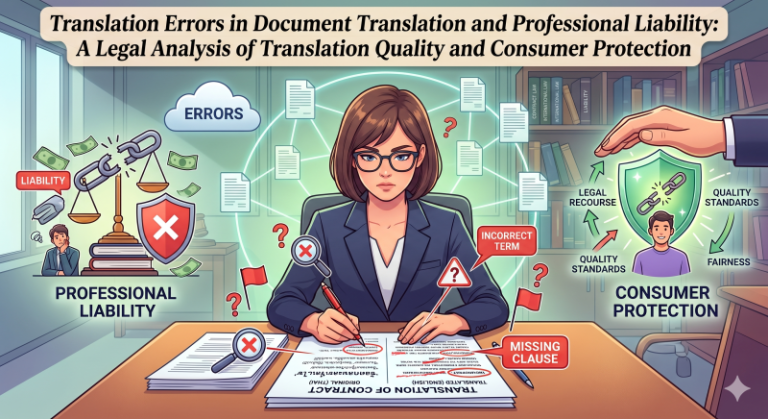
Translation Errors in Document Translation and Professional Liability:
A Legal Analysis of Translation Quality and Consumer Protection
30 May 2026, Bangkok — Document translation is a professional service directly connected to the rights, obligations, and interests of service users, particularly in relation to documents used for legal proceedings, governmental procedures, consular matters, immigration processes, or the verification of personal status. Translation errors are therefore not merely linguistic deficiencies; they may lead to economic losses, procedural delays, and missed opportunities for consumers.
This article aims to analyze the issue of translation errors in document translation through a case study involving a consumer adversely affected by a translation that required multiple rounds of correction. The analysis is conducted through the frameworks of translation quality, professional liability, the Thai Civil and Commercial Code, and ISO 17100 standards. The findings indicate that translation service providers have a duty to implement appropriate quality assurance procedures. Where translation errors cause damage to consumers, service providers may incur liability under contractual obligations, professional ethics, and principles of equitable compensation for damages.
Keywords: Document Translation, Translation Quality, Professional Liability, Civil and Commercial Code, ISO 17100, Consumer Protection
Introduction
In contemporary society, document translation is not merely a linguistic activity but a professional service that significantly affects individuals’ access to rights and the conduct of transactions at both national and international levels. A substantial number of translated documents are submitted to government agencies, embassies, courts, immigration authorities, and organizations empowered to make decisions concerning the legal status of applicants. Consequently, the accuracy of translated documents is a critical factor that directly influences the success or failure of such processes.
Nevertheless, the selection of translation service providers today is often based heavily on online review ratings. Many consumers regard high average ratings and numerous positive reviews as reliable indicators of service quality. Although review systems may reduce information asymmetry between service providers and consumers to some extent, they cannot fully substitute for assessments of professional standards, quality control procedures, and provider accountability.
The case study examined in this article illustrates the problems that may arise when a consumer selects a document translation company based primarily on the credibility of online reviews, only to discover that the translated documents require multiple revisions. As a result, the consumer incurs additional expenses related to accommodation, travel, and delays while waiting for corrected documents. This case therefore serves as an important example demonstrating that translation errors may cause losses far exceeding the cost of the translation service itself and should be examined from the perspectives of translation quality, professional ethics, and legal liability.
Translation quality is a multidimensional concept that cannot be assessed solely on the basis of fluency in the target language. In translation studies, a high-quality translation must accurately and completely convey the meaning of the source text, remain consistent with its context, and be appropriate for the intended purpose of the document (Munday, 2016). In the case of official or legal documents, the accuracy of specific details—such as personal names, dates, locations, document numbers, technical terminology, and prescribed formatting requirements—is of paramount importance. Even minor inaccuracies may result in the rejection of a document or necessitate costly revisions.
When a translated document requires multiple rounds of correction, this may indicate deficiencies in the translation and revision process. Errors can arise at various stages, including comprehension of the source text, selection of specialized terminology, verification of factual consistency, and pre-delivery proofreading. Where a service provider lacks a concrete quality assurance system, the likelihood that errors will reach the end user increases significantly.
From an impact perspective, the consequences of translation errors are often ongoing and complex. Consumers may suffer losses extending far beyond the translation fee itself. Additional expenses may include transportation costs, accommodation expenses, meal costs, supplementary administrative fees, and lost opportunities resulting from postponed appointments or deadlines. Such consequences demonstrate that document translation—particularly translation intended for official, governmental, or legal processes—constitutes a higher-risk professional service than general translation work.
Professional Liability of Translation Service Providers
Document translation is a professional service that requires specialized knowledge and a level of care consistent with professional standards. Translation providers therefore cannot claim that translation is merely a general language transfer activity. Rather, they must recognize that translated documents may be used as evidence or supporting documentation in decision-making processes conducted by authorities and institutions. In this respect, translation providers owe a duty of care to consumers.
Professional liability encompasses the duty to translate accurately, the duty to revise and proofread, the duty to disclose limitations affecting the work, and the duty to remedy errors appropriately when they occur. If a service provider accepts an assignment without adequately assessing the complexity of the document, fails to engage qualified revisers, or delivers the work without sufficient review, such conduct may be regarded as a failure to meet the standards reasonably expected of a professional practitioner.
In the case under consideration, the fact that the consumer was required to wait through multiple rounds of corrections and incurred additional expenses raises important questions regarding the scope of the service provider’s responsibility. Specifically, where the losses arise from translation errors that could reasonably have been prevented through professional-quality review procedures, the provider should be expected to offer remedies extending beyond merely correcting the translation at no additional charge.
Under the Thai Civil and Commercial Code, the legal relationship between a client and a document translation company may be analyzed within the framework of a contract for work (hire of work). Section 587 provides that a contract for work is an agreement whereby one person undertakes to accomplish a specific piece of work for another person, and the latter agrees to pay remuneration for the result of that work. Document translation may therefore be regarded as a service in which the contractor is obligated to deliver a completed result consistent with the agreed purpose. In other words, the translated document must possess sufficient quality to be used for the purpose communicated by the client or that the service provider ought reasonably to have understood from the nature of the assignment.
Where a service provider delivers a translation containing errors that render it unsuitable for its intended purpose, such conduct may constitute a breach of contract or the delivery of defective work inconsistent with the agreement. In such circumstances, the consumer may have grounds to demand correction of the work, a refund of service fees, or compensation for damages, provided that the losses can be shown to have resulted directly from the service provider’s deficiencies.
In addition to the contractual framework, such cases may also be examined under the law of tort pursuant to Section 420 of the Civil and Commercial Code. This may apply where the service provider’s conduct amounts to an unlawful intentional act or negligence causing injury to the property, rights, or legally protected interests of the consumer. Tort principles become particularly significant where the losses extend beyond the translation fee itself and encompass consequential expenses arising from the translation errors, such as transportation costs, accommodation expenses, or loss of opportunity.
However, any claim for damages requires proof of a causal relationship between the translation errors and the losses suffered. The consumer must demonstrate that the damages were in fact caused by the defective translation rather than by external factors or delays attributable to other agencies or institutions. It must also be considered whether the losses were reasonably foreseeable in the ordinary course of events. If the service provider was informed from the outset that the documents would be submitted to a consular authority or governmental agency, delays and expenses resulting from the need to correct the translation may constitute foreseeable losses that the provider should reasonably have anticipated.
Accordingly, under the framework of Thai private law, the liability of a translation service provider may be founded upon breach of a contract for work, tortious liability, or both simultaneously, depending on the facts of the case, the terms of the agreement, evidence of communications between the parties, and proof of the actual damages sustained.
Compensation for losses arising from translation errors should be considered from both legal and professional ethical perspectives. At a fundamental level, service providers should correct any errors without imposing additional charges, as the delivery of an accurate translation constitutes their primary contractual obligation. However, correction alone may not be sufficient where the error has caused the consumer to incur additional expenses or lose significant opportunities.
Where a translated document cannot be used for its intended purpose, the service provider should consider providing a full or partial refund of the service fee, particularly where the errors result from inadequate review procedures or the provider’s own negligence. If additional losses can be substantiated—such as hotel expenses, travel costs, fees for resubmission of documents, or the cost of engaging another translator—the provider should establish an appropriate mechanism for compensation based on the available evidence and the circumstances of the case.
In practice, translation companies should clearly define their policies regarding liability and customer remedies before accepting assignments. Such policies may address matters including correction procedures, quality guarantee periods, limitations of liability, and complaint-handling processes. These policies should not be used as a means of excluding all responsibility; rather, they should serve as a mechanism for promoting a fair and transparent understanding between service providers and consumers.
For high-risk translation assignments—such as official documents, legal documents, or documents intended for use in international administrative processes—service providers should consider maintaining professional indemnity insurance to address situations in which translation errors cause losses to clients. Such measures would enhance the credibility of the translation industry and provide consumers with a greater degree of protection.
ISO 17100 is an international standard that specifies requirements for translation services, encompassing core processes, human resources, and other elements necessary for delivering translation services that meet agreed quality requirements (International Organization for Standardization, 2015). The significance of this standard lies not merely in certifying the competence of individual translators but also in establishing a transparent, auditable, and systematically controlled operational framework for translation service providers.
A central principle of ISO 17100 is the separation of roles between the translator and the reviser. The standard requires that translated content be reviewed by another suitably qualified individual before delivery to the client. This principle is particularly important for consumer protection because it reduces the risk of errors that may be overlooked by the translator and provides assurance that the translation has not been assessed solely by a single individual.
In the context of official and legal documents, ISO 17100 enables consumers to evaluate translation service providers on criteria that extend beyond online review ratings. Consumers may inquire, for example, about the provider’s project intake procedures, methods for assessing translator competence, the existence of independent revision processes, and systems for handling complaints. Such inquiries allow consumers to make decisions based on professional standards rather than on impressions or marketing representations alone.
Furthermore, ISO 17100 serves an important preventive function in reducing the likelihood of harm. Where a provider genuinely implements the requirements of the standard, the risk of serious translation errors is significantly reduced. Should problems nevertheless arise, the documented procedures required by the standard make it possible to trace the source of the error, identify the responsible stage in the workflow, and determine how corrective measures can be implemented. In this respect, the standard is not merely a quality certification framework but also a mechanism for risk management and accountability toward consumers.
However, claiming compliance with ISO 17100 is meaningful only when the underlying principles are genuinely implemented in practice. The mere invocation of the standard for marketing purposes is insufficient. Without an effective revision process, appropriate selection of translators based on subject-matter expertise, and adequate quality control procedures prior to delivery, reference to ISO 17100 cannot provide meaningful protection for consumers.
This case study highlights the necessity for the translation profession to place greater emphasis on responsibility for the outcomes of translation work rather than merely delivering assignments on time. In the context of translating documents with legal or official implications, service providers should recognize that clients are not simply purchasing text in another language; they are purchasing accuracy, reliability, and confidence that the translated document will be fit for its intended purpose.
From a professional policy perspective, translation and interpreting associations should play an active role in promoting best practices relating to project acceptance, risk assessment, revision procedures, quality assurance, and compensation for losses. The development of professional codes of ethics and complaint-handling guidelines would help establish common industry standards and reduce uncertainty regarding consumer protection.
At the same time, consumers should be encouraged to understand that online review ratings are merely one factor in the decision-making process and do not constitute a complete guarantee of quality. When selecting a document translation provider, consumers should consider relevant subject-matter experience, quality control systems, correction policies, and the transparency of the service provider in addition to online reputation.
Conclusion
Translation errors in document translation constitute an issue that extends far beyond linguistic concerns. Such errors may directly affect consumers’ rights, legal status, financial interests, and opportunities. The case study examined in this article demonstrates that where service providers lack adequate quality control systems, translation errors may become the source of consequential losses whose value far exceeds the original translation fee.
Under the Thai Civil and Commercial Code, document translation services may fall within the legal framework of a contract for work. In certain circumstances, they may also give rise to tort liability where errors result from negligence and cause damage to consumers. Translation service providers should therefore assume responsibility for correcting errors, providing appropriate remedies, and compensating losses in accordance with the facts of each case and principles of fairness.
ISO 17100 plays a significant role in improving the quality of translation services and protecting consumers through its requirements for structured workflows, revision procedures, and systematic quality control. Where service providers genuinely implement the standard, the risk of translation errors can be substantially reduced, thereby fostering greater consumer confidence than reliance on online reviews alone.
Ultimately, the advancement of the translation profession requires the integration of quality standards, legal accountability, professional ethics, and effective consumer protection mechanisms. Only through the combined application of these elements can document translation services remain trustworthy, fair, and commensurate with the importance of the documents that consumers rely upon in their everyday lives.
- Chesterman, A. (2016). Memes of translation: The spread of ideas in translation theory (Rev. ed.). John Benjamins Publishing Company.
- International Organization for Standardization. (2015). ISO 17100:2015 translation services—Requirements for translation services. ISO.
- Munday, J. (2016). Introducing translation studies: Theories and applications (4th ed.). Routledge.
- Pym, A. (2014). Exploring translation theories (2nd ed.). Routledge.
- ราชกิจจานุเบกษา. (ม.ป.ป.). ประมวลกฎหมายแพ่งและพาณิชย์. สืบค้นจาก https://ratchakitcha.soc.go.th/
- Venuti, L. (2018). The translator’s invisibility: A history of translation (3rd ed.). Routledge.
For professional services, please visit https://www.seaproti.org/practitioners/
About certified translators, translation certifiers, and certified interpreters associated with SEAProTI. The Southeast Asian Association of Professional Translators and Interpreters (SEAProTI) has officially shared the qualifications and requirements for becoming certified translators, translation certification providers, and certified interpreters in Sections 9 and 10 of the Royal Gazette, which was published by the Prime Minister’s Office in Thailand on July 25, 2024. Certified Translators, Translation Certification Providers, and Certified Interpreters
The Council of State has proposed the enactment of a Royal Decree, granting registered translators and recognised translation certifiers from professional associations or accredited language institutions the authority to provide legally valid translation certification (Letter to SEAProTI dated April 28, 2025)
SEAProTI is the first professional association in Thailand and Southeast Asia to implement a comprehensive certification system for translators, certifiers, and interpreters.
Head Office: Baan Ratchakru Building, No. 33, Room 402, Soi Phahonyothin 5, Phahonyothin Road, Phaya Thai District, Bangkok 10400, Thailand
Email: hello@seaproti.com | Tel.: (+66) 2-114-3128 (Office hours: Mon–Fri, 09:00–17:00).
ความผิดพลาดในการแปลเอกสารกับความรับผิดทางวิชาชีพ: การวิเคราะห์เชิงกฎหมาย คุณภาพงานแปล และการคุ้มครองผู้บริโภค
ผู้แต่ง วณิชชา สุมานัส นายกสมาคมวิชาชีพนักแปลและล่ามแห่งเอเชียตะวันออกเฉียงใต้ อนุญาโตตุลาการ ผู้ไกล่เกลี่ย และนักนิติภาษาศาสตร์วิชาชีพ
คำสำคัญ: การแปลเอกสาร, คุณภาพงานแปล, ความรับผิดทางวิชาชีพ, ประมวลกฎหมายแพ่งและพาณิชย์, ISO 17100, การคุ้มครองผู้บริโภค
บทนำ
ในบริบทของสังคมร่วมสมัย การแปลเอกสารมิได้เป็นเพียงกิจกรรมทางภาษา หากแต่เป็นบริการทางวิชาชีพที่มีผลต่อการเข้าถึงสิทธิและการดำเนินธุรกรรมของบุคคลทั้งในระดับประเทศและระหว่างประเทศ เอกสารแปลจำนวนมากถูกนำไปใช้ต่อหน่วยงานราชการ สถานทูต ศาล หน่วยงานตรวจคนเข้าเมือง หรือองค์กรที่มีอำนาจตัดสินใจเกี่ยวกับสถานะทางกฎหมายของผู้ยื่นเอกสาร ดังนั้น ความถูกต้องของงานแปลจึงเป็นเงื่อนไขสำคัญที่ส่งผลโดยตรงต่อความสำเร็จหรือความล้มเหลวของกระบวนการดังกล่าว
อย่างไรก็ตาม การเลือกผู้ให้บริการแปลในปัจจุบันมักอาศัยคะแนนรีวิวออนไลน์เป็นปัจจัยสำคัญ ผู้บริโภคจำนวนมากเชื่อว่าคะแนนเฉลี่ยที่สูงและรีวิวเชิงบวกจำนวนมากเป็นตัวบ่งชี้คุณภาพของบริการได้อย่างน่าเชื่อถือ แม้ว่าระบบรีวิวจะช่วยลดความไม่สมมาตรของข้อมูลระหว่างผู้ให้บริการและผู้บริโภคได้ในระดับหนึ่ง แต่ก็ไม่อาจทดแทนการประเมินมาตรฐานวิชาชีพ กระบวนการควบคุมคุณภาพ และความรับผิดชอบของผู้ให้บริการได้ทั้งหมด
กรณีศึกษาที่นำมาวิเคราะห์ในบทความนี้สะท้อนให้เห็นปัญหาที่เกิดขึ้นเมื่อผู้บริโภคเลือกใช้บริการบริษัทแปลเอกสารจากความน่าเชื่อถือของรีวิวออนไลน์ แต่กลับพบว่างานแปลต้องได้รับการแก้ไขหลายครั้ง ส่งผลให้เกิดค่าใช้จ่ายเพิ่มเติมจากการพักอาศัย การเดินทาง และการรอคอยเอกสารที่ถูกต้อง กรณีดังกล่าวจึงเป็นตัวอย่างสำคัญที่ชี้ให้เห็นว่าความผิดพลาดในการแปลเอกสารอาจสร้างความเสียหายที่มากกว่าค่าบริการแปล และควรได้รับการพิจารณาทั้งในเชิงคุณภาพงานแปล จริยธรรมวิชาชีพ และความรับผิดตามกฎหมาย
ปัญหาคุณภาพงานแปลในเอกสารที่มีผลทางราชการและกฎหมาย
คุณภาพงานแปลเป็นแนวคิดที่มีหลายมิติ ไม่สามารถพิจารณาได้จากความลื่นไหลของภาษาปลายทางเพียงประการเดียว ในทางวิชาการ งานแปลที่มีคุณภาพต้องสามารถถ่ายทอดความหมายของต้นฉบับได้อย่างถูกต้อง ครบถ้วน สอดคล้องกับบริบท และเหมาะสมกับวัตถุประสงค์การใช้งานของเอกสารนั้น ๆ (Munday, 2016) ในกรณีของเอกสารราชการหรือเอกสารทางกฎหมาย ความถูกต้องของรายละเอียดเฉพาะ เช่น ชื่อบุคคล วันที่ สถานที่ เลขเอกสาร คำศัพท์เฉพาะทาง และรูปแบบตามที่หน่วยงานกำหนด มีความสำคัญอย่างยิ่ง เนื่องจากความคลาดเคลื่อนเพียงเล็กน้อยอาจทำให้เอกสารถูกปฏิเสธหรือจำเป็นต้องแก้ไขใหม่
กรณีที่เอกสารแปลต้องได้รับการแก้ไขหลายครั้งสะท้อนให้เห็นถึงความเป็นไปได้ของความบกพร่องในกระบวนการแปลและตรวจทาน ความผิดพลาดอาจเกิดขึ้นตั้งแต่ขั้นตอนการทำความเข้าใจต้นฉบับ การเลือกใช้คำศัพท์เฉพาะ การตรวจสอบความสอดคล้องของข้อมูล ไปจนถึงการตรวจทานก่อนส่งมอบงาน หากผู้ให้บริการไม่มีระบบควบคุมคุณภาพที่เป็นรูปธรรม ความเสี่ยงที่ข้อผิดพลาดจะหลุดรอดไปถึงผู้ใช้บริการย่อมเพิ่มสูงขึ้น
ในเชิงผลกระทบ ความเสียหายจากงานแปลผิดพลาดมีลักษณะต่อเนื่องและซับซ้อน ผู้บริโภคอาจไม่ได้เสียหายเฉพาะค่าบริการแปลเท่านั้น แต่ยังอาจต้องเสียค่าเดินทาง ค่าที่พัก ค่าอาหาร ค่าธรรมเนียมเพิ่มเติม หรือเสียโอกาสจากการเลื่อนกำหนดการสำคัญ ความเสียหายเหล่านี้สะท้อนให้เห็นว่างานแปลเอกสาร โดยเฉพาะงานแปลที่ใช้ในกระบวนการราชการหรือกฎหมาย มีสถานะเป็นบริการที่มีความเสี่ยงสูงกว่างานแปลทั่วไป
ความรับผิดทางวิชาชีพของผู้ให้บริการแปล
การแปลเอกสารเป็นบริการที่ต้องอาศัยความรู้เฉพาะทางและความระมัดระวังในระดับวิชาชีพ ผู้ให้บริการจึงไม่อาจอ้างได้ว่างานแปลเป็นเพียงการถ่ายทอดภาษาโดยทั่วไป หากแต่ต้องตระหนักว่าผลงานแปลอาจถูกนำไปใช้เป็นหลักฐานหรือเอกสารประกอบการตัดสินใจของหน่วยงานที่มีอำนาจ ในแง่นี้ ผู้ให้บริการแปลจึงมีหน้าที่แห่งความระมัดระวังต่อผู้บริโภค
ความรับผิดทางวิชาชีพประกอบด้วยหน้าที่ในการแปลอย่างถูกต้อง หน้าที่ในการตรวจทาน หน้าที่ในการแจ้งข้อจำกัดของงาน และหน้าที่ในการแก้ไขข้อผิดพลาดอย่างเหมาะสม หากผู้ให้บริการรับงานโดยไม่ประเมินความซับซ้อนของเอกสาร ไม่จัดให้มีผู้ตรวจทานที่มีความเชี่ยวชาญ หรือส่งมอบงานโดยไม่มีการตรวจสอบเพียงพอ ย่อมอาจถือได้ว่าเป็นการไม่ปฏิบัติตามมาตรฐานที่ผู้ประกอบวิชาชีพพึงมี
ในกรณีศึกษานี้ การที่ผู้บริโภคต้องรอการแก้ไขเอกสารหลายรอบและเกิดค่าใช้จ่ายเพิ่มเติม สะท้อนประเด็นสำคัญเกี่ยวกับขอบเขตความรับผิดของผู้ให้บริการ กล่าวคือ หากความเสียหายเกิดจากข้อผิดพลาดของงานแปลที่ผู้ให้บริการสามารถป้องกันได้ด้วยการตรวจทานตามมาตรฐานวิชาชีพ ผู้ให้บริการย่อมควรมีมาตรการเยียวยาที่มากกว่าการแก้ไขงานโดยไม่คิดค่าใช้จ่ายเท่านั้น
การวิเคราะห์ตามประมวลกฎหมายแพ่งและพาณิชย์ของไทย
เมื่อพิจารณาตามประมวลกฎหมายแพ่งและพาณิชย์ของไทย ความสัมพันธ์ระหว่างผู้ว่าจ้างและบริษัทแปลเอกสารสามารถวิเคราะห์ได้ในกรอบของสัญญาจ้างทำของ เนื่องจากมาตรา 587 บัญญัติว่า สัญญาจ้างทำของคือสัญญาที่บุคคลหนึ่งตกลงทำการงานสิ่งใดสิ่งหนึ่งจนสำเร็จให้แก่อีกบุคคลหนึ่ง และอีกฝ่ายตกลงให้สินจ้างเพื่อผลสำเร็จแห่งการนั้น การแปลเอกสารจึงอาจถือเป็นงานที่ผู้รับจ้างต้องส่งมอบผลสำเร็จตามวัตถุประสงค์ที่ตกลงกัน กล่าวคือ เอกสารแปลต้องมีคุณภาพเพียงพอที่จะใช้ตามวัตถุประสงค์ที่ลูกค้าแจ้งหรือที่ผู้ให้บริการควรรู้โดยสภาพของงาน
หากผู้ให้บริการส่งมอบงานแปลที่มีข้อผิดพลาดจนไม่สามารถใช้ได้ตามวัตถุประสงค์ อาจถือเป็นการปฏิบัติผิดสัญญาหรือการส่งมอบงานที่ไม่สมบูรณ์ตามข้อตกลง ผู้บริโภคย่อมมีเหตุที่จะเรียกร้องให้แก้ไขงาน คืนค่าบริการ หรือเรียกร้องค่าเสียหาย หากสามารถพิสูจน์ได้ว่าความเสียหายเกิดจากความบกพร่องของผู้ให้บริการโดยตรง
นอกจากมิติของสัญญาจ้างทำของแล้ว กรณีดังกล่าวยังอาจพิจารณาภายใต้หลักละเมิดตามมาตรา 420 ได้ในบางกรณี หากการกระทำของผู้ให้บริการเข้าลักษณะจงใจหรือประมาทเลินเล่อโดยผิดกฎหมาย และก่อให้เกิดความเสียหายแก่ทรัพย์สิน สิทธิ หรือประโยชน์อย่างหนึ่งอย่างใดของผู้บริโภค หลักละเมิดมีความสำคัญในกรณีที่ความเสียหายมิได้จำกัดอยู่เฉพาะค่าบริการแปล แต่ขยายไปสู่ค่าใช้จ่ายอื่นที่เกิดขึ้นจากความผิดพลาด เช่น ค่าเดินทาง ค่าที่พัก หรือค่าเสียโอกาส
อย่างไรก็ตาม การเรียกร้องค่าเสียหายต้องอาศัยการพิสูจน์ความสัมพันธ์เชิงเหตุและผลระหว่างข้อผิดพลาดของงานแปลกับความเสียหายที่เกิดขึ้น ผู้บริโภคจำเป็นต้องแสดงให้เห็นว่าความเสียหายนั้นเกิดขึ้นเพราะงานแปลผิดพลาดจริง มิใช่เกิดจากปัจจัยภายนอกหรือความล่าช้าจากหน่วยงานอื่น นอกจากนี้ ยังต้องพิจารณาว่าความเสียหายดังกล่าวเป็นความเสียหายที่คาดหมายได้ตามปกติหรือไม่ หากผู้ให้บริการทราบตั้งแต่ต้นว่าเอกสารดังกล่าวใช้เพื่อยื่นต่อกงสุลหรือหน่วยงานราชการ ความล่าช้าและค่าใช้จ่ายที่เกิดจากการแก้ไขเอกสารอาจเป็นผลเสียหายที่ผู้ให้บริการควรคาดเห็นได้ในระดับหนึ่ง
ดังนั้น ภายใต้กรอบกฎหมายแพ่งไทย ความรับผิดของผู้ให้บริการแปลอาจตั้งอยู่บนฐานของการผิดสัญญาจ้างทำของ การกระทำละเมิด หรือทั้งสองฐานร่วมกัน ทั้งนี้ขึ้นอยู่กับข้อเท็จจริง รายละเอียดของข้อตกลง หลักฐานการสื่อสารระหว่างคู่สัญญา และหลักฐานเกี่ยวกับความเสียหายที่เกิดขึ้นจริง
การชดใช้และการเยียวยาความเสียหาย
การชดใช้ความเสียหายในกรณีงานแปลผิดพลาดควรพิจารณาทั้งในเชิงกฎหมายและเชิงจริยธรรมวิชาชีพ ในระดับพื้นฐาน ผู้ให้บริการควรแก้ไขข้อผิดพลาดโดยไม่คิดค่าใช้จ่ายเพิ่มเติม เนื่องจากการส่งมอบงานที่ถูกต้องเป็นหน้าที่หลักตามสัญญา อย่างไรก็ตาม การแก้ไขงานเพียงอย่างเดียวอาจไม่เพียงพอ หากข้อผิดพลาดนั้นทำให้ผู้บริโภคต้องเสียค่าใช้จ่ายเพิ่มเติมหรือสูญเสียโอกาสสำคัญ
ในกรณีที่งานแปลไม่สามารถใช้ได้ตามวัตถุประสงค์ ผู้ให้บริการควรพิจารณาคืนค่าบริการทั้งหมดหรือบางส่วน โดยเฉพาะเมื่อข้อผิดพลาดเกิดจากการขาดการตรวจทานหรือความประมาทของผู้ให้บริการเอง หากมีความเสียหายเพิ่มเติมที่พิสูจน์ได้ เช่น ค่าโรงแรม ค่าเดินทาง ค่าธรรมเนียมการยื่นเอกสารใหม่ หรือค่าใช้จ่ายจากการต้องจ้างผู้แปลรายอื่น ผู้ให้บริการควรมีแนวทางพิจารณาชดใช้ตามความเหมาะสมและตามพยานหลักฐาน
ในทางปฏิบัติ บริษัทแปลควรกำหนดนโยบายการรับผิดชอบต่อความเสียหายไว้อย่างชัดเจนตั้งแต่ก่อนรับงาน เช่น เงื่อนไขการแก้ไขงาน ระยะเวลาการรับประกันคุณภาพ ขอบเขตความรับผิด และขั้นตอนการร้องเรียน นโยบายดังกล่าวไม่ควรถูกใช้เพื่อปฏิเสธความรับผิดทั้งหมด แต่ควรเป็นกลไกสร้างความเข้าใจที่เป็นธรรมระหว่างผู้ให้บริการและผู้บริโภค
สำหรับงานแปลที่มีความเสี่ยงสูง เช่น เอกสารราชการ เอกสารกฎหมาย หรือเอกสารที่ใช้ในกระบวนการต่างประเทศ ผู้ให้บริการควรพิจารณาจัดให้มีระบบประกันความรับผิดทางวิชาชีพ หรือ professional indemnity insurance เพื่อรองรับกรณีที่ข้อผิดพลาดก่อให้เกิดความเสียหายแก่ลูกค้า แนวทางดังกล่าวจะช่วยยกระดับความน่าเชื่อถือของอุตสาหกรรมการแปล และทำให้ผู้บริโภคได้รับความคุ้มครองมากขึ้น
บทบาทของมาตรฐาน ISO 17100 ต่อการคุ้มครองผู้บริโภค
มาตรฐาน ISO 17100 เป็นมาตรฐานสากลที่กำหนดข้อกำหนดสำหรับบริการแปล โดยครอบคลุมกระบวนการหลัก ทรัพยากรบุคคล และองค์ประกอบอื่นที่จำเป็นต่อการส่งมอบบริการแปลที่มีคุณภาพตามข้อกำหนดที่ตกลงกันไว้ (International Organization for Standardization, 2015) บทบาทสำคัญของมาตรฐานนี้มิได้อยู่ที่การรับรองความสามารถของนักแปลเพียงรายบุคคลเท่านั้น แต่ยังอยู่ที่การวางระบบการทำงานของผู้ให้บริการให้มีความโปร่งใส ตรวจสอบได้ และมีการควบคุมคุณภาพอย่างเป็นขั้นตอน
หัวใจสำคัญของ ISO 17100 คือการแยกบทบาทระหว่างผู้แปลและผู้ตรวจทาน โดยกำหนดให้กระบวนการแปลต้องมีการตรวจทานโดยบุคคลที่มีคุณสมบัติเหมาะสมอีกคนหนึ่งก่อนส่งมอบงาน แนวคิดนี้มีความสำคัญอย่างยิ่งต่อการคุ้มครองผู้บริโภค เพราะช่วยลดความเสี่ยงจากข้อผิดพลาดที่ผู้แปลอาจมองข้าม และสร้างหลักประกันว่าผลงานแปลไม่ได้ผ่านการพิจารณาจากบุคคลเพียงคนเดียว
ในบริบทของเอกสารราชการหรือเอกสารทางกฎหมาย มาตรฐาน ISO 17100 ช่วยให้ผู้บริโภคสามารถประเมินผู้ให้บริการได้มากกว่าการดูคะแนนรีวิวออนไลน์ กล่าวคือ ผู้บริโภคสามารถสอบถามได้ว่าผู้ให้บริการมีขั้นตอนรับงานอย่างไร มีการประเมินความเชี่ยวชาญของผู้แปลหรือไม่ มีการตรวจทานโดยผู้ตรวจทานอิสระหรือไม่ และมีระบบจัดการข้อร้องเรียนอย่างไร คำถามเหล่านี้ช่วยให้ผู้บริโภคตัดสินใจโดยอาศัยมาตรฐานวิชาชีพมากกว่าความรู้สึกหรือภาพลักษณ์ทางการตลาด
นอกจากนี้ ISO 17100 ยังมีบทบาทเชิงป้องกันความเสียหาย กล่าวคือ หากผู้ให้บริการปฏิบัติตามมาตรฐานดังกล่าวอย่างจริงจัง โอกาสที่เอกสารจะมีข้อผิดพลาดร้ายแรงย่อมลดลง และหากเกิดปัญหาขึ้น ก็ยังสามารถตรวจสอบย้อนหลังได้ว่าความผิดพลาดเกิดขึ้นในขั้นตอนใด ใครเป็นผู้รับผิดชอบ และควรแก้ไขระบบอย่างไร มาตรฐานจึงมิใช่เพียงเครื่องหมายรับรองคุณภาพ แต่เป็นกลไกในการบริหารความเสี่ยงและสร้างความรับผิดชอบต่อผู้บริโภค
อย่างไรก็ดี การอ้างอิงว่าใช้มาตรฐาน ISO 17100 จะมีความหมายก็ต่อเมื่อผู้ให้บริการนำหลักการดังกล่าวไปใช้จริง ไม่ใช่เพียงการใช้ชื่อมาตรฐานเพื่อประโยชน์ทางการตลาด หากไม่มีระบบตรวจทาน ไม่มีการคัดเลือกผู้แปลตามความเชี่ยวชาญ และไม่มีการควบคุมคุณภาพก่อนส่งมอบ การอ้างถึงมาตรฐานย่อมไม่สามารถคุ้มครองผู้บริโภคได้อย่างแท้จริง
บทวิเคราะห์เชิงจริยธรรมและนโยบายวิชาชีพ
กรณีศึกษานี้ชี้ให้เห็นความจำเป็นที่วิชาชีพการแปลต้องให้ความสำคัญกับความรับผิดชอบต่อผลลัพธ์ของงานมากกว่าการส่งมอบงานให้เสร็จตามกำหนดเวลาเพียงอย่างเดียว ในงานแปลเอกสารที่มีผลทางกฎหมายหรือราชการ ผู้ให้บริการควรตระหนักว่าลูกค้าไม่ได้ซื้อเพียงข้อความในอีกภาษาหนึ่ง แต่ซื้อความถูกต้อง ความน่าเชื่อถือ และความมั่นใจว่าเอกสารนั้นจะสามารถใช้ประกอบการดำเนินการได้ตามวัตถุประสงค์
ในเชิงนโยบายวิชาชีพ สมาคมวิชาชีพด้านการแปลและล่ามควรมีบทบาทในการส่งเสริมแนวปฏิบัติที่ดีเกี่ยวกับการรับงาน การประเมินความเสี่ยง การตรวจทาน การรับรองคุณภาพ และการเยียวยาความเสียหาย การจัดทำแนวทางจริยธรรมและแนวทางการจัดการข้อร้องเรียนจะช่วยสร้างมาตรฐานร่วมของอุตสาหกรรม และลดความไม่แน่นอนในการคุ้มครองผู้บริโภค
ขณะเดียวกัน ผู้บริโภคควรได้รับการส่งเสริมให้เข้าใจว่าคะแนนรีวิวออนไลน์เป็นเพียงข้อมูลประกอบการตัดสินใจ ไม่ใช่หลักประกันคุณภาพอย่างสมบูรณ์ การเลือกผู้ให้บริการแปลเอกสารควรพิจารณาจากประสบการณ์เฉพาะด้าน ระบบควบคุมคุณภาพ เงื่อนไขการแก้ไขงาน และความโปร่งใสของผู้ให้บริการควบคู่กันไป
บทสรุป
ความผิดพลาดในการแปลเอกสารเป็นประเด็นที่มีความสำคัญมากกว่าปัญหาทางภาษา เพราะสามารถส่งผลกระทบต่อสิทธิ สถานะทางกฎหมาย ค่าใช้จ่าย และโอกาสของผู้บริโภคได้โดยตรง กรณีศึกษาที่นำมาวิเคราะห์สะท้อนให้เห็นว่าหากผู้ให้บริการขาดระบบควบคุมคุณภาพที่เพียงพอ งานแปลอาจกลายเป็นต้นเหตุของความเสียหายต่อเนื่องที่มีมูลค่าสูงกว่าค่าบริการแปลหลายเท่า
เมื่อพิจารณาตามประมวลกฎหมายแพ่งและพาณิชย์ของไทย การให้บริการแปลเอกสารอาจอยู่ในกรอบของสัญญาจ้างทำของ และในบางกรณีอาจเกี่ยวข้องกับความรับผิดทางละเมิด หากความผิดพลาดเกิดจากความประมาทเลินเล่อและก่อให้เกิดความเสียหายแก่ผู้บริโภค ผู้ให้บริการจึงควรมีความรับผิดชอบในการแก้ไข เยียวยา และชดใช้ค่าเสียหายตามข้อเท็จจริงและหลักความเป็นธรรม
มาตรฐาน ISO 17100 มีบทบาทสำคัญในการยกระดับคุณภาพบริการแปลและคุ้มครองผู้บริโภคผ่านการกำหนดกระบวนการทำงาน การตรวจทาน และการควบคุมคุณภาพอย่างเป็นระบบ หากผู้ให้บริการนำมาตรฐานดังกล่าวไปใช้จริง ย่อมช่วยลดความเสี่ยงจากข้อผิดพลาดและสร้างความเชื่อมั่นให้แก่ผู้บริโภคได้มากกว่าการพึ่งพารีวิวออนไลน์เพียงอย่างเดียว
ท้ายที่สุด การพัฒนาวิชาชีพการแปลจำเป็นต้องอาศัยทั้งมาตรฐานคุณภาพ ความรับผิดทางกฎหมาย จริยธรรมวิชาชีพ และกลไกการคุ้มครองผู้บริโภคที่มีประสิทธิภาพ เพื่อให้บริการแปลเอกสารเป็นบริการที่น่าเชื่อถือ เป็นธรรม และสอดคล้องกับความสำคัญของเอกสารที่ผู้บริโภคนำไปใช้ในชีวิตจริง
เอกสารอ้างอิง
- Chesterman, A. (2016). Memes of translation: The spread of ideas in translation theory (Rev. ed.). John Benjamins Publishing.
- International Organization for Standardization. (2015). ISO 17100:2015 Translation services—Requirements for translation services. ISO.
- Munday, J. (2016). Introducing translation studies: Theories and applications (4th ed.). Routledge.
- Pym, A. (2014). Exploring translation theories (2nd ed.). Routledge.
- ราชกิจจานุเบกษา. (ม.ป.ป.). ประมวลกฎหมายแพ่งและพาณิชย์.
- Venuti, L. (2018). The translator’s invisibility: A history of translation (3rd ed.). Routledge.
สำนักคณะกรรมการกฤษฎีกาเสนอให้ตราเป็นพระราชกฤษฎีกา โดยกำหนดให้นักแปลที่ขึ้นทะเบียน รวมถึงผู้รับรองการแปลจากสมาคมวิชาชีพหรือสถาบันสอนภาษาที่มีการอบรมและขึ้นทะเบียน สามารถรับรองคำแปลได้ (จดหมายถึงสมาคม SEAProTI ลงวันที่ 28 เม.ย. 2568)
สมาคมวิชาชีพนักแปลและล่ามแห่งเอเชียตะวันออกเฉียงใต้เป็นสมาคมวิชาชีพแห่งแรกและแห่งเดียวในประเทศไทยและภูมิภาคเอเชียตะวันออกเฉียงใต้ที่มีระบบรับรองนักแปลรับรอง ผู้รับรองการแปล และล่ามรับรอง
สำนักงานใหญ่: อาคารบ้านราชครู เลขที่ 33 ห้อง 402 ซอยพหลโยธิน 5 ถนนพหลโยธิน แขวงพญาไท เขตพญาไท กรุงเทพมหานคร 10400 ประเทศไทย