


Separating the Right to Written Translation from the Right to Interpretation in Criminal Proceedings: An Analysis of James Brannan’s Concept under European Law
Author: Griroek Gruaythong
29 May 2026, Bangkok – This article analyzes James Brannan’s concept concerning the separation between the “right to written translation” and the “right to interpretation” in criminal proceedings under the European Convention on Human Rights (ECHR) and Directive 2010/64/EU of the European Union. The study demonstrates that although European legal systems have long recognized linguistic rights within judicial proceedings, practical implementation has traditionally prioritized oral interpretation over written translation. As a consequence, foreign defendants or individuals who do not understand the language of the court may be unable to access case information fully and effectively. The article argues that the concept that “oral explanation is not always equivalent to written translation” constitutes a significant turning point in recognizing written translation as an autonomous right directly connected to the principle of a fair trial and the right to defense. The study further suggests that the quality of legal translation and the regulation of professional translation standards are essential components of human rights protection within modern justice systems.
Introduction
Linguistic rights in criminal proceedings constitute an essential component of the principle of a fair trial under international human rights law, particularly in societies characterized by increasing cross-border mobility and the growing number of criminal cases involving foreign nationals. Nevertheless, legal discussions in the past have tended to focus primarily on courtroom interpretation rather than on the written translation of legal documents relevant to criminal proceedings (Brannan, 2017).
Brannan (2017) argues that this tendency reflects a limitation within the European justice system, which has historically failed to distinguish clearly between “translation” and “interpretation,” despite the fact that the two professions involve significantly different functions, skills, and professional competencies. Interpretation involves the immediate oral transfer of speech between parties, whereas written translation requires legal precision, the interpretation of legal terminology, and the preservation of the legal meaning of the source text.
Although the European Court of Human Rights has affirmed that defendants must understand the accusations against them and be able to defend themselves effectively, courts in many cases have accepted that oral explanations or oral summaries are sufficient for protecting defendants’ rights. Consequently, many important legal documents have not been translated into written form (Brannan, 2017). This situation raises important questions regarding whether oral explanation can genuinely substitute for written translation, particularly in complex criminal cases involving serious consequences for individual liberty.
This article therefore aims to analyze the conceptual separation between written translation and interpretation under European law, as well as to examine the relationship between written translation, the principle of a fair trial, and the right to defense.
The Right to Interpretation and the Right to Written Translation in Criminal Justice
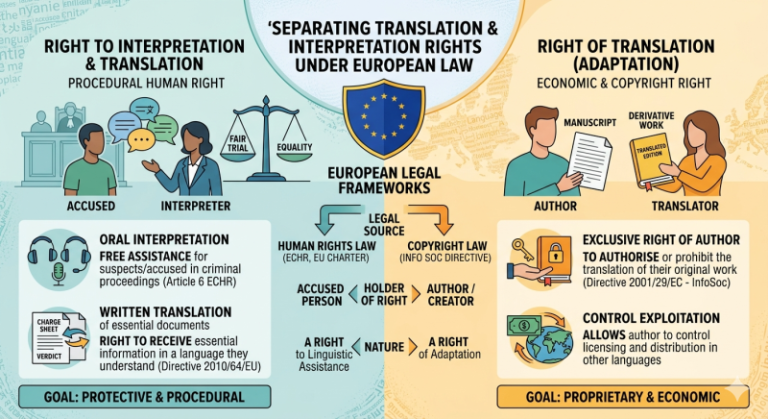
The right to interpretation is a fundamental right of suspects or defendants who do not understand the language used in criminal proceedings. Its purpose is to ensure that such individuals are capable of understanding the charges against them, comprehending procedural steps, and communicating effectively with the court and legal counsel. This right is recognized under Article 6(3)(e) of the European Convention on Human Rights, which guarantees free assistance of an interpreter to persons who cannot understand or speak the language of the court (Trechsel, 2006).
From a professional perspective, interpretation involves the immediate oral transfer of speech in real-time communicative situations. Interpreters are required to convey meaning, intention, and contextual nuance as accurately as possible. Interpretation therefore plays a crucial role during police interrogations, hearings, and courtroom proceedings.
By contrast, the right to written translation refers to the right of suspects or defendants to receive essential legal documents in a language that they can read and understand. This enables them to examine facts, analyze evidence, and prepare their defense effectively. The right became more explicitly recognized under Directive 2010/64/EU, which states that defendants must receive “written translation of essential documents” separately from oral interpretation rights (Brannan, 2017).
Written translation differs significantly from interpretation because it requires accuracy in transferring written legal texts, especially within legal systems characterized by specialized terminology and complex legal structures. Legal translators must therefore preserve the legal meaning of the source text while also considering differences between source and target legal systems (Cao, 2007).
Brannan (2017) contends that although interpretation rights and written translation rights both relate to linguistic protection within judicial proceedings, they should not be regarded as identical rights. Oral explanation or oral summary cannot always substitute for direct access to written legal documents, particularly in complex criminal cases. Access to translated written documents is therefore an essential element of the principle of a fair trial and the effective exercise of defense rights.
Literature Review
Research on linguistic rights in European criminal justice became more prominent following the judgment in Luedicke, Belkacem and Koç v. Germany, where the European Court of Human Rights established that defendants who do not understand the language of the court are entitled to free linguistic assistance. Initially, however, the emphasis remained largely on interpretation rather than written translation (Trechsel, 2006).
Later, in Kamasinski v. Austria, the Court expanded the scope of Article 6(3)(e) of the ECHR to include both interpretation and certain categories of documents necessary for defense rights. Nevertheless, the Court maintained that not all documents required written translation and that oral explanation could sometimes suffice (Brannan, 2017).
Brannan (2017) criticizes this jurisprudence for continuing to blur the distinction between translation and interpretation both legally and professionally, despite the fact that legal document translation requires greater precision and directly affects defendants’ ability to review evidence, examine procedural details, and consult with legal counsel.
Similarly, Ortega Herráez, Giambruno, and Hertog (2013) observe that many justice systems prioritize interpretation over legal translation, resulting in slower development of professional standards for legal translators compared with court interpreters. Scholars in legal translation studies further argue that legal translation involves not merely linguistic transfer but also the transfer of legal systems and jurisprudential concepts from one context to another (Cao, 2007).
Directive 2010/64/EU represents a major development in European law because it was the first European Union instrument to explicitly recognize defendants’ right to “written translation of essential documents” independently from oral interpretation rights (Brannan, 2017). This recognition reflects an effort to elevate written translation into an autonomous right directly connected to the principles of a fair trial and equality of arms.
Research Methodology
This article employs qualitative research methodology through documentary analysis and comparative legal analysis. The materials analyzed include judgments of the European Court of Human Rights, European Union legal instruments, and academic literature concerning legal translation and human rights law.
The analysis focuses on identifying the conceptual differences between translation and interpretation within criminal justice contexts and examining how European law developed the concept of written translation from earlier judicial decisions to Directive 2010/64/EU.
Furthermore, the study applies human rights and due process frameworks to explain the importance of access to legal documents in a language understood by defendants, as well as to evaluate the impact of oral summaries on the effectiveness of legal defense.
Discussion
Brannan’s most significant contribution lies in the assertion that “oral explanation is not always equivalent to written translation” (Brannan, 2017). This argument challenges the long-standing practice within European justice systems of relying on oral explanations instead of written translation in many criminal cases.
While oral interpretation allows defendants to understand immediate courtroom situations, written translation serves an entirely different function. Legal documents are materials that defendants must be able to revisit, examine, analyze, and discuss with their lawyers during trial preparation. Temporary comprehension through oral interpretation alone is therefore insufficient for the full exercise of procedural rights.
This argument is directly connected to the principle of equality of arms, which requires that parties in criminal proceedings have equal opportunities to access information and defend themselves effectively. Defendants who cannot read legal documents personally are placed at a structural disadvantage compared with individuals who understand the language of the court.
Another important issue concerns the growing recognition within European law that translation quality forms part of the fair trial principle rather than merely a technical linguistic matter. Brannan (2017) argues that if translation quality is inadequate, the right to translation may become meaningless in practice. Consequently, Directive 2010/64/EU emphasizes quality assurance, professional registers for translators, and complaint mechanisms concerning translation quality.
Nevertheless, although the Directive constitutes significant progress, it still permits the use of oral summaries in certain circumstances. This reflects an attempt to balance human rights protection with budgetary and administrative constraints within justice systems. The issue demonstrates that recognition of written translation rights remains influenced by policy considerations and procedural costs.
Future Research Directions
Future studies should extend comparative analysis beyond Europe in order to examine how different legal systems recognize written translation rights and regulate translation quality standards, particularly in developing countries where professional certification systems for legal translators remain limited.
Further research should also investigate the impact of artificial intelligence and machine translation on criminal justice systems. Although automated translation technologies may reduce costs and increase efficiency, they may also produce legal inaccuracies capable of undermining fair trial guarantees.
Another important area for future study concerns the ethical role and decision-making processes of legal translators, particularly in situations where source and target legal systems differ substantially in legal culture and jurisprudential structure.
Conclusion
Brannan’s concept represents a significant contribution to the development of linguistic rights within the European justice system because it advocates recognition of written translation as an autonomous right distinct from interpretation.
The article demonstrates that oral explanation cannot always substitute for written translation, especially in complex criminal proceedings involving serious implications for individual rights and liberties. Written translation should therefore be understood not merely as a linguistic service but as an essential component of the principles of fair trial and due process.
Directive 2010/64/EU marks an important legal development by strengthening the formal recognition of written translation rights within European law and by elevating the role of legal translators as important actors in the protection of human rights within modern criminal justice systems.
References
- Brannan, J. (2017). Identifying written translation in criminal proceedings as a separate right: Scope and supervision under European law. JoSTrans: The Journal of Specialised Translation, 27, 36–59.
- Cao, D. (2007). Translating law. Multilingual Matters.
- Ortega Herráez, J. M., Giambruno, C., & Hertog, E. (2013). Translating for domestic courts in multicultural regions. In A. Borja Albi & F. Prieto Ramos (Eds.), Legal translation in context (pp. 89–121). Peter Lang.
- Trechsel, S. (2006). Human rights in criminal proceedings. Oxford University Press.
- European Union. (2010). Directive 2010/64/EU of the European Parliament and of the Council on the right to interpretation and translation in criminal proceedings.
For professional services, please visit: https://www.seaproti.org/practitioners/
About certified translators, translation certifiers, and certified interpreters associated with SEAProTI. The Southeast Asian Association of Professional Translators and Interpreters (SEAProTI) has officially shared the qualifications and requirements for becoming Certified Translators, Translation Certification Providers, and Certified Interpreters in Sections 9 and 10 of the Royal Gazette, which was published by the Prime Minister’s Office in Thailand on July 25, 2024. Certified Translators, Translation Certification Providers, and Certified Interpreters
The Council of State has proposed the enactment of a Royal Decree, granting registered translators and recognised translation certifiers from professional associations or accredited language institutions the authority to provide legally valid translation certification (Letter to SEAProTI dated April 28, 2025)
SEAProTI is the first professional association in Thailand and Southeast Asia to implement a comprehensive certification system for translators, certifiers, and interpreters.
Head Office: Baan Ratchakru Building, No. 33, Room 402, Soi Phahonyothin 5, Phahonyothin Road, Phaya Thai District, Bangkok 10400, Thailand
Email: hello@seaproti.com | Tel.: (+66) 2-114-3128 (Office hours: Mon–Fri, 09:00–17:00).
การแยกสิทธิในการแปลเอกสารออกจากสิทธิในการล่ามในกระบวนการพิจารณาคดีอาญา: การวิเคราะห์แนวคิดของ เจมส์ แบรนแนน ภายใต้กฎหมายยุโรป
ผู้เขียน: ไกรฤกษ์ กรวยทอง
29 พฤษภาคม 2569, กรุงเทพมหานคร – บทความนี้มุ่งวิเคราะห์แนวคิดของเจมส์ แบรนแนนเกี่ยวกับการแยก “สิทธิในการแปลเอกสารลายลักษณ์อักษร” ออกจาก “สิทธิในการล่าม” ในกระบวนการพิจารณาคดีอาญาภายใต้อนุสัญญายุโรปว่าด้วยสิทธิมนุษยชน (European Convention on Human Rights: ECHR) และข้อกำหนดสหภาพยุโรป 2010/64/EU ของสหภาพยุโรป งานศึกษาชี้ให้เห็นว่า แม้ระบบกฎหมายยุโรปจะรับรองสิทธิด้านภาษาในกระบวนการยุติธรรมมาเป็นเวลานาน แต่ในทางปฏิบัติกลับให้ความสำคัญกับการล่ามปากเปล่ามากกว่าการแปลเอกสาร ส่งผลให้จำเลยต่างชาติหรือผู้ที่ไม่เข้าใจภาษาของศาลไม่สามารถเข้าถึงข้อมูลทางคดีได้อย่างสมบูรณ์ บทความอภิปรายว่าแนวคิด การอธิบายด้วยวาจาไม่อาจเทียบเท่ากับการแปลเอกสารลายลักษณ์อักษรได้เสมอไปเป็นจุดเปลี่ยนสำคัญที่ทำให้การแปลเอกสารถูกยกระดับเป็นสิทธิอิสระที่เกี่ยวข้องโดยตรงกับหลักการพิจารณาคดีอย่างเป็นธรรม (fair trial) และสิทธิในการต่อสู้คดี งานวิจัยยังเสนอว่าคุณภาพของการแปลกฎหมายและการกำกับมาตรฐานวิชาชีพนักแปลมีความสำคัญต่อการคุ้มครองสิทธิมนุษยชนในกระบวนการยุติธรรมสมัยใหม่
บทนำ
สิทธิด้านภาษาในกระบวนการพิจารณาคดีอาญาเป็นองค์ประกอบสำคัญของหลักการพิจารณาคดีอย่างเป็นธรรมภายใต้กฎหมายสิทธิมนุษยชนระหว่างประเทศ โดยเฉพาะในสังคมที่มีการเคลื่อนย้ายข้ามพรมแดนและการดำเนินคดีต่อชาวต่างชาติเพิ่มขึ้นอย่างต่อเนื่อง อย่างไรก็ตาม การอภิปรายทางกฎหมายในอดีตมักมุ่งเน้นไปที่การทำล่ามในห้องพิจารณาคดี มากกว่าการแปลเอกสารลายลักษณ์อักษรที่เกี่ยวข้องกับการดำเนินคดี (แบรนแนน, 2560)
แบรนแนน (2560) เสนอว่า แนวคิดดังกล่าวสะท้อนข้อจำกัดของระบบยุติธรรมยุโรปที่ยังไม่แยก “การแปลเอกสาร” (translation) ออกจาก “การล่าม” (interpretation) อย่างชัดเจน ทั้งที่สองวิชาชีพมีลักษณะ หน้าที่ และทักษะเฉพาะทางแตกต่างกันอย่างมีนัยสำคัญ การล่ามมีลักษณะเป็นการถ่ายทอดภาษาด้วยวาจาแบบทันที ในขณะที่การแปลเอกสารต้องอาศัยความแม่นยำเชิงนิติศาสตร์ การตีความศัพท์กฎหมาย และความสามารถในการรักษาความหมายทางกฎหมายของต้นฉบับ
แม้ศาลสิทธิมนุษยชนยุโรปจะรับรองว่าจำเลยต้องเข้าใจข้อกล่าวหาและสามารถต่อสู้คดีได้ แต่ในหลายกรณีศาลกลับยอมรับว่า “การอธิบายด้วยวาจา” หรือ “บทสรุปด้วยวาจา” (oral summary) เพียงพอต่อการคุ้มครองสิทธิของจำเลย ส่งผลให้เอกสารสำคัญจำนวนมากไม่ได้รับการแปลเป็นลายลักษณ์อักษร (แบรนแนน, 2560) สถานการณ์ดังกล่าวก่อให้เกิดข้อถกเถียงว่าการอธิบายด้วยปากเปล่าสามารถทดแทนการแปลเอกสารได้จริงหรือไม่ โดยเฉพาะในคดีอาญาที่มีความซับซ้อนสูงและมีผลกระทบต่อเสรีภาพของบุคคล
บทความนี้จึงมีวัตถุประสงค์เพื่อวิเคราะห์แนวคิดการแยก “การแปลเอกสารลายลักษณ์อักษร” (written translation) ออกจาก “การล่าม” (interpretation) ภายใต้กฎหมายยุโรป ตลอดจนศึกษาความสัมพันธ์ระหว่างการแปลเอกสารกับหลักการพิจารณาคดีอย่างเป็นธรรม (fair trial) และสิทธิในการต่อสู้คดี
สิทธิในการล่ามและสิทธิในการแปลเอกสารในกระบวนการยุติธรรมอาญา
สิทธิในการล่ามเป็นสิทธิขั้นพื้นฐานของผู้ต้องหาหรือจำเลยที่ไม่เข้าใจภาษาที่ใช้ในกระบวนการพิจารณาคดี โดยมีวัตถุประสงค์เพื่อให้บุคคลดังกล่าวสามารถรับรู้ข้อกล่าวหา เข้าใจขั้นตอนการดำเนินคดี และสื่อสารกับศาลหรือทนายความได้อย่างมีประสิทธิภาพ สิทธิดังกล่าวได้รับการรับรองภายใต้ข้อ 6(3)(e) ของอนุสัญญายุโรปว่าด้วยสิทธิมนุษยชน ซึ่งกำหนดให้บุคคลที่ไม่เข้าใจภาษาของศาลมีสิทธิได้รับความช่วยเหลือจากล่ามโดยไม่เสียค่าใช้จ่าย (เทรคเซล, 2549)
ในเชิงวิชาชีพ การล่ามมีลักษณะเป็นการถ่ายทอดภาษาด้วยวาจาแบบทันที ผู้ล่ามต้องทำหน้าที่ถ่ายทอดสารระหว่างคู่สนทนาในสถานการณ์เฉพาะหน้า โดยรักษาความหมาย เจตนา และบริบทของการสื่อสารให้ใกล้เคียงต้นฉบับมากที่สุด ด้วยเหตุนี้ การล่ามจึงมีความสำคัญอย่างยิ่งในชั้นสอบสวน การไต่สวน และการพิจารณาคดีในศาล
ในขณะที่สิทธิในการแปลเอกสารหมายถึงสิทธิของผู้ต้องหาหรือจำเลยในการได้รับเอกสารสำคัญทางคดีในภาษาที่ตนสามารถอ่านและเข้าใจได้ เพื่อให้สามารถตรวจสอบข้อเท็จจริง วิเคราะห์พยานหลักฐาน และเตรียมการต่อสู้คดีได้อย่างเต็มที่ สิทธิดังกล่าวได้รับการรับรองอย่างชัดเจนมากขึ้นภายใต้ข้อกำหนดสหภาพยุโรป 2010/64/EU ซึ่งระบุว่าจำเลยต้องได้รับ การแปลเอกสารสำคัญเป็นลายลักษณ์อักษร (written translation of essential documents) แยกจากสิทธิในการล่ามปากเปล่า (แบรนแนน, 2560)
การแปลเอกสารมีลักษณะแตกต่างจากการล่ามอย่างมีนัยสำคัญ เนื่องจากต้องอาศัยความแม่นยำในการถ่ายทอดข้อความลายลักษณ์อักษร โดยเฉพาะในบริบทของกฎหมายที่มีศัพท์เฉพาะและโครงสร้างทางนิติศาสตร์ซับซ้อน นักแปลกฎหมายจึงต้องรักษาความหมายทางกฎหมายของต้นฉบับ ตลอดจนพิจารณาความแตกต่างระหว่างระบบกฎหมายของภาษาต้นทางและภาษาปลายทาง (เฉา, 2550)
แบรนแนน (2560) เสนอว่า แม้สิทธิในการล่ามและสิทธิในการแปลเอกสารจะเกี่ยวข้องกับการคุ้มครองสิทธิด้านภาษาเช่นเดียวกัน แต่ทั้งสองสิทธิไม่ควรถูกมองว่าเป็นเรื่องเดียวกัน เนื่องจาก “การอธิบายด้วยวาจา” หรือ “บทสรุปด้วยวาจา” ไม่สามารถทดแทนการเข้าถึงเอกสารลายลักษณ์อักษรได้เสมอไป โดยเฉพาะในคดีอาญาที่มีความซับซ้อนสูง การมีเอกสารแปลเป็นลายลักษณ์อักษรจึงเป็นองค์ประกอบสำคัญของหลักการพิจารณาคดีอย่างเป็นธรรมและสิทธิในการต่อสู้คดีอย่างมีประสิทธิภาพ
ทบทวนวรรณกรรม
งานศึกษาด้านสิทธิทางภาษาในกระบวนการยุติธรรมยุโรปเริ่มมีความชัดเจนมากขึ้นภายหลังคำพิพากษาในคดี ลือดิคเคอ, เบลคาเซม และ โคช ปะทะ เยอรมนี (Luedicke, Belkacem and Koç v. Germany) ซึ่งศาลสิทธิมนุษยชนยุโรปวางหลักว่าผู้ต้องหาที่ไม่เข้าใจภาษาของศาลมีสิทธิได้รับความช่วยเหลือทางภาษาโดยไม่เสียค่าใช้จ่าย อย่างไรก็ตาม ในระยะแรก แนวคิดดังกล่าวยังมุ่งเน้นที่ “การล่าม” มากกว่าการแปลเอกสาร (เทรคเซล, 2549)
ต่อมาในคดี คามาซินสกี ปะทะ ออสเตรีย (Kamasinski v. Austria) ศาลได้ขยายขอบเขตของข้อ 6(3)(e) ของอนุสัญญายุโรปว่าด้วยสิทธิมนุษยชน (ECHR) ให้ครอบคลุมทั้งการล่ามและเอกสารบางประเภทที่จำเป็นต่อการต่อสู้คดี อย่างไรก็ตาม ศาลยังยืนยันว่าไม่จำเป็นต้องแปลเอกสารทุกฉบับ และในหลายกรณีการอธิบายด้วยวาจาอาจเพียงพอ (แบรนแนน, 2560)
แบรนแนน (2560) วิจารณ์ว่าแนวคำพิพากษาดังกล่าวยังสะท้อนการไม่แยกระหว่างการแปลเอกสารกับการล่าม ทั้งในเชิงกฎหมายและเชิงวิชาชีพ ทั้งที่การแปลเอกสารกฎหมายต้องอาศัยความแม่นยำสูงกว่าและมีผลโดยตรงต่อความสามารถของจำเลยในการตรวจสอบข้อมูล ทบทวนพยานหลักฐาน และปรึกษาทนายความ
ในทำนองเดียวกัน ออร์เตกา เอร์ราเอซ, เจียมบรูโน และเฮอร์ท็อก (2556) ชี้ว่า ระบบยุติธรรมในหลายประเทศยังให้ความสำคัญกับการล่ามมากกว่างานแปลกฎหมาย ส่งผลให้การพัฒนามาตรฐานวิชาชีพนักแปลกฎหมายล่าช้ากว่าวิชาชีพล่ามศาล นอกจากนี้ นักวิชาการด้านการแปลกฎหมาย (legal translation) ยังเสนอว่าการแปลกฎหมายไม่ใช่เพียงการถ่ายทอดภาษา แต่เป็นการถ่ายทอดระบบกฎหมายและแนวคิดทางนิติศาสตร์จากบริบทหนึ่งสู่อีกบริบทหนึ่ง (เฉา, 2550)
ข้อกำหนดสหภาพยุโรป 2010/64/EU ถือเป็นพัฒนาการสำคัญของกฎหมายยุโรป เนื่องจากเป็นครั้งแรกที่สหภาพยุโรประบุชัดเจนว่าจำเลยมีสิทธิได้รับการแปลเอกสารสำคัญเป็นลายลักษณ์อักษร (written translation of essential documents) โดยแยกจากสิทธิในการล่ามปากเปล่า (แบรนแนน, 2560) การบัญญัติดังกล่าวสะท้อนความพยายามยกระดับการแปลเอกสารให้เป็นสิทธิอิสระที่เชื่อมโยงโดยตรงกับหลักการพิจารณาคดีอย่างเป็นธรรมและหลักความเสมอภาคในการต่อสู้คดี (equality of arms)
ระเบียบวิธีการวิจัย
บทความนี้ใช้ระเบียบวิธีวิจัยเชิงคุณภาพ (qualitative research) โดยอาศัยการวิเคราะห์เอกสาร (documentary analysis) และการวิเคราะห์เชิงกฎหมายเปรียบเทียบ (comparative legal analysis) เป็นหลัก ข้อมูลที่ใช้ในการศึกษาประกอบด้วยคำพิพากษาของศาลสิทธิมนุษยชนยุโรป เอกสารกฎหมายของสหภาพยุโรป และงานวิชาการด้านการแปลกฎหมาย (legal translation) และกฎหมายสิทธิมนุษยชน (human rights law)
การวิเคราะห์มุ่งศึกษาความแตกต่างระหว่างแนวคิดเรื่องการแปลเอกสารกับการล่ามในบริบทของกระบวนการยุติธรรม รวมถึงวิเคราะห์ว่ากฎหมายยุโรปได้พัฒนาแนวคิดเกี่ยวกับการแปลเอกสารลายลักษณ์อักษรอย่างไรจากแนวคำพิพากษาเดิมสู่ข้อกำหนดสหภาพยุโรป 2010/64/EU
นอกจากนี้ การวิจัยยังใช้แนวคิดด้านสิทธิมนุษยชนและกระบวนการอันชอบด้วยกฎหมาย (due process) เป็นกรอบในการอธิบายความสำคัญของการเข้าถึงเอกสารในภาษาที่จำเลยเข้าใจ ตลอดจนวิเคราะห์ผลกระทบของบทสรุปด้วยวาจา (oral summary) ต่อประสิทธิภาพของการต่อสู้คดี
อภิปราย
แนวคิดสำคัญที่สุดของแบรนแนน (2560) คือ การยืนยันว่าการอธิบายด้วยวาจาไม่อาจเทียบเท่ากับการแปลเอกสารลายลักษณ์อักษรได้เสมอไป ซึ่งเป็นการตั้งคำถามต่อแนวปฏิบัติของระบบยุติธรรมยุโรปที่ใช้การอธิบายด้วยวาจาแทนการแปลเอกสารในหลายกรณี
แม้การล่ามปากเปล่าจะช่วยให้จำเลยเข้าใจสถานการณ์เฉพาะหน้าในห้องพิจารณา แต่การแปลเอกสารมีบทบาทที่แตกต่างออกไปโดยสิ้นเชิง เนื่องจากเอกสารทางกฎหมายเป็นข้อมูลที่จำเลยต้องสามารถกลับมาทบทวน วิเคราะห์ และใช้ในการเตรียมการต่อสู้คดีร่วมกับทนายความ การรับรู้ข้อมูลเพียงชั่วคราวผ่านการล่ามจึงไม่เพียงพอต่อการใช้สิทธิอย่างเต็มที่
แนวคิดดังกล่าวสัมพันธ์โดยตรงกับหลักความเสมอภาคในการต่อสู้คดี (equality of arms) ซึ่งกำหนดให้คู่ความต้องมีโอกาสเข้าถึงข้อมูลและใช้สิทธิในการต่อสู้คดีอย่างเท่าเทียม หากจำเลยไม่สามารถอ่านเอกสารด้วยตนเอง ย่อมเกิดความเสียเปรียบเชิงโครงสร้างเมื่อเปรียบเทียบกับผู้ที่เข้าใจภาษาของศาล
อีกประเด็นสำคัญคือ การที่กฎหมายยุโรปเริ่มยอมรับว่าคุณภาพของการแปลเป็นส่วนหนึ่งของหลักการพิจารณาคดีอย่างเป็นธรรม ไม่ใช่เพียงประเด็นทางเทคนิคด้านภาษา แบรนแนน (2560) ชี้ว่า หากงานแปลไม่มีคุณภาพ สิทธิในการแปลก็อาจไม่มีความหมายในทางปฏิบัติ ดังนั้น ข้อกำหนดสหภาพยุโรป 2010/64/EU จึงเน้นเรื่องการประกันคุณภาพ (quality assurance) การขึ้นทะเบียนนักแปล และกลไกการร้องเรียนเกี่ยวกับคุณภาพงานแปล
อย่างไรก็ตาม แม้ข้อกำหนดดังกล่าวจะถือเป็นความก้าวหน้าสำคัญ แต่ก็ยังเปิดช่องให้รัฐใช้บทสรุปด้วยวาจา (oral summary) ได้ในบางกรณี ซึ่งสะท้อนความพยายามประนีประนอมระหว่างการคุ้มครองสิทธิมนุษยชนกับข้อจำกัดด้านงบประมาณและประสิทธิภาพของรัฐ ปัญหาดังกล่าวแสดงให้เห็นว่าการรับรองสิทธิในการแปลเอกสารยังคงอยู่ภายใต้แรงกดดันทางนโยบายและต้นทุนของกระบวนการยุติธรรม
แนวทางของงานวิจัยในอนาคต
การศึกษาต่อไปควรขยายการวิเคราะห์ไปยังระบบกฎหมายนอกยุโรป เพื่อเปรียบเทียบว่าประเทศต่าง ๆ รับรองสิทธิในการแปลเอกสารอย่างไร และมีมาตรฐานในการกำกับคุณภาพการแปลมากน้อยเพียงใด โดยเฉพาะในประเทศกำลังพัฒนาที่ยังขาดระบบรับรองวิชาชีพนักแปลกฎหมาย
นอกจากนี้ ควรมีการศึกษาผลกระทบของเทคโนโลยีปัญญาประดิษฐ์และการแปลด้วยเครื่อง (machine translation) ต่อกระบวนการยุติธรรม เนื่องจากหลายประเทศเริ่มนำระบบแปลอัตโนมัติมาใช้ในงานด้านกฎหมาย แม้จะช่วยลดต้นทุนและเพิ่มความรวดเร็ว แต่ก็อาจก่อให้เกิดความคลาดเคลื่อนทางนิติศาสตร์และส่งผลกระทบต่อหลักการพิจารณาคดีอย่างเป็นธรรมได้
อีกประเด็นที่ควรศึกษาเพิ่มเติมคือบทบาทด้านจริยธรรมและกระบวนการตัดสินใจของนักแปลกฎหมาย โดยเฉพาะในกรณีที่ภาษาและระบบกฎหมายของต้นฉบับกับภาษาปลายทางมีความแตกต่างเชิงวัฒนธรรมและเชิงกฎหมายอย่างมาก
สรุป
แนวคิดของแบรนแนน (2560) มีความสำคัญอย่างยิ่งต่อพัฒนาการของสิทธิด้านภาษาในกระบวนการยุติธรรมยุโรป เนื่องจากเป็นการผลักดันให้ “การแปลเอกสารลายลักษณ์อักษร” (written translation) ได้รับการยอมรับเป็นสิทธิอิสระที่แยกจาก “การล่าม” (interpretation) อย่างชัดเจน
บทความชี้ว่า การอธิบายด้วยวาจาไม่สามารถทดแทนการแปลเอกสารได้เสมอไป โดยเฉพาะในคดีอาญาที่ซับซ้อนและมีผลกระทบต่อสิทธิและเสรีภาพของบุคคล การแปลเอกสารจึงไม่ใช่เพียงบริการทางภาษา แต่เป็นองค์ประกอบของหลักการพิจารณาคดีอย่างเป็นธรรมและกระบวนการอันชอบด้วยกฎหมาย (due process)
ข้อกำหนดสหภาพยุโรป 2010/64/EU ถือเป็นพัฒนาการสำคัญที่ทำให้สิทธิในการแปลเอกสารมีสถานะชัดเจนมากขึ้นในกฎหมายยุโรป พร้อมทั้งยกระดับบทบาทของนักแปลกฎหมายในฐานะกลไกสำคัญของการคุ้มครองสิทธิมนุษยชนในกระบวนการยุติธรรมสมัยใหม่
เอกสารอ้างอิง
- แบรนแนน, เจ. (2560). Identifying written translation in criminal proceedings as a separate right: Scope and supervision under European law. JoSTrans: The Journal of Specialised Translation, 27, 36–59.
- เฉา, ดี. (2550). Translating law. Multilingual Matters.
- ออร์เตกา เอร์ราเอซ, เจ. เอ็ม., เจียมบรูโน, ซี., และเฮอร์ท็อก, อี. (2556). Translating for domestic courts in multicultural regions. ใน A. Borja Albi และ F. Prieto Ramos (บ.ก.), Legal translation in context (น. 89–121). Peter Lang.
- เทรคเซล, เอส. (2549). Human rights in criminal proceedings. Oxford University Press.
- สหภาพยุโรป. (2553). Directive 2010/64/EU of the European Parliament and of the Council on the right to interpretation and translation in criminal proceedings.
สมาคมวิชาชีพนักแปลและล่ามแห่งเอเชียตะวันออกเฉียงใต้ (SEAProTI) ได้ประกาศหลักเกณฑ์และคุณสมบัติของผู้ที่ขึ้นทะเบียนเป็น “นักแปลรับรอง (Certified Translators) และผู้รับรองการแปล (Translation Certification Providers) และล่ามรับรอง (Certified Interpreters)” ของสมาคม หมวดที่ 9 และหมวดที่ 10 ในราชกิจจานุเบกษา ของสำนักเลขาธิการคณะรัฐมนตรี ในสำนักนายกรัฐมนตรี แห่งราชอาณาจักรไทย ลงวันที่ 25 ก.ค. 2567 เล่มที่ 141 ตอนที่ 66 ง หน้า 100 อ่านฉบับเต็มได้ที่: นักแปลรับรอง ผู้รับรองการแปล และล่ามรับรอง
สำนักคณะกรรมการกฤษฎีกาเสนอให้ตราเป็นพระราชกฤษฎีกา โดยกำหนดให้นักแปลที่ขึ้นทะเบียน รวมถึงผู้รับรองการแปลจากสมาคมวิชาชีพหรือสถาบันสอนภาษาที่มีการอบรมและขึ้นทะเบียน สามารถรับรองคำแปลได้ (จดหมายถึงสมาคม SEAProTI ลงวันที่ 28 เม.ย. 2568)
สมาคมวิชาชีพนักแปลและล่ามแห่งเอเชียตะวันออกเฉียงใต้เป็นสมาคมวิชาชีพแห่งแรกและแห่งเดียวในประเทศไทยและภูมิภาคเอเชียตะวันออกเฉียงใต้ที่มีระบบรับรองนักแปลรับรอง ผู้รับรองการแปล และล่ามรับรอง
สำนักงานใหญ่: อาคารบ้านราชครู เลขที่ 33 ห้อง 402 ซอยพหลโยธิน 5 ถนนพหลโยธิน แขวงพญาไท เขตพญาไท กรุงเทพมหานคร 10400 ประเทศไทย