



Drafting Employment Contracts in Thailand: Labor Law Dimensions and the Role of Certified Translators and Certified Interpreters in the International Context
Author: Griroek Gruaythong
29 May 2026, Bangkok – Drafting employment contracts in Thailand is a complex legal process involving statutory labor provisions, labor court decisions, and factual circumstances surrounding each case. The use of standardized templates or contracts drafted without adequate legal knowledge may lead to disputes concerning the legal status of the relationship between employers and employees. This article examines the legal principles governing employment contracts in Thailand, the distinction between employment contracts and contracts for work and labor, as well as the role of certified translators, translation certification providers, and certified interpreters in the preparation, review, and certification of labor-related legal documents. Particular attention is given to cases involving foreign parties or bilingual documentation. The article argues that language professionals with certification credentials play a crucial role in reducing legal ambiguity, enhancing document reliability, and supporting judicial processes in international labor disputes.
Introduction
An employment contract is a fundamental legal instrument that establishes the rights, duties, and legal relationship between employers and employees within a modern economic system. Under Thai law, the existence of an employment contract is not determined solely by the wording contained in a written document, but also by the factual circumstances of the relationship, the degree of supervision, and the actual nature of the work performed (Civil and Commercial Code of Thailand, 2025). Consequently, drafting employment contracts requires comprehensive knowledge of labor law principles and labor court precedents.
Such complexity becomes even more significant in the context of foreign labor employment, multinational corporations, and international business operations, where contractual documents are frequently prepared in multiple languages. Legal translation in labor matters is therefore not merely a linguistic exercise, but also a process of accurately transferring legal meaning between legal systems (Cao, 2007). Certified translators, translation certification providers, and certified interpreters consequently play an essential role in ensuring the accuracy and credibility of legal documents and judicial proceedings in labor disputes.
Legal Characteristics of Employment Contracts in Thailand
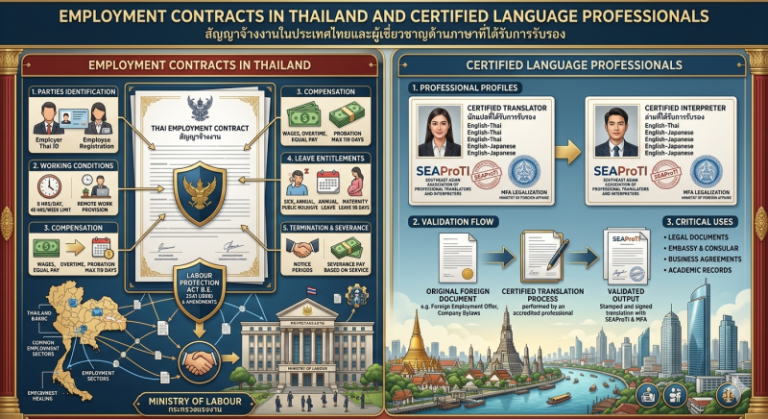
Thai labor law requires employment contracts to contain several essential elements, including the place of employment, working hours, holidays, wages, and conditions relating to termination. If such essential elements are not clearly specified, the Labor Court may determine that the legal relationship does not constitute an employment contract, even if the parties describe themselves as “employer” and “employee” (Siam Legal International, n.d.).
One particularly important issue is the “control and supervision test,” which courts apply in determining employee status. Where the hiring party lacks authority to supervise working methods or regulate working hours, the relationship may instead be interpreted as a contract for work and labor under Thai law (Labor Protection Act B.E. 2541 [1998]).
A commonly cited example involves restaurants hiring singers to perform regularly. In such cases, the employer may primarily seek the result of the performance rather than control over the methods of work. Accordingly, the court may classify the arrangement as a contract for work rather than an employment contract. The determination, however, depends upon the specific facts of each case, including whether the agreement provides annual leave, sick leave, or employment-related benefits commonly associated with employment contracts (Siam Legal International, n.d.).
The Importance of Drafting Contracts with Legal Expertise
Drafting employment contracts using templates obtained from the internet may create substantial legal risks because each contract must correspond with the actual working relationship and comply with the Labor Protection Act B.E. 2541 (1998) and other related legislation. The assistance of labor law specialists or qualified legal practitioners is therefore essential, particularly in cases involving foreign employees or international contractual elements (Baker & Phongpaichit, 2014).
Furthermore, bilingual contracts, particularly those prepared in Thai and English, require a high degree of legal-linguistic precision. Even minor translation inaccuracies may significantly affect the interpretation of contractual rights and obligations. Legal translation must therefore take into account both linguistic structure and the legal systems of the jurisdictions involved (Munday, 2016).
The Role of Certified Translators and Certified Interpreters in International Labor Disputes
In the era of globalization and transnational labor mobility, certified translators and certified interpreters have become increasingly important in employment-related legal processes, particularly in the drafting of employment contracts, translation of supporting employment documents, and litigation involving foreign parties.
Certified translators are responsible for ensuring that translated texts accurately and completely reflect the legal meaning of the original documents. Translation certification enhances the credibility of documents submitted before courts, government agencies, and international organizations (Nida & Taber, 2003). Translation certification providers further contribute by verifying translation standards and confirming the professional qualifications of translators in accordance with professional ethics and regulatory requirements.
Certified interpreters play a critical role in court hearings, labor dispute negotiations, and fact-finding proceedings, especially where parties are unable to communicate effectively in Thai. Interpreters who lack specialized knowledge of labor law may create misunderstandings that adversely affect procedural fairness and the parties’ rights within judicial proceedings (González, Vásquez, & Mikkelson, 2012).
Professional associations of translators and interpreters in Southeast Asia also contribute significantly to establishing professional standards, promoting ethical guidelines, and providing specialized training in labor and legal interpretation. These organizations support the development of professional certification systems that enhance both the quality and international recognition of language professionals working within legal contexts.
Conclusion
Drafting employment contracts in Thailand requires not only legal expertise in labor law but also a comprehensive understanding of the factual nature of working relationships. The distinction between employment contracts and contracts for work may substantially affect the rights and obligations of the parties involved. Within the context of international employment, legal translation and interpretation play an indispensable role in ensuring accuracy, transparency, and fairness in labor processes. Certified translators, translation certification providers, and certified interpreters therefore function not merely as language mediators, but also as essential mechanisms for protecting labor rights and supporting justice within an increasingly globalized society.
References
- Baker, C., & Phongpaichit, P. (2014). A history of Thailand (3rd ed.). Cambridge University Press.
- Cao, D. (2007). Translating law. Multilingual Matters.
- Civil and Commercial Code of Thailand. (2025). Sections 575–586.
- González, R. D., Vásquez, V. F., & Mikkelson, H. (2012). Fundamentals of court interpretation: Theory, policy and practice (2nd ed.). Carolina Academic Press.
- Labor Protection Act B.E. 2541 (1998). Government Gazette of Thailand, Vol. 115, Part 8 A.
- Munday, J. (2016). Introducing translation studies: Theories and applications (4th ed.). Routledge.
- Nida, E. A., & Taber, C. R. (2003). The theory and practice of translation. Brill.
- Siam Legal International. (n.d.). Drafting an employment contract in Thailand. Retrieved from https://www.siam-legal.com
For professional services, please visit: https://www.seaproti.org/practitioners/
About certified translators, translation certifiers, and certified interpreters associated with SEAProTI. The Southeast Asian Association of Professional Translators and Interpreters (SEAProTI) has officially shared the qualifications and requirements for becoming Certified Translators, Translation Certification Providers, and Certified Interpreters in Sections 9 and 10 of the Royal Gazette, which was published by the Prime Minister’s Office in Thailand on July 25, 2024. Certified Translators, Translation Certification Providers, and Certified Interpreters
The Council of State has proposed the enactment of a Royal Decree, granting registered translators and recognised translation certifiers from professional associations or accredited language institutions the authority to provide legally valid translation certification (Letter to SEAProTI dated April 28, 2025)
SEAProTI is the first professional association in Thailand and Southeast Asia to implement a comprehensive certification system for translators, certifiers, and interpreters.
Head Office: Baan Ratchakru Building, No. 33, Room 402, Soi Phahonyothin 5, Phahonyothin Road, Phaya Thai District, Bangkok 10400, Thailand
Email: hello@seaproti.com | Tel.: (+66) 2-114-3128 (Office hours: Mon–Fri, 09:00–17:00).
การร่างสัญญาจ้างแรงงานในประเทศไทย: มิติทางกฎหมายแรงงานและบทบาทของนักแปลรับรองและล่ามรับรองล
ในบริบทระหว่างประเทศ
ผู้เขียน: ไกรฤกษ์ กรวยทอง
29 พฤษภาคม 2569, กรุงเทพมหานคร – การร่างสัญญาจ้างแรงงานในประเทศไทยเป็นกระบวนการทางกฎหมายที่มีความซับซ้อนและเกี่ยวข้องกับทั้งบทบัญญัติของกฎหมายแรงงาน คำพิพากษาศาลแรงงาน และข้อเท็จจริงแห่งคดี การใช้สัญญาสำเร็จรูปหรือการร่างสัญญาโดยปราศจากความรู้ด้านกฎหมายอาจนำไปสู่ข้อพิพาทเกี่ยวกับสถานะของนิติสัมพันธ์ระหว่างนายจ้างและลูกจ้างได้ บทความนี้มุ่งศึกษาหลักกฎหมายเกี่ยวกับสัญญาจ้างแรงงานในประเทศไทย ความแตกต่างระหว่างสัญญาจ้างแรงงานกับสัญญาจ้างทำของ ตลอดจนบทบาทของนักแปลรับรอง ผู้รับรองการแปล และล่ามรับรองในกระบวนการจัดทำ ตรวจสอบ และรับรองเอกสารทางกฎหมายด้านแรงงาน โดยเฉพาะในกรณีที่มีคู่สัญญาชาวต่างชาติหรือมีการใช้เอกสารสองภาษา บทความเสนอว่าผู้ประกอบวิชาชีพด้านภาษาในระดับรับรองมีบทบาทสำคัญในการลดความคลาดเคลื่อนทางกฎหมาย สร้างความน่าเชื่อถือของเอกสาร และสนับสนุนกระบวนการยุติธรรมในคดีแรงงานระหว่างประเทศ
บทนำ
สัญญาจ้างแรงงานเป็นนิติกรรมพื้นฐานที่กำหนดสิทธิ หน้าที่ และความสัมพันธ์ทางกฎหมายระหว่างนายจ้างและลูกจ้างในระบบเศรษฐกิจสมัยใหม่ ภายใต้กฎหมายไทย สัญญาจ้างแรงงานไม่ได้พิจารณาเพียงแต่ข้อความที่ปรากฏในเอกสารเท่านั้น แต่ยังรวมถึงพฤติการณ์แห่งคดี อำนาจบังคับบัญชา และลักษณะของการทำงานจริงด้วย (ประมวลกฎหมายแพ่งและพาณิชย์, 2568) ด้วยเหตุนี้ การร่างสัญญาจ้างแรงงานจึงต้องอาศัยความเข้าใจเชิงลึกทั้งด้านกฎหมายแรงงานและแนวคำพิพากษาของศาลแรงงาน
ความซับซ้อนดังกล่าวยิ่งเพิ่มขึ้นในบริบทของการจ้างแรงงานต่างชาติ บริษัทข้ามชาติ และการดำเนินธุรกิจระหว่างประเทศ ซึ่งเอกสารสัญญามักจัดทำเป็นหลายภาษา การแปลเอกสารทางกฎหมายแรงงานจึงมิใช่เพียงการถ่ายทอดภาษา แต่เป็นการถ่ายทอดความหมายทางกฎหมายอย่างถูกต้องและสอดคล้องกับระบบกฎหมายที่เกี่ยวข้อง (เฉา, 2550) นักแปลรับรอง (Certified Translators) ผู้รับรองการแปล (Translation Certification Providers) และล่ามรับรอง (Certified Interpreters) จึงเข้ามามีบทบาทสำคัญในการสนับสนุนความถูกต้องและความน่าเชื่อถือของเอกสารและกระบวนการพิจารณาคดีแรงงาน
ลักษณะทางกฎหมายของสัญญาจ้างแรงงานในประเทศไทย
กฎหมายแรงงานไทยกำหนดว่าสัญญาจ้างแรงงานต้องมีองค์ประกอบสำคัญหลายประการ ได้แก่ สถานที่ทำงาน เวลาทำงาน วันหยุด และเงื่อนไขเกี่ยวกับค่าจ้างและการเลิกจ้าง หากสัญญาไม่ระบุองค์ประกอบดังกล่าวอย่างชัดเจน ศาลแรงงานอาจวินิจฉัยว่านิติสัมพันธ์ดังกล่าวมิใช่สัญญาจ้างแรงงาน แม้คู่สัญญาจะเรียกตนเองว่า “นายจ้าง” และ “ลูกจ้าง” ก็ตาม (Siam Legal International, n.d.)
ประเด็นสำคัญประการหนึ่งคือ “อำนาจบังคับบัญชา” (Control and Supervision Test) ซึ่งศาลใช้ในการวินิจฉัยว่ามีสถานะเป็นลูกจ้างหรือไม่ หากผู้ว่าจ้างไม่มีอำนาจควบคุมวิธีการทำงานหรือกำหนดเวลาการทำงาน ความสัมพันธ์ดังกล่าวอาจถูกตีความว่าเป็นสัญญาจ้างทำของแทน (พระราชบัญญัติคุ้มครองแรงงาน พ.ศ. 2541)
ตัวอย่างที่ปรากฏบ่อยคือกรณีร้านอาหารว่าจ้างนักร้องให้ทำการแสดงประจำ หากผู้ว่าจ้างมุ่งหวังเพียง “ผลแห่งงาน” มากกว่าการควบคุมวิธีการทำงาน ศาลอาจตีความว่าเป็นสัญญาจ้างทำของ มิใช่สัญญาจ้างแรงงาน ทั้งนี้ การพิจารณาจะขึ้นอยู่กับข้อเท็จจริงรายกรณี เช่น การกำหนดวันลา สิทธิการลาป่วย และสวัสดิการต่าง ๆ ซึ่งมักพบในสัญญาจ้างแรงงานโดยทั่วไป (สยามลีกัลอินเตอร์เนชันแนล, ม.ป.ป.)
ความสำคัญของการร่างสัญญาโดยผู้เชี่ยวชาญด้านกฎหมาย
การร่างสัญญาจ้างแรงงานโดยใช้แบบฟอร์มสำเร็จรูปจากอินเทอร์เน็ตอาจก่อให้เกิดความเสี่ยงทางกฎหมาย เนื่องจากสัญญาแต่ละประเภทต้องสอดคล้องกับลักษณะการจ้างงานจริง รวมถึงต้องเป็นไปตามพระราชบัญญัติคุ้มครองแรงงาน พ.ศ. 2541 และกฎหมายที่เกี่ยวข้อง การใช้บริการของนักกฎหมายหรือทนายความที่มีความเชี่ยวชาญด้านแรงงานจึงมีความสำคัญอย่างยิ่ง โดยเฉพาะในกรณีที่มีองค์ประกอบระหว่างประเทศหรือการจ้างแรงงานต่างชาติ (Baker & Phongpaichit, 2014)
นอกจากนี้ การจัดทำสัญญาสองภาษา เช่น ภาษาไทยและภาษาอังกฤษ จำเป็นต้องอาศัยความแม่นยำทางภาษากฎหมายอย่างสูง เนื่องจากความคลาดเคลื่อนเพียงเล็กน้อยอาจส่งผลต่อการตีความสิทธิและหน้าที่ของคู่สัญญาได้ การแปลกฎหมายจึงต้องคำนึงถึงทั้งโครงสร้างภาษาและระบบกฎหมายของทั้งสองประเทศ (มันเดย์, 2559)
บทบาทของนักแปลรับรองและล่ามรับรองในคดีแรงงานระหว่างประเทศ
ในยุคโลกาภิวัตน์และการเคลื่อนย้ายแรงงานระหว่างประเทศ บทบาทของนักแปลรับรองและล่ามรับรองมีความสำคัญเพิ่มขึ้นอย่างต่อเนื่อง โดยเฉพาะในการจัดทำสัญญาจ้างแรงงาน การแปลเอกสารประกอบการจ้างงาน และการดำเนินคดีแรงงานที่เกี่ยวข้องกับชาวต่างชาติ
นักแปลรับรองมีหน้าที่รับรองว่าเนื้อหาที่แปลมีความถูกต้อง ครบถ้วน และสอดคล้องกับต้นฉบับทางกฎหมาย การรับรองการแปลช่วยเพิ่มความน่าเชื่อถือของเอกสารเมื่อนำไปใช้ต่อศาล หน่วยงานราชการ หรือองค์กรระหว่างประเทศ (ไนดา และ เทเบอร์, 2546) ขณะที่ผู้รับรองการแปลมีบทบาทในการตรวจสอบมาตรฐานของเอกสารแปลและรับรองคุณสมบัติของผู้แปลตามหลักวิชาชีพ
ล่ามรับรองมีบทบาทสำคัญในกระบวนการไต่สวน การเจรจาข้อพิพาทแรงงาน และการสอบข้อเท็จจริง โดยเฉพาะในกรณีที่คู่กรณีไม่สามารถสื่อสารภาษาไทยได้อย่างเพียงพอ ล่ามที่ขาดความรู้ด้านกฎหมายแรงงานอาจทำให้เกิดความคลาดเคลื่อนในการสื่อสาร ซึ่งอาจส่งผลกระทบต่อสิทธิในการต่อสู้คดีและหลักความเป็นธรรมในกระบวนการยุติธรรม (กอนซาเลซ และคณะ, 2555)
สมาคมวิชาชีพนักแปลและล่ามแห่งเอเชียตะวันออกเฉียงใต้มีบทบาทในการกำหนดมาตรฐานวิชาชีพ พัฒนาหลักจริยธรรม และส่งเสริมการอบรมด้านการแปลและล่ามกฎหมายแรงงานระหว่างประเทศ สมาคมดังกล่าวยังมีส่วนสนับสนุนการสร้างมาตรฐานการรับรองวิชาชีพ เพื่อให้ผู้ประกอบวิชาชีพสามารถปฏิบัติงานได้อย่างมีคุณภาพและเป็นที่ยอมรับในระดับสากล
สรุป
การร่างสัญญาจ้างแรงงานในประเทศไทยเป็นกระบวนการที่ต้องอาศัยทั้งความรู้ด้านกฎหมายแรงงานและความเข้าใจในข้อเท็จจริงของความสัมพันธ์ในการทำงาน ความแตกต่างระหว่างสัญญาจ้างแรงงานกับสัญญาจ้างทำของอาจส่งผลต่อสิทธิและหน้าที่ของคู่สัญญาอย่างมีนัยสำคัญ ในบริบทของการจ้างงานระหว่างประเทศ การแปลและการล่ามทางกฎหมายมีบทบาทสำคัญในการสร้างความถูกต้อง ความโปร่งใส และความเป็นธรรมในกระบวนการแรงงาน นักแปลรับรอง ผู้รับรองการแปล และล่ามรับรองจึงมิได้เป็นเพียงผู้ถ่ายทอดภาษา แต่เป็นกลไกสำคัญในการคุ้มครองสิทธิแรงงานและสนับสนุนกระบวนการยุติธรรมในสังคมโลกาภิวัตน์
เอกสารที่ใช้อ้างอิง
- เบเกอร์, ซี., และ ผ่องไพจิตร, พี. (2557). A history of Thailand (พิมพ์ครั้งที่ 3). Cambridge University Press.
- เฉา, ดี. (2550). Translating law. Multilingual Matters.
- กอนซาเลซ, อาร์. ดี., บัสเกซ, วี. เอฟ., และ มิคเคลสัน, เอช. (2555). Fundamentals of court interpretation: Theory, policy and practice (พิมพ์ครั้งที่ 2). Carolina Academic Press.
- มันเดย์, เจ. (2559). Introducing translation studies: Theories and applications (พิมพ์ครั้งที่ 4). Routledge.
- ไนดา, อี. เอ., และ เทเบอร์, ซี. อาร์. (2546). The theory and practice of translation. Brill.
- สยามลีกัลอินเตอร์เนชันแนล. (ม.ป.ป.). Drafting an employment contract in Thailand. สืบค้นจาก https://www.siam-legal.com
- ประมวลกฎหมายแพ่งและพาณิชย์. (2568). ลักษณะจ้างแรงงาน มาตรา 575–586.
- พระราชบัญญัติคุ้มครองแรงงาน พ.ศ. 2541. (2541). ราชกิจจานุเบกษา, เล่ม 115 ตอนที่ 8 ก.
สมาคมวิชาชีพนักแปลและล่ามแห่งเอเชียตะวันออกเฉียงใต้ (SEAProTI) ได้ประกาศหลักเกณฑ์และคุณสมบัติของผู้ที่ขึ้นทะเบียนเป็น “นักแปลรับรอง (Certified Translators) และผู้รับรองการแปล (Translation Certification Providers) และล่ามรับรอง (Certified Interpreters)” ของสมาคม หมวดที่ 9 และหมวดที่ 10 ในราชกิจจานุเบกษา ของสำนักเลขาธิการคณะรัฐมนตรี ในสำนักนายกรัฐมนตรี แห่งราชอาณาจักรไทย ลงวันที่ 25 ก.ค. 2567 เล่มที่ 141 ตอนที่ 66 ง หน้า 100 อ่านฉบับเต็มได้ที่: นักแปลรับรอง ผู้รับรองการแปล และล่ามรับรอง
สำนักคณะกรรมการกฤษฎีกาเสนอให้ตราเป็นพระราชกฤษฎีกา โดยกำหนดให้นักแปลที่ขึ้นทะเบียน รวมถึงผู้รับรองการแปลจากสมาคมวิชาชีพหรือสถาบันสอนภาษาที่มีการอบรมและขึ้นทะเบียน สามารถรับรองคำแปลได้ (จดหมายถึงสมาคม SEAProTI ลงวันที่ 28 เม.ย. 2568)
สมาคมวิชาชีพนักแปลและล่ามแห่งเอเชียตะวันออกเฉียงใต้เป็นสมาคมวิชาชีพแห่งแรกและแห่งเดียวในประเทศไทยและภูมิภาคเอเชียตะวันออกเฉียงใต้ที่มีระบบรับรองนักแปลรับรอง ผู้รับรองการแปล และล่ามรับรอง
สำนักงานใหญ่: อาคารบ้านราชครู เลขที่ 33 ห้อง 402 ซอยพหลโยธิน 5 ถนนพหลโยธิน แขวงพญาไท เขตพญาไท กรุงเทพมหานคร 10400 ประเทศไทย