



The Importance of Judicial Benches in the Indian Court System: A Mechanism for Legal Stability and Consistency
Author: Wanitcha Sumanat, President of the Southeast Asian Association of Professional Translators and Interpreters (SEAProTI), arbitrator, mediator, and certified forensic linguist
30 May 2026, New Delhi—The Indian judicial system places significant importance on the concept of the judicial bench, which serves as a vital mechanism for maintaining judicial discipline, consistency in decision-making, and certainty in the law. The number of judges hearing a case is not merely a procedural matter; it directly influences the authority, scope, and precedential value of a judgment.
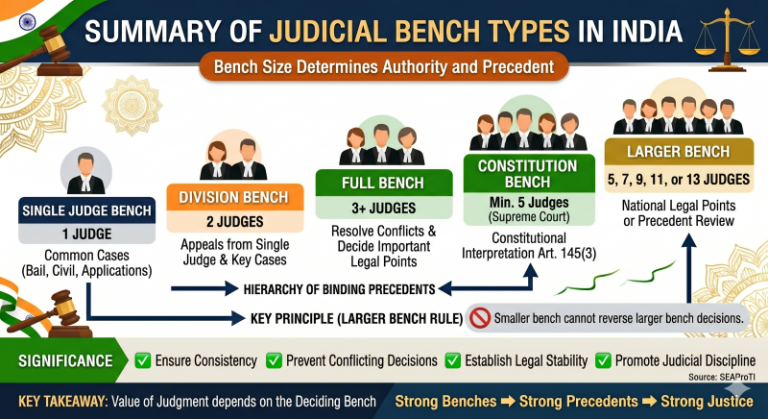
In legal terms, a “bench” refers to the number of judges who jointly hear and decide a case. Different types of benches are constituted depending on the nature of the dispute and the legal questions involved.
Types of Judicial Benches
Single Bench
A single bench consists of one judge. It commonly hears routine matters in high courts, including writ petitions, bail applications, civil revisions, and certain categories of appeals.
Division Bench
A Division Bench consists of two judges. It generally hears appeals against decisions rendered by a single bench, as well as important, urgent, and special matters.
Full Bench
A Full Bench typically comprises three or more judges of the same court. It is often constituted to resolve conflicting judicial opinions or to determine significant questions of law.
Constitution Bench
A Constitution Bench of the Supreme Court consists of at least five judges. Under Article 145(3) of the Constitution of India, cases involving substantial questions of law relating to the interpretation of the Constitution must be heard by such a bench.
Larger Bench
A larger bench may consist of 5, 7, 9, 11, or even 13 judges. It is constituted to resolve major legal controversies, reconsider important precedents, or settle conflicts in judicial interpretation.
The Fundamental Principle: A Smaller Bench Cannot Overrule a Larger Bench
One of the most important doctrines in Indian jurisprudence is the Larger Bench Rule, which establishes that decisions of a bench with greater numerical strength are binding on benches of lesser strength.
Under this principle:
- A Single Bench is bound by the decisions of a Division Bench.
- A Division Bench is bound by the decisions of a Full Bench.
- A Full Bench is bound by the decisions of a Larger Bench.
Decisions of a Constitution Bench carry particularly high precedential authority, especially on matters involving constitutional interpretation.
Consequently, if a smaller bench disagrees with an existing decision of a larger bench, it cannot overrule or disregard that precedent. Instead, the matter must be referred to a bench of equal or greater strength for reconsideration.
A Pillar of Legal Stability
Legal scholars regard the bench system as a cornerstone of India’s judicial framework. It helps prevent contradictory judgments, promotes uniformity in the interpretation of law, and enhances public confidence in the administration of justice.
For law students, judicial service aspirants, and legal practitioners, understanding bench strength is essential. The authority of a judgment depends not only on what the court says but also on which bench delivers the decision.
Ultimately, this principle reflects a fundamental idea within the Indian legal system: “Strong benches create strong precedents, and strong precedents strengthen justice.”
For professional services, please visit https://www.seaproti.org/practitioners/
About certified translators, translation certifiers, and certified interpreters associated with SEAProTI. The Southeast Asian Association of Professional Translators and Interpreters (SEAProTI) has officially shared the qualifications and requirements for becoming certified translators, translation certification providers, and certified interpreters in Sections 9 and 10 of the Royal Gazette, which was published by the Prime Minister’s Office in Thailand on July 25, 2024. Certified Translators, Translation Certification Providers, and Certified Interpreters
The Council of State has proposed the enactment of a Royal Decree, granting registered translators and recognised translation certifiers from professional associations or accredited language institutions the authority to provide legally valid translation certification (Letter to SEAProTI dated April 28, 2025)
SEAProTI is the first professional association in Thailand and Southeast Asia to implement a comprehensive certification system for translators, certifiers, and interpreters.
Head Office: Baan Ratchakru Building, No. 33, Room 402, Soi Phahonyothin 5, Phahonyothin Road, Phaya Thai District, Bangkok 10400, Thailand
Email: hello@seaproti.com | Tel.: (+66) 2-114-3128 (Office hours: Mon–Fri, 09:00–17:00).
ความสำคัญขององค์คณะผู้พิพากษาในระบบศาลอินเดีย: กลไกสร้างความมั่นคงและเอกภาพของกฎหมาย
ผู้แต่ง: วณิชชา สุมานัส นายกสมาคมวิชาชีพนักแปลและล่ามแห่งเอเชียตะวันออกเฉียงใต้ (SEAProTI) อนุญาโตตุลาการ ผู้ไกล่เกลี่ย และนักนิติภาษาศาสตร์วิชาชีพ
นิวเดลี – ระบบตุลาการของอินเดียให้ความสำคัญอย่างยิ่งกับ “องค์คณะผู้พิพากษา” (Judicial Bench) ซึ่งเป็นกลไกสำคัญในการรักษาวินัยทางตุลาการ ความสอดคล้องของคำพิพากษา และความแน่นอนของหลักกฎหมาย โดยจำนวนผู้พิพากษาที่นั่งพิจารณาคดีไม่ได้เป็นเพียงเรื่องของโครงสร้างการพิจารณาเท่านั้น แต่ยังส่งผลโดยตรงต่ออำนาจ ขอบเขต และคุณค่าทางบรรทัดฐานของคำพิพากษาอีกด้วย
ในทางกฎหมาย คำว่า “Bench” หมายถึงจำนวนผู้พิพากษาที่ร่วมกันพิจารณาและวินิจฉัยคดี โดยแต่ละประเภทขององค์คณะมีบทบาทและอำนาจหน้าที่แตกต่างกันตามลักษณะของคดีและประเด็นข้อกฎหมายที่ต้องวินิจฉัย
ประเภทขององค์คณะผู้พิพากษา
Single Bench (องค์คณะเดี่ยว)
ประกอบด้วยผู้พิพากษา 1 คน มักทำหน้าที่พิจารณาคดีทั่วไปในศาลสูงของรัฐ (High Courts) เช่น คำร้องตามรัฐธรรมนูญ การประกันตัว การแก้ไขคำสั่งในคดีแพ่ง และคดีอุทธรณ์บางประเภท
Division Bench (องค์คณะคู่)
ประกอบด้วยผู้พิพากษา 2 คน โดยทั่วไปมีอำนาจพิจารณาอุทธรณ์จากคำพิพากษาขององค์คณะเดี่ยว รวมถึงคดีสำคัญ คดีเร่งด่วน และการพิจารณาคำร้องพิเศษบางประเภท
Full Bench (องค์คณะเต็ม)
โดยปกติประกอบด้วยผู้พิพากษา 3 คนขึ้นไปในศาลเดียวกัน มักจัดตั้งขึ้นเพื่อวินิจฉัยประเด็นกฎหมายสำคัญ หรือแก้ไขความขัดแย้งระหว่างแนวคำพิพากษาที่แตกต่างกันภายในศาลเดียวกัน
Constitution Bench (องค์คณะรัฐธรรมนูญ)
เป็นองค์คณะของศาลฎีกาอินเดียที่มีผู้พิพากษาอย่างน้อย 5 คน ตามมาตรา 145(3) ของรัฐธรรมนูญอินเดีย ซึ่งกำหนดให้คดีที่เกี่ยวข้องกับปัญหาสำคัญในการตีความรัฐธรรมนูญต้องได้รับการพิจารณาโดยองค์คณะประเภทนี้
Larger Bench (องค์คณะที่มีจำนวนมากกว่า)
อาจประกอบด้วยผู้พิพากษา 5, 7, 9, 11 หรือแม้แต่ 13 คน จัดตั้งขึ้นเพื่อพิจารณาข้อพิพาททางกฎหมายที่มีความสำคัญเป็นพิเศษ หรือเพื่อทบทวนและแก้ไขแนวคำพิพากษาที่มีอยู่เดิม
หลักการสำคัญ: องค์คณะที่เล็กกว่าห้ามล้มล้างคำวินิจฉัยขององค์คณะที่ใหญ่กว่า
หนึ่งในหลักการพื้นฐานที่สุดของระบบบรรทัดฐานทางกฎหมายของอินเดีย คือ “Larger Bench Rule” หรือหลักองค์คณะที่มีจำนวนผู้พิพากษามากกว่ามีผลผูกพันเหนือองค์คณะที่มีจำนวนน้อยกว่า
ภายใต้หลักการดังกล่าว
- องค์คณะเดี่ยว (Single Bench) ต้องปฏิบัติตามคำวินิจฉัยขององค์คณะคู่ (Division Bench)
- องค์คณะคู่ ต้องปฏิบัติตามคำวินิจฉัยขององค์คณะเต็ม (Full Bench)
- องค์คณะเต็ม ต้องปฏิบัติตามคำวินิจฉัยขององค์คณะที่มีขนาดใหญ่กว่า
- คำวินิจฉัยขององค์คณะรัฐธรรมนูญ (Constitution Bench) มีคุณค่าทางบรรทัดฐานสูง โดยเฉพาะในประเด็นการตีความรัฐธรรมนูญ
ดังนั้น หากองค์คณะที่มีจำนวนน้อยกว่าไม่เห็นด้วยกับแนวคำพิพากษาขององค์คณะที่ใหญ่กว่า ก็ไม่สามารถวินิจฉัยขัดแย้งหรือล้มล้างคำวินิจฉัยเดิมได้ แต่จะต้องส่งเรื่องให้องค์คณะที่มีขนาดใหญ่กว่าเป็นผู้พิจารณาแทน
เสาหลักของความมั่นคงทางกฎหมาย
ผู้เชี่ยวชาญด้านกฎหมายมองว่าระบบองค์คณะผู้พิพากษาของอินเดียมีบทบาทสำคัญในการป้องกันการเกิดคำพิพากษาที่ขัดแย้งกัน สร้างความเป็นเอกภาพในการตีความกฎหมาย และเสริมสร้างความเชื่อมั่นของประชาชนต่อกระบวนการยุติธรรม
สำหรับนักศึกษากฎหมาย ผู้เตรียมสอบเข้ารับราชการตุลาการ และผู้ประกอบวิชาชีพกฎหมาย การทำความเข้าใจเรื่อง “Bench Strength” หรือขนาดขององค์คณะผู้พิพากษา ถือเป็นความรู้พื้นฐานที่สำคัญ เนื่องจากคุณค่าของคำพิพากษาไม่ได้ขึ้นอยู่เพียงกับเนื้อหาของคำวินิจฉัยเท่านั้น แต่ยังขึ้นอยู่กับว่า “องค์คณะใด” เป็นผู้มีคำพิพากษาด้วย
ในท้ายที่สุด หลักการดังกล่าวสะท้อนแนวคิดสำคัญของระบบกฎหมายอินเดียว่า “องค์คณะที่เข้มแข็ง สร้างบรรทัดฐานที่มั่นคง และบรรทัดฐานที่มั่นคง ย่อมนำไปสู่ความยุติธรรมที่ยั่งยืน”
สมาคมวิชาชีพนักแปลและล่ามแห่งเอเชียตะวันออกเฉียงใต้ (SEAProTI) ได้ประกาศหลักเกณฑ์และคุณสมบัติของผู้ที่ขึ้นทะเบียนเป็น “นักแปลรับรอง (Certified Translators) และผู้รับรองการแปล (Translation Certification Providers) และล่ามรับรอง (Certified Interpreters)” ของสมาคม หมวดที่ 9 และหมวดที่ 10 ในราชกิจจานุเบกษา ของสำนักเลขาธิการคณะรัฐมนตรี ในสำนักนายกรัฐมนตรี แห่งราชอาณาจักรไทย ลงวันที่ 25 ก.ค. 2567 เล่มที่ 141 ตอนที่ 66 ง หน้า 100 อ่านฉบับเต็มได้ที่: นักแปลรับรอง ผู้รับรองการแปล และล่ามรับรอง
สำนักคณะกรรมการกฤษฎีกาเสนอให้ตราเป็นพระราชกฤษฎีกา โดยกำหนดให้นักแปลที่ขึ้นทะเบียน รวมถึงผู้รับรองการแปลจากสมาคมวิชาชีพหรือสถาบันสอนภาษาที่มีการอบรมและขึ้นทะเบียน สามารถรับรองคำแปลได้ (จดหมายถึงสมาคม SEAProTI ลงวันที่ 28 เม.ย. 2568)
สมาคมวิชาชีพนักแปลและล่ามแห่งเอเชียตะวันออกเฉียงใต้เป็นสมาคมวิชาชีพแห่งแรกและแห่งเดียวในประเทศไทยและภูมิภาคเอเชียตะวันออกเฉียงใต้ที่มีระบบรับรองนักแปลรับรอง ผู้รับรองการแปล และล่ามรับรอง
สำนักงานใหญ่: อาคารบ้านราชครู เลขที่ 33 ห้อง 402 ซอยพหลโยธิน 5 ถนนพหลโยธิน แขวงพญาไท เขตพญาไท กรุงเทพมหานคร 10400 ประเทศไทย