


Marriage Between Thai and Western Nationals in Thailand: Conflict of Laws, Family Law, and the Role of Certified Translators and Certified Interpreters
Author: Griroek Gruaythong
26 May 2026, Bangkok – Marriage between Thai nationals and Western nationals has become an increasingly significant social and legal phenomenon within the context of globalization, migration, and intercultural relationships. Such relationships give rise to various issues in private international law, particularly conflict of laws, jurisdiction, recognition of foreign judgments, enforcement of prenuptial agreements, and rights concerning property and child custody. This article examines Thai family law in the context of marriages between Thai and Western spouses while also analyzing the roles of certified translators, translation certification providers, and certified interpreters affiliated with professional associations of translators and interpreters in Southeast Asia in legal proceedings and intercultural communication. The study finds that professionally certified translation and interpreting services are essential to ensuring accuracy, legality, and the protection of the rights of spouses in transnational family disputes. Furthermore, these services help reduce linguistic and cultural misunderstandings within judicial processes and international legal transactions.
Introduction
Marriage between individuals of different nationalities is a consequence of globalization, international mobility, and the expansion of transnational economic and social relations. Thailand is among the countries with a high rate of marriages between Thai nationals and foreigners, particularly spouses from Western countries such as the United States, the United Kingdom, Germany, France, and Australia. Such relationships are not only social and cultural matters but are also closely connected to private international law and family law.
When disputes concerning marriage, divorce, division of marital property, or child custody arise, a major legal issue concerns determining which country’s court has jurisdiction and which legal system should govern the dispute. Conflict of laws principles therefore play a crucial role in adjudicating such cases (North & Fawcett, 2018). In addition, legal documents such as marriage certificates, prenuptial agreements, foreign court judgments, and custody documents often require accurate translation and certification in order to be legally recognized in another jurisdiction.
Within this context, certified translators, translation certification providers, and certified interpreters play an essential role in judicial proceedings and intercultural communication. Their work is particularly important under the professional standards promoted by Southeast Asian professional associations of translators and interpreters, which emphasize ethical conduct, translation accuracy, and interpreter impartiality.
Conflict of Laws and Marriage Between Thai and Western Nationals
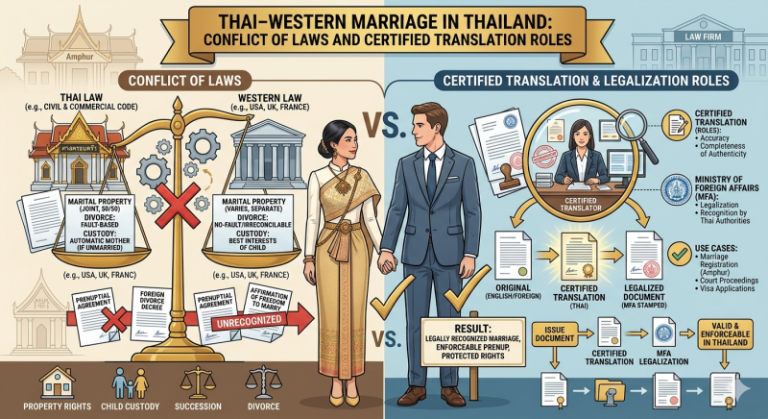
Thai conflict of laws principles generally provide that the court of the country where the cause of action arises has jurisdiction over the case, and the law of the country where the relevant legal event occurred governs the dispute. However, foreign law may only be applied insofar as it does not conflict with the public order or good morals of Thailand (Conflict of Laws Act B.E. 2481 [1938]).
In cases involving marriages between Thai nationals and foreigners, if the marriage was registered abroad, Thai courts may refuse to accept jurisdiction over divorce proceedings if one spouse contests the authority of the Thai court. In such situations, the parties may be required to return to the country where the marriage was registered in order to obtain a divorce. Thailand recognizes foreign marriages and divorces provided that they were legally conducted under the law of the foreign jurisdiction and are not contrary to Thai public order or morality.
These principles reflect the concept of comity in international law, whereby states acknowledge and respect foreign legal acts and judicial decisions as long as such recognition does not undermine national sovereignty or public morality (Dicey, Morris, & Collins, 2012).
Prenuptial Agreements and International Legal Complexity
Prenuptial agreements constitute an important mechanism for defining spouses’ property rights, particularly in transnational marriages. Nevertheless, legal systems differ significantly in their treatment of such agreements. Under Thai law, the Civil and Commercial Code requires that a prenuptial agreement be made in writing, signed by both parties and two witnesses, and registered simultaneously with the marriage registration; otherwise, the agreement is void.
In many Western jurisdictions, prenuptial agreements are treated as private contracts and are not necessarily filed with government authorities. Consequently, when such agreements are presented before Thai courts, the courts will examine whether the agreement conflicts with Thai law. If the agreement contains a foreign choice-of-law clause, Thai courts may refuse to recognize that provision.
Differences between legal systems necessitate a high degree of precision in legal translation because even minor inaccuracies may affect the interpretation of property rights, marital assets, or child support obligations (Cao, 2007).
The Role of Certified Translators and Certified Interpreters in Transnational Family Cases
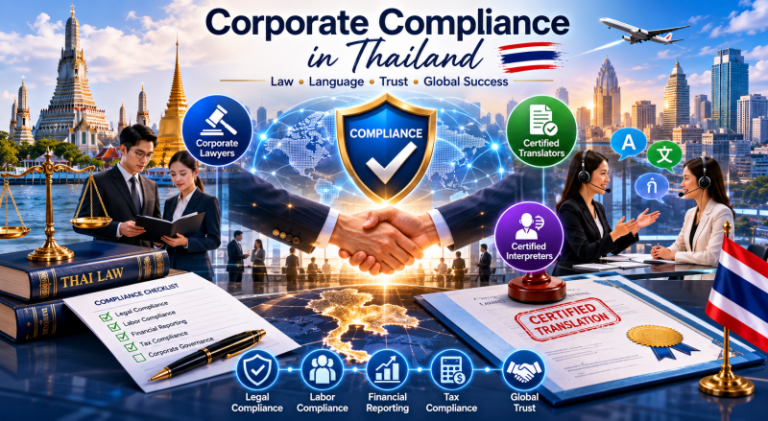
In transnational family disputes involving Thai and Western spouses, certified translators and certified interpreters perform functions that extend beyond mere linguistic transfer. They serve as intermediaries between different legal systems and cultural frameworks. Important documents such as birth certificates, marriage certificates, divorce judgments, powers of attorney, and prenuptial agreements must be translated by professionals who possess expertise in legal terminology and official documentation practices in both jurisdictions.
Translation certification providers are responsible for certifying that translated documents accurately and completely reflect the original texts. Such certification is particularly important when submitting documents to courts, embassies, or foreign governmental agencies. Certified translations enhance the credibility of legal documents and reduce disputes regarding their authenticity and accuracy.
Certified interpreters also play a significant role in court hearings, mediation proceedings, and interviews with government authorities, particularly when one spouse lacks proficiency in Thai or English. Interpreters who are professionally certified are expected to maintain impartiality, confidentiality, and accuracy in communication, which constitute core principles of interpreting ethics (Mikkelson, 2016).
Professional associations of translators and interpreters in Southeast Asia contribute to establishing professional standards, training programs, and competency certification systems for translators and interpreters within the region. These organizations help improve the quality of legal translation and court interpreting in transnational cases, strengthen the reliability of translated documents, and facilitate equal access to justice for international spouses.
Intercultural Communication and Challenges in Marital Relationships
Although legal rules are fundamental in determining the rights and obligations of spouses, cultural differences also significantly influence relationships between Thai and Western partners. Concepts relating to family structures, gender roles, financial management, and child-rearing practices may differ substantially.
Accordingly, translators and interpreters must possess intercultural communication competence in addition to linguistic proficiency in order to avoid misunderstandings and conflicts arising from translation. Translation in the context of family law involves not only the transfer of terminology but also the interpretation of the social and cultural contexts of both spouses (Baker, 2018).
Conclusion
Marriage between Thai and Western nationals involves complex legal, linguistic, and cultural dimensions. Thai conflict of laws principles play a critical role in determining jurisdiction and applicable law in transnational family disputes. At the same time, differences between Thai and Western legal systems, particularly concerning prenuptial agreements, recognition of foreign judgments, and property rights, create a substantial need for high-quality translation and interpreting services.
Certified translators, translation certification providers, and certified interpreters affiliated with Southeast Asian professional associations therefore play a vital role in supporting judicial processes and intercultural communication. These professionals not only facilitate linguistic transfer but also help protect the rights of spouses, minimize errors in legal interpretation, and promote fairness within international legal proceedings.
References
- Baker, M. (2018). In other words: A coursebook on translation (3rd ed.). Routledge.
- Cao, D. (2007). Translating law. Multilingual Matters.
- Dicey, A. V., Morris, J. H. C., & Collins, L. (2012). Dicey, Morris & Collins on the conflict of laws (15th ed.). Sweet & Maxwell.
- Mikkelson, H. (2016). Introduction to court interpreting (2nd ed.). Routledge.
- North, P., & Fawcett, J. (2018). Cheshire and North private international law (15th ed.). Oxford University Press.
- Conflict of Laws Act B.E. 2481 (1938).
- Civil and Commercial Code of Thailand.
For professional services, please visit: https://www.seaproti.org/practitioners/
About certified translators, translation certifiers, and certified interpreters associated with SEAProTI. The Southeast Asian Association of Professional Translators and Interpreters (SEAProTI) has officially shared the qualifications and requirements for becoming Certified Translators, Translation Certification Providers, and Certified Interpreters in Sections 9 and 10 of the Royal Gazette, which was published by the Prime Minister’s Office in Thailand on July 25, 2024. Certified Translators, Translation Certification Providers, and Certified Interpreters
The Council of State has proposed the enactment of a Royal Decree, granting registered translators and recognised translation certifiers from professional associations or accredited language institutions the authority to provide legally valid translation certification (Letter to SEAProTI dated April 28, 2025)
SEAProTI is the first professional association in Thailand and Southeast Asia to implement a comprehensive certification system for translators, certifiers, and interpreters.
Head Office: Baan Ratchakru Building, No. 33, Room 402, Soi Phahonyothin 5, Phahonyothin Road, Phaya Thai District, Bangkok 10400, Thailand
Email: hello@seaproti.com | Tel.: (+66) 2-114-3128 (Office hours: Mon–Fri, 09:00–17:00).
การสมรสระหว่างชาวไทยและชาวตะวันตกในประเทศไทย: การขัดกันแห่งกฎหมาย กฎหมายครอบครัว และบทบาทของนักแปลรับรองและล่ามรับรอง
ผู้เขียน: ไกรฤกษ์กรวยทอง
26 พฤษภาคม 2569, กรุงเทพมหานคร – การสมรสระหว่างบุคคลสัญชาติไทยกับชาวตะวันตกเป็นปรากฏการณ์ทางสังคมและกฎหมายที่เพิ่มขึ้นอย่างต่อเนื่องภายใต้บริบทโลกาภิวัตน์ การย้ายถิ่นฐาน และความสัมพันธ์ข้ามวัฒนธรรม ความสัมพันธ์ลักษณะดังกล่าวก่อให้เกิดประเด็นทางกฎหมายระหว่างประเทศ โดยเฉพาะเรื่องกฎหมายขัดกัน (conflict of laws) เขตอำนาจศาล การรับรองคำพิพากษาต่างประเทศ การบังคับใช้สัญญาก่อนสมรส และสิทธิในทรัพย์สินหรือการปกครองบุตร บทความนี้มุ่งศึกษากฎหมายครอบครัวไทยในบริบทของการสมรสระหว่างคนไทยกับชาวตะวันตก ตลอดจนวิเคราะห์บทบาทของนักแปลรับรอง ผู้รับรองการแปล และล่ามรับรองของสมาคมวิชาชีพนักแปลและล่ามแห่งเอเชียตะวันออกเฉียงใต้ต่อกระบวนการทางกฎหมายและการสื่อสารข้ามวัฒนธรรม ผลการศึกษาพบว่า เอกสารแปลและการล่ามที่มีมาตรฐานวิชาชีพมีความสำคัญต่อความถูกต้อง ความชอบด้วยกฎหมาย และการคุ้มครองสิทธิของคู่สมรสในคดีข้ามชาติ ทั้งยังช่วยลดความคลาดเคลื่อนทางภาษาและวัฒนธรรมในกระบวนการยุติธรรมและการดำเนินธุรกรรมทางกฎหมายระหว่างประเทศ
บทนำ
การสมรสระหว่างบุคคลต่างสัญชาติเป็นผลจากการเปลี่ยนแปลงของสังคมโลกในยุคโลกาภิวัตน์ การเดินทางระหว่างประเทศ และการขยายตัวของเศรษฐกิจระหว่างประเทศ ประเทศไทยเป็นหนึ่งในประเทศที่มีการสมรสระหว่างคนไทยกับชาวต่างชาติในอัตราสูง โดยเฉพาะคู่สมรสจากประเทศตะวันตก เช่น สหรัฐอเมริกา สหราชอาณาจักร เยอรมนี ฝรั่งเศส และออสเตรเลีย ความสัมพันธ์ดังกล่าวมิได้เป็นเพียงประเด็นทางสังคมและวัฒนธรรม แต่ยังเชื่อมโยงกับกฎหมายระหว่างประเทศแผนกคดีบุคคลและกฎหมายครอบครัวอย่างใกล้ชิด
เมื่อเกิดข้อพิพาทเกี่ยวกับการสมรส การหย่า การแบ่งทรัพย์สิน หรือการปกครองบุตร ปัญหาที่สำคัญคือการกำหนดว่าศาลของประเทศใดมีเขตอำนาจ และกฎหมายของประเทศใดควรใช้บังคับ หลักกฎหมายขัดกันจึงมีบทบาทสำคัญต่อการวินิจฉัยคดีเหล่านี้ (นอร์ท และ ฟอว์เซตต์, 2561) นอกจากนี้ เอกสารทางกฎหมาย เช่น ทะเบียนสมรส สัญญาก่อนสมรส คำพิพากษาศาลต่างประเทศ หรือเอกสารเกี่ยวกับสิทธิการปกครองบุตร มักจำเป็นต้องได้รับการแปลและรับรองอย่างถูกต้องเพื่อให้สามารถใช้ในอีกประเทศหนึ่งได้
ในบริบทดังกล่าว นักแปลรับรอง (Certified Translators) ผู้รับรองการแปล (Translation Certification Providers) และล่ามรับรอง (Certified Interpreters) มีบทบาทสำคัญต่อกระบวนการยุติธรรมและการสื่อสารข้ามวัฒนธรรม โดยเฉพาะภายใต้มาตรฐานวิชาชีพของสมาคมวิชาชีพนักแปลและล่ามแห่งเอเชียตะวันออกเฉียงใต้ ซึ่งส่งเสริมมาตรฐานทางจริยธรรม ความถูกต้องของการแปล และความเป็นกลางในการล่าม
กฎหมายขัดกันกับการสมรสระหว่างคนไทยและชาวตะวันตก
กฎหมายขัดกันของไทยมีหลักสำคัญว่าศาลของประเทศที่เหตุแห่งคดีเกิดขึ้นมีเขตอำนาจในการพิจารณาคดี และกฎหมายของประเทศที่เหตุแห่งคดีเกิดขึ้นย่อมใช้บังคับแก่ข้อพิพาทนั้น ทั้งนี้ การใช้กฎหมายต่างประเทศจะต้องไม่ขัดต่อความสงบเรียบร้อยหรือศีลธรรมอันดีของประเทศไทย (พระราชบัญญัติว่าด้วยการขัดกันแห่งกฎหมาย พ.ศ. 2481)
ในกรณีการสมรสระหว่างคนไทยกับชาวต่างชาติ หากการสมรสเกิดขึ้นในต่างประเทศ ศาลไทยอาจไม่รับพิจารณาคดีหย่าหากคู่สมรสอีกฝ่ายคัดค้านเขตอำนาจศาลไทย คู่สมรสอาจต้องกลับไปดำเนินคดี ณ ประเทศที่จดทะเบียนสมรส การยอมรับการสมรสหรือการหย่าจากต่างประเทศในประเทศไทยขึ้นอยู่กับว่ากระบวนการดังกล่าวชอบด้วยกฎหมายของประเทศต้นทางและไม่ขัดต่อความสงบเรียบร้อยของไทย
ประเด็นดังกล่าวสะท้อนแนวคิดเรื่อง comity ในกฎหมายระหว่างประเทศ ซึ่งหมายถึงการเคารพการตัดสินหรือการกระทำทางกฎหมายของรัฐอื่นภายใต้เงื่อนไขที่ไม่กระทบต่ออธิปไตยและหลักศีลธรรมของรัฐผู้รับรอง (ไดซี, มอร์ริส, และ คอลลินส์, 2555)
สัญญาก่อนสมรสและความซับซ้อนทางกฎหมายระหว่างประเทศ
สัญญาก่อนสมรส (prenuptial agreement) เป็นกลไกสำคัญในการกำหนดสิทธิในทรัพย์สินของคู่สมรส โดยเฉพาะในการสมรสข้ามชาติ อย่างไรก็ตาม ระบบกฎหมายของแต่ละประเทศมีแนวทางแตกต่างกัน ในประเทศไทย ประมวลกฎหมายแพ่งและพาณิชย์กำหนดว่าสัญญาก่อนสมรสต้องทำเป็นหนังสือ ลงลายมือชื่อคู่สมรสและพยานสองคน และต้องจดแจ้งพร้อมการจดทะเบียนสมรส มิฉะนั้นจะตกเป็นโมฆะ
ในหลายประเทศตะวันตก สัญญาก่อนสมรสถือเป็นสัญญาส่วนบุคคลและไม่จำเป็นต้องยื่นต่อหน่วยงานรัฐ ดังนั้น เมื่อมีการนำสัญญาดังกล่าวมาใช้ในประเทศไทย ศาลไทยจะพิจารณาว่าสัญญานั้นขัดต่อกฎหมายไทยหรือไม่ หากมีข้อกำหนดเลือกใช้กฎหมายต่างประเทศ ศาลไทยอาจไม่รับรองเงื่อนไขดังกล่าว
ความแตกต่างระหว่างระบบกฎหมายทำให้การแปลเอกสารทางกฎหมายต้องมีความแม่นยำสูง เพราะความคลาดเคลื่อนเพียงเล็กน้อยอาจส่งผลต่อการตีความสิทธิในทรัพย์สิน การแบ่งสินสมรส หรือสิทธิในการเลี้ยงดูบุตรได้ (เฉา, 2550)
บทบาทของนักแปลรับรองและล่ามรับรองในคดีครอบครัวข้ามชาติ
ในคดีครอบครัวระหว่างคนไทยกับชาวตะวันตก นักแปลรับรองและล่ามรับรองมีบทบาทมากกว่าการถ่ายทอดภาษา แต่ยังเป็นผู้เชื่อมโยงระบบกฎหมายและบริบทวัฒนธรรมที่แตกต่างกัน เอกสารสำคัญ เช่น สูติบัตร ทะเบียนสมรส คำพิพากษาหย่า หนังสือมอบอำนาจ หรือสัญญาก่อนสมรส จำเป็นต้องได้รับการแปลโดยผู้เชี่ยวชาญที่เข้าใจศัพท์กฎหมายและรูปแบบเอกสารราชการของทั้งสองประเทศ
ผู้รับรองการแปลมีหน้าที่รับรองว่าเอกสารแปลเป็นคำแปลที่ถูกต้องครบถ้วนตามต้นฉบับ ซึ่งมีความสำคัญอย่างยิ่งต่อการยื่นเอกสารต่อศาล สถานทูต หรือหน่วยงานราชการต่างประเทศ การรับรองการแปลยังช่วยเพิ่มความน่าเชื่อถือและลดข้อโต้แย้งเกี่ยวกับความถูกต้องของเอกสาร
ล่ามรับรองมีบทบาทสำคัญในกระบวนการพิจารณาคดี การเจรจาไกล่เกลี่ย และการสัมภาษณ์กับหน่วยงานรัฐ โดยเฉพาะเมื่อคู่สมรสฝ่ายหนึ่งไม่สามารถใช้ภาษาไทยหรือภาษาอังกฤษได้อย่างคล่องแคล่ว ล่ามที่ผ่านการรับรองตามมาตรฐานวิชาชีพจะต้องรักษาความเป็นกลาง ความลับ และความถูกต้องของสารที่ถ่ายทอด ซึ่งเป็นหลักการสำคัญของจริยธรรมวิชาชีพล่าม (มิคเคลสัน, 2559)
สมาคมวิชาชีพนักแปลและล่ามแห่งเอเชียตะวันออกเฉียงใต้มีบทบาทในการกำหนดมาตรฐานวิชาชีพ การอบรม และการรับรองความสามารถของนักแปลและล่ามในภูมิภาค สมาคมดังกล่าวช่วยยกระดับคุณภาพของงานแปลกฎหมายและการล่ามในคดีข้ามชาติ ส่งเสริมความน่าเชื่อถือของเอกสารแปล และสนับสนุนการเข้าถึงกระบวนการยุติธรรมของคู่สมรสต่างสัญชาติอย่างเป็นธรรม
การสื่อสารข้ามวัฒนธรรมและความท้าทายในชีวิตสมรส
แม้ว่ากฎหมายจะเป็นปัจจัยสำคัญในการกำหนดสิทธิและหน้าที่ของคู่สมรส แต่ความแตกต่างทางวัฒนธรรมก็มีอิทธิพลอย่างมากต่อความสัมพันธ์ระหว่างคนไทยกับชาวตะวันตก แนวคิดเกี่ยวกับครอบครัว บทบาททางเพศ การจัดการทรัพย์สิน และการเลี้ยงดูบุตรอาจแตกต่างกันอย่างมีนัยสำคัญ
นักแปลและล่ามจึงต้องมีความสามารถด้านการสื่อสารข้ามวัฒนธรรม (intercultural communication competence) ควบคู่กับทักษะทางภาษา เพื่อหลีกเลี่ยงการแปลที่อาจก่อให้เกิดความเข้าใจผิดหรือความขัดแย้ง การแปลในบริบทกฎหมายครอบครัวมิใช่เพียงการถ่ายทอดคำศัพท์ แต่ยังเกี่ยวข้องกับการตีความบริบททางสังคมและวัฒนธรรมของคู่สมรสทั้งสองฝ่าย (เบเกอร์, 2561)
สรุป
การสมรสระหว่างคนไทยกับชาวตะวันตกเป็นประเด็นที่มีความซับซ้อนทั้งด้านกฎหมาย ภาษา และวัฒนธรรม กฎหมายขัดกันของไทยมีบทบาทสำคัญในการกำหนดเขตอำนาจศาลและกฎหมายที่ใช้บังคับในคดีครอบครัวข้ามชาติ ขณะเดียวกัน ความแตกต่างระหว่างระบบกฎหมายไทยและตะวันตก โดยเฉพาะเรื่องสัญญาก่อนสมรส การรับรองคำพิพากษาต่างประเทศ และสิทธิในทรัพย์สิน ก่อให้เกิดความจำเป็นในการใช้เอกสารแปลและบริการล่ามที่มีมาตรฐานสูง
นักแปลรับรอง ผู้รับรองการแปล และล่ามรับรองของสมาคมวิชาชีพนักแปลและล่ามแห่งเอเชียตะวันออกเฉียงใต้จึงมีบทบาทสำคัญในการสนับสนุนกระบวนการยุติธรรมและการสื่อสารข้ามวัฒนธรรม บุคลากรเหล่านี้ไม่เพียงทำหน้าที่ถ่ายทอดภาษา แต่ยังช่วยคุ้มครองสิทธิของคู่สมรส ลดความคลาดเคลื่อนในการตีความกฎหมาย และสร้างความเป็นธรรมในกระบวนการทางกฎหมายระหว่างประเทศ
เอกสารอ้างอิง
- เบเกอร์, เอ็ม. (2561). In other words: A coursebook on translation (พิมพ์ครั้งที่ 3). Routledge.
- เฉา, ดี. (2550). Translating law. Multilingual Matters.
- ไดซี, เอ. วี., มอร์ริส, เจ. เอช. ซี., และ คอลลินส์, แอล. (2555). Dicey, Morris & Collins on the conflict of laws (พิมพ์ครั้งที่ 15). Sweet & Maxwell.
- มิคเคลสัน, เอช. (2559). Introduction to court interpreting (พิมพ์ครั้งที่ 2). Routledge.
- นอร์ท, พี., และ ฟอว์เซตต์, เจ. (2561). Cheshire and North private international law (พิมพ์ครั้งที่ 15). Oxford University Press.
- พระราชบัญญัติว่าด้วยการขัดกันแห่งกฎหมาย พ.ศ. 2481.
- ประมวลกฎหมายแพ่งและพาณิชย์.
สมาคมวิชาชีพนักแปลและล่ามแห่งเอเชียตะวันออกเฉียงใต้ (SEAProTI) ได้ประกาศหลักเกณฑ์และคุณสมบัติของผู้ที่ขึ้นทะเบียนเป็น “นักแปลรับรอง (Certified Translators) และผู้รับรองการแปล (Translation Certification Providers) และล่ามรับรอง (Certified Interpreters)” ของสมาคม หมวดที่ 9 และหมวดที่ 10 ในราชกิจจานุเบกษา ของสำนักเลขาธิการคณะรัฐมนตรี ในสำนักนายกรัฐมนตรี แห่งราชอาณาจักรไทย ลงวันที่ 25 ก.ค. 2567 เล่มที่ 141 ตอนที่ 66 ง หน้า 100 อ่านฉบับเต็มได้ที่: นักแปลรับรอง ผู้รับรองการแปล และล่ามรับรอง
สำนักคณะกรรมการกฤษฎีกาเสนอให้ตราเป็นพระราชกฤษฎีกา โดยกำหนดให้นักแปลที่ขึ้นทะเบียน รวมถึงผู้รับรองการแปลจากสมาคมวิชาชีพหรือสถาบันสอนภาษาที่มีการอบรมและขึ้นทะเบียน สามารถรับรองคำแปลได้ (จดหมายถึงสมาคม SEAProTI ลงวันที่ 28 เม.ย. 2568)
สมาคมวิชาชีพนักแปลและล่ามแห่งเอเชียตะวันออกเฉียงใต้เป็นสมาคมวิชาชีพแห่งแรกและแห่งเดียวในประเทศไทยและภูมิภาคเอเชียตะวันออกเฉียงใต้ที่มีระบบรับรองนักแปลรับรอง ผู้รับรองการแปล และล่ามรับรอง
สำนักงานใหญ่: อาคารบ้านราชครู เลขที่ 33 ห้อง 402 ซอยพหลโยธิน 5 ถนนพหลโยธิน แขวงพญาไท เขตพญาไท กรุงเทพมหานคร 10400 ประเทศไทย