



Reframing Museum Translation: Multilingual Communication and Visitor Interpretation in Cultural Heritage Institutions
Author: Phakaporn Tanjararak
19 May 2026, Bangkok – Translation within museums, galleries, and heritage sites has developed into a significant interdisciplinary field situated at the intersection of translation studies and museology. Despite increasing scholarly attention, a persistent gap remains between theoretical models and practical implementation in institutional contexts. This article critically examines recent developments in museum translation with particular reference to Neather (2025), Translating for Museums, Galleries and Heritage Sites. The study synthesizes key theoretical perspectives and practitioner-oriented insights to evaluate how multilingual communication is constructed and operationalized in cultural institutions. Using qualitative documentary analysis of secondary literature, the article identifies dominant frameworks, translational strategies, and institutional constraints shaping museum translation.
Findings indicate that while theoretical models are well established, practical guidance remains uneven, particularly in multimodal and visitor-centered translation. The study concludes that future development must integrate digital mediation, audience diversity, and participatory translation practices more systematically (Neather, 2025; Mertens & Decroupet, 2024).
Introduction
The globalization of cultural heritage has intensified the need for effective multilingual communication in museums, galleries, and heritage sites. These institutions now function not only as repositories of artifacts but also as interpretive spaces where meaning is constructed through language and mediation. Translation is therefore central to shaping visitor experience and institutional accessibility.
Recent scholarship frames museum translation as an interdisciplinary field combining semiotics, discourse analysis, and cultural mediation (Mertens & Decroupet, 2024; Neelsen, 2021). However, despite increasing theoretical sophistication, practitioners still lack systematic guidance for implementation in real-world contexts (Neather, 2025).
Neather (2025) explicitly notes that practical resources remain limited for professionals engaged in museum translation (p. 1), highlighting a persistent disconnect between theory and practice.
This article addresses this gap by examining how translation operates within museum environments and how institutional and communicative constraints shape translational decision-making (Neather, 2024).
Literature Review
Museum translation has evolved from early linguistically oriented approaches toward broader socio-semiotic frameworks. Whitehead (2012) conceptualizes museum communication as operating across verbal, environmental, and experiential dimensions, emphasizing visitor interpretation as central to meaning-making (Whitehead, 2012).
Ravelli (2005) further develops this by proposing a communication framework that distinguishes representational, interactional, and organizational meanings in museum texts.
Neather (2012; 2024; 2025) extends these frameworks by emphasizing institutional conditions and professional practice. In particular, Neather (2025) argues that translation in museums is shaped not only by linguistic equivalence but also by institutional negotiation, audience expectations, and curatorial intent. Similarly, Hutchinson and Eardley (2019) highlight the challenges of maintaining fidelity in specialized museum-related translation such as audio description.
Mertens and Decroupet (2024) further emphasize that museum translation must be understood as cultural translation involving interlingual and intersemiotic processes rather than simple linguistic transfer. Neelsen (2021) similarly argues that museum artifacts function as plurisemiotic works requiring multimodal interpretive strategies.
Despite these advances, the literature remains fragmented between theoretical abstraction and applied case studies, with limited integration between conceptual models and practical frameworks (Neather, 2025).
Methodology
This study employs qualitative documentary analysis of academic literature on museum translation. The primary source is Neather’s (2025) Translating for Museums, Galleries and Heritage Sites, supported by peer-reviewed journal articles and foundational theoretical works in translation studies and museology (Ravelli, 2005; Whitehead, 2012; Mertens & Decroupet, 2024).
A thematic synthesis approach is used to identify recurring conceptual categories, including institutional translation practice, multimodal communication, visitor-centered design, and translation strategies. The analysis focuses on interpreting how scholarly discourse constructs the role and function of translation within museum environments rather than generating new empirical data.
Findings
Institutional Constraints and Translation Briefs
Museum translation is strongly shaped by institutional frameworks. Translation briefs function as key mediating tools that define purpose, audience, and communicative goals. According to Neather (2025), these briefs are essential in aligning translation output with curatorial and institutional expectations. Institutional factors such as funding, staffing, and visitor demographics further influence translation strategies (Neather, 2025).
Multimodality and Textual Diversity
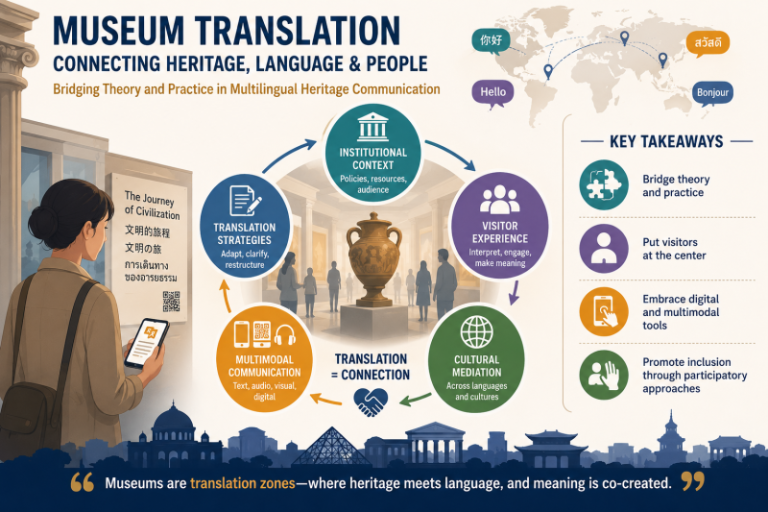
Museum communication consists of multiple text types, including labels, wall panels, leaflets, worksheets, audio guides, catalogues, and digital content. Each text type performs distinct communicative functions within the exhibition environment.
Fixed exhibition texts such as labels prioritize informational clarity, but translation often involves condensation, restructuring, or omission depending on spatial and interpretive constraints (Ravelli, 2005). Neather (2025) emphasizes that even minor representational changes in such texts may alter interactional and organizational meanings.
Supplementary materials such as leaflets and worksheets introduce greater flexibility, allowing translators to adopt more visitor-oriented styles. Audio guides further complicate translation due to their oral and temporal characteristics, requiring preservation of conversational tone and listener engagement strategies (Hutchinson & Eardley, 2019).
Interactional Meaning and Cultural Adaptation
A central finding is the importance of interactional meaning in museum translation. Translation is not limited to linguistic equivalence but involves adjustments in tone, addressivity, and rhetorical framing (Ravelli, 2005). Neather (2025) demonstrates that strategies such as explicitation, demetaphorization, and restructuring are frequently employed to align texts with target audience expectations.
However, such adaptation may lead to interpretive shifts, particularly when cultural or ideological content is recontextualized. Mertens and Decroupet (2024) argue that such processes reflect broader dynamics of cultural translation rather than neutral linguistic transfer.
Visitor-Centered Translation Practices
Across the literature, there is strong emphasis on the visitor as an active interpreter of museum content. Neather (2024) conceptualizes visitor experience itself as a form of translation, in which meaning is constructed through interaction with multilingual and multimodal resources.
This perspective aligns with sociological theories of symbolic interactionism and habitus, which emphasize meaning-making as socially situated and culturally conditioned (Blumer, 1969; Bourdieu, 1977). Neather (2025) further describes museums as “translation zones” where visitors actively negotiate meaning across linguistic and cultural boundaries.
Discussion
The findings demonstrate that museum translation operates as a multidimensional practice integrating linguistic, cultural, institutional, and experiential factors (Neather, 2025). While theoretical models such as those proposed by Ravelli (2005) and Whitehead (2012) provide structured analytical frameworks, their application in practice remains inconsistent.
One key issue is the absence of standardized guidelines for multimodal and digital translation environments. Emerging technologies such as QR codes, interactive displays, and mobile applications introduce new spatial and semiotic dimensions that extend beyond traditional textual translation frameworks (Neather, 2025). These developments require expanded theoretical models capable of accounting for interactivity and user-driven interpretation.
Another significant tension lies between accessibility and interpretive fidelity. Simplification strategies may improve readability but risk altering cultural nuance or curatorial intent. This reflects broader debates in translation studies concerning domestication and foreignization, as well as the ethical dimensions of cultural representation (Mertens & Decroupet, 2024).
Recommendations for Future Research
Future research should prioritize empirical studies on visitor reception of translated museum materials to evaluate interpretive effectiveness (Neather, 2024). In addition, digital translation environments should be systematically examined, particularly regarding multimodal interaction and user experience design.
Comparative cross-cultural studies would also enhance understanding of how institutional and linguistic contexts shape translation practices globally. Furthermore, participatory translation models involving community collaboration should be explored as mechanisms for increasing inclusivity and cultural representation (Neather, 2025).
Conclusion
Museum translation represents a complex interdisciplinary field that extends beyond linguistic transfer to include institutional negotiation, multimodal communication, and visitor-centered interpretation. Neather (2025) provides a crucial contribution by bridging theoretical frameworks with applied guidance, although significant gaps remain in standardization and digital integration.
Overall, effective museum translation requires an integrated approach that considers linguistic accuracy, cultural adaptation, and institutional context simultaneously.
As museums continue to evolve into dynamic communicative spaces, translation will remain central to shaping how cultural heritage is experienced and understood by diverse global audiences (Ravelli, 2005; Whitehead, 2012; Neather, 2025).
References
- Blumer, H. (1969). Symbolic interactionism: Perspective and method. University of California Press.
- Bourdieu, P. (1977). Outline of a theory of practice (R. Nice, Trans.). Cambridge University Press.
- Hutchinson, R. S., & Eardley, A. F. (2019). Museum audio description: The problem of textual fidelity. Perspectives: Studies in Translation Theory and Practice, 27(1), 42–57.
- Mertens, I., & Decroupet, S. (2024). Conceptualizing museum translation: Cultural translation, interlingual processes and other perspectives. BABEL: International Journal of Translation, 70(5), 593–614.
- Neather, R. (2012). “Non-expert” translators in a professional community. The Translator, 18(2), 245–268.
- Neather, R. (2024). Visitor experience as translation. BABEL: International Journal of Translation, 70(5), 615–636.
- Neather, R. (2025). Translating for museums, galleries and heritage sites. Routledge.
- Neelsen, S. (2021). What is a plurisemiotic work in translation? Journal of Specialised Translation, 35, 17–30.
- Ravelli, L. (2005). Museum texts: Communication frameworks. Routledge.
- Whitehead, C. (2012). Interpreting art in museums and galleries. Routledge.
For professional services, please visit: https://www.seaproti.org/practitioners/
About certified translators, translation certifiers, and certified interpreters associated with SEAProTI. The Southeast Asian Association of Professional Translators and Interpreters (SEAProTI) has officially shared the qualifications and requirements for becoming Certified Translators, Translation Certification Providers, and Certified Interpreters in Sections 9 and 10 of the Royal Gazette, which was published by the Prime Minister’s Office in Thailand on July 25, 2024. Certified Translators, Translation Certification Providers, and Certified Interpreters
The Council of State has proposed the enactment of a Royal Decree, granting registered translators and recognised translation certifiers from professional associations or accredited language institutions the authority to provide legally valid translation certification (Letter to SEAProTI dated April 28, 2025)
SEAProTI is the first professional association in Thailand and Southeast Asia to implement a comprehensive certification system for translators, certifiers, and interpreters.
Head Office: Baan Ratchakru Building, No. 33, Room 402, Soi Phahonyothin 5, Phahonyothin Road, Phaya Thai District, Bangkok 10400, Thailand
Email: hello@seaproti.com | Tel.: (+66) 2-114-3128 (Office hours: Mon–Fri, 09:00–17:00).
การปรับกรอบแนวคิดการแปลในพิพิธภัณฑ์: การสื่อสารพหุภาษาและการตีความของผู้เข้าชมในสถาบันมรดกทางวัฒนธรรม
ผู้เขียน: ภคพร ตันจรารักษ์
19 พฤษภาคม 2569, กรุงเทพมหานคร – การแปลในพิพิธภัณฑ์ หอศิลป์ และแหล่งมรดกทางวัฒนธรรมได้พัฒนาเป็นสาขาวิชาที่มีลักษณะสหวิทยาการ โดยอยู่บนจุดตัดระหว่างสาขาวิชาการแปลและพิพิธภัณฑ์ศึกษา แม้ว่าจะมีความสนใจทางวิชาการเพิ่มมากขึ้น แต่ยังคงพบช่องว่างระหว่างกรอบแนวคิดเชิงทฤษฎีกับการนำไปใช้จริงในระดับสถาบัน บทความนี้วิเคราะห์พัฒนาการล่าสุดของการแปลในพิพิธภัณฑ์ โดยอ้างอิงงานของเนเธอร์ (พ.ศ. 2568) ที่เสนอแนวคิดเกี่ยวกับการแปลในบริบทพิพิธภัณฑ์ หอศิลป์ และแหล่งมรดกทางวัฒนธรรม การศึกษานี้สังเคราะห์มุมมองเชิงทฤษฎีและแนวปฏิบัติ เพื่อประเมินการสร้างและการดำเนินงานของการสื่อสารพหุภาษาในสถาบันทางวัฒนธรรม โดยใช้การวิเคราะห์เอกสารเชิงคุณภาพจากวรรณกรรมทุติยภูมิ
ผลการศึกษาพบว่า แม้กรอบทฤษฎีจะมีความก้าวหน้า แต่แนวทางเชิงปฏิบัติยังไม่เป็นระบบ โดยเฉพาะในงานแปลเชิงพหุสื่อและการมุ่งเน้นผู้ชมเป็นศูนย์กลาง การศึกษาสรุปว่าการพัฒนาในอนาคตควรบูรณาการเทคโนโลยีดิจิทัล ความหลากหลายของผู้ชม และการมีส่วนร่วมของชุมชนอย่างเป็นระบบมากขึ้น (เนเธอร์, พ.ศ. 2568, เมอร์เทนส์ และ เดครูเปต์, พ.ศ. 2567)
บทนำ
โลกาภิวัตน์ของมรดกทางวัฒนธรรมได้เพิ่มความสำคัญของการสื่อสารพหุภาษาในพิพิธภัณฑ์ หอศิลป์ และแหล่งมรดกทางวัฒนธรรมอย่างมาก สถาบันเหล่านี้ไม่ได้ทำหน้าที่เพียงจัดแสดงวัตถุอีกต่อไป แต่ยังเป็นพื้นที่เชิงตีความที่สร้างความหมายผ่านภาษาและการสื่อกลาง ดังนั้นการแปลจึงมีบทบาทสำคัญต่อการกำหนดประสบการณ์ของผู้เข้าชมและการเข้าถึงของสาธารณะ
งานวิชาการร่วมสมัยมองว่าการแปลในพิพิธภัณฑ์เป็นสาขาสหวิทยาการที่รวมสัญวิทยา การวิเคราะห์วาทกรรม และการสื่อสารทางวัฒนธรรม (เมอร์เทนส์ และ เดครูเปต์, พ.ศ. 2567, นีลเซน, พ.ศ. 2564)
อย่างไรก็ตาม แม้ว่าทฤษฎีจะมีความซับซ้อนมากขึ้น ผู้ปฏิบัติงานยังขาดแนวทางเชิงระบบในการนำไปใช้จริง (เนเธอร์, พ.ศ. 2568) โดยเนเธอร์ (พ.ศ. 2568) ระบุชัดเจนว่าทรัพยากรเชิงปฏิบัติยังมีอยู่อย่างจำกัด (หน้า 1) ซึ่งสะท้อนช่องว่างระหว่างทฤษฎีและการปฏิบัติ
บทความนี้จึงมุ่งวิเคราะห์การทำงานของการแปลในบริบทพิพิธภัณฑ์ รวมถึงข้อจำกัดเชิงสถาบันและการสื่อสารที่ส่งผลต่อการตัดสินใจเชิงการแปล (เนเธอร์, พ.ศ. 2567)
ทบทวนวรรณกรรม
การแปลในพิพิธภัณฑ์พัฒนาไปจากแนวทางเชิงภาษาศาสตร์แบบดั้งเดิมไปสู่กรอบแนวคิดเชิงสังคม-สัญวิทยาที่กว้างขึ้น ไวท์เฮด (พ.ศ. 2555) เสนอว่าการสื่อสารในพิพิธภัณฑ์ประกอบด้วยมิติทางวัจนภาษา สิ่งแวดล้อม และประสบการณ์ โดยเน้นว่าการตีความของผู้เข้าชมเป็นหัวใจสำคัญของการสร้างความหมาย (ไวท์เฮด, พ.ศ. 2555)
เรเวลลี (พ.ศ. 2548) ขยายแนวคิดนี้โดยเสนอกรอบการสื่อสารที่แบ่งความหมายออกเป็นสามระดับ ได้แก่ ความหมายเชิงตัวแทน ความหมายเชิงปฏิสัมพันธ์ และความหมายเชิงโครงสร้าง ซึ่งช่วยอธิบายลักษณะของข้อความในพิพิธภัณฑ์อย่างเป็นระบบ
งานของเนเธอร์ (พ.ศ. 2555, พ.ศ. 2567, พ.ศ. 2568) ได้ขยายกรอบแนวคิดเหล่านี้โดยเน้นบริบทเชิงสถาบันและการปฏิบัติทางวิชาชีพ โดยเฉพาะเนเธอร์ (พ.ศ. 2568) ชี้ว่าการแปลไม่ได้ขึ้นอยู่กับความเทียบเท่าทางภาษาเพียงอย่างเดียว แต่ยังขึ้นอยู่กับการเจรจาเชิงสถาบัน ความคาดหวังของผู้ชม และเจตนาของภัณฑารักษ์ ขณะเดียวกัน ฮัตชินสันและเอิร์ดลีย์ (พ.ศ. 2562) เน้นปัญหาความเที่ยงตรงในการแปลงานเฉพาะทาง เช่น คำบรรยายเสียง
เมอร์เทนส์และเดครูเปต์ (พ.ศ. 2567) เสนอว่าการแปลในพิพิธภัณฑ์ควรถูกมองว่าเป็น “การแปลเชิงวัฒนธรรม” ที่รวมกระบวนการระหว่างภาษาและระหว่างสัญลักษณ์ ไม่ใช่เพียงการแทนที่ทางภาษา ขณะที่นีลเซน (พ.ศ. 2564) มองว่าวัตถุในพิพิธภัณฑ์เป็นงานที่มีความหลากหลายเชิงสัญลักษณ์ซึ่งต้องอาศัยการตีความหลายรูปแบบ
แม้จะมีความก้าวหน้า งานวิจัยยังคงแยกส่วนระหว่างทฤษฎีและกรณีศึกษาเชิงปฏิบัติ ทำให้ขาดการบูรณาการอย่างเป็นระบบ (เนเธอร์, พ.ศ. 2568)
ระเบียบวิธีวิจัย
การศึกษานี้ใช้การวิเคราะห์เอกสารเชิงคุณภาพจากวรรณกรรมทางวิชาการเกี่ยวกับการแปลในพิพิธภัณฑ์ แหล่งข้อมูลหลักคือหนังสือของเนเธอร์ (พ.ศ. 2568) ร่วมกับบทความวิชาการและงานทฤษฎีพื้นฐานในสาขาการแปลและพิพิธภัณฑ์ศึกษา (เรเวลลี, พ.ศ. 2548, ไวท์เฮด, พ.ศ. 2555, เมอร์เทนส์ และ เดครูเปต์, พ.ศ. 2567)
ใช้วิธีการสังเคราะห์เชิงประเด็นเพื่อระบุแนวคิดหลักที่เกิดซ้ำ ได้แก่ การปฏิบัติการแปลในเชิงสถาบัน การสื่อสารเชิงพหุสื่อ การออกแบบที่เน้นผู้เข้าชม และกลยุทธ์การแปล การวิเคราะห์มุ่งเน้นการตีความว่าความรู้เชิงวิชาการสร้างความหมายต่อบทบาทของการแปลในพิพิธภัณฑ์อย่างไร มากกว่าการสร้างข้อมูลเชิงประจักษ์ใหม่
ผลการศึกษา
ข้อจำกัดเชิงสถาบันและคำสั่งงานแปล
การแปลในพิพิธภัณฑ์ได้รับอิทธิพลอย่างมากจากโครงสร้างเชิงสถาบัน คำสั่งงานแปลทำหน้าที่กำหนดวัตถุประสงค์ กลุ่มผู้ชม และเป้าหมายการสื่อสาร โดยเนเธอร์ (พ.ศ. 2568) ระบุว่าคำสั่งงานเหล่านี้มีความสำคัญต่อการทำให้ผลลัพธ์การแปลสอดคล้องกับความคาดหวังของภัณฑารักษ์และสถาบัน ปัจจัยเช่นงบประมาณ บุคลากร และประชากรผู้เข้าชมยังมีผลต่อกลยุทธ์การแปลอย่างมีนัยสำคัญ (เนเธอร์, พ.ศ. 2568)
ความหลากหลายเชิงพหุสื่อและประเภทข้อความ
การสื่อสารในพิพิธภัณฑ์ประกอบด้วยข้อความหลายประเภท เช่น ป้ายคำอธิบาย แผ่นผนัง ใบปลิว แบบฝึกหัด คู่มือเสียง แค็ตตาล็อก และสื่อดิจิทัล แต่ละประเภทมีหน้าที่ต่างกันในการสื่อสาร
ข้อความนิทรรศการแบบถาวร เช่น ป้ายคำอธิบาย มุ่งเน้นความชัดเจนของข้อมูล แต่การแปลมักต้องมีการตัดทอน จัดโครงสร้างใหม่ หรือปรับลดข้อมูลตามข้อจำกัดด้านพื้นที่และการตีความ (เรเวลลี, พ.ศ. 2548) เนเธอร์ (พ.ศ. 2568) เน้นว่าการเปลี่ยนแปลงเล็กน้อยในเชิงตัวแทนอาจส่งผลต่อความหมายเชิงปฏิสัมพันธ์และเชิงโครงสร้าง
สื่อเสริม เช่น ใบปลิวและแบบฝึกหัดมีความยืดหยุ่นมากกว่า ทำให้สามารถใช้รูปแบบที่เน้นผู้เข้าชมได้มากขึ้น ส่วนคู่มือเสียงมีความซับซ้อนมากขึ้นเนื่องจากลักษณะเชิงเสียงและเวลา ซึ่งต้องรักษาน้ำเสียงและการมีส่วนร่วมของผู้ฟัง (ฮัตชินสัน และ เอิร์ดลีย์, พ.ศ. 2562)
ความหมายเชิงปฏิสัมพันธ์และการปรับเชิงวัฒนธรรม
ผลการศึกษาพบว่าความหมายเชิงปฏิสัมพันธ์เป็นหัวใจสำคัญของการแปลในพิพิธภัณฑ์ การแปลไม่ได้จำกัดเพียงความเทียบเท่าทางภาษา แต่รวมถึงการปรับน้ำเสียง การเรียกผู้ชม และโครงสร้างเชิงวาทศิลป์ (เรเวลลี, พ.ศ. 2548) เนเธอร์ (พ.ศ. 2568) พบว่ากลยุทธ์เช่นการขยายความ การลดอุปลักษณ์ และการจัดโครงสร้างใหม่ถูกใช้อย่างแพร่หลายเพื่อให้เหมาะสมกับผู้ชมเป้าหมาย
อย่างไรก็ตาม การปรับดังกล่าวอาจนำไปสู่การเปลี่ยนแปลงเชิงการตีความ โดยเฉพาะเมื่อเนื้อหาทางวัฒนธรรมหรืออุดมการณ์ถูกนำไปวางบริบทใหม่ เมอร์เทนส์และเดครูเปต์ (พ.ศ. 2567) มองว่านี่เป็นกระบวนการของการแปลเชิงวัฒนธรรมมากกว่าการถ่ายโอนภาษาแบบเป็นกลาง
การแปลที่เน้นผู้เข้าชม
งานวิจัยทั้งหมดเน้นว่าผู้เข้าชมมีบทบาทเป็นผู้ตีความเชิงรุก เนเธอร์ (พ.ศ. 2567) เสนอว่าประสบการณ์ของผู้เข้าชมเองเป็นรูปแบบหนึ่งของการแปล ซึ่งความหมายถูกสร้างผ่านการปฏิสัมพันธ์กับสื่อหลายภาษาและหลายรูปแบบ
แนวคิดนี้สอดคล้องกับทฤษฎีสังคมวิทยาเรื่องปฏิสัมพันธ์เชิงสัญลักษณ์และฮาบิทัส ซึ่งมองว่าการสร้างความหมายเกิดขึ้นภายใต้บริบททางสังคมและวัฒนธรรม (บลูเมอร์, พ.ศ. 2512, พ.ศ. บูร์ดิเยอ, พ.ศ. 2520) เนเธอร์ (พ.ศ. 2568) ยังอธิบายว่าพิพิธภัณฑ์เป็น “พื้นที่การแปล” ที่ผู้เข้าชมต้องเจรจาความหมายข้ามภาษาและวัฒนธรรม
อภิปรายผล
ผลการศึกษาชี้ว่าการแปลในพิพิธภัณฑ์เป็นกระบวนการหลายมิติที่รวมปัจจัยทางภาษา วัฒนธรรม สถาบัน และประสบการณ์เข้าไว้ด้วยกัน (เนเธอร์, พ.ศ. 2568) แม้ว่ากรอบทฤษฎีของเรเวลลี (พ.ศ. 2548) และไวท์เฮด (พ.ศ. 2555) จะช่วยให้เข้าใจโครงสร้างการสื่อสารได้ดี แต่การนำไปใช้จริงยังไม่สม่ำเสมอ
ปัญหาสำคัญคือการขาดมาตรฐานสำหรับการแปลเชิงพหุสื่อและสื่อดิจิทัล เทคโนโลยีใหม่ เช่น คิวอาร์โค้ด หน้าจออินเทอร์แอคทีฟ และแอปพลิเคชันมือถือ ได้เพิ่มมิติใหม่ที่ท้าทายกรอบทฤษฎีดั้งเดิม (เนเธอร์, พ.ศ. 2568)
อีกประเด็นคือความตึงเครียดระหว่างความเข้าใจง่ายกับความเที่ยงตรงเชิงตีความ การลดทอนข้อมูลอาจช่วยให้เข้าถึงง่ายขึ้น แต่ก็อาจทำให้สูญเสียความละเอียดเชิงวัฒนธรรม ซึ่งเป็นประเด็นถกเถียงในสาขาการแปลระหว่างการทำให้คุ้นเคยกับผู้ชมและการรักษาความต่างทางวัฒนธรรม (เมอร์เทนส์ และ เดครูเปต์, พ.ศ. 2567)
ข้อเสนอแนะสำหรับงานวิจัยในอนาคต
ควรมีการศึกษาวิจัยเชิงประจักษ์เกี่ยวกับการรับรู้ของผู้เข้าชมต่อสื่อที่แปลในพิพิธภัณฑ์ เพื่อประเมินประสิทธิภาพของการตีความ (เนเธอร์, พ.ศ. 2567) นอกจากนี้ควรศึกษาสภาพแวดล้อมการแปลเชิงดิจิทัลอย่างเป็นระบบ โดยเฉพาะการมีปฏิสัมพันธ์เชิงพหุสื่อและประสบการณ์ผู้ใช้
ควรมีการศึกษาเชิงเปรียบเทียบระหว่างวัฒนธรรมเพื่อทำความเข้าใจอิทธิพลของบริบทเชิงสถาบันต่อการแปลในระดับโลก และควรพัฒนาโมเดลการแปลแบบมีส่วนร่วมที่เปิดโอกาสให้ชุมชนมีบทบาทในการสร้างความหมายมากขึ้น (เนเธอร์, พ.ศ. 2568)
สรุป
การแปลในพิพิธภัณฑ์เป็นสาขาสหวิทยาการที่ซับซ้อน ซึ่งครอบคลุมมากกว่าการถ่ายโอนทางภาษา แต่รวมถึงการเจรจาเชิงสถาบัน การสื่อสารเชิงพหุสื่อ และการตีความโดยผู้เข้าชม เนเธอร์ (พ.ศ. 2568) มีบทบาทสำคัญในการเชื่อมโยงทฤษฎีกับการปฏิบัติ แม้ว่ายังมีช่องว่างในด้านมาตรฐานและเทคโนโลยีดิจิทัล
โดยรวม การแปลที่มีประสิทธิภาพในพิพิธภัณฑ์ต้องอาศัยการบูรณาการระหว่างความแม่นยำทางภาษา การปรับเชิงวัฒนธรรม และบริบทเชิงสถาบัน ขณะที่พิพิธภัณฑ์พัฒนาไปสู่พื้นที่สื่อสารเชิงพลวัต การแปลจะยังคงเป็นกลไกสำคัญในการกำหนดวิธีที่มรดกทางวัฒนธรรมถูกตีความและรับรู้โดยผู้ชมหลากหลายกลุ่ม (เรเวลลี, พ.ศ. 2548, ไวท์เฮด, พ.ศ. 2555, เนเธอร์, พ.ศ. 2568)
เอกสารอ้างอิง
- บลูเมอร์, เอช. (พ.ศ. 2512). ปฏิสัมพันธ์เชิงสัญลักษณ์: มุมมองและระเบียบวิธี. สำนักพิมพ์มหาวิทยาลัยแคลิฟอร์เนีย.
- บูร์ดิเยอ, พี. (พ.ศ. 2520). โครงร่างทฤษฎีการปฏิบัติ. สำนักพิมพ์มหาวิทยาลัยเคมบริดจ์.
- ฮัตชินสัน, อาร์. เอส., และ เอิร์ดลีย์, เอ. เอฟ. (พ.ศ. 2562). คำบรรยายเสียงในพิพิธภัณฑ์: ปัญหาความเที่ยงตรงของข้อความ, ปีที่ 27 ฉบับที่ 1, หน้า 42–57.
- เมอร์เทนส์, ไอ., และ เดครูเปต์, เอส. (พ.ศ. 2567). การกำหนดแนวคิดการแปลในพิพิธภัณฑ์: การแปลเชิงวัฒนธรรม กระบวนการระหว่างภาษา และมุมมองอื่น ๆ, ปีที่ 70 ฉบับที่ 5, หน้า 593–614.
- เนเธอร์, อาร์. (พ.ศ. 2555). ผู้แปลที่ไม่ใช่มืออาชีพในชุมชนวิชาชีพ: อัตลักษณ์ ความวิตกกังวล และการรับรู้เกี่ยวกับความเชี่ยวชาญของผู้แปลในชุมชนพิพิธภัณฑ์จีน, ปีที่ 18 ฉบับที่ 2, หน้า 245–268.
- เนเธอร์, อาร์. (พ.ศ. 2567). ประสบการณ์ของผู้เข้าชมในฐานะการแปล, ปีที่ 70 ฉบับที่ 5, หน้า 615–636.
- เนเธอร์, อาร์. (พ.ศ. 2568). การแปลสำหรับพิพิธภัณฑ์ หอศิลป์ และแหล่งมรดกทางวัฒนธรรม. สำนักพิมพ์รูทเลดจ์.
- นีลเซน, เอส. (พ.ศ. 2564). งานเชิงพหุสัญญะในการแปลคืออะไร, ฉบับที่ 35, หน้า 17–30.
- เรเวลลี, แอล. (พ.ศ. 2548). ข้อความในพิพิธภัณฑ์: กรอบการสื่อสาร. สำนักพิมพ์รูทเลดจ์.
- ไวท์เฮด, ซี. (พ.ศ. 2555). การตีความศิลปะในพิพิธภัณฑ์และหอศิลป์. สำนักพิมพ์รูทเลดจ์.
สมาคมวิชาชีพนักแปลและล่ามแห่งเอเชียตะวันออกเฉียงใต้ (SEAProTI) ได้ประกาศหลักเกณฑ์และคุณสมบัติของผู้ที่ขึ้นทะเบียนเป็น “นักแปลรับรอง (Certified Translators) และผู้รับรองการแปล (Translation Certification Providers) และล่ามรับรอง (Certified Interpreters)” ของสมาคม หมวดที่ 9 และหมวดที่ 10 ในราชกิจจานุเบกษา ของสำนักเลขาธิการคณะรัฐมนตรี ในสำนักนายกรัฐมนตรี แห่งราชอาณาจักรไทย ลงวันที่ 25 ก.ค. 2567 เล่มที่ 141 ตอนที่ 66 ง หน้า 100 อ่านฉบับเต็มได้ที่: นักแปลรับรอง ผู้รับรองการแปล และล่ามรับรอง
สำนักคณะกรรมการกฤษฎีกาเสนอให้ตราเป็นพระราชกฤษฎีกา โดยกำหนดให้นักแปลที่ขึ้นทะเบียน รวมถึงผู้รับรองการแปลจากสมาคมวิชาชีพหรือสถาบันสอนภาษาที่มีการอบรมและขึ้นทะเบียน สามารถรับรองคำแปลได้ (จดหมายถึงสมาคม SEAProTI ลงวันที่ 28 เม.ย. 2568)
สมาคมวิชาชีพนักแปลและล่ามแห่งเอเชียตะวันออกเฉียงใต้เป็นสมาคมวิชาชีพแห่งแรกและแห่งเดียวในประเทศไทยและภูมิภาคเอเชียตะวันออกเฉียงใต้ที่มีระบบรับรองนักแปลรับรอง ผู้รับรองการแปล และล่ามรับรอง
สำนักงานใหญ่: อาคารบ้านราชครู เลขที่ 33 ห้อง 402 ซอยพหลโยธิน 5 ถนนพหลโยธิน แขวงพญาไท เขตพญาไท กรุงเทพมหานคร 10400 ประเทศไทย