



Guidelines for Recovering Assets After Becoming a Victim of Fraud in Thailand
Author: Phakaporn Tanjararak
19 May 2026, Bangkok – Fraud in Thailand has continued to increase significantly, particularly online fraud and digital financial transaction scams, affecting both Thai citizens and foreign nationals residing in or traveling to Thailand. This article aims to examine the procedures and guidelines for responding after becoming a victim of fraud in Thailand, focusing on reporting incidents to governmental authorities, suspending financial transactions, seeking assistance from diplomatic missions, and pursuing legal measures to recover assets and remedy damages. The study found that prompt action, comprehensive evidence collection, and obtaining legal advice from professionals are crucial factors that increase the likelihood of recovering lost assets and minimizing the legal and financial consequences suffered by victims (Royal Thai Police, 2026).
Introduction
In an era in which information technology and digital financial systems play an essential role in everyday life, forms of economic crime and fraud have evolved rapidly and become increasingly sophisticated. In particular, online fraud, investment scams, and financial data falsification have caused substantial financial losses to numerous victims. Such problems are not limited solely to Thai citizens but also affect foreign nationals who travel to or reside in Thailand (Securities and Exchange Commission, 2026).
Becoming a victim of fraud results in economic, psychological, and social consequences, while also undermining confidence in legal and financial systems. Many victims lack sufficient understanding of legal procedures and asset recovery processes, preventing them from taking appropriate and timely action. Therefore, studying the procedures for responding after becoming a victim of fraud is highly important for protecting victims’ rights and enhancing the effectiveness of the justice system (Royal Thai Police, 2026).
This article examines the essential steps to be taken following incidents of fraud in Thailand, including reporting incidents to governmental authorities, freezing or reversing financial transactions, coordinating with embassies or consulates in cases involving foreign victims, and pursuing civil and criminal legal actions to recover assets and obtain remedies for damages.
Guidelines for Recovering Assets After Becoming a Victim of Fraud
Reporting Incidents and Filing Complaints with Government Authorities
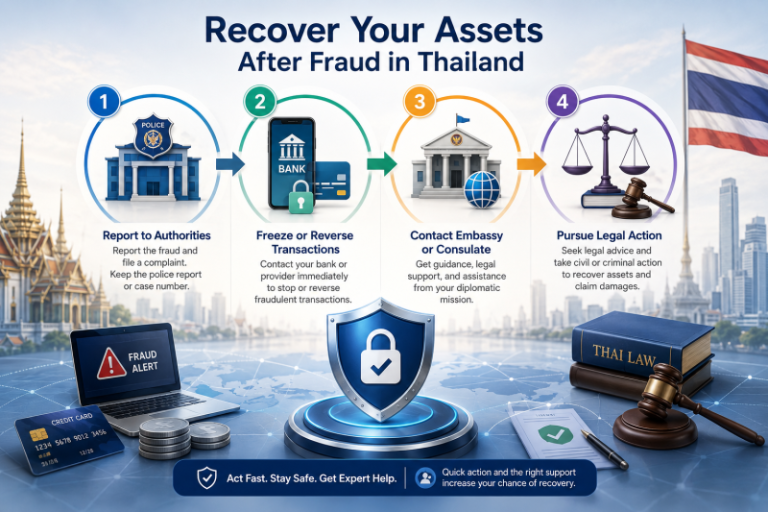
After becoming a victim of fraud, individuals should promptly report the incident and file a complaint with relevant governmental authorities in order to increase the likelihood of identifying offenders and preventing further damage. Victims should prepare all relevant information and evidence, including the date, time, and location of the incident, the amount of money lost, transfer slips, chat records, and the contact information of the offender (Royal Thai Police, 2026).
Relevant agencies responsible for receiving fraud complaints include the Tourist Police, the Royal Thai Police, and cybercrime reporting centers. Furthermore, in cases involving investment or securities fraud, victims may also file complaints with the Securities and Exchange Commission (Securities and Exchange Commission, 2026).
Victims should request copies of police reports or case numbers as evidence, since such documents are essential for subsequent financial and legal procedures.
Suspending or Reversing Financial Transactions
Upon discovering fraudulent transactions, victims should immediately contact banks or financial service providers in order to freeze accounts or suspend suspicious transactions. In cases involving credit or debit cards, victims may submit requests to dispute unauthorized transactions (Royal Thai Police, 2026).
For bank transfers or digital asset transactions, victims should notify financial institutions to investigate and attempt to reverse fraudulent transfers as quickly as possible. In addition, victims should change passwords, activate two-factor authentication systems, and review the security of all online accounts to prevent future unauthorized access.
Contacting Embassies or Consulates
In cases where victims are foreign nationals, contacting their embassies or consulates in Thailand constitutes another important course of action. Such diplomatic missions may provide guidance regarding legal procedures, coordinate with Thai governmental authorities, and assist in preparing emergency travel documents when necessary.
Furthermore, certain embassies may provide information regarding legal services, victim assistance organizations, or emergency financial assistance procedures, depending on the policies and authority of each country.
Pursuing Legal Measures
If the financial damage is substantial or the offender can be identified, victims may consider pursuing additional legal measures. Such measures may include filing civil lawsuits to recover assets or initiating criminal proceedings against offenders for fraud under Thai law. Legal proceedings require clear and sufficient evidence to support the claims (Royal Thai Police, 2026).
Hiring lawyers who specialize in fraud and financial crime cases can improve the effectiveness of evidence collection, coordination with governmental authorities, and court proceedings. In some cases, legal measures may also include tracing and freezing offenders’ assets in order to compensate victims for their losses.
Conclusion
Fraud constitutes a serious problem that significantly affects victims both economically and psychologically, particularly in the digital era where fraudulent schemes have become increasingly complex. Nevertheless, prompt action, comprehensive evidence preservation, and obtaining legal advice from professionals can substantially improve the chances of recovering lost assets and minimizing damages (Securities and Exchange Commission, 2026).
Moreover, enhancing public understanding of legal procedures and available channels for assistance is an important factor in protecting victims’ rights and improving the effectiveness of Thailand’s justice system.
References
- Royal Thai Police. (2026). Online complaint reporting system and information regarding cybercrime. Retrieved from Royal Thai Police
- Securities and Exchange Commission. (2026). Investment scam and securities fraud alerts. Retrieved from Securities and Exchange Commission
For professional services, please visit: https://www.seaproti.org/practitioners/
About certified translators, translation certifiers, and certified interpreters associated with SEAProTI. The Southeast Asian Association of Professional Translators and Interpreters (SEAProTI) has officially shared the qualifications and requirements for becoming Certified Translators, Translation Certification Providers, and Certified Interpreters in Sections 9 and 10 of the Royal Gazette, which was published by the Prime Minister’s Office in Thailand on July 25, 2024. Certified Translators, Translation Certification Providers, and Certified Interpreters
The Council of State has proposed the enactment of a Royal Decree, granting registered translators and recognised translation certifiers from professional associations or accredited language institutions the authority to provide legally valid translation certification (Letter to SEAProTI dated April 28, 2025)
SEAProTI is the first professional association in Thailand and Southeast Asia to implement a comprehensive certification system for translators, certifiers, and interpreters.
Head Office: Baan Ratchakru Building, No. 33, Room 402, Soi Phahonyothin 5, Phahonyothin Road, Phaya Thai District, Bangkok 10400, Thailand
Email: hello@seaproti.com | Tel.: (+66) 2-114-3128 (Office hours: Mon–Fri, 09:00–17:00).
แนวทางการดำเนินการเพื่อเรียกคืนทรัพย์สินภายหลังตกเป็นเหยื่อการฉ้อโกงในประเทศไทย
ผู้เขียน: ภคพร ตันจรารักษ์
19 พฤษภาคม 2569, กรุงเทพมหานคร – ปัญหาการฉ้อโกงในประเทศไทยมีแนวโน้มเพิ่มสูงขึ้นอย่างต่อเนื่อง โดยเฉพาะการฉ้อโกงผ่านระบบออนไลน์และธุรกรรมทางการเงินดิจิทัล ซึ่งส่งผลกระทบต่อทั้งประชาชนชาวไทยและชาวต่างชาติที่พำนักหรือเดินทางเข้ามาในประเทศไทย บทความนี้มีวัตถุประสงค์เพื่อศึกษากระบวนการและแนวทางการดำเนินการภายหลังตกเป็นเหยื่อการฉ้อโกงในประเทศไทย โดยมุ่งเน้นการรายงานเหตุแก่หน่วยงานของรัฐ การระงับธุรกรรมทางการเงิน การขอความช่วยเหลือจากหน่วยงานทางการทูต และการดำเนินมาตรการทางกฎหมายเพื่อเรียกคืนทรัพย์สินและเยียวยาความเสียหาย การศึกษาพบว่า การดำเนินการอย่างรวดเร็ว การเก็บรวบรวมพยานหลักฐานอย่างครบถ้วน และการได้รับคำแนะนำจากผู้เชี่ยวชาญด้านกฎหมาย เป็นปัจจัยสำคัญที่ช่วยเพิ่มโอกาสในการติดตามทรัพย์สินคืนและลดผลกระทบทางกฎหมายและการเงินที่อาจเกิดขึ้นแก่ผู้เสียหาย (สำนักงานตำรวจแห่งชาติ, พ.ศ. 2569)
บทนำ
ในยุคที่เทคโนโลยีสารสนเทศและระบบการเงินดิจิทัลมีบทบาทสำคัญต่อการดำเนินชีวิตประจำวัน รูปแบบของอาชญากรรมทางเศรษฐกิจและการฉ้อโกงได้พัฒนาไปอย่างรวดเร็วและซับซ้อนมากยิ่งขึ้น โดยเฉพาะการฉ้อโกงผ่านสื่อออนไลน์ การหลอกลวงด้านการลงทุน และการปลอมแปลงข้อมูลทางการเงิน ซึ่งส่งผลให้ประชาชนจำนวนมากตกเป็นเหยื่อและสูญเสียทรัพย์สินเป็นมูลค่าสูง ทั้งนี้ ปัญหาดังกล่าวมิได้จำกัดอยู่เฉพาะประชาชนชาวไทย แต่ยังรวมถึงชาวต่างชาติที่เดินทางเข้ามาท่องเที่ยวหรือพำนักในประเทศไทยอีกด้วย (สำนักงานคณะกรรมการกำกับหลักทรัพย์และตลาดหลักทรัพย์, พ.ศ. 2569)
การตกเป็นเหยื่อของการฉ้อโกงก่อให้เกิดผลกระทบทั้งด้านเศรษฐกิจ จิตใจ และความเชื่อมั่นในระบบกฎหมายและธุรกรรมทางการเงิน ผู้เสียหายจำนวนมากมักขาดความรู้ความเข้าใจเกี่ยวกับขั้นตอนทางกฎหมายและกระบวนการติดตามทรัพย์สินคืน ส่งผลให้ไม่สามารถดำเนินการได้อย่างถูกต้องและทันท่วงที ดังนั้น การศึกษาแนวทางการดำเนินการภายหลังตกเป็นเหยื่อการฉ้อโกงจึงมีความสำคัญอย่างยิ่ง ทั้งในด้านการคุ้มครองสิทธิของผู้เสียหายและการเสริมสร้างประสิทธิภาพของกระบวนการยุติธรรม (สำนักงานตำรวจแห่งชาติ, พ.ศ. 2569)
บทความนี้มุ่งศึกษาขั้นตอนสำคัญในการดำเนินการภายหลังเกิดเหตุฉ้อโกงในประเทศไทย โดยครอบคลุมการแจ้งเหตุแก่หน่วยงานภาครัฐ การอายัดหรือย้อนกลับธุรกรรมทางการเงิน การประสานงานกับสถานเอกอัครราชทูตหรือสถานกงสุลในกรณีผู้เสียหายเป็นชาวต่างชาติ ตลอดจนแนวทางการดำเนินคดีทางแพ่งและอาญาเพื่อเรียกคืนทรัพย์สินและเยียวยาความเสียหาย
แนวทางการดำเนินการเพื่อเรียกคืนทรัพย์สินภายหลังตกเป็นเหยื่อการฉ้อโกง
การแจ้งเหตุและร้องทุกข์ต่อหน่วยงานของรัฐ
ภายหลังการตกเป็นเหยื่อของการฉ้อโกง ผู้เสียหายควรดำเนินการแจ้งเหตุและร้องทุกข์ต่อหน่วยงานของรัฐโดยเร็วที่สุด เพื่อเพิ่มโอกาสในการติดตามตัวผู้กระทำความผิดและระงับความเสียหายที่อาจขยายตัวเพิ่มเติม ทั้งนี้ ผู้เสียหายควรจัดเตรียมข้อมูลและหลักฐานที่เกี่ยวข้องให้ครบถ้วน ได้แก่ วัน เวลา และสถานที่เกิดเหตุ จำนวนเงินที่สูญเสีย หลักฐานการโอนเงิน ข้อความสนทนา และข้อมูลติดต่อของผู้กระทำความผิด (สำนักงานตำรวจแห่งชาติ, พ.ศ. 2569)
หน่วยงานสำคัญที่เกี่ยวข้องกับการรับแจ้งเหตุ ได้แก่ ตำรวจท่องเที่ยว สำนักงานตำรวจแห่งชาติ และศูนย์รับแจ้งเหตุอาชญากรรมทางเทคโนโลยีสารสนเทศ นอกจากนี้ ในกรณีที่เกี่ยวข้องกับการลงทุนหรือหลักทรัพย์ ผู้เสียหายสามารถร้องเรียนต่อสำนักงานคณะกรรมการกำกับหลักทรัพย์และตลาดหลักทรัพย์ได้เช่นกัน (สำนักงานคณะกรรมการกำกับหลักทรัพย์และตลาดหลักทรัพย์, พ.ศ. 2569)
ผู้เสียหายควรขอรับสำเนาบันทึกประจำวันหรือหมายเลขคดีไว้เป็นหลักฐาน เนื่องจากเอกสารดังกล่าวมีความสำคัญต่อการดำเนินการด้านการเงินและกระบวนการทางกฎหมายในลำดับต่อไป
การระงับหรือย้อนกลับธุรกรรมทางการเงิน
เมื่อพบว่ามีการทำธุรกรรมที่เกี่ยวข้องกับการฉ้อโกง ผู้เสียหายควรติดต่อธนาคารหรือผู้ให้บริการทางการเงินทันที เพื่อแจ้งอายัดบัญชีหรือขอระงับธุรกรรมที่ผิดปกติ โดยเฉพาะในกรณีของบัตรเครดิตและบัตรเดบิต ผู้เสียหายสามารถยื่นคำร้องเพื่อขอปฏิเสธรายการใช้จ่ายในกรณีที่เป็นธุรกรรมที่ไม่ได้รับอนุญาต (สำนักงานตำรวจแห่งชาติ, พ.ศ. 2569)
สำหรับการโอนเงินผ่านธนาคารหรือสินทรัพย์ดิจิทัล ผู้เสียหายควรแจ้งให้สถาบันการเงินดำเนินการตรวจสอบและพยายามย้อนกลับธุรกรรมโดยเร็วที่สุด นอกจากนี้ ควรเปลี่ยนรหัสผ่าน เปิดใช้งานระบบยืนยันตัวตนแบบสองขั้นตอน และตรวจสอบความปลอดภัยของบัญชีออนไลน์ทั้งหมด เพื่อป้องกันการเข้าถึงโดยไม่ได้รับอนุญาตในอนาคต
การติดต่อสถานเอกอัครราชทูตหรือสถานกงสุล
ในกรณีที่ผู้เสียหายเป็นชาวต่างชาติ การติดต่อสถานเอกอัครราชทูตหรือสถานกงสุลของประเทศตนในประเทศไทยถือเป็นอีกช่องทางหนึ่งที่มีความสำคัญ เนื่องจากหน่วยงานดังกล่าวสามารถให้คำแนะนำเกี่ยวกับขั้นตอนทางกฎหมาย การประสานงานกับหน่วยงานของรัฐไทย รวมถึงการจัดเตรียมเอกสารการเดินทางฉุกเฉินในกรณีจำเป็น
นอกจากนี้ สถานเอกอัครราชทูตบางแห่งอาจให้ข้อมูลเกี่ยวกับบริการด้านกฎหมาย หน่วยงานช่วยเหลือผู้เสียหาย หรือแนวทางการขอความช่วยเหลือทางการเงินในกรณีฉุกเฉิน ทั้งนี้ ขึ้นอยู่กับนโยบายและขอบเขตอำนาจของแต่ละประเทศ
การดำเนินมาตรการทางกฎหมาย
หากความเสียหายมีมูลค่าสูงหรือสามารถระบุตัวผู้กระทำความผิดได้ ผู้เสียหายอาจพิจารณาดำเนินมาตรการทางกฎหมายเพิ่มเติม โดยอาจใช้สิทธิฟ้องร้องคดีแพ่งเพื่อเรียกคืนทรัพย์สิน หรือดำเนินคดีอาญาต่อผู้กระทำความผิดฐานฉ้อโกงตามกฎหมายไทย ทั้งนี้ การดำเนินคดีจำเป็นต้องอาศัยพยานหลักฐานที่ชัดเจนและครบถ้วน (สำนักงานตำรวจแห่งชาติ, พ.ศ. 2569)
การว่าจ้างทนายความที่มีความเชี่ยวชาญด้านคดีฉ้อโกงและอาชญากรรมทางการเงินจะช่วยเพิ่มประสิทธิภาพในการรวบรวมพยานหลักฐาน การประสานงานกับหน่วยงานของรัฐ และการดำเนินกระบวนการทางศาล นอกจากนี้ ในบางกรณี ยังสามารถดำเนินมาตรการติดตามและอายัดทรัพย์สินของผู้กระทำความผิดเพื่อใช้ในการชดใช้ความเสียหายแก่ผู้เสียหายได้
บทสรุป
การฉ้อโกงถือเป็นปัญหาที่ส่งผลกระทบอย่างรุนแรงต่อทั้งด้านเศรษฐกิจและสภาพจิตใจของผู้เสียหาย โดยเฉพาะในยุคดิจิทัลที่รูปแบบการหลอกลวงมีความซับซ้อนมากขึ้น อย่างไรก็ตาม การดำเนินการอย่างรวดเร็ว การเก็บรักษาพยานหลักฐานอย่างครบถ้วน และการได้รับคำแนะนำจากผู้เชี่ยวชาญด้านกฎหมาย สามารถช่วยเพิ่มโอกาสในการติดตามทรัพย์สินคืนและลดผลกระทบที่อาจเกิดขึ้นได้ (สำนักงานคณะกรรมการกำกับหลักทรัพย์และตลาดหลักทรัพย์, พ.ศ. 2569)
นอกจากนี้ การเสริมสร้างความรู้ความเข้าใจเกี่ยวกับกระบวนการทางกฎหมายและช่องทางการขอความช่วยเหลือจากหน่วยงานที่เกี่ยวข้อง ยังเป็นปัจจัยสำคัญในการคุ้มครองสิทธิของผู้เสียหายและส่งเสริมประสิทธิภาพของกระบวนการยุติธรรมในประเทศไทย
เอกสารอ้างอิง
- สำนักงานคณะกรรมการกำกับหลักทรัพย์และตลาดหลักทรัพย์. (พ.ศ. 2569). การแจ้งเตือนภัยการลงทุนและการหลอกลวงด้านหลักทรัพย์. สืบค้นจาก สำนักงานคณะกรรมการกำกับหลักทรัพย์และตลาดหลักทรัพย์
- สำนักงานตำรวจแห่งชาติ. (พ.ศ. 2569). ระบบรับแจ้งความออนไลน์และข้อมูลเกี่ยวกับอาชญากรรมทางเทคโนโลยี. สืบค้นจาก สำนักงานตำรวจแห่งชาติ
สมาคมวิชาชีพนักแปลและล่ามแห่งเอเชียตะวันออกเฉียงใต้ (SEAProTI) ได้ประกาศหลักเกณฑ์และคุณสมบัติของผู้ที่ขึ้นทะเบียนเป็น “นักแปลรับรอง (Certified Translators) และผู้รับรองการแปล (Translation Certification Providers) และล่ามรับรอง (Certified Interpreters)” ของสมาคม หมวดที่ 9 และหมวดที่ 10 ในราชกิจจานุเบกษา ของสำนักเลขาธิการคณะรัฐมนตรี ในสำนักนายกรัฐมนตรี แห่งราชอาณาจักรไทย ลงวันที่ 25 ก.ค. 2567 เล่มที่ 141 ตอนที่ 66 ง หน้า 100 อ่านฉบับเต็มได้ที่: นักแปลรับรอง ผู้รับรองการแปล และล่ามรับรอง
สำนักคณะกรรมการกฤษฎีกาเสนอให้ตราเป็นพระราชกฤษฎีกา โดยกำหนดให้นักแปลที่ขึ้นทะเบียน รวมถึงผู้รับรองการแปลจากสมาคมวิชาชีพหรือสถาบันสอนภาษาที่มีการอบรมและขึ้นทะเบียน สามารถรับรองคำแปลได้ (จดหมายถึงสมาคม SEAProTI ลงวันที่ 28 เม.ย. 2568)
สมาคมวิชาชีพนักแปลและล่ามแห่งเอเชียตะวันออกเฉียงใต้เป็นสมาคมวิชาชีพแห่งแรกและแห่งเดียวในประเทศไทยและภูมิภาคเอเชียตะวันออกเฉียงใต้ที่มีระบบรับรองนักแปลรับรอง ผู้รับรองการแปล และล่ามรับรอง
สำนักงานใหญ่: อาคารบ้านราชครู เลขที่ 33 ห้อง 402 ซอยพหลโยธิน 5 ถนนพหลโยธิน แขวงพญาไท เขตพญาไท กรุงเทพมหานคร 10400 ประเทศไทย