


The European Union’s Visa Cascade Regime for Thai Passport Holders: Implications for International Relations and the Role of Certified Translators in Cross-Border Mobility
Author: Griroek Gruaaythong
18 May 2026, Bangkok – This article examines the implementation of the Visa Cascade regime by the European Commission for Thai passport holders on 8 May 2026, as well as its political, economic, and social implications within the broader context of Thailand–European Union relations. The study argues that the Visa Cascade regime is not merely a visa facilitation mechanism, but also a reflection of the European Union’s increasing confidence in Thai travelers in terms of migration compliance, security considerations, and document reliability. Furthermore, this article explores the roles of certified translators, translation certification providers, and certified interpreters within the framework of Southeast Asian professional translation and interpreting associations. These professionals play a crucial role in ensuring document accuracy, facilitating intercultural communication, and strengthening institutional trust in visa application procedures. The article suggests that translation and interpreting professions constitute an essential structural component of transnational mobility in the era of globalization and contribute significantly to international cooperation and people-to-people connectivity.
Keywords: Visa Cascade, Schengen visa, certified translators, certified interpreters, European Union, cross-border mobility
Introduction
The movement of people across borders in the twenty-first century is closely associated with immigration policies, international cooperation, and the credibility of official documentation. Visa policies are therefore not only mechanisms of border control but also indicators of interstate trust and the perceived reliability of passport holders. In this context, the decision by the European Commission to extend the Visa Cascade regime to Thailand on 8 May 2026 represents a significant milestone in Thailand–European Union relations and reflects growing confidence in Thai travelers (Ministry of Foreign Affairs of Thailand, 2026).
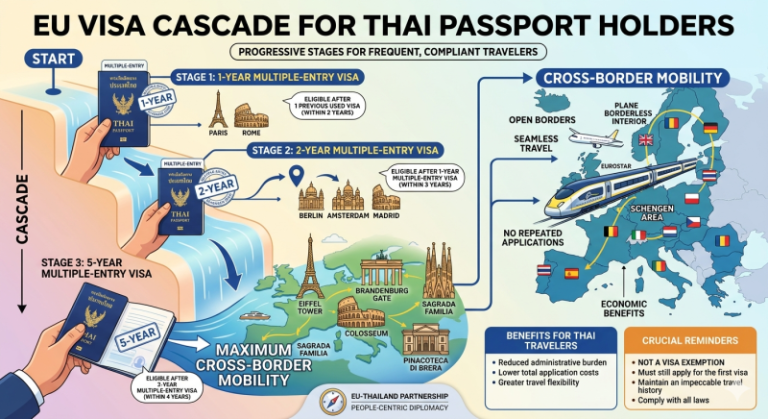
The Visa Cascade regime operates as a graduated visa-validity system that allows applicants with a positive travel history and lawful prior use of Schengen visas to obtain multiple-entry visas with progressively longer validity periods. Applicants who have previously obtained and lawfully used a Schengen visa within the previous two years may become eligible for a one-year multiple-entry visa. Those who have properly used a one-year multiple-entry visa within the previous three years may qualify for a two-year visa, while individuals who have lawfully used a two-year visa within the previous four years may become eligible for a five-year visa (European Commission, 2026).
Beyond its implications for travel and economic exchanges, the regime also highlights the increasing importance of translation and interpreting professions. International visa applications require numerous official documents to be translated accurately and reliably, including academic certificates, financial records, civil registration documents, and legal paperwork. Consequently, certified translators and interpreters have become essential actors in bridging linguistic, legal, and institutional differences between states.
The Visa Cascade Regime and Its Implications for International Policy
The Visa Cascade regime primarily aims to facilitate travel for individuals with a strong record of lawful international mobility. Applicants who have previously complied with Schengen visa regulations may progressively receive longer-validity multiple-entry visas. Specifically, applicants who have lawfully used a Schengen visa within the previous two years may receive a one-year visa. Those who have properly used a one-year multiple-entry visa within the previous three years may obtain a two-year visa, while those with a well-maintained travel history under a two-year visa within the previous four years may become eligible for a five-year visa (European Commission, 2026).
From a policy perspective, the measure reflects a model of risk-based mobility governance, whereby countries whose citizens are assessed as posing low migration and security risks are granted greater travel privileges. According to the Ministry of Foreign Affairs of Thailand, the approval of the regime was supported by evidence demonstrating that Thai passport holders present relatively low immigration risks and contribute significant economic benefits to Schengen member states (MFA Thailand, 2026).
The measure also signifies deepening relations between Thailand and the European Union, particularly following the provisional implementation of the Thailand–EU Comprehensive Partnership and Cooperation Agreement (PCA) on 20 October 2024. The PCA has expanded cooperation in areas such as trade, education, security, and the mobility of highly skilled workers (European External Action Service, 2024).
The Role of Certified Translators and Certified Interpreters in Visa Procedures
Although the Visa Cascade regime reduces the frequency of visa applications, the documentation process remains highly rigorous. Applicants are still required to submit reliable and verifiable documentation, much of which must be translated into English or the official language of the destination country. This requirement significantly increases the importance of certified translators.
Certified translators are responsible for ensuring that translated documents accurately reflect the content of the originals, while translation certification providers verify the quality and authenticity of translated materials. These documents often include birth certificates, household registration records, employment certificates, educational transcripts, and financial statements. Even minor translation inaccuracies may affect the credibility of visa applicants and potentially lead to visa refusal.
Certified interpreters also play an important role in visa interviews, immigration procedures, and communication with governmental institutions abroad. Their services become particularly essential when applicants face linguistic barriers or must engage in legal or consular processes.
Professional translation and interpreting associations in Southeast Asia contribute significantly to maintaining professional standards through certification systems, ethics training, and the development of best practices for official document translation. Such efforts strengthen what may be termed “linguistic credibility,” a crucial component of international visa and immigration systems.
Translation and Cross-Border Mobility in the Era of Globalization
From the perspectives of applied linguistics and social sciences, translation is not merely the transfer of meaning between languages; it is also a process of mediating between different legal systems, cultures, and institutional frameworks. Pym (2014) argues that translators function as cultural mediators who reduce ambiguity and facilitate intercultural understanding in transnational communication.
Within the context of visa applications, the accuracy and reliability of translated documents directly influence an individual’s “mobility capital,” or their capacity to access international opportunities such as education, employment, and professional networking. Individuals with access to high-quality certified translation services are therefore more likely to benefit from global mobility opportunities. Translation and interpreting professions thus play a significant role in enabling social and economic mobility in the contemporary globalized world.
Conclusion
The implementation of the Visa Cascade regime for Thai passport holders represents a major development in Thailand–European Union relations and reflects increasing European confidence in Thai travelers. Although the regime does not constitute a visa exemption, it substantially reduces the administrative burden, time, and financial costs associated with repeated visa applications.
At the same time, the regime underscores the growing importance of certified translators, translation certification providers, and certified interpreters, who serve as essential actors in establishing document credibility and facilitating international communication. Translation and interpreting professions should therefore be understood not merely as linguistic services, but as integral components of the infrastructure of cross-border mobility in the era of globalization. Their contribution is increasingly important for strengthening international cooperation, intercultural understanding, and global connectivity.
References
- European Commission. (2026). Implementation of the Visa Cascade regime for Thai nationals. Brussels: European Commission.
- European External Action Service. (2024). Thailand–European Union Comprehensive Partnership and Cooperation Agreement (PCA). Brussels: EEAS.
- Ministry of Foreign Affairs of Thailand. (2026). The EU adopts Visa Cascade regime for Thai nationals. Ministry of Foreign Affairs of Thailand
- Moser-Mercer, B. (2015). The role of professional interpreters in international mobility and institutional communication. Translation and Interpreting Studies, 10(2), 251–268.
- Pym, A. (2014). Exploring translation theories (2nd ed.). https://www.routledge.com/Exploring-Translation-Theories/Pym/p/book/9781032457512
- Risku, H. (2016). Situatedness in translation studies. Cognitive Systems Research, 38, 1–5.
For professional services, please visit: https://www.seaproti.org/practitioners/
About certified translators, translation certifiers, and certified interpreters associated with SEAProTI. The Southeast Asian Association of Professional Translators and Interpreters (SEAProTI) has officially shared the qualifications and requirements for becoming Certified Translators, Translation Certification Providers, and Certified Interpreters in Sections 9 and 10 of the Royal Gazette, which was published by the Prime Minister’s Office in Thailand on July 25, 2024. Certified Translators, Translation Certification Providers, and Certified Interpreters
The Council of State has proposed the enactment of a Royal Decree, granting registered translators and recognised translation certifiers from professional associations or accredited language institutions the authority to provide legally valid translation certification (Letter to SEAProTI dated April 28, 2025)
SEAProTI is the first professional association in Thailand and Southeast Asia to implement a comprehensive certification system for translators, certifiers, and interpreters.
Head Office: Baan Ratchakru Building, No. 33, Room 402, Soi Phahonyothin 5, Phahonyothin Road, Phaya Thai District, Bangkok 10400, Thailand
Email: hello@seaproti.com | Tel.: (+66) 2-114-3128 (Office hours: Mon–Fri, 09:00–17:00).
มาตรการ Visa Cascade ของสหภาพยุโรปต่อผู้ถือหนังสือเดินทางไทย: นัยต่อความสัมพันธ์ระหว่างประเทศและบทบาทของนักแปลรับรองในกระบวนการเคลื่อนย้ายข้ามพรมแดน
ผู้เขียน: ไกรฤกษ์ กรวยทอง
18 พฤษภาคม 2569, กรุงเทพมหานคร – บทความนี้มุ่งศึกษามาตรการ Visa Cascade ของ European Commission ที่มีผลบังคับใช้กับผู้ถือหนังสือเดินทางไทยเมื่อวันที่ 8 พฤษภาคม พ.ศ. 2569 ตลอดจนนัยสำคัญทางการเมือง เศรษฐกิจ และสังคมที่เกิดขึ้นจากมาตรการดังกล่าว โดยเฉพาะในบริบทของความสัมพันธ์ระหว่างประเทศไทยกับ European Union บทความวิเคราะห์ว่ามาตรการ Visa Cascade มิได้เป็นเพียงกลไกอำนวยความสะดวกด้านวีซ่า หากแต่สะท้อนระดับความเชื่อมั่นของสหภาพยุโรปต่อผู้เดินทางชาวไทยในด้านความมั่นคง การเข้าเมือง และความน่าเชื่อถือของเอกสารราชการ นอกจากนี้ บทความยังอภิปรายบทบาทของนักแปลรับรอง (certified translators) ผู้รับรองการแปล (translation certification providers) และล่ามรับรอง (certified interpreters) ภายใต้กรอบการทำงานของสมาคมวิชาชีพนักแปลและล่ามแห่งเอเชียตะวันออกเฉียงใต้ ซึ่งมีบทบาทสำคัญในการสนับสนุนความถูกต้องของเอกสาร การสื่อสารข้ามวัฒนธรรม และการสร้างความน่าเชื่อถือในกระบวนการตรวจลงตรา การศึกษานี้เสนอว่า วิชาชีพการแปลและล่ามมีบทบาทเชิงโครงสร้างต่อการเคลื่อนย้ายของบุคคลในยุคโลกาภิวัตน์ และเป็นส่วนหนึ่งของกลไกที่ช่วยเสริมสร้างความร่วมมือระหว่างประเทศ
คำสำคัญ: Visa Cascade, วีซ่าเชงเกน, นักแปลรับรอง, ล่ามรับรอง, สหภาพยุโรป, การเคลื่อนย้ายข้ามพรมแดน
บทนำ
การเคลื่อนย้ายของผู้คนระหว่างประเทศในศตวรรษที่ 21 มีความสัมพันธ์อย่างใกล้ชิดกับนโยบายด้านการตรวจคนเข้าเมือง ความร่วมมือระหว่างประเทศ และระบบความน่าเชื่อถือของเอกสารราชการ มาตรการด้านวีซ่าจึงมิได้เป็นเพียงกลไกควบคุมพรมแดน แต่ยังสะท้อนระดับความเชื่อมั่นระหว่างรัฐ ตลอดจนศักยภาพทางเศรษฐกิจและสังคมของประเทศผู้ถือหนังสือเดินทาง ในบริบทดังกล่าว การที่ European Commission อนุมัติมาตรการ Visa Cascade ให้แก่ประเทศไทยเมื่อวันที่ 8 พฤษภาคม พ.ศ. 2569 ถือเป็นพัฒนาการสำคัญของความสัมพันธ์ไทย–สหภาพยุโรป และเป็นสัญญาณของความเชื่อมั่นที่เพิ่มสูงขึ้นต่อผู้เดินทางชาวไทย (กระทรวงการต่างประเทศ, 2569)
มาตรการ Visa Cascade เป็นระบบการออกวีซ่าแบบไล่ระดับ ซึ่งอนุญาตให้ผู้ที่เคยได้รับและใช้วีซ่าเชงเกนอย่างถูกต้อง สามารถได้รับวีซ่าแบบเข้าออกหลายครั้ง (multiple-entry visa) ที่มีอายุยาวนานขึ้นตามลำดับ ตั้งแต่วีซ่า 1 ปี 2 ปี จนถึง 5 ปี ทั้งนี้ มาตรการดังกล่าวยังคงรักษากระบวนการยื่นขอวีซ่าเดิม และมิใช่การยกเว้นการตรวจลงตราแต่อย่างใด (คณะกรรมาธิการยุโรป, 2569)
นอกจากผลกระทบด้านการเดินทางและเศรษฐกิจแล้ว มาตรการดังกล่าวยังทำให้บทบาทของวิชาชีพด้านการแปลและล่ามมีความสำคัญมากยิ่งขึ้น เนื่องจากการยื่นขอวีซ่าระหว่างประเทศต้องอาศัยเอกสารจำนวนมากที่ต้องได้รับการแปลอย่างถูกต้องและน่าเชื่อถือ ไม่ว่าจะเป็นเอกสารการศึกษา เอกสารทางการเงิน เอกสารทะเบียนราษฎร หรือเอกสารด้านกฎหมาย ดังนั้น นักแปลรับรองและล่ามรับรองจึงกลายเป็นกลไกสำคัญในการเชื่อมโยงระบบราชการ ภาษา และกฎหมายระหว่างประเทศ
มาตรการ Visa Cascade และความหมายเชิงนโยบายระหว่างประเทศ
มาตรการ Visa Cascade มีเป้าหมายหลักในการอำนวยความสะดวกแก่ผู้เดินทางที่มีประวัติการเดินทางที่ดี โดยผู้สมัครที่เคยได้รับวีซ่าเชงเกนและปฏิบัติตามเงื่อนไขการพำนักอย่างถูกต้อง จะสามารถได้รับวีซ่าที่มีอายุยาวนานขึ้นตามลำดับ กล่าวคือ ผู้ที่เคยได้รับวีซ่าและใช้วีซ่าอย่างถูกต้องภายในระยะเวลาไม่เกินสองปี อาจได้รับวีซ่าแบบ multiple-entry ระยะเวลา 1 ปี ขณะที่ผู้ที่เคยได้รับวีซ่า 1 ปี และใช้ถูกต้องภายในสามปี อาจได้รับวีซ่า 2 ปี และในระดับสูงสุด ผู้ที่เคยได้รับวีซ่า 2 ปี และมีประวัติการเดินทางที่ดีภายในสี่ปี อาจได้รับวีซ่าระยะเวลา 5 ปี (คณะกรรมาธิการยุโรป, 2569)
ในเชิงนโยบาย มาตรการดังกล่าวสะท้อนแนวคิด “risk-based mobility governance” หรือการบริหารจัดการการเคลื่อนย้ายโดยอาศัยการประเมินความเสี่ยง กล่าวคือ ประเทศที่มีประชาชนซึ่งถูกประเมินว่ามีความเสี่ยงด้านการเข้าเมืองผิดกฎหมายต่ำ จะได้รับสิทธิประโยชน์ด้านการเดินทางมากขึ้น กระทรวงการต่างประเทศไทยระบุว่า การผลักดันมาตรการนี้เกิดจากการนำเสนอข้อมูลเชิงประจักษ์ต่อฝ่ายยุโรปว่า ผู้ถือหนังสือเดินทางไทยมีระดับความเสี่ยงต่ำ และสร้างประโยชน์ทางเศรษฐกิจแก่ประเทศสมาชิกเชงเกน (กระทรวงการต่างประเทศ, 2569)
มาตรการดังกล่าวยังสะท้อนความสัมพันธ์ที่แน่นแฟ้นขึ้นระหว่างประเทศไทยกับสหภาพยุโรป โดยเฉพาะภายหลังการมีผลบังคับใช้ชั่วคราวของ Thailand–EU Comprehensive Partnership and Cooperation Agreement หรือ PCA เมื่อวันที่ 20 ตุลาคม พ.ศ. 2567 ซึ่งช่วยขยายความร่วมมือด้านเศรษฐกิจ การศึกษา ความมั่นคง และการเคลื่อนย้ายแรงงานทักษะสูง (ฝ่ายปฏิบัติการภายนอกของสหภาพยุโรป, 2567)
บทบาทของนักแปลรับรองและล่ามรับรองในกระบวนการตรวจลงตรา
แม้มาตรการ Visa Cascade จะช่วยลดความถี่ในการยื่นขอวีซ่า แต่กระบวนการด้านเอกสารยังคงมีความเข้มงวดเช่นเดิม ผู้สมัครยังจำเป็นต้องยื่นเอกสารที่มีความถูกต้องและสามารถตรวจสอบได้ เอกสารจำนวนมากในกระบวนการดังกล่าวจำเป็นต้องได้รับการแปลเป็นภาษาของประเทศปลายทางหรือภาษาอังกฤษ จึงทำให้บทบาทของนักแปลรับรองมีความสำคัญอย่างยิ่ง
นักแปลรับรอง (certified translators) ทำหน้าที่รับรองว่าเอกสารที่แปลมีความถูกต้องและสอดคล้องกับต้นฉบับ ขณะที่ผู้รับรองการแปล (translation certification providers) มีบทบาทในการตรวจสอบมาตรฐานและความน่าเชื่อถือของงานแปล โดยเฉพาะในกรณีของเอกสารราชการ เช่น สูติบัตร ทะเบียนบ้าน หนังสือรับรองการทำงาน และเอกสารการศึกษา หากเกิดข้อผิดพลาดในการแปล อาจส่งผลต่อการประเมินคุณสมบัติของผู้สมัครวีซ่าได้
นอกจากนี้ ล่ามรับรอง (certified interpreters) ยังมีบทบาทในการสัมภาษณ์วีซ่า การติดต่อหน่วยงานตรวจคนเข้าเมือง และการอำนวยความสะดวกในการสื่อสารระหว่างผู้เดินทางกับเจ้าหน้าที่รัฐในต่างประเทศ โดยเฉพาะในกรณีที่ผู้เดินทางมีข้อจำกัดด้านภาษา หรือต้องเข้าสู่กระบวนการทางกฎหมายและกงสุล
สมาคมวิชาชีพนักแปลและล่ามแห่งเอเชียตะวันออกเฉียงใต้มีบทบาทสำคัญในการยกระดับมาตรฐานวิชาชีพผ่านระบบรับรองคุณวุฒิ การอบรมจริยธรรม และการพัฒนามาตรฐานการแปลเอกสารระหว่างประเทศ บทบาทดังกล่าวช่วยสร้าง “ความน่าเชื่อถือทางภาษา” (linguistic credibility) ซึ่งเป็นปัจจัยสำคัญในระบบการตรวจลงตราระหว่างประเทศ
การแปลกับการเคลื่อนย้ายข้ามพรมแดนในยุคโลกาภิวัตน์
ในมิติทางภาษาศาสตร์ประยุกต์และสังคมศาสตร์ การแปลมิได้เป็นเพียงการถ่ายทอดความหมายจากภาษาหนึ่งสู่อีกภาษาหนึ่ง หากแต่เป็นกระบวนการสร้างความเข้าใจระหว่างระบบกฎหมาย วัฒนธรรม และสถาบันรัฐของแต่ละประเทศ พิม (2557) เสนอว่า นักแปลมีบทบาทเป็น “cultural mediators” หรือผู้ไกล่เกลี่ยทางวัฒนธรรม ซึ่งช่วยลดความคลุมเครือและความขัดแย้งในการสื่อสารข้ามพรมแดน
ในบริบทของการขอวีซ่า ความถูกต้องของการแปลเอกสารมีผลโดยตรงต่อ “mobility capital” หรือทุนแห่งการเคลื่อนย้ายของบุคคล ผู้ที่สามารถเข้าถึงบริการแปลรับรองที่มีคุณภาพสูง มักมีโอกาสเข้าถึงการศึกษา การทำงาน และเครือข่ายระหว่างประเทศได้มากกว่า ดังนั้น วิชาชีพการแปลและล่ามจึงมีบทบาทสำคัญต่อการเคลื่อนย้ายทางสังคมและเศรษฐกิจในโลกยุคปัจจุบัน
สรุป
มาตรการ Visa Cascade ของสหภาพยุโรปต่อผู้ถือหนังสือเดินทางไทยถือเป็นพัฒนาการสำคัญของความสัมพันธ์ไทย–สหภาพยุโรป และสะท้อนถึงระดับความเชื่อมั่นที่เพิ่มสูงขึ้นต่อผู้เดินทางชาวไทย แม้มาตรการดังกล่าวจะมิใช่การยกเว้นวีซ่า แต่ก็ช่วยลดภาระด้านเวลาและค่าใช้จ่ายของผู้เดินทางอย่างมีนัยสำคัญ
ขณะเดียวกัน มาตรการดังกล่าวยังเผยให้เห็นความสำคัญของนักแปลรับรอง ผู้รับรองการแปล และล่ามรับรอง ซึ่งทำหน้าที่เป็นกลไกสำคัญในการสร้างความน่าเชื่อถือของเอกสารและการสื่อสารระหว่างประเทศ วิชาชีพด้านการแปลและล่ามจึงไม่ได้เป็นเพียงงานด้านภาษา หากแต่เป็นส่วนหนึ่งของโครงสร้างพื้นฐานด้านการเคลื่อนย้ายข้ามพรมแดนในยุคโลกาภิวัตน์ และมีบทบาทสำคัญต่อการพัฒนาความร่วมมือระหว่างประเทศในอนาคต
บรรณานุกรม
- คณะกรรมาธิการยุโรป. (2569). การดำเนินมาตรการระบอบ Visa Cascade สำหรับคนสัญชาติไทย. บรัสเซลส์: คณะกรรมาธิการยุโรป.
- ฝ่ายปฏิบัติการภายนอกของสหภาพยุโรป. (2567). ความตกลงหุ้นส่วนและความร่วมมือแบบครอบคลุมระหว่างไทย–สหภาพยุโรป (PCA). บรัสเซลส์: EEAS.
- กระทรวงการต่างประเทศ. (2569). สหภาพยุโรปประกาศใช้ระบอบ Visa Cascade สำหรับคนสัญชาติไทย. กระทรวงการต่างประเทศ.
- โมเซอร์-เมอร์เซอร์, บี. (2558). The role of professional interpreters in international mobility and institutional communication. Translation and Interpreting Studies, 10(2), 251–268.
- พิม, เอ. (2557). Exploring translation theories (พิมพ์ครั้งที่ 2). https://www.routledge.com/Exploring-Translation-Theories/Pym/p/book/9781032457512
- ริสกู, เอช. (2559). Situatedness in translation studies. Cognitive Systems Research, 38, 1–5.
สมาคมวิชาชีพนักแปลและล่ามแห่งเอเชียตะวันออกเฉียงใต้ (SEAProTI) ได้ประกาศหลักเกณฑ์และคุณสมบัติของผู้ที่ขึ้นทะเบียนเป็น “นักแปลรับรอง (Certified Translators) และผู้รับรองการแปล (Translation Certification Providers) และล่ามรับรอง (Certified Interpreters)” ของสมาคม หมวดที่ 9 และหมวดที่ 10 ในราชกิจจานุเบกษา ของสำนักเลขาธิการคณะรัฐมนตรี ในสำนักนายกรัฐมนตรี แห่งราชอาณาจักรไทย ลงวันที่ 25 ก.ค. 2567 เล่มที่ 141 ตอนที่ 66 ง หน้า 100 อ่านฉบับเต็มได้ที่: นักแปลรับรอง ผู้รับรองการแปล และล่ามรับรอง
สำนักคณะกรรมการกฤษฎีกาเสนอให้ตราเป็นพระราชกฤษฎีกา โดยกำหนดให้นักแปลที่ขึ้นทะเบียน รวมถึงผู้รับรองการแปลจากสมาคมวิชาชีพหรือสถาบันสอนภาษาที่มีการอบรมและขึ้นทะเบียน สามารถรับรองคำแปลได้ (จดหมายถึงสมาคม SEAProTI ลงวันที่ 28 เม.ย. 2568)
สมาคมวิชาชีพนักแปลและล่ามแห่งเอเชียตะวันออกเฉียงใต้เป็นสมาคมวิชาชีพแห่งแรกและแห่งเดียวในประเทศไทยและภูมิภาคเอเชียตะวันออกเฉียงใต้ที่มีระบบรับรองนักแปลรับรอง ผู้รับรองการแปล และล่ามรับรอง
สำนักงานใหญ่: อาคารบ้านราชครู เลขที่ 33 ห้อง 402 ซอยพหลโยธิน 5 ถนนพหลโยธิน แขวงพญาไท เขตพญาไท กรุงเทพมหานคร 10400 ประเทศไทย