



Audiovisual Translation in the Digital Era: Accessibility, Technology, and Emerging Research Trends
Author: Phakaporn Tanjararak
22 May 2026, Bangkok – The book The Palgrave Handbook of Audiovisual Translation and Media Accessibility, edited by Łukasz Bogucki and Mikołaj Deckert, represents an important academic contribution reflecting the rapid development of audiovisual translation and media accessibility studies at the international level. The volume contains 34 chapters written by leading scholars and covers theoretical perspectives, research methodologies, technological developments, pedagogical applications, and contemporary practices within the media industry.
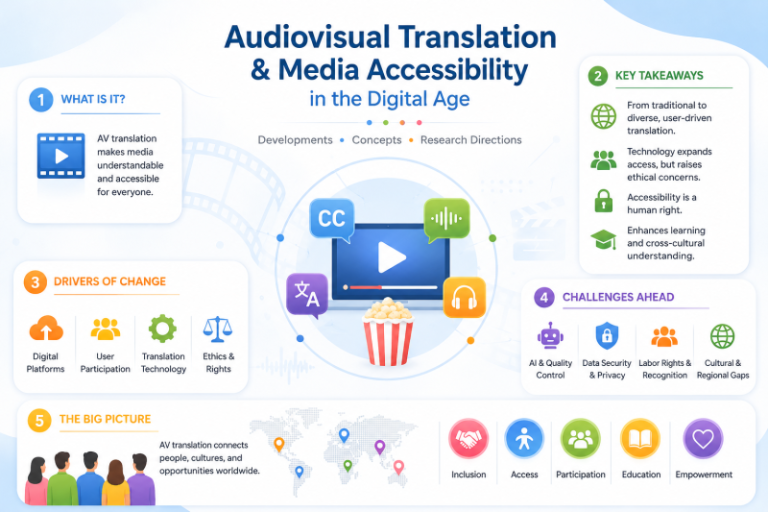
This article aims to critically examine the principal themes presented in the handbook through an academic perspective, with particular emphasis on digital technology, accessibility for people with disabilities, fansubbing, dubbing, subtitling, and ethical concerns in translation practice. The findings reveal that audiovisual translation is no longer merely a linguistic transfer process but has become a significant mechanism for promoting equality in access to information, culture, and entertainment. Furthermore, technological innovation has profoundly transformed the working practices of translators and media producers by increasing efficiency, accelerating production processes, and creating new opportunities for future research.
Introduction
Over the past several decades, audiovisual translation has emerged as a major field within translation studies and media studies, particularly within the context of the digital society where films, television, video games, and streaming platforms play a central role in everyday life. Bogucki and Deckert (2020) compiled contemporary knowledge regarding audiovisual translation and media accessibility in The Palgrave Handbook of Audiovisual Translation and Media Accessibility, which is widely regarded as one of the most significant academic publications in this area.
Deckert (2020) argues that the growing interest in audiovisual translation and media accessibility demonstrates that accessibility should no longer be considered merely secondary to translation itself. Instead, it has developed into an independent and influential field of inquiry. This transformation has occurred alongside technological advancement and changing audience behavior, as contemporary viewers increasingly demand content that is accessible, diverse, and inclusive.
Moreover, the expansion of digital platforms has broadened the scope of audiovisual translation beyond traditional dubbing and subtitling into newer forms such as fansubbing, amateur dubbing, live subtitling, and translation services for visually and hearing-impaired audiences. These developments reflect the dynamic nature of contemporary media culture and demonstrate how translation practices continue to evolve in response to digital communication technologies (Chaume, 2013).
Literature Review
The handbook is divided into several sections, each addressing important dimensions of audiovisual translation studies in a systematic manner. The first section focuses on the theoretical foundations and historical development of the discipline. In particular, the interview conducted by Łukasz Bogucki with Jorge Díaz-Cintas provides a comprehensive reflection on the evolution of audiovisual translation, including terminology, technological innovation, pedagogy, and future developments within the field. Díaz-Cintas (2020) emphasizes the importance of reducing the gap between academia and the audiovisual translation industry in order to better satisfy the needs of both sectors.
In relation to media accessibility, Greco and Jankowska (2020) propose that accessibility should not be restricted solely to translation-based solutions. Instead, it should also include practices such as clean audio production and soundtrack enhancement to improve audience comprehension. This perspective positions media accessibility as an issue closely connected to human rights and equality of access to communication.
The second section of the volume examines various modes of audiovisual translation, including dubbing, subtitling, surtitling, game localization, and audio description for visually impaired audiences. Chaume (2013) notes that the increasing popularity of dubbed English-language content has significantly altered the previously negative perception of dubbing, which had often been associated with authoritarian political regimes and cultural inferiority.
At the same time, fan-based translation practices have become increasingly significant in the digital era. Massidda (2020) discusses the copyright issues frequently faced by fansubbing communities, including website closures and financial penalties. Nevertheless, the growth of online media platforms continues to provide opportunities for fan translators to circulate translated content globally. Similarly, Baños (2019) argues that fandubbing activities are not always motivated solely by entertainment purposes but may also serve political, social, or charitable goals.
Technological development is another important theme throughout the handbook. Bolaños-García-Escribano and Díaz-Cintas (2020) explain that cloud-based environments and translation technologies such as translation memory systems and machine translation tools have become essential components of modern audiovisual translation workflows because they increase productivity and reduce operational costs. However, Olohan (2017) warns that the ethical implications of integrating technology into translation practices require further critical examination.
Cultural references and humor also receive substantial scholarly attention within the volume. Ranzato (2016) explains that the translation of culture-specific references in television programs changes over time according to audience familiarity and cultural globalization. For example, the character “Mr Potato Head” in the sitcom Friends was replaced with “E.T.” in the Italian dubbed version during the 1990s because Italian audiences were unfamiliar with the original reference. However, in later productions such as Modern Family, the original reference could be retained because the character had become internationally recognizable. This example demonstrates how audiovisual translation is shaped by shifting cultural contexts and audience expectations.
Findings
The study reveals that audiovisual translation in the digital era has undergone rapid transformation in both theoretical and practical dimensions. Digital technology has played a crucial role in expanding translation practices to accommodate increasingly diverse audiences, particularly hearing-impaired and visually impaired viewers. Subtitling for the deaf and hard of hearing and audio description have consequently become essential components of the contemporary media industry.
Furthermore, the emergence of online platforms has enabled ordinary users to participate actively in translation production. Fansubbing and fandubbing demonstrate a shift in media production power from large corporations to individual users and online communities. Although copyright debates continue to surround these practices, they have contributed significantly to the international circulation of cultural products.
In the field of education, audiovisual translation has gained growing recognition as an effective tool for foreign language learning. Talaván (2020) and Incalcaterra McLoughlin and Nocchi (2020) argue that audiovisual materials can enhance language skills while increasing student motivation and engagement in language acquisition processes.
Another important finding concerns the relationship between technology and ethics in translation practice. Although machine translation systems and cloud-based tools improve efficiency and productivity, they may also create concerns regarding translation quality, data security, and the diminishing role of human translators within media production processes.
Conclusion
The Palgrave Handbook of Audiovisual Translation and Media Accessibility represents a major scholarly contribution that comprehensively illustrates the development of audiovisual translation studies in the digital era. The volume addresses theoretical frameworks, technological innovation, professional practice, and accessibility in ways that demonstrate the interdisciplinary nature of the field.
This study highlights that audiovisual translation should not be understood solely as a linguistic activity. Instead, it functions as an important mechanism for promoting equal access to information, culture, and entertainment for diverse audiences. Simultaneously, technological advancement presents both opportunities and challenges concerning translation quality, ethics, and the future role of human translators. Consequently, future research should continue seeking a balance between technological innovation and humanistic values to ensure the sustainable development of audiovisual translation in digital society.
References
- Bogucki, Łukasz, & Deckert, Mikołaj (Eds.). (2020). The Palgrave Handbook of Audiovisual Translation and Media Accessibility. London and New York: Palgrave Macmillan.
- Chaume, Frederic. (2013). “The Turn of Audiovisual Translation: New Audiences and New Technologies.” Translation Spaces, 2, 105–123.
- Díaz-Cintas, Jorge. (2019). “Film Censorship in Franco’s Spain: The Transforming Power of Dubbing.” Perspectives, 27(2), 182–200.
- Olohan, Maeve. (2017). “Technology, Translation and Society: A Constructivist, Critical Theory Approach.” Target, 29(2), 264–283.
- Ranzato, Irene. (2016). Translating Culture Specific References on Television: The Case of Dubbing. London and New York: Routledge.
For professional services, please visit: https://www.seaproti.org/practitioners/
About certified translators, translation certifiers, and certified interpreters associated with SEAProTI. The Southeast Asian Association of Professional Translators and Interpreters (SEAProTI) has officially shared the qualifications and requirements for becoming Certified Translators, Translation Certification Providers, and Certified Interpreters in Sections 9 and 10 of the Royal Gazette, which was published by the Prime Minister’s Office in Thailand on July 25, 2024. Certified Translators, Translation Certification Providers, and Certified Interpreters
The Council of State has proposed the enactment of a Royal Decree, granting registered translators and recognised translation certifiers from professional associations or accredited language institutions the authority to provide legally valid translation certification (Letter to SEAProTI dated April 28, 2025)
SEAProTI is the first professional association in Thailand and Southeast Asia to implement a comprehensive certification system for translators, certifiers, and interpreters.
Head Office: Baan Ratchakru Building, No. 33, Room 402, Soi Phahonyothin 5, Phahonyothin Road, Phaya Thai District, Bangkok 10400, Thailand
Email: hello@seaproti.com | Tel.: (+66) 2-114-3128 (Office hours: Mon–Fri, 09:00–17:00).
การแปลโสตทัศน์ในยุคดิจิทัล: การเข้าถึงสื่อ เทคโนโลยี และแนวโน้มการวิจัยร่วมสมัย
ผู้เขียน: ภคพร ตันจรารักษ์
22 พฤษภาคม 2569, กรุงเทพมหานคร – หนังสือ คู่มือพัลเกรฟด้านการแปลโสตทัศน์และการเข้าถึงสื่อ ซึ่งเรียบเรียงโดย ลูคัช โบกุคกี และ มิโคไวจ์ เด็คเคิร์ต นับเป็นผลงานทางวิชาการที่สะท้อนความก้าวหน้าของศาสตร์ด้านการแปลโสตทัศน์และการเข้าถึงสื่อในระดับสากลอย่างชัดเจน หนังสือเล่มนี้รวบรวมบทความจำนวน 34 บทจากนักวิชาการชั้นนำ โดยครอบคลุมประเด็นด้านทฤษฎี วิธีวิจัย เทคโนโลยี การเรียนการสอน และแนวปฏิบัติร่วมสมัยในอุตสาหกรรมสื่อ
งานเขียนนี้มีวัตถุประสงค์เพื่อวิเคราะห์สาระสำคัญของหนังสือดังกล่าวผ่านมุมมองเชิงวิชาการ โดยเน้นการอภิปรายเกี่ยวกับบทบาทของเทคโนโลยีดิจิทัล การเข้าถึงสื่อสำหรับผู้พิการ การแปลโดยแฟนคลับ การพากย์ การบรรยายใต้ภาพ ตลอดจนประเด็นด้านจริยธรรมและคุณภาพในการแปล ผลการศึกษาพบว่า การแปลโสตทัศน์ในปัจจุบันมิได้เป็นเพียงกระบวนการถ่ายทอดภาษา แต่ได้กลายเป็นกลไกสำคัญในการสร้างความเท่าเทียมในการเข้าถึงข้อมูลข่าวสารและวัฒนธรรม นอกจากนี้ เทคโนโลยีสมัยใหม่ยังมีบทบาทอย่างมากต่อการเปลี่ยนแปลงแนวทางการทำงานของนักแปลและผู้ผลิตสื่อ ทั้งในด้านประสิทธิภาพ ความรวดเร็ว และการสร้างพื้นที่ใหม่สำหรับการวิจัยในอนาคต
บทนำ
ในช่วงหลายทศวรรษที่ผ่านมา การแปลโสตทัศน์ได้กลายเป็นสาขาวิชาที่มีความสำคัญอย่างมากในวงการการแปลศึกษาและสื่อศึกษา โดยเฉพาะภายใต้บริบทของสังคมดิจิทัลที่สื่อภาพยนตร์ โทรทัศน์ เกม และแพลตฟอร์มสตรีมมิงเข้ามามีบทบาทต่อชีวิตประจำวันของผู้คนทั่วโลก ลูคัช โบกุคกี และ มิโคไวจ์ เด็คเคิร์ต (พ.ศ. 2563) ได้รวบรวมองค์ความรู้ร่วมสมัยเกี่ยวกับการแปลโสตทัศน์และการเข้าถึงสื่อไว้ในหนังสือ คู่มือพัลเกรฟด้านการแปลโสตทัศน์และการเข้าถึงสื่อ ซึ่งถือเป็นหนึ่งในผลงานสำคัญของวงการวิชาการด้านนี้
เด็คเคิร์ต (พ.ศ. 2563) อธิบายว่า ความสนใจที่เพิ่มขึ้นต่อการแปลโสตทัศน์และการเข้าถึงสื่อสะท้อนให้เห็นว่า “การเข้าถึงสื่อ” มิได้เป็นเพียงองค์ประกอบรองของการแปลอีกต่อไป แต่เป็นศาสตร์ที่มีความสำคัญในตัวเอง การเปลี่ยนแปลงดังกล่าวเกิดขึ้นพร้อมกับความก้าวหน้าทางเทคโนโลยีและพฤติกรรมการบริโภคสื่อของผู้ชมยุคใหม่ ซึ่งต้องการเนื้อหาที่เข้าถึงได้ง่าย หลากหลาย และตอบสนองต่อผู้ใช้งานทุกกลุ่ม
นอกจากนี้ ความก้าวหน้าของแพลตฟอร์มดิจิทัลยังทำให้การแปลโสตทัศน์ขยายขอบเขตจากการพากย์และบรรยายใต้ภาพแบบดั้งเดิม ไปสู่รูปแบบใหม่ เช่น การแปลโดยแฟนคลับ การพากย์โดยผู้ใช้งานทั่วไป การบรรยายสด และการแปลสำหรับผู้พิการทางการได้ยินและการมองเห็น ซึ่งล้วนเป็นปรากฏการณ์ที่สะท้อนพลวัตของสังคมสื่อร่วมสมัย (เชาเมอ, พ.ศ. 2556)
ทบทวนวรรณกรรม
หนังสือเล่มนี้แบ่งออกเป็นหลายส่วน โดยแต่ละส่วนสะท้อนประเด็นสำคัญของศาสตร์การแปลโสตทัศน์อย่างเป็นระบบ ส่วนแรกมุ่งเน้นการอภิปรายรากฐานทางทฤษฎีและพัฒนาการของศาสตร์ดังกล่าว โดยบทสัมภาษณ์ระหว่าง ลูคัช โบกุคกี กับ ฮอร์เค ดิอัซ-ซินตัส ได้สะท้อนให้เห็นถึงความเปลี่ยนแปลงของวงการการแปลโสตทัศน์ ทั้งในด้านเทคโนโลยี การเรียนการสอน และแนวโน้มในอนาคต ดิอัซ-ซินตัส (พ.ศ. 2563) เน้นว่าช่องว่างระหว่างภาคอุตสาหกรรมกับวงวิชาการควรถูกลดทอนลง เพื่อให้ทั้งสองภาคส่วนสามารถตอบสนองต่อความต้องการของกันและกันได้อย่างมีประสิทธิภาพ
ในด้านการเข้าถึงสื่อ เกรโก และ ยานคอฟสกา (พ.ศ. 2563) เสนอว่า การเข้าถึงสื่อไม่ควรถูกจำกัดอยู่เพียงการแปลภาษา แต่ควรรวมถึงกระบวนการอื่น เช่น การปรับคุณภาพเสียงเพื่อให้ผู้ชมสามารถเข้าใจเนื้อหาได้ดีขึ้น แนวคิดดังกล่าวสะท้อนว่าการเข้าถึงสื่อเป็นประเด็นด้านสิทธิมนุษยชนและความเท่าเทียมในการรับสาร
ส่วนที่สองของหนังสือมุ่งเน้นรูปแบบต่าง ๆ ของการแปลโสตทัศน์ เช่น การพากย์เสียง การบรรยายใต้ภาพ การแปลละครเวที การแปลเกม และการบรรยายเสียงสำหรับผู้พิการทางสายตา เชาเมอ (พ.ศ. 2556) ชี้ให้เห็นว่าความนิยมของการพากย์เสียงภาษาอังกฤษที่เพิ่มขึ้นในยุคปัจจุบัน ได้ช่วยเปลี่ยนภาพลักษณ์เดิมของการพากย์ที่เคยถูกมองว่าเป็นเครื่องมือของระบอบเผด็จการและขาดคุณค่าทางวัฒนธรรม
ในอีกด้านหนึ่ง การแปลโดยแฟนคลับได้รับความสนใจอย่างมากในยุคดิจิทัล มัสซิดดา (พ.ศ. 2563) กล่าวถึงปัญหาด้านลิขสิทธิ์ที่กลุ่มการบรรยายใต้ภาพโดยแฟนคลับ อาจเผชิญ เช่น การถูกสั่งปิดเว็บไซต์หรือการถูกปรับ อย่างไรก็ตาม การเติบโตของสื่อออนไลน์ยังคงเปิดพื้นที่ให้การแปลลักษณะนี้ดำรงอยู่ต่อไป ขณะที่ บาโญส (พ.ศ. 2562) ชี้ว่า การพากย์โดยผู้ใช้งานทั่วไปมิได้เกิดขึ้นเพียงเพื่อความบันเทิง แต่ยังอาจมีเป้าหมายทางสังคม การเมือง หรือการกุศลอีกด้วย
ด้านเทคโนโลยี โบลาญอส-การ์เซีย-เอสกริบาโน และ ดิอัซ-ซินตัส (พ.ศ. 2563) อธิบายว่า ระบบคลาวด์และเครื่องมือช่วยแปล เช่น หน่วยความจำการแปลและระบบแปลอัตโนมัติ ได้กลายเป็นส่วนสำคัญของกระบวนการแปลสมัยใหม่ เนื่องจากช่วยเพิ่มประสิทธิภาพในการทำงานและลดต้นทุน อย่างไรก็ตาม โอโลแฮน (พ.ศ. 2560) เตือนว่า การนำเทคโนโลยีมาใช้ในงานแปลยังมีประเด็นด้านจริยธรรมที่ควรได้รับการศึกษาเพิ่มเติม
ประเด็นด้านวัฒนธรรมและอารมณ์ขันก็ได้รับความสนใจเช่นกัน รันซาโต (พ.ศ. 2559) อธิบายว่าการแปลสิ่งอ้างอิงทางวัฒนธรรมในรายการโทรทัศน์มีการเปลี่ยนแปลงตามยุคสมัย ตัวอย่างเช่น ตัวละคร “มิสเตอร์โปเตโตเฮด” ในซีรีส์ เฟรนด์ส เคยถูกแทนที่ด้วย “อีที” ในฉบับพากย์อิตาลี เนื่องจากผู้ชมอิตาลีในขณะนั้นไม่รู้จักตัวละครดังกล่าว แต่เมื่อเวลาผ่านไป ตัวละครนี้กลับกลายเป็นที่รู้จักในระดับสากล ทำให้สามารถใช้ชื่อเดิมได้ในซีรีส์ยุคหลัง เช่น โมเดิร์นครอบครัว
ระเบียบวิธีวิจัย
การศึกษานี้ใช้ระเบียบวิธีวิจัยเชิงคุณภาพในรูปแบบการวิเคราะห์เอกสาร โดยมุ่งศึกษาหนังสือ คู่มือพัลเกรฟด้านการแปลโสตทัศน์และการเข้าถึงสื่อ ซึ่งเรียบเรียงโดย ลูคัช โบกุคกี และ มิโคไวจ์ เด็คเคิร์ต เป็นแหล่งข้อมูลหลัก ผู้วิจัยทำการวิเคราะห์เนื้อหาเชิงวิชาการจากบทต่าง ๆ ภายในหนังสือ รวมถึงเอกสารอ้างอิงที่เกี่ยวข้องกับการแปลโสตทัศน์ การเข้าถึงสื่อ เทคโนโลยีดิจิทัล และการศึกษาด้านวัฒนธรรม
การวิเคราะห์ข้อมูลอาศัยแนวทางการวิเคราะห์เนื้อหาเชิงตีความ โดยพิจารณาประเด็นสำคัญ ได้แก่ พัฒนาการของการแปลโสตทัศน์ บทบาทของเทคโนโลยี การเข้าถึงสื่อสำหรับผู้พิการ รูปแบบการแปลร่วมสมัย และแนวโน้มการวิจัยในอนาคต ทั้งนี้ ผู้วิจัยยังใช้การเปรียบเทียบแนวคิดจากนักวิชาการหลายท่าน เพื่อสังเคราะห์ภาพรวมขององค์ความรู้ในศาสตร์ดังกล่าวอย่างเป็นระบบ
สรุป
หนังสือ คู่มือพัลเกรฟด้านการแปลโสตทัศน์และการเข้าถึงสื่อ ถือเป็นผลงานสำคัญที่สะท้อนพัฒนาการของศาสตร์การแปลโสตทัศน์ในยุคดิจิทัลได้อย่างครอบคลุม ทั้งในด้านทฤษฎี เทคโนโลยี การปฏิบัติ และการเข้าถึงสื่อ งานศึกษานี้ชี้ให้เห็นว่า การแปลโสตทัศน์ไม่ได้เป็นเพียงกระบวนการทางภาษา แต่เป็นเครื่องมือสำคัญในการสร้างความเท่าเทียมในการเข้าถึงข้อมูล วัฒนธรรม และความบันเทิงสำหรับผู้คนทุกกลุ่ม
ขณะเดียวกัน ความก้าวหน้าของเทคโนโลยียังนำมาซึ่งโอกาสและความท้าทายใหม่ ๆ ต่อวงการการแปล ทั้งด้านคุณภาพ จริยธรรม และบทบาทของมนุษย์ในกระบวนการผลิตสื่อ ดังนั้น การวิจัยในอนาคตจึงควรมุ่งเน้นการสร้างสมดุลระหว่างเทคโนโลยีกับคุณค่าทางมนุษยศาสตร์ เพื่อให้การแปลโสตทัศน์สามารถตอบสนองต่อสังคมดิจิทัลได้อย่างยั่งยืน
อ้างอิง
- โบกุคกี, ลูคัช และ เด็คเคิร์ต, มิโคไวจ์ (บรรณาธิการ). (พ.ศ. 2563). คู่มือพัลเกรฟด้านการแปลโสตทัศน์และการเข้าถึงสื่อ. ลอนดอน และ นิวยอร์ก: พัลเกรฟ แมคมิลแลน.
- เชาเมอ, เฟรเดอริก. (พ.ศ. 2556). “จุดเปลี่ยนของการแปลโสตทัศน์: ผู้ชมใหม่และเทคโนโลยีใหม่.” ทรานสเลชัน สเปซ, 2, 105-123.
- ดิอัซ-ซินตัส, ฮอร์เค. (พ.ศ. 2562). “การเซ็นเซอร์ภาพยนตร์ในสเปนยุคฟรังโก: อำนาจการเปลี่ยนแปลงของการพากย์เสียง.” เพอร์สเปกทีฟส์, 27(2), 182-200.
- โอโลแฮน, เมฟ. (พ.ศ. 2560). “เทคโนโลยี การแปล และสังคม: แนวทางทฤษฎีวิพากษ์เชิงสร้างสรรค์.” ทาร์เก็ต, 29(2), 264-283.
- รันซาโต, ไอรีน. (พ.ศ. 2559). การแปลสิ่งอ้างอิงเฉพาะวัฒนธรรมในโทรทัศน์: กรณีศึกษาการพากย์เสียง. ลอนดอน และ นิวยอร์ก: รูทเลดจ์.
สมาคมวิชาชีพนักแปลและล่ามแห่งเอเชียตะวันออกเฉียงใต้ (SEAProTI) ได้ประกาศหลักเกณฑ์และคุณสมบัติของผู้ที่ขึ้นทะเบียนเป็น “นักแปลรับรอง (Certified Translators) และผู้รับรองการแปล (Translation Certification Providers) และล่ามรับรอง (Certified Interpreters)” ของสมาคม หมวดที่ 9 และหมวดที่ 10 ในราชกิจจานุเบกษา ของสำนักเลขาธิการคณะรัฐมนตรี ในสำนักนายกรัฐมนตรี แห่งราชอาณาจักรไทย ลงวันที่ 25 ก.ค. 2567 เล่มที่ 141 ตอนที่ 66 ง หน้า 100 อ่านฉบับเต็มได้ที่: นักแปลรับรอง ผู้รับรองการแปล และล่ามรับรอง
สำนักคณะกรรมการกฤษฎีกาเสนอให้ตราเป็นพระราชกฤษฎีกา โดยกำหนดให้นักแปลที่ขึ้นทะเบียน รวมถึงผู้รับรองการแปลจากสมาคมวิชาชีพหรือสถาบันสอนภาษาที่มีการอบรมและขึ้นทะเบียน สามารถรับรองคำแปลได้ (จดหมายถึงสมาคม SEAProTI ลงวันที่ 28 เม.ย. 2568)
สมาคมวิชาชีพนักแปลและล่ามแห่งเอเชียตะวันออกเฉียงใต้เป็นสมาคมวิชาชีพแห่งแรกและแห่งเดียวในประเทศไทยและภูมิภาคเอเชียตะวันออกเฉียงใต้ที่มีระบบรับรองนักแปลรับรอง ผู้รับรองการแปล และล่ามรับรอง
สำนักงานใหญ่: อาคารบ้านราชครู เลขที่ 33 ห้อง 402 ซอยพหลโยธิน 5 ถนนพหลโยธิน แขวงพญาไท เขตพญาไท กรุงเทพมหานคร 10400 ประเทศไทย