



An Alien Among Aliens: Translating Multicultural Identities in Singapore’s Contemporary Theatre
Author: Petra Bordt
May 12, 2026, Bordt – This article explores the dual role of Kuo Pao Kun (1939-2002) as both a playwright and a translator, who is widely regarded as a foundational figure in Singapore’s contemporary theatre. By analyzing his self-translated play Descendants of the Eunuch Admiral (1995), the study examines how Kuo navigated the tensions between state-imposed multiracialism and his vision of organic multiculturalism.
Introduction
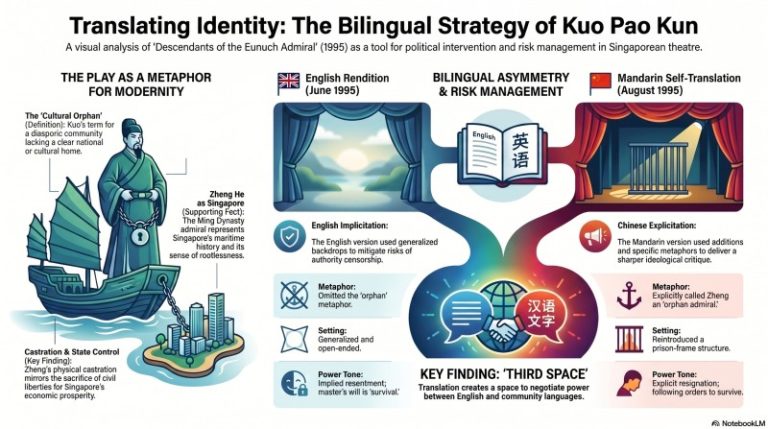
Kuo Pao Kun was a pivotal arts activist who used theatre to challenge the sociopolitical fabric of Singapore. Born in China and moving to Singapore, his work reflects the nation’s evolution from a colonial port to a thriving city-state where the government’s multiracialism policy (categorizing citizens as Chinese, Malay, Indian, and Others) regulated linguistic and cultural life. Kuo’s theatre serves as a “third space” where power relations between English and community languages are dynamically negotiated.
The Play: Descendants of the Eunuch Admiral
The play focuses on the historical figure of Zheng He, a Ming Dynasty eunuch admiral, as a metaphor for contemporary Singaporeans. Kuo portrays Singaporeans as “cultural orphans”—a diasporic community lacking clear national roots due to rapid modernization and the homogenization of culture. The play uses the motif of “castration” to symbolize the sacrifices made for material success and the loss of individual agency under state capitalism.
Translator Intervention and Risk Management
The study reveals significant differences between the English version (June 1995) and the Mandarin Chinese version (August 1995). Kuo utilized “implicitation” and “omission” in the English version to mitigate risks of censorship, while the Chinese version was more explicit in its critique of authority. For example, the metaphor of “ubiquitous eunuchs” representing widespread oppression was omitted in English to make the play more acceptable to the general public.
Conclusion
Kuo’s self-translation practices demonstrate that translation in theatre is not merely representational but a performative act of resistance. He proposed multiculturalism as a counternarrative to official discourse, advocating for an expanded cultural identity that embraces uncertainty and communication across diverse cultures.
References
- Baker, M. (2005). Narratives in and of translation. SKASE Journal of Translation and Interpretation, 1(1), 4–13.
- Baker, M. (2006). Translation and conflict. A narrative account. Routledge.
- Baines, R., Marinetti, C., & Perteghella, M. (Eds.). (2010). Staging and performing translation. Palgrave Macmillan.
- Banks, A. M. (2005). Moderating politics in post-conflict states. UCLA Journal of International Law and Foreign Affairs, 10(1), 1–65.
- Bauman, Z. (2012). Liquid modernity. Polity.
- Beaujard, P. (2005). The Indian Ocean in Eurasian and African world systems. Journal of World History, 16(4), 412.
- Benjamin, G. (1976). The cultural logic of Singapore’s ‘multiracialism’. In R. Hassan (Ed.), Singapore: Society in transition (pp. 115–33). Oxford University Press.
- Bhabha, H. (1994). The location of culture. Routledge.
- Bigliazzi, S., Ambrosi, A., & Kofler, P. (Eds.). (2013). Theatre translation in performance. Routledge.
- Billiani, F. (2007). Assessing boundaries: Censorship and translation. Routledge.
- Birch, D. (1993). Staging crises: Media and citizenship. Longman Cheshire.
- Curran, B. (2007). Theatre translation theory and performance in contemporary Japan. St. Jerome.
- Department of Statistics Singapore. (2020). Singapore census of population 2020.
- Davies, B., & Harre, R. (1990). Positioning: The discursive production of selves. Journal for the Theory of Social Behaviour, 20(1), 43–63.
- Diamond, C. (2012). Communities of imagination. University of Hawaii Press.
- Harper, T. N. (1999). The end of empire and the making of Malaya. Cambridge University Press.
- Koh, B. P. (1995a). Castration and corporate ladder. Straits Times.
- Koh, B. P. (1995b). She spins 300 times. Straits Times.
- Kong, L. (2000). Cultural policy in Singapore. Geoforum, 31(4), 409–424.
- Kong, L., Ching, C.-H., & Chou, T.-L. (2015). Arts, culture and the making of global cities. Edward Elgar.
- Kuo, P. K. (1988). Mama looking for her cat. Practice Theatre Ensemble.
- Kuo, P. K. (1995a). Descendants of the eunuch admiral. The Victoria Theatre.
- Kuo, P. K. (1995b). Zheng He De Hou Dai. The Theatre Practice.
- Kuo, P. K. (2000). Images at the margins. Times Media.
- Kuo, P. K. (2003). Two plays by Kuo Pao Kun. SNP.
- Kuo, P. K. (2008). The complete works of Kuo Pao Kun. The Theatre Practice and Global Publishing.
- Kwok, K.-W. (2001). Chinese-educated intellectuals in Singapore. Asian Journal of Social Science, 29(3), 495–519.
- Kwok, K.-W., & Low, K.-H. (2002). Cultural policy and the city-state. Routledge.
- Langenbach, R. (2004). Jacked-off with no pleasure: Censorship and the necessary stage. Times Editions.
- Leng, R. (2016). Kuo Pao Kun’s Zheng He legend. Southeast Asian Studies, 5(2), 287–303.
- Lee, T. K. (2013). Translating anglophobia. Target, 25(2), 228–251.
- Li, W., & Lee, T. (2024). Transpositioning: Translanguaging and the liquidity of identity. Applied Linguistics, 45(5), 873–888.
- Marinetti, C. (2013). Translation and theatre. Target, 25(3), 307–320.
- Marinetti, C. (2022). Doubly invisible. Translation Studies, 15(3), 258–274.
- Mok, W. (1996). Keng Sen interview. TheatreWorks.
- O’Leary, C. (2018). Translating the armed struggle. Translation Studies, 11(1), 47–65.
- Oon, C. (2010). Reading Kuo Pao Kun’s early leftist plays. S/pores Journal.
- Pak, V., & Hiramoto, M. (2023). Sticky raciolinguistics. Signs and Society, 11(1), 45–67.
- Peterson, W. (2001). Theater and the politics of culture in contemporary Singapore. Wesleyan University Press.
- Philip, S. (2008). (En)Gendering the nation. SARE, 48(1), 67–80.
- Philip, S. (2009). Kuo Pao Kun’s Descendants. Routledge.
- Proust, M. (1931). Time regained. Chatto & Windus.
- Pym, A. (2015). Translating as risk management. Journal of Pragmatics, 85, 67–80.
- Quah, S. R. (2004). Form as ideology. Times Edition.
- Quah, S. R. (2020). Intellectual consciousness. Inter-Asia Cultural Studies, 21(2), 2229–2250.
- Rocha, Z. L., & Yeoh, B. (2021). Managing the complexities of race. Journal of Ethnic and Migration Studies, 47(4), 878–894.
- Siddique, S. (1989). Singaporean identity. Institute of Southeast Asian Studies.
- Tan, C. (2015). Why Kuo Pao Kun’s Descendants matters. Straits Times.
- Teo, T.-A. (2022). Minstrelsy beyond the ‘West’. Journal of Intercultural Studies, 43(1), 1–22.
- Tymoczko, M. (2008). Censorship and self-censorship in translation. Four Courts Press.
- van Langenhove, L., & Harre, R. (1999). Introducing positioning theory. Blackwell.
- Verges, F. (2003). Writing on water. Positions, 11(1), 241–257.
- Wee, C. J. W.-L. (2003a). Special issue Kuo Pao Kun. Inter-Asia Cultural Studies, 21(2).
- Wee, C. J. W.-L. (2003b). Creating high culture. The Drama Review, 47(4), 84–97.
- Wee, C. J. W.-L. (2015). Culture, the arts, and the global city. Edward Elgar Publishing.
- Wee, C. J. W.-L. (2020). Beyond national identity. Inter-Asia Cultural Studies, 21(2), 251–265.
- Wee, C. J. W.-L., & Lee, K. (2003). Two Plays by Kuo Pao Kun. SNP.
- Zatlin, P. (2005). Theatre translation and film adaptation. Multilingual Matters.
For professional services, please visit: https://www.seaproti.org/practitioners/
About certified translators, translation certifiers, and certified interpreters associated with SEAProTI. The Southeast Asian Association of Professional Translators and Interpreters (SEAProTI) has officially shared the qualifications and requirements for becoming Certified Translators, Translation Certification Providers, and Certified Interpreters in Sections 9 and 10 of the Royal Gazette, which was published by the Prime Minister’s Office in Thailand on July 25, 2024. Certified Translators, Translation Certification Providers, and Certified Interpreters
The Council of State has proposed the enactment of a Royal Decree, granting registered translators and recognised translation certifiers from professional associations or accredited language institutions the authority to provide legally valid translation certification (Letter to SEAProTI dated April 28, 2025)
SEAProTI is the first professional association in Thailand and Southeast Asia to implement a comprehensive certification system for translators, certifiers, and interpreters.
Head Office: Baan Ratchakru Building, No. 33, Room 402, Soi Phahonyothin 5, Phahonyothin Road, Phaya Thai District, Bangkok 10400, Thailand
Email: hello@seaproti.com | Tel.: (+66) 2-114-3128 (Office hours: Mon–Fri, 09:00–17:00).
คนแปลกหน้าในหมู่คนแปลกหน้า: การแปลอัตลักษณ์พหุวัฒนธรรมในละครเวทีร่วมสมัยของสิงคโปร์
ผู้เขียน: เภตรา โบรด
12 พฤษภาคม 2569, กรุงเทพมหานคร – บทความนี้ศึกษาบทบาทที่ซ้อนทับกันของ กัว เป่า คุน (1939-2002) ในฐานะนักแปลและนักเขียนบทละคร ผู้ซึ่งได้รับการยกย่องว่าเป็นเสาหลักของละครเวทีร่วมสมัยในสิงคโปร์ งานวิจัยนี้วิเคราะห์บทละครที่เขาแปลด้วยตนเองเรื่อง Descendants of the Eunuch Admiral (1995) เพื่อชี้ให้เห็นว่ากัวจัดการกับความตึงเครียดระหว่างนโยบาย “พหุเชื้อชาติ” (Multiracialism) ของรัฐ กับวิสัยทัศน์ “พหุวัฒนธรรม” (Multiculturalism) ของเขาอย่างไร
บทนำ
กัว เป่า คุน เป็นนักกิจกรรมทางศิลปะคนสำคัญที่ใช้ละครเวทีเป็นเครื่องมือท้าทายโครงสร้างทางสังคมและการเมืองของสิงคโปร์ ผลงานของเขาสะท้อนภาพการเปลี่ยนผ่านของสิงคโปร์จากเมืองท่าอาณานิคมสู่รัฐที่รุ่งเรือง ซึ่งรัฐใช้นโยบายพหุเชื้อชาติในการควบคุมวิถีชีวิตทางวัฒนธรรมและภาษา ละครของกัวเปรียบเสมือน “พื้นที่ที่สาม” (Third space) ที่เปิดโอกาสให้มีการต่อรองอำนาจระหว่างภาษาอังกฤษและภาษาของกลุ่มชาติพันธุ์ต่างๆ อย่างมีพลวัต
บทละคร
บทละครเรื่องนี้ใช้ตัวละครทางประวัติศาสตร์อย่าง เจิ้งเหอ (Zheng He) แม่ทัพขันทีแห่งราชวงศ์หมิง เป็นสัญลักษณ์แทนชาวสิงคโปร์ร่วมสมัย กัวนำเสนอว่าชาวสิงคโปร์เปรียบเสมือน “กำพร้าทางวัฒนธรรม” (Cultural orphans) ซึ่งเป็นกลุ่มคนพลัดถิ่นที่ขาดรากเหง้าอันชัดเจนเนื่องจากการพัฒนาสู่ความทันสมัยอย่างรวดเร็ว นอกจากนี้ยังมีการใช้สัญลักษณ์ “การตอน” (Castration) เพื่อสื่อถึงการสูญเสียตัวตนและเสรีภาพส่วนบุคคลเพื่อแลกกับความสำเร็จทางวัตถุภายใต้ระบบทุนนิยมโดยรัฐ
การแทรกแซงโดยนักแปลและการบริหารความเสี่ยง
งานวิจัยพบความแตกต่างที่สำคัญระหว่างบทละครเวอร์ชันภาษาอังกฤษและภาษาจีน กัวใช้กลยุทธ์ “การไม่กล่าวถึง” (Omission) ในเวอร์ชันภาษาอังกฤษเพื่อลดความเสี่ยงจากการถูกเซ็นเซอร์ ในขณะที่เวอร์ชันภาษาจีนมีการวิพากษ์วิจารณ์อำนาจรัฐอย่างตรงไปตรงมามากกว่า เช่น การตัดอุปมาเรื่อง “ขันทีที่มีอยู่ทุกหนทุกแห่ง” ในเวอร์ชันภาษาอังกฤษ เพื่อให้ผลงานเป็นที่ยอมรับในวงกว้างมากขึ้น
บทสรุป
การแปลของกัวแสดงให้เห็นว่า การแปลในละครเวทีไม่ใช่เพียงการถ่ายทอดความหมาย แต่เป็นการแสดงออกเพื่อต่อต้านอำนาจ เขาเสนอว่าพหุวัฒนธรรมคือเรื่องเล่าที่สวนทางกับวาทกรรมหลักของรัฐ เพื่อสร้างอัตลักษณ์ทางวัฒนธรรมที่เปิดกว้างและยอมรับความแตกต่างหลากหลาย
เอกสารอ้างอิง
- เบเกอร์, เอ็ม. (2005). Narratives in and of translation. SKASE Journal of Translation and Interpretation, 1(1), 4–13.
- เบเกอร์, เอ็ม. (2006). Translation and conflict. A narrative account. Routledge.
- เบนส์, อาร์., มาริเนตตี, ซี., และ เพอร์เทเกลลา, เอ็ม. (บรรณาธิการ). (2010). Staging and performing translation. Palgrave Macmillan.
- แบงก์ส, เอ. เอ็ม. (2005). Moderating politics in post-conflict states. UCLA Journal of International Law and Foreign Affairs, 10(1), 1–65.
- โบแมน, แซด. (2012). Liquid modernity. Polity.
- โบชารด์, พี. (2005). The Indian Ocean in Eurasian and African world systems. Journal of World History, 16(4), 412.
- เบนจามิน, จี. (1976). The cultural logic of Singapore’s ‘multiracialism’. Oxford University Press.
- บาบา, เอช. (1994). The location of culture. Routledge.
- บิเกลียซซี, เอส., แอมโบรซี, เอ., และ คอฟเลอร์, พี. (บรรณาธิการ). (2013). Theatre translation in performance. Routledge.
- บิลเลียนี, เอฟ. (2007). Assessing boundaries: Censorship and translation. Routledge.
- เบิร์ช, ดี. (1993). Staging crises: Media and citizenship. Longman Cheshire.
- เคอร์รัน, บี. (2007). Theatre translation theory and performance in contemporary Japan. St. Jerome.
- กรมสถิติสิงคโปร์. (2020). Singapore census of population 2020.
- เดวีส์, บี., และ ฮาร์เร, อาร์. (1990). Positioning: The discursive production of selves. Journal for the Theory of Social Behaviour, 20(1), 43–63.
- ไดมอนด์, ซี. (2012). Communities of imagination. University of Hawaii Press.
- ฮาร์เปอร์, ที. เอ็น. (1999). The end of empire and the making of Malaya. Cambridge University Press.
- โกะห์, บี. พี. (1995ก). Castration and corporate ladder. Straits Times.
- โกะห์, บี. พี. (1995ข). She spins 300 times. Straits Times.
- คง, แอล. (2000). Cultural policy in Singapore. Geoforum, 31(4), 409–424.
- คง, แอล., ชิง, ซี.-เอช., และ โจว, ที.-แอล. (2015). Arts, culture and the making of global cities. Edward Elgar.
- กัว, เป่า คุน. (1988). Mama looking for her cat. Practice Theatre Ensemble.
- กัว, เป่า คุน. (1995ก). Descendants of the eunuch admiral. The Victoria Theatre.
- กัว, เป่า คุน. (1995ข). Zheng He De Hou Dai. The Theatre Practice.
- กัว, เป่า คุน. (2000). Images at the margins. Times Media.
- กัว, เป่า คุน. (2003). Two plays by Kuo Pao Kun. SNP.
- กัว, เป่า คุน. (2008). The complete works of Kuo Pao Kun. The Theatre Practice and Global Publishing.
- กว๊อก, เค.-ดับเบิลยู. (2001). Chinese-educated intellectuals in Singapore. Asian Journal of Social Science, 29(3), 495–519.
- กว๊อก, เค.-ดับเบิลยู., และ โลว์, เค.-เอช. (2002). Cultural policy and the city-state. Routledge.
- ลางเกนบาค, อาร์. (2004). Jacked-off with no pleasure: Censorship and the necessary stage. Times Editions.
- เลง, อาร์. (2016). Kuo Pao Kun’s Zheng He legend. Southeast Asian Studies, 5(2), 287–303.
- ลี, ที. เค. (2013). Translating anglophobia. Target, 25(2), 228–251.
- หลี่, ดับเบิลยู., และ ลี, ที. (2024). Transpositioning: Translanguaging and the liquidity of identity. Applied Linguistics, 45(5), 873–888.
- มาริเนตตี, ซี. (2013). Translation and theatre. Target, 25(3), 307–320.
- มาริเนตตี, ซี. (2022). Doubly invisible. Translation Studies, 15(3), 258–274.
- มก, ดับเบิลยู. (1996). Keng Sen interview. TheatreWorks.
- โอเลียรี, ซี. (2018). Translating the armed struggle. Translation Studies, 11(1), 47–65.
- อุน, ซี. (2010). Reading Kuo Pao Kun’s early leftist plays. S/pores Journal.
- พัค, วี., และ ฮิราโมโตะ, เอ็ม. (2023). Sticky raciolinguistics. Signs and Society, 11(1), 45–67.
- ปีเตอร์สัน, ดับเบิลยู. (2001). Theater and the politics of culture in contemporary Singapore. Wesleyan University Press.
- ฟิลิป, เอส. (2008). (En)Gendering the nation. SARE, 48(1), 67–80.
- ฟิลิป, เอส. (2009). Kuo Pao Kun’s Descendants. Routledge.
- พรูสต์, เอ็ม. (1931). Time regained. Chatto & Windus.
- พิม, เอ. (2015). Translating as risk management. Journal of Pragmatics, 85, 67–80.
- กัวะห์, เอส. อาร์. (2004). Form as ideology. Times Edition.
- กัวะห์, เอส. อาร์. (2020). Intellectual consciousness. Inter-Asia Cultural Studies, 21(2), 2229–2250.
- โรชา, แซด. แอล., และ เยียะห์, บี. (2021). Managing the complexities of race. Journal of Ethnic and Migration Studies, 47(4), 878–894.
- ซิดดิก, เอส. (1989). Singaporean identity. Institute of Southeast Asian Studies.
- ตัน, ซี. (2015). Why Kuo Pao Kun’s Descendants matters. Straits Times.
- เทียว, ที.-เอ. (2022). Minstrelsy beyond the ‘West’. Journal of Intercultural Studies, 43(1), 1–22.
- ทีโมซโก, เอ็ม. (2008). Censorship and self-censorship in translation. Four Courts Press.
- ฟาน ลางเกนโฮฟ, แอล., และ ฮาร์เร, อาร์. (1999). Introducing positioning theory. Blackwell.
- แวร์เฌส, เอฟ. (2003). Writing on water. Positions, 11(1), 241–257.
- วี, ซี. เจ. ดับเบิลยู.-แอล. (2003ก). Special issue Kuo Pao Kun. Inter-Asia Cultural Studies, 21(2).
- วี, ซี. เจ. ดับเบิลยู.-แอล. (2003ข). Creating high culture. The Drama Review, 47(4), 84–97.
- วี, ซี. เจ. ดับเบิลยู.-แอล. (2015). Culture, the arts, and the global city. Edward Elgar Publishing.
- วี, ซี. เจ. ดับเบิลยู.-แอล. (2020). Beyond national identity. Inter-Asia Cultural Studies, 21(2), 251–265.
- วี, ซี. เจ. ดับเบิลยู.-แอล., และ ลี, เค. (2003). Two Plays by Kuo Pao Kun. SNP.
- แซตลิน, พี. (2005). Theatre translation and film adaptation. Multilingual Matters.
สมาคมวิชาชีพนักแปลและล่ามแห่งเอเชียตะวันออกเฉียงใต้ (SEAProTI) ได้ประกาศหลักเกณฑ์และคุณสมบัติของผู้ที่ขึ้นทะเบียนเป็น “นักแปลรับรอง (Certified Translators) และผู้รับรองการแปล (Translation Certification Providers) และล่ามรับรอง (Certified Interpreters)” ของสมาคม หมวดที่ 9 และหมวดที่ 10 ในราชกิจจานุเบกษา ของสำนักเลขาธิการคณะรัฐมนตรี ในสำนักนายกรัฐมนตรี แห่งราชอาณาจักรไทย ลงวันที่ 25 ก.ค. 2567 เล่มที่ 141 ตอนที่ 66 ง หน้า 100 อ่านฉบับเต็มได้ที่: นักแปลรับรอง ผู้รับรองการแปล และล่ามรับรอง
สำนักคณะกรรมการกฤษฎีกาเสนอให้ตราเป็นพระราชกฤษฎีกา โดยกำหนดให้นักแปลที่ขึ้นทะเบียน รวมถึงผู้รับรองการแปลจากสมาคมวิชาชีพหรือสถาบันสอนภาษาที่มีการอบรมและขึ้นทะเบียน สามารถรับรองคำแปลได้ (จดหมายถึงสมาคม SEAProTI ลงวันที่ 28 เม.ย. 2568)
สมาคมวิชาชีพนักแปลและล่ามแห่งเอเชียตะวันออกเฉียงใต้เป็นสมาคมวิชาชีพแห่งแรกและแห่งเดียวในประเทศไทยและภูมิภาคเอเชียตะวันออกเฉียงใต้ที่มีระบบรับรองนักแปลรับรอง ผู้รับรองการแปล และล่ามรับรอง
สำนักงานใหญ่: อาคารบ้านราชครู เลขที่ 33 ห้อง 402 ซอยพหลโยธิน 5 ถนนพหลโยธิน แขวงพญาไท เขตพญาไท กรุงเทพมหานคร 10400 ประเทศไทย