


The Reform of Thailand’s Alcohol Sales Regulations in 2025: Legal Implications, Tourism, Hospitality Businesses, and the Role of Certified Translators and Certified Interpreters in the Context of International Law
Author: Phakaporn Tanjararak
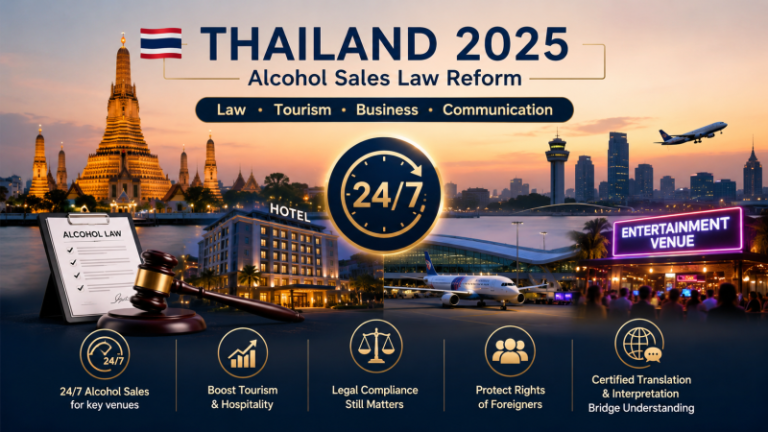
18 May 2026, Bangkok – This article aims to examine the amendments to Thailand’s alcohol control regulations in 2025, which permit certain venues to sell alcoholic beverages twenty-four hours a day, particularly legally registered hotels, international airports, and licensed entertainment venues under Thai law. Such legal changes reflect the Thai government’s broader policy direction toward promoting the tourism economy and the hospitality industry while maintaining legal restrictions on alcohol sales in general public areas. The article further analyzes the implications for foreign nationals, investors, entrepreneurs, and tourists who must navigate the complexity of Thai legal regulations. In addition, this study highlights the significant role of certified translators, translation certification providers, and certified interpreters affiliated with the Southeast Asian Association of Translators and Interpreters in legal document translation, cross-cultural legal communication, and the protection of foreigners’ legal rights. This study employs documentary analysis of legal materials, governmental announcements, and theoretical perspectives from jurisprudence and legal translation studies to explain the evolving dynamics of alcohol control law in contemporary Thailand.
Introduction
Thailand has long maintained a strict regulatory system governing the sale of alcoholic beverages. The state imposed limited time periods during which alcohol could legally be sold and prohibited alcohol sales on important Buddhist holy days. However, in 2025, the Thai government introduced reforms to the country’s alcohol control regulations in order to support the tourism and hospitality sectors, which had been affected by increasing international economic competition. These legal reforms represent a significant development in Thai public policy because they relax time restrictions on alcohol sales for certain establishments associated with international tourism.
Under the new regulations, hotels registered under Thailand’s Hotel Act, international airports operating overseas flights, and entertainment venues licensed under Thailand’s Entertainment Venue Act are permitted to sell alcoholic beverages twenty-four hours a day. This differs substantially from previous regulations that allowed alcohol sales only during the periods of 11:00 a.m.–2:00 p.m. and 5:00 p.m.–12:00 a.m. Furthermore, the Thai government also authorized alcohol sales on selected Buddhist holy days under specific conditions for tourism-related venues (Office of the Prime Minister, 2025).
These legal changes directly affect foreign nationals, investors, hotel operators, and tourists who must accurately understand Thai law, especially because the regulations contain complex provisions and venue-specific exemptions. Consequently, the role of certified translators, translation certification providers, and certified interpreters has become increasingly important in ensuring accurate legal communication and reducing the risks of unintentional violations of Thai law.
The Development of Alcohol Control Regulations in Thailand
Before the 2025 legal amendments, Thailand permitted most vendors and businesses to sell alcoholic beverages only between 11:00 a.m.–2:00 p.m. and 5:00 p.m.–12:00 a.m. Alcohol sales were also prohibited on major Buddhist holy days, including Makha Bucha Day, Visakha Bucha Day, Asarnha Bucha Day, Buddhist Lent Day, and the End of Buddhist Lent. These policies reflected the influence of Buddhist moral principles and public health perspectives aimed at regulating alcohol consumption within Thai society.
Nevertheless, the Thai government later adjusted its policy by allowing certain venues to sell alcoholic beverages on Buddhist holidays, including international airports, entertainment venues, hotels, chartered trains, tourist attractions, and sites hosting national or international events. The purpose of these reforms was to facilitate international tourism and enhance the competitiveness of Thailand’s tourism industry (Ministry of Tourism and Sports, 2025).
Subsequently, on June 27, 2025, the new regulations were officially published in the Royal Gazette and immediately came into legal effect. As a result, designated venues became legally authorized to sell alcoholic beverages twenty-four hours a day, marking one of the most significant reforms in Thailand’s alcohol control policy in recent decades.
Impacts on Tourism and the Hospitality Economy
The relaxation of time restrictions on alcohol sales is directly linked to the Thai government’s economic strategy of promoting international tourism. Since Thailand relies heavily on tourism revenue, facilitating convenience for foreign visitors has become a major public policy objective. Scholars in tourism economics argue that excessively restrictive regulations may negatively affect tourist satisfaction and reduce Thailand’s competitiveness compared with neighboring countries (Teerachai, 2024).
Moreover, permitting hotels and entertainment venues to sell alcoholic beverages around the clock creates additional business opportunities for hospitality entrepreneurs, particularly in major tourist destinations such as Bangkok, Phuket, Pattaya, and Chiang Mai, where large numbers of international tourists travel annually. Nonetheless, the regulations continue to restrict alcohol sales in convenience stores, supermarkets, and general retail businesses in order to maintain a balance between economic promotion and social regulation.
Legal Implications for Foreign Nationals and Tourists
Although the new regulations relax certain restrictions, many provisions remain legally enforceable, particularly the prohibition on alcohol sales between 12:00 a.m.–11:00 a.m. and 2:00 p.m.–5:00 p.m. for ordinary retail establishments. Foreign tourists unfamiliar with Thai law may mistakenly assume that alcohol can be sold freely throughout the country, potentially resulting in unintentional legal violations by both consumers and business operators.
In some cases, foreign entrepreneurs may encounter legal complications relating to licensing requirements, the interpretation of legal exemptions, or communication with Thai governmental authorities. Such situations require accurately translated and properly certified legal documents. Even minor translation inaccuracies may affect legal status, business operations, or court proceedings (Supawadee, 2023).
The Role of Certified Translators, Translation Certification Providers, and Certified Interpreters
Within the context of international law and cross-border tourism, certified translators and certified interpreters play a critical role in supporting legal processes and facilitating legal communication, particularly when foreign nationals interact with Thai governmental agencies, hotels, tourism companies, courts, or immigration offices.
Certified translators affiliated with the Southeast Asian Association of Translators and Interpreters are responsible for translating legal documents related to business licenses, company registrations, commercial contracts, alcohol regulations, and official governmental documents in accordance with legal and linguistic standards. Translation certification is essential for ensuring the credibility and legal reliability of documents used in administrative and judicial procedures.
At the same time, translation certification providers are responsible for reviewing the accuracy of translated content, verifying consistency in legal terminology, and ensuring the completeness of documents before their submission to courts or governmental institutions. Such certification procedures help minimize the risks of legal misinterpretation that could adversely affect the rights of foreign nationals or international business operators.
Certified interpreters also play an indispensable role in situations involving investigations, litigation, business negotiations, and communication with state authorities. Certified interpreters must accurately and impartially convey legal meanings while remaining sensitive to cultural contexts, as interpretation errors may lead to violations of the fundamental rights of foreign individuals (Southeast Asian Association of Translators and Interpreters, 2022).
In the context of Thailand’s alcohol regulations, certified translators and interpreters additionally contribute to the preparation of multilingual public information materials, the translation of legal guidelines for tourists, and language consultation services for foreign business operators. These services enhance legal understanding and help reduce disputes between Thai authorities and foreign nationals.
Conclusion
The reform of Thailand’s alcohol control regulations in 2025 reflects the Thai government’s attempt to balance social regulation with the stimulation of the tourism economy. Although the relaxation of time restrictions on alcohol sales supports the hospitality sector and improves convenience for tourists, the regulations continue to contain complex provisions and venue-specific exemptions that may create confusion for foreign nationals and international entrepreneurs.
Within this context, certified translators, translation certification providers, and certified interpreters affiliated with the Southeast Asian Association of Translators and Interpreters play an essential role in promoting legal understanding, ensuring accurate communication, and protecting the rights of foreign nationals within legal and international business processes. Consequently, the professions of translation and interpretation should not be viewed merely as linguistic activities, but rather as crucial mechanisms of justice, intercultural administration, and globalized economic development in the contemporary world.
References
- Ministry of Tourism and Sports. (2025). Tourism Promotion Policies and the Relaxation of Alcohol Restrictions. Bangkok: Ministry of Tourism and Sports.
- Southeast Asian Association of Translators and Interpreters. (2022). Bangkok: Southeast Asian Association of Translators and Interpreters.
- Supawadee Jansakul. (2023). Legal Translation and Miscommunication in Cross-Linguistic Contexts. Chiang Mai: Chiang Mai University Press.
- Teerachai Wattanakul. (2024). “Tourism Economics and Alcohol Control Policies in Southeast Asia.” Journal of Tourism Economics, 12(2), 45–67.
- The Office of the Prime Minister. (2025). Announcement on the Amendment of Alcohol Sales Regulations (2025). Bangkok: Royal Gazette.
For professional services, please visit: https://www.seaproti.org/practitioners/
About certified translators, translation certifiers, and certified interpreters associated with SEAProTI. The Southeast Asian Association of Professional Translators and Interpreters (SEAProTI) has officially shared the qualifications and requirements for becoming Certified Translators, Translation Certification Providers, and Certified Interpreters in Sections 9 and 10 of the Royal Gazette, which was published by the Prime Minister’s Office in Thailand on July 25, 2024. Certified Translators, Translation Certification Providers, and Certified Interpreters
The Council of State has proposed the enactment of a Royal Decree, granting registered translators and recognised translation certifiers from professional associations or accredited language institutions the authority to provide legally valid translation certification (Letter to SEAProTI dated April 28, 2025)
SEAProTI is the first professional association in Thailand and Southeast Asia to implement a comprehensive certification system for translators, certifiers, and interpreters.
Head Office: Baan Ratchakru Building, No. 33, Room 402, Soi Phahonyothin 5, Phahonyothin Road, Phaya Thai District, Bangkok 10400, Thailand
Email: hello@seaproti.com | Tel.: (+66) 2-114-3128 (Office hours: Mon–Fri, 09:00–17:00).
การปรับปรุงกฎหมายการจำหน่ายเครื่องดื่มแอลกอฮอล์ของประเทศไทย พ.ศ. 2568: ผลกระทบทางกฎหมาย การท่องเที่ยว ธุรกิจบริการ และบทบาทของนักแปลรับรองและล่ามรับรองในบริบทกฎหมายระหว่างประเทศ
ผู้เขียน: ภคพร ตันจรารักษ์
18 พฤษภาคม 2569, กรุงเทพมหานคร – บทความนี้มีวัตถุประสงค์เพื่อศึกษาการแก้ไขกฎหมายควบคุมเครื่องดื่มแอลกอฮอล์ของประเทศไทยใน พ.ศ. 2568 ซึ่งอนุญาตให้สถานที่บางประเภทสามารถจำหน่ายเครื่องดื่มแอลกอฮอล์ได้ตลอด 24 ชั่วโมง โดยเฉพาะโรงแรมที่จดทะเบียนถูกต้องตามกฎหมาย ท่าอากาศยานนานาชาติ และสถานบันเทิงที่ได้รับใบอนุญาตตามกฎหมายไทย การเปลี่ยนแปลงดังกล่าวสะท้อนแนวโน้มของรัฐไทยในการส่งเสริมเศรษฐกิจการท่องเที่ยวและอุตสาหกรรมบริการ ภายใต้กรอบของการควบคุมทางกฎหมายที่ยังคงจำกัดการจำหน่ายในพื้นที่ทั่วไป บทความนี้ยังวิเคราะห์ผลกระทบต่อชาวต่างชาติ นักลงทุน ผู้ประกอบการ และนักท่องเที่ยวที่ต้องเผชิญกับความซับซ้อนของกฎหมายไทย ตลอดจนบทบาทสำคัญของนักแปลรับรอง ผู้รับรองการแปล และล่ามรับรองของสมาคมวิชาชีพนักแปลและล่ามแห่งเอเชียตะวันออกเฉียงใต้ในการแปลเอกสารทางกฎหมาย การสื่อสารข้ามภาษา และการคุ้มครองสิทธิทางกฎหมายของบุคคลต่างชาติ งานศึกษานี้ใช้วิธีการวิเคราะห์เอกสารทางกฎหมาย ข่าวสารภาครัฐ และแนวคิดด้านนิติศาสตร์และการแปลเชิงกฎหมายเพื่ออธิบายพลวัตของกฎหมายเครื่องดื่มแอลกอฮอล์ในประเทศไทยร่วมสมัย
บทนำ
ประเทศไทยมีระบบควบคุมการจำหน่ายเครื่องดื่มแอลกอฮอล์ที่เข้มงวดมาเป็นเวลานาน โดยรัฐกำหนดช่วงเวลาที่สามารถจำหน่ายเครื่องดื่มแอลกอฮอล์ได้อย่างจำกัด รวมถึงห้ามจำหน่ายในวันสำคัญทางพระพุทธศาสนา อย่างไรก็ตาม ใน พ.ศ. 2568 รัฐบาลไทยได้ดำเนินการปรับปรุงกฎหมายควบคุมเครื่องดื่มแอลกอฮอล์ เพื่อสนับสนุนอุตสาหกรรมการท่องเที่ยวและภาคบริการ ซึ่งได้รับผลกระทบจากการแข่งขันทางเศรษฐกิจระดับนานาชาติ การเปลี่ยนแปลงดังกล่าวถือเป็นพัฒนาการสำคัญของนโยบายสาธารณะ เนื่องจากเป็นการผ่อนคลายข้อจำกัดด้านเวลาในการจำหน่ายแอลกอฮอล์แก่สถานประกอบการบางประเภทที่มีความเกี่ยวข้องกับการท่องเที่ยวระหว่างประเทศ
ภายใต้กฎหมายฉบับใหม่ โรงแรมที่จดทะเบียนตามพระราชบัญญัติโรงแรม ท่าอากาศยานนานาชาติที่มีเที่ยวบินระหว่างประเทศ และสถานบันเทิงที่ได้รับใบอนุญาตตามกฎหมายสถานบริการ สามารถจำหน่ายเครื่องดื่มแอลกอฮอล์ได้ตลอด 24 ชั่วโมง แตกต่างจากข้อกำหนดเดิมที่อนุญาตให้จำหน่ายได้เฉพาะช่วงเวลา 11.00–14.00 นาฬิกา และ 17.00–24.00 นาฬิกาเท่านั้น นอกจากนี้ รัฐบาลยังอนุญาตให้มีการจำหน่ายเครื่องดื่มแอลกอฮอล์ในวันสำคัญทางพระพุทธศาสนาบางวันภายใต้เงื่อนไขเฉพาะสำหรับสถานที่ที่เกี่ยวข้องกับการท่องเที่ยว (สำนักนายกรัฐมนตรี, พ.ศ. 2568)
การเปลี่ยนแปลงทางกฎหมายดังกล่าวส่งผลโดยตรงต่อชาวต่างชาติ นักลงทุน ผู้ประกอบการโรงแรม และนักท่องเที่ยวจำนวนมาก ซึ่งจำเป็นต้องทำความเข้าใจกฎหมายไทยอย่างถูกต้อง โดยเฉพาะเมื่อกฎหมายดังกล่าวมีรายละเอียดซับซ้อนและมีข้อยกเว้นเฉพาะสถานที่ ปัจจัยนี้ทำให้บทบาทของนักแปลรับรอง ผู้รับรองการแปล และล่ามรับรองมีความสำคัญอย่างยิ่งต่อการสื่อสารข้อมูลทางกฎหมายอย่างถูกต้องและการลดความเสี่ยงในการละเมิดกฎหมายไทย
พัฒนาการของกฎหมายควบคุมเครื่องดื่มแอลกอฮอล์ในประเทศไทย
ก่อนการแก้ไขกฎหมายใน พ.ศ. 2568 ประเทศไทยกำหนดให้ร้านค้าและผู้ประกอบการส่วนใหญ่สามารถจำหน่ายเครื่องดื่มแอลกอฮอล์ได้เฉพาะในช่วงเวลา 11.00–14.00 นาฬิกา และ 17.00–24.00 นาฬิกาเท่านั้น อีกทั้งยังห้ามจำหน่ายในวันสำคัญทางพระพุทธศาสนา เช่น วันมาฆบูชา วันวิสาขบูชา วันอาสาฬหบูชา วันเข้าพรรษา และวันออกพรรษา นโยบายดังกล่าวสะท้อนอิทธิพลของศีลธรรมทางพุทธศาสนาและแนวคิดด้านสาธารณสุขที่มุ่งควบคุมการบริโภคเครื่องดื่มแอลกอฮอล์ในสังคมไทย
อย่างไรก็ตาม รัฐบาลไทยได้ปรับเปลี่ยนนโยบายในเวลาต่อมา โดยอนุญาตให้สถานที่บางประเภทสามารถจำหน่ายเครื่องดื่มแอลกอฮอล์ในวันสำคัญทางพระพุทธศาสนาได้ ได้แก่ ท่าอากาศยานนานาชาติ สถานบันเทิง โรงแรม รถไฟเช่าเหมาลำ แหล่งท่องเที่ยว และสถานที่จัดงานระดับชาติหรือนานาชาติ การแก้ไขดังกล่าวมีเป้าหมายเพื่ออำนวยความสะดวกแก่นักท่องเที่ยวต่างชาติและเพิ่มขีดความสามารถในการแข่งขันของอุตสาหกรรมท่องเที่ยวไทย (กระทรวงการท่องเที่ยวและกีฬา, พ.ศ. 2568)
ต่อมา เมื่อวันที่ 27 มิถุนายน พ.ศ. 2568 กฎหมายฉบับใหม่ได้รับการประกาศในราชกิจจานุเบกษาและมีผลบังคับใช้ทันที ส่งผลให้สถานที่บางประเภทสามารถจำหน่ายเครื่องดื่มแอลกอฮอล์ได้ตลอด 24 ชั่วโมง ถือเป็นการเปลี่ยนแปลงครั้งสำคัญที่สุดของกฎหมายควบคุมเครื่องดื่มแอลกอฮอล์ไทยในรอบหลายปี
ผลกระทบต่ออุตสาหกรรมการท่องเที่ยวและเศรษฐกิจบริการ
การผ่อนคลายข้อจำกัดด้านเวลาการจำหน่ายเครื่องดื่มแอลกอฮอล์มีความสัมพันธ์โดยตรงกับยุทธศาสตร์เศรษฐกิจของรัฐบาลไทยที่มุ่งส่งเสริมการท่องเที่ยวระหว่างประเทศ เนื่องจากประเทศไทยพึ่งพารายได้จากการท่องเที่ยวในสัดส่วนสูง การอำนวยความสะดวกแก่นักท่องเที่ยวจึงกลายเป็นประเด็นสำคัญของนโยบายสาธารณะ นักวิชาการด้านเศรษฐศาสตร์การท่องเที่ยวชี้ว่า กฎระเบียบที่เข้มงวดเกินไปอาจส่งผลกระทบต่อความพึงพอใจของนักท่องเที่ยวและลดศักยภาพการแข่งขันกับประเทศเพื่อนบ้าน (ธีระชัย, พ.ศ. 2567)
นอกจากนี้ การอนุญาตให้โรงแรมและสถานบันเทิงจำหน่ายเครื่องดื่มแอลกอฮอล์ได้ตลอด 24 ชั่วโมง ยังช่วยเพิ่มโอกาสทางธุรกิจแก่ผู้ประกอบการภาคบริการ โดยเฉพาะในเมืองท่องเที่ยวสำคัญ เช่น กรุงเทพมหานคร ภูเก็ต พัทยา และเชียงใหม่ ซึ่งมีนักท่องเที่ยวต่างชาติเดินทางเข้ามาจำนวนมาก อย่างไรก็ตาม กฎหมายดังกล่าวยังคงจำกัดการจำหน่ายในร้านสะดวกซื้อ ซูเปอร์มาร์เก็ต และร้านค้าทั่วไป เพื่อรักษาสมดุลระหว่างการส่งเสริมเศรษฐกิจและการควบคุมผลกระทบทางสังคม
ผลกระทบทางกฎหมายต่อชาวต่างชาติและนักท่องเที่ยว
แม้ว่ากฎหมายฉบับใหม่จะผ่อนคลายข้อจำกัดบางประการ แต่ข้อกำหนดจำนวนมากยังคงมีผลบังคับใช้ โดยเฉพาะการห้ามจำหน่ายเครื่องดื่มแอลกอฮอล์ในช่วงเวลา 00.00–11.00 นาฬิกา และ 14.00–17.00 นาฬิกา สำหรับร้านค้าทั่วไป นักท่องเที่ยวต่างชาติที่ไม่เข้าใจกฎหมายไทยอาจเข้าใจผิดว่าการจำหน่ายเครื่องดื่มแอลกอฮอล์สามารถกระทำได้อย่างเสรีทั่วประเทศ ส่งผลให้เกิดการละเมิดกฎหมายโดยไม่เจตนา ทั้งในฐานะผู้ซื้อและผู้ประกอบการ
ในบางกรณี ผู้ประกอบการต่างชาติอาจเผชิญกับปัญหาด้านใบอนุญาต การตีความข้อยกเว้นทางกฎหมาย หรือการสื่อสารกับเจ้าหน้าที่รัฐไทย ซึ่งจำเป็นต้องใช้เอกสารทางกฎหมายที่แปลอย่างถูกต้องและได้รับการรับรอง ความคลาดเคลื่อนในการแปลเพียงเล็กน้อยอาจส่งผลต่อสถานะทางกฎหมาย การดำเนินธุรกิจ หรือการดำเนินคดีในศาลได้ (สุภาวดี, พ.ศ. 2566)
บทบาทของนักแปลรับรอง ผู้รับรองการแปล และล่ามรับรอง
ภายใต้บริบทของกฎหมายระหว่างประเทศและการท่องเที่ยวข้ามพรมแดน นักแปลรับรองและล่ามรับรองมีบทบาทสำคัญอย่างยิ่งในการสนับสนุนกระบวนการยุติธรรมและการสื่อสารทางกฎหมาย โดยเฉพาะในกรณีที่ชาวต่างชาติต้องติดต่อหน่วยงานรัฐไทย โรงแรม บริษัทท่องเที่ยว ศาล หรือสำนักงานตรวจคนเข้าเมือง
นักแปลรับรองของสมาคมวิชาชีพนักแปลและล่ามแห่งเอเชียตะวันออกเฉียงใต้มีหน้าที่แปลเอกสารทางกฎหมายที่เกี่ยวข้องกับใบอนุญาตประกอบธุรกิจ การจดทะเบียนบริษัท สัญญาทางพาณิชย์ ข้อกำหนดเกี่ยวกับเครื่องดื่มแอลกอฮอล์ และเอกสารราชการต่าง ๆ ให้มีความถูกต้องตามหลักกฎหมายและภาษาศาสตร์ การรับรองคำแปลมีความสำคัญต่อความน่าเชื่อถือของเอกสารในกระบวนการทางกฎหมายและการบริหารราชการ
ในขณะเดียวกัน ผู้รับรองการแปลมีบทบาทในการตรวจสอบความถูกต้องของเนื้อหา ความสอดคล้องของศัพท์กฎหมาย และความครบถ้วนของเอกสารก่อนนำไปใช้ต่อหน่วยงานราชการหรือศาล การรับรองดังกล่าวช่วยลดความเสี่ยงของการตีความผิดพลาดที่อาจส่งผลต่อสิทธิของชาวต่างชาติหรือผู้ประกอบการระหว่างประเทศ
สำหรับล่ามรับรอง บทบาทมีความสำคัญอย่างยิ่งในสถานการณ์ที่เกี่ยวข้องกับการสอบสวน การดำเนินคดี การเจรจาทางธุรกิจ และการสื่อสารกับหน่วยงานรัฐ ล่ามรับรองต้องสามารถถ่ายทอดความหมายทางกฎหมายได้อย่างแม่นยำ เป็นกลาง และสอดคล้องกับบริบททางวัฒนธรรม เนื่องจากความผิดพลาดในการล่ามอาจนำไปสู่การละเมิดสิทธิขั้นพื้นฐานของบุคคลต่างชาติได้ (สมาคมวิชาชีพนักแปลและล่ามแห่งเอเชียตะวันออกเฉียงใต้, พ.ศ. 2565)
ในบริบทของกฎหมายเครื่องดื่มแอลกอฮอล์ นักแปลและล่ามรับรองยังมีบทบาทในการจัดทำเอกสารประชาสัมพันธ์หลายภาษา การแปลข้อกำหนดทางกฎหมายสำหรับนักท่องเที่ยว และการให้คำปรึกษาด้านภาษาสำหรับผู้ประกอบการต่างชาติ ซึ่งช่วยส่งเสริมความเข้าใจทางกฎหมายและลดข้อพิพาทระหว่างภาครัฐกับชาวต่างชาติ
สรุป
การแก้ไขกฎหมายควบคุมเครื่องดื่มแอลกอฮอล์ของประเทศไทยใน พ.ศ. 2568 สะท้อนถึงความพยายามของรัฐไทยในการสร้างสมดุลระหว่างการควบคุมทางสังคมกับการกระตุ้นเศรษฐกิจการท่องเที่ยว แม้ว่าการผ่อนคลายข้อจำกัดด้านเวลาการจำหน่ายเครื่องดื่มแอลกอฮอล์จะช่วยสนับสนุนภาคบริการและเพิ่มความสะดวกแก่นักท่องเที่ยว แต่กฎหมายดังกล่าวยังคงมีรายละเอียดซับซ้อนและข้อยกเว้นเฉพาะที่อาจสร้างความสับสนแก่ชาวต่างชาติและผู้ประกอบการระหว่างประเทศ
ภายใต้บริบทดังกล่าว นักแปลรับรอง ผู้รับรองการแปล และล่ามรับรองของสมาคมวิชาชีพนักแปลและล่ามแห่งเอเชียตะวันออกเฉียงใต้จึงมีบทบาทสำคัญในการสร้างความเข้าใจทางกฎหมาย ถ่ายทอดข้อมูลอย่างถูกต้อง และคุ้มครองสิทธิของบุคคลต่างชาติในกระบวนการทางกฎหมายและธุรกิจระหว่างประเทศ อาชีพด้านการแปลและล่ามจึงไม่ได้เป็นเพียงการถ่ายทอดภาษาเท่านั้น หากแต่เป็นกลไกสำคัญของความยุติธรรม การบริหารจัดการระหว่างวัฒนธรรม และการพัฒนาเศรษฐกิจโลกาภิวัตน์ร่วมสมัย
เอกสารอ้างอิง
- กระทรวงการท่องเที่ยวและกีฬา. (พ.ศ. 2568). นโยบายส่งเสริมการท่องเที่ยวและการผ่อนคลายข้อจำกัดด้านเครื่องดื่มแอลกอฮอล์. กรุงเทพมหานคร: กระทรวงการท่องเที่ยวและกีฬา
- สมาคมวิชาชีพนักแปลและล่ามแห่งเอเชียตะวันออกเฉียงใต้. (พ.ศ. 2565). กรุงเทพมหานคร: สมาคมวิชาชีพนักแปลและล่ามแห่งเอเชียตะวันออกเฉียงใต้.
- ธีระชัย วัฒนกุล. (พ.ศ. 2567). “เศรษฐกิจการท่องเที่ยวกับนโยบายควบคุมเครื่องดื่มแอลกอฮอล์ในเอเชียตะวันออกเฉียงใต้.” วารสารเศรษฐศาสตร์การท่องเที่ยว, 12(2), 45–67
- สำนักนายกรัฐมนตรี. (พ.ศ. 2568). ประกาศเกี่ยวกับการแก้ไขข้อกำหนดการจำหน่ายเครื่องดื่มแอลกอฮอล์ พ.ศ. 2568. กรุงเทพมหานคร: ราชกิจจานุเบกษา
- สุภาวดี จันทร์สกุล. (พ.ศ. 2566). การแปลกฎหมายและความคลาดเคลื่อนในการสื่อสารข้ามภาษา. เชียงใหม่: สำนักพิมพ์มหาวิทยาลัยเชียงใหม่
สมาคมวิชาชีพนักแปลและล่ามแห่งเอเชียตะวันออกเฉียงใต้ (SEAProTI) ได้ประกาศหลักเกณฑ์และคุณสมบัติของผู้ที่ขึ้นทะเบียนเป็น “นักแปลรับรอง (Certified Translators) และผู้รับรองการแปล (Translation Certification Providers) และล่ามรับรอง (Certified Interpreters)” ของสมาคม หมวดที่ 9 และหมวดที่ 10 ในราชกิจจานุเบกษา ของสำนักเลขาธิการคณะรัฐมนตรี ในสำนักนายกรัฐมนตรี แห่งราชอาณาจักรไทย ลงวันที่ 25 ก.ค. 2567 เล่มที่ 141 ตอนที่ 66 ง หน้า 100 อ่านฉบับเต็มได้ที่: นักแปลรับรอง ผู้รับรองการแปล และล่ามรับรอง
สำนักคณะกรรมการกฤษฎีกาเสนอให้ตราเป็นพระราชกฤษฎีกา โดยกำหนดให้นักแปลที่ขึ้นทะเบียน รวมถึงผู้รับรองการแปลจากสมาคมวิชาชีพหรือสถาบันสอนภาษาที่มีการอบรมและขึ้นทะเบียน สามารถรับรองคำแปลได้ (จดหมายถึงสมาคม SEAProTI ลงวันที่ 28 เม.ย. 2568)
สมาคมวิชาชีพนักแปลและล่ามแห่งเอเชียตะวันออกเฉียงใต้เป็นสมาคมวิชาชีพแห่งแรกและแห่งเดียวในประเทศไทยและภูมิภาคเอเชียตะวันออกเฉียงใต้ที่มีระบบรับรองนักแปลรับรอง ผู้รับรองการแปล และล่ามรับรอง
สำนักงานใหญ่: อาคารบ้านราชครู เลขที่ 33 ห้อง 402 ซอยพหลโยธิน 5 ถนนพหลโยธิน แขวงพญาไท เขตพญาไท กรุงเทพมหานคร 10400 ประเทศไทย