



The impact of subtitle speed and individual differences on subtitle processing in L1 and L2: an eye-tracking study on intralingual English subtitles
Author: Petra Bordt
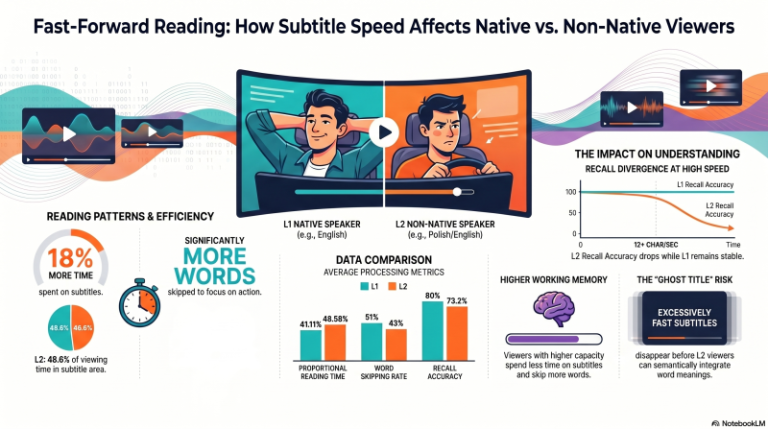
May 8, 2026, Bangkok – This study investigates the impact of subtitle speed on native English speakers (L1) and non-native speakers (L2-Polish). As global streaming platforms like Netflix drive subtitle speeds higher (up to 20 characters per second), understanding how viewers process this information becomes critical. Using eye-tracking technology, the research monitors reading patterns, word skipping, and recall accuracy across different language cohorts.
Introduction Subtitle viewing habits are shifting, with younger generations like Gen Z increasingly choosing to watch content with subtitles even in their native language. The rise of automation and fast-paced editing has led to faster subtitle speeds, raising questions about whether viewers can keep up,. This study treats speed as a continuous variable to reflect real-world viewing conditions more accurately.
Methodology and Results The study tested 83 participants (33 L1 and 50 L2) watching video clips from the film Don’t Look Up,. Key eye-tracking measures included Gaze Duration (GD), Total Time (TT), and Proportional Reading Time (PRT).
Language Effect: L2 speakers were more affected by fast subtitles, spending more time in the subtitle area and skipping fewer words than L1 speakers,.
Speed Effect: As subtitle speed increased, time spent reading (PRT) rose, and recall accuracy for L2 speakers declined,.
Individual Differences: Factors like age, working memory (WM), and prior familiarity with the video significantly influenced how viewers interacted with the subtitles,,.
Conclusion The findings highlight that while native speakers can often handle faster subtitles, non-native speakers experience higher cognitive loads and reduced recall at high speeds,. This suggests that for educational or L2 learning contexts, slower subtitle speeds are necessary for effective comprehension.
References
- Baddeley, A. D. (2007). Working Memory, Thought, and Action. Oxford University Press.
- Bairstow, D., & Lavaur, J. M. (2012). Audiovisual Information Processing by Monolinguals and Bilinguals: Effects of Intralingual and Interlingual Subtitles. Rodopi.
- Bisson, M.-J., Van Heuven, W. J. B., Conklin, K., & Tunney, R. J. (2014). Processing of native and foreign language subtitles in films: An eye tracking study. Applied Psycholinguistics, 35(02).
- Clifton, C., Staub, A., & Rayner, K. (2007). Eye movements in reading words and sentences. Elsevier.
- Conklin, K., Alotaibi, S., Pellicer-Sanchez, A., & Vilkaite-Lozdiene, L. (2020). What eye-tracking tells us about reading-only and reading-while-listening in a first and second language. Second Language Research, 36(3).
- Conway, A. R. A., Kane, M. J., Bunting, M. F., Hambrick, D. Z., Wilhelm, O., & Engle, R. W. (2005). Working memory span tasks: A methodological review and user’s guide. Psychonomic Bulletin & Review, 12(5).
- Cop, U., Dirix, N., Van Assche, E. V. A., Drieghe, D., & Duyck, W. (2017). Reading a book in one or two languages? An eye movement study of cognate facilitation in L1 and L2 reading. Bilingualism, 20(4).
- Cop, U., Drieghe, D., & Duyck, W. (2015). Eye Movement Patterns in Natural Reading: A Comparison of Monolingual and Bilingual Reading of a Novel. PLoS ONE, 10(8).
- d’Ydewalle, G., & De Bruycker, W. (2007). Eye movements of children and adults while reading television subtitles. European Psychologist, 12(3).
- d’Ydewalle, G., Muylle, P., & Rensbergen, J. v. (1985). Attention shifts in partially redundant information situations. Elsevier.
- d’Ydewalle, G., Praet, C., Verfaillie, K., & Van Rensbergen, J. (1991). Watching subtitled television: automatic reading behavior. Communication Research, 18(5).
- d’Ydewalle, G., Van Rensbergen, J., & Pollet, J. (1987). Reading a message when the same message is available auditorily in another language: the case of subtitling. Elsevier.
- Danan, M. (2016). Enhancing listening with captions and transcripts: Exploring learner differences. Applied Language Learning, 26(2).
- Diaz-Cintas, J., & Remael, A. (2021). Subtitling. Concepts and Practices. Routledge.
- Drieghe, D., Brysbaert, M., Desmet, T., & De Baecke, C. (2004). Word skipping in reading: On the interplay of linguistic and visual factors. European Journal of Cognitive Psychology, 16(1-2).
- Ellis, N. C. (2001). Memory for language. Cambridge University Press.
- Gass, S., Winke, P., Isbell, D. R., & Ahn, J. (2019). How captions help people learn languages: A working-memory, eye-tracking study. Language Learning & Technology, 23(2).
- Godfroid, A. (2020). Eye tracking in second language acquisition and bilingualism: a research synthesis and methodological guide. Routledge.
- Greenwood, G. (2023). Younger TV viewers prefer to watch with subtitles on. The Times.
- Hagstrom, H., & Pedersen, J. (2022). Subtitles in the 2020s: The Influence of Machine Translation. Journal of Audiovisual Translation, 5(1).
- Harada, C. N., Natelson Love, M. C., & Triebel, K. L. (2013). Normal cognitive aging. Clinics in Geriatric Medicine, 29(4).
- Kliegl, R., Grabner, E., Rolfs, M., & Engbert, R. (2004). Length, frequency, and predictability effects of words on eye movements in reading. European Journal of Cognitive Psychology, 16(1-2).
- Koolstra, C. M., Van Der Voort, T. H. A., & d’Ydewalle, G. (1999). Lengthening the presentation time of subtitles on television: effects on children’s reading time and recognition. Communications, 24(4).
- Krejtz, I., Szarkowska, A., & Loginska, M. (2016). Reading function and content words in subtitled videos. Journal of Deaf Studies and Deaf Education, 21(2).
- Kruger, J.-L., Wisniewska, N., & Liao, S. (2022). Why subtitle speed matters: Evidence from word skipping and rereading. Applied Psycholinguistics, 43.
- Kruger, J. L., & Liao, S. (2023). Busting ghost titles on streaming services. Media for All 10 Conference, Antwerp.
- Kunzli, A., & Ehrensberger-Dow, M. (2011). Innovative subtitling: A reception study. John Benjamins.
- Lang, J., Vrzakova, H., & Mehtatalo, L. (2021). Modelling Gaze Behaviour in Subtitle Processing: The Effect of Structural and Lexical Properties. Journal of Audiovisual Translation, 4(1).
- Lee, M., & Revesz, A. (2020). Promoting grammatical development through captions and textual enhancement in multimodal input-based tasks. Studies in Second Language Acquisition, 42(3).
- Lemhofer, K., & Broersma, M. (2012). Introducing LexTALE: A quick and valid Lexical Test for Advanced Learners of English. Behavior Research Methods, 44(2).
- Liao, S., Yu, L., Kruger, J.-L., & Reichle, E. D. (2022). The impact of audio on the reading of intralingual versus interlingual subtitles: Evidence from eye movements. Applied Psycholinguistics, 41(1).
- Liao, S., Yu, L., Reichle, E. D., & Kruger, J.-L. (2021). Using Eye Movements to Study the Reading of Subtitles in Video. Scientific Studies of Reading, 25(5).
- Meteyard, L., & Davies, R. A. I. (2020). Best practice guidance for linear mixed-effects models in psychological science. Journal of Memory and Language, 112.
- Mitterer, H., & McQueen, J. M. (2009). Foreign subtitles help but native-language subtitles harm foreign speech perception. PLoS ONE, 4(11).
- Montero Perez, M. (2022). Second or foreign language learning through watching audio-visual input and the role of on-screen text. Language Teaching, 55(2).
- Munoz, C. (2017). The role of age and proficiency in subtitle reading. An eye-tracking study. System, 67.
- Netflix. (2020). Timed Text Style Guide: Subtitle Timing Guidelines.
- Netflix. (2021). English Timed Text Style Guide.
- Ofcom. (2024). Ensuring the quality of TV and on-demand services.
- Orrego-Carmona, D. (2015). The Reception of (Non)Professional Subtitling. Universitat Rovira i Virgili.
- Pedersen, J. (2018). From old tricks to Netflix: How local are interlingual subtitling norms for streamed television? Journal of Audiovisual Translation, 1(1).
- Perego, E., Del Missier, F., & Bottiroli, S. (2015). Dubbing versus subtitling in young and older adults: cognitive and evaluative aspects. Perspectives, 23(1).
- Perego, E., Del Missier, F., Porta, M., & Mosconi, M. (2010). The cognitive effectiveness of subtitle processing. Media Psychology, 13(3).
- Rayner, K. (1998). Eye Movements in Reading and Information Processing: 20 Years of Research. Psychological Bulletin, 124(3).
- Rayner, K., Pollatsek, A., Ashby, J., & Clifton, C. J. (2012). Psychology of Reading (2 ed.). Psychology Press.
- Rayner, K., Schotter, E. R., Masson, M. E., Potter, M. C., & Treiman, R. (2016). So Much to Read, So Little Time. Psychological Science in the Public Interest, 17(1).
- Rayner, K., Slattery, T. J., Drieghe, D., & Liversedge, S. P. (2011). Eye movements and word skipping during reading. Journal of Experimental Psychology: Human Perception and Performance, 37(2).
- Reichle, E. D. (2021). Computational Models of Reading: A Handbook. Oxford University Press.
- Romero-Fresco, P. (2015). Final thoughts: Viewing speed in subtitling. Peter Lang.
- Schroeder, S., Hyona, J., & Liversedge, S. P. (2015). Developmental eye-tracking research in reading. Journal of Cognitive Psychology, 27(5).
- Silva, B., Orrego-Carmona, D., & Szarkowska, A. (2022). Using linear mixed models to analyze data from eye-tracking research on subtitling. Translation Spaces, 11(1).
- Szarkowska, A. (2016a). Report on the results of an online survey on subtitle presentation times and line breaks in interlingual subtitling. Part 1.
- Szarkowska, A. (2016b). Report on the results of an online survey on subtitle presentation times and line breaks in interlingual subtitling. Part 2.
- Szarkowska, A., & Gerber-Moron, O. (2018). Viewers can keep up with fast subtitles: Evidence from eye movements. PLoS ONE, 13(6).
- Szarkowska, A., Ragni, V., Szkriba, S., Black, S., Orrego-Carmona, D., & Kruger, J.-L. (2024). Watching subtitled videos with the sound off affects viewers’ comprehension, cognitive load, immersion, enjoyment, and gaze patterns. PLoS ONE, 19(10).
- Szarkowska, A., Ragni, V., Szkriba, S., Orrego-Carmona, D., Black, S., Kruger, J.-L., & Krejtz, K. (2024). The impact of video and subtitle speed on subtitle reading: an eye-tracking replication study. Journal of Audiovisual Translation, 7.
- Szarkowska, A., Silva, B., & Orrego-Carmona, D. (2021). Effects of subtitle speed on proportional reading time. Translation, Cognition & Behavior, 4(2).
- Winke, P., Gass, S., & Sydorenko, T. (2010). The Effects of Captioning Videos Used for Foreign Language Listening Activities. Language Learning & Technology, 14(1).
- Winke, P., Gass, S., & Sydorenko, T. (2013). Factors Influencing the Use of Captions by Foreign Language Learners: An Eye-Tracking Study. The Modern Language Journal, 97(1).
- Wisniewska, N., & Mora, J. C. (2020). Can Captioned Video Benefit Second Language Pronunciation? Studies in Second Language Acquisition, 42(3).
For professional services, please visit: https://www.seaproti.org/practitioners/
About certified translators, translation certifiers, and certified interpreters associated with SEAProTI. The Southeast Asian Association of Professional Translators and Interpreters (SEAProTI) has officially shared the qualifications and requirements for becoming Certified Translators, Translation Certification Providers, and Certified Interpreters in Sections 9 and 10 of the Royal Gazette, which was published by the Prime Minister’s Office in Thailand on July 25, 2024. Certified Translators, Translation Certification Providers, and Certified Interpreters
The Council of State has proposed the enactment of a Royal Decree, granting registered translators and recognised translation certifiers from professional associations or accredited language institutions the authority to provide legally valid translation certification (Letter to SEAProTI dated April 28, 2025)
SEAProTI is the first professional association in Thailand and Southeast Asia to implement a comprehensive certification system for translators, certifiers, and interpreters.
Head Office: Baan Ratchakru Building, No. 33, Room 402, Soi Phahonyothin 5, Phahonyothin Road, Phaya Thai District, Bangkok 10400, Thailand
Email: hello@seaproti.com | Tel.: (+66) 2-114-3128 (Office hours: Mon–Fri, 09:00–17:00).
อิทธิพลของความเร็วซับไตเติลและความแตกต่างรายบุคคลต่อการประมวลผลซับไตเติลในภาษาแม่ (L1) และภาษาที่สอง (L2): การศึกษาด้วยเครื่องติดตามดวงตาในซับไตเติลภาษาอังกฤษ
ผู้เขียน: เภตรา โบรด
8 พฤษภาคม 2569, กรุงเทพมหานคร – งานวิจัยนี้ศึกษาผลกระทบของความเร็วซับไตเติลต่อผู้ชมที่ใช้ภาษาอังกฤษเป็นภาษาแม่ (L1) และผู้ชมที่ใช้ภาษาอังกฤษเป็นภาษาที่สอง (L2-โปแลนด์) ในยุคที่แพลตฟอร์มสตรีมมิ่งระดับโลกอย่าง Netflix เร่งความเร็วของซับไตเติลขึ้น (สูงสุดถึง 20 ตัวอักษรต่อวินาที) การทำความเข้าใจว่าผู้ชมประมวลผลข้อมูลเหล่านี้อย่างไรจึงมีความสำคัญอย่างยิ่ง ผู้วิจัยได้ใช้เทคโนโลยีการติดตามดวงตา (Eye-tracking) เพื่อวัดรูปแบบการอ่าน การข้ามคำ และความถูกต้องในการจดจำข้อมูลในกลุ่มภาษาที่แตกต่างกัน
บทนำ พฤติกรรมการชมซับไตเติลกำลังเปลี่ยนไป โดยเฉพาะในกลุ่ม Gen Z ที่นิยมเปิดซับไตเติลแม้จะชมเนื้อหาในภาษาแม่ของตนเองก็ตาม การนำระบบอัตโนมัติมาใช้และการตัดต่อที่รวดเร็วส่งผลให้ความเร็วของซับไตเติลเพิ่มสูงขึ้น นำไปสู่คำถามที่ว่าผู้ชมจะสามารถอ่านทันหรือไม่, งานวิจัยนี้มองความเร็วเป็นตัวแปรแบบต่อเนื่องเพื่อให้สะท้อนสภาวะการรับชมจริงได้แม่นยำที่สุด
ระเบียบวิธีวิจัยและผลการศึกษา การทดสอบดำเนินการในผู้ร่วมวิจัย 83 คน (L1 33 คน และ L2 50 คน) โดยชมคลิปวิดีโอจากภาพยนตร์เรื่อง Don’t Look Up, มาตรวัดสำคัญคือระยะเวลาการจ้องมอง (GD), เวลารวม (TT) และสัดส่วนเวลาการอ่าน (PRT)
ผลทางภาษา: ผู้ชมกลุ่ม L2 ได้รับผลกระทบจากซับไตเติลที่รวดเร็วมากกว่ากลุ่ม L1 โดยใช้เวลาในพื้นที่ซับไตเติลนานกว่าและมีการข้ามคำน้อยกว่า,
ผลของความเร็ว: เมื่อความเร็วเพิ่มขึ้น สัดส่วนเวลาการอ่าน (PRT) จะสูงขึ้น และความแม่นยำในการจดจำข้อมูลของกลุ่ม L2 จะลดลงอย่างเห็นได้ชัด,
ความแตกต่างรายบุคคล: ปัจจัยด้านอายุ, ความจำใช้งาน (Working Memory), และความคุ้นเคยกับวิดีโอ มีอิทธิพลอย่างมากต่อพฤติกรรมการอ่านซับไตเติล,,
บทสรุป ผลการวิจัยชี้ให้เห็นว่า แม้ผู้ที่ใช้ภาษาแม่จะสามารถรับมือกับซับไตเติลที่รวดเร็วได้ แต่ผู้ที่ใช้ภาษาที่สองจะเกิดภาระทางพุทธิปัญญา (Cognitive Load) สูงขึ้นและความสามารถในการจดจำลดลงเมื่อความเร็วสูงเกินไป, สิ่งนี้บ่งชี้ว่าในบริบทของการศึกษาหรือการเรียนรู้ภาษาที่สอง การใช้ความเร็วซับไตเติลที่ช้าลงยังคงเป็นสิ่งจำเป็นเพื่อให้เกิดความเข้าใจที่มีประสิทธิภาพ
เอกสารอ้างอิง
- แบดเดอลีย์, เอ. ดี. (2007). Working Memory, Thought, and Action. Oxford University Press.
- แบร์สโตว์, ดี., และ ลาวอร์, เจ. เอ็ม. (2012). Audiovisual Information Processing by Monolinguals and Bilinguals: Effects of Intralingual and Interlingual Subtitles. Rodopi.
- บิสสัน, เอ็ม.-เจ., ฟาน ฮอยเวน, ดับเบิลยู. เจ. บี., คอนคลิน, เค., และ ทันนีย์, อาร์. เจ. (2014). Processing of native and foreign language subtitles in films: An eye tracking study. Applied Psycholinguistics, 35(02).
- คลิฟตัน, ซี., สเตาบ์, เอ., และ เรย์เนอร์, เค. (2007). Eye movements in reading words and sentences. Elsevier.
- คอนคลิน, เค., อโลไทบี, เอส., เปลลิเซอร์-ซานเชซ, เอ., และ วิลไคเต-ลอซดิเอน, แอล. (2020). What eye-tracking tells us about reading-only and reading-while-listening in a first and second language. Second Language Research, 36(3).
- คอนเวย์, เอ. อาร์. เอ., เคน, เอ็ม. เจ., บันติ้ง, เอ็ม. เอฟ., แฮมบริก, ดี. แซด., วิลเฮล์ม, โอ., และ เอิงเกิล, อาร์. ดับเบิลยู. (2005). Working memory span tasks: A methodological review and user’s guide. Psychonomic Bulletin & Review, 12(5).
- คอป, ยู., ดิริกซ์, เอ็น., ฟาน อัสเชอ, อี. วี. เอ., ดรีก์เฮอ, ดี., และ ดอยก์, ดับเบิลยู. (2017). Reading a book in one or two languages? An eye movement study of cognate facilitation in L1 and L2 reading. Bilingualism, 20(4).
- คอป, ยู., ดรีก์เฮอ, ดี., และ ดอยก์, ดับเบิลยู. (2015). Eye Movement Patterns in Natural Reading: A Comparison of Monolingual and Bilingual Reading of a Novel. PLoS ONE, 10(8).
- ดี’ไดย์วัลล์, จี., และ เดอ บรอยเกอร์, ดับเบิลยู. (2007). Eye movements of children and adults while reading television subtitles. European Psychologist, 12(3).
- ดี’ไดย์วัลล์, จี., มุยล์, พี., และ เรนส์เบอร์เกน, เจ. วี. (1985). Attention shifts in partially redundant information situations. Elsevier.
- ดี’ไดย์วัลล์, จี., เพรท, ซี., แฟร์แฟลี, เค., และ ฟาน เรนส์เบอร์เกน, เจ. (1991). Watching subtitled television: automatic reading behavior. Communication Research, 18(5).
- ดี’ไดย์วัลล์, จี., ฟาน เรนส์เบอร์เกน, เจ., และ พอลเลต, เจ. (1987). Reading a message when the same message is available auditorily in another language: the case of subtitling. Elsevier.
- ดานัน, เอ็ม. (2016). Enhancing listening with captions and transcripts: Exploring learner differences. Applied Language Learning, 26(2).
- ดิแอซ-ซินตัส, เจ., และ เรแมล, เอ. (2021). Subtitling. Concepts and Practices. Routledge.
- ดรีก์เฮอ, ดี., บริสแบร์ต, เอ็ม., เดสเมต์, ที., และ เดอ แบกเกอ, ซี. (2004). Word skipping in reading: On the interplay of linguistic and visual factors. European Journal of Cognitive Psychology, 16(1-2).
- เอลลิส, เอ็น. ซี. (2001). Memory for language. Cambridge University Press.
- แกสส์, เอส., วิงเกอ, พี., อิสเบลล์, ดี. อาร์., และ อาน, เจ. (2019). How captions help people learn languages: A working-memory, eye-tracking study. Language Learning & Technology, 23(2).
- ก็อดฟรอยด์, เอ. (2020). Eye tracking in second language acquisition and bilingualism: a research synthesis and methodological guide. Routledge.
- กรีนวูด, จี. (2023). Younger TV viewers prefer to watch with subtitles on. The Times.
- ฮักสตรอม, เอช., และ พีเดอร์เซน, เจ. (2022). Subtitles in the 2020s: The Influence of Machine Translation. Journal of Audiovisual Translation, 5(1).
- ฮาราดะ, ซี. เอ็น., นาเทลสัน เลิฟ, เอ็ม. ซี., และ ทรีเบล, เค. แอล. (2013). Normal cognitive aging. Clinics in Geriatric Medicine, 29(4).
- คลีเกิล, อาร์., กรับเนอร์, อี., โรลฟส์, เอ็ม., และ เอิงเบิร์ต, อาร์. (2004). Length, frequency, and predictability effects of words on eye movements in reading. European Journal of Cognitive Psychology, 16(1-2).
- คูลสตรา, ซี. เอ็ม., ฟาน เดอร์ โวร์ท, ที. เอช. เอ., และ ดี’ไดย์วัลล์, จี. (1999). Lengthening the presentation time of subtitles on television: effects on children’s reading time and recognition. Communications, 24(4).
- เครตซ์, ไอ., ซาร์คอฟสกา, เอ., และ โลกินสกา, เอ็ม. (2016). Reading function and content words in subtitled videos. Journal of Deaf Studies and Deaf Education, 21(2).
- ครูเกอร์, เจ.-แอล., วิสเนียฟสกา, เอ็น., และ เหลียว, เอส. (2022). Why subtitle speed matters: Evidence from word skipping and rereading. Applied Psycholinguistics, 43.
- ครูเกอร์, เจ. แอล., และ เหลียว, เอส. (2023). Busting ghost titles on streaming services. Media for All 10 Conference, Antwerp.
- คุนซ์ลี, เอ., และ เอเรนสเบอร์เกอร์-ดอว์, เอ็ม. (2011). Innovative subtitling: A reception study. John Benjamins.
- ลาง, เจ., เวอร์ซาโควา, เอช., และ เมห์ตาตาโล, แอล. (2021). Modelling Gaze Behaviour in Subtitle Processing: The Effect of Structural and Lexical Properties. Journal of Audiovisual Translation, 4(1).
- ลี, เอ็ม., และ เรเวสซ์, เอ. (2020). Promoting grammatical development through captions and textual enhancement in multimodal input-based tasks. Studies in Second Language Acquisition, 42(3).
- เลมโฮเฟอร์, เค., และ โบรเออร์สมา, เอ็ม. (2012). Introducing LexTALE: A quick and valid Lexical Test for Advanced Learners of English. Behavior Research Methods, 44(2).
- เหลียว, เอส., ยู, แอล., ครูเกอร์, เจ.-แอล., และ ไรเคิล, อี. ดี. (2022). The impact of audio on the reading of intralingual versus interlingual subtitles: Evidence from eye movements. Applied Psycholinguistics, 41(1).
- เหลียว, เอส., ยู, แอล., ไรเคิล, อี. ดี., และ ครูเกอร์, เจ.-แอล. (2021). Using Eye Movements to Study the Reading of Subtitles in Video. Scientific Studies of Reading, 25(5).
- เมทเทียร์ด, แอล., และ เดวีส์, อาร์. เอ. ไอ. (2020). Best practice guidance for linear mixed-effects models in psychological science. Journal of Memory and Language, 112.
- มิตเทอเรอร์, เอช., และ แมคควีน, เจ. เอ็ม. (2009). Foreign subtitles help but native-language subtitles harm foreign speech perception. PLoS ONE, 4(11).
- มอนเทอโร เปเรซ, เอ็ม. (2022). Second or foreign language learning through watching audio-visual input and the role of on-screen text. Language Teaching, 55(2).
- มูนญอซ, ซี. (2017). The role of age and proficiency in subtitle reading. An eye-tracking study. System, 67.
- เน็ตฟลิกซ์. (2020). Timed Text Style Guide: Subtitle Timing Guidelines.
- เน็ตฟลิกซ์. (2021). English Timed Text Style Guide.
- ออฟคอม. (2024). Ensuring the quality of TV and on-demand services.
- ออร์เรโก-คาร์โมนา, เดวิด. (2015). The Reception of (Non)Professional Subtitling. Universitat Rovira i Virgili.
- พีเดอร์เซน, เจ. (2018). From old tricks to Netflix: How local are interlingual subtitling norms for streamed television? Journal of Audiovisual Translation, 1(1).
- เปเรโก, อี., เดล มิสซิเยร์, เอฟ., และ บอตติโรลี, เอส. (2015). Dubbing versus subtitling in young and older adults: cognitive and evaluative aspects. Perspectives, 23(1).
- เปเรโก, อี., เดล มิสซิเยร์, เอฟ., ปอร์ตา, เอ็ม., และ มอสโกนี, เอ็ม. (2010). The cognitive effectiveness of subtitle processing. Media Psychology, 13(3).
- เรย์เนอร์, เค. (1998). Eye Movements in Reading and Information Processing: 20 Years of Research. Psychological Bulletin, 124(3).
- เรย์เนอร์, เค., พอลแลตเซก, เอ., แอชบี, เจ., และ คลิฟตัน, ซี. เจ. (2012). Psychology of Reading (2 ed.). Psychology Press.
- เรย์เนอร์, เค., ชอตเตอร์, อี. อาร์., แมสสัน, เอ็ม. อี., พอตเตอร์, เอ็ม. ซี., และ เทรแมน, อาร์. (2016). So Much to Read, So Little Time. Psychological Science in the Public Interest, 17(1).
- เรย์เนอร์, เค., สแลตเทอรี่, ที. เจ., ดรีก์เฮอ, ดี., และ ลิเวอร์เซดจ์, เอส. พี. (2011). Eye movements and word skipping during reading. Journal of Experimental Psychology: Human Perception and Performance, 37(2).
- ไรเคิล, อี. ดี. (2021). Computational Models of Reading: A Handbook. Oxford University Press.
- โรเมโร-เฟรสโก, พี. (2015). Final thoughts: Viewing speed in subtitling. Peter Lang.
- ชโรเดอร์, เอส., เฮอนา, เจ., และ ลิเวอร์เซดจ์, เอส. พี. (2015). Developmental eye-tracking research in reading. Journal of Cognitive Psychology, 27(5).
- ซิลวา, บี., ออร์เรโก-คาร์โมนา, เดวิด, และ ซาร์คอฟสกา, อักนีซกา. (2022). Using linear mixed models to analyze data from eye-tracking research on subtitling. Translation Spaces, 11(1).
- ซาร์คอฟสกา, อักนีซกา. (2016a). Report on the results of an online survey on subtitle presentation times and line breaks in interlingual subtitling. Part 1.
- ซาร์คอฟสกา, อักนีซกา. (2016b). Report on the results of an online survey on subtitle presentation times and line breaks in interlingual subtitling. Part 2.
- ซาร์คอฟสกา, อักนีซกา, และ เกอร์เบอร์-โมรอน, โอ. (2018). Viewers can keep up with fast subtitles: Evidence from eye movements. PLoS ONE, 13(6).
- ซาร์คอฟสกา, อักนีซกา, ราญี, วาเลนตินา, ชกรีบา, โซเนีย, แบล็ก, แชรอน, ออร์เรโก-คาร์โมนา, เดวิด, และ ครูเกอร์, เจ.-แอล. (2024). Watching subtitled videos with the sound off affects viewers’ comprehension, cognitive load, immersion, enjoyment, and gaze patterns. PLoS ONE, 19(10).
- ซาร์คอฟสกา, อักนีซกา, ราญี, วาเลนตินา, ชกรีบา, โซเนีย, ออร์เรโก-คาร์โมนา, เดวิด, แบล็ก, แชรอน, ครูเกอร์, เจ.-แอล., และ เครตซ์, เค. (2024). The impact of video and subtitle speed on subtitle reading: an eye-tracking replication study. Journal of Audiovisual Translation, 7.
- ซาร์คอฟสกา, อักนีซกา, ซิลวา, บี., และ ออร์เรโก-คาร์โมนา, เดวิด. (2021). Effects of subtitle speed on proportional reading time. Translation, Cognition & Behavior, 4(2).
- วิงเกอ, พี., แกสส์, เอส., และ ซีโดเรนโก, ที. (2010). The Effects of Captioning Videos Used for Foreign Language Listening Activities. Language Learning & Technology, 14(1).
- วิงเกอ, พี., แกสส์, เอส., และ ซีโดเรนโก, ที. (2013). Factors Influencing the Use of Captions by Foreign Language Learners: An Eye-Tracking Study. The Modern Language Journal, 97(1).
- วิสเนียฟสกา, เอ็น., และ โมรา, เจ. ซี. (2020). Can Captioned Video Benefit Second Language Pronunciation? Studies in Second Language Acquisition, 42(3).
ขอใช้บริการนักวิชาชีพของสมาคมได้ที่:https://www.seaproti.org/practitioners/
สมาคมวิชาชีพนักแปลและล่ามแห่งเอเชียตะวันออกเฉียงใต้ (SEAProTI) ได้ประกาศหลักเกณฑ์และคุณสมบัติของผู้ที่ขึ้นทะเบียนเป็น “นักแปลรับรอง (Certified Translators) และผู้รับรองการแปล (Translation Certification Providers) และล่ามรับรอง (Certified Interpreters)” ของสมาคม หมวดที่ 9 และหมวดที่ 10 ในราชกิจจานุเบกษา ของสำนักเลขาธิการคณะรัฐมนตรี ในสำนักนายกรัฐมนตรี แห่งราชอาณาจักรไทย ลงวันที่ 25 ก.ค. 2567 เล่มที่ 141 ตอนที่ 66 ง หน้า 100 อ่านฉบับเต็มได้ที่: นักแปลรับรอง ผู้รับรองการแปล และล่ามรับรอง
สำนักคณะกรรมการกฤษฎีกาเสนอให้ตราเป็นพระราชกฤษฎีกา โดยกำหนดให้นักแปลที่ขึ้นทะเบียน รวมถึงผู้รับรองการแปลจากสมาคมวิชาชีพหรือสถาบันสอนภาษาที่มีการอบรมและขึ้นทะเบียน สามารถรับรองคำแปลได้ (จดหมายถึงสมาคม SEAProTI ลงวันที่ 28 เม.ย. 2568)
สมาคมวิชาชีพนักแปลและล่ามแห่งเอเชียตะวันออกเฉียงใต้เป็นสมาคมวิชาชีพแห่งแรกและแห่งเดียวในประเทศไทยและภูมิภาคเอเชียตะวันออกเฉียงใต้ที่มีระบบรับรองนักแปลรับรอง ผู้รับรองการแปล และล่ามรับรอง
สำนักงานใหญ่: อาคารบ้านราชครู เลขที่ 33 ห้อง 402 ซอยพหลโยธิน 5 ถนนพหลโยธิน แขวงพญาไท เขตพญาไท กรุงเทพมหานคร 10400 ประเทศไทย