



Rewriting the Intersex Body: On the Opera Adaptation of Herculine Barbin’s Memoirs A Synthetic Analysis of Rewriting and Adaptation as Intermedial Translation
Author: Petra Bordt
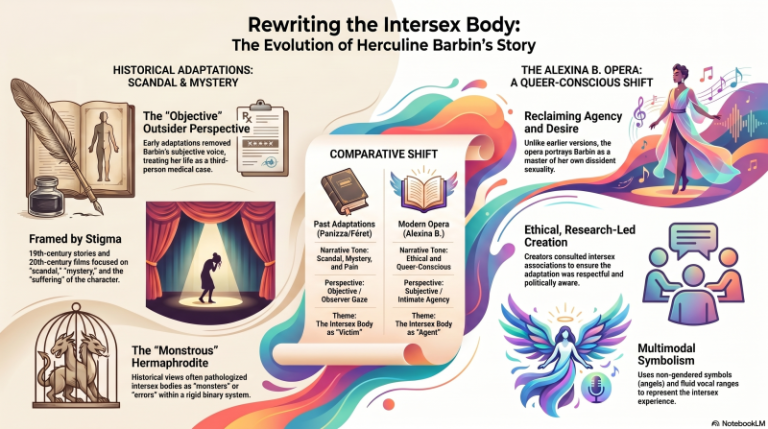
May 07, 2026, Bangkok – This article explores the process of “rewriting” as a form of intermedial translation through the study of the opera Alexina B. (García-Tomás, 2023). Based on the memoirs of Herculine Barbin, the first historically documented intersex person, the analysis employs queer theory and the concept of discourse ethos. It argues that this operatic adaptation represents a more ethical and queer-conscious mediation of the source text compared to previous versions.
Introduction
The memoirs of Herculine Barbin (1838–1868) were first published by Dr. Auguste Tardieu in 1860. Michel Foucault’s 1978 republication later established them as a foundational text in the history of sexuality. Barbin’s life, marked by a forced legal transition from female to male and eventual suicide, has been adapted into various forms, including a 19th-century German story and a 1985 French film,. This article focuses on the latest operatic rewriting premiered in Barcelona.
Theoretical Framework
The study adopts Venuti’s perspective, viewing translation and adaptation as deeply interconnected practices. It also draws on Adrienne Rich’s concept of “re-vision” as an act of cultural survival for marginalized voices. In terms of Translation Studies, it utilizes Rose’s (2021) monograph on translating trans and intersex identities, emphasizing the preservation of “undecidability” within the text.
Analysis of the Opera Alexina B.
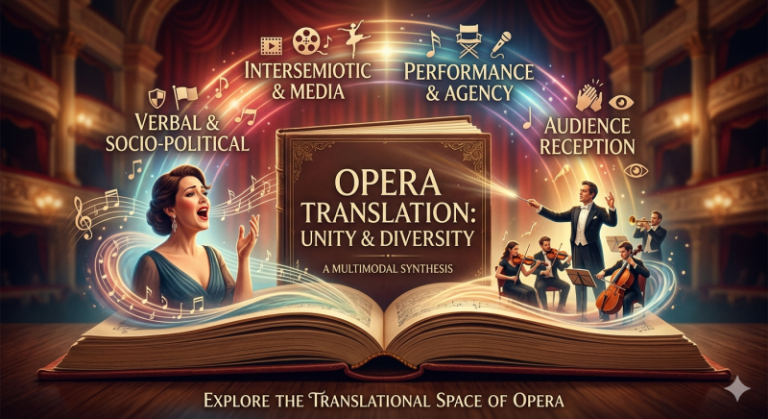
The analysis highlights three key translational dimensions:
Libretto: The creators prioritized non-gendered expressions (e.g., mon enfant) and gave agency to secondary characters like Sara, who were historically silenced,.
Mise-en-scène: Visual symbols like “lichen green” represent oppressive systems (medicine, law, church), contrasting with the vibrant colors associated with the characters’ desires and childhood.
Composition: The use of a mezzosoprano for the lead role allows for a duality of registers, while countertenor registers for male roles subvert traditional operatic masculinity,.
Conclusion
Alexina B. functions as a powerful reworking of both individual and collective ethos for intersex people. By moving away from narratives of “scandal” or “mystery,” the opera centers on Barbin’s subjectivity and desire, providing the original text with a new opportunity for survival through contemporary re-vision.
References
- Amorim, L. M. (2003). Traducao e adaptacao: entre a identidade e a diferenca, os limites da transgressao.
- Amossy, R. (1999). Images de soi dans le discours. La construction de l’ethos.
- Amossy, R. (2001). Ethos at the crossroads of disciplines: Rhetoric, pragmatics, sociology. Poetics Today, 22(1).
- Amossy, R. (2010). La presentation de soi. Ethos et identite verbale.
- Amossy, R. (2014). L’ethos et ses doubles contemporains. Perspectives disciplinaires. Langage et Societe, 149(3), 13–30.
- Artvinli, F. (2021). What if Michel Foucault was alive or Herculine Barbin was in Istanbul?. Noropsikiyatri Arsivi, 58(4), 334–337.
- Baer, B.J. (2020). Queer theory and Translation Studies: Language, politics, desire.
- Baer, B.J., & Kaindl, K. (Eds.) (2018). Queering translation, translating the queer: Theory, practice, activism.
- Butler, J. (1990). Gender trouble: Feminism and the subversion of identity.
- Butler, J. (2004). Undoing gender.
- Demont, M. (2018). On three modes of translating queer literary texts. In Queering Translation, Translating the Queer.
- Dreger, A.D. (2019). Hermaphrodites and the medical invention of sex.
- Ducrot, O. (1984). Le dire et le dit.
- Epstein, B.J., & Gillett, R. (Eds.) (2017). Queer in translation.
- Eugenides, J. (2002). Middlesex.
- Fausto-Sterling, A. (2000). Sexing the body: Gender politics and the construction of sexuality.
- Feret, R. (1985). Mystere Alexina.
- Foucault, M. (1978). Herculine Barbin dite Alexina B.
- Foucault, M. (1980). Herculine Barbin: Being the recently discovered memoirs of a nineteenth-century hermaphrodite.
- Fundacio Gran Teatre del Liceu. (2023). Alexina B. [Programme].
- Garcia-Tomas, R. (2023). Alexina B. Mondigromax.
- Genette, G. (1989). Palimpsestos: La literatura en segundo grado.
- Gomolka, C.J. (2012). Lost in (trans)lation: The misread body of Herculine Barbin. Synthesis.
- Hakoda, T. (2014). Bodies and pleasures in the happy limbo of a non-identity. The Journal of Ars Vivendi.
- Holmes, M. (2008). Intersex: A perilous difference.
- Iturregui-Gallardo, G. (2023). Permagel/permafrost: Lesbian desire and its translation. Mutatis Mutandis.
- Kedem, N. (2019). What is queer translation?. Symploke, 27(1-2), 157-183.
- Koopman, C. (2019). Critique without judgment in political theory. Contemporary Political Theory.
- Lafrance, M. (2002). Uncertain erotic: A Foucauldian reading of Herculine Barbin. Contemporary French and Francophone Studies.
- Laqueur, T. (1991). Making sex: Body and gender from the Greeks to Freud.
- Martinez Pleguezuelos, A.J. (2018). Traduccion e identidad sexual: Reescrituras audiovisuales desde la teoria queer.
- Martinez Pleguezuelos, A.J. (2021). Translating the queer body. Babel.
- Monro, S. (2019). Non-binary and genderqueer: An overview of the field. International Journal of Transgenderism.
- Orkibi, E. (2008). Ethos collectif et Rhetorique de polarisation. Argumentation et Analyse Du Discours.
- Repo, J. (2014). Herculine Barbin and the omission of biopolitics from Judith Butler’s gender genealogy. Feminist Theory.
- Rich, A. (1972). When we dead awaken: Writing as re-vision. College English, 34(1), 18–30.
- Rose, E. (2021). Translating trans identity: (Re)writing undecidable texts and bodies.
- Schwanebeck, W. (2022). Introduction: Adaptation as revision. Adaptation, 15(1), 1–6.
- Spoturno, M.L. (2019). El retrabajo del ethos en el discurso autotraducido. Hermeneus.
- Spoturno, M.L. (2022). Ethos colectivo, redes de lucha y practicas de escritura. Revista Letral.
- Tardieu, A. (1874). Question medico-legale de l’identite.
- Venuti, L. (2004). The Translation Studies reader.
- Venuti, L. (2007). Adaptation, translation, critique. Journal of Visual Culture.
- Webb, J. (2019). Herculine Barbin: Human error, criminality and the case of the monstrous hermaphrodite. In Hosting the Monster.
For professional services, please visit: https://www.seaproti.org/practitioners/
About certified translators, translation certifiers, and certified interpreters associated with SEAProTI. The Southeast Asian Association of Professional Translators and Interpreters (SEAProTI) has officially shared the qualifications and requirements for becoming Certified Translators, Translation Certification Providers, and Certified Interpreters in Sections 9 and 10 of the Royal Gazette, which was published by the Prime Minister’s Office in Thailand on July 25, 2024. Certified Translators, Translation Certification Providers, and Certified Interpreters
The Council of State has proposed the enactment of a Royal Decree, granting registered translators and recognised translation certifiers from professional associations or accredited language institutions the authority to provide legally valid translation certification (Letter to SEAProTI dated April 28, 2025)
SEAProTI is the first professional association in Thailand and Southeast Asia to implement a comprehensive certification system for translators, certifiers, and interpreters.
Head Office: Baan Ratchakru Building, No. 33, Room 402, Soi Phahonyothin 5, Phahonyothin Road, Phaya Thai District, Bangkok 10400, Thailand
Email: hello@seaproti.com | Tel.: (+66) 2-114-3128 (Office hours: Mon–Fri, 09:00–17:00).
การรีไรต์เรื่องร่างกายแบบอินเทอร์เซ็กซ์: ว่าด้วยการดัดแปลงบันทึกความทรงจำของ Herculine Barbin สู่โอเปรา การวิเคราะห์เชิงสังเคราะห์ของการเขียนใหม่และการดัดแปลงในฐานะการแปลข้ามสื่อ
ผู้เขียน: เภตรา โบรด
07 พฤษภาคม 2569, กรุงเทพมหานคร– บทความนี้มุ่งวิเคราะห์กระบวนการ “เขียนใหม่” (Rewriting) ในฐานะการแปลข้ามสื่อ (Intermedial Translation) โดยศึกษาจากโอเปราเรื่อง Alexina B. (García-Tomás, 2023) ซึ่งดัดแปลงจากบันทึกความทรงจำของ Herculine Barbin ผู้เป็นบุคคลอินเทอร์เซ็กซ์ (Intersex) คนแรกที่มีการบันทึกไว้ในประวัติศาสตร์ งานชิ้นนี้ใช้กรอบแนวคิดทฤษฎีเควียร์ (Queer Theory) และทฤษฎีบทบาทวาทกรรม (Ethos) เพื่อพิสูจน์ว่าโอเปราเรื่องนี้เป็นการดัดแปลงที่มีจริยธรรมและตระหนักถึงตัวตนของเควียร์มากที่สุดเมื่อเทียบกับการดัดแปลงในรูปแบบอื่นๆ ในอดีต
บทนำ
บันทึกของ Herculine Barbin (ค.ศ. 1838–1868) ถูกค้นพบและเผยแพร่ครั้งแรกโดยนายแพทย์ Auguste Tardieu ในศตวรรษที่ 19 ต่อมา Michel Foucault ได้นำมาตีพิมพ์ใหม่ในปี 1978 จนกลายเป็นข้อความสำคัญในประวัติศาสตร์เพศวิถี เรื่องราวของ Barbin ผู้ถูกบังคับให้เปลี่ยนสถานะทางเพศจากหญิงเป็นชายตามกฎหมายจนนำไปสู่การจบชีวิตตนเอง ได้ถูกนำไปสร้างเป็นเรื่องสั้นและภาพยนตร์ แต่ในบทความนี้จะเน้นไปที่การผลิตซ้ำผ่านศิลปะโอเปราที่เพิ่งเปิดตัวในบาร์เซโลนา
ทบทวนวรรณกรรมและกรอบทฤษฎี
ผู้วิจัยใช้แนวคิดของ Venuti ที่มองว่าการดัดแปลง (Adaptation) และการแปล (Translation) มีความเชื่อมโยงกันอย่างแยกไม่ออก, นอกจากนี้ยังประยุกต์ใช้แนวคิดเรื่อง “การแก้ไขใหม่” (Revision) ของ Adrienne Rich ซึ่งถือเป็นการกระทำเพื่อความอยู่รอดของกลุ่มคนชายขอบ, ในมิติของการแปล บทความนี้อ้างอิงงานของ Rose (2021) เกี่ยวกับการแปลอัตลักษณ์ทรานส์และอินเทอร์เซ็กซ์ ซึ่งเน้นการรักษาความ “ไม่ชัดเจน” (Undecidability) ของเพศสภาพไว้ในตัวบท
การวิเคราะห์โอเปรา Alexina B
การวิเคราะห์ชี้ให้เห็นว่าโอเปราเรื่องนี้มีจุดเด่น 3 ด้าน
บทโอเปรา: มีการเลือกใช้คำที่ปราศจากเพศ (Non-gendered) เช่นคำว่า mon enfant และให้ความสำคัญกับเสียงของตัวละครหญิงอย่าง Sara มากกว่าในภาพยนตร์
การจัดฉาก: ใช้สัญลักษณ์และสีเพื่อสื่อความหมายข้ามสัญศาสตร์ เช่น สีเขียวไลเคนแทนระบบที่กดขี่ (แพทย์, พระ, ผู้พิพากษา) ตัดกับสีสันสดใสของตัวละครที่เป็นอิสระ
การประพันธ์ดนตรี: ใช้ช่วงเสียงที่หลากหลายของ mezzosoprano เพื่อนำเสนอความเป็นทวิลักษณ์ และใช้ countertenor สำหรับบทชายเพื่อตั้งคำถามกับความเป็นชายในระบบดั้งเดิม
บทสรุป
โอเปรา Alexina B. ไม่เพียงแต่เป็นการดัดแปลงงานเขียน แต่เป็นการสร้างภาพลักษณ์ใหม่ (Reworking of Ethos) ให้กับบุคคลอินเทอร์เซ็กซ์ โดยเปลี่ยนจากมุมมองที่มองว่าเป็น “เรื่องอื้อฉาว” หรือ “ความลึกลับ” มาเป็นการนำเสนอผ่านอัตวิสัยและความปรารถนาของเจ้าของเรื่องเอง
เอกสารอ้างอิง
- อะโมริม, แอล. เอ็ม. (2003). Tradução e adaptação: entre a identidade e a diferença, os limites da transgressão.
- อามอสซี, อา. (1999). Images de soi dans le discours. La construction de l’ethos.
- อามอสซี, อา. (2001). Ethos at the crossroads of disciplines: Rhetoric, pragmatics, sociology. Poetics Today, 22(1).
- อามอสซี, อา. (2010). La présentation de soi. Ethos et identité verbale.
- อามอสซี, อา. (2014). L’éthos et ses doubles contemporains. Perspectives disciplinaires. Langage et Societe, 149(3), 13–30.
- อาร์ตวินลี, เอฟ. (2021). What if Michel Foucault was alive or Herculine Barbin was in İstanbul?. Noropsikiyatri Arsivi, 58(4), 334–337.
- แบร์, บี.เจ. (2020). Queer theory and Translation Studies: Language, politics, desire.
- แบร์, บี.เจ., และไคนด์ล, เค. (บก.) (2018). Queering translation, translating the queer: Theory, practice, activism.
- บัตเลอร์, เจ. (1990). Gender trouble: Feminism and the subversion of identity.
- บัตเลอร์, เจ. (2004). Undoing gender.
- เดอมงต์, เอ็ม. (2018). On three modes of translating queer literary texts. ใน Queering Translation, Translating the Queer.
- เดรเกอร์, เอ.ดี. (2019). Hermaphrodites and the medical invention of sex.
- ดูโครต์, โอ. (1984). Le dire et le dit.
- เอพสไตน์, บี.เจ., และจิลเล็ตต์, อาร์. (บก.) (2017). Queer in translation.
- ยูจีนิเดส, เจ. (2002). Middlesex.
- เฟาสโต-สเตอร์ลิง, เอ. (2000). Sexing the body: Gender politics and the construction of sexuality.
- เฟเรต์, อาร์. (1985). Mystère Alexina.
- ฟูโกต์, เอ็ม. (1978). Herculine Barbin dite Alexina B.
- ฟูโกต์, เอ็ม. (1980). Herculine Barbin: Being the recently discovered memoirs of a nineteenth-century hermaphrodite.
- มูลนิธิโรงละครกราน เทอาเตร เดล ลีเซอ. (2023). Alexina B. [Programme].
- การ์เซีย-โตมัส, อาร์. (2023). Alexina B. Mondigromax.
- เจเน็ตต์, จี. (1989). Palimpsestos: La literatura en segundo grado.
- โกมอลกา, ซี.เจ. (2012). Lost in (trans)lation: The misread body of Herculine Barbin. Synthesis.
- ฮาโกดะ, ที. (2014). Bodies and pleasures in the happy limbo of a non–identity. The Journal of Ars Vivendi.
- โฮล์มส์, เอ็ม. (2008). Intersex: A perilous difference.
- อิตูร์รีกิ-กัลญาร์โด, จี. (2023). Permagel/permafrost: Lesbian desire and its translation. Mutatis Mutandis.
- เคเด็ม, เอ็น. (2019). What is queer translation?. Symplokē, 27(1–2), 157–183.
- คูปแมน, ซี. (2019). Critique without judgment in political theory. Contemporary Political Theory.
- ลาฟรองซ์, เอ็ม. (2002). Uncertain erotic: A Foucauldian reading of Herculine Barbin. Contemporary French and Francophone Studies.
- ลาเกอร์, ที. (1991). Making sex: Body and gender from the Greeks to Freud.
- มาร์ติเนซ เปลเกซูเอลอส, เอ.เจ. (2018). Traducción e identidad sexual: Reescrituras audiovisuales desde la teoría queer.
- มาร์ติเนซ เปลเกซูเอลอส, เอ.เจ. (2021). Translating the queer body. Babel.
- มอนโร, เอส. (2019). Non-binary and genderqueer: An overview of the field. International Journal of Transgenderism.
- ออร์คิปี, อี. (2008). Ethos collectif et Rhétorique de polarisation. Argumentation et Analyse Du Discours.
- เรโป, เจ. (2014). Herculine Barbin and the omission of biopolitics from Judith Butler’s gender genealogy. Feminist Theory.
- ริช, เอ. (1972). When we dead awaken: Writing as re-vision. College English, 34(1), 18–30.
- โรส, อี. (2021). Translating trans identity: (Re)writing undecidable texts and bodies.
- ชวาเนเบ็ค, ดับเบิลยู. (2022). Introduction: Adaptation as revision. Adaptation, 15(1), 1–6.
- สปอตูร์โน, เอ็ม.แอล. (2019). El retrabajo del ethos en el discurso autotraducido. Hermēneus.
- สปอตูร์โน, เอ็ม.แอล. (2022). Ethos colectivo, redes de lucha y prácticas de escritura. Revista Letral.
- ตาร์ดิเยอ, เอ. (1874). Question medico-legale de l’identite.
- เวนูติ, แอล. (2004). The Translation Studies reader.
- เวนูติ, แอล. (2007). Adaptation, translation, critique. Journal of Visual Culture.
- เว็บป์, เจ. (2019). Herculine Barbin: Human error, criminality and the case of the monstrous hermaphrodite. ใน Hosting the Monster.
ขอใช้บริการนักวิชาชีพของสมาคมได้ที่:https://www.seaproti.org/practitioners/
สมาคมวิชาชีพนักแปลและล่ามแห่งเอเชียตะวันออกเฉียงใต้ (SEAProTI) ได้ประกาศหลักเกณฑ์และคุณสมบัติของผู้ที่ขึ้นทะเบียนเป็น “นักแปลรับรอง (Certified Translators) และผู้รับรองการแปล (Translation Certification Providers) และล่ามรับรอง (Certified Interpreters)” ของสมาคม หมวดที่ 9 และหมวดที่ 10 ในราชกิจจานุเบกษา ของสำนักเลขาธิการคณะรัฐมนตรี ในสำนักนายกรัฐมนตรี แห่งราชอาณาจักรไทย ลงวันที่ 25 ก.ค. 2567 เล่มที่ 141 ตอนที่ 66 ง หน้า 100 อ่านฉบับเต็มได้ที่: นักแปลรับรอง ผู้รับรองการแปล และล่ามรับรอง
สำนักคณะกรรมการกฤษฎีกาเสนอให้ตราเป็นพระราชกฤษฎีกา โดยกำหนดให้นักแปลที่ขึ้นทะเบียน รวมถึงผู้รับรองการแปลจากสมาคมวิชาชีพหรือสถาบันสอนภาษาที่มีการอบรมและขึ้นทะเบียน สามารถรับรองคำแปลได้ (จดหมายถึงสมาคม SEAProTI ลงวันที่ 28 เม.ย. 2568)
สมาคมวิชาชีพนักแปลและล่ามแห่งเอเชียตะวันออกเฉียงใต้เป็นสมาคมวิชาชีพแห่งแรกและแห่งเดียวในประเทศไทยและภูมิภาคเอเชียตะวันออกเฉียงใต้ที่มีระบบรับรองนักแปลรับรอง ผู้รับรองการแปล และล่ามรับรอง
สำนักงานใหญ่: อาคารบ้านราชครู เลขที่ 33 ห้อง 402 ซอยพหลโยธิน 5 ถนนพหลโยธิน แขวงพญาไท เขตพญาไท กรุงเทพมหานคร 10400 ประเทศไทย