



Quality in Simultaneous Interpreting with Text: A Corpus-Based Case Study
Author: Petra Bordt
May 08, 2026, Bangkok – This study investigates the practice of simultaneous interpreting with text (SIT) at United Nations (UN) conferences. By analyzing a corpus of authentic English–Chinese interpretations, the research establishes whether the availability of a speaker’s script is beneficial or detrimental to the quality of the output, focusing on accuracy, completeness, and delivery.
Introduction
Simultaneous interpreting with text (SIT) is a common mode in international organizations where interpreters rely on both auditory input and a written script. While early scholars preferred impromptu speech, modern diplomacy often involves dense, carefully crafted manuscripts. This study addresses whether the script helps interpreters perform better than they would without it.
Methodology
The research uses a corpus-based approach, comparing professional interpretations produced at a UN conference in Vienna. It employs a “natural experiment” design, matching two speeches delivered at high speed (approx. 150 wpm) by the same interpreter—one rendered with the script (SIT) and one without (SI).
Results and Discussion
The findings reveal a “mixed” effect of working with a script
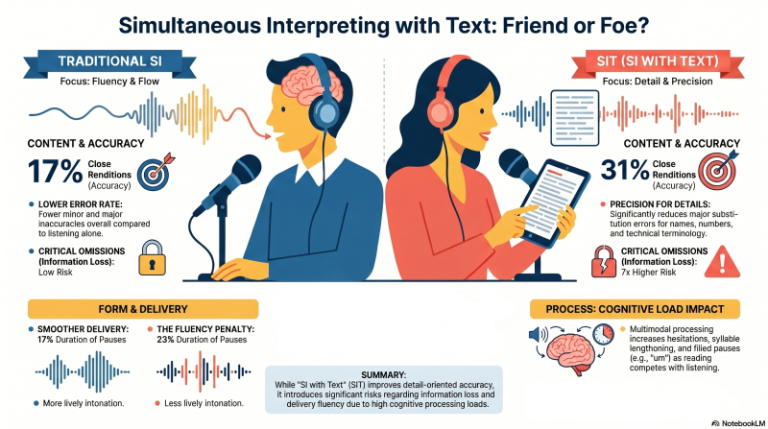
Accuracy: SIT significantly improved the rendering of details such as names, numbers, and technical terms.
Completeness: Conversely, SIT showed a higher risk of critical information loss. Interpreters focusing on the text sometimes missed ad-libbed remarks or fell behind the speaker’s pace.
Form and Delivery: Working with a script had a negative impact on fluency, leading to more filled pauses, hesitations, and unusual syntax due to source-language interference.
Conclusion
The study suggests that while a script is a “friend” for technical accuracy, it can be a “foe” to delivery and completeness. The authors suggest that future computer-assisted interpreting (CAI) tools, such as speech-to-text, might help mitigate the cognitive load associated with SIT.
References
- Baigorri-Jalon, J., & Travieso-Rodriguez, C. (2017). Interpreting at the United Nations: The impact of external variables. The Interpreters’ View. CLINA, 3(2), 53-72.
- Baigorri-Jalon, J. (2004). Interpreters at the United Nations: A history. Universidad de Salamanca.
- Barghout, A., Rosendo, L. R., & Garcia, M. V. (2015). The influence of speed on omissions in simultaneous interpretation: An experimental study. Babel, 61(3), 305-334.
- Barik, H. C. (1994). A description of various types of omissions, additions and errors of translation encountered in simultaneous interpretation. In S. Lambert, & B. Moser-Mercer (Eds.), Bridging the gap: Empirical research in simultaneous interpretation (pp. 121-137). John Benjamins.
- Beaugrande, R.-A. de, & Dressler, W. U. (1981). Introduction to text linguistics. Longman.
- Bendazzoli, C. (2016). The ethnography of interpreter-mediated communication: Methodological challenges in fieldwork. In C. Bendazzoli, & C. Monacelli (Eds.), Addressing methodological challenges in interpreting studies research (pp. 3-30). Cambridge Scholars Publishing.
- Boersma, P., & Weenink, D. (2015). Praat: Doing phonetics by computer, Version 5.4.21. http://www.praat.org/.
- Cammoun, R., Davies, C., Ivanov, K., & Naimushin B. (2009). Simultaneous interpretation with text: Is the text “friend” or “foe”? Laying foundations for a teaching module. Master’s thesis, University of Geneva.
- Chmiel, A., Janikowski, P., & Lijewska A. (2020). Multimodal processing in simultaneous interpreting with text: Interpreters focus more on the visual than the auditory modality. Target, 32(1), 37-58.
- Coverlizza, L. (2004). L’interpretazione simultanea con e senza il testo scritto del discorso di partenza: Uno studio sperimentale. Master’s thesis, University of Bologna.
- Defrancq, B., & Fantinuoli, C. (2021). Automatic speech recognition in the booth: Assessment of system performance, interpreters’ performances and interactions in the context of numbers. Target, 33(1), 73-102.
- De Jong, N. H., & Bosker, H. R. (2013). Choosing a threshold for silent pauses to measure second language fluency. In R. Eklund (Ed.), Proceedings of the 6th workshop on disfluency in spontaneous speech (DiSS) (pp. 17-20). MPG. PuRe.
- Dejean le Feal, K. (1982). Why impromptu speech is easy to understand. In N. E. Enkvist (Ed.), Impromptu speech: A symposium (pp. 221-239). Abo Akademi.
- Diaz-Galaz, S., Padilla, P., & Bajo, M. T. (2015). The role of advance preparation in simultaneous interpreting: A comparison of professional interpreters and interpreting students. Interpreting, 17(1), 1-25.
- Diur, M. (2015). Interpreting at the United Nations: An empirical study on the Language Competitive Examination (LCE). Doctoral dissertation, Universidad Pablo de Olavide.
- Dunning, T. (2012). Natural experiments in the social sciences: A design-based approach. Cambridge University Press.
- Frittella, F. M. (2022). CAI tool-supported SI of numbers: A theoretical and methodological contribution. International Journal of Interpreter Education, 14(1), 32-56.
- Gile, D. (2009). Basic concepts and models for interpreter and translator training. John Benjamins.
- Krippendorff, K. (2019). Content analysis: An introduction to its methodology. Sage.
- Kumcu, A. (2011). Visual focal loci in simultaneous interpreting. Master’s thesis, Hacettepe University.
- Lamberger-Felber, H. (2001). Text-oriented research into interpreting: Examples from a case-study. Hermes, 26, 39-64.
- Lamberger-Felber, H. (2003). Performance variability among conference interpreters: Examples from a case study. In A. Collados Ais, M. M. Fernandez Sanchez, & D. Gile (Eds.), La evaluacion de la calidad en interpretacion: Investigacion (pp. 147-168). Comares.
- Lamberger-Felber, H., & Schneider, J. (2008). Linguistic interference in simultaneous interpreting with text. In G. Hansen, A. Chesterman, & H. Gerzymisch-Arbogast (Eds.), Efforts and models in interpreting and translation research: A tribute to Daniel Gile (pp. 215-236). John Benjamins.
- Lambert, S. (2004). Shared attention during sight translation, sight interpretation and simultaneous interpretation. Meta, 49(2), 294-306.
- Lee, J. (2014). Rating scales for interpreting performance assessment. The Interpreter and Translator Trainer, 2(2), 165-184.
- Moser-Mercer, B. (1996). Quality in interpreting: Some methodological issues. The Interpreters’ Newsletter, 7, 43-55.
- Mellinger, C., & Hanson, T. (2017). Quantitative research methods in translation and interpreting studies. Routledge.
- Plevoets, K., & Defrancq, B. (2018). The cognitive load of interpreters in the European parliament: A corpus-based study of predictors for the disfluency uh(m). Interpreting, 20(1), 1-28.
- Pochhacker, F. (2021). Multimodality in interpreting. In Y. Gambier, & L. Van Doorslaer (Eds.), Handbook of translation studies (pp.151-157). John Benjamins.
- Pochhacker, F. (2022). Introducing interpreting studies. Routledge.
- Prandi, B. (2023). Computer-assisted simultaneous interpreting: A cognitive-experimental study on terminology. Language Science Press.
- Pyoun, H. R. (2015). Parametres quantitatifs en interpretation simultanee avec et sans texte. Forum, 13(2), 129-150.
- Riffe, D., Lacy, S., Watson, B., & Fico, F. (2019). Analyzing media messages: Using quantitative content analysis in research. Routledge.
- Romero-Fresco, P., & Pochhacker, F. (2017). Quality assessment in interlingual live subtitling: The NTR model. Linguistica Antverpiensia, New Series – Themes in Translation Studies, 16, 149-167.
- Ruiz Rosendo, L., & Diur, M. (2021). Conference interpreting at the United Nations. In M. Albl-Mikasa, & E. Tiselius (Eds.), The Routledge handbook of conference interpreting (pp. 115-125). Routledge.
- Russo, M., Bendazzoli, C., Sandrelli, A., & Spinolo, N. (2012). The European parliament interpreting corpus (EPIC): Implementation and developments. In F. S. Sergio, & C. Falbo (Eds.), Breaking ground in corpus-based interpreting studies (pp. 53-90). Peter Lang.
- Seeber, K. (2017). Multimodal processing in simultaneous interpreting. In J. W. Schwieter, & A. Ferreira (Eds.), The handbook of translation and cognition (pp. 461-475). Wiley Blackwell.
- Seeber, K., Keller, L., & Hervais-Adelman, A. (2020). When the ear leads the eye: The use of text during simultaneous interpreting. Language, Cognition and Neuroscience, 35(10), 1480-1494.
- Setton, R. (1999). Simultaneous interpretation: A cognitive-pragmatic analysis. John Benjamins.
- Setton, R. (2015). Simultaneous interpreting with text. In F. Pochhacker (Ed.), Routledge encyclopedia of interpreting studies (pp. 385-386). Routledge.
- Setton, R., & Motta, M. (2007). Syntacrobatics: Quality and reformulation in simultaneous-with-text. Interpreting, 9(2), 199-230.
- Shermet, S. (2018). United Nations interpreters: An insider’s view – Part 4. http://www.ata-divisions.org/ID/un-interpreters-an-insiders-view-4/.
- Spychala, J. (2015). The impact of source text availability on simultaneous interpreting performance. Master’s thesis, Adam Mickiewicz University Poznan.
- Tannenbaum, P. H., Williams F., & Wood, B. S. (1967). Hesitation phenomena and related encoding characteristics in speech and typewriting. Language and Speech, 10(3), 203-215.
- UNOOSA (2023). Digital recordings. https://www.unoosa.org/oosa/audio/v3/index-staging.jspx.
- Wadensjo, C. (1998). Interpreting as interaction. Longman.
- Yang, S., Li, D., & Lei, V. L. C. (2020). The impact of source text presence on simultaneous interpreting performance in fast speeches: Will it help trainees or not? Babel, 66(4/5), 588-603.
- Zhao, L. (2021). Simultaneous interpreting with text: A study in the context of the United Nations. Doctoral dissertation, University of Vienna.
For professional services, please visit: https://www.seaproti.org/practitioners/
About certified translators, translation certifiers, and certified interpreters associated with SEAProTI. The Southeast Asian Association of Professional Translators and Interpreters (SEAProTI) has officially shared the qualifications and requirements for becoming Certified Translators, Translation Certification Providers, and Certified Interpreters in Sections 9 and 10 of the Royal Gazette, which was published by the Prime Minister’s Office in Thailand on July 25, 2024. Certified Translators, Translation Certification Providers, and Certified Interpreters
The Council of State has proposed the enactment of a Royal Decree, granting registered translators and recognised translation certifiers from professional associations or accredited language institutions the authority to provide legally valid translation certification (Letter to SEAProTI dated April 28, 2025)
SEAProTI is the first professional association in Thailand and Southeast Asia to implement a comprehensive certification system for translators, certifiers, and interpreters.
Head Office: Baan Ratchakru Building, No. 33, Room 402, Soi Phahonyothin 5, Phahonyothin Road, Phaya Thai District, Bangkok 10400, Thailand
Email: hello@seaproti.com | Tel.: (+66) 2-114-3128 (Office hours: Mon–Fri, 09:00–17:00).
คุณภาพของการล่ามแบบพูดพร้อมในโหมดที่มีตัวบทประกอบ: กรณีศึกษาเชิงพรรณนาจากคลังข้อมูล
ผู้เขียน:เภตรา โบรด
8 พฤษภาคม 2569, กรุงเทพมหานคร – งานวิจัยนี้ศึกษาการทำงานของการล่ามแบบพูดพร้อมโดยมีตัวบทประกอบ (Simultaneous Interpreting with Text – SIT) ในบริบทการประชุมของสหประชาชาติ (UN) โดยวิเคราะห์ผ่านคลังข้อมูลการล่ามจริงคู่ภาษาอังกฤษ–จีน เพื่อพิสูจน์ว่าการมีบทพูดของผู้พูดอยู่ในมือช่วยส่งเสริมหรือขัดขวางคุณภาพของงานล่าม ทั้งในด้านความถูกต้อง ความครบถ้วน และลีลาการนำเสนอ
บทนำ
การล่ามแบบพูดพร้อมโดยมีตัวบทประกอบ (SIT) เป็นโหมดการทำงานปกติในองค์กรระหว่างประเทศ ซึ่งล่ามต้องอาศัยทั้งข้อมูลจากการฟังและตัวบทที่เขียนไว้แม้นักวิชาการในยุคแรกจะมองว่าการล่ามแบบพูดสด (Impromptu speech) ทำได้ดีกว่า แต่ในทางการทูตสมัยใหม่มักมีการใช้บทพูดที่มีความหนาแน่นของข้อมูลสูง งานวิจัยนี้จึงมุ่งตอบคำถามว่าตัวบทที่เขียนไว้ช่วยให้ล่ามทำงานได้ดีขึ้นจริงหรือไม่
ระเบียบวิธีวิจัย
ผู้วิจัยใช้แนวทางคลังข้อมูล (Corpus-based) เปรียบเทียบผลงานการล่ามของมืออาชีพในการประชุมจริง ณ กรุงเวียนนาโดยใช้การออกแบบการทดลองแบบธรรมชาติ (Natural experiment) เพื่อเปรียบเทียบการล่ามบทพูดที่ใช้ความเร็วสูง (ประมาณ 150 คำต่อนาที) โดยล่ามคนเดียวกัน ใน 2 สภาวะ คือการล่ามแบบมีตัวบท (SIT) และไม่มีตัวบท (SI)
ผลการศึกษาและการวิเคราะห์
ผลการศึกษาพบว่าการทำงานกับตัวบทส่งผลแบบ “ผสม” ดังนี้
- ความถูกต้อง: SIT ช่วยให้ความถูกต้องในรายละเอียด เช่น ชื่อเฉพาะ ตัวเลข และศัพท์เฉพาะทาง ดีขึ้นอย่างเห็นได้ชัด
- ความครบถ้วน:ในทางกลับกัน SIT มีความเสี่ยงที่จะทำให้ข้อมูลสำคัญสูญหายได้มากกว่า เนื่องจากการเพ่งสมาธิไปที่ตัวบทอาจทำให้ล่ามพลาดสิ่งที่ผู้พูดพูดนอกบท หรือล่ามตามความเร็วของผู้พูดไม่ทัน
- รูปแบบและการนำเสนอ:การใช้ตัวบทส่งผลเสียต่อความลื่นไหล โดยพบการหยุดชะงัก การลังเล และการใช้โครงสร้างประโยคที่ผิดธรรมชาติบ่อยครั้งขึ้นเนื่องจากได้รับอิทธิพลจากภาษาต้นทาง
บทสรุป
งานวิจัยสรุปว่าตัวบทเปรียบเสมือนเป็นทั้ง “มิตร” ในด้านความแม่นยำทางเทคนิค และ “ศัตรู” ในด้านความลื่นไหลและความครบถ้วนของข้อมูลผู้วิจัยเสนอว่าในอนาคตเครื่องมือช่วยล่าม (CAI) เช่น ระบบแปลงเสียงเป็นข้อความ อาจช่วยลดภาระทางพุทธิปัญญาในการทำงานแบบ SIT ได้
เอกสารอ้างอิง (Thai Version)
- ไปกอร์รี-คาลอน, เจ., และ ทราเบียโซ-โรดริเกซ, ซี. (2017). Interpreting at the United Nations: The impact of external variables. The Interpreters’ View. CLINA, 3(2), 53-72.
- ไปกอร์รี-คาลอน, เจ. (2004). Interpreters at the United Nations: A history. Universidad de Salamanca.
- บาร์ฆูต, เอ., โรเซนโด, แอล. อาร์., และ การ์เซีย, เอ็ม. วี. (2015). The influence of speed on omissions in simultaneous interpretation: An experimental study. Babel, 61(3), 305-334.
- บาริก, เอช. ซี. (1994). A description of various types of omissions, additions and errors of translation encountered in simultaneous interpretation. ใน S. Lambert, & B. Moser-Mercer (Eds.), Bridging the gap: Empirical research in simultaneous interpretation (pp. 121-137). John Benjamins.
- เดอ โบกรองด์, อาร์.-เอ., และ เดรสเลอร์, ดับเบิลยู. ยู. (1981). Introduction to text linguistics. Longman.
- เบนดัซโซลี, ซี. (2016). The ethnography of interpreter-mediated communication: Methodological challenges in fieldwork. ใน C. Bendazzoli, & C. Monacelli (Eds.), Addressing methodological challenges in interpreting studies research (pp. 3-30). Cambridge Scholars Publishing.
- บอร์สมา, พี., และ วีนิงก์, ดี. (2015). Praat: Doing phonetics by computer, Version 5.4.21. http://www.praat.org/.
- กัมมูน, อาร์., เดวีส์, ซี., อิวานอฟ, เค., และ ไนมูชิน บี. (2009). Simultaneous interpretation with text: Is the text “friend” or “foe”? Laying foundations for a teaching module. วิทยานิพนธ์ปริญญาโท, University of Geneva.
- ชเมียล, เอ., ยานิคอฟสกี, พี., และ ลิเยฟสกา เอ. (2020). Multimodal processing in simultaneous interpreting with text: Interpreters focus more on the visual than the auditory modality. Target, 32(1), 37-58.
- คอแวร์ลิซซา, แอล. (2004). L’interpretazione simultanea con e senza il testo scritto del discorso di partenza: Uno studio sperimentale. วิทยานิพนธ์ปริญญาโท, University of Bologna.
- เดอฟรองค์, บี., และ ฟานตินูโอลี, ซี. (2021). Automatic speech recognition in the booth: Assessment of system performance, interpreters’ performances and interactions in the context of numbers. Target, 33(1), 73-102.
- เดอ ยอง, เอ็น. เอช., และ บอสเกอร์, เอช. อาร์. (2013). Choosing a threshold for silent pauses to measure second language fluency. ใน R. Eklund (Ed.), Proceedings of the 6th workshop on disfluency in spontaneous speech (DiSS) (pp. 17-20). MPG. PuRe.
- เดอฌอง เลอ เฟอัล, เค. (1982). Why impromptu speech is easy to understand. ใน N. E. Enkvist (Ed.), Impromptu speech: A symposium (pp. 221-239). Abo Akademi.
- ดิแอซ-กาลัซ, เอส., พาดิลญา, พี., และ บาโฆ, เอ็ม. ที. (2015). The role of advance preparation in simultaneous interpreting: A comparison of professional interpreters and interpreting students. Interpreting, 17(1), 1-25.
- ดิอูร์, เอ็ม. (2015). Interpreting at the United Nations: An empirical study on the Language Competitive Examination (LCE). ดุษฎีนิพนธ์, Universidad Pablo de Olavide.
- ดันนิง, ที. (2012). Natural experiments in the social sciences: A design-based approach. Cambridge University Press.
- ฟริตเตลลา, เอฟ. เอ็ม. (2022). CAI tool-supported SI of numbers: A theoretical and methodological contribution. International Journal of Interpreter Education, 14(1), 32-56.
- กิล, ดี. (2009). Basic concepts and models for interpreter and translator training. John Benjamins.
- คริพเพนดอร์ฟ, เค. (2019). Content analysis: An introduction to its methodology. Sage.
- คุมชู, เอ. (2011). Visual focal loci in simultaneous interpreting. วิทยานิพนธ์ปริญญาโท, Hacettepe University.
- ลัมแบร์เกอร์-เฟลเบอร์, เอช. (2001). Text-oriented research into interpreting: Examples from a case-study. Hermes, 26, 39-64.
- ลัมแบร์เกอร์-เฟลเบอร์, เอช. (2003). Performance variability among conference interpreters: Examples from a case study. ใน Á. Collados Aís, M. M. Fernández Sánchez, & D. Gile (Eds.), La evaluación de la calidad en interpretación: Investigación (pp. 147-168). Comares.
- ลัมแบร์เกอร์-เฟลเบอร์, เอช., และ ชไนเดอร์, เจ. (2008). Linguistic interference in simultaneous interpreting with text. ใน G. Hansen, A. Chesterman, & H. Gerzymisch-Arbogast (Eds.), Efforts and models in interpreting and translation research: A tribute to Daniel Gile (pp. 215-236). John Benjamins.
- แลมแบร์ต, เอส. (2004). Shared attention during sight translation, sight interpretation and simultaneous interpretation. Meta, 49(2), 294-306.
- ลี, เจ. (2014). Rating scales for interpreting performance assessment. The Interpreter and Translator Trainer, 2(2), 165-184.
- โมเซอร์-เมอร์เซอร์, บี. (1996). Quality in interpreting: Some methodological issues. The Interpreters’ Newsletter, 7, 43-55.
- เมลลิงเกอร์, ซี., และ แฮนสัน, ที. (2017). Quantitative research methods in translation and interpreting studies. Routledge.
- เพลโวต์ส, เค., และ เดอฟรองค์, บี. (2018). The cognitive load of interpreters in the European parliament: A corpus-based study of predictors for the disfluency uh(m). Interpreting, 20(1), 1-28.
- เพอชฮัคเกอร์, เอฟ. (2021). Multimodality in interpreting. ใน Y. Gambier, & L. Van Doorslaer (Eds.), Handbook of translation studies (pp.151-157). John Benjamins.
- เพอชฮัคเกอร์, เอฟ. (2022). Introducing interpreting studies. Routledge.
- ปรานดี, บี. (2023). Computer-assisted simultaneous interpreting: A cognitive-experimental study on terminology. Language Science Press.
- พยอน, เอช. อาร์. (2015). Paramètres quantitatifs en interprétation simultanée avec et sans texte. Forum, 13(2), 129-150.
- ริฟฟ์, ดี., เลซี, เอส., วัตสัน, บี., และ ฟิโก, เอฟ. (2019). Analyzing media messages: Using quantitative content analysis in research. Routledge.
- โรเมโร-เฟรสโก, พี., และ เพอชฮัคเกอร์, เอฟ. (2017). Quality assessment in interlingual live subtitling: The NTR model. Linguistica Antverpiensia, New Series – Themes in Translation Studies, 16, 149-167.
- รุยซ์ โรเซนโด, แอล., และ ดิอูร์, เอ็ม. (2021). Conference interpreting at the United Nations. ใน M. Albl-Mikasa, & E. Tiselius (Eds.), The Routledge handbook of conference interpreting (pp. 115-125). Routledge.
- รุสโซ, เอ็ม., เบนดัซโซลี, ซี., แซนเดรลลี, เอ., และ สปิโนโล, เอ็น. (2012). The European parliament interpreting corpus (EPIC): Implementation and developments. ใน F. S. Sergio, & C. Falbo (Eds.), Breaking ground in corpus-based interpreting studies (pp. 53-90). Peter Lang.
- ซีเบอร์, เค. (2017). Multimodal processing in simultaneous interpreting. ใน J. W. Schwieter, & A. Ferreira (Eds.), The handbook of translation and cognition (pp. 461-475). Wiley Blackwell.
- ซีเบอร์, เค., เคลเลอร์, แอล., และ แอร์แวส์-อาเดลมง, เอ. (2020). When the ear leads the eye: The use of text during simultaneous interpreting. Language, Cognition and Neuroscience, 35(10), 1480-1494.
- เซตตัน, อาร์. (1999). Simultaneous interpretation: A cognitive-pragmatic analysis. John Benjamins.
- เซตตัน, อาร์. (2015). Simultaneous interpreting with text. ใน F. Pöchhacker (Ed.), Routledge encyclopedia of interpreting studies (pp. 385-386). Routledge.
- เซตตัน, อาร์., และ มอตตา, เอ็ม. (2007). Syntacrobatics: Quality and reformulation in simultaneous-with-text. Interpreting, 9(2), 199-230.
- เชอร์เมต, เอส. (2018). United Nations interpreters: An insider’s view – Part 4. http://www.ata-divisions.org/ID/un-interpreters-an-insiders-view-4/.
- สปีคาลา, เจ. (2015). The impact of source text availability on simultaneous interpreting performance. วิทยานิพนธ์ปริญญาโท, Adam Mickiewicz University Poznań.
- ทันเนนบอม, พี. เอช., วิลเลียมส์ เอฟ., และ วูด, บี. เอส. (1967). Hesitation phenomena and related encoding characteristics in speech and typewriting. Language and Speech, 10(3), 203-215.
- UNOOSA (2023). Digital recordings. https://www.unoosa.org/oosa/audio/v3/index-staging.jspx.
- วอเดนเชอ, ซี. (1998). Interpreting as interaction. Longman.
- หยาง, เอส., หลี่, ดี., และ เลย, วี. แอล. ซี. (2020). The impact of source text presence on simultaneous interpreting performance in fast speeches: Will it help trainees or not? Babel, 66(4/5), 588-603.
- จ้าว, แอล. (2021). Simultaneous interpreting with text: A study in the context of the United Nations. ดุษฎีนิพนธ์, University of Vienna.
ขอใช้บริการนักวิชาชีพของสมาคมได้ที่:https://www.seaproti.org/practitioners/
สมาคมวิชาชีพนักแปลและล่ามแห่งเอเชียตะวันออกเฉียงใต้ (SEAProTI) ได้ประกาศหลักเกณฑ์และคุณสมบัติของผู้ที่ขึ้นทะเบียนเป็น “นักแปลรับรอง (Certified Translators) และผู้รับรองการแปล (Translation Certification Providers) และล่ามรับรอง (Certified Interpreters)” ของสมาคม หมวดที่ 9 และหมวดที่ 10 ในราชกิจจานุเบกษา ของสำนักเลขาธิการคณะรัฐมนตรี ในสำนักนายกรัฐมนตรี แห่งราชอาณาจักรไทย ลงวันที่ 25 ก.ค. 2567 เล่มที่ 141 ตอนที่ 66 ง หน้า 100 อ่านฉบับเต็มได้ที่: นักแปลรับรอง ผู้รับรองการแปล และล่ามรับรอง
สำนักคณะกรรมการกฤษฎีกาเสนอให้ตราเป็นพระราชกฤษฎีกา โดยกำหนดให้นักแปลที่ขึ้นทะเบียน รวมถึงผู้รับรองการแปลจากสมาคมวิชาชีพหรือสถาบันสอนภาษาที่มีการอบรมและขึ้นทะเบียน สามารถรับรองคำแปลได้ (จดหมายถึงสมาคม SEAProTI ลงวันที่ 28 เม.ย. 2568)
สมาคมวิชาชีพนักแปลและล่ามแห่งเอเชียตะวันออกเฉียงใต้เป็นสมาคมวิชาชีพแห่งแรกและแห่งเดียวในประเทศไทยและภูมิภาคเอเชียตะวันออกเฉียงใต้ที่มีระบบรับรองนักแปลรับรอง ผู้รับรองการแปล และล่ามรับรอง
สำนักงานใหญ่: อาคารบ้านราชครู เลขที่ 33 ห้อง 402 ซอยพหลโยธิน 5 ถนนพหลโยธิน แขวงพญาไท เขตพญาไท กรุงเทพมหานคร 10400 ประเทศไทย