


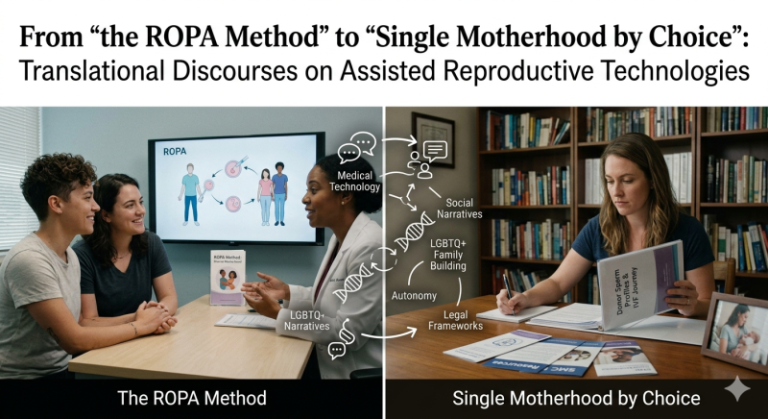
From “the ROPA Method” to “Single Motherhood by Choice”: Translational Discourses on Assisted Reproductive Technologies
Author: Griroek Gruaythong
14 May 2026, Bangkok — This article investigates translational discourses surrounding assisted reproductive technologies (ART) through the combined approaches of Critical Discourse Analysis and Corpus Linguistics. The researcher compiled a bilingual parallel corpus in Spanish and Italian from the websites of fertility clinics and assisted reproduction institutes in Spain, as well as a comparable monolingual Italian corpus drawn from original Italian texts belonging to the same discourse domain. The study pursues three principal objectives: first, to examine linguistic and multimodal practices reflecting gender bias in the representation of individuals involved in assisted reproduction processes, including the dissemination and amplification of such biases through translation; second, to explore the impact of translation on the formation of Italian specialized language in the field of assisted reproductive technologies; and third, to analyze the role of translation as a mechanism for disseminating new discourses on motherhood, as well as the translation challenges posed by medical procedures that remain legally unrecognized in Italy.
The findings reveal significant asymmetries between Spain and Italy regarding access to infertility treatment services. They also demonstrate clear evidence of linguistic and cultural negotiation between the two languages. Furthermore, translation plays a crucial role in reproducing discourses related to gender, motherhood, and emerging family models, while simultaneously contributing to the expansion of gender bias at both the linguistic and visual levels. The study therefore highlights the interrelationship between language, translation, ideology, and reproductive health rights in contemporary Europe.
Keywords: assisted reproductive technologies, translational discourse, corpus linguistics, gender, critical translation studies, specialized language
Introduction
Health tourism, and particularly “reproductive tourism” or “fertility tourism,” has become a major phenomenon in contemporary Europe. The term refers to traveling abroad in order to access fertility treatments and assisted reproductive technologies. Spain has emerged as one of the leading destinations within the European Union for such services, generating hundreds of millions of euros annually and attracting large numbers of patients from Italy. According to the Spanish Fertility Society and the Spanish Ministry of Health, more than 127,000 in vitro fertilization (IVF) procedures were performed in 2020, including over 12,000 international patients, the majority originating from France and Italy.
A key factor underlying this phenomenon is the restrictive legal framework governing assisted reproduction in Italy, particularly under Legge 19 febbraio 2004, n. 40, whereas Spanish legislation under Ley 14/2006 provides considerably broader access to reproductive services. These legal differences create significant asymmetries in access to infertility treatments, both in terms of the techniques permitted and the categories of individuals eligible for treatment.
In Italy, assisted reproductive technologies are available only to heterosexual couples who are married or cohabiting. By contrast, Spain permits access for single women and same-sex couples. Such differences have facilitated the emergence of new concepts within the Spanish context, including “shared motherhood” through the “ROPA method” (Recepción de Ovocitos de la Pareja), which enables lesbian couples to divide reproductive roles between the genetic mother and the gestational mother. Another emerging discourse is “single motherhood by choice,” which reflects the decision of single women to have children independently of a partner.
Issues related to assisted reproductive technologies have attracted increasing attention in discourse studies and translation studies because they constitute an intersectional field involving medicine, bioethics, law, sociology, anthropology, and gender studies. They also exemplify the interdisciplinary character of specialized language (Calvi, 2023). Moreover, these issues hold particular relevance for translation, as translation functions as a crucial mechanism for informing Italian patients who travel to Spain to access treatments or procedures unavailable in their own country.
The proliferation of Spanish fertility clinic websites translated into Italian has therefore become an important site for examining the dynamics of translation and discourse transfer across languages and cultures. The methodological shift introduced by Corpus-based Translation Studies (CBTS) has enabled increasingly empirical analyses of translation and translated language. Concepts such as “translationese,” the “third code,” and “translation universals” have been employed to describe characteristics distinguishing translated texts from non-translated originals, including simplification, explicitation, normalization, and standardization (Baker, 1993; Laviosa, 2012; Toury, 1995).
These features may be interpreted negatively as evidence of linguistic interference or positively as spaces of linguistic and cultural innovation (Cardinaletti, 2005; Malamatidou, 2016). Consequently, such discursive hybridity offers a significant framework for studying translation both as a product and as a process of linguistic and cultural interpretation.
This study therefore aims to analyze translational discourses surrounding assisted reproductive technologies from the perspectives of Corpus Linguistics and Critical Discourse Analysis with a gender-oriented approach. The principal research questions include the following: How does translation contribute to the reduction or amplification of gender bias in language? Does translation reflect or reproduce ideological and stereotypical discursive structures related to gender? And how do legal differences between Spain and Italy influence translational discourses on fertility and motherhood?
Research Methodology
This study adopts a corpus linguistic approach combined with translational discourse analysis, employing both corpus-driven and corpus-based methodologies (Tognini-Bonelli, 2001). The researcher compiled a bilingual Spanish–Italian parallel corpus from Spanish assisted reproduction clinics targeting Italian patients, as well as a comparable monolingual Italian corpus derived from Italian fertility clinic websites to serve as a reference corpus.
The software programs Sketch Engine and BootCat were used for corpus compilation and management. Semi-manual alignment procedures were subsequently carried out because many websites presented formatting issues, including JavaScript code, cookies, special characters, and non-textual elements. Data cleaning therefore constituted a crucial stage in constructing a reliable corpus.
Corpus-Assisted Discourse Analysis
1. The Convergence of Gender Bias in Language and Translation
Language functions not merely as a communicative tool but also as a central mechanism for constructing social reality and positioning individuals within the world, consistent with the theory of linguistic relativity proposed by Sapir and Whorf (2017). Consequently, the language used on websites related to assisted reproductive technologies plays a major role in shaping representations of gender, family, and motherhood, particularly when such texts are disseminated through translation and reach broad transnational audiences.
This phenomenon reflects the persistence of gender bias within translation processes and may also relate to the “male bias” observed in machine translation systems, which frequently default to masculine forms (Vanmassenhove et al., 2021).
2. Problematic Lexical Choices
The findings indicate that lexical selection strongly affects reader comprehension, especially in cases involving transliteration. For example, terms such as “yusheng” and “niang” proved difficult for many participants, who were unable to determine whether these words referred to food items, cooking techniques, or ingredients. Nevertheless, some participants argued that preserving Chinese lexical forms helped maintain cultural identity and generated a sense of novelty for readers.
Similarly, unfamiliar English vocabulary also created comprehension difficulties. For instance, the term “dace,” referring to a species of freshwater fish, although lexically accurate, was unfamiliar to most participants and hindered their ability to visualize the dish being described.
Moreover, the use of vocabulary from non-Australian English varieties caused confusion. The word “punky,” used to describe the texture of pork offal, was not understood by any participant, and some attempted to infer its meaning solely from its phonetic qualities.
3. Translating “What Does Not Exist”: Terminological and Legal Challenges
These expressions reflect the transfer of concepts from the Spanish context into Italian through translation, despite the absence of legal recognition for such concepts in Italy. The researcher argues that this form of translation creates a “third space,” following Bhabha’s (1994) conceptualization, as a site of negotiation, hybridity, and cultural indeterminacy.
Conclusion
This article examined the translation of medical websites related to assisted reproductive technologies between Spanish and Italian through the theoretical frameworks of Corpus Linguistics, Critical Discourse Analysis, and Translation Studies. The research focused on how translation influences the construction of meanings related to gender, family representation, and social roles. To achieve this objective, the researcher compiled both monolingual and parallel corpora from fertility clinic and reproductive medicine websites in Italy and Spain in order to analyze linguistic features, specialized terminology, and translational strategies within digital medical communication.
The findings demonstrate that the language employed on these websites is far from neutral; rather, it reflects broader social and cultural ideologies concerning gender, family, and reproduction. This is particularly evident in the use of masculine generic forms, the marginalization of women’s roles in translated texts, and the emergence of “translationese,” or linguistic patterns shaped by source-language influence. Furthermore, translation technologies and multilingual website localization may contribute to gender bias and discursive distortions, thereby influencing users’ perceptions in intercultural contexts.
The study ultimately argues that translating medical websites involves not merely the transfer of information but also the construction of social meaning and gender identity. Translators and machine translation practitioners should therefore remain attentive to ethical considerations, gender equality, and cultural sensitivity in contemporary medical communication, especially in an era in which translation technologies and artificial intelligence increasingly shape cross-cultural communication practices.
References
- Baker, M. (1993). Corpus linguistics and translation studies: Implications and applications. In M. Baker, G. Francis, & E. Tognini-Bonelli (Eds.), Text and technology: In honor of John Sinclair (pp. 233–250). Benjamins.
- Balirano, G., Mackenzie, J., & Zottola, A. (Eds.). (2024). The discursive construction of contemporary family types. de genere. Rivista di studi letterari, postcoloniali e di genere.
- Bhabha, H. K. (2004). The location of culture. Routledge. (Original work published 1994)
- Calvi, M. V. (2023). Las lenguas de especialidad. In M. V. Calvi, C. Bordonaba Zabalza, G. Mapelli, & J. Santos López (Eds.), Las lenguas de especialidad en español (pp. 19–43). Carocci editore.
-
Cardinaletti, A. (2005). La traduzione: un caso di attrito linguistico. In A. Cardinaletti & G. Garzone (Eds.), L’italiano delle traduzioni (pp. 59–83). FrancoAngeli.
-
Corpas Pastor, G. (2008). Investigar con corpus en traducción: Los retos de un nuevo paradigma. Peter Lang.
- Laviosa, S. (2012). Corpus linguistics in translation studies. In C. Millán & F. Bartrina (Eds.), The Routledge handbook of translation studies (pp. 228–240). Routledge.
- Machin, D., & Mayr, A. (2023). How to do critical discourse analysis: A multimodal introduction (2nd ed.). SAGE.
- Malamatidou, S. (2016). Understanding translation as a site of language contact: The potential of the code-copying framework as a descriptive mechanism in translation studies. Target, 28(3), 399–423.
- Mapelli, G. (2023). El lenguaje técnico-científico. In M. V. Calvi, C. Bordonaba Zabalza, G. Mapelli, & J. Santos López (Eds.), Las lenguas de especialidad en español (pp. 127–152). Carocci editore.
- Pym, A. (2025). Risk management in translation. Cambridge University Press.
- Rico Pérez, C., & Martínez Peláezuelos, A. J. (2025). Exploring gender bias in machine translation of legal texts. In E. Monzó-Nebot & V. Tasa-Fuster (Eds.), Gendered technology in translation and interpreting (pp. 253–273). Routledge.
- Santamaría Pérez, M. I. (2023). Salud y comunicación: análisis lingüístico de las páginas web sanitarias. In A. Sánchez Fajardo & C. Vargas Sierra (Eds.), La traducción en la encrucijada interdisciplinar (pp. 341–376). Tirant lo Blanch.
- Tognini-Bonelli, E. (2001). Corpus linguistics at work. John Benjamins.
- Toury, G. (1995). Descriptive translation studies and beyond. John Benjamins.
- Vanmassenhove, E., Hardmeier, C., & Way, A. (2021). Getting gender right in neural machine translation. Proceedings of the 2018 Conference on Empirical Methods in Natural Language Processing, 3003–3008.
- Van Leeuwen, T. (2008). Discourse and practice: New tools for critical discourse analysis. Oxford University Press.
For professional services, please visit: https://www.seaproti.org/practitioners/
About certified translators, translation certifiers, and certified interpreters associated with SEAProTI. The Southeast Asian Association of Professional Translators and Interpreters (SEAProTI) has officially shared the qualifications and requirements for becoming Certified Translators, Translation Certification Providers, and Certified Interpreters in Sections 9 and 10 of the Royal Gazette, which was published by the Prime Minister’s Office in Thailand on July 25, 2024. Certified Translators, Translation Certification Providers, and Certified Interpreters
The Council of State has proposed the enactment of a Royal Decree, granting registered translators and recognised translation certifiers from professional associations or accredited language institutions the authority to provide legally valid translation certification (Letter to SEAProTI dated April 28, 2025)
SEAProTI is the first professional association in Thailand and Southeast Asia to implement a comprehensive certification system for translators, certifiers, and interpreters.
Head Office: Baan Ratchakru Building, No. 33, Room 402, Soi Phahonyothin 5, Phahonyothin Road, Phaya Thai District, Bangkok 10400, Thailand
Email: hello@seaproti.com | Tel.: (+66) 2-114-3128 (Office hours: Mon–Fri, 09:00–17:00).
จาก “วิธีการ ROPA” สู่ “ความเป็นมารดาโดยลำพัง”: วาทกรรมแปลในเว็บไซต์เกี่ยวกับเทคโนโลยีช่วยการเจริญพันธุ์
ผู้เขียน: ไกรฤกษ์ กรวยทอง
14 พฤษภาคม 2569, กรุงเทพมหานคร – บทความนี้มุ่งศึกษาวาทกรรมแปลเกี่ยวกับเทคโนโลยีช่วยการเจริญพันธุ์ผ่านแนวทางการวิเคราะห์วาทกรรมเชิงวิพากษ์ร่วมกับภาษาศาสตร์คลังข้อมูล โดยผู้วิจัยได้จัดทำคลังข้อมูลสองภาษาแบบขนานระหว่างภาษาสเปนและภาษาอิตาลีจากเว็บไซต์ของศูนย์และสถาบันด้านเทคโนโลยีช่วยการเจริญพันธุ์ในประเทศสเปน ตลอดจนสร้างคลังข้อมูลภาษาอิตาลีแบบภาษาเดียวเพื่อใช้เป็นข้อมูลอ้างอิงจากข้อความต้นฉบับในวาทกรรมประเภทเดียวกัน งานวิจัยมีวัตถุประสงค์สำคัญสามประการ ได้แก่ การศึกษาการใช้ภาษาและสื่อหลายรูปแบบที่สะท้อนอคติทางเพศในการอธิบายผู้มีส่วนเกี่ยวข้องกับกระบวนการช่วยการเจริญพันธุ์ รวมถึงการแพร่กระจายและการขยายอคติดังกล่าวผ่านการแปล การศึกษาผลกระทบของการแปลต่อการก่อรูปภาษาเฉพาะทางภาษาอิตาลีในบริบทของเทคโนโลยีช่วยการเจริญพันธุ์ และการศึกษาบทบาทของการแปลในฐานะกลไกเผยแพร่วาทกรรมใหม่เกี่ยวกับความเป็นมารดา ตลอดจนการวิเคราะห์ปัญหาการแปลศัพท์ที่อ้างถึงกระบวนการทางการแพทย์ซึ่งยังไม่มีการรับรองทางกฎหมายในประเทศอิตาลี
ผลการศึกษาพบความไม่สมมาตรระหว่างประเทศสเปนและอิตาลีในการเข้าถึงบริการรักษาภาวะมีบุตรยาก ทั้งยังพบร่องรอยของการปะทะและการแลกเปลี่ยนทางภาษาและวัฒนธรรมระหว่างสองภาษาอย่างชัดเจน นอกจากนี้ การแปลยังมีบทบาทสำคัญในการผลิตซ้ำวาทกรรมเกี่ยวกับเพศ ความเป็นมารดา และครอบครัวรูปแบบใหม่ ตลอดจนมีส่วนในการขยายอคติทางเพศทั้งในระดับภาษาและภาพสื่อประกอบ การศึกษานี้จึงสะท้อนให้เห็นถึงความสัมพันธ์ระหว่างภาษา การแปล อุดมการณ์ และสิทธิด้านอนามัยการเจริญพันธุ์ในบริบทยุโรปร่วมสมัย
คำสำคัญ: เทคโนโลยีช่วยการเจริญพันธุ์, วาทกรรมแปล, ภาษาศาสตร์คลังข้อมูล, เพศภาวะ, การแปลเชิงวิพากษ์, ภาษาเฉพาะทาง
บทนำ
การท่องเที่ยวเชิงสุขภาพและโดยเฉพาะอย่างยิ่ง “การท่องเที่ยวเพื่อการเจริญพันธุ์” (reproductive tourism หรือ fertility tourism) ได้กลายเป็นปรากฏการณ์สำคัญในยุโรปยุคปัจจุบัน โดยหมายถึงการเดินทางไปยังต่างประเทศเพื่อเข้ารับบริการด้านภาวะเจริญพันธุ์และเทคโนโลยีช่วยการเจริญพันธุ์ ประเทศสเปนถือเป็นหนึ่งในจุดหมายปลายทางสำคัญของสหภาพยุโรปในด้านดังกล่าว โดยสร้างรายได้หลายร้อยล้านยูโรต่อปี และมีผู้เข้ารับบริการจำนวนมากจากประเทศอิตาลี ตามข้อมูลของสมาคมภาวะเจริญพันธุ์แห่งสเปนและกระทรวงสาธารณสุขสเปน ระบุว่า ในปี พ.ศ. 2563 มีการดำเนินกระบวนการปฏิสนธินอกร่างกาย (In Vitro Fertilization: IVF) มากกว่า 127,000 รอบ และในจำนวนนั้นมีผู้ป่วยจากต่างประเทศมากกว่า 12,000 ราย โดยส่วนใหญ่มาจากฝรั่งเศสและอิตาลี
สาเหตุสำคัญของปรากฏการณ์ดังกล่าวมาจากข้อจำกัดทางกฎหมายในประเทศอิตาลี ซึ่งกำหนดเงื่อนไขการเข้าถึงเทคโนโลยีช่วยการเจริญพันธุ์อย่างเข้มงวดภายใต้กฎหมาย Legge 19 febbraio 2004, n. 40 ในขณะที่กฎหมายสเปนภายใต้ Ley 14/2006 เปิดกว้างต่อการเข้าถึงบริการดังกล่าวมากกว่าอย่างมีนัยสำคัญ ความแตกต่างเชิงกฎหมายระหว่างสองประเทศส่งผลให้เกิดความไม่สมมาตรในการเข้าถึงบริการรักษาภาวะมีบุตรยาก ทั้งในด้านประเภทของเทคนิคที่ได้รับอนุญาตและกลุ่มบุคคลที่มีสิทธิใช้บริการ
ในประเทศอิตาลี เทคโนโลยีช่วยการเจริญพันธุ์เปิดให้ใช้ได้เฉพาะคู่รักต่างเพศที่สมรสหรืออยู่กินฉันสามีภรรยาเท่านั้น ขณะที่ประเทศสเปนอนุญาตให้สตรีโสดและคู่รักเพศเดียวกันเข้าถึงบริการได้ ความแตกต่างดังกล่าวนำไปสู่การก่อรูปแนวคิดใหม่ในบริบทสเปน เช่น “ความเป็นมารดาร่วมกัน” (shared motherhood) ผ่าน “วิธีการ ROPA” (Recepción de Ovocitos de la Pareja) ซึ่งเปิดโอกาสให้คู่รักหญิงรักหญิงสามารถแบ่งบทบาทระหว่างมารดาทางพันธุกรรมและมารดาผู้ตั้งครรภ์ได้ รวมถึงแนวคิด “ความเป็นมารดาโดยลำพัง” (single motherhood by choice) ที่สะท้อนการตัดสินใจของผู้หญิงโสดในการมีบุตรโดยไม่จำเป็นต้องมีคู่ครอง
ประเด็นเกี่ยวกับเทคโนโลยีช่วยการเจริญพันธุ์ได้รับความสนใจเพิ่มขึ้นในแวดวงการศึกษาวาทกรรมและการแปลศึกษา เนื่องจากเป็นพื้นที่ตัดผ่านระหว่างศาสตร์หลายแขนง เช่น การแพทย์ ชีวจริยธรรม กฎหมาย สังคมวิทยา มานุษยวิทยา และเพศศึกษา อีกทั้งยังสะท้อนลักษณะสหวิทยาการของภาษาเฉพาะทาง (กัลวี, 2566) นอกจากนี้ ประเด็นดังกล่าวยังมีนัยสำคัญต่อการแปล เนื่องจากการแปลทำหน้าที่เป็นกลไกสำคัญในการให้ข้อมูลแก่ชาวอิตาลีที่เดินทางไปยังสเปนเพื่อเข้ารับการรักษาหรือเทคนิคที่ไม่ได้รับอนุญาตในประเทศของตนเอง
การแพร่หลายของเว็บไซต์ศูนย์รักษาภาวะมีบุตรยากในสเปนที่แปลเป็นภาษาอิตาลีจึงกลายเป็นพื้นที่ศึกษาสำคัญสำหรับการวิเคราะห์พลวัตของการแปลและการถ่ายโอนวาทกรรมระหว่างภาษาและวัฒนธรรม การปฏิวัติทางระเบียบวิธีของภาษาศาสตร์คลังข้อมูลในสาขาการแปลศึกษา (Corpus-based Translation Studies: CBTS) ทำให้สามารถศึกษาการแปลและภาษาที่ผ่านการแปลในเชิงประจักษ์ได้มากขึ้น แนวคิดเกี่ยวกับ “ภาษาแปล” (translationese) “รหัสที่สาม” (third code) และ “สากลของการแปล” (translation universals) ถูกใช้เพื่ออธิบายลักษณะเฉพาะของข้อความแปลที่แตกต่างจากข้อความต้นฉบับ เช่น ความเรียบง่าย ความชัดเจน ความเป็นแบบแผน และการอธิบายอย่างชัดแจ้ง (เบเกอร์, 2536; ลาวิโอซา, 2555; ตูรี, 2538)
ลักษณะดังกล่าวอาจถูกมองได้ทั้งในเชิงลบในฐานะผลจากการรบกวนทางภาษา หรือในเชิงบวกในฐานะพื้นที่ของการสร้างนวัตกรรมทางภาษาและวัฒนธรรม (คาร์ดินาเลตตี, 2548; มาลามาติดู, 2559) ปรากฏการณ์การผสมผสานเชิงวาทกรรมดังกล่าวจึงเปิดพื้นที่สำคัญสำหรับการศึกษาทั้งในมิติของ “การแปลในฐานะผลผลิต” และ “การแปลในฐานะกระบวนการตีความทางภาษาและวัฒนธรรม”
การศึกษานี้จึงมีเป้าหมายสำคัญในการวิเคราะห์วาทกรรมแปลเกี่ยวกับเทคโนโลยีช่วยการเจริญพันธุ์ผ่านมุมมองของภาษาศาสตร์คลังข้อมูลและการวิเคราะห์วาทกรรมเชิงวิพากษ์จากมิติทางเพศ โดยตั้งคำถามวิจัยหลัก ได้แก่ การแปลมีบทบาทอย่างไรในการลดทอนหรือขยายอคติทางเพศในภาษา การแปลสะท้อนหรือผลิตซ้ำอุดมการณ์และโครงสร้างวาทกรรมแบบเหมารวมเกี่ยวกับเพศหรือไม่ และความแตกต่างทางกฎหมายระหว่างสเปนและอิตาลีส่งผลต่อวาทกรรมแปลเกี่ยวกับภาวะเจริญพันธุ์และความเป็นมารดาอย่างไร
ระเบียบวิธีวิจัย
งานวิจัยนี้ใช้แนวทางภาษาศาสตร์คลังข้อมูลร่วมกับการวิเคราะห์วาทกรรมแปล โดยอาศัยทั้งแนวทางแบบ corpus-driven และ corpus-based (ตอญญีนี-โบเนลลี, 2544) ผู้วิจัยได้สร้างคลังข้อมูลสองภาษาแบบขนานระหว่างภาษาสเปนและภาษาอิตาลีจากเว็บไซต์ของศูนย์เทคโนโลยีช่วยการเจริญพันธุ์ในประเทศสเปนที่ให้บริการแก่ชาวอิตาลี รวมทั้งสร้างคลังข้อมูลภาษาอิตาลีแบบภาษาเดียวจากเว็บไซต์ศูนย์รักษาภาวะมีบุตรยากในอิตาลีเพื่อใช้เป็นคลังข้อมูลอ้างอิง
ผู้วิจัยใช้โปรแกรม Sketch Engine และ BootCat ในการรวบรวมข้อมูลและจัดการคลังข้อมูล จากนั้นดำเนินการจัดแนวข้อความ (alignment) แบบกึ่งแมนนวล เนื่องจากเว็บไซต์จำนวนมากมีปัญหาด้านรูปแบบ เช่น โค้ด JavaScript คุกกี้ สัญลักษณ์พิเศษ และองค์ประกอบที่ไม่ใช่ข้อความ กระบวนการทำความสะอาดข้อมูลจึงมีความสำคัญอย่างยิ่งในการสร้างคลังข้อมูลที่เชื่อถือได้
การวิเคราะห์วาทกรรมโดยใช้คลังข้อมูล
1. การบรรจบกันระหว่างอคติทางเพศในภาษาและการแปล
ภาษาไม่เพียงทำหน้าที่เป็นเครื่องมือสื่อสารเท่านั้น หากยังเป็นกลไกสำคัญในการสร้างความจริงทางสังคมและกำหนดตำแหน่งแห่งที่ของปัจเจกในโลกตามแนวคิดสัมพัทธภาพทางภาษา (ซาเพียร์ และ วอร์ฟ, 2560) ด้วยเหตุนี้ ภาษาในเว็บไซต์เกี่ยวกับเทคโนโลยีช่วยการเจริญพันธุ์จึงมีบทบาทอย่างยิ่งในการสร้างภาพแทนเกี่ยวกับเพศ ครอบครัว และความเป็นมารดา โดยเฉพาะเมื่อข้อความดังกล่าวถูกเผยแพร่ผ่านการแปลและเข้าถึงผู้คนจำนวนมากในระดับข้ามพรมแดน
ลักษณะดังกล่าวสะท้อนการดำรงอยู่ของอคติทางเพศในกระบวนการแปล รวมทั้งอาจเกี่ยวข้องกับ “อคติแบบเพศชาย” (male bias) ของระบบแปลอัตโนมัติ ซึ่งมีแนวโน้มเลือกใช้รูปเพศชายเป็นค่าเริ่มต้น (ฟันมัสเซินโฮเฟอ และคณะ, 2564)
2. การเลือกใช้คำที่เป็นปัญหา
ผลการศึกษาพบว่าการเลือกใช้คำศัพท์มีผลอย่างยิ่งต่อความเข้าใจของผู้อ่าน โดยเฉพาะในกรณีของการทับศัพท์ เช่น “yusheng” และ “niang” ผู้เข้าร่วมจำนวนมากไม่สามารถระบุได้ว่าคำดังกล่าวหมายถึงอาหาร เทคนิคการปรุง หรือส่วนผสม อย่างไรก็ตาม ผู้เข้าร่วมบางคนกลับเห็นว่าการคงรูปคำภาษาจีนช่วยรักษาอัตลักษณ์ทางวัฒนธรรมและสร้างประสบการณ์ความแปลกใหม่แก่ผู้อ่าน
ในอีกด้านหนึ่ง การใช้คำภาษาอังกฤษที่ไม่คุ้นเคยก็สร้างปัญหาเช่นกัน ตัวอย่างเช่น คำว่า “dace” ซึ่งเป็นชื่อปลาน้ำจืดชนิดหนึ่ง แม้จะเป็นคำภาษาอังกฤษที่ถูกต้อง แต่ผู้เข้าร่วมส่วนใหญ่ไม่รู้จักคำนี้ ทำให้ไม่สามารถจินตนาการถึงอาหารได้อย่างชัดเจน
นอกจากนี้ การเลือกใช้คำจากภาษาอังกฤษบางสำเนียงที่ไม่ใช่ภาษาอังกฤษแบบออสเตรเลียยังสร้างความสับสน ตัวอย่างเช่น การใช้คำว่า “punky” เพื่ออธิบายสัมผัสของเครื่องในหมู ซึ่งผู้เข้าร่วมไม่มีใครเข้าใจความหมาย และบางคนพยายามเดาจากเสียงของคำแทน
3. การแปล “สิ่งที่ไม่มีอยู่”: ความท้าทายทางศัพท์และกฎหมาย
คำเหล่านี้สะท้อนกระบวนการถ่ายโอนแนวคิดจากบริบทสเปนเข้าสู่ภาษาอิตาลีผ่านการแปล แม้แนวคิดดังกล่าวจะยังไม่มีสถานะทางกฎหมายในอิตาลีก็ตาม ผู้วิจัยมองว่าการแปลในลักษณะนี้ก่อให้เกิด “พื้นที่ที่สาม” (third space) ตามแนวคิดของ ภาภา (2537) ซึ่งเป็นพื้นที่แห่งการเจรจา การผสมผสาน และความไม่แน่นอนทางวัฒนธรรม
สรุป
บทความนี้ศึกษาการแปลเว็บไซต์ด้านการแพทย์ช่วยการเจริญพันธุ์ระหว่างภาษาสเปนและภาษาอิตาลีผ่านกรอบแนวคิดด้านภาษาศาสตร์คลังข้อมูล (Corpus Linguistics) วาทกรรมวิเคราะห์เชิงวิพากษ์ (Critical Discourse Analysis) และการศึกษาการแปล (Translation Studies) โดยมุ่งวิเคราะห์ว่าการแปลส่งผลต่อการสร้างความหมายเกี่ยวกับเพศ ภาพลักษณ์ของครอบครัว และบทบาททางสังคมอย่างไร ผู้วิจัยได้สร้างคลังข้อมูลทั้งแบบภาษาเดียวและแบบขนานจากเว็บไซต์คลินิกผู้มีบุตรยากและศูนย์เวชศาสตร์การเจริญพันธุ์ในอิตาลีและสเปน เพื่อศึกษาลักษณะภาษา คำศัพท์เฉพาะ และกลวิธีการแปลในบริบทการสื่อสารทางการแพทย์ดิจิทัล
ผลการศึกษาพบว่าภาษาที่ใช้ในเว็บไซต์ดังกล่าวไม่ได้มีลักษณะเป็นกลาง แต่สะท้อนอุดมการณ์ทางสังคมและวัฒนธรรมเกี่ยวกับเพศ ครอบครัว และการสืบพันธุ์อย่างชัดเจน โดยเฉพาะการใช้รูปเพศชายเป็นมาตรฐานทางภาษา (masculine generic forms) การลดทอนบทบาทของผู้หญิงในข้อความแปล และการเกิด “translationese” หรือรูปแบบภาษาที่ได้รับอิทธิพลจากต้นฉบับ นอกจากนี้ การแปลด้วยเทคโนโลยีหรือการปรับเว็บไซต์หลายภาษาอาจก่อให้เกิดอคติทางเพศและความคลาดเคลื่อนเชิงวาทกรรม ซึ่งส่งผลต่อการรับรู้ของผู้ใช้บริการในบริบทระหว่างวัฒนธรรม
ผู้วิจัยชี้ให้เห็นว่าการแปลเว็บไซต์ทางการแพทย์ไม่ใช่เพียงการถ่ายทอดข้อมูล แต่เป็นกระบวนการสร้างความหมายทางสังคมและอัตลักษณ์ทางเพศด้วย ดังนั้น นักแปลและผู้แปลด้วยเครื่องจึงควรตระหนักถึงมิติด้านจริยธรรม ความเท่าเทียมทางเพศ และความไวทางวัฒนธรรมในการสื่อสารทางการแพทย์สมัยใหม่ โดยเฉพาะในยุคที่เทคโนโลยีการแปลและระบบปัญญาประดิษฐ์มีบทบาทมากขึ้นในงานสื่อสารข้ามภาษาและข้ามวัฒนธรรม
เอกสารอ้างอิง
- เบเกอร์, เอ็ม. (2536). Corpus linguistics and translation studies: Implications and applications. ใน M. Baker, G. Francis, และ E. Tognini-Bonelli (บ.ก.), Text and technology: In honor of John Sinclair (น. 233–250). Benjamins.
- บาลิราโน, จี., แมกเคนซี, เจ., และ ซอตโตลา, เอ. (บ.ก.). (2567). The discursive construction of contemporary family types. de genere. Rivista di studi letterari, postcoloniali e di genere.
- ภาภา, เอช. เค. (2547). The location of culture. Routledge. (ตีพิมพ์ครั้งแรก พ.ศ. 2537)
- กัลวี, เอ็ม. วี. (2566). Las lenguas de especialidad. ใน M. V. Calvi, C. Bordonaba Zabalza, G. Mapelli, และ J. Santos López (บ.ก.), Las lenguas de especialidad en español (น. 19–43). Carocci editore.
- คาร์ดินาเลตตี, เอ. (2548). La traduzione: un caso di attrito linguistico. ใน A. Cardinaletti และ G. Garzone (บ.ก.), L’italiano delle traduzioni (น. 59–83). FrancoAngeli.
- กอร์ปัส ปัสตอร์, จี. (2551). Investigar con corpus en traducción: Los retos de un nuevo paradigma. Peter Lang.
- ลาวิโอซา, เอส. (2555). Corpus linguistics in translation studies. ใน C. Millán และ F. Bartrina (บ.ก.), The Routledge handbook of translation studies (น. 228–240). Routledge.
- มาชิน, ดี., และ เมเยอร์, เอ. (2566). How to do critical discourse analysis: A multimodal introduction (พิมพ์ครั้งที่ 2). SAGE.
- มาลามาติดู, เอส. (2559). Understanding translation as a site of language contact: The potential of the code-copying framework as a descriptive mechanism in translation studies. Target, 28(3), 399–423.
- มาเปลลี, จี. (2566). El lenguaje técnico-científico. ใน M. V. Calvi, C. Bordonaba Zabalza, G. Mapelli, และ J. Santos López (บ.ก.), Las lenguas de especialidad en español (น. 127–152). Carocci editore.
- พิม, เอ. (2568). Risk management in translation. Cambridge University Press.
- รีโก เปเรซ, ซี., และ มาร์ติเนซ เปลเกซูเอลอส, เอ. เจ. (2568). Exploring gender bias in machine translation of legal texts. ใน E. Monzó-Nebot และ V. Tasa-Fuster (บ.ก.), Gendered technology in translation and interpreting (น. 253–273). Routledge.
-
ซันตามาเรีย เปเรซ, เอ็ม. ไอ. (2566). Salud y comunicación: análisis lingüístico de las páginas web sanitarias. ใน A. Sánchez Fajardo และ C. Vargas Sierra (บ.ก.), La traducción en la encrucijada interdisciplinar (น. 341–376). Tirant lo Blanch.
-
ตอญญีนี-โบเนลลี, อี. (2544). Corpus linguistics at work. John Benjamins.
- ตูรี, จี. (2538). Descriptive translation studies and beyond. John Benjamins.
- ฟันมัสเซินโฮเฟอ, อี., ฮาร์ดไมเออร์, ซี., และ เวย์, เอ. (2564). Getting gender right in neural machine translation. Proceedings of the 2018 Conference on Empirical Methods in Natural Language Processing, 3003–3008.
- ฟัน เลวเวิน, ที. (2551). Discourse and practice: New tools for critical discourse analysis. Oxford University Press.
สมาคมวิชาชีพนักแปลและล่ามแห่งเอเชียตะวันออกเฉียงใต้ (SEAProTI) ได้ประกาศหลักเกณฑ์และคุณสมบัติของผู้ที่ขึ้นทะเบียนเป็น “นักแปลรับรอง (Certified Translators) และผู้รับรองการแปล (Translation Certification Providers) และล่ามรับรอง (Certified Interpreters)” ของสมาคม หมวดที่ 9 และหมวดที่ 10 ในราชกิจจานุเบกษา ของสำนักเลขาธิการคณะรัฐมนตรี ในสำนักนายกรัฐมนตรี แห่งราชอาณาจักรไทย ลงวันที่ 25 ก.ค. 2567 เล่มที่ 141 ตอนที่ 66 ง หน้า 100 อ่านฉบับเต็มได้ที่: นักแปลรับรอง ผู้รับรองการแปล และล่ามรับรอง
สำนักคณะกรรมการกฤษฎีกาเสนอให้ตราเป็นพระราชกฤษฎีกา โดยกำหนดให้นักแปลที่ขึ้นทะเบียน รวมถึงผู้รับรองการแปลจากสมาคมวิชาชีพหรือสถาบันสอนภาษาที่มีการอบรมและขึ้นทะเบียน สามารถรับรองคำแปลได้ (จดหมายถึงสมาคม SEAProTI ลงวันที่ 28 เม.ย. 2568)
สมาคมวิชาชีพนักแปลและล่ามแห่งเอเชียตะวันออกเฉียงใต้เป็นสมาคมวิชาชีพแห่งแรกและแห่งเดียวในประเทศไทยและภูมิภาคเอเชียตะวันออกเฉียงใต้ที่มีระบบรับรองนักแปลรับรอง ผู้รับรองการแปล และล่ามรับรอง
สำนักงานใหญ่: อาคารบ้านราชครู เลขที่ 33 ห้อง 402 ซอยพหลโยธิน 5 ถนนพหลโยธิน แขวงพญาไท เขตพญาไท กรุงเทพมหานคร 10400 ประเทศไทย