



Reforming the Bank Account Freezing System in Thailand Under Anti-Mule Account Measures: Impacts on Consumer Rights and Businesses
Author: Phakaporn Tanjararak
14 May 2026, Bangkok – This article aims to examine the issue of bank account freezes in Thailand under anti-mule account measures, which form part of the government’s policies to prevent financial crimes and online fraud. Although such measures are intended to prevent the transfer of illegal funds, they have adversely affected innocent citizens, small business operators, professionals, and foreigners who rely on digital financial systems for daily life and business activities. This article analyzes the causes of the problem, its impacts on the economy and consumer rights, as well as the reform measures proposed by the Thai Senate. Furthermore, the article examines the roles of certified translators, translation certification providers, and certified interpreters of the Southeast Asian Association of Professional Translators and Interpreters in supporting appeal procedures, translating legal and financial documents, and protecting the rights of affected individuals in an international context. The study found that reforms of the bank account freezing system must consider both the effectiveness of crime prevention and the principle of fairness toward financial service users in order to strengthen confidence in Thailand’s digital banking system and legal framework in the long term.
Introduction
In an era where the digital economy and online transactions have become integral parts of daily life, electronic banking systems and digital payment platforms have gained increasing popularity in Thailand. However, the expansion of online transactions has also been accompanied by a rise in cybercrime, particularly financial fraud and the use of “mule accounts” to transfer money obtained through illegal activities. Consequently, the Thai government has intensified measures to suppress such networks through the monitoring and freezing of bank accounts suspected of suspicious activities (Thai Lawmakers Address Rising Concerns Over Wrongful Bank Account Freezes, p. 1, 2026).
Although these measures are intended to protect the public from online fraud, in practice they have affected a large number of innocent individuals, particularly small business owners, online sellers, independent professionals, and foreigners residing or conducting business in Thailand. This is because banks and government agencies often rely on financial behavior patterns to assess risk, such as receiving multiple transfers per day or holding several bank accounts simultaneously. Such behaviors are common in ordinary business operations. As a result, many individuals have had their bank accounts frozen without prior notice and have faced lengthy and complicated appeal procedures (Thai Lawmakers Address Rising Concerns Over Wrongful Bank Account Freezes, p. 2, 2026).
This situation has generated public debate regarding the balance between law enforcement and the protection of citizens’ fundamental economic and financial rights. The Senate Committee on Economy, Finance, and Banking, together with the Committee on Law and Justice, has therefore begun promoting reforms to the bank account freezing system in order to reduce the negative impacts on innocent individuals (Thai Lawmakers Address Rising Concerns Over Wrongful Bank Account Freezes, p. 3, 2026).
In addition, this issue is connected to international contexts and cross-linguistic communication, as some affected individuals are foreigners, investors, or long-term visa holders who require multilingual legal and financial documents to submit appeals or clarifications to government agencies and financial institutions. Therefore, certified translators, translation certification providers, and certified interpreters play important roles in supporting judicial processes and protecting the rights of these individuals, particularly under the professional standards established by the Southeast Asian Association of Professional Translators and Interpreters, which is responsible for setting translation and interpreting standards within the Southeast Asian region. This article therefore aims to examine the problem of bank account freezes in Thailand, the impacts on financial service users, proposed reform measures, and the roles of certified translation and interpreting professionals in supporting legal and financial procedures. The study seeks to emphasize the importance of fairness, transparency, and the protection of citizens’ rights in the digital economy era.
Causes of Bank Account Freezes in Thailand
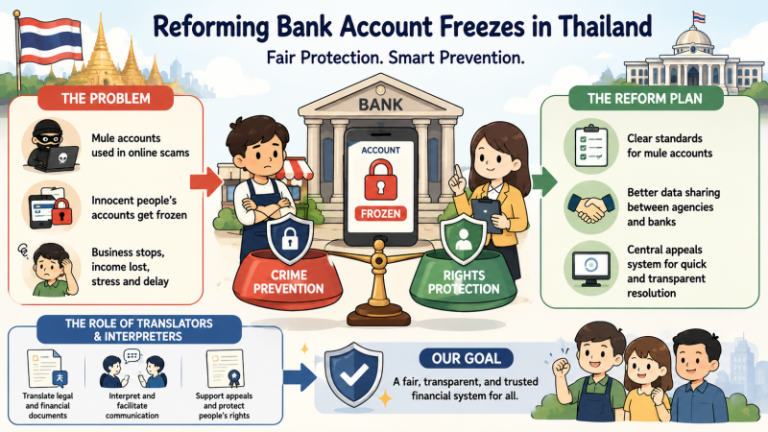
The problem of bank account freezes in Thailand is directly linked to anti-mule account measures, as mule accounts are commonly used as tools for transferring money obtained through online scams. Cybercriminal networks frequently use the accounts of other individuals to receive and transfer money in order to evade government investigations. As a result, regulatory authorities and commercial banks have accelerated proactive measures to detect accounts exhibiting suspicious behavior (Thai Lawmakers Address Rising Concerns Over Wrongful Bank Account Freezes, p. 2, 2026).
However, such systems primarily rely on algorithms or financial behavior analysis criteria, including the number of money transfers, transaction frequency, or the ownership of multiple accounts simultaneously. Although these behaviors may appear in money laundering networks, they are also common among online entrepreneurs, small business owners, and individuals who regularly engage in digital transactions. Consequently, many innocent individuals have had their accounts frozen without sufficient factual investigation.
Impacts on Consumers and the Business Sector
Bank account freezes have severely affected the daily lives and economic activities of citizens, particularly small and medium-sized enterprises that rely on digital transfers for the purchase and sale of goods and services. Once an account is frozen, businesses are unable to receive payments from customers, pay suppliers, compensate employees, or pay rent. As a result, cash flow is interrupted and businesses may eventually be forced to close (Thai Lawmakers Address Rising Concerns Over Wrongful Bank Account Freezes, p. 4, 2026).
Furthermore, fear of account freezes has caused many businesses to avoid accepting payments through QR codes or online transfers and instead return to cash transactions. This represents a regression in Thailand’s digital economy and may undermine public confidence in electronic banking systems in the long term.
Approaches to Reforming the Bank Account Freezing System
The Thai Senate has proposed reforms to the bank account freezing system in three stages: short-term, medium-term, and long-term measures. Short-term measures aim to establish standardized definitions of mule accounts in order to reduce ambiguous interpretations. Medium-term measures focus on improving cooperation between government agencies and banks through systematic information sharing. Long-term measures aim to establish a centralized appeals center and a national database that would enable citizens to verify and clarify their cases quickly and transparently (Thai Lawmakers Address Rising Concerns Over Wrongful Bank Account Freezes, p. 6, 2026).
These reforms reflect the government’s efforts to balance financial crime prevention with the protection of financial service users’ rights, which constitutes an essential component of the rule of law in a democratic society.
The Roles of Certified Translators and Certified Interpreters in Rights Protection Processes
In the context of account freezes involving foreigners, investors, and long-term residents in Thailand, certified translators, translation certification providers, and certified interpreters play significant roles in supporting legal and financial procedures. This is particularly important in the translation of essential documents such as income certificates, business contracts, tax documents, bank statements, and immigration documents for use in appeals submitted to banks or government agencies.
The Southeast Asian Association of Professional Translators and Interpreters plays an important role in establishing professional standards for translation and interpreting within the region, while also promoting ethics, accuracy, and the reliability of certified translations. These elements are crucial to judicial processes and the protection of the rights of individuals affected by account freezes.
In addition, certified interpreters facilitate communication between affected individuals and government agencies, banks, or legal proceedings. They help reduce misunderstandings in cross-linguistic communication and promote accurate understanding among all parties, which constitutes an essential component of access to justice in a multilingual society.
Conclusion
The issue of bank account freezes in Thailand under anti-mule account measures reflects the challenge faced by the state in balancing financial crime prevention with the protection of citizens’ rights. Although proactive measures help reduce illegal financial transfers, the lack of rigorous verification systems and effective appeal procedures has adversely affected many innocent individuals in economic, social, and psychological dimensions, as well as public confidence in digital banking systems.
Therefore, reforms of the bank account freezing system should emphasize transparency, fairness, and effective verification mechanisms simultaneously. At the same time, certified translators, translation certification providers, and certified interpreters play important roles in supporting the protection of affected individuals’ rights, particularly within multilingual societies and international economic contexts. The development of professional standards in translation and interpreting is thus another significant factor that can promote access to justice and strengthen confidence in Thailand’s legal and financial systems in the future.
References
- Thai Lawmakers Address Rising Concerns Over Wrongful Bank Account Freezes. (2026). pp. 1–6.
For professional services, please visit: https://www.seaproti.org/practitioners/
About certified translators, translation certifiers, and certified interpreters associated with SEAProTI. The Southeast Asian Association of Professional Translators and Interpreters (SEAProTI) has officially shared the qualifications and requirements for becoming Certified Translators, Translation Certification Providers, and Certified Interpreters in Sections 9 and 10 of the Royal Gazette, which was published by the Prime Minister’s Office in Thailand on July 25, 2024. Certified Translators, Translation Certification Providers, and Certified Interpreters
The Council of State has proposed the enactment of a Royal Decree, granting registered translators and recognised translation certifiers from professional associations or accredited language institutions the authority to provide legally valid translation certification (Letter to SEAProTI dated April 28, 2025)
SEAProTI is the first professional association in Thailand and Southeast Asia to implement a comprehensive certification system for translators, certifiers, and interpreters.
Head Office: Baan Ratchakru Building, No. 33, Room 402, Soi Phahonyothin 5, Phahonyothin Road, Phaya Thai District, Bangkok 10400, Thailand
Email: hello@seaproti.com | Tel.: (+66) 2-114-3128 (Office hours: Mon–Fri, 09:00–17:00).
การปฏิรูประบบอายัดบัญชีธนาคารในประเทศไทยภายใต้มาตรการปราบปรามบัญชีม้า: ผลกระทบต่อสิทธิของผู้บริโภคและธุรกิจ
ผู้เขียน: ภคพร ตันจรารักษ์
14 พฤษภาคม 2569, กรุงเทพมหานคร – บทความนี้มีวัตถุประสงค์เพื่อศึกษาปัญหาการอายัดบัญชีธนาคารในประเทศไทยภายใต้มาตรการปราบปรามบัญชีม้า ซึ่งเป็นส่วนหนึ่งของนโยบายป้องกันอาชญากรรมทางการเงินและการหลอกลวงออนไลน์ของภาครัฐ แม้มาตรการดังกล่าวมีเป้าหมายเพื่อยับยั้งการเคลื่อนย้ายเงินผิดกฎหมาย แต่กลับส่งผลกระทบต่อประชาชนผู้บริสุทธิ์ ผู้ประกอบการรายย่อย ผู้ประกอบวิชาชีพ และชาวต่างชาติที่ใช้ระบบการเงินดิจิทัลในการดำเนินชีวิตและประกอบธุรกิจ บทความนี้วิเคราะห์สาเหตุของปัญหา ผลกระทบต่อเศรษฐกิจและสิทธิของผู้บริโภค ตลอดจนแนวทางการปฏิรูปที่เสนอโดยวุฒิสภาไทย นอกจากนี้ยังศึกษาบทบาทของนักแปลรับรอง ผู้รับรองการแปล และล่ามรับรองของ สมาคมวิชาชีพนักแปลและล่ามแห่งเอเชียตะวันออกเฉียงใต้ ในการสนับสนุนกระบวนการอุทธรณ์ การแปลเอกสารทางกฎหมายและการเงิน และการคุ้มครองสิทธิของผู้ได้รับผลกระทบในบริบทระหว่างประเทศ ผลการศึกษาพบว่าการปฏิรูประบบอายัดบัญชีจำเป็นต้องคำนึงถึงทั้งประสิทธิภาพในการป้องกันอาชญากรรมและหลักความเป็นธรรมต่อผู้ใช้บริการทางการเงิน เพื่อสร้างความเชื่อมั่นต่อระบบธนาคารดิจิทัลและระบบกฎหมายของประเทศไทยในระยะยาว
บทนำ
ในยุคที่เศรษฐกิจดิจิทัลและธุรกรรมออนไลน์กลายเป็นส่วนสำคัญของการดำเนินชีวิตประจำวัน ระบบธนาคารอิเล็กทรอนิกส์และการชำระเงินผ่านแพลตฟอร์มดิจิทัลได้รับความนิยมเพิ่มขึ้นอย่างต่อเนื่องในประเทศไทย อย่างไรก็ตาม การขยายตัวของธุรกรรมออนไลน์ได้มาพร้อมกับการเพิ่มขึ้นของอาชญากรรมทางไซเบอร์ โดยเฉพาะการหลอกลวงทางการเงินและการใช้ “บัญชีม้า” ในการเคลื่อนย้ายเงินที่ได้จากการกระทำผิดกฎหมาย รัฐบาลไทยจึงเร่งดำเนินมาตรการปราบปรามเครือข่ายดังกล่าวผ่านการตรวจสอบและอายัดบัญชีธนาคารที่มีพฤติกรรมต้องสงสัย (สมาชิกรัฐสภาไทยเร่งแก้ไขความกังวลที่เพิ่มขึ้นเกี่ยวกับการอายัดบัญชีธนาคารโดยมิชอบ, น. 1, พ.ศ. 2569)
แม้มาตรการดังกล่าวจะมีเป้าหมายเพื่อปกป้องประชาชนจากการฉ้อโกงทางออนไลน์ แต่ในทางปฏิบัติกลับส่งผลกระทบต่อผู้บริสุทธิ์จำนวนมาก โดยเฉพาะผู้ประกอบการรายย่อย ผู้ค้าขายออนไลน์ ผู้ประกอบวิชาชีพอิสระ รวมถึงชาวต่างชาติที่พำนักหรือดำเนินธุรกิจในประเทศไทย เนื่องจากระบบตรวจสอบของธนาคารและหน่วยงานรัฐมักใช้รูปแบบพฤติกรรมทางการเงินเป็นเกณฑ์ในการประเมินความเสี่ยง เช่น การรับโอนเงินหลายครั้งต่อวัน หรือการถือครองบัญชีหลายบัญชี ซึ่งเป็นพฤติกรรมที่สามารถพบได้ในการดำเนินธุรกิจทั่วไป ส่งผลให้ประชาชนจำนวนหนึ่งถูกอายัดบัญชีโดยไม่มีการแจ้งเตือนล่วงหน้า และต้องเผชิญกระบวนการอุทธรณ์ที่ใช้เวลานานและมีความซับซ้อน (สมาชิกรัฐสภาไทยเร่งแก้ไขความกังวลที่เพิ่มขึ้นเกี่ยวกับการอายัดบัญชีธนาคารโดยมิชอบ, น. 2, พ.ศ. 2569)
สถานการณ์ดังกล่าวก่อให้เกิดข้อถกเถียงในสังคมเกี่ยวกับความสมดุลระหว่างการบังคับใช้กฎหมายกับการคุ้มครองสิทธิขั้นพื้นฐานทางเศรษฐกิจและการเงินของประชาชน คณะกรรมาธิการเศรษฐกิจ การเงิน และการธนาคาร รวมถึงคณะกรรมาธิการกฎหมายและกระบวนการยุติธรรมของวุฒิสภาไทย จึงเริ่มผลักดันแนวทางการปฏิรูประบบอายัดบัญชีเพื่อป้องกันผลกระทบที่เกิดกับผู้บริสุทธิ์ (สมาชิกรัฐสภาไทยเร่งแก้ไขความกังวลที่เพิ่มขึ้นเกี่ยวกับการอายัดบัญชีธนาคารโดยมิชอบ, น. 3, พ.ศ. 2569)
นอกจากนี้ ประเด็นดังกล่าวยังเชื่อมโยงกับบริบทระหว่างประเทศและการสื่อสารข้ามภาษา เนื่องจากผู้ได้รับผลกระทบบางส่วนเป็นชาวต่างชาติ นักลงทุน หรือผู้ถือวีซ่าระยะยาว ซึ่งจำเป็นต้องใช้เอกสารทางกฎหมายและการเงินหลายภาษาในการยื่นอุทธรณ์หรือชี้แจงต่อหน่วยงานรัฐและสถาบันการเงิน ดังนั้น นักแปลรับรอง ผู้รับรองการแปล และล่ามรับรองจึงมีบทบาทสำคัญในการสนับสนุนกระบวนการยุติธรรมและคุ้มครองสิทธิของบุคคลเหล่านี้ โดยเฉพาะภายใต้มาตรฐานวิชาชีพของ สมาคมวิชาชีพนักแปลและล่ามแห่งเอเชียตะวันออกเฉียงใต้ ซึ่งทำหน้าที่กำหนดมาตรฐานด้านการแปลและล่ามในภูมิภาคเอเชียตะวันออกเฉียงใต้ บทความนี้จึงมุ่งศึกษาปัญหาการอายัดบัญชีธนาคารในประเทศไทย ผลกระทบต่อผู้ใช้บริการทางการเงิน แนวทางการปฏิรูประบบ รวมถึงบทบาทของผู้เชี่ยวชาญด้านการแปลและล่ามรับรองในการสนับสนุนกระบวนการทางกฎหมายและการเงิน เพื่อสะท้อนให้เห็นถึงความสำคัญของความเป็นธรรม ความโปร่งใส และการคุ้มครองสิทธิของประชาชนในยุคเศรษฐกิจดิจิทัล
สาเหตุของการอายัดบัญชีธนาคารในประเทศไทย
ปัญหาการอายัดบัญชีธนาคารในประเทศไทยมีความเชื่อมโยงโดยตรงกับมาตรการปราบปรามบัญชีม้า ซึ่งถูกใช้เป็นเครื่องมือสำคัญในการเคลื่อนย้ายเงินจากการหลอกลวงออนไลน์ เครือข่ายอาชญากรรมทางไซเบอร์มักใช้บัญชีของบุคคลอื่นในการรับและโอนเงินเพื่อหลีกเลี่ยงการตรวจสอบของเจ้าหน้าที่รัฐ ส่งผลให้หน่วยงานกำกับดูแลและธนาคารพาณิชย์ต้องเร่งดำเนินมาตรการเชิงรุกในการตรวจจับบัญชีที่มีพฤติกรรมผิดปกติ (สมาชิกรัฐสภาไทยเร่งแก้ไขความกังวลที่เพิ่มขึ้นเกี่ยวกับการอายัดบัญชีธนาคารโดยมิชอบ, น. 2, พ.ศ. 2569)
อย่างไรก็ตาม ระบบดังกล่าวมักอาศัยอัลกอริทึมหรือเกณฑ์การวิเคราะห์พฤติกรรมทางการเงินเป็นหลัก เช่น จำนวนครั้งของการโอนเงิน ความถี่ของธุรกรรม หรือการถือครองหลายบัญชีพร้อมกัน พฤติกรรมเหล่านี้แม้อาจพบในเครือข่ายฟอกเงิน แต่ก็สามารถพบได้ทั่วไปในกลุ่มผู้ประกอบการออนไลน์ ผู้ค้ารายย่อย หรือผู้ที่ทำธุรกรรมดิจิทัลเป็นประจำ ส่งผลให้เกิดการอายัดบัญชีของผู้บริสุทธิ์จำนวนมากโดยไม่มีการตรวจสอบข้อเท็จจริงอย่างเพียงพอ
ผลกระทบต่อผู้บริโภคและภาคธุรกิจ
การอายัดบัญชีธนาคารส่งผลกระทบอย่างรุนแรงต่อการดำเนินชีวิตและกิจกรรมทางเศรษฐกิจของประชาชน โดยเฉพาะผู้ประกอบธุรกิจขนาดเล็กและขนาดกลางที่พึ่งพาการโอนเงินผ่านระบบดิจิทัลในการซื้อขายสินค้าและบริการ เมื่อบัญชีถูกอายัด ธุรกิจไม่สามารถรับเงินจากลูกค้า ชำระค่าสินค้า จ่ายค่าแรงพนักงาน หรือชำระค่าเช่าได้ ส่งผลให้กระแสเงินสดหยุดชะงักและอาจนำไปสู่การปิดกิจการในที่สุด (สมาชิกรัฐสภาไทยเร่งแก้ไขความกังวลที่เพิ่มขึ้นเกี่ยวกับการอายัดบัญชีธนาคารโดยมิชอบ, น. 4, พ.ศ. 2569)
นอกจากนี้ ความหวาดกลัวต่อการถูกอายัดบัญชียังส่งผลให้ร้านค้าหลายแห่งเริ่มหลีกเลี่ยงการรับชำระเงินผ่าน QR Code หรือการโอนเงินออนไลน์ และหันกลับไปใช้เงินสดแทน ซึ่งถือเป็นการถอยหลังของระบบเศรษฐกิจดิจิทัลไทย และอาจกระทบต่อความเชื่อมั่นของประชาชนต่อระบบธนาคารอิเล็กทรอนิกส์ในระยะยาว
แนวทางการปฏิรูประบบอายัดบัญชี
วุฒิสภาไทยได้เสนอแนวทางปฏิรูประบบอายัดบัญชีในสามระดับ ได้แก่ ระยะสั้น ระยะกลาง และระยะยาว โดยระยะสั้นมุ่งสร้างมาตรฐานกลางในการนิยามบัญชีม้า เพื่อลดการตีความที่คลุมเครือ ระยะกลางมุ่งพัฒนาความร่วมมือระหว่างหน่วยงานภาครัฐและธนาคารในการแลกเปลี่ยนข้อมูลอย่างเป็นระบบ และระยะยาวมุ่งจัดตั้งศูนย์กลางการอุทธรณ์และฐานข้อมูลระดับประเทศเพื่อให้ประชาชนสามารถตรวจสอบและชี้แจงกรณีของตนได้อย่างรวดเร็วและโปร่งใส (สมาชิกรัฐสภาไทยเร่งแก้ไขความกังวลที่เพิ่มขึ้นเกี่ยวกับการอายัดบัญชีธนาคารโดยมิชอบ, น. 6, พ.ศ. 2569)
การปฏิรูปดังกล่าวสะท้อนให้เห็นถึงความพยายามของภาครัฐในการสร้างสมดุลระหว่างการป้องกันอาชญากรรมทางการเงินกับการคุ้มครองสิทธิของผู้ใช้บริการทางการเงิน ซึ่งถือเป็นองค์ประกอบสำคัญของหลักนิติธรรมในสังคมประชาธิปไตย
บทบาทของนักแปลรับรองและล่ามรับรองในกระบวนการคุ้มครองสิทธิ
ในบริบทของการอายัดบัญชีที่เกี่ยวข้องกับชาวต่างชาติ นักลงทุน และผู้พำนักระยะยาวในประเทศไทย นักแปลรับรอง ผู้รับรองการแปล และล่ามรับรองมีบทบาทสำคัญในการสนับสนุนกระบวนการทางกฎหมายและการเงิน โดยเฉพาะในการแปลเอกสารสำคัญ เช่น หนังสือรับรองรายได้ สัญญาทางธุรกิจ เอกสารภาษี รายการเดินบัญชี และเอกสารตรวจคนเข้าเมือง เพื่อใช้ในการอุทธรณ์ต่อธนาคารหรือหน่วยงานรัฐ
สมาคมวิชาชีพนักแปลและล่ามแห่งเอเชียตะวันออกเฉียงใต้ มีบทบาทในการกำหนดมาตรฐานวิชาชีพด้านการแปลและล่ามในภูมิภาค รวมถึงส่งเสริมจรรยาบรรณ ความถูกต้อง และความน่าเชื่อถือของเอกสารแปลรับรอง ซึ่งมีความสำคัญต่อกระบวนการยุติธรรมและการคุ้มครองสิทธิของผู้ได้รับผลกระทบจากการอายัดบัญชี
นอกจากนี้ ล่ามรับรองยังมีบทบาทในการอำนวยความสะดวกด้านการสื่อสารระหว่างผู้เสียหายกับหน่วยงานราชการ ธนาคาร หรือกระบวนการพิจารณาทางกฎหมาย โดยช่วยลดความคลาดเคลื่อนในการสื่อสารข้ามภาษาและสร้างความเข้าใจที่ถูกต้องระหว่างทุกฝ่าย ซึ่งถือเป็นองค์ประกอบสำคัญของการเข้าถึงความยุติธรรมในสังคมพหุภาษา
สรุป
ปัญหาการอายัดบัญชีธนาคารในประเทศไทยภายใต้มาตรการปราบปรามบัญชีม้าสะท้อนให้เห็นถึงความท้าทายของรัฐในการสร้างสมดุลระหว่างการป้องกันอาชญากรรมทางการเงินกับการคุ้มครองสิทธิของประชาชน แม้มาตรการเชิงรุกจะช่วยลดการเคลื่อนย้ายเงินผิดกฎหมาย แต่การขาดระบบตรวจสอบที่รัดกุมและกระบวนการอุทธรณ์ที่มีประสิทธิภาพกลับส่งผลกระทบต่อผู้บริสุทธิ์จำนวนมาก ทั้งในด้านเศรษฐกิจ สังคม และความเชื่อมั่นต่อระบบธนาคารดิจิทัล
การปฏิรูประบบอายัดบัญชีจึงควรมุ่งเน้นความโปร่งใส ความเป็นธรรม และการตรวจสอบที่มีประสิทธิภาพควบคู่กันไป ขณะเดียวกัน นักแปลรับรอง ผู้รับรองการแปล และล่ามรับรองมีบทบาทสำคัญในการสนับสนุนกระบวนการคุ้มครองสิทธิของผู้ได้รับผลกระทบ โดยเฉพาะในบริบทของสังคมพหุภาษาและเศรษฐกิจระหว่างประเทศ การพัฒนามาตรฐานวิชาชีพด้านการแปลและล่ามจึงเป็นอีกปัจจัยหนึ่งที่ช่วยส่งเสริมการเข้าถึงความยุติธรรมและสร้างความเชื่อมั่นต่อระบบกฎหมายและการเงินของประเทศไทยในอนาคต
เอกสารอ้างอิง
- ไทยลอว์เมกเกอร์ส แอดเดรส ไรซิง คอนเซิร์นส์ โอเวอร์ รองฟูล แบงก์ แอ็กเคานต์ ฟรีซเซส. (พ.ศ. 2569). น. 1–6.
สมาคมวิชาชีพนักแปลและล่ามแห่งเอเชียตะวันออกเฉียงใต้ (SEAProTI) ได้ประกาศหลักเกณฑ์และคุณสมบัติของผู้ที่ขึ้นทะเบียนเป็น “นักแปลรับรอง (Certified Translators) และผู้รับรองการแปล (Translation Certification Providers) และล่ามรับรอง (Certified Interpreters)” ของสมาคม หมวดที่ 9 และหมวดที่ 10 ในราชกิจจานุเบกษา ของสำนักเลขาธิการคณะรัฐมนตรี ในสำนักนายกรัฐมนตรี แห่งราชอาณาจักรไทย ลงวันที่ 25 ก.ค. 2567 เล่มที่ 141 ตอนที่ 66 ง หน้า 100 อ่านฉบับเต็มได้ที่: นักแปลรับรอง ผู้รับรองการแปล และล่ามรับรอง
สำนักคณะกรรมการกฤษฎีกาเสนอให้ตราเป็นพระราชกฤษฎีกา โดยกำหนดให้นักแปลที่ขึ้นทะเบียน รวมถึงผู้รับรองการแปลจากสมาคมวิชาชีพหรือสถาบันสอนภาษาที่มีการอบรมและขึ้นทะเบียน สามารถรับรองคำแปลได้ (จดหมายถึงสมาคม SEAProTI ลงวันที่ 28 เม.ย. 2568)
สมาคมวิชาชีพนักแปลและล่ามแห่งเอเชียตะวันออกเฉียงใต้เป็นสมาคมวิชาชีพแห่งแรกและแห่งเดียวในประเทศไทยและภูมิภาคเอเชียตะวันออกเฉียงใต้ที่มีระบบรับรองนักแปลรับรอง ผู้รับรองการแปล และล่ามรับรอง
สำนักงานใหญ่: อาคารบ้านราชครู เลขที่ 33 ห้อง 402 ซอยพหลโยธิน 5 ถนนพหลโยธิน แขวงพญาไท เขตพญาไท กรุงเทพมหานคร 10400 ประเทศไทย