


Gender Politics in Contemporary Classical Chinese Opera
Author: Petra Bordt
May 07, 2026, Bangkok – This article explores the intersection of feminism and androgyny in contemporary classical Chinese opera (xiqu), examining how gender fluidity and feminist representation connect with modern audiences. The analysis focuses on Amy Ng’s translation of Rescuing One’s Sister in the Wind and Dust (2021) and all-female Yue Opera productions such as New Dragon Gate Inn (2023) and Coriolanus and Du Liniang (2016).
Introduction: The Doubleness of Contemporary Classics
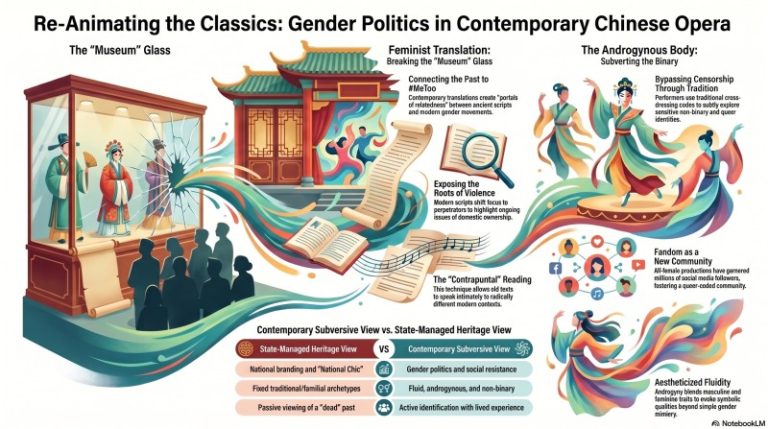
The concept of “contemporary classical” serves as an oxymoron that highlights the layering of multiple temporalities in theatre and translation. Translated performance brings the past and present into sharp relief, destabilizing fixed assumptions of “presentism”. In China, classical opera is often commodified as a dead relic or a symbol of national pride managed by top-down systems. However, new translations and performances challenge this by embedding feminist and gender-inclusive themes, resisting official expectations in subtle ways.
Feminist Representation of the Classics
Feminist interpretations through a feminist lens provide a “contrapuntal” texture to the stage, allowing women to see their own lives mirrored in the experiences of historical figures. Amy Ng’s translation of Guan Hanqing’s 13th-century play recontextualizes domestic violence and sex work for a contemporary audience. By exposing the perpetrator’s perspective and using anachronistic terms like “break her in,” the translation connects historical oppression with modern movements like #MeToo.
The Androgynous Body and Gender Fluidity
Androgyny in Chinese opera is a long-standing tradition where performers cross gender boundaries—male actors in female roles (dan) and female actors in male roles (sheng). Contemporary productions by the Zhejiang Xiaobaihua Yue Opera troupe utilize all-female casting to embody gender fluidity. Their production of New Dragon Gate Inn (2023) became a social media sensation, with the androgynous portrayal of characters like Jade-faced Jia Ting appealing to a young audience’s interest in non-binary identities and queer subtexts.
Conclusion
Translation and performance act as artistic and political resistance. By prising apart the “floodgates” of gender representation, these works allow the past to merge into a modernized narrative that aligns with progressive global discourses on identity.
References
- Benjamin, W. (1996). On the program of the coming philosophy. In M. B. Jennings, & M. B. Jennings (Ed.), Selected Writings (Vol. 1, pp. 100–110). Cambridge, Massachusetts: Harvard University Press.
- Bentley, E. (1964). The life of the drama. Atheneum: New York.
- Berger, J. (2003). Written in the night: The pain of living in the present world. Le Monde Diplomatique.
- Billington, M. (2017). Snow in Midsummer review — Restless spirit seeks revenge in Chinese classic. The Guardian.
- Chu, J. H. and Fan, Y. (2024). Art of adaptation: How Yue opera Is winning over young Chinese. Sixth Tone.
- Guan, H. (2023). Zhao Pan’er Rescuing one’s sister in the wind and dust. Classical Chinese Texts.
- Jin, J. (2011). Women playing men: Yue opera and social change in twentieth-century Shanghai. University of Washington Press.
- Johnston, D. (2016). Travelling through the emotions: Staging the erotic. Palimpsestes, 29.
- Johnston, D. (2024). Theatre, translation, and philosophy. In D. Johnston and J. Johnson (Eds.), Juan Mayorga: Six plays (pp. 11–25). London: Routledge.
- Kearney, R. (2002). Strangers and others: From deconstruction to hermeneutics. Critical Horizons, 3(1), 7–36.
- Loo, F. Y., & Deng, S. X. (2024). Female roles in Western-style Chinese opera: From Confucianist female archetype and political allegory to postmodern complexity. Women’s History Review, 1–19.
- Garcia Lorca, F. (2007). Theory and play of the Duende. Translated by A. S. Kline. Poetry in Translation.
- Ho, M. H. S., Li, E. C. Y., & Kam, L. Y. L. (2021). Editorial introduction: Androgynous bodies and cultures in Asia. Inter-Asia Cultural Studies, 22(2), 129–138.
- National Radio and Television Administration. (2017). The Internet audiovisual programmes content censorship rules published. Xinhuanet.
- National Radio and Television Administration. (2021). The Internet Short Video Content Censorship Standards.
- Ng, A. (Translator). (2021). Rescuing one’s sister in the wind and dust [Video]. YouTube.
- RSC. (2019). The Birth of Chinese drama. Royal Shakespeare Company.
- Shen, J. (2024). Husband Sister, Zhuhuan Fairy… This generation of stage actors get popular in a special way. ELLE.
- Sun, D. (1981). The collection of the regular cases. In L. Wang, The Yuan Ming and Qing dynasties banned the destruction of novels and opera historical materials (p. 26). Shanghai: Shanghai Classics Publishing House.
- Tse, P. (2021). Performing androgyny: Cross-dressing actresses, fandom, and queer sensibility in Hong Kong Cantonese opera. Inter-Asia Cultural Studies, 22(2), 139–157.
- Wang, R. (2009). The Injustice of Dou’E. In H. Wang, Anthology of Chinese masterpieces in English translation (pp. 240–243). Beijing: Foreign Language Teaching and Research Press.
- Wang, Y., Hu, Z., Peng, K. et al. (2020). Mapping out a spectrum of the Chinese public’s discrimination toward the LGBT community: Results from a national survey. BMC Public Health, 20(669), 1–10.
- Wong, B. (2022). The long road to ending gendered violence in China. USALI Perspectives, 3(9).
- Xu, L. (Forthcoming). Exploring the affordance of feminism in the translation of Rescuing One’s Sister in the Wind and Dust for the London Stage. Journal of The Society for Asian Humanities.
- Xu, W. (2003). The biography of Meng Xiaodong. Shanghai: Shanghai People’s Press.
For professional services, please visit: https://www.seaproti.org/practitioners/
About certified translators, translation certifiers, and certified interpreters associated with SEAProTI. The Southeast Asian Association of Professional Translators and Interpreters (SEAProTI) has officially shared the qualifications and requirements for becoming Certified Translators, Translation Certification Providers, and Certified Interpreters in Sections 9 and 10 of the Royal Gazette, which was published by the Prime Minister’s Office in Thailand on July 25, 2024. Certified Translators, Translation Certification Providers, and Certified Interpreters
The Council of State has proposed the enactment of a Royal Decree, granting registered translators and recognised translation certifiers from professional associations or accredited language institutions the authority to provide legally valid translation certification (Letter to SEAProTI dated April 28, 2025)
SEAProTI is the first professional association in Thailand and Southeast Asia to implement a comprehensive certification system for translators, certifiers, and interpreters.
Head Office: Baan Ratchakru Building, No. 33, Room 402, Soi Phahonyothin 5, Phahonyothin Road, Phaya Thai District, Bangkok 10400, Thailand
Email: hello@seaproti.com | Tel.: (+66) 2-114-3128 (Office hours: Mon–Fri, 09:00–17:00).
การเมืองเรื่องเพศในงิ้วจีนร่วมสมัย
ผู้เขียน: เภตรา โบรด
07 พฤษภาคม 2569, กรุงเทพมหานคร – บทความนี้สำรวจจุดตัดระหว่างสตรีนิยมและสภาวะกะเทย (androgyny) ในงิ้วจีนร่วมสมัย โดยวิเคราะห์ว่าความลื่นไหลทางเพศและการนำเสนอผ่านมุมมองสตรีนิยมสร้างเงื่อนไขในการเชื่อมโยงกับผู้ชมรุ่นใหม่ได้อย่างไร การสนทนามุ่งเน้นไปที่สองตัวอย่างหลัก ได้แก่ บทแปลของ เอมี่ อึ้ง เรื่อง Rescuing One’s Sister in the Wind and Dust (2021) และการแสดงงิ้วเยว่ที่มีนักแสดงหญิงล้วนในเรื่อง New Dragon Gate Inn (2023) และ Coriolanus and Du Liniang (2016)
บทนำ: ความเป็นทวิลักษณ์ของงานคลาสสิกสมัยใหม่
แนวคิดเรื่อง “คลาสสิกร่วมสมัย” เป็นคำที่ดูขัดแย้งกันแต่สื่อถึงการซ้อนทับของเวลาหลายมิติในการแปลและการสร้างละคร การแสดงที่ผ่านการแปลช่วยนำอดีตและปัจจุบันมาวางเคียงกันเพื่อสั่นคลอนความเชื่อที่ยึดติดกับปัจจุบัน ในประเทศจีน งิ้วคลาสสิกมักถูกทำให้กลายเป็นสินค้าในฐานะโบราณคดีที่ตายแล้ว หรือเป็นสัญลักษณ์ของความภูมิใจในชาติที่จัดการโดยระบบจากบนลงล่าง อย่างไรก็ตาม บทแปลและการแสดงใหม่ๆ ได้ท้าทายกรอบนี้ด้วยการสอดแทรกประเด็นสตรีนิยมและความหลากหลายทางเพศ ซึ่งเป็นการขัดขืนต่อความคาดหวังของรัฐอย่างแนบเนียน
การนำเสนอภาพลักษณ์สตรีนิยมในงานคลาสสิก
การตีความผ่านเลนส์สตรีนิยมช่วยให้ผู้ชมผู้หญิงสามารถอ่านชีวิตของตนเองผ่านชีวิตของตัวละครในอดีตได้ บทแปลของ เอมี่ อึ้ง จากบทละครศตวรรษที่ 13 ของ กวาน ฮั่นชิง ได้เปลี่ยนบริบทของความรุนแรงในครอบครัวและการค้าประเวณีให้เข้ากับยุคสมัย โดยการเปิดเผยทัศนคติของผู้กระทำผิดโดยตรง และใช้ถ้อยคำที่ฉีกยุคสมัยเพื่อเชื่อมโยงความอยุติธรรมในอดีตเข้ากับขบวนการสมัยใหม่อย่าง #MeToo
ร่างกายกะเทยและความลื่นไหลทางเพศ
สภาวะกะเทยในงิ้วจีนเป็นประเพณีที่มีมาอย่างยาวนาน ผ่านบทบาทที่ข้ามพรมแดนทางเพศ เช่น นักแสดงชายในบทหญิง (ต้าน) และนักแสดงหญิงในบทชาย (เซิง) การแสดงงิ้วเยว่หญิงล้วนของคณะ เจ้อเจียง เสี่ยวไป่ฮัว ในเรื่อง New Dragon Gate Inn (2023) ได้สร้างกระแสในโซเชียลมีเดีย โดยเฉพาะตัวละครที่มีลักษณะกะเทยซึ่งดึงดูดผู้ชมรุ่นใหม่ที่สนใจในอัตลักษณ์นอนไบนารีและนัยยะแบบเควียร์ (queer subtexts)
บทสรุป
การแปลและการแสดงทำหน้าที่เป็นการต่อต้านทางศิลปะและการเมือง สิ่งเหล่านี้ช่วยให้พรมแดนที่ปิดกั้นการนำเสนอเรื่องเพศค่อยๆ เปิดออก และทำให้อดีตหลอมรวมเข้ากับเรื่องเล่าสมัยใหม่ที่สอดคล้องกับวาทกรรมระดับโลกเกี่ยวกับอัตลักษณ์
เอกสารอ้างอิง
- เบนจามิน, ดับเบิลยู. (1996). On the program of the coming philosophy. In M. B. Jennings, & M. B. Jennings (Ed.), Selected Writings (Vol. 1, pp. 100–110). Cambridge, Massachusetts: Harvard University Press.
- เบนท์ลีย์, อี. (1964). The life of the drama. Atheneum: New York.
- เบอร์เจอร์, จอห์น. (2003). Written in the night: The pain of living in the present world. Le Monde Diplomatique.
- บิลลิงตัน, เอ็ม. (2017). Snow in Midsummer review — Restless spirit seeks revenge in Chinese classic. The Guardian.
- ชู, เจ. เอช. และ แฟน, วาย. (2024). Art of adaptation: How Yue opera Is winning over young Chinese. Sixth Tone.
- กวาน ฮั่นชิง. (2023). 赵盼儿风月救风尘 [‘Zhao Pan’er Rescuing one’s sister in the wind and dust]’. 中华典藏 [Classical Chinese Texts].
- จิน, เจ. (2011). Women playing men: Yue opera and social change in twentieth-century Shanghai. University of Washington Press.
- จอห์นสตัน, ดี. (2016). Travelling through the emotions: Staging the erotic. Palimpsestes, 29.
- จอห์นสตัน, ดี. (2024). Theatre, translation, and philosophy. In D. Johnston and J. Johnson (Eds.), Juan Mayorga: Six plays (pp. 11–25). London: Routledge.
- เคียร์นีย์, อาร์. (2002). Strangers and others: From deconstruction to hermeneutics. Critical Horizons, 3(1), 7–36.
- ลู, เอฟ. วาย. และ เติ้ง, เอส. เอ็กซ์. (2024). Female roles in Western-style Chinese opera: From Confucianist female archetype and political allegory to postmodern complexity. Women’s History Review, 1–19.
- การ์เซีย ลอร์กา, เอฟ. (2007). Theory and play of the Duende. Translated by A. S. Kline. Poetry in Translation.
- โฮ, เอ็ม. เอช. เอส., หลี่, อี. ซี. วาย. และ คัม, แอล. วาย. แอล. (2021). Editorial introduction: Androgynous bodies and cultures in Asia. Inter-Asia Cultural Studies, 22(2), 129–138.
- สำนักงานวิทยุและโทรทัศน์แห่งชาติ. (2017). 网络视听节目内容审核通则发布 [The Internet audiovisual programmes content censorship rules published]. Xinhuanet.
- สำนักงานวิทยุและโทรทัศน์แห่งชาติ. (2021). The Internet Short Video Content Censorship Standards.
- อึ้ง, เอ. (Translator). (2021). Rescuing one’s sister in the wind and dust [Video]. YouTube.
- RSC. (2019). The Birth of Chinese drama. Royal Shakespeare Company.
- เฉิน, เจ. (2024). “⽼公姐”、”朱鹮仙”…这⼀届ของนักแสดงละครเวทีมีการแจ้งเกิดที่พิเศษ [‘Husband Sister’, ‘Zhuhuan Fairy’… This generation of stage actors get popular in a special way]. ELLE.
- ซุน, ดี. (1981). 定例成案合钞 [‘The collection of the regular cases’]. In หวัง, แอล., 元明清三代禁毁小说戏曲史料 [‘The Yuan Ming and Qing dynasties banned the destruction of novels and opera historical materials’] (p. 26). Shanghai: Shanghai Classics Publishing House.
- เซ, พี. (2021). Performing androgyny: Cross-dressing actresses, fandom, and queer sensibility in Hong Kong Cantonese opera. Inter-Asia Cultural Studies, 22(2), 139–157.
- หวัง, อาร์. (2009). 窦娥冤 (The Injustice of Dou’E). In หวัง, เอช., 中华文化典籍英译 (Anthology of Chinese masterpieces in English translation) (pp. 240–243). Beijing: Foreign Language Teaching and Research Press.
- หวัง, วาย., หู, แซด., เผิง, เค. และคณะ. (2020). Mapping out a spectrum of the Chinese public’s discrimination toward the LGBT community: Results from a national survey. BMC Public Health, 20(669), 1–10.
- วอง, บี. (2022). The long road to ending gendered violence in China. USALI Perspectives, 3(9).
- สวี่, แอล. (Forthcoming). Exploring the affordance of feminism in the translation of Rescuing One’s Sister in the Wind and Dust for the London Stage. Journal of The Society for Asian Humanities.
- สวี่, ดับเบิลยู. (2003). 梨园东皇孟小冬传 [‘The biography of Meng Xiaodong’]. Shanghai: Shanghai People’s Press.
ขอใช้บริการนักวิชาชีพของสมาคมได้ที่:https://www.seaproti.org/practitioners/
สมาคมวิชาชีพนักแปลและล่ามแห่งเอเชียตะวันออกเฉียงใต้ (SEAProTI) ได้ประกาศหลักเกณฑ์และคุณสมบัติของผู้ที่ขึ้นทะเบียนเป็น “นักแปลรับรอง (Certified Translators) และผู้รับรองการแปล (Translation Certification Providers) และล่ามรับรอง (Certified Interpreters)” ของสมาคม หมวดที่ 9 และหมวดที่ 10 ในราชกิจจานุเบกษา ของสำนักเลขาธิการคณะรัฐมนตรี ในสำนักนายกรัฐมนตรี แห่งราชอาณาจักรไทย ลงวันที่ 25 ก.ค. 2567 เล่มที่ 141 ตอนที่ 66 ง หน้า 100 อ่านฉบับเต็มได้ที่: นักแปลรับรอง ผู้รับรองการแปล และล่ามรับรอง
สำนักคณะกรรมการกฤษฎีกาเสนอให้ตราเป็นพระราชกฤษฎีกา โดยกำหนดให้นักแปลที่ขึ้นทะเบียน รวมถึงผู้รับรองการแปลจากสมาคมวิชาชีพหรือสถาบันสอนภาษาที่มีการอบรมและขึ้นทะเบียน สามารถรับรองคำแปลได้ (จดหมายถึงสมาคม SEAProTI ลงวันที่ 28 เม.ย. 2568)
สมาคมวิชาชีพนักแปลและล่ามแห่งเอเชียตะวันออกเฉียงใต้เป็นสมาคมวิชาชีพแห่งแรกและแห่งเดียวในประเทศไทยและภูมิภาคเอเชียตะวันออกเฉียงใต้ที่มีระบบรับรองนักแปลรับรอง ผู้รับรองการแปล และล่ามรับรอง
สำนักงานใหญ่: อาคารบ้านราชครู เลขที่ 33 ห้อง 402 ซอยพหลโยธิน 5 ถนนพหลโยธิน แขวงพญาไท เขตพญาไท กรุงเทพมหานคร 10400 ประเทศไทย