


Guidelines for Foreigners Getting Married in Thailand: Legal Frameworks, Document Certification Procedures, and the Role of Certified Translators and Certified Interpreters in International Marriage Contexts
Author: Griroek Gruaythong
14 May 2569, Bangkok – Thailand has become one of the major destinations for international marriages, particularly among foreigners wishing to register marriages with Thai nationals or other foreign nationals in the country. Such processes involve not only cultural ceremonies but also legal procedures, document translation, and cross-border certification practices. This article examines the guidelines for foreigners getting married in Thailand through the lenses of family law, official document translation, and translation certification. Particular emphasis is placed on the roles of certified translators, translation certification providers, and certified interpreters within the broader context of transnational mobility. The article argues that translation functions not merely as linguistic transfer but also as a crucial mechanism for establishing legal validity, documentary credibility, and access to legal rights for married couples in international settings.
Introduction
In the era of globalization, marriages between individuals of different nationalities have become an increasingly common social phenomenon. Thailand, as a regional center for tourism, long-term residence, and foreign investment, has emerged as a significant site for transnational marriages, including unions between Thai nationals and foreigners as well as marriages between foreign nationals themselves. Marriage in Thailand is therefore not merely a cultural practice but also a legal process requiring documentation, certification, and translation procedures.
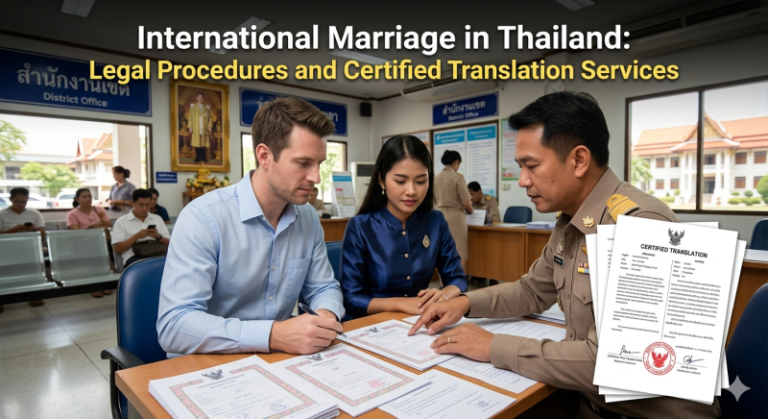
Although wedding ceremonies in Thai culture hold symbolic and traditional significance, Thai law recognizes a marriage as legally valid only upon official registration at a district office in accordance with statutory requirements. The distinction between a “wedding ceremony” and “marriage registration” is therefore particularly important for foreigners who may come from legal systems that attribute legal effect to religious or ceremonial practices.
Wedding Ceremonies and Marriage Registration under Thai Law
Under Thai law, wedding ceremonies are considered social and cultural activities rather than acts that automatically establish marital status. A marriage becomes legally effective only when the parties formally register their union before a registrar pursuant to the provisions of the Civil and Commercial Code. This process reflects the characteristics of the modern state, in which documentary administration and civil registration systems regulate personal status.
For foreigners, marriage registration in Thailand requires documentation from their country of origin, including passports and an Affidavit of Freedom to Marry issued by their embassy in Thailand. Such documents must be translated into Thai and certified by the Ministry of Foreign Affairs before they can be used for marriage registration purposes.
Translation and Document Certification in International Marriage Procedures
Document translation constitutes a fundamental component of international marriage procedures because governmental institutions generally require official documents to be presented in languages recognized and verifiable by state authorities. In Thailand, foreign-language documents must be translated into Thai by qualified translators before entering the certification process administered by the Ministry of Foreign Affairs.
Conversely, after marriage registration, Thai marriage certificates—which are issued in Thai—often need to be translated into English or other languages for submission to foreign embassies, immigration authorities, or civil registration offices in the parties’ home countries. This process demonstrates that translation is not merely a linguistic activity but also a mechanism for the legalization of transnational documents.
This perspective aligns with the argument advanced by Baker (1993), who emphasizes that translation is deeply connected to social and institutional contexts rather than functioning solely as a transfer of meaning between languages. In the context of official documentation, translation is also intertwined with state authority, identity verification, and the establishment of documentary credibility within international bureaucratic systems.
The Role of Certified Translators and Translation Certification Providers
Within the context of international marriage, certified translators play a critical role in ensuring the accuracy and consistency of translated documents. Even minor discrepancies involving names, dates of birth, or personal status may result in the rejection of documents by authorities in Thailand or abroad.
In addition, translation certification providers contribute to the credibility of translated documents through verification procedures and professional standards. Such mechanisms are particularly significant when documents must be recognized across multiple jurisdictions, each of which may impose different linguistic and certification requirements.
Within the framework of professional translator and interpreter associations in Southeast Asia, certified translators and translation certification providers contribute to the establishment of professional standards, ethical training, and certification guidelines for legal and official documents. Their work helps minimize risks associated with document fraud, translation inaccuracies, and legal disputes arising in immigration procedures or nationality applications.
The Role of Certified Interpreters in Legal and Administrative Processes
Certified interpreters also play an essential role when foreign spouses possess limited proficiency in Thai. This is particularly relevant during marriage registration procedures, interactions with government agencies, and communications involving legal declarations. Interpreters facilitate accurate and impartial transmission of legal information, rights, and obligations between the parties and state authorities.
In many cases, government agencies may require the presence of certified interpreters to confirm that foreign spouses fully understand the contents and legal implications of official documents. Such functions are vital for the protection of individual rights and the prevention of future disputes, especially in matters involving immigration, spousal visas, or permanent residency applications.
Certified interpreters affiliated with professional translator and interpreter associations in Southeast Asia also contribute to the promotion of professional ethics, neutrality, and accuracy in multilingual communication. These qualities constitute essential elements of administrative governance and justice systems in multilingual societies.
Marriage Reporting and Transnational Mobility
Following marriage registration, certain foreign nationals may be required to report their marriage to their embassy in Thailand. This procedure generally requires a properly translated and certified marriage certificate. Such reporting obligations reflect the relationship between marriage and the population management systems of modern states, encompassing issues related to nationality, visas, residency rights, and family rights.
Within this framework, translation and document certification function as mechanisms connecting the legal systems of multiple countries. Translators and interpreters therefore act not merely as language mediators but also as legal and cultural intermediaries facilitating individuals’ access to rights and legal status across borders.
Conclusion
Marriage procedures involving foreigners in Thailand are closely connected to legal frameworks, official documentation, and multilingual communication. Translation and document certification play crucial roles in establishing legal validity and documentary reliability within international contexts. At the same time, certified translators, translation certification providers, and certified interpreters perform institutional functions that protect the rights of married couples, reduce communicative misunderstandings, and support state administration in multilingual environments.
The role of language professionals in international marriage procedures ultimately demonstrates that translation is not simply a technical activity but an essential component of legal structures, governance, and transnational mobility in the contemporary globalized world.
References
- Baker, M. (1993). Corpus linguistics and translation studies: Implications and applications. In M. Baker, G. Francis, & E. Tognini-Bonelli (Eds.), Text and technology: In honour of John Sinclair (pp. 233–250). John Benjamins.
- Balirano, G., Mackenzie, J., & Zottola, A. (Eds.). (2024). Language, mediation and migration. Routledge.
- Mikkelson, H. (2016). Introduction to court interpreting (2nd ed.). Routledge.
- Siam Legal International. (2025). Guideline to foreigners getting married in Thailand. Siam Legal International.
- Office of the Permanent Secretary, Ministry of Foreign Affairs. (2025). Guidelines for document legalization for international use. Ministry of Foreign Affairs.
For professional services, please visit: https://www.seaproti.org/practitioners/
About certified translators, translation certifiers, and certified interpreters associated with SEAProTI. The Southeast Asian Association of Professional Translators and Interpreters (SEAProTI) has officially shared the qualifications and requirements for becoming Certified Translators, Translation Certification Providers, and Certified Interpreters in Sections 9 and 10 of the Royal Gazette, which was published by the Prime Minister’s Office in Thailand on July 25, 2024. Certified Translators, Translation Certification Providers, and Certified Interpreters
The Council of State has proposed the enactment of a Royal Decree, granting registered translators and recognised translation certifiers from professional associations or accredited language institutions the authority to provide legally valid translation certification (Letter to SEAProTI dated April 28, 2025)
SEAProTI is the first professional association in Thailand and Southeast Asia to implement a comprehensive certification system for translators, certifiers, and interpreters.
Head Office: Baan Ratchakru Building, No. 33, Room 402, Soi Phahonyothin 5, Phahonyothin Road, Phaya Thai District, Bangkok 10400, Thailand Email: hello@seaproti.com | Tel.: (+66) 2-114-3128 (Office hours: Mon–Fri, 09:00–17:00).
แนวทางสำหรับชาวต่างชาติในการสมรสในประเทศไทย: กรอบกฎหมาย กระบวนการรับรองเอกสาร และบทบาทของนักแปลรับรองและล่ามรับรองในบริบทการสมรสระหว่างประเทศ
ผู้เขียน: ไกรฤกษ์ กรวยทอง
14 พฤษภาคม 2569, กรุงเทพมหานคร – ประเทศไทยเป็นหนึ่งในจุดหมายสำคัญของการสมรสระหว่างประเทศ โดยเฉพาะในกลุ่มชาวต่างชาติที่ประสงค์จะจดทะเบียนสมรสกับคู่สมรสชาวไทยหรือคู่สมรสชาวต่างชาติในประเทศไทย กระบวนการดังกล่าวมิได้เกี่ยวข้องเพียงพิธีกรรมทางวัฒนธรรม หากยังเชื่อมโยงกับกระบวนการทางกฎหมาย การแปลเอกสาร และการรับรองเอกสารข้ามพรมแดน บทความนี้มุ่งวิเคราะห์แนวทางการสมรสของชาวต่างชาติในประเทศไทยผ่านมิติของกฎหมายครอบครัว การแปลเอกสารราชการ และการรับรองคำแปล โดยเน้นบทบาทของนักแปลรับรอง (Certified Translators) ผู้รับรองการแปล (Translation Certification Providers) และล่ามรับรอง (Certified Interpreters) ภายใต้บริบทของการเคลื่อนย้ายข้ามชาติ บทความเสนอว่าการแปลมิได้ทำหน้าที่เพียงถ่ายทอดภาษา แต่เป็นกลไกสำคัญในการสร้างความชอบด้วยกฎหมาย ความน่าเชื่อถือของเอกสาร และการเข้าถึงสิทธิของคู่สมรสในระดับระหว่างประเทศ
บทนำ
ในยุคโลกาภิวัตน์ การสมรสระหว่างบุคคลต่างสัญชาติกลายเป็นปรากฏการณ์ทางสังคมที่พบได้เพิ่มขึ้นอย่างต่อเนื่อง ประเทศไทยในฐานะศูนย์กลางด้านการท่องเที่ยว การพำนักระยะยาว และการลงทุนของชาวต่างชาติ ได้กลายเป็นพื้นที่สำคัญของการสมรสข้ามชาติ ทั้งในลักษณะของการสมรสระหว่างชาวต่างชาติกับคนไทย และการสมรสระหว่างชาวต่างชาติด้วยกันเอง การสมรสในประเทศไทยจึงมิใช่เพียงกิจกรรมทางวัฒนธรรม หากยังเป็นกระบวนการทางกฎหมายที่ต้องอาศัยเอกสาร การรับรอง และการแปลอย่างเป็นระบบ
แม้ว่าพิธีแต่งงานในวัฒนธรรมไทยจะมีความสำคัญเชิงสัญลักษณ์และประเพณี แต่ตามกฎหมายไทย การสมรสจะมีผลสมบูรณ์ต่อเมื่อมีการจดทะเบียนสมรส ณ สำนักทะเบียนอำเภอหรือเขตตามที่กฎหมายกำหนด การแยกความแตกต่างระหว่าง “พิธีสมรส” กับ “การจดทะเบียนสมรส” จึงเป็นประเด็นสำคัญสำหรับชาวต่างชาติที่อาจคุ้นชินกับระบบกฎหมายของประเทศตนเองซึ่งให้ความสำคัญกับพิธีกรรมทางศาสนาหรือพิธีทางแพ่งในลักษณะแตกต่างกัน
พิธีสมรสและการจดทะเบียนสมรสในบริบทกฎหมายไทย
ภายใต้กฎหมายไทย พิธีสมรสมีสถานะเป็นกิจกรรมทางสังคมและวัฒนธรรม มิใช่กลไกที่ก่อให้เกิดสถานะสมรสโดยอัตโนมัติ การสมรสจะสมบูรณ์ได้ต่อเมื่อคู่สมรสได้ดำเนินการจดทะเบียนต่อพนักงานทะเบียนตามบทบัญญัติแห่งประมวลกฎหมายแพ่งและพาณิชย์ กระบวนการดังกล่าวสะท้อนลักษณะของรัฐสมัยใหม่ที่ใช้งานเอกสารและทะเบียนราษฎรเป็นเครื่องมือในการกำกับสถานะบุคคล
ในกรณีของชาวต่างชาติ การจดทะเบียนสมรสในประเทศไทยจำเป็นต้องอาศัยเอกสารจากประเทศต้นทาง เช่น หนังสือเดินทาง และหนังสือรับรองสถานภาพโสดหรือหนังสือรับรองความสามารถในการสมรส (Affidavit of Freedom to Marry) ซึ่งต้องออกโดยสถานเอกอัครราชทูตของบุคคลนั้นในประเทศไทย เอกสารดังกล่าวจำเป็นต้องได้รับการแปลเป็นภาษาไทยและผ่านการรับรองจากกระทรวงการต่างประเทศก่อนนำไปใช้ในการจดทะเบียนสมรส
การแปลและการรับรองเอกสารในกระบวนการสมรสระหว่างประเทศ
การแปลเอกสารถือเป็นองค์ประกอบสำคัญของกระบวนการสมรสระหว่างประเทศ เนื่องจากระบบราชการของแต่ละรัฐกำหนดให้เอกสารราชการต้องอยู่ในภาษาที่หน่วยงานของรัฐสามารถตรวจสอบและรับรองได้ ในประเทศไทย เอกสารภาษาต่างประเทศต้องได้รับการแปลเป็นภาษาไทยโดยนักแปลที่มีความรู้ความสามารถ ก่อนนำเข้าสู่กระบวนการรับรองเอกสารของกระทรวงการต่างประเทศ
ในทางกลับกัน หลังจากการจดทะเบียนสมรสแล้ว ใบสำคัญการสมรสของไทยซึ่งจัดทำเป็นภาษาไทย มักจำเป็นต้องได้รับการแปลเป็นภาษาอังกฤษหรือภาษาอื่นเพื่อใช้ยื่นต่อหน่วยงานต่างประเทศ เช่น สถานเอกอัครราชทูต หน่วยงานตรวจคนเข้าเมือง หรือหน่วยงานทะเบียนของประเทศต้นทาง กระบวนการดังกล่าวสะท้อนให้เห็นว่าการแปลมิใช่เพียงกิจกรรมเชิงภาษา หากเป็นกระบวนการสร้างความชอบด้วยกฎหมายของเอกสารข้ามพรมแดน (legalization of transnational documents)
แนวคิดดังกล่าวสอดคล้องกับข้อเสนอของ Baker (1993) ที่มองว่าการแปลเกี่ยวข้องกับบริบททางสังคมและสถาบัน มิใช่เพียงการถ่ายโอนความหมายระหว่างภาษาเท่านั้น ในกรณีของเอกสารราชการ การแปลยังเชื่อมโยงกับอำนาจของรัฐ การตรวจสอบตัวตน และการสร้างความน่าเชื่อถือของข้อมูลส่วนบุคคลในระบบราชการระหว่างประเทศ
บทบาทของนักแปลรับรองและผู้รับรองการแปล
ในบริบทของการสมรสระหว่างประเทศ นักแปลรับรองมีบทบาทสำคัญในการรับรองความถูกต้องและความสอดคล้องของเอกสารต้นฉบับกับเอกสารแปล ความคลาดเคลื่อนแม้เพียงเล็กน้อย เช่น การสะกดชื่อ วันเดือนปีเกิด หรือสถานภาพบุคคล อาจส่งผลให้เอกสารถูกปฏิเสธโดยหน่วยงานของรัฐทั้งในประเทศไทยและต่างประเทศได้
นอกจากนี้ ผู้รับรองการแปลหรือหน่วยงานที่ทำหน้าที่รับรองคำแปลยังมีบทบาทในการสร้างความน่าเชื่อถือให้แก่เอกสารผ่านกระบวนการตรวจสอบมาตรฐานการแปลและการรับรองตัวตนของผู้แปล กระบวนการดังกล่าวมีความสำคัญอย่างยิ่งในกรณีที่เอกสารต้องใช้ในหลายเขตอำนาจศาล ซึ่งแต่ละประเทศอาจมีข้อกำหนดด้านภาษาและการรับรองแตกต่างกัน
ในบริบทของสมาคมวิชาชีพนักแปลและล่ามแห่งเอเชียตะวันออกเฉียงใต้ นักแปลรับรองและผู้รับรองการแปลมีบทบาทในการกำหนดมาตรฐานวิชาชีพ การอบรมจริยธรรม และการพัฒนาหลักเกณฑ์การรับรองคำแปลสำหรับเอกสารกฎหมายและเอกสารราชการระหว่างประเทศ บทบาทดังกล่าวช่วยลดความเสี่ยงจากการปลอมแปลงเอกสาร การแปลผิดพลาด และข้อพิพาททางกฎหมายที่อาจเกิดขึ้นในกระบวนการตรวจคนเข้าเมืองหรือการขอสัญชาติ
บทบาทของล่ามรับรองในกระบวนการทางกฎหมายและการบริหาร
ล่ามรับรองมีบทบาทสำคัญในกรณีที่คู่สมรสชาวต่างชาติไม่สามารถสื่อสารภาษาไทยได้อย่างเพียงพอ โดยเฉพาะในกระบวนการจดทะเบียนสมรส การติดต่อหน่วยงานราชการ และการให้ถ้อยคำต่อเจ้าหน้าที่รัฐ ล่ามทำหน้าที่ถ่ายทอดข้อมูลทางกฎหมาย สิทธิ และหน้าที่ของคู่สมรสอย่างถูกต้องและเป็นกลาง
ในหลายกรณี หน่วยงานของรัฐอาจต้องการให้มีล่ามรับรองเข้าร่วมเพื่อยืนยันว่าคู่สมรสต่างชาติเข้าใจเนื้อหาของเอกสารและเงื่อนไขทางกฎหมายอย่างครบถ้วน บทบาทดังกล่าวมีความสำคัญต่อการคุ้มครองสิทธิของบุคคลและการป้องกันข้อพิพาทที่อาจเกิดขึ้นภายหลัง โดยเฉพาะในกรณีของการสมรสที่เกี่ยวข้องกับการย้ายถิ่นฐาน การขอวีซ่าคู่สมรส หรือการขอสถานะผู้พำนักถาวร
ล่ามรับรองภายใต้สมาคมวิชาชีพนักแปลและล่ามแห่งเอเชียตะวันออกเฉียงใต้ยังมีบทบาทในการส่งเสริมมาตรฐานจริยธรรมวิชาชีพ ความเป็นกลาง และความแม่นยำในการสื่อสารข้ามภาษา ซึ่งถือเป็นองค์ประกอบสำคัญของกระบวนการยุติธรรมและการบริหารราชการในบริบทพหุภาษา
การรายงานการสมรสและการเคลื่อนย้ายข้ามพรมแดน
หลังการจดทะเบียนสมรส คู่สมรสบางสัญชาติจำเป็นต้องรายงานการสมรสต่อสถานเอกอัครราชทูตของประเทศตนในประเทศไทย กระบวนการนี้มักต้องใช้ใบสำคัญการสมรสที่ผ่านการแปลและรับรองอย่างถูกต้อง การรายงานดังกล่าวสะท้อนให้เห็นถึงความสัมพันธ์ระหว่างการสมรสกับระบบการบริหารจัดการประชากรของรัฐสมัยใหม่ ซึ่งครอบคลุมประเด็นด้านสัญชาติ วีซ่า สิทธิในการพำนัก และสิทธิด้านครอบครัว
ในบริบทนี้ การแปลและการรับรองเอกสารจึงเป็นกลไกสำคัญที่เชื่อมต่อระบบกฎหมายของหลายประเทศเข้าด้วยกัน นักแปลและล่ามมิได้เป็นเพียง “ผู้ถ่ายทอดภาษา” หากทำหน้าที่เป็นตัวกลางทางกฎหมายและวัฒนธรรมที่ช่วยให้บุคคลสามารถเข้าถึงสิทธิและสถานะทางกฎหมายในระดับระหว่างประเทศได้อย่างมีประสิทธิภาพ
สรุป
การสมรสของชาวต่างชาติในประเทศไทยเป็นกระบวนการที่เกี่ยวข้องกับกฎหมาย เอกสารราชการ และการสื่อสารข้ามภาษาอย่างใกล้ชิด การแปลและการรับรองเอกสารมีบทบาทสำคัญในการสร้างความชอบด้วยกฎหมายและความน่าเชื่อถือของเอกสารในบริบทระหว่างประเทศ ขณะเดียวกัน นักแปลรับรอง ผู้รับรองการแปล และล่ามรับรองต่างมีบทบาทเชิงสถาบันในการคุ้มครองสิทธิของคู่สมรส ลดความคลาดเคลื่อนในการสื่อสาร และสนับสนุนการดำเนินงานของรัฐในสังคมพหุภาษา
บทบาทของผู้เชี่ยวชาญด้านภาษาในกระบวนการสมรสระหว่างประเทศจึงสะท้อนให้เห็นว่าการแปลมิได้เป็นเพียงกิจกรรมเชิงเทคนิค หากเป็นองค์ประกอบสำคัญของโครงสร้างทางกฎหมาย การบริหาร และการเคลื่อนย้ายข้ามพรมแดนในโลกยุคโลกาภิวัตน์
เอกสารอ้างอิง
- เบเกอร์, เอ็ม. (2536). Corpus linguistics and translation studies: Implications and applications. ใน M. Baker, G. Francis, และ E. Tognini-Bonelli (บ.ก.), Text and technology: In honour of John Sinclair (น. 233–250). John Benjamins.
- บาลิราโน, จี., แมกเคนซี, เจ., และ ซอตโตลา, เอ. (บ.ก.). (2567). Language, mediation and migration. Routledge.
- มิกเคลสัน, เอช. (2559). Introduction to court interpreting (พิมพ์ครั้งที่ 2). Routledge.
- Siam Legal International. (2568). Guideline to foreigners getting married in Thailand. Siam Legal International.
- สำนักงานปลัดกระทรวงการต่างประเทศ. (2568). แนวทางการรับรองเอกสารเพื่อใช้ในต่างประเทศ. กระทรวงการต่างประเทศ.
สมาคมวิชาชีพนักแปลและล่ามแห่งเอเชียตะวันออกเฉียงใต้ (SEAProTI) ได้ประกาศหลักเกณฑ์และคุณสมบัติของผู้ที่ขึ้นทะเบียนเป็น “นักแปลรับรอง (Certified Translators) และผู้รับรองการแปล (Translation Certification Providers) และล่ามรับรอง (Certified Interpreters)” ของสมาคม หมวดที่ 9 และหมวดที่ 10 ในราชกิจจานุเบกษา ของสำนักเลขาธิการคณะรัฐมนตรี ในสำนักนายกรัฐมนตรี แห่งราชอาณาจักรไทย ลงวันที่ 25 ก.ค. 2567 เล่มที่ 141 ตอนที่ 66 ง หน้า 100 อ่านฉบับเต็มได้ที่: นักแปลรับรอง ผู้รับรองการแปล และล่ามรับรอง
สำนักคณะกรรมการกฤษฎีกาเสนอให้ตราเป็นพระราชกฤษฎีกา โดยกำหนดให้นักแปลที่ขึ้นทะเบียน รวมถึงผู้รับรองการแปลจากสมาคมวิชาชีพหรือสถาบันสอนภาษาที่มีการอบรมและขึ้นทะเบียน สามารถรับรองคำแปลได้ (จดหมายถึงสมาคม SEAProTI ลงวันที่ 28 เม.ย. 2568)
สมาคมวิชาชีพนักแปลและล่ามแห่งเอเชียตะวันออกเฉียงใต้เป็นสมาคมวิชาชีพแห่งแรกและแห่งเดียวในประเทศไทยและภูมิภาคเอเชียตะวันออกเฉียงใต้ที่มีระบบรับรองนักแปลรับรอง ผู้รับรองการแปล และล่ามรับรอง
สำนักงานใหญ่: อาคารบ้านราชครู เลขที่ 33 ห้อง 402 ซอยพหลโยธิน 5 ถนนพหลโยธิน แขวงพญาไท เขตพญาไท กรุงเทพมหานคร 10400 ประเทศไทย