



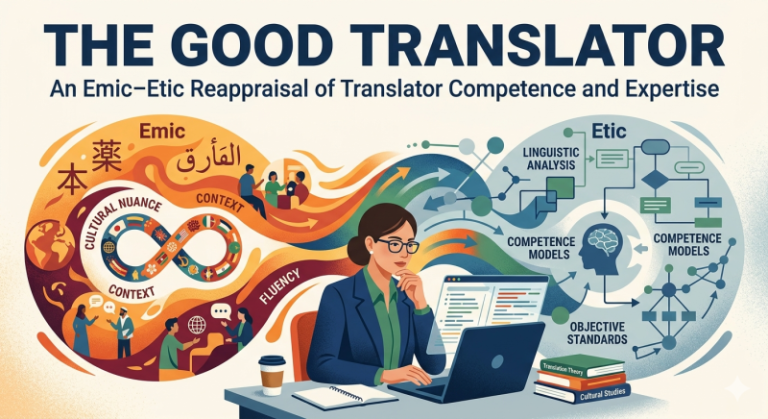
The Good Translator: An Emic–Etic Reappraisal of Translator Competence and Expertise
Author: Griroek Gruaythong
29 April 2026 – Research on translator competence and expertise has largely been dominated by theoretically driven, etic perspectives, while practitioners’ emic viewpoints remain comparatively underexplored. This study addresses this gap by integrating both perspectives through an empirical investigation of how professional translators conceptualise competence and expertise. Drawing on focus groups, individual interviews, and a follow-up dissemination workshop with twelve experienced Danish translators, the study examines the extent to which a widely recognised theoretical competence model aligns with practitioners’ lived experiences.
The findings confirm the relevance of five established competence domains—language, thematic and cultural, instrumental, service provision, and methodological and strategic competences (Hurtado Albir et al., 2023)—while also identifying two additional competences emerging from practice: prioritisation competence and overview competence. Furthermore, participants highlight a wide range of personal dispositions, including diligence, curiosity, resilience, adaptability, and creativity, as integral to professional performance.
Although formal training is acknowledged as foundational, the study demonstrates that professional experience constitutes the primary driver of competence development. The results thus support a holistic understanding of translator competence that bridges theoretical constructs and situated professional practice, contributing to ongoing debates on the relationship between competence and expertise.
Keywords: translator competence; translator expertise; emic perspective; etic perspective; translation practice; LSP translation
1. Introduction
The question of what constitutes a “good translator” has long been central to Translation Studies. Early work in the field sought to identify the knowledge and skills required for effective translation (Wilss, 1976), while later contributions, most notably Holz-Mänttäri’s (1984) conceptualisation of translation as expert action, reframed translation as a specialised professional activity. Since then, extensive research has attempted to define translator competence and distinguish expert from novice performance.
Despite this substantial body of work, important gaps remain. Much of the existing research has been conducted within translation process research and cognitive translation studies, often relying on experimental methods such as eye-tracking and keystroke logging (Risku & Schlager, 2022). Consequently, the field has been dominated by an etic perspective—analytical frameworks constructed by researchers—while the emic perspective of practising translators has received comparatively limited attention (Angelone & García, 2019).
This imbalance has resulted in a limited understanding of how translators themselves conceptualise competence, how they prioritise different skills, and how such competences develop through practice. Addressing this gap, the present study combines etic and emic perspectives by examining how professional translators engage with a theoretical competence model and articulate their own understanding of what it means to be a good translator.
The study was conducted within the context of the EFFORT project (Hurtado Albir et al., 2023) and draws primarily on the PACTE competence model. While this model provides the analytical starting point, the primary objective is to explore practitioners’ perspectives on competence and expertise. Conceptually, the study adopts a holistic approach that bridges core competences associated with formal training and the expertise that develops through professional practice.
2. Translator Competence and Expertise
2.1 Conceptualising Translation Competence
Translation competence is widely conceptualised as a multidimensional construct, often described as a macro-competence or supercompetence encompassing multiple sub-competences (Esfandiari et al., 2015; Pym, 2003). However, there is little consensus regarding its precise composition or internal structure (Acioly-Régnier et al., 2015; Göpferich, 2021).
Some scholars advocate minimalist approaches focusing on translation-specific skills (Pym, 2003), whereas others propose multi-componential models incorporating linguistic, cultural, technological, and professional dimensions (EMT, 2022; Göpferich, 2009; Hurtado Albir, 2015).
Among the most influential frameworks is the PACTE model, which conceptualises translation competence as comprising five interrelated sub-competences: language, thematic and cultural, instrumental, service provision, and methodological and strategic competences (Hurtado Albir et al., 2023). A closely related framework is the EMT competence model, which similarly identifies five domains but places greater emphasis on technological and interpersonal competences (EMT, 2022).
2.2 From Competence to Expertise
Increasingly, scholars distinguish between competence and expertise. Competence is typically understood as the foundational capacity to perform a task, whereas expertise refers to consistently superior performance developed through experience (Ericsson & Charness, 1997; Tiselius & Hild, 2017).
However, the relationship between these concepts remains contested. Some researchers view expertise as an advanced level of competence, while others argue that it entails qualitatively distinct capabilities (Shreve et al., 2018).
Critiques of competence-based models further emphasise the situated nature of professional knowledge. Olohan (2020) argues that competence should be understood as “situated capability,” highlighting the importance of acting knowledgeably within specific contexts.
2.3 A Holistic Perspective
Building on these debates, the present study adopts a holistic perspective in which competence and expertise are conceptualised as part of a continuum shaped by training and experience. In line with Schäffner and Adab (2000), competence is treated as an umbrella term encompassing overall performance ability, including both formally acquired skills and practice-based capabilities.
3. Methodology
3.1 Participants
The study involved twelve professional translators working within the Danish translation market, including institutional contexts within the European Union. All participants held a Master’s degree in specialised translation and had extensive professional experience ranging from 9 to 34 years.
Eight participants contributed to the primary dataset through interviews, representing diverse professional settings, including translation agencies, private companies, and EU institutions. An additional four experienced translators contributed data during a dissemination workshop.
All participants specialised in non-fiction translation, particularly within economic and financial domains, although they also reported experience across other LSP areas such as legal and technical translation.
3.2 Data Collection Procedure
Data were collected through two focus-group interviews, two individual interviews, and a dissemination workshop conducted between April 2022 and June 2023.
Prior to the interviews, participants received a preparatory document outlining key aspects of translation competence based on existing literature and structured around the PACTE model. The document served as a stimulus for discussion rather than a prescriptive framework.
The interviews were semi-structured and designed to elicit reflections grounded in participants’ professional practice. The dissemination workshop further enriched the dataset by inviting participants to articulate key characteristics of “the good translator.”
3.3 Data Analysis
The dataset included interview transcripts, observer notes, and written outputs from the workshop. A thematic analysis approach was employed, combining deductive coding based on predefined competence categories and inductive coding capturing emergent themes.
The analysis was iterative and resulted in the identification of three overarching competence domains: theory-derived competences, practice-driven competences, and personal competences.
4. Results
4.1 Theory-Derived Competences
Participants broadly confirmed the relevance of the five sub-competences proposed by the PACTE model.
Language competence was consistently identified as foundational, particularly mastery of the target language, which was described as requiring high levels of nuance and stylistic sensitivity.
Thematic competence was emphasised as essential in LSP contexts, encompassing both specialised domain knowledge and general world knowledge.
Instrumental competence was primarily associated with information retrieval strategies and the effective use of technological and human resources.
Service provision competence included client interaction, collaboration, and project management, while methodological and strategic competence involved planning, problem-solving, and adaptation to context and audience.
4.2 Practice-Driven Competences
Participants identified two additional competences emerging exclusively from professional practice.
Prioritisation competence refers to the ability to manage competing demands under time constraints, balancing quality and efficiency.
Overview competence denotes the ability to situate individual tasks within a broader textual and organisational context, ensuring coherence and consistency across projects.
4.3 Personal Competences
Participants highlighted a wide range of personal qualities, including diligence, curiosity, resilience, adaptability, and openness to feedback.
Interpersonal skills, such as collaboration and empathy, were also considered essential. Creativity and courage were emphasised as enabling translators to produce effective and contextually appropriate translations.
Importantly, many of these qualities appear to develop over time through sustained engagement in professional practice.
5. Discussion and Conclusion
This study integrates etic and emic perspectives on translator competence, demonstrating strong alignment between theoretical models and practitioners’ experiences while also identifying additional practice-driven competences.
The findings highlight the central role of experience in competence development, supporting a holistic understanding of translation as a dynamic, practice-based activity.
Furthermore, the study underscores the importance of personal attributes in shaping professional performance, suggesting that competence extends beyond technical skills to include dispositional and interpersonal dimensions.
Overall, the “good translator” emerges as a reflective, adaptive, and experienced practitioner capable of navigating complex communicative and professional contexts.
References
- Acioly-Régnier, N. M., Koroleva, D. B., Mikhaleva, L. V., & Régnier, J. (2015). Translation competence as a complex multidimensional aspect. Procedia – Social and Behavioural Sciences, 192(44), 142–148. https://doi.org/10.1016/j.sbspro.2015.08.035
- Alves, F., & Gonçalves, J. L. (2007). Modelling translator’s competence: Relevance and expertise under scrutiny. In Y. Gambier, M. Shlesinger, & R. Stolze (Eds.), Doubts and directions in translation studies: Selected contributions from the EST Congress, Lisbon 2004 (pp. 41–55). John Benjamins.
- Angelone, E., & García, A. M. (2019). Expertise acquisition through deliberate practice: Gauging perceptions and behaviors of translators and project managers. In H. Risku, R. Rogl, & J. Milosevic (Eds.), Translation practice in the field: Current research on socio-cognitive processes (pp. 123–160). John Benjamins.
- European Commission. (2022). EMT competence framework 2022. https://commission.europa.eu/system/files/2022-11/emt_competence_fwk_2022_en.pdf
- Ericsson, K. A., & Charness, N. (1997). Cognitive and developmental factors in expert performance. In P. J. Feltovich, K. M. Ford, & R. R. Hoffmann (Eds.), Expertise in context: Human and machine (pp. 3–41). AAAI Press/MIT Press.
- Esfandiari, M. R., Sepora, T., & Mahadi, T. (2015). Translation competence: Aging towards modern views. Procedia – Social and Behavioural Sciences, 192(44), 44–53. https://doi.org/10.1016/j.sbspro.2015.06.007
- Göpferich, S. (2009). Towards a model of translation competence and its acquisition: The longitudinal study
- “TransComp.” In S. Göpferich, A. L. Jakobsen, & I. M. Mees (Eds.), Behind the mind: Methods, models and results in translation process research (pp. 11–37). Samfundslitteratur.
- Göpferich, S. (2021). Competence, translation. In M. Baker & G. Saldanha (Eds.), Routledge encyclopedia of translation studies (pp. 89–95). Routledge.
- Holz-Mänttäri, J. (1984). Translatorisches Handeln: Theorie und Methode. Suomalainen Tiedeakatemia.
- Hurtado Albir, A. (2015). The acquisition of translation competence: Competences, tasks, and assessment in translator training. Meta, 60(2), 256–280. https://doi.org/10.7202/1032857ar
- Hurtado Albir, A., Rodríguez-Inés, P., Prieto Ramos, F., Dam, H. V., Dimitriu, R., Haro Soler, M. M., Huertas Barros, E., Kujamäki, M., Kuźnik, A., Pokorn, N., van Egdom, G. M. W., Ciobanu, S., Cogeanu-Haraga, O., Ghivirigă, T., González Cruz, S., Gostkowska, K., Pisanski Peterlin, A., Vesterager, A. K., Vine, J., Walczyński, M., & Zethsen, K. K. (2023). Common European framework of reference for translation – Competence level C (specialist translator): A proposal by the EFFORT project. https://www.effortproject.eu/
- Muñoz Martín, R. (2014). Situating translation expertise: A review with a sketch of a construct. In J. W. Schwieter & A. Ferreira (Eds.), The development of translation competence: Theories and methodologies from psycholinguistics and cognitive science (pp. 2–56). Cambridge Scholars Publishing.
- Olohan, M. (2020). Translation and practice theory. Routledge.
- Pym, A. (2003). Redefining translation competence in an electronic age: In defense of a minimalist approach. Meta, 48(4), 481–497. https://doi.org/10.7202/008533ar
- Risku, H. (1998). Translatorische Kompetenz: Kognitive Grundlagen des Übersetzens als Expertentätigkeit. Stauffenburg.
- Risku, H., & Schlager, D. (2022). Epistemologies of translation expertise: Notions in research and praxis. In A. Marín García & S. Halverson (Eds.), Contesting epistemologies in cognitive translation and interpreting studies (pp. 11–31). Routledge.
- Schäffner, C., & Adab, B. (2000). Developing translation competence. John Benjamins.
- Schlager, D., & Risku, H. (2023). Contextualising translation expertise: Lived practice and social construction. Translation, Cognition & Behavior, 6(2), 231–252.
- Schlager, D., & Risku, H. (2024). What does it take to be a good in-house translator? Constructs of expertise in the workplace. The Journal of Specialised Translation, 42, 2–19.
- Shreve, G. M. (2006). The deliberate practice: Translation and expertise. Journal of Translation Studies, 9(1), 27–42.
- Shreve, G. M., Angelone, E., & Lacruz, I. (2018). Are expertise and translation competence the same? Psychological reality and the theoretical status of competence. In I. Lacruz & R. Jääskeläinen (Eds.), Innovation and expansion in translation process research (pp. 37–54). John Benjamins.
- Tiselius, E. (2013). Same, same but different? Competence and expertise in translation and interpreting studies (Trial lecture). University of Bergen.
- Tiselius, E., & Hild, A. (2017). Expertise and competence in translation and interpreting. In J. W. Schwieter & A. Ferreira (Eds.), The handbook of translation and cognition (pp. 425–444). Wiley.
- Wilss, W. (1976). Perspectives and limitations of a didactic framework for the teaching of translation. In R. W. Brislin (Ed.), Translation: Applications and research (pp. 117–137). Gardner Press.
For professional services, please visit: https://www.seaproti.org/practitioners/
About certified translators, translation certifiers, and certified interpreters associated with SEAProTI.
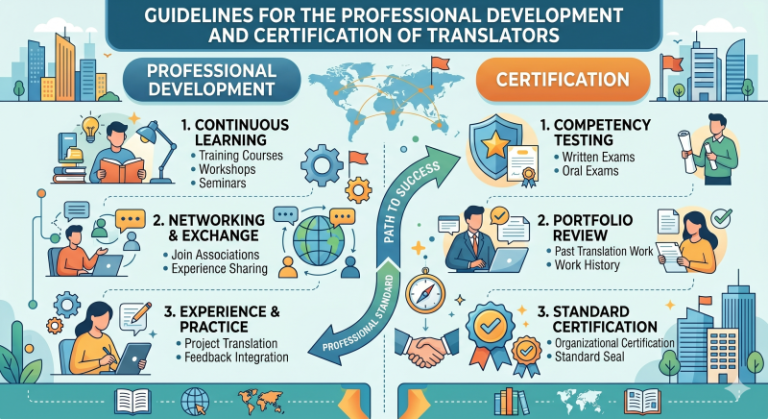
The Southeast Asian Association of Professional Translators and Interpreters (SEAProTI) has officially shared the qualifications and requirements for becoming Certified Translators, Translation Certification Providers, and Certified Interpreters in Sections 9 and 10 of the Royal Gazette, which was published by the Prime Minister’s Office in Thailand on July 25, 2024. Certified Translators, Translation Certification Providers, and Certified Interpreters
The Council of State has proposed the enactment of a Royal Decree, granting registered translators and recognised translation certifiers from professional associations or accredited language institutions the authority to provide legally valid translation certification (Letter to SEAProTI dated April 28, 2025)
SEAProTI is the first professional association in Thailand and Southeast Asia to implement a comprehensive certification system for translators, certifiers, and interpreters.
Head Office: Baan Ratchakru Building, No. 33, Room 402, Soi Phahonyothin 5, Phahonyothin Road, Phaya Thai District, Bangkok 10400, Thailand
Email: hello@seaproti.com | Tel.: (+66) 2-114-3128 (Office hours: Mon–Fri, 09:00–17:00).
นักแปลที่ดี: การพิจารณาสมรรถนะและความเชี่ยวชาญของนักแปลผ่านมุมมองเอมิก–เอติก
ผู้แต่ง: ไกรฤกษ์ กรวยทอง
29 เมษายน 2569 – การศึกษาว่าด้วยสมรรถนะและความเชี่ยวชาญของนักแปลส่วนใหญ่ในอดีตมักอาศัยกรอบแนวคิดเชิงทฤษฎีจากมุมมองภายนอก (etic) ขณะที่มุมมองจากผู้ปฏิบัติงานจริง (emic) ยังได้รับการศึกษาอย่างจำกัด งานวิจัยนี้มีวัตถุประสงค์เพื่ออุดช่องว่างดังกล่าว โดยบูรณาการทั้งสองมุมมองผ่านการศึกษาประสบการณ์และการรับรู้ของนักแปลมืออาชีพต่อแนวคิดเรื่องสมรรถนะและความเชี่ยวชาญ
ข้อมูลถูกรวบรวมผ่านการสนทนากลุ่ม การสัมภาษณ์รายบุคคล และกิจกรรมเผยแพร่ผลการวิจัย โดยมีผู้เข้าร่วมจำนวน 12 คน ซึ่งเป็นนักแปลชาวเดนมาร์กที่มีประสบการณ์สูง ผลการศึกษายืนยันความสอดคล้องของสมรรถนะหลัก 5 ด้าน ได้แก่ สมรรถนะทางภาษา สมรรถนะด้านเนื้อหาและวัฒนธรรม สมรรถนะด้านเครื่องมือ สมรรถนะด้านการให้บริการ และสมรรถนะเชิงระเบียบวิธีและกลยุทธ์ (อูร์ตาโด อัลบีร์ และคณะ, 2566) พร้อมทั้งระบุสมรรถนะเพิ่มเติมที่เกิดจากประสบการณ์ปฏิบัติงาน ได้แก่ สมรรถนะด้านการจัดลำดับความสำคัญ และสมรรถนะด้านการมองภาพรวม
นอกจากนี้ ผู้เข้าร่วมยังเน้นย้ำคุณลักษณะส่วนบุคคลที่สำคัญ เช่น ความละเอียดรอบคอบ ความใฝ่รู้ ความยืดหยุ่น และความคิดสร้างสรรค์ แม้ว่าการฝึกอบรมอย่างเป็นทางการจะเป็นพื้นฐานสำคัญ แต่ผลการวิจัยชี้ให้เห็นว่าประสบการณ์จากการปฏิบัติงานจริงเป็นปัจจัยหลักในการพัฒนาสมรรถนะโดยรวมของนักแปล
คำสำคัญ: สมรรถนะนักแปล; ความเชี่ยวชาญนักแปล; มุมมองเอมิก; มุมมองเอติก; การปฏิบัติการแปล
1. บทนำ
คำถามที่ว่า “อะไรทำให้นักแปลเป็นนักแปลที่ดี” เป็นประเด็นสำคัญในสาขาวิชาการแปลมาอย่างยาวนาน งานศึกษาในระยะแรกพยายามกำหนดองค์ความรู้และทักษะที่จำเป็นต่อการแปล (วิลส์, 2519) ขณะที่งานของ โฮลซ์-แม็นแทร์รี (2527) ได้เสนอแนวคิดสำคัญที่มองการแปลในฐานะกิจกรรมเชิงวิชาชีพที่ต้องอาศัยความเชี่ยวชาญ
อย่างไรก็ตาม แม้ว่างานวิจัยในสาขานี้จะมีจำนวนมาก แต่ยังคงมีข้อจำกัดสำคัญ โดยเฉพาะการที่งานวิจัยส่วนใหญ่อาศัยมุมมองเชิงทดลองและเชิงปริมาณ เช่น การติดตามการเคลื่อนไหวของสายตา หรือการบันทึกการพิมพ์ (ริสคู และ ชลาเกอร์, 2565) ส่งผลให้มุมมองของนักแปลในฐานะผู้ปฏิบัติงานจริงยังไม่ถูกนำมาศึกษาอย่างเพียงพอ (แองเจโลน และ การ์เซีย, 2562)
การศึกษานี้จึงมีเป้าหมายในการบูรณาการมุมมองเชิงทฤษฎีและมุมมองจากผู้ปฏิบัติงาน โดยสำรวจว่าผู้แปลมืออาชีพนิยาม “นักแปลที่ดี” อย่างไร และสมรรถนะใดที่พวกเขาเห็นว่าสำคัญ
2. สมรรถนะและความเชี่ยวชาญของนักแปล
2.1 แนวคิดสมรรถนะการแปล
สมรรถนะการแปลมักถูกนิยามว่าเป็นโครงสร้างหลายมิติ (เอสฟานดิอารี และคณะ, 2558; พิม, 2546) อย่างไรก็ตาม ยังไม่มีข้อสรุปที่เป็นเอกฉันท์เกี่ยวกับองค์ประกอบภายในของแนวคิดนี้ (อาซิโอลี-เรญีเยร์ และคณะ, 2558; เกิพเฟอริช, 2564)
แบบจำลองที่ได้รับการยอมรับอย่างแพร่หลาย ได้แก่ แบบจำลองของกลุ่ม PACTE ซึ่งเสนอว่าสมรรถนะการแปลประกอบด้วย 5 องค์ประกอบหลัก (อูร์ตาโด อัลบีร์ และคณะ, 2566) ขณะที่กรอบ EMT (2565) ก็เสนอองค์ประกอบที่คล้ายคลึงกัน แต่เน้นเทคโนโลยีและทักษะด้านบุคคลมากขึ้น
2.2 จากสมรรถนะสู่ความเชี่ยวชาญ
นักวิชาการจำนวนมากแยกความแตกต่างระหว่าง “สมรรถนะ” และ “ความเชี่ยวชาญ” โดยมองว่าสมรรถนะเป็นพื้นฐานของการปฏิบัติงาน ส่วนความเชี่ยวชาญเป็นระดับสูงที่พัฒนาขึ้นจากประสบการณ์ (เอริคสัน และ ชาร์เนสส์, 2540; ทิเซลิอุส และ ฮิลด์, 2560)
แนวคิดล่าสุดยังเน้นบทบาทของบริบทและการปฏิบัติจริง โดย โอโลฮาน (2563) เสนอแนวคิด “ความสามารถเชิงสถานการณ์” ซึ่งชี้ให้เห็นว่าความรู้เกิดขึ้นผ่านการปฏิบัติ ไม่ใช่เพียงการเรียนรู้เชิงทฤษฎี
2.3 มุมมองแบบองค์รวม
งานวิจัยนี้จึงนำเสนอแนวคิดแบบองค์รวมที่มองว่าสมรรถนะและความเชี่ยวชาญเป็นกระบวนการต่อเนื่องที่พัฒนาไปตามประสบการณ์ (แชฟฟ์เนอร์ และ อดาบ, 2543)
3. ระเบียบวิธีวิจัย
3.1 ผู้เข้าร่วมวิจัย
ผู้เข้าร่วมจำนวน 12 คน เป็นนักแปลมืออาชีพในตลาดเดนมาร์ก มีประสบการณ์ 9–34 ปี และสำเร็จการศึกษาระดับปริญญาโทด้านการแปลเฉพาะทาง
3.2 การเก็บข้อมูล
ข้อมูลถูกรวบรวมผ่านการสนทนากลุ่ม การสัมภาษณ์ และกิจกรรมเชิงปฏิบัติการ โดยใช้กรอบแนวคิดจากแบบจำลอง PACTE เป็นตัวกระตุ้นการอภิปราย
3.3 การวิเคราะห์ข้อมูล
ใช้การวิเคราะห์เชิงธีม (thematic analysis) โดยผสมผสานการวิเคราะห์แบบนิรนัยและอุปนัย เพื่อจัดกลุ่มสมรรถนะออกเป็น 3 ประเภทหลัก
4. ผลการวิจัย
4.1 สมรรถนะตามทฤษฎี
ผู้เข้าร่วมยืนยันความสำคัญของสมรรถนะทั้ง 5 ด้าน โดยเฉพาะสมรรถนะทางภาษาและความเชี่ยวชาญในภาษาเป้าหมาย
4.2 สมรรถนะจากการปฏิบัติ
พบสมรรถนะเพิ่มเติม ได้แก่ การจัดลำดับความสำคัญของงาน การมองภาพรวมของงานและบริบท
4.3 สมรรถนะเชิงบุคคล
คุณลักษณะสำคัญ ได้แก่ ความละเอียด ความใฝ่รู้ ความยืดหยุ่น การทำงานร่วมกับผู้อื่น และความคิดสร้างสรรค์
5. อภิปรายผลและสรุป
ผลการวิจัยชี้ให้เห็นว่าสมรรถนะของนักแปลไม่สามารถอธิบายได้ด้วยกรอบทฤษฎีเพียงอย่างเดียว แต่ต้องคำนึงถึงประสบการณ์และบริบทของการปฏิบัติงานจริง
ประสบการณ์ถูกมองว่าเป็นปัจจัยหลักในการพัฒนาสมรรถนะ ขณะที่คุณลักษณะส่วนบุคคลมีบทบาทสำคัญในการเสริมสร้างความเป็นมืออาชีพ
โดยสรุป “นักแปลที่ดี” คือผู้ที่สามารถผสมผสานความรู้ ทักษะ ประสบการณ์ และคุณลักษณะส่วนบุคคล เพื่อรับมือกับความซับซ้อนของงานแปลในบริบทจริงได้อย่างมีประสิทธิภาพ
บรรณานุกรม
- อาซิโอลี-เรญีเยร์, น. ม., โคโรเลวา, ด. บ., มิคาเลวา, ล. ว., และ เรญีเยร์, จ. (2558). สมรรถนะการแปลในฐานะมิติที่ซับซ้อนหลายด้าน. Procedia – Social and Behavioural Sciences, 192(44), 142–148.
- อัลเวส, ฟ., และ กอนซัลเวส, จ. ล. (2550). การสร้างแบบจำลองสมรรถนะนักแปล: ความเกี่ยวข้องและความเชี่ยวชาญภายใต้การพิจารณา. ใน Y. Gambier, M. Shlesinger, และ R. Stolze (บ.ก.), Doubts and directions in translation studies (น. 41–55). John Benjamins.
- แองเจโลน, อ., และ การ์เซีย, อ. ม. (2562). การพัฒนาความเชี่ยวชาญผ่านการฝึกฝนอย่างมีเป้าหมาย. ใน H. Risku, R. Rogl, และ J. Milosevic (บ.ก.), Translation practice in the field (น. 123–160). John Benjamins.
- คณะกรรมาธิการยุโรป. (2565). กรอบสมรรถนะ EMT 2022.
- เอริคสัน, ค. อ., และ ชาร์เนสส์, น. (2540). ปัจจัยทางปัญญาและพัฒนาการของความเชี่ยวชาญ. ใน P. J. Feltovic, K. M. Ford, และ R. R. Hoffmann (บ.ก.), Expertise in context (น. 3–41). MIT Press.
- เอสฟานดิอารี, ม. ร., เซปอรา, ท., และ มาฮาดี, ท. (2558). สมรรถนะการแปล: แนวโน้มสมัยใหม่. Procedia – Social and Behavioural Sciences, 192(44), 44–53.
- เกิพเฟอริช, ส. (2552). สู่แบบจำลองสมรรถนะการแปลและการได้มา. ใน S. Göpferich, A. L. Jakobsen, และ I. M. Mees (บ.ก.), Behind the mind (น. 11–37). Samfundslitteratur.
- เกิพเฟอริช, ส. (2564). สมรรถนะการแปล. ใน M. Baker และ G. Saldanha (บ.ก.), Routledge encyclopedia of translation studies (น. 89–95). Routledge.
- โฮลซ์-แม็นแทร์รี, ย. (2527). Translatorisches Handeln. Suomalainen Tiedeakatemia.
- อูร์ตาโด อัลบีร์, อ. (2558). การได้มาซึ่งสมรรถนะการแปล. Meta, 60(2), 256–280.
- อูร์ตาโด อัลบีร์, อ., โรดริเกซ-อิเนส, พ., ปรีเอโต รามอส, ฟ., ดาม, ฮ. ว., และคณะ. (2566). Common European framework of reference for translation.
- มูญอซ มาร์ติน, ร. (2557). การวางกรอบความเชี่ยวชาญด้านการแปล. ใน J. W. Schwieter และ A. Ferreira (บ.ก.), The development of translation competence (น. 2–56). Cambridge Scholars.
- โอโลฮาน, ม. (2563). Translation and practice theory. Routledge.
- พิม, อ. (2546). การนิยามสมรรถนะการแปลใหม่ในยุคดิจิทัล. Meta, 48(4), 481–497.
- ริสคู, ฮ. (2541). Translatorische Kompetenz. Stauffenburg.
- ริสคู, ฮ., และ ชลาเกอร์, ด. (2565). ญาณวิทยาของความเชี่ยวชาญด้านการแปล. ใน A. Marín García และ S. Halverson (บ.ก.), Contesting epistemologies in translation studies (น. 11–31). Routledge.
- แชฟฟ์เนอร์, ค., และ อดาบ, บ. (2543). Developing translation competence. John Benjamins.
- ชลาเกอร์, ด., และ ริสคู, ฮ. (2566). การทำให้ความเชี่ยวชาญด้านการแปลมีบริบท. Translation, Cognition & Behavior, 6(2), 231–252.
- ชลาเกอร์, ด., และ ริสคู, ฮ. (2567). นักแปลในองค์กรที่ดีต้องมีอะไรบ้าง. The Journal of Specialised Translation, 42, 2–19.
- ชรีฟ, ก. ม. (2549). การฝึกฝนอย่างมีเป้าหมาย. Journal of Translation Studies, 9(1), 27–42.
- ชรีฟ, ก. ม., แองเจโลน, อ., และ ลาครูซ, อ. (2561). ความเชี่ยวชาญกับสมรรถนะเหมือนกันหรือไม่. ใน I. Lacruz และ R. Jääskeläinen (บ.ก.), Innovation in translation process research (น. 37–54). John Benjamins.
- ทิเซลิอุส, อ. (2556). สมรรถนะและความเชี่ยวชาญในการแปล. University of Bergen.
- ทิเซลิอุส, อ., และ ฮิลด์, อ. (2560). ความเชี่ยวชาญและสมรรถนะในการแปล. ใน J. W. Schwieter และ A. Ferreira (บ.ก.), The handbook of translation and cognition (น. 425–444). Wiley.
- วิลส์, ว. (2519). กรอบแนวคิดการสอนการแปล. ใน R. W. Brislin (บ.ก.), Translation: Applications and research (น. 117–137). Gardner Press.
ติดต่อขอใช้บริการนักวิชาชีพของสมาคมได้ที่:https://www.seaproti.org/practitioners/
สมาคมวิชาชีพนักแปลและล่ามแห่งเอเชียตะวันออกเฉียงใต้ (SEAProTI) ได้ประกาศหลักเกณฑ์และคุณสมบัติของผู้ที่ขึ้นทะเบียนเป็น “นักแปลรับรอง (Certified Translators) และผู้รับรองการแปล (Translation Certification Providers) และล่ามรับรอง (Certified Interpreters)” ของสมาคม หมวดที่ 9 และหมวดที่ 10 ในราชกิจจานุเบกษา ของสำนักเลขาธิการคณะรัฐมนตรี ในสำนักนายกรัฐมนตรี แห่งราชอาณาจักรไทย ลงวันที่ 25 ก.ค. 2567 เล่มที่ 141 ตอนที่ 66 ง หน้า 100 อ่านฉบับเต็มได้ที่: นักแปลรับรอง ผู้รับรองการแปล และล่ามรับรอง
สำนักคณะกรรมการกฤษฎีกาเสนอให้ตราเป็นพระราชกฤษฎีกา โดยกำหนดให้นักแปลที่ขึ้นทะเบียน รวมถึงผู้รับรองการแปลจากสมาคมวิชาชีพหรือสถาบันสอนภาษาที่มีการอบรมและขึ้นทะเบียน สามารถรับรองคำแปลได้ (จดหมายถึงสมาคม SEAProTI ลงวันที่ 28 เม.ย. 2568)
สมาคมวิชาชีพนักแปลและล่ามแห่งเอเชียตะวันออกเฉียงใต้เป็นสมาคมวิชาชีพแห่งแรกและแห่งเดียวในประเทศไทยและภูมิภาคเอเชียตะวันออกเฉียงใต้ที่มีระบบรับรองนักแปลรับรอง ผู้รับรองการแปล และล่ามรับรอง
สำนักงานใหญ่: อาคารบ้านราชครู เลขที่ 33 ห้อง 402 ซอยพหลโยธิน 5 ถนนพหลโยธิน แขวงพญาไท เขตพญาไท กรุงเทพมหานคร 10400 ประเทศไทย
อีเมล: hello@seaproti.com โทรศัพท์: (+66) 2-114-3128(เวลาทำการ: วันจันทร์–วันศุกร์ เวลา 09.00–17.00 น.)