


Setting the stage for enhanced performance and well-being in translation practice through sports
Authors: Petra Bordt
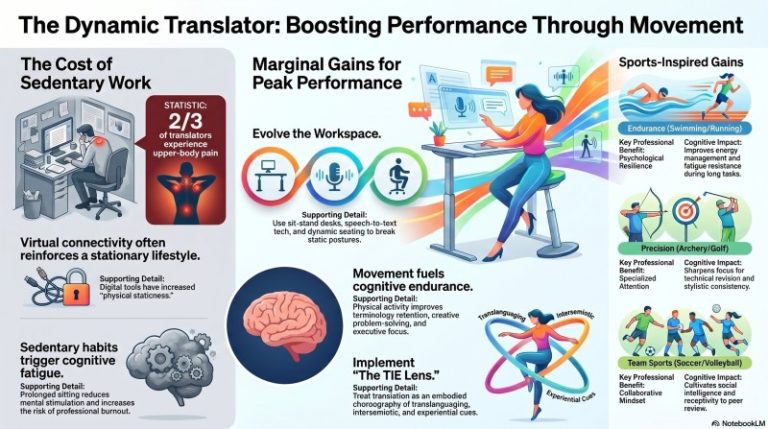
May 06 2026, Bangkok – Translating and sports may seem like opposites—one sedentary and deskbound, the other physically demanding. However, evidence from fields like neuroscience and sports science suggests that physical activity can significantly enhance cognitive functions, particularly in high-cognition fields like translation. This paper challenges the image of the “solitary, sedentary translator” and explores how regular movement can improve well-being, creativity, and productivity.
Keywords: Sports; physical activity; translators; ergonomics; well-being; creativity; problem-solving; happiness at work.
Introduction
The traditional image of a translator is often that of a solitary figure like Saint Jerome, confined to a desk. While technology has turned translation into a collaborative “translaboration,” the profession remains largely stationary. This sedentary lifestyle leads to physical stressors like musculoskeletal disorders and cognitive fatigue.
Findings and Proposed Interventions
The research advocates for “marginal gains”—small, manageable improvements that lead to significant overall results. Key proposed interventions include:
Immediate Workspace: Desk exercises (e.g., wrist stretches) and adjustable workstations like sit-stand desks.
Dynamic Workspace: Integrating speech-to-text technologies to reduce physical strain while potentially boosting creativity.
Collaborative Balance: Walking meetings and group fitness challenges to foster community and mental clarity.
Conclusion
By redefining translation as an embodied activity rather than a passive task, the profession can harmonize mental agility with physical vitality, ensuring long-term sustainability and happiness at work.
References
- Aga, K., et al. (2021). The Effect of Acute Aerobic Exercise on Divergent and Convergent Thinking and Its Influence by Mood. Brain Sciences, 11(5), 546.
- Alfer, A. (2021). Entering the Translab: Translation as collaboration, collaboration as translation, and the third space of translaboration. Translation and Translanguaging in Multilingual Contexts, 3(3), 275–290.
- Alkhajah, T. A., et al. (2012). Sit-Stand Workstations. American Journal of Preventive Medicine, 43(3), 298–303.
- Austermuhl, F. (2014). Electronic Tools for Translators. London: Routledge.
- Bani-Melhem, S., et al. (2018). Determinants of employees innovative behavior. International Journal of Contemporary Hospitality Management, 30(3), 1601–1620.
- Bednarova-Gibova, K. (2021). Organizational ergonomics of translation as a powerful predictor of translators happiness at work? Perspectives, 29(3), 391–406.
- Biau Gil, J. R., & Pym, A. (2006). Technology and translation (a pedagogical overview). Translation Technology and its Teaching, 5–19.
- Caspersen, C. J., et al. (1985). Physical activity, exercise, and physical fitness: definitions and distinctions for health-related research. Public Health Reports, 100(2), 126–131.
- Castonguay, P. (2017). Rouler vers le savoir. University Affairs.
- CIOL, et al. (2017). UK Translator Survey: Final Report.
- Chen, C. (2024). Exploring the impact of acute physical activity on creative thinking. Discover Psychology, 4(1), 3.
- Chen, Y., & Feeley, T. H. (2014). Social support, social strain, loneliness, and well-being among older adults. The Journal of Social and Personal Relationships, 31(2), 141–161.
- Ciobanu, D. (2016). Automatic Speech Recognition in the Professional Translation Process. Translation Spaces, 5(1), 124–144.
- Coffeng, J. K., et al. (2015). Physical Activity and Relaxation During and After Work. Journal of Physical Activity and Health, 12(1), 109–115.
- Costa, B., et al. (2020). Self-care as an ethical responsibility. Translation and interpreting studies, 15(1), 36–56.
- Courtney, J., & Phelan, M. (2019). Translators experiences of occupational stress and job satisfaction. The International Journal of Translation and Interpreting Research, 11(1), 100–113.
- Daems, J. (2024). Students Attitudes Towards Interactive and Adaptive Translation Technology. New Advances in Translation Technology, 239–261.
- Delistathi, C. (2023). Industrialisation of translation and collaborative practices. Cultus, 16, 139–158.
- Diao, H. (2022). Translation in global health emergencies. Cadernos de Traducao, 42(01), 1–23.
- Turner, W. C. (2004). Energy management handbook. Lilburn, GA: The Fairmont Press.
- Drugan, J. (2013). Quality in professional translation: Assessment and improvement. London/New York: Bloomsbury Academic.
- Ehrensberger-Dow, M., et al. (2016). An International Survey of the Ergonomics of Professional Translation. ILCEA, 27.
- Ehrensberger-Dow, M. (2021). Ergonomics and translation workplaces. Handbook of Translation Studies: Volume 5, 67-72.
- Eichberger, D. (2024). The material and the immaterial: Saint Jerome in his Study. Albrecht Durers material world, 87–98.
- Esselink, B. (2000). A Practical Guide to Localization. John Benjamins Publishing Company.
- Eys, M., et al. (2019). The dynamic group environment in sport and exercise. Psychology of Sport and Exercise, 42, 40–47.
- Federici, E. (2023). Collaborative translation(s) and feminism(s). Cultus, 16, 159–176.
- Fenesi, B., et al. (2022). Physical Activity in High School Classrooms. International Journal of Environmental Research and Public Health, 19(2), 688.
- Fisher, C. D. (2010). Happiness at Work. International Journal of Management Reviews, 12(4), 384– 412.
- Fraser, J., & Gold, M. (2001). Portfolio workers: Autonomy and control amongst freelance translators. Work, Employment and Society, 15(4), 679–697.
- Frerot, C., et al. (2019). Designing an Authentic Translation Environment for Future Translators. InTRAlinea.
- Goldsmith, E. (2024). Upper-body musculoskeletal pain and eye strain among language professionals. arXiv.
- Gregory, D. E., et al. (2006). Stability Ball Versus Office Chair. Human Factors, 48(1), 142–153.
- Guerberof-Arenas, A., & Toral, A. (2022). Creativity in translation. Translation Spaces, 11(2), 184–212.
- Hall, D., et al. (2012). Marginal gains: Olympic lessons in high performance for organisations. HR Bulletin: research and practice, 7(2), 9-13.
- Hamer, M., & Chida, Y. (2008). Active commuting and cardiovascular risk. Preventive Medicine, 46(1), 9–13.
- Haskell, W. L., & Blair, S. N. (1980). The physical activity component of health promotion in occupational settings. Public Health Reports, 95(2), 109.
- Henriksen, K., et al. (2010). Holistic approach to athletic talent development environments. Psychology of sport and exercise, 11(3), 212–222.
- Hernandez-Mendo, A., et al. (2019). Physical activity, sports practice, and cognitive functioning. Frontiers in Psychology, 10, 2658.
- Hetu, M.-P. (2012). Le travail au dictaphone, une solution ergonomique? Circuit, 116, 23.
- Huberscher-Davidson, S. (2017). Translation and Emotion. New York: Routledge.
- IEA. (2025). What Is Ergonomics (HFE)?
- ITI. (2024). 10 tips for emotional wellbeing as a translator or interpreter.
- Jimenez-Crespo, M. A. (2017). Crowdsourcing and online collaborative translations. Amsterdam: John Benjamins.
- Jolly, P. H. (1983). Antonello da Messinas Saint Jerome in His Study. The Art Bulletin, 65(2), 238–253.
- Jones, D., et al. (2019). What do Workplace Wellness Programs do? The Quarterly Journal of Economics, 134(4), 1747–1791.
- Joyce, K., et al. (2010). Flexible working conditions and their effects on employee health and wellbeing. Cochrane Database of Systematic Reviews, 2.
- Kappus, M., & Ehrensberger-Dow, M. (2020). The ergonomics of translation tools. Interpreter and Translator Trainer, 14(4), 386–404.
- Katan, D. (2009). Occupation or profession: A survey of the translators world. Translation and Interpreting Studies, 4, 187–209.
- Kassawat, M. (2024). Agile working and job satisfaction for localisation language agents. Translation Spaces.
- Kingscott, G. (1985). Who are the translators? The growing professionalism of translating. Proceedings of Translating and the Computer 7, 1–10.
- Korpal, P. (2021). Stress experienced by Polish sworn translators and interpreters. Perspectives, 29.
- Korpal, P., & Mellinger, C. D. (2022). Self-care strategies of professional community interpreters. Translation, Cognition and Behavior, 5(2), 275–299.
- Kussmaul, P. (1995). Training the Translator. John Benjamins Publishing Company.
- Lambert, J., & Walker, C. (2024). Thriving or Surviving. Mikael, 17(1), 89—104.
- Lavault-Olleon, E. (2011). L ergonomie, nouveau paradigme pour la traductologie. ILCEA, 14.
- Levy, J. (1967). Translation as a decision process. To honor Roman Jakobson, Vol. 2, 1171–1182.
- Lindwall, M., et al. (2014). The relationships of change in physical activity with change in depression, anxiety, and burnout. Health Psychology, 33(11), 1309–1318.
- Magnon, V., et al. (2018). Sedentary behavior at work and cognitive functioning: a systematic review. Frontiers in Public Health, 6, 239.
- Mahindru, A., et al. (2023). Role of Physical Activity on Mental Health and Well-Being: A Review. Cureus.
- Massey, G., et al. (2023). Meeting evolution with innovation. The Interpreter and Translator Trainer, 17(3), 325–331.
- Massidda, S. (2015). Audiovisual translation in the digital age. Basingstoke: Palgrave-MacMillan.
- McEwan, D., & Beauchamp, M. R. (2014). Teamwork in sport. International review of sport and exercise psychology, 7(1), 229–250.
- Moorkens, J. (2017). Under pressure: translation in times of austerity. Perspectives, 25(3), 464–477.
- Moorkens, J., et al. (2018). Translators perceptions of literary post-editing. Translation Spaces, 7(2), 240—262.
- Naczenski, L. M., et al. (2017). Systematic review of the association between physical activity and burnout. Journal of Occupational Health, 59(6), 477–494.
- O Brien, S. (2012). Translation as human-computer interaction. Translation Spaces, 1(1), 101–122.
- O Brien, S., & Ehrensberger-Dow, M. (2017). Why Ergonomics Matters to Professional Translators. The ATA Chronicle.
- Ocon, A. J. (2013). Caught in the thickness of brain fog. Frontiers in physiology, 4, 63.
- Olga, L. (2015). Cognitive dissonance from the intercultural communication perspective. Russian Journal of Linguistics, (4), 49-56.
- Olson, J. S., & Olson, G. M. (2014). Working Together Apart. Springer International Publishing.
- Oppezzo, M., & Schwartz, D. L. (2014). Give your ideas some legs. Journal of Experimental Psychology, 40(4), 1142—1152.
- OTTIAQ. (2012). L ergonomie et les langagiers. Circuit, 116.
- OTTIAQ. (2021). Apprendre et exercer nos professions en tout confort. Circuit, 151.
- Penalver, E. A., & Santamaria Urbieta, A. (2020). The healthy and fit translator: a reality or a necessity? The Interpreter and Translator Trainer, 14(4), 461–477.
- Penet, J. (2024). Working as a Professional Translator. London: Routledge.
- Ploughman, M. (2008). Exercise is brain food. Developmental neurorehabilitation, 11(3), 236–240.
- Pontifex, M. B., et al. (2016). The association between physical activity during the day and long-term memory stability. Scientific Reports, 6(1), 38148.
- Prieske, O., et al. (2019). Effects of physical exercise training in the workplace on physical fitness. Sports medicine, 49(12), 1903–1921.
- Quirion, J., et al. (2017). Le terminocyclisme, vous connaissez? Circuit.
- Ramos, A., et al. (2020). Increasing tactical complexity to enhance the synchronisation of collective behaviours. Journal of Sports Sciences, 38(22), 2611– 2619.
- Rodriguez-Castro, M. (2024). Extrinsic sources of translator job satisfaction. Translation Spaces, 13(1), 32–53.
- Rominger, C., et al. (2022). Acute and Chronic Physical Activity Increases Creative Ideation Performance. Sports Medicine Open, 8(1), 62.
- Rothwell, A., et al. (2023). Translation Tools and Technologies. London: Routledge.
- Ruokonen, M., & Svahn, E. (2024). What do we know about translators job satisfaction? Translation Spaces, 13(1), 7–31.
- Saadat, S. (2017). Translaboration: Collaborative translation to challenge hegemony. Translation and Translanguaging in Multilingual Contexts, 3(3), 349–369.
- Salas-Vallina, A., & Alegre-Vidal, J. (2018). Happiness at work: Developing a shorter measure. Journal of Management and Organization, 27(3), 460—480.
- Salvagioni, D. A. J., et al. (2017). Physical, psychological and occupational consequences of job burnout. PLOS ONE, 12(10).
- Samuelsson-Brown, G. (2010). A Practical Guide for Translators. Multilingual Matters.
- Schmidt-Kassow, M., et al. (2014). Treadmill walking during vocabulary encoding improves verbal long-term memory. Behavioral and Brain Functions, 10(1), 24.
- Seron-Ordonez, I., & Martin-Mor, A. (2016). Translation and Mobile Devices. Tradumatica 14.
- Shevchuk, A., et al. (2019). The autonomy paradox. ILR Review, 72(1), 75–100.
- Shneiderman, B., et al. (2016). Designing the User Interface. Pearson.
- Sjogaard, G., et al. (2016). Exercise is more than medicine. Journal of Sport and Health Science, 5(2), 159–165.
- Slater, M. (2012). Olympics cycling: Marginal gains underpin Team GB dominance. BBC Sport.
- Stryker, J. B., et al. (2012). Creating Collaboration Opportunity. IEEE Transactions on Engineering Management, 59(4), 609–620.
- St. Andre, J. (2010). Lessons from Chinese History. TTR, 23(1), 71—94.
- Teixeira, C. S., & O Brien, S. (2017). Investigating the cognitive ergonomic aspects of translation tools. Translation spaces, 6(1), 79–103.
- Teixeira, C. S., et al. (2019). Creating a Multimodal Translation Tool. Informatics, 6(1), 13.
- Teixeira, C. S., & Zapata, J. (2024). Technical translators. Handbook of the Language Industry, 349-374.
- Thorp, A. A., et al. (2014). Breaking up workplace sitting time with intermittent standing bouts. Occupational and Environmental Medicine, 71(11), 765–771.
- Tik, M., et al. (2018). Ultra high field fMRI insights on insight. Human Brain Mapping, 39(8), 3241—3252.
- Trollebo, S. O., et al. (2024). Uncovering perspectives on physical activity in nursing homes. BMC Health Services Research, 24(1), 1222.
- Van Dongen, E. V., et al. (2016). Physical exercise performed four hours after learning improves memory retention. Current Biology, 26(13), 1722–1727.
- Van Egdom, G.W., et al. (2020). A turn to ergonomics in translator and interpreter training. The Interpreter and Translator Trainer, 14(4), 363–368.
- Van Egdom, G.W. (2025). Zelfzorg voor literair vertalers. Kennisbank Expertisecentrum Literair Vertalen.
- Vicente, K. (2004). Le facteur humain. Outremont: Logiques.
- WHO. (2018). Global action plan on physical activity 2018–2030.
- Wang, T. (2023). The collaborative translation of Buddhist scriptures in China. Cultus, 16, 18–43.
- Wheeler, M. J., et al. (2017). Sedentary behavior as a risk factor for cognitive decline? Alzheimers and Dementia, 3(3), 291–300.
- Yilmaz, E. D., et al. (2023). AI-Driven Labor Substitution. INSEAD Working Paper No. 2023/24/EFE.
- Zapata, J., et al. (2023). Escritores que dictan: y por que no los traductores literarios? Tradumatica, 21, 103–128.
- Zapata, J., & Quirion, J. (2016). La traduction dictee interactive et sa necessaire integration a la formation des traducteurs. Babel, 62(4), 531–551.
- Zapata, J., & Saint, E. C. (2017). Traduire a voix haute. InTRAlinea, 19.
- Zhao, S., et al. (2023). Heads-Up Computing: Moving Beyond the Device-Centered Paradigm. Communications of the ACM, 66(9), 56–63.
For professional services, please visit: https://www.seaproti.org/practitioners/
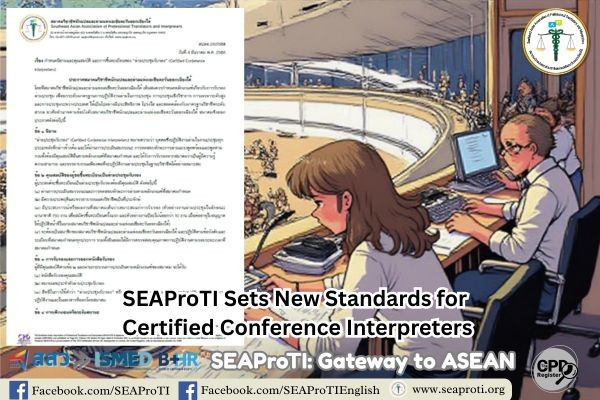
About certified translators, translation certifiers, and certified interpreters associated with SEAProTI. The Southeast Asian Association of Professional Translators and Interpreters (SEAProTI) has officially shared the qualifications and requirements for becoming Certified Translators, Translation Certification Providers, and Certified Interpreters in Sections 9 and 10 of the Royal Gazette, which was published by the Prime Minister’s Office in Thailand on July 25, 2024. Certified Translators, Translation Certification Providers, and Certified Interpreters
The Council of State has proposed the enactment of a Royal Decree, granting registered translators and recognised translation certifiers from professional associations or accredited language institutions the authority to provide legally valid translation certification (Letter to SEAProTI dated April 28, 2025)
SEAProTI is the first professional association in Thailand and Southeast Asia to implement a comprehensive certification system for translators, certifiers, and interpreters.
Head Office: Baan Ratchakru Building, No. 33, Room 402, Soi Phahonyothin 5, Phahonyothin Road, Phaya Thai District, Bangkok 10400, Thailand
Email: hello@seaproti.com | Tel.: (+66) 2-114-3128 (Office hours: Mon–Fri, 09:00–17:00).
การเตรียมความพร้อมเพื่อยกระดับประสิทธิภาพและสุขภาวะในการปฏิบัติงานแปลผ่านการกีฬา
ผู้เขียน: เภตรา โบรด
06 พฤษภาคม 2569, กรุงเทพมหานคร – การแปลและการเล่นกีฬาอาจดูเหมือนกิจกรรมที่อยู่คนละขั้ว—อย่างหนึ่งคืองานนั่งโต๊ะที่ไม่ได้เคลื่อนไหว ส่วนอีกอย่างคือการใช้แรงกายอย่างหนัก อย่างไรก็ตาม หลักฐานจากสาขาวิชาต่างๆ เช่น ประสาทวิทยาศาสตร์ และวิทยาศาสตร์การกีฬา ชี้ให้เห็นว่ากิจกรรมทางกายสามารถเพิ่มประสิทธิภาพการทำงานของสมองได้อย่างมีนัยสำคัญ โดยเฉพาะในงานที่ต้องใช้ความสามารถทางสติปัญญาสูงอย่างการแปล บทความนี้ท้าทายภาพลักษณ์ของ “นักแปลสันโดษที่นั่งติดโต๊ะ” และสำรวจว่าการเคลื่อนไหวร่างกายเป็นประจำสามารถส่งเสริมสุขภาวะ ความคิดสร้างสรรค์ และประสิทธิภาพการทำงานได้อย่างไร
คำสำคัญ: กีฬา; กิจกรรมทางกาย; นักแปล; การยศาสตร์; สุขภาวะ; ความคิดสร้างสรรค์; การแก้ปัญหา; ความสุขในการทำงาน
บทนำ
ภาพจำดั้งเดิมของนักแปลมักเป็นบุคคลที่โดดเดี่ยว เช่น นักบุญเจอโรม ที่นั่งทำงานอยู่เพียงลำพังที่โต๊ะ แม้ว่าเทคโนโลยีจะเปลี่ยนการแปลให้กลายเป็นการทำงานร่วมกันแบบ “Translaboration” แต่ลักษณะอาชีพส่วนใหญ่ยังคงเป็นการทำงานที่อยู่กับที่ รูปแบบการใช้ชีวิตที่นั่งนิ่งเป็นเวลานานนี้นำไปสู่ความเครียดทางกาย เช่น โรคระบบทางเดินหายใจและกล้ามเนื้อ รวมถึงความล้าทางสติปัญญา
ข้อเสนอแนะและแนวทางการปรับปรุง
งานวิจัยสนับสนุนแนวคิด “Marginal Gains” หรือการปรับปรุงเล็กน้อยในหลายๆ ด้านที่รวมกันแล้วส่งผลลัพธ์อันยิ่งใหญ่ โดยมีข้อเสนอแนะหลักดังนี้
พื้นที่ทำงานทันที: การออกกำลังกายที่โต๊ะ (เช่น การยืดเหยียดข้อมือ) และการใช้โต๊ะทำงานที่ปรับระดับนั่ง-ยืนได้
พื้นที่ทำงานแบบไดนามิก: การรวมเทคโนโลยีเปลี่ยนเสียงเป็นข้อความ (Speech-to-text) เพื่อลดภาระทางกายพร้อมกับกระตุ้นความคิดสร้างสรรค์
สมดุลชีวิตและการทำงานร่วมกัน: การประชุมขณะเดิน (Walking meetings) และกิจกรรมท้าทายความฟิตในกลุ่ม เพื่อสร้างชุมชนและความปลอดโปร่งทางจิตใจ
สรุป
การกำหนดนิยามใหม่ให้การแปลเป็น “กิจกรรมที่มีร่างกายเป็นส่วนร่วม” แทนที่จะเป็นเพียงงานนั่งโต๊ะ จะช่วยให้นักแปลสามารถผสานความว่องไวทางจิตใจเข้ากับความแข็งแรงทางกาย เพื่อความยั่งยืนของวิชาชีพและความสุขในการทำงานในระยะยาว
เอกสารอ้างอิง
- อากะ, เค. และคณะ (2021). The Effect of Acute Aerobic Exercise on Divergent and Convergent Thinking and Its Influence by Mood. Brain Sciences, 11(5), 546.
- อัลเฟอร์, เอ. (2021). Entering the Translab: Translation as collaboration, collaboration as translation, and the third space of ‘translaboration.’ Translation and Translanguaging in Multilingual Contexts, 3(3), 275–290.
- อัลคาจาห์, ที. เอ. และคณะ (2012). Sit-Stand Workstations. American Journal of Preventive Medicine, 43(3), 298–303.
- ออสเตอร์มูห์ล, เอฟ. (2014). Electronic Tools for Translators. London: Routledge.
- บานี-เมลเฮม, เอส. และคณะ (2018). Determinants of employees’ innovative behavior. International Journal of Contemporary Hospitality Management, 30(3), 1601–1620.
- เบดนาโรวา-กิโบวา, เค. (2021). Organizational ergonomics of translation as a powerful predictor of translators’ happiness at work? Perspectives, 29(3), 391–406.
- เบียอู กิล, เจ. อาร์. และ พิม, เอ. (2006). Technology and translation (a pedagogical overview). Translation Technology and its Teaching, 5–19.
- แคสเปอร์เซน, ซี. เจ. และคณะ (1985). Physical activity, exercise, and physical fitness: definitions and distinctions for health-related research. Public Health Reports, 100(2), 126–131.
- คาสตงเกย์, พี. (2017). Rouler vers le savoir. University Affairs.
- สถาบันนักภาษาศาสตร์ (CIOL) และคณะ (2017). UK Translator Survey: Final Report.
- เฉิน, ซี. (2024). Exploring the impact of acute physical activity on creative thinking. Discover Psychology, 4(1), 3.
- เฉิน, วาย. และ ฟีลีย์, ที. เอช. (2014). Social support, social strain, loneliness, and well-being among older adults. The Journal of Social and Personal Relationships, 31(2), 141–161.
- โชบานู, ดี. (2016). Automatic Speech Recognition in the Professional Translation Process. Translation Spaces, 5(1), 124–144.
- คอฟเฟง, เจ. เค. และคณะ (2015). Physical Activity and Relaxation During and After Work. Journal of Physical Activity and Health, 12(1), 109–115.
- คอสตา, บี. และคณะ (2020). Self-care as an ethical responsibility. Translation and interpreting studies, 15(1), 36–56.
- คอร์ตนีย์, เจ. และ ฟีแลน, เอ็ม. (2019). Translators’ experiences of occupational stress and job satisfaction. The International Journal of Translation and Interpreting Research, 11(1), 100–113.
- แดมส์, เจ. (2024). Students’ Attitudes Towards Interactive and Adaptive Translation Technology. New Advances in Translation Technology, 239–261.
- เดลิสทาที, ซี. (2023). Industrialisation of translation and collaborative practices. Cultus, 16, 139–158.
- เตียว, เอช. (2022). Translation in global health emergencies. Cadernos de Tradução, 42(01), 1–23.
- เทอร์เนอร์, ดับเบิลยู. ซี. (2004). Energy management handbook. Lilburn, GA: The Fairmont Press.
- ดรูแกน, เจ. (2013). Quality in professional translation: Assessment and improvement. London/New York: Bloomsbury Academic.
- เอเรนสเบอร์เกอร์-ดอว์, เอ็ม. และคณะ (2016). An International Survey of the Ergonomics of Professional Translation. ILCEA, 27.
- เอเรนสเบอร์เกอร์-ดอว์, เอ็ม. (2021). Ergonomics and translation workplaces. Handbook of Translation Studies: Volume 5, 67-72.
- ไอช์เบอร์เกอร์, ดี. (2024). The material and the immaterial: Saint Jerome in his Study. Albrecht Dürer’s material world, 87–98.
- เอสเซลินก์, บี. (2000). A Practical Guide to Localization. John Benjamins Publishing Company.
- ไอส์, เอ็ม. และคณะ (2019). The dynamic group environment in sport and exercise. Psychology of Sport and Exercise, 42, 40–47.
- เฟเดอริชี, อี. (2023). Collaborative translation(s) and feminism(s). Cultus, 16, 159– 176.
- เฟเนซี, บี. และคณะ (2022). Physical Activity in High School Classrooms. International Journal of Environmental Research and Public Health, 19(2), 688.
- ฟิชเชอร์, ซี. ดี. (2010). Happiness at Work. International Journal of Management Reviews, 12(4), 384– 412.
- เฟรเซอร์, เจ. และ โกลด์, เอ็ม. (2001). ‘Portfolio workers’: Autonomy and control amongst freelance translators. Work, Employment and Society, 15(4), 679–697.
- เฟรรอต, ซี. และคณะ (2019). Designing an Authentic Translation Environment for Future Translators. InTRAlinea.
- โกลด์สมิธ, อี. (2024). Upper-body musculoskeletal pain and eye strain among language professionals. arXiv.
- เกรกอรี, ดี. อี. และคณะ (2006). Stability Ball Versus Office Chair. Human Factors, 48(1), 142–153.
- เกอร์เบอรอฟ-อารีนัส, เอ. และ ทอรัล, เอ. (2022). Creativity in translation. Translation Spaces, 11(2), 184–212.
- ฮอลล์, ดี. และคณะ (2012). Marginal gains: Olympic lessons in high performance for organisations. HR Bulletin: research and practice, 7(2), 9-13.
- แฮมเมอร์, เอ็ม. และ ชิดา, วาย. (2008). Active commuting and cardiovascular risk. Preventive Medicine, 46(1), 9–13.
- ฮาสเคลล์, ดับเบิลยู. แอล. และ แบลร์, เอส. เอ็น. (1980). The physical activity component of health promotion in occupational settings. Public Health Reports, 95(2), 109.
- เฮนริกเซน, เค. และคณะ (2010). Holistic approach to athletic talent development environments. Psychology of sport and exercise, 11(3), 212–222.
- เอร์นันเดซ-เมนโด, เอ. และคณะ (2019). Physical activity, sports practice, and cognitive functioning. Frontiers in Psychology, 10, 2658.
- เอตู, เอ็ม.-พี. (2012). Le travail au dictaphone, une solution ergonomique? Circuit, 116, 23.
- ฮูเบอร์เชอร์-เดวิดสัน, เอส. (2017). Translation and Emotion. New York: Routledge.
- สมาคมการยศาสตร์นานาชาติ (IEA) (2025). What Is Ergonomics (HFE)?
- สถาบันการแปลและล่าม (ITI) (2024). 10 tips for emotional wellbeing as a translator or interpreter.
- ฆิเมเนซ-เครสโป, เอ็ม. เอ. (2017). Crowdsourcing and online collaborative translations. Amsterdam: John Benjamins.
- จอลลี, พี. เอช. (1983). Antonello da Messina’s Saint Jerome in His Study. The Art Bulletin, 65(2), 238–253.
- โจนส์, ดี. และคณะ (2019). What do Workplace Wellness Programs do? The Quarterly Journal of Economics, 134(4), 1747–1791.
- จอยซ์, เค. และคณะ (2010). Flexible working conditions and their effects on employee health and wellbeing. Cochrane Database of Systematic Reviews, 2.
- คัพพุส, เอ็ม. และ เอเรนสเบอร์เกอร์-ดอว์, เอ็ม. (2020). The ergonomics of translation tools. Interpreter and Translator Trainer, 14(4), 386–404.
- คาตัน, ดี. (2009). Occupation or profession: A survey of the translators’ world. Translation and Interpreting Studies, 4, 187–209.
- คัสซาวัต, เอ็ม. (2024). Agile working and job satisfaction for localisation language agents. Translation Spaces.
- คิงส์คอตต์, จี. (1985). Who are the translators? The growing professionalism of translating. Proceedings of Translating and the Computer 7, 1–10.
- คอร์พัล, พี. (2021). Stress experienced by Polish sworn translators and interpreters. Perspectives, 29.
- คอร์พัล, พี. และ เมลลิงเกอร์, ซี. ดี. (2022). Self-care strategies of professional community interpreters. Translation, Cognition & Behavior, 5(2), 275–299.
- คุสส์เมาล์, พี. (1995). Training the Translator. John Benjamins Publishing Company.
- แลมเบิร์ต, เจ. และ วอล์กเกอร์, ซี. (2024). Thriving or Surviving. Mikael, 17(1), 89—104.
- ลาโวลต์-ออลลีอง, อี. (2011). L’ergonomie, nouveau paradigme pour la traductologie. ILCEA, 14.
- เลอวี, เจ. (1967). Translation as a decision process. To honor Roman Jakobson, Vol. 2, 1171–1182.
- ลินด์วอลล์, เอ็ม. และคณะ (2014). The relationships of change in physical activity with change in depression, anxiety, and burnout. Health Psychology, 33(11), 1309–1318.
- มาญง, วี. และคณะ (2018). Sedentary behavior at work and cognitive functioning: a systematic review. Frontiers in Public Health, 6, 239.
- มาฮินดรู, เอ. และคณะ (2023). Role of Physical Activity on Mental Health and Well-Being: A Review. Cureus.
- แมสซีย์, จี. และคณะ (2023). Meeting evolution with innovation. The Interpreter and Translator Trainer, 17(3), 325–331.
- มาสซิดดา, เอส. (2015). Audiovisual translation in the digital age. Basingstoke: Palgrave-MacMillan.
- แมคอีแวน, ดี. และ โบแชมป์, เอ็ม. อาร์. (2014). Teamwork in sport. International review of sport and exercise psychology, 7(1), 229–250.
- มัวร์เกนส์, เจ. (2017). Under pressure: translation in times of austerity. Perspectives, 25(3), 464–477.
- มัวร์เกนส์, เจ. และคณะ (2018). Translators’ perceptions of literary post-editing. Translation Spaces, 7(2), 240—262.
- นาเซนสกี, แอล. เอ็ม. และคณะ (2017). Systematic review of the association between physical activity and burnout. Journal of Occupational Health, 59(6), 477–494.
- โอไบรอัน, เอส. (2012). Translation as human-computer interaction. Translation Spaces, 1(1), 101–122.
- โอไบรอัน, เอส. และ เอเรนสเบอร์เกอร์-ดอว์, เอ็ม. (2017). Why Ergonomics Matters to Professional Translators. The ATA Chronicle.
- โอคอน, เอ. เจ. (2013). Caught in the thickness of brain fog. Frontiers in physiology, 4, 63.
- โอลกา, แอล. (2015). Cognitive dissonance from the intercultural communication perspective. Russian Journal of Linguistics, (4), 49-56.
- โอลสัน, เจ. เอส. และ โอลสัน, จี. เอ็ม. (2014). Working Together Apart. Springer International Publishing.
- ออพเปซโซ, เอ็ม. และ ชวาร์ตซ์, ดี. แอล. (2014). Give your ideas some legs. Journal of Experimental Psychology, 40(4), 1142—1152.
- สมาคมนักแปลล่ามควีเบก (OTTIAQ) (2012). L’ergonomie et les langagiers. Circuit, 116.
- สมาคมนักแปลล่ามควีเบก (OTTIAQ) (2021). Apprendre et exercer nos professions en tout confort. Circuit, 151.
- เปญัลแวร์, อี. เอ. และ ซานตามาริอา อูร์เบียตา, เอ. (2020). The healthy and fit translator: a reality or a necessity? The Interpreter and Translator Trainer, 14(4), 461–477.
- เปอเนต์, เจ. (2024). Working as a Professional Translator. London: Routledge.
- พลาวแมน, เอ็ม. (2008). Exercise is brain food. Developmental neurorehabilitation, 11(3), 236–240.
- พอนทิเฟ็กซ์, เอ็ม. บี. และคณะ (2016). The association between physical activity during the day and long-term memory stability. Scientific Reports, 6(1), 38148.
- พรีสเก, โอ. และคณะ (2019). Effects of physical exercise training in the workplace on physical fitness. Sports medicine, 49(12), 1903–1921.
- คีริออง, เจ. และคณะ (2017). Le terminocyclisme, vous connaissez? Circuit.
- รามอส, เอ. และคณะ (2020). Increasing tactical complexity to enhance the synchronisation of collective behaviours. Journal of Sports Sciences, 38(22), 2611– 2619.
- โรดริเกซ-คาสโตร, เอ็ม. (2024). Extrinsic sources of translator job satisfaction. Translation Spaces, 13(1), 32–53.
- โรมิงเกอร์, ซี. และคณะ (2022). Acute and Chronic Physical Activity Increases Creative Ideation Performance. Sports Medicine—Open, 8(1), 62.
- รอทเวลล์, เอ. และคณะ (2023). Translation Tools and Technologies. London: Routledge.
- รูโอโกเนน, เอ็ม. และ สวาน, อี. (2024). What do we know about translators’ job satisfaction? Translation Spaces, 13(1), 7–31.
- ซาดัต, เอส. (2017). Translaboration: Collaborative translation to challenge hegemony. Translation and Translanguaging in Multilingual Contexts, 3(3), 349–369.
- ซาลาส-วัลลีนา, เอ. และ อาเลเกร-วิดัล, เจ. (2018). Happiness at work: Developing a shorter measure. Journal of Management & Organization, 27(3), 460—480.
- ซัลวาจิโอนี, ดี. เอ. เจ. และคณะ (2017). Physical, psychological and occupational consequences of job burnout. PLOS ONE, 12(10).
- ซามูเอลสัน-บราวน์, จี. (2010). A Practical Guide for Translators. Multilingual Matters.
- ชมิดท์-คาสโซว์, เอ็ม. และคณะ (2014). Treadmill walking during vocabulary encoding improves verbal long-term memory. Behavioral and Brain Functions, 10(1), 24.
- เซรอน-ออร์โดเญซ, ไอ. และ มาร์ติน-มอร์, เอ. (2016). Translation and Mobile Devices. Tradumàtica 14.
- เชฟชุก, เอ. และคณะ (2019). The autonomy paradox. ILR Review, 72(1), 75–100.
- ชไนเดอร์แมน, บี. และคณะ (2016). Designing the User Interface. Pearson.
- เชอการ์ด, จี. และคณะ (2016). Exercise is more than medicine. Journal of Sport and Health Science, 5(2), 159–165.
- สเลเตอร์, เอ็ม. (2012). Olympics cycling: Marginal gains underpin Team GB dominance. BBC Sport.
- สไตรเกอร์, เจ. บี. และคณะ (2012). Creating Collaboration Opportunity. IEEE Transactions on Engineering Management, 59(4), 609–620.
- เซนต์ แอนเดร, เจ. (2010). Lessons from Chinese History. TTR, 23(1), 71—94.
- เตเซรา, ซี. เอส. และ โอไบรอัน, เอส. (2017). Investigating the cognitive ergonomic aspects of translation tools. Translation spaces, 6(1), 79–103.
- เตเซรา, ซี. เอส. และคณะ (2019). Creating a Multimodal Translation Tool. Informatics, 6(1), 13.
- เตเซรา, ซี. เอส. และ ซาปาตา, เจ. (2024). “Technical translators”. Handbook of the Language Industry, 349-374.
- ทอร์ป, เอ. เอ. และคณะ (2014). Breaking up workplace sitting time with intermittent standing bouts. Occupational and Environmental Medicine, 71(11), 765–771.
- ทิก, เอ็ม. และคณะ (2018). Ultra‐high‐field fMRI insights on insight. Human Brain Mapping, 39(8), 3241—3252.
- ทรอลเลอโบ, เอส. โอ. และคณะ (2024). Uncovering perspectives on physical activity in nursing homes. BMC Health Services Research, 24(1), 1222.
- ฟาน ดองเก็น, อี. วี. และคณะ (2016). Physical exercise performed four hours after learning improves memory retention. Current Biology, 26(13), 1722–1727.
- ฟาน เอ็กดอม, กิส-วอลต์ และคณะ (2020). A turn to ergonomics in translator and interpreter training. The Interpreter and Translator Trainer, 14(4), 363–368.
- ฟาน เอ็กดอม, กิส-วอลต์ (2025). Zelfzorg voor literair vertalers. Kennisbank Expertisecentrum Literair Vertalen.
- วิเซนต์, เค. (2004). Le facteur humain. Outremont: Logiques.
- องค์การอนามัยโลก (WHO) (2018). Global action plan on physical activity 2018–2030.
- หวัง, ที. (2023). The collaborative translation of Buddhist scriptures in China. Cultus, 16, 18–43.
- วีลเลอร์, เอ็ม. เจ. และคณะ (2017). Sedentary behavior as a risk factor for cognitive decline? Alzheimer’s & Dementia, 3(3), 291–300.
- ยิลมาซ, อี. ดี. และคณะ (2023). AI-Driven Labor Substitution. INSEAD Working Paper No. 2023/24/EFE.
- ซาปาตา, เจ. และคณะ (2023). Escritores que dictan: ¿y por qué no los traductores literarios? Tradumàtica, 21, 103–128.
- ซาปาตา, เจ. และ คีริออง, เจ. (2016). La traduction dictée interactive et sa nécessaire intégration à la formation des traducteurs. Babel, 62(4), 531–551.
- ซาปาตา, เจ. และ เซนต์, อี. ซี. (2017). Traduire à voix haute. InTRAlinea, 19.
- จ้าว, เอส. และคณะ (2023). Heads-Up Computing: Moving Beyond the Device-Centered Paradigm. Communications of the ACM, 66(9), 56–63.
ขอใช้บริการนักวิชาชีพของสมาคมได้ที่:https://www.seaproti.org/practitioners/
สมาคมวิชาชีพนักแปลและล่ามแห่งเอเชียตะวันออกเฉียงใต้ (SEAProTI) ได้ประกาศหลักเกณฑ์และคุณสมบัติของผู้ที่ขึ้นทะเบียนเป็น “นักแปลรับรอง (Certified Translators) และผู้รับรองการแปล (Translation Certification Providers) และล่ามรับรอง (Certified Interpreters)” ของสมาคม หมวดที่ 9 และหมวดที่ 10 ในราชกิจจานุเบกษา ของสำนักเลขาธิการคณะรัฐมนตรี ในสำนักนายกรัฐมนตรี แห่งราชอาณาจักรไทย ลงวันที่ 25 ก.ค. 2567 เล่มที่ 141 ตอนที่ 66 ง หน้า 100 อ่านฉบับเต็มได้ที่: นักแปลรับรอง ผู้รับรองการแปล และล่ามรับรอง
สำนักคณะกรรมการกฤษฎีกาเสนอให้ตราเป็นพระราชกฤษฎีกา โดยกำหนดให้นักแปลที่ขึ้นทะเบียน รวมถึงผู้รับรองการแปลจากสมาคมวิชาชีพหรือสถาบันสอนภาษาที่มีการอบรมและขึ้นทะเบียน สามารถรับรองคำแปลได้ (จดหมายถึงสมาคม SEAProTI ลงวันที่ 28 เม.ย. 2568)
สมาคมวิชาชีพนักแปลและล่ามแห่งเอเชียตะวันออกเฉียงใต้เป็นสมาคมวิชาชีพแห่งแรกและแห่งเดียวในประเทศไทยและภูมิภาคเอเชียตะวันออกเฉียงใต้ที่มีระบบรับรองนักแปลรับรอง ผู้รับรองการแปล และล่ามรับรอง
สำนักงานใหญ่: อาคารบ้านราชครู เลขที่ 33 ห้อง 402 ซอยพหลโยธิน 5 ถนนพหลโยธิน แขวงพญาไท เขตพญาไท กรุงเทพมหานคร 10400 ประเทศไทย