



Interlingual Readings of Political Discourse: Translation, Interpreting, and Contrastive Analysis
Author: Phakaporn Tanjararak
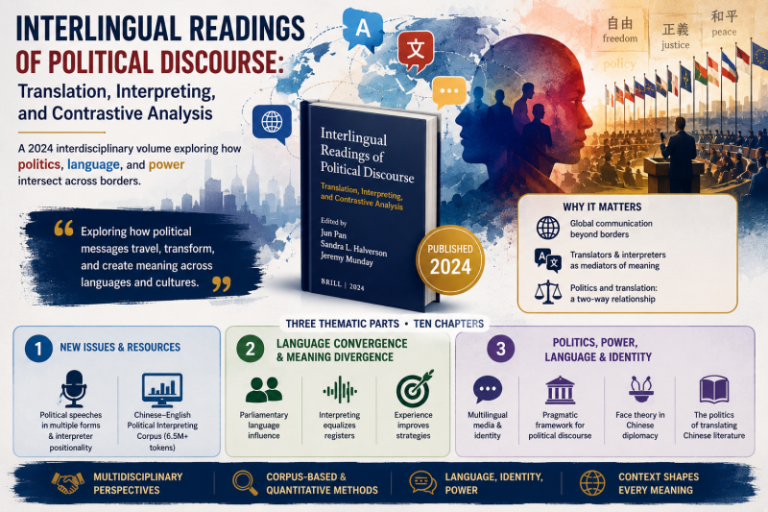
12 May 2026, Bangkok – The book Interlingual Readings of Political Discourse: Translation, Interpreting, and Contrastive Analysis, edited by Jun Pan, Sandra L. Halverson, and Jeremy Munday and published in 2024, constitutes a significant scholarly contribution that explores the relationship among political discourse, translation, and interpreting within the context of globalization. The volume brings together contributions from scholars across various disciplines, including Translation Studies, Linguistics, Political Science, and Communication Studies, in order to examine political discourse through the dimensions of language, identity, power, and intercultural communication.
The chapters emphasize corpus-based methodologies, quantitative analysis, and discourse analysis, while also discussing the roles of translators and interpreters as mediators of political meaning. This review aims to summarize the main arguments of each chapter, analyze the strengths and limitations of the volume, and evaluate its contribution to contemporary Translation Studies and the study of political discourse.
Introduction
In the age of globalization, political communication is no longer confined within the boundaries of nation-states. Instead, it has expanded into international spheres through digital media, diplomacy, and transnational communication networks. Such developments have rendered translation and interpreting essential mechanisms for transferring ideologies, policies, and political images from one context to another. Consequently, the relationship between politics and translation has become a prominent subject of interest in contemporary academia, particularly in terms of both “the translation of politics” and “the politics of translation.”
The volume Interlingual Readings of Political Discourse: Translation, Interpreting, and Contrastive Analysis, published as part of the “Utrecht Studies in Language and Communication” series, aims to investigate this relationship through an interdisciplinary framework. The book assembles contributions from scholars examining political discourse through the lenses of language, interpreting, translation, identity, and power. As such, the volume is highly significant for the study of political communication in multilingual contexts.
This review seeks to summarize the major contents of each chapter, analyze the theoretical frameworks and methodologies employed, and evaluate the strengths and limitations of the book as a scholarly work in Translation Studies and political discourse analysis.
Content and Analysis
Part 1 Political Discourse, Translation, and Interpreting: New Issues and Research Resources
Chapter 2
In Chapter 2, Jeremy Munday argues that a political speech may exist in multiple forms and undergo transformation through translation, interpreting, and various media channels. Using speeches delivered by Donald Trump as case studies, the author employs Hallidayan Systemic Functional Linguistics, register analysis, and appraisal theory to identify ideologically sensitive points within texts that may generate difficulties in translation or interpreting.
The study raises crucial questions concerning the positionality of interpreters, which may lead to ethical dilemmas. Munday discusses the concepts of “resistant reading,” “compliant reading,” and “tactical reading,” particularly advocating the latter as a useful approach for interpreting texts within new contexts unforeseen by the original author.
Chapter 3
In Chapter 3, Jun Pan surveys existing monolingual and bilingual corpora of political discourse around the world, noting that most bilingual corpora remain limited in size and accessibility. The author subsequently introduces the Chinese–English Political Interpreting Corpus, an open-access online platform containing more than 6.5 million word tokens.
The corpus includes political speeches in Mandarin Chinese, Cantonese, and English, together with translated and interpreted texts aligned at the paragraph level. It also contains metadata, annotations of linguistic and paralinguistic features, and part-of-speech tagging in order to represent both the linguistic and social dimensions of the data. Pan demonstrates through several case studies that the corpus serves as a valuable resource for analyzing interpreted language and political discourse translation.
Part 2 Language Convergence and Meaning Divergence
Chapter 4
Chapter 4, authored by Bart Defrancq and Koen Plevoets, investigates linguistic convergence between Members of the European Parliament and interpreters through a comparison of three varieties of Dutch: the variety spoken in national parliaments, the variety used by Members of the European Parliament, and the variety used by interpreters. The authors employ N-gram analysis and Discriminant Correspondence Analysis to examine whether these groups constitute a shared “discourse community.”
The findings suggest that Members of the European Parliament and interpreters do not clearly form a homogeneous discourse community. Nevertheless, the linguistic patterns used by Members of the European Parliament resemble those of interpreters more closely than those of national parliamentarians, indicating the influence of interpreters on parliamentary language use. The authors explain this phenomenon by referring to interpreters as peripheral members of the European political discourse community.
Chapter 5
In Chapter 5, Nannan Liu conducts a contrastive register analysis comparing Chinese political speeches, their interpreted English versions, and political speeches originally produced by native English speakers. A major strength of this study lies in its ability to facilitate both intralinguistic and interlinguistic comparisons in order to examine the effects of target-register expectations, interpreting modalities, and source-language interference.
Using multidimensional statistical analysis, Liu finds that interpreted speeches display highly similar characteristics regardless of whether the source speech is oral or literate in style. Specifically, interpreters tend to render formal source speeches into more oral forms while simultaneously transforming oral speeches into more formal forms. These findings demonstrate the “equalizing effect” of interpreting. However, the author concludes that target-context expectations concerning register exert only limited influence.
Chapter 6
Chapter 6, written by Shanshan Yang, adopts a corpus-assisted approach to examine the impact of professional experience on interpreter performance by comparing professional interpreters with novice interpreters. A notable feature of the study is that both groups interpreted the same political speech under identical conditions in a naturalistic setting.
The study focuses on how culture-specific items are managed in interpreting. Interpreting strategies are categorized into transcoding, paraphrasing, substitution, and deletion. The findings reveal that professional interpreters employ more sophisticated and effective strategies, whereas novice interpreters rely heavily on deletion. Yang concludes that professional experience significantly contributes to interpreters’ strategic processing abilities and encyclopedic knowledge.
Part 3 Politics, Power, Language, and Identity
Chapter 7
In Chapter 7, Sangeeta Bagga-Gupta and Aprameya Rao present an interdisciplinary empirical analysis of “languaging” within public media landscapes in India and Sweden. The authors analyze all posts published on the official Facebook pages of four political parties over a six-week period and identify three major themes: the nature of media, identity positions in political media landscapes, and the nature of language in social media.
The chapter is particularly relevant to Translation Studies because it addresses issues surrounding multilingualism and the deployment of semiotic resources in contemporary political communication. It raises important questions concerning accessibility, linguistic boundaries, script usage, and colonial language hegemony. The authors conclude that contemporary media landscapes simultaneously enable and constrain new forms of linguistic existence across the Global South and the Global North.
Chapter 8
In Chapter 8, Jun Pan proposes a pragmatic framework for analyzing political discourse. The framework consists of three levels: the meaning of meaning, the structure of meaning, and meaning in extended contexts. Using a corpus of policy addresses and budget speeches from Hong Kong and the United Kingdom between 1997 and 2017, the author demonstrates how the framework can be applied effectively to political discourse analysis.
A major contribution of this chapter lies in its use of corpus linguistic tools to identify pragmatically significant linguistic patterns as the starting point for deeper analysis. The study not only contributes to political language studies but also sheds light on the role of translation and interpreting as mediating mechanisms in political communication.
Chapter 9
Chapter 9, by Maria Marakhovskaiia and Alan Partington, examines the applicability of face theory within the context of Chinese diplomacy. The authors analyze English-language press briefings issued by the Chinese Foreign Ministry in 2016 and compare them with White House press briefings through corpus-assisted discourse analysis and N-gram analysis.
Although the study provides valuable insights into the construction of “national face,” it pays relatively limited attention to implications for Translation Studies. This limitation arises because the analyzed texts are interpreted or edited versions in which mediation by interpreters and editors is unavoidable.
Chapter 10
The final chapter, authored by Babette Bernhardt, differs from the preceding chapters by shifting attention from “the translation of politics” to “the politics of translation.” The study investigates the translation and dissemination of Chinese literature in East Germany during the 1950s and beyond. The author draws upon official documents, publishing-house archives, and translation paratexts such as prefaces and postfaces.
The findings demonstrate that the selection, translation, dissemination, and evaluation of Chinese literature during this period were primarily shaped by socialist cultural policies rather than literary merit. Consequently, the chapter serves as an effective illustration of how translation analysis can illuminate broader historical and ideological contexts.
Critique and Discussion
Overall, this volume constitutes an important contribution to the study of politics, translation, and interpreting. One major strength lies in the diversity of political discourse genres, languages, communication modes, and institutional and cultural contexts examined throughout the book. This diversity enables readers to appreciate both the complexity and the interdisciplinary nature of the field.
Second, the volume expands the meanings of “translation” and “interpreting” beyond the conventional notion of linguistic transfer to encompass ideological transformation and meaning-making processes, as demonstrated particularly in Chapter 7. This broader conceptualization significantly widens the scope of Translation Studies.
Third, the volume treats both “the translation of politics” and “the politics of translation” with equal importance, thereby encouraging deeper explorations of the relationships among language, power, and ideology.
Despite these strengths, the volume also exhibits several limitations. One major issue concerns the relatively small size of the interpreting corpora used in several studies, which may reduce the reliability of statistical analyses. Bart Defrancq and Koen Plevoets themselves acknowledge that their study relies on data from only one interpreting booth and employs a predominantly quantitative methodology.
Furthermore, several chapters rely excessively on quantitative analysis despite the fact that relationships between linguistic features and communicative functions are rarely straightforward. A single linguistic feature may serve multiple functions, while a single communicative function may be realized through different linguistic forms.
Mason (2001) warns that drawing conclusions about translator behavior solely from statistical data without considering discourse context and rhetorical purpose may produce misleading interpretations. Similarly, Saldanha and O’Brien (2014) argue that combining qualitative and quantitative methodologies provides a more comprehensive understanding of the relationship between language practices and cultural transmission. Therefore, several studies in this volume could have benefited from more contextualized qualitative analysis.
Conclusion
Interlingual Readings of Political Discourse: Translation, Interpreting, and Contrastive Analysis is a highly valuable scholarly contribution to Translation Studies and contemporary political discourse analysis. The volume successfully demonstrates the complexity of political communication in multilingual societies and highlights the crucial roles of translators and interpreters as mediators of meaning, ideology, and power. Although certain methodological limitations remain, the book overall serves as an essential reference for scholars and students in Translation Studies, Linguistics, Political Science, Communication Studies, and Diplomacy.
References
- Almanna, A., & House, J. (Eds.). (2023). Translation Politicised and Politics Translated. Peter Lang.
- Mason, I. (2001). Translator behaviour and language usage: Some constraints on contrastive studies. Hermes, 26, 65–89.
- Pan, J., Halverson, S. L., & Munday, J. (Eds.). (2024). Interlingual Readings of Political Discourse: Translation, Interpreting, and Contrastive Analysis. Leiden and Boston: Brill.
- Saldanha, G., & O’Brien, S. (2014). Research Methodologies in Translation Studies. Routledge.
For professional services, please visit: https://www.seaproti.org/practitioners/
About certified translators, translation certifiers, and certified interpreters associated with SEAProTI. The Southeast Asian Association of Professional Translators and Interpreters (SEAProTI) has officially shared the qualifications and requirements for becoming Certified Translators, Translation Certification Providers, and Certified Interpreters in Sections 9 and 10 of the Royal Gazette, which was published by the Prime Minister’s Office in Thailand on July 25, 2024. Certified Translators, Translation Certification Providers, and Certified Interpreters
The Council of State has proposed the enactment of a Royal Decree, granting registered translators and recognised translation certifiers from professional associations or accredited language institutions the authority to provide legally valid translation certification (Letter to SEAProTI dated April 28, 2025)
SEAProTI is the first professional association in Thailand and Southeast Asia to implement a comprehensive certification system for translators, certifiers, and interpreters.
Head Office: Baan Ratchakru Building, No. 33, Room 402, Soi Phahonyothin 5, Phahonyothin Road, Phaya Thai District, Bangkok 10400, Thailand
Email: hello@seaproti.com | Tel.: (+66) 2-114-3128 (Office hours: Mon–Fri, 09:00–17:00).
การอ่านวาทกรรมการเมืองข้ามภาษา: การแปล การล่าม และการวิเคราะห์เชิงเปรียบต่าง
ผู้เขียน: ภคพร ตันจรารักษ์
12 พฤษภาคม 2569, กรุงเทพมหานคร – หนังสือ การอ่านวาทกรรมการเมืองข้ามภาษา: การแปล การล่าม และการวิเคราะห์เชิงเปรียบต่าง ซึ่งบรรณาธิการโดย จุน พาน แซนดรา แอล ฮาลเวอร์สัน และเจเรมี มันเดย์ ตีพิมพ์เมื่อ พ.ศ. 2567 ถือเป็นผลงานวิชาการสำคัญที่นำเสนอความสัมพันธ์ระหว่างวาทกรรมการเมือง การแปล และการล่ามในบริบทสังคมโลกาภิวัตน์ หนังสือเล่มนี้รวบรวมบทความจากนักวิชาการหลากหลายสาขา อาทิ การแปลศึกษา ภาษาศาสตร์ รัฐศาสตร์ และนิเทศศาสตร์ เพื่อนำเสนอการวิเคราะห์วาทกรรมการเมืองผ่านมิติของภาษา อัตลักษณ์ อำนาจ และการสื่อสารข้ามวัฒนธรรม
บทความในเล่มให้ความสำคัญกับวิธีวิทยาเชิงคลังข้อมูล การวิเคราะห์เชิงปริมาณ และการวิเคราะห์เชิงวาทกรรม รวมถึงอภิปรายบทบาทของนักแปลและล่ามในฐานะผู้ไกล่เกลี่ยความหมายทางการเมือง บทวิจารณ์นี้มุ่งสรุปสาระสำคัญของแต่ละบท วิเคราะห์จุดแข็งและข้อจำกัดของหนังสือ ตลอดจนประเมินคุณูปการของหนังสือที่มีต่อวงการการแปลศึกษาและการศึกษาวาทกรรมการเมืองร่วมสมัย
บทนำ
ในยุคโลกาภิวัตน์ การสื่อสารทางการเมืองมิได้จำกัดอยู่ภายในขอบเขตของรัฐชาติอีกต่อไป หากแต่ขยายตัวสู่พื้นที่สากลผ่านสื่อดิจิทัล การทูตระหว่างประเทศ และเครือข่ายสื่อสารข้ามพรมแดน กระบวนการดังกล่าวทำให้ “การแปล” และ “การล่าม” กลายเป็นกลไกสำคัญในการถ่ายทอดอุดมการณ์ นโยบาย และภาพลักษณ์ทางการเมืองจากบริบทหนึ่งไปสู่อีกบริบทหนึ่ง ความสัมพันธ์ระหว่างการเมืองกับการแปลจึงเป็นประเด็นที่ได้รับความสนใจอย่างกว้างขวางในวงวิชาการร่วมสมัย ทั้งในด้าน “การแปลการเมือง” และ “การเมืองของการแปล”
หนังสือ การอ่านวาทกรรมการเมืองข้ามภาษา: การแปล การล่าม และการวิเคราะห์เชิงเปรียบต่าง ซึ่งอยู่ภายใต้ชุดหนังสือ “อูเทรคต์ศึกษาในภาษาและการสื่อสาร” มีเป้าหมายในการสำรวจความสัมพันธ์ดังกล่าวผ่านกรอบสหวิทยาการ โดยรวบรวมบทความจากนักวิชาการที่ศึกษาวาทกรรมการเมืองผ่านมิติของภาษา การล่าม การแปล อัตลักษณ์ และอำนาจ หนังสือเล่มนี้จึงมีความสำคัญอย่างยิ่งต่อการศึกษาการสื่อสารทางการเมืองในโลกพหุภาษา
บทวิจารณ์นี้มีวัตถุประสงค์เพื่อสรุปสาระสำคัญของแต่ละบท วิเคราะห์แนวคิดและวิธีวิทยาที่ใช้ ตลอดจนประเมินจุดแข็งและข้อจำกัดของหนังสือในฐานะผลงานวิชาการด้านการแปลศึกษาและวาทกรรมการเมือง
เนื้อหาและการวิเคราะห์
ภาคที่ 1 วาทกรรมการเมือง การแปล และการล่าม: ประเด็นใหม่และทรัพยากรวิจัย
บทที่ 2 โดยเจเรมี มันเดย์ เสนอว่าสุนทรพจน์ทางการเมืองหนึ่งชิ้นสามารถดำรงอยู่ได้ในหลายรูปแบบและถูกแปรเปลี่ยนผ่านกระบวนการแปล การล่าม และสื่อหลากหลายประเภท ผู้วิจัยใช้สุนทรพจน์ของโดนัลด์ ทรัมป์ เป็นกรณีศึกษา และนำแนวคิดภาษาศาสตร์เชิงหน้าที่ระบบของฮัลลิเดย์มาใช้วิเคราะห์จุดที่มีความอ่อนไหวเชิงอุดมการณ์ในการแปล ทั้งยังอภิปรายประเด็นจริยธรรมและจุดยืนของล่าม โดยเสนอแนวคิด “การอ่านเชิงยุทธวิธี” เพื่ออธิบายการตีความตัวบทในบริบทใหม่
บทที่ 3 โดยจุน พาน มุ่งนำเสนอคลังข้อมูลการล่ามการเมืองจีน–อังกฤษ ซึ่งพัฒนาเป็นฐานข้อมูลออนไลน์แบบเปิดและประกอบด้วยข้อมูลมากกว่า 6.5 ล้านหน่วยคำ คลังข้อมูลดังกล่าวรวบรวมสุนทรพจน์ภาษาจีนและภาษาอังกฤษ พร้อมบทล่ามและบทแปลที่จัดแนวระดับย่อหน้า รวมถึงข้อมูลอรรถาธิบายทางสังคมและภาษาศาสตร์ ผู้วิจัยชี้ให้เห็นว่าคลังข้อมูลนี้มีศักยภาพในการศึกษาคุณลักษณะของภาษาล่ามและการสื่อสารทางการเมืองข้ามภาษา
ภาคที่ 2 การบรรจบของภาษาและความแตกต่างของความหมาย
บทที่ 4 โดยบาร์ต เดอฟรังก์ และคูน เพลโวตส์ วิเคราะห์ความสอดคล้องทางภาษาระหว่างสมาชิกรัฐสภายุโรปกับล่าม ผ่านการศึกษาภาษาดัตช์ 3 รูปแบบ ได้แก่ ภาษาที่ใช้ในรัฐสภาแห่งชาติ ภาษาที่สมาชิกสภายุโรปใช้ และภาษาที่ล่ามใช้ นักวิจัยใช้การวิเคราะห์เอ็นแกรมและการวิเคราะห์ความสอดคล้องเชิงจำแนกเพื่อศึกษาว่ากลุ่มผู้พูดเหล่านี้มีลักษณะเป็น “ชุมชนวาทกรรม” ร่วมกันหรือไม่ ผลการศึกษาพบว่าล่ามมีอิทธิพลต่อรูปแบบภาษาของสมาชิกรัฐสภายุโรป แม้ล่ามจะมีสถานะเพียงสมาชิกชายขอบของชุมชนวาทกรรมดังกล่าว
บทที่ 5 โดยหนานหนาน หลิว ใช้วิธีวิเคราะห์รีจิสเตอร์เชิงเปรียบต่างระหว่างสุนทรพจน์การเมืองภาษาจีน บทล่ามภาษาอังกฤษ และสุนทรพจน์ภาษาอังกฤษที่สร้างขึ้นโดยเจ้าของภาษา ผลการศึกษาพบว่าการล่ามมีแนวโน้มทำให้ระดับภาษาถูกปรับเข้าสู่ลักษณะกึ่งกลาง กล่าวคือ ภาษาที่เป็นทางการมากถูกทำให้เป็นภาษาพูดมากขึ้น ขณะที่ภาษาพูดถูกทำให้มีลักษณะเป็นทางการมากขึ้น สะท้อน “ผลของการปรับสมดุล” ที่เกิดจากกระบวนการล่าม
บทที่ 6 โดยชานชาน หยาง ศึกษาผลของประสบการณ์วิชาชีพต่อคุณภาพการล่าม โดยเปรียบเทียบล่ามมืออาชีพกับล่ามมือใหม่ในการจัดการคำหรือแนวคิดเฉพาะวัฒนธรรม ผลการศึกษาพบว่าล่ามมืออาชีพใช้กลยุทธ์ที่ซับซ้อนและมีประสิทธิภาพมากกว่า ขณะที่ล่ามมือใหม่มักใช้วิธีละข้อความ ผลลัพธ์ดังกล่าวสะท้อนความสำคัญของประสบการณ์วิชาชีพและองค์ความรู้เชิงสารานุกรมต่อคุณภาพการล่าม
ภาคที่ 3 การเมือง อำนาจ ภาษา และอัตลักษณ์
บทที่ 7 โดยสังกีตา บักกา-คุปตะ และอปราเมยา เรา วิเคราะห์การใช้ภาษาและทรัพยากรสัญศาสตร์ในสื่อสังคมออนไลน์ของพรรคการเมืองในอินเดียและสวีเดน ผู้วิจัยเสนอแนวคิด “การสร้างความหมายผ่านภาษา” เพื่ออธิบายการใช้ภาษาหลากหลายรูปแบบในภูมิทัศน์สื่อการเมืองร่วมสมัย โดยเฉพาะประเด็นการเข้าถึงสาร การใช้ภาษาหลายรูปแบบ และอิทธิพลของอำนาจอาณานิคมทางภาษา
บทที่ 8 โดยจุน พาน เสนอกรอบวิเคราะห์เชิงวัจนปฏิบัติสำหรับศึกษาวาทกรรมการเมือง ซึ่งประกอบด้วย 3 ระดับ ได้แก่ ความหมายของความหมาย โครงสร้างของความหมาย และความหมายในบริบทขยาย ผู้วิจัยใช้คลังข้อมูลสุนทรพจน์ด้านนโยบายและงบประมาณของฮ่องกงและสหราชอาณาจักรระหว่าง พ.ศ. 2540–พ.ศ. 2560 เพื่อแสดงให้เห็นว่าการแปลและการล่ามมีบทบาทสำคัญในการไกล่เกลี่ยความหมายทางการเมือง
บทที่ 9 โดยมาเรีย มาราคอฟสไกอา และอลัน พาร์ทิงตัน ศึกษาทฤษฎี “การรักษาหน้า” ในบริบทการทูตจีน โดยวิเคราะห์ถ้อยแถลงของกระทรวงการต่างประเทศจีนและทำเนียบขาวผ่านวิธีวิเคราะห์วาทกรรมเชิงคลังข้อมูล แม้งานวิจัยจะช่วยอธิบายแนวคิดเรื่อง “หน้าระดับชาติ” ได้อย่างน่าสนใจ แต่กลับให้ความสำคัญต่อบทบาทของนักแปลและบรรณาธิการค่อนข้างจำกัด
บทสุดท้ายโดยบาเบ็ต เบิร์นฮาร์ดท์ เปลี่ยนจุดเน้นจาก “การแปลการเมือง” ไปสู่ “การเมืองของการแปล” ผ่านการศึกษาการแปลวรรณกรรมจีนในเยอรมนีตะวันออกช่วงทศวรรษ พ.ศ. 2490 ผู้วิจัยชี้ให้เห็นว่าการคัดเลือก การแปล และการเผยแพร่วรรณกรรมจีนในช่วงเวลาดังกล่าวถูกกำหนดโดยนโยบายวัฒนธรรมแบบสังคมนิยมมากกว่าคุณค่าทางวรรณศิลป์
วิจารณ์และอภิปราย
หนังสือเล่มนี้มีจุดแข็งสำคัญหลายประการ ประการแรก คือ ความหลากหลายของประเภทวาทกรรม ภาษา บริบททางวัฒนธรรม และวิธีวิทยาที่ใช้ศึกษา ทำให้ผู้อ่านมองเห็นความซับซ้อนและความเป็นสหวิทยาการของการศึกษาวาทกรรมการเมืองและการแปล ประการที่ 2 หนังสือขยายความหมายของ “การแปล” และ “การล่าม” ให้ครอบคลุมกระบวนการสร้างความหมายและการเปลี่ยนผ่านทางอุดมการณ์ มิใช่เพียงการถ่ายทอดภาษาเท่านั้น ประการที่ 3 หนังสือให้ความสำคัญต่อทั้ง “การแปลการเมือง” และ “การเมืองของการแปล” อย่างสมดุล ซึ่งช่วยเปิดพื้นที่ให้เกิดการศึกษาความสัมพันธ์ระหว่างภาษา อำนาจ และอุดมการณ์ในระดับลึก
อย่างไรก็ตาม หนังสือยังมีข้อจำกัดบางประการ โดยเฉพาะการพึ่งพาวิธีวิเคราะห์เชิงปริมาณและข้อมูลเชิงคลังมากเกินไป หลายบทใช้คลังข้อมูลที่มีขนาดเล็ก ส่งผลต่อความน่าเชื่อถือของผลวิเคราะห์เชิงสถิติ นอกจากนี้ การวิเคราะห์เชิงปริมาณเพียงอย่างเดียวอาจไม่เพียงพอต่อการอธิบายหน้าที่เชิงวาทกรรมและวัตถุประสงค์เชิงวาทศิลป์ของภาษา เมสัน (พ.ศ. 2544) เตือนว่าการสรุปพฤติกรรมของนักแปลจากข้อมูลเชิงสถิติโดยไม่คำนึงถึงบริบททางวาทกรรมอาจนำไปสู่ข้อสรุปที่คลาดเคลื่อน ขณะที่ซัลดันยา และโอไบรอัน (พ.ศ. 2557) เสนอว่าการผสานวิธีวิจัยเชิงคุณภาพและเชิงปริมาณจะช่วยให้เข้าใจการถ่ายทอดวัฒนธรรมผ่านภาษาได้อย่างลุ่มลึกมากกว่า
สรุป
หนังสือ การอ่านวาทกรรมการเมืองข้ามภาษา: การแปล การล่าม และการวิเคราะห์เชิงเปรียบต่าง เป็นผลงานวิชาการที่มีคุณูปการอย่างยิ่งต่อการศึกษาความสัมพันธ์ระหว่างการเมือง ภาษา และการแปล หนังสือสามารถสะท้อนให้เห็นถึงความซับซ้อนของการสื่อสารทางการเมืองในโลกพหุภาษา และชี้ให้เห็นบทบาทสำคัญของนักแปลและล่ามในฐานะผู้ไกล่เกลี่ยอุดมการณ์และความหมาย แม้หนังสือจะมีข้อจำกัดด้านวิธีวิทยาบางประการ แต่โดยภาพรวมถือเป็นแหล่งอ้างอิงสำคัญสำหรับนักวิชาการและนักศึกษาในสาขาการแปลศึกษา ภาษาศาสตร์ รัฐศาสตร์ นิเทศศาสตร์ และการทูต
เอกสารอ้างอิง
- อัลมันนา, เอ. และ เฮาส์, เจ. (บรรณาธิการ). (พ.ศ. 2566). การเมืองของการแปลและการแปลของการเมือง. ปีเตอร์ แลง.
- เมสัน, ไอ. (พ.ศ. 2544). พฤติกรรมของนักแปลและการใช้ภาษา: ข้อจำกัดบางประการของการศึกษาเชิงเปรียบต่าง. เฮอร์มีส, 26, 65–89.
- พาน, จ., ฮาลเวอร์สัน, แซนดรา แอล., และ มันเดย์, เจ. (บรรณาธิการ). (พ.ศ. 2567). การอ่านวาทกรรมการเมืองข้ามภาษา: การแปล การล่าม และการวิเคราะห์เชิงเปรียบต่าง. ไลเดิน และบอสตัน: บริลล์.
- ซัลดันยา, จี. และ โอไบรอัน, เอส. (พ.ศ. 2557). ระเบียบวิธีวิจัยในการแปลศึกษา. รูทเลดจ์.
สมาคมวิชาชีพนักแปลและล่ามแห่งเอเชียตะวันออกเฉียงใต้ (SEAProTI) ได้ประกาศหลักเกณฑ์และคุณสมบัติของผู้ที่ขึ้นทะเบียนเป็น “นักแปลรับรอง (Certified Translators) และผู้รับรองการแปล (Translation Certification Providers) และล่ามรับรอง (Certified Interpreters)” ของสมาคม หมวดที่ 9 และหมวดที่ 10 ในราชกิจจานุเบกษา ของสำนักเลขาธิการคณะรัฐมนตรี ในสำนักนายกรัฐมนตรี แห่งราชอาณาจักรไทย ลงวันที่ 25 ก.ค. 2567 เล่มที่ 141 ตอนที่ 66 ง หน้า 100 อ่านฉบับเต็มได้ที่: นักแปลรับรอง ผู้รับรองการแปล และล่ามรับรอง
สำนักคณะกรรมการกฤษฎีกาเสนอให้ตราเป็นพระราชกฤษฎีกา โดยกำหนดให้นักแปลที่ขึ้นทะเบียน รวมถึงผู้รับรองการแปลจากสมาคมวิชาชีพหรือสถาบันสอนภาษาที่มีการอบรมและขึ้นทะเบียน สามารถรับรองคำแปลได้ (จดหมายถึงสมาคม SEAProTI ลงวันที่ 28 เม.ย. 2568)
สมาคมวิชาชีพนักแปลและล่ามแห่งเอเชียตะวันออกเฉียงใต้เป็นสมาคมวิชาชีพแห่งแรกและแห่งเดียวในประเทศไทยและภูมิภาคเอเชียตะวันออกเฉียงใต้ที่มีระบบรับรองนักแปลรับรอง ผู้รับรองการแปล และล่ามรับรอง
สำนักงานใหญ่: อาคารบ้านราชครู เลขที่ 33 ห้อง 402 ซอยพหลโยธิน 5 ถนนพหลโยธิน แขวงพญาไท เขตพญาไท กรุงเทพมหานคร 10400 ประเทศไทย