



From responsibilities to responsibility: a study of the effects of translation workflow automation
Author: Petra Bordt
May 11, 2026, Bangkok – This article explores the impact of automating job allocation systems within a translation company. Based on a survey of project managers and translators, the study analyzes how automation affects professional roles, accountability, and job satisfaction in the modern translation industry.
Introduction
Technological advancements have significantly reshaped the translation industry, changing how work is organized and executed. While automation is often driven by the need for efficiency and productivity, it also introduces socio-technical changes that affect the human actors involved in the process.
Methodology
The research focuses on a medium-sized translation company implementing a new Job Allocation System (JAS). The study uses an online questionnaire to collect data from 38 participants, including project managers, in-house translators, and freelance translators, to gauge their perceptions of the transition from manual to automated workflows.
Results and Discussion
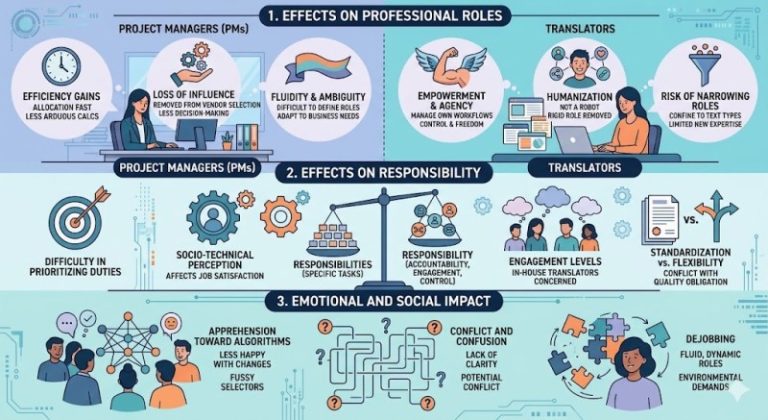
The study identifies a shift from “responsibilities” (specific tasks and duties) to a broader sense of “responsibility” (moral obligation and accountability).
Impact on Roles: Automation can both enhance and restrict professional autonomy.
Project Managers: Experienced difficulty in reaching a consensus on their main duties due to the fluid nature of their roles.
Translators: In-house translators showed a higher level of engagement with the concept of professional responsibility compared to other groups.
Conclusion
The findings suggest that while technology increases efficiency, it must be implemented with a focus on human factors to ensure job satisfaction and maintain professional standards. Successful automation requires clear communication and the inclusion of human insights in technical development.
References
- Abdallah, K. (2012). Translators in Production Networks. Reflections on Agency, Quality and Ethics. University of Eastern Finland.
- Azmi, F. T. (2007). Job Descriptions to Job Fluidity: Treading the Dejobbing Path. EBS Review 23, 86–98.
- Dam, H. V., & Zethsen, K. K. (2009). Translation Studies: Focus on the Translator. Hermes 42(1), 7–12.
- Dessler, G. (2004). Human Resource Management. 9th ed. Pearson Education.
- do Carmo, F. (2020). “Time Is Money” and the Value of Translation. Translation Spaces 9(1), 35–57.
- Docherty, P., Kira, M., & Shani, A. B. (R.) (2008). What the World Needs Now is Sustainable Work Systems. Routledge.
- Drugan, J. (2013). Quality in Professional Translation: Assessment and Improvement. Bloomsbury.
- Drugan, J. (2017). Ethics and Social Responsibility in Practice. The Translator 23(2), 126–142.
- Drugan, J., & Tipton, R. (2017). Translation, Ethics and Social Responsibility. The Translator 23(2), 119–125.
- Folaron, D. (2010). Translation Tools. Handbook of Translation Studies. John Benjamins, 429–436.
- Gan, M., & Kleiner, B. H. (2005). How to Write Job Descriptions Effectively. Management Research News 28(8), 48–54.
- Garcia, I. (2009). Beyond Translation Memory: Computers and the Professional Translator. JoSTrans 12(12), 199–214.
- Garcia, I. (2015). Cloud marketplaces: Procurement of translators in the age of social media. JoSTrans 23, 18–38.
- Gough, J. et al. (2023). Concurrent Translation on Collaborative Platforms. Translation Spaces.
- Kenny, D., Moorkens, J., & do Carmo, F. (2020). Fair MT: Towards Ethical, Sustainable Machine Translation. Translation Spaces 9(1), 1–11.
- Koskinen, K., & Ruokonen, M. (2017). Love Letters or Hate Mail? Translators’ Technology Acceptance. Routledge.
- Kuznik, A., & Verd, J. M. (2010). Investigating Real Work Situations in Translation Agencies. Hermes 44, 25–43.
- Lazar, J., Feng, J. H., & Hochheiser, H. (2017). Research Methods in Human-Computer Interaction. Morgan Kaufmann.
- LeBlanc, M. (2013). Translators on Translation Memory (TM). Translation & Interpreting 5(2), 1–13.
- LeBlanc, M. (2017). ‘I Can’t Get No Satisfaction!’ Should We Blame Translation Technologies? Routledge.
- Matthews, B., & Ross, L. (2010). Research Methods: A Practical Guide for the Social Sciences. Pearson Education.
- Moorkens, J. (2020). ‘A Tiny Cog in a Large Machine’: Digital Taylorism in the Translation Industry. Translation Spaces 9(1), 12–34.
- Mossop, B. (2006). Has Computerization Changed Translation? Meta 51(4), 787–805.
- Müller, H., Sedley, A., & Ferrall-Nunge, E. (2014). Survey Research in HCI. Springer, 229–266.
- O’Brien, S. (2012). Translation as Human-Computer Interaction. Translation Spaces 1(1), 101–122.
- Olohan, M. (2011). Translators and Translation Technology: The Dance of Agency. Translation Studies 4(3), 342–357.
- Olohan, M., & Davitti, E. (2017). Dynamics of Trusting in Translation Project Management. Journal of Contemporary Ethnography 46(4), 391–416.
- Risku, H., Milošević, J., & Rogl, R. (2021). Responsibility, Powerlessness and Conflict. John Benjamins, 145–168.
- Risku, H., Pein-Weber, C., & Milošević, J. (2016). ‘The Task of the Translator’. International Journal of Communication 10, 989–1008.
- Rodríguez-Castro, M. (2016). Intrinsic and Extrinsic Sources of Translator Satisfaction. Entreculturas 7–8, 195–229.
- Sakamoto, A. (2018). Disruption in Translator-Client Matching. Revista Tradumàtica 16, 85–94.
- Sakamoto, A. (2019). Unintended Consequences of Translation Technologies. Perspectives 27(1), 58–73.
- Sakamoto, A., & Yamada, M. (2020). Social Groups in Machine Translation Post-Editing. Translation Spaces 9(1) 78–97.
- Saldanha, G., & O’Brien, S. (2014). Research Methodologies in Translation Studies. Routledge.
- Stahl, B. C., Timmermans, J., & Flick, C. (2017). Ethics of Emerging Information and Communication Technologies. Science and Public Policy 44(3), 369–381.
- Wilkinson, S. (2008). Focus groups. Wiley, 344–376.
- Collins Dictionary (n.d.). “Responsibility” Definition and Meaning.
- DePalma, D. A. (2017). Augmented Translation Powers up Language Services.
For professional services, please visit: https://www.seaproti.org/practitioners/
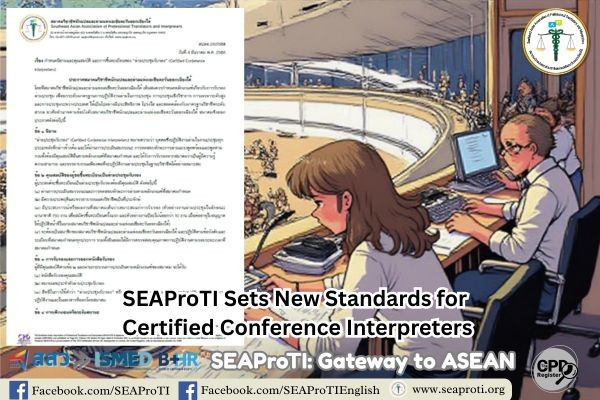
About certified translators, translation certifiers, and certified interpreters associated with SEAProTI. The Southeast Asian Association of Professional Translators and Interpreters (SEAProTI) has officially shared the qualifications and requirements for becoming Certified Translators, Translation Certification Providers, and Certified Interpreters in Sections 9 and 10 of the Royal Gazette, which was published by the Prime Minister’s Office in Thailand on July 25, 2024. Certified Translators, Translation Certification Providers, and Certified Interpreters
The Council of State has proposed the enactment of a Royal Decree, granting registered translators and recognised translation certifiers from professional associations or accredited language institutions the authority to provide legally valid translation certification (Letter to SEAProTI dated April 28, 2025)
SEAProTI is the first professional association in Thailand and Southeast Asia to implement a comprehensive certification system for translators, certifiers, and interpreters.
Head Office: Baan Ratchakru Building, No. 33, Room 402, Soi Phahonyothin 5, Phahonyothin Road, Phaya Thai District, Bangkok 10400, Thailand
Email: hello@seaproti.com | Tel.: (+66) 2-114-3128 (Office hours: Mon–Fri, 09:00–17:00).
จาก “ความรับผิดชอบในหน้าที่” สู่ “ความสำนึกในความรับผิดชอบ”: การศึกษาผลกระทบของการนำระบบอัตโนมัติมาใช้ในกระบวนการทำงานแปล
ผู้เขียน: เภตรา โบรด
11 พฤษภาคม 2569, กรุงเทพมหานคร – บทความนี้ศึกษาผลกระทบของการนำระบบจัดสรรงานอัตโนมัติมาใช้ในบริษัทแปล โดยวิเคราะห์ผ่านการสำรวจความคิดเห็นของผู้จัดการโครงการและนักแปล เพื่อทำความเข้าใจว่าระบบอัตโนมัติส่งผลต่อบทบาททางวิชาชีพ ความรับผิดชอบ และความพึงพอใจในการทำงานในอุตสาหกรรมการแปลยุคใหม่อย่างไร
บทนำ
พัฒนาการทางเทคโนโลยีได้ปรับเปลี่ยนอุตสาหกรรมการแปลไปอย่างมาก โดยส่งผลกระทบต่อทั้งสถานที่ทำงานและลักษณะของงานที่ทำ แม้ว่าการนำระบบอัตโนมัติมาใช้มักมีแรงผลักดันจากความต้องการเพิ่มผลผลิต แต่การเปลี่ยนแปลงนี้เป็นเรื่องเชิงสังคม-เทคนิคที่ส่งผลต่อปัจจัยด้านมนุษย์ในกระบวนการทำงานด้วย
ระเบียบวิธีวิจัย
กรณีศึกษานี้ศึกษาบริษัทแปลขนาดกลางที่กำลังพัฒนาระบบจัดสรรงาน (Job Allocation System – JAS) โดยใช้แบบสอบถามออนไลน์เก็บข้อมูลจากผู้เข้าร่วม 38 คน ประกอบด้วยผู้จัดการโครงการ นักแปลประจำ และนักแปลอิสระ เพื่อรวบรวมทัศนคติที่มีต่อการเปลี่ยนแปลงจากกระบวนการทำงานแบบเดิมไปสู่ระบบอัตโนมัติ
ผลการศึกษาและการวิเคราะห์
ผลการวิจัยชี้ให้เห็นถึงความแตกต่างระหว่าง “Responsibilities” (หน้าที่และภารกิจตามนิยามงาน) และ “Responsibility” (พันธกิจทางศีลธรรมและความสำนึกในความรับผิดชอบ)
ผลต่อบทบาท: ระบบอัตโนมัติสามารถทั้งส่งเสริมและจำกัดความเป็นอิสระในการทำงาน
ผู้จัดการโครงการ: มีความเห็นที่แตกต่างกันอย่างมากเกี่ยวกับหน้าที่หลักของตนเอง เนื่องจากลักษณะงานที่มีความลื่นไหลสูง
นักแปล: กลุ่มนักแปลประจำบริษัทเป็นกลุ่มที่ให้ความสำคัญและเอ่ยถึงแนวคิดเรื่องความสำนึกในความรับผิดชอบทางวิชาชีพมากที่สุด
บทสรุป
งานวิจัยสรุปว่าแม้เทคโนโลยีจะช่วยเพิ่มประสิทธิภาพ แต่การนำมาใช้ต้องคำนึงถึงปัจจัยด้านมนุษย์เพื่อรักษาความพึงพอใจในงานและมาตรฐานวิชาชีพ การนำระบบอัตโนมัติมาใช้ให้ประสบความสำเร็จจำเป็นต้องมีการสื่อสารที่ชัดเจนและการให้ผู้ใช้มีส่วนร่วมในการพัฒนา
เอกสารอ้างอิง
- อับดัลเลาะห์, เค. (2012). Translators in Production Networks. Reflections on Agency, Quality and Ethics. University of Eastern Finland.
- อัซมี, เอฟ. ที. (2007). Job Descriptions to Job Fluidity: Treading the Dejobbing Path. EBS Review 23, 86–98.
- แดม, เอช. วี., และ เซธเซน, เค. เค. (2009). Translation Studies: Focus on the Translator. Hermes 42(1), 7–12.
- เดสเลอร์, จี. (2004). Human Resource Management. 9th ed. Pearson Education.
- ดู การ์โม, เอฟ. (2020). “Time Is Money” and the Value of Translation. Translation Spaces 9(1), 35–57.
- โดเชอร์ตี้, พี., คิระ, เอ็ม., และ ชานี่, เอ. บี. (อาร์.) (2008). What the World Needs Now is Sustainable Work Systems. Routledge.
- ดรูแกน, เจ. (2013). Quality in Professional Translation: Assessment and Improvement. Bloomsbury.
- ดรูแกน, เจ. (2017). Ethics and Social Responsibility in Practice. The Translator 23(2), 126–142.
- ดรูแกน, เจ., และ ทิปตัน, อาร์. (2017). Translation, Ethics and Social Responsibility. The Translator 23(2), 119–125.
- โฟลารอน, ดี. (2010). Translation Tools. Handbook of Translation Studies. John Benjamins, 429–436.
- กัน, เอ็ม., และ ไคลเนอร์, บี. เอช. (2005). How to Write Job Descriptions Effectively. Management Research News 28(8), 48–54.
- การ์เซีย, ไอ. (2009). Beyond Translation Memory: Computers and the Professional Translator. JoSTrans 12(12), 199–214.
- การ์เซีย, ไอ. (2015). Cloud marketplaces: Procurement of translators in the age of social media. JoSTrans 23, 18–38.
- กัฟ, เจ. และคณะ (2023). Concurrent Translation on Collaborative Platforms. Translation Spaces.
- เคนนี่, ดี., มอร์เคนส์, เจ., และ ดู การ์โม, เอฟ. (2020). Fair MT: Towards Ethical, Sustainable Machine Translation. Translation Spaces 9(1), 1–11.
- คอสคิเนน, เค., และ รูโอโกเนน, เอ็ม. (2017). Love Letters or Hate Mail? Translators’ Technology Acceptance. Routledge.
- คุซนิค, เอ., และ แวร์ด, เจ. เอ็ม. (2010). Investigating Real Work Situations in Translation Agencies. Hermes 44, 25–43.
- ลาซาร์, เจ., เฟิง, เจ. เอช., และ ฮอคไฮเซอร์, เอช. (2017). Research Methods in Human-Computer Interaction. Morgan Kaufmann.
- เลอบลองก์, เอ็ม. (2013). Translators on Translation Memory (TM). Translation & Interpreting 5(2), 1–13.
- เลอบลองก์, เอ็ม. (2017). ‘I Can’t Get No Satisfaction!’ Should We Blame Translation Technologies? Routledge.
- แมทธิวส์, บี., และ รอสส์, แอล. (2010). Research Methods: A Practical Guide for the Social Sciences. Pearson Education.
- มอร์เคนส์, เจ. (2020). ‘A Tiny Cog in a Large Machine’: Digital Taylorism in the Translation Industry. Translation Spaces 9(1), 12–34.
- มอสซอป, บี. (2006). Has Computerization Changed Translation? Meta 51(4), 787–805.
- มุลเลอร์, เอช., เซดลีย์, เอ., และ เฟอร์รัลล์-นันจ์, อี. (2014). Survey Research in HCI. Springer, 229–266.
- โอไบรอัน, เอส. (2012). Translation as Human-Computer Interaction. Translation Spaces 1(1), 101–122.
- โอโลแฮน, เอ็ม. (2011). Translators and Translation Technology: The Dance of Agency. Translation Studies 4(3), 342–357.
- โอโลแฮน, เอ็ม., และ ดาวิตติ, อี. (2017). Dynamics of Trusting in Translation Project Management. Journal of Contemporary Ethnography 46(4), 391–416.
- ริสกู, เอช., มิโลเซวิช, เจ., และ โรเกิล, อาร์. (2021). Responsibility, Powerlessness and Conflict. John Benjamins, 145–168.
- ริสกู, เอช., ไพน์-เวเบอร์, ซี., และ มิโลเซวิช, เจ. (2016). ‘The Task of the Translator’. International Journal of Communication 10, 989–1008.
- โรดริเกซ-กาสโตร, เอ็ม. (2016). Intrinsic and Extrinsic Sources of Translator Satisfaction. Entreculturas 7–8, 195–229.
- ซากาโมโตะ, เอ. (2018). Disruption in Translator-Client Matching. Revista Tradumàtica 16, 85–94.
- ซากาโมโตะ, เอ. (2019). Unintended Consequences of Translation Technologies. Perspectives 27(1), 58–73.
- ซากาโมโตะ, เอ., และ ยามาดะ, เอ็ม. (2020). Social Groups in Machine Translation Post-Editing. Translation Spaces 9(1) 78–97.
- ซัลดันญา, จี., และ โอไบรอัน, เอส. (2014). Research Methodologies in Translation Studies. Routledge.
- สตาห์ล, บี. ซี., ทิมเมอร์แมนส์, เจ., และ ฟลิก, ซี. (2017). Ethics of Emerging Information and Communication Technologies. Science and Public Policy 44(3), 369–381.
- วิลกินสัน, เอส. (2008). Focus groups. Wiley, 344–376.
- พจนานุกรมคอลลินส์ (n.d.). “Responsibility” Definition and Meaning.
- เดอพัลมา, ดี. เอ. (2017). Augmented Translation Powers up Language Services.
ขอใช้บริการนักวิชาชีพของสมาคมได้ที่:https://www.seaproti.org/practitioners/สมาคมวิชาชีพนักแปลและล่ามแห่งเอเชียตะวันออกเฉียงใต้ (SEAProTI) ได้ประกาศหลักเกณฑ์และคุณสมบัติของผู้ที่ขึ้นทะเบียนเป็น “นักแปลรับรอง (Certified Translators) และผู้รับรองการแปล (Translation Certification Providers) และล่ามรับรอง (Certified Interpreters)” ของสมาคม หมวดที่ 9 และหมวดที่ 10 ในราชกิจจานุเบกษา ของสำนักเลขาธิการคณะรัฐมนตรี ในสำนักนายกรัฐมนตรี แห่งราชอาณาจักรไทย ลงวันที่ 25 ก.ค. 2567 เล่มที่ 141 ตอนที่ 66 ง หน้า 100 อ่านฉบับเต็มได้ที่: นักแปลรับรอง ผู้รับรองการแปล และล่ามรับรอง
สำนักคณะกรรมการกฤษฎีกาเสนอให้ตราเป็นพระราชกฤษฎีกา โดยกำหนดให้นักแปลที่ขึ้นทะเบียน รวมถึงผู้รับรองการแปลจากสมาคมวิชาชีพหรือสถาบันสอนภาษาที่มีการอบรมและขึ้นทะเบียน สามารถรับรองคำแปลได้ (จดหมายถึงสมาคม SEAProTI ลงวันที่ 28 เม.ย. 2568)
สมาคมวิชาชีพนักแปลและล่ามแห่งเอเชียตะวันออกเฉียงใต้เป็นสมาคมวิชาชีพแห่งแรกและแห่งเดียวในประเทศไทยและภูมิภาคเอเชียตะวันออกเฉียงใต้ที่มีระบบรับรองนักแปลรับรอง ผู้รับรองการแปล และล่ามรับรอง
สำนักงานใหญ่: อาคารบ้านราชครู เลขที่ 33 ห้อง 402 ซอยพหลโยธิน 5 ถนนพหลโยธิน แขวงพญาไท เขตพญาไท กรุงเทพมหานคร 10400 ประเทศไทย