



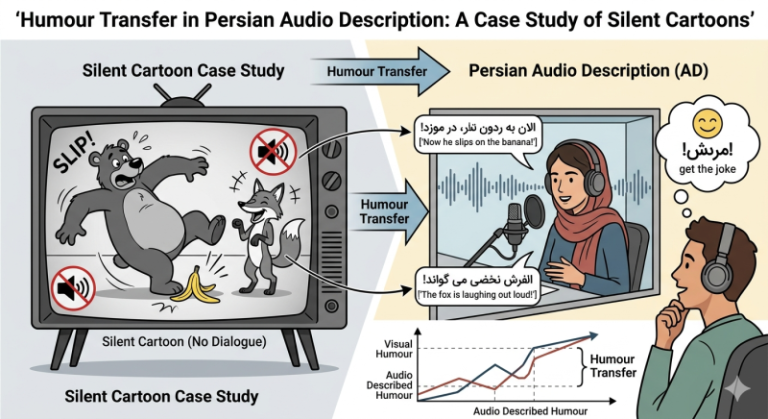
Humour Transfer through Persian Audio Description: A Case Study of the Silent Cartoons Shaun the Sheep, Road Runner, and The Pink Panther
Author: Griroek Gruaythong
6 May 2026, Bangkok – In contemporary society, concepts such as human rights, equality, participation, and media accessibility have become major global concerns. The Universal Declaration of Human Rights of the United Nations explicitly states that everyone has the right to participate in cultural life and to enjoy the arts and scientific advancement (United Nations, 1948). Within this context, access to audiovisual media is not merely a technological issue, but also a matter of rights and social equality (Greco, 2022).
Audio Description (AD) is a media accessibility service designed to help blind and visually impaired audiences perceive visual content in films, television programs, live performances, and other audiovisual products through verbal narration (Mazur, 2020; Perego, 2024). Over the last two decades, AD has evolved from an accessibility practice into a specialized research field within audiovisual translation (AVT), while also becoming a growing professional and economic industry (Taylor & Perego, 2022).
Although numerous studies have explored character description, emotions, facial expressions, children’s programming, culture-specific elements, and linguistic taboos in AD (Benecke, 2014; Jankowska, 2022; López, 2010; Sanz-Moreno, 2018), the issue of “humour” has received comparatively limited scholarly attention, particularly in the context of Persian-language AD and silent animation. Previous research has mostly focused on humour transfer in films or television series containing dialogue (Dore, 2020; Martínez-Sierra, 2009, 2013, 2021).
Humour constitutes a crucial component of human communication and social interaction (Kostopoulou & Misiou, 2024). Consequently, humour translation is not merely a process of transferring meaning, but also of recreating an emotional effect that resembles that of the source text as closely as possible (Bucaria, 2017; Yus, 2016). In audiovisual media, this complexity increases further because humour often emerges from the interaction of images, sounds, music, timing, and spoken language (Chaume, 2020; Dore, 2020).
Within the context of AD, describers must compensate for visually impaired viewers’ lack of access to visual information by selecting and verbalizing elements that are essential to the comic effect (Martínez-Sierra, 2021). If visual elements responsible for generating humour are omitted from the description, visually impaired audiences may lose part of the emotional experience available to sighted viewers (Starr & Braun, 2021).
This article therefore investigates the strategies employed by Iranian audio describers to transfer humour in Persian AD versions of English-language silent animations, particularly in contexts where storytelling relies almost entirely on visual elements rather than dialogue.
Literature Review
1. Audio Description and Humour Transfer
Humour translation is widely considered one of the most complex tasks in translation because it depends heavily on language, culture, context, and the audience’s shared knowledge (Chiaro, 2017; Kostopoulou & Misiou, 2024). In audiovisual translation, this challenge becomes even more intricate, since meaning and humour frequently emerge through the interaction of multiple semiotic systems, including image, sound, music, and language (Chaume, 2020).
Martínez-Sierra (2009, 2013, 2021) was among the first scholars to examine humour transfer in AD. He argues that omitting certain visual elements may diminish the comic impact for visually impaired audiences. However, he also introduces the concept of the “composite nature of humour,” suggesting that humour may still be perceived even when some elements are lost, provided that other humorous components remain accessible.
Similarly, Dore (2020), in her analysis of English and Italian AD for comedy films, found that detailed descriptions of facial expressions, gestures, and emotions significantly contribute to preserving comic effects, especially in scenes based on visual humour.
2. Audio Description in Silent Films and Silent Animation
Audio description in silent films differs substantially from AD in films containing dialogue. In conventional films, dialogue serves as a primary source of information that helps audiences understand the narrative (Vercauteren & Remael, 2022). In silent films, however, audio describers are required to convey nearly all aspects of the story, emotions, and character relationships.
Stevens and Claire (2014) note that AD for silent films resembles “continuous storytelling” rather than the insertion of brief descriptions between dialogues. Moreover, silent animation frequently relies on rapid visual pacing, sound effects, and physical comedy, requiring describers to select information with particular care.
Methodology
This study adopts a qualitative and multimodal analytical approach. Three silent animated series were selected: Shaun the Sheep, Road Runner, and The Pink Panther, all of which have Persian AD versions produced by Iranian media accessibility organizations, namely Sevina and Mahale Nabinayan.
The three researchers collaboratively selected six humorous scenes from the three animations based on the prominence of visual humour. The scenes were then analyzed according to Martínez-Sierra’s (2021) framework, which categorizes humorous elements into eight types: community-and-institution references, community sense of humour, linguistic elements, paralinguistic elements, visual elements, graphic elements, sound elements, and non-marked humorous elements.
Findings and Discussion
The findings indicate that Persian audio describers were able to preserve the humour of the source texts to a certain extent, even though some humorous elements were inevitably lost during the AD process. This was particularly evident in scenes where humour emerged from the interaction of multiple elements such as visuals, sounds, and movement timing.
Nevertheless, the study identified several significant limitations. First, time constraints in AD insertion forced describers to prioritize only the most essential elements, resulting in the loss of certain humorous details. Second, graphic information and on-screen onomatopoeic expressions such as “beep” or “snap,” which often play an important role in animated comedy, proved difficult to render effectively in Persian AD.
In addition, the researchers observed a tendency toward “subjectivity” in Persian AD practices. Some describers introduced personal interpretations, humorous tones, laughter, or even voiced characters’ implied emotions. Although traditional AD guidelines generally emphasize neutrality and objectivity (Colmenero, 2024), such interpretative and performative strategies may contribute to a more engaging viewing experience for visually impaired audiences in the context of silent animation (Fryer, 2016).
Another important issue concerns the absence of official AD guidelines in Iran. As a result, describers tend to adopt varying approaches based on individual experience and personal judgment (Khoshsaligheh & Shafiee, 2021).
Conclusion
This study demonstrates that humour transfer through Persian AD in silent animation is a highly complex process that requires continuous interpretative decision-making. Although certain humorous elements are inevitably lost due to time limitations and the unique characteristics of the medium, audio describers can still preserve comic effects by carefully selecting key elements and employing emotionally expressive narration.
The findings highlight the need for the development of formal Persian AD guidelines, as well as the importance of future audience reception studies involving visually impaired viewers. Furthermore, the study suggests additional research on the roles of timing, sound, effects, and describer subjectivity in constructing humorous experiences through accessible media.
References
- Antonini, R. (2005). The perception of subtitled humor in Italy. HUMOR: International Journal of Humour Research, 18(2), 209–225. https://doi.org/10.1515/humr.2005.18.2.209
- Benecke, B. (2014). Character fixation and character description. In A. Maszerowska, A. Matamala, & P. Orero (Eds.), Audio description: New perspectives illustrated (pp. 142–157). John Benjamins.
- Braun, S., & Starr, K. (2021). Introduction: Mapping new horizons in audio description research. In S. Braun & K. Starr (Eds.), Innovation in audio description research (pp. 1–12). Routledge.
- Bucaria, C. (2017). Audiovisual translation of humor. In S. Attardo (Ed.), The Routledge handbook of language and humor (pp. 430–443). Routledge.
- Chaume, F. (2020). Dubbing. In Ł. Bogucki & M. Deckert (Eds.), The Palgrave handbook of audiovisual translation and media accessibility (pp. 103–132). Palgrave Macmillan.
- Chiaro, D. (2017). Humor and translation. In S. Attardo (Ed.), The Routledge handbook of language and humor (pp. 414–429). Routledge.
- Colmenero, M. A. L. (2024). Subjectivity and creativity versus audio description guidelines. In A. Marcus-Quinn, K. Krejtz, & C. Duarte (Eds.), Transforming media accessibility in Europe (pp. 39–52). Springer Nature.
- Dore, M. (2020). Humour in audiovisual translation: Theories and applications. Routledge.
- Fryer, L. (2016). An introduction to audio description: A practical guide. Routledge.
- Greco, G. M. (2022). The question of accessibility. In C. Taylor & E. Perego (Eds.), The Routledge handbook of audio description (pp. 13–26). Routledge.
- Khoshsaligheh, M., & Shafiee, S. (2021). Audio description in Iran: The status quo. Language and Translation Studies, 54(2), 1–30. https://doi.org/10.22067/lts.v54i2.2101-1006(R2)
- Kostopoulou, L., & Misiou, V. (2024). Introduction: The transmedial turn in humour translation. In L. Kostopoulou & V. Misiou (Eds.), Transmedial perspectives on humour and translation (pp. 1–12). Routledge.
- Martínez-Sierra, J. J. (2021). Audio describing humour: Seeking laughter when images do not suffice. In M. Dore (Ed.), Humour translation in the age of multimedia (pp. 177–195). Routledge.
- Mazur, I. (2020). Audio description: Concepts, theories and research approaches. In Ł. Bogucki & M. Deckert (Eds.), The Palgrave handbook of audiovisual translation and media accessibility (pp. 227–247). Palgrave Macmillan.
- Perego, E. (2024). Audio description for the arts: A linguistic perspective. Routledge.
- Stevens, N., & Claire, J. (2014). The challenges of audio describing silent films.
- Taylor, C., & Perego, E. (2022). Introduction. In C. Taylor & E. Perego (Eds.), The Routledge handbook of audio description (pp. 1–10). Routledge.
- United Nations. (1948). Universal Declaration of Human Rights.
- Vercauteren, G., & Remael, N. (2022). Audio describing sound–what sounds are described and how? Journal of Audiovisual Translation, 5(2), 114–133.
- Yus, F. (2016). Humour and relevance. John Benjamins.
For professional services, please visit: https://www.seaproti.org/practitioners/
About certified translators, translation certifiers, and certified interpreters associated with SEAProTI. The Southeast Asian Association of Professional Translators and Interpreters (SEAProTI) has officially shared the qualifications and requirements for becoming Certified Translators, Translation Certification Providers, and Certified Interpreters in Sections 9 and 10 of the Royal Gazette, which was published by the Prime Minister’s Office in Thailand on July 25, 2024. Certified Translators, Translation Certification Providers, and Certified Interpreters
The Council of State has proposed the enactment of a Royal Decree, granting registered translators and recognised translation certifiers from professional associations or accredited language institutions the authority to provide legally valid translation certification (Letter to SEAProTI dated April 28, 2025)
SEAProTI is the first professional association in Thailand and Southeast Asia to implement a comprehensive certification system for translators, certifiers, and interpreters.
Head Office: Baan Ratchakru Building, No. 33, Room 402, Soi Phahonyothin 5, Phahonyothin Road, Phaya Thai District, Bangkok 10400, Thailand
การถ่ายทอดอารมณ์ขันผ่านเสียงบรรยายภาษาเปอร์เซีย: กรณีศึกษาการ์ตูนเงียบเรื่อง Shaun the Sheep, Road Runner และ The Pink Panther
ผู้เขียน: ไกรฤกษ์ กรวยทอง
6 เมษายน 2569, กรุงเทพมหานคร – ในสังคมร่วมสมัย แนวคิดเรื่องสิทธิมนุษยชน ความเท่าเทียม การมีส่วนร่วม และการเข้าถึงสื่อกลายเป็นประเด็นสำคัญระดับสากล ปฏิญญาสากลว่าด้วยสิทธิมนุษยชนขององค์การสหประชาชาติระบุไว้อย่างชัดเจนว่า ทุกคนมีสิทธิในการมีส่วนร่วมในชีวิตทางวัฒนธรรมและการเข้าถึงศิลปะและความก้าวหน้าทางวิทยาศาสตร์ (ยูไนเต็ดเนชันส์, 2491) ภายใต้บริบทดังกล่าว การเข้าถึงสื่อโสตทัศน์จึงไม่ใช่เพียงประเด็นด้านเทคโนโลยี หากแต่เป็นประเด็นด้านสิทธิและความเสมอภาคทางสังคม (เกรโก, 2565)
การบรรยายเสียง หรือ Audio Description (AD) เป็นบริการด้านการเข้าถึงสื่อที่ออกแบบมาเพื่อช่วยผู้พิการทางการมองเห็นหรือผู้มีสายตาเลือนรางให้สามารถรับรู้เนื้อหาภาพในภาพยนตร์ รายการโทรทัศน์ การแสดงสด และสื่อโสตทัศน์ประเภทต่าง ๆ ผ่านคำบรรยายด้วยเสียง (มาซูร์, 2563; เปเรโก, 2567) ในช่วงสองทศวรรษที่ผ่านมา AD ได้พัฒนาจากแนวปฏิบัติด้านการเข้าถึงสื่อไปสู่สาขาการวิจัยเฉพาะทางภายใต้การแปลโสตทัศน์ (audiovisual translation: AVT) และกลายเป็นอุตสาหกรรมที่มีมูลค่าทางเศรษฐกิจและวิชาชีพเพิ่มขึ้นอย่างต่อเนื่อง (เทย์เลอร์ และ เปเรโก, 2565)
แม้งานวิจัยจำนวนมากจะศึกษาการบรรยายลักษณะตัวละคร อารมณ์ สีหน้า รายการสำหรับเด็ก วัฒนธรรมเฉพาะ และข้อห้ามทางภาษาในการทำ AD (เบอเนคเคอ, 2557; ยังคอฟสกา, 2565; โลเปซ, 2553; ซานซ์-โมเรโน, 2561) แต่ประเด็นเรื่อง “อารมณ์ขัน” ยังคงได้รับความสนใจค่อนข้างจำกัด โดยเฉพาะในบริบทของภาษาเปอร์เซียและแอนิเมชันเงียบ งานวิจัยก่อนหน้าส่วนใหญ่มุ่งเน้นการถ่ายทอดอารมณ์ขันในภาพยนตร์หรือซีรีส์ที่มีบทสนทนา (โดเร, 2563; มาร์ติเนซ-เซียร์รา, 2552, 2553, 2564)
อารมณ์ขันถือเป็นองค์ประกอบสำคัญของการสื่อสารมนุษย์และการปฏิสัมพันธ์ทางสังคม (คอสโตปูลู และ มิซิอู, 2567) การแปลอารมณ์ขันจึงมิได้เป็นเพียงการถ่ายทอดข้อความ หากแต่เป็นกระบวนการสร้างผลกระทบเชิงอารมณ์ให้ใกล้เคียงกับต้นฉบับมากที่สุด (บูคาเรีย, 2560; ยูส, 2559) สำหรับสื่อโสตทัศน์ ความซับซ้อนยิ่งเพิ่มขึ้น เนื่องจากอารมณ์ขันเกิดจากการทำงานร่วมกันขององค์ประกอบภาพ เสียง ดนตรี จังหวะ และภาษาพูด (เชาเม, 2563; โดเร, 2563)
ในบริบทของ AD ผู้บรรยายเสียงจำเป็นต้องชดเชยการขาดการเข้าถึงข้อมูลภาพของผู้ชมด้วยการเลือกบรรยายองค์ประกอบที่สำคัญต่อผลลัพธ์เชิงตลก (มาร์ติเนซ-เซียร์รา, 2564) หากองค์ประกอบภาพที่ก่อให้เกิดอารมณ์ขันไม่ได้รับการบรรยาย ผู้ชมที่มีความบกพร่องทางการมองเห็นอาจสูญเสียประสบการณ์ทางอารมณ์ที่ผู้ชมทั่วไปได้รับ (สตาร์ และ เบราน์, 2564)
บทความนี้จึงมุ่งศึกษาวิธีการที่นักบรรยายเสียงชาวอิหร่านใช้ในการถ่ายทอดอารมณ์ขันใน AD ภาษาเปอร์เซียของแอนิเมชันเงียบภาษาอังกฤษ โดยเฉพาะในบริบทที่ไม่มีบทสนทนาและต้องอาศัยองค์ประกอบภาพเป็นแกนหลักของการเล่าเรื่อง
ทบทวนวรรณกรรม
1. การบรรยายเสียงและการถ่ายทอดอารมณ์ขัน
การแปลอารมณ์ขันเป็นหนึ่งในภารกิจที่ซับซ้อนที่สุดของการแปล เนื่องจากอาศัยปัจจัยด้านภาษา วัฒนธรรม บริบท และการรับรู้ร่วมกันของผู้ชม (เคียโร, 2560; คอสโตปูลู และ มิซิอู, 2567) ในการแปลสื่อโสตทัศน์ ความท้าทายดังกล่าวยิ่งทวีความซับซ้อน เพราะความหมายและอารมณ์ขันมักเกิดจากการทำงานร่วมกันขององค์ประกอบหลายระบบ ทั้งภาพ เสียง ดนตรี และภาษา (เชาเม, 2563)
มาร์ติเนซ-เซียร์รา (2552, 2553, 2564) เป็นหนึ่งในนักวิชาการกลุ่มแรกที่ศึกษาการถ่ายทอดอารมณ์ขันผ่าน AD โดยเสนอว่า การละเว้นองค์ประกอบภาพบางประการอาจลดทอนผลกระทบเชิงตลกต่อผู้ชมที่มีความบกพร่องทางการมองเห็น อย่างไรก็ตาม เขายังเสนอแนวคิดเรื่อง “ลักษณะเชิงผสมผสานของมุกตลก” ซึ่งชี้ว่า แม้องค์ประกอบบางส่วนจะหายไป แต่อารมณ์ขันอาจยังคงถูกรับรู้ได้จากองค์ประกอบอื่นที่ยังคงอยู่
ในทำนองเดียวกัน โดเร (2563) วิเคราะห์ AD ภาษาอังกฤษและภาษาอิตาลีของภาพยนตร์ตลก และพบว่าความละเอียดในการบรรยายสีหน้า ท่าทาง และอารมณ์ของตัวละครส่งผลอย่างมากต่อการรักษาผลกระทบเชิงตลก โดยเฉพาะในฉากที่อาศัยอารมณ์ขันเชิงภาพ
2. การบรรยายเสียงในภาพยนตร์และแอนิเมชันเงียบ
การบรรยายเสียงในภาพยนตร์เงียบมีความแตกต่างจากภาพยนตร์ที่มีบทสนทนาอย่างชัดเจน ในภาพยนตร์ทั่วไป บทสนทนาทำหน้าที่เป็นแหล่งข้อมูลหลักที่ช่วยให้ผู้ชมเข้าใจเรื่องราว (แวร์เคาเทอเริน และ เรอวีแยร์ส, 2565) แต่ในภาพยนตร์เงียบ ผู้บรรยายเสียงต้องรับหน้าที่แทบทั้งหมดในการถ่ายทอดเนื้อเรื่อง อารมณ์ และความสัมพันธ์ของตัวละคร
สตีเวนส์ และ แคลร์ (2557) ชี้ว่า การทำ AD สำหรับภาพยนตร์เงียบมีลักษณะคล้าย “การเล่าเรื่องตลอดทั้งเรื่อง” มากกว่าการแทรกคำอธิบายสั้น ๆ ระหว่างบทสนทนา นอกจากนี้ แอนิเมชันเงียบยังมักใช้จังหวะภาพที่รวดเร็ว เสียงเอฟเฟกต์ และมุกตลกเชิงกายภาพ (physical comedy) ทำให้ผู้บรรยายเสียงต้องเลือกข้อมูลอย่างระมัดระวัง
ระเบียบวิธีวิจัย
การศึกษานี้ใช้แนวทางเชิงคุณภาพและการวิเคราะห์พหุสัญศาสตร์ (multimodal analysis) โดยเลือกแอนิเมชันเงียบสามเรื่อง ได้แก่ Shaun the Sheep, Road Runner และ The Pink Panther ซึ่งมีฉบับ AD ภาษาเปอร์เซียผลิตโดยองค์กรด้านการเข้าถึงสื่อในอิหร่าน ได้แก่ Sevina และ Mahale Nabinayan
ผู้วิจัยทั้งสามร่วมกันคัดเลือกฉากตลกจำนวนหกฉากจากทั้งสามเรื่อง โดยพิจารณาจากความเด่นชัดของอารมณ์ขันเชิงภาพ จากนั้นจึงวิเคราะห์องค์ประกอบเชิงตลกตามกรอบของ มาร์ติเนซ-เซียร์รา (2564) ซึ่งแบ่งองค์ประกอบอารมณ์ขันออกเป็นแปดประเภท ได้แก่ องค์ประกอบอ้างอิง องค์ประกอบความนิยม องค์ประกอบทางภาษา องค์ประกอบพาราภาษา องค์ประกอบภาพ องค์ประกอบกราฟิก องค์ประกอบเสียง และองค์ประกอบเชิงตลกที่ไม่สามารถจัดหมวดหมู่ได้
ผลการศึกษาและอภิปรายผล
ผลการศึกษาพบว่า นักบรรยายเสียงภาษาเปอร์เซียสามารถรักษาอารมณ์ขันของต้นฉบับไว้ได้ในระดับหนึ่ง แม้องค์ประกอบบางส่วนจะสูญหายระหว่างการบรรยายเสียงก็ตาม โดยเฉพาะในกรณีที่อารมณ์ขันเกิดจากหลายองค์ประกอบทำงานร่วมกัน เช่น ภาพ เสียง และจังหวะการเคลื่อนไหว
อย่างไรก็ตาม งานวิจัยพบข้อจำกัดสำคัญหลายประการ ประการแรก คือ ข้อจำกัดด้านเวลาในการแทรกคำบรรยาย ทำให้ผู้บรรยายเสียงต้องเลือกเพียงองค์ประกอบที่สำคัญที่สุด ส่งผลให้อารมณ์ขันบางส่วนหายไป ประการที่สอง คือ ความยากในการถ่ายทอดข้อความกราฟิกหรือคำเลียนเสียงบนจอ เช่น คำว่า “beep” หรือ “snap” ซึ่งมีบทบาทสำคัญต่อมุกตลกในแอนิเมชัน
นอกจากนี้ ผู้วิจัยยังพบแนวโน้มของ “ความเป็นอัตวิสัย” ใน AD ภาษาเปอร์เซีย ผู้บรรยายเสียงบางรายเพิ่มการตีความส่วนตัว ใช้น้ำเสียงตลก เสียงหัวเราะ หรือพูดแทนตัวละคร แม้แนวทาง AD แบบดั้งเดิมจะเน้นความเป็นกลางและวัตถุวิสัย (โคลเมเนโร, 2567) แต่ในบริบทของแอนิเมชันเงียบ การใช้น้ำเสียงและการตีความดังกล่าวอาจช่วยสร้างประสบการณ์การรับชมที่มีชีวิตชีวามากขึ้นสำหรับผู้ชมที่มีความบกพร่องทางการมองเห็น (ฟรายเออร์, 2559)
อีกประเด็นสำคัญคือ อิหร่านยังไม่มีแนวปฏิบัติมาตรฐานด้าน AD อย่างเป็นทางการ ส่งผลให้ผู้บรรยายเสียงแต่ละรายใช้วิธีการที่แตกต่างกันตามประสบการณ์และการตัดสินใจส่วนบุคคล (โคชซาลีเกห์ และ ชาฟีอี, 2564)
สรุป
การศึกษานี้ชี้ให้เห็นว่า การถ่ายทอดอารมณ์ขันผ่าน AD ในแอนิเมชันเงียบภาษาเปอร์เซียเป็นกระบวนการที่ซับซ้อนและต้องอาศัยการตัดสินใจเชิงตีความอย่างต่อเนื่อง แม้องค์ประกอบบางส่วนของอารมณ์ขันจะสูญหายจากข้อจำกัดด้านเวลาและลักษณะเฉพาะของสื่อ แต่ผู้บรรยายเสียงยังสามารถรักษาผลกระทบเชิงตลกไว้ได้ผ่านการเลือกองค์ประกอบสำคัญและการใช้น้ำเสียงเชิงอารมณ์
ผลการศึกษาสะท้อนให้เห็นถึงความจำเป็นในการพัฒนาแนวปฏิบัติด้าน AD ภาษาเปอร์เซีย รวมถึงความสำคัญของการศึกษาการตอบรับของผู้ชมที่มีความบกพร่องทางการมองเห็นในอนาคต นอกจากนี้ งานวิจัยยังเสนอให้มีการศึกษาเพิ่มเติมเกี่ยวกับบทบาทของจังหวะ เสียง เอฟเฟกต์ และความเป็นอัตวิสัยของผู้บรรยายเสียงในการสร้างประสบการณ์ด้านอารมณ์ขันผ่านสื่อที่เข้าถึงได้
เอกสารอ้างอิง
- อโทนินี, ร. (2548). The perception of subtitled humor in Italy. HUMOR: International Journal of Humour Research, 18(2), 209–225. https://doi.org/10.1515/humr.2005.18.2.209
- เบอเนคเคอ, บ. (2557). Character fixation and character description. In A. Maszerowska, A. Matamala, & P. Orero (Eds.), Audio description: New perspectives illustrated (pp. 142–157). John Benjamins.
- เบราน์, ส., และ สตาร์, ค. (2564). Introduction: Mapping new horizons in audio description research. In S. Braun & K. Starr (Eds.), Innovation in audio description research (pp. 1–12). Routledge.
- บูคาเรีย, ค. (2560). Audiovisual translation of humor. In S. Attardo (Ed.), The Routledge handbook of language and humor (pp. 430–443). Routledge.
- เชาเม, ฟ. (2563). Dubbing. In Ł. Bogucki & M. Deckert (Eds.), The Palgrave handbook of audiovisual translation and media accessibility (pp. 103–132). Palgrave Macmillan.
- เคียโร, ด. (2560). Humor and translation. In S. Attardo (Ed.), The Routledge handbook of language and humor (pp. 414–429). Routledge.
- โคลเมเนโร, ม. อ. ล. (2567). Subjectivity and creativity versus audio description guidelines. In A. Marcus-Quinn, K. Krejtz, & C. Duarte (Eds.), Transforming media accessibility in Europe (pp. 39–52). Springer Nature.
- โดเร, ม. (2563). Humour in audiovisual translation: Theories and applications. Routledge.
- ฟรายเออร์, ล. (2559). An introduction to audio description: A practical guide. Routledge.
- เกรโก, ก. ม. (2565). The question of accessibility. In C. Taylor & E. Perego (Eds.), The Routledge handbook of audio description (pp. 13–26). Routledge.
- โคชซาลีเกห์, ม., และ ชาฟีอี, ส. (2564). Audio description in Iran: The status quo. Language and Translation Studies, 54(2), 1–30. https://doi.org/10.22067/lts.v54i2.2101-1006(R2)
- คอสโตปูลู, ล., และ มิซิอู, ว. (2567). Introduction: The transmedial turn in humour translation. In L. Kostopoulou & V. Misiou (Eds.), Transmedial perspectives on humour and translation (pp. 1–12). Routledge.
- มาร์ติเนซ-เซียร์รา, ฆ. ฆ. (2564). Audio describing humour: Seeking laughter when images do not suffice. In M. Dore (Ed.), Humour translation in the age of multimedia (pp. 177–195). Routledge.
- มาซูร์, อ. (2563). Audio description: Concepts, theories and research approaches. In Ł. Bogucki & M. Deckert (Eds.), The Palgrave handbook of audiovisual translation and media accessibility (pp. 227–247). Palgrave Macmillan.
- เปเรโก, อ. (2567). Audio description for the arts: A linguistic perspective. Routledge.
- สตีเวนส์, น., และ แคลร์, จ. (2557). The challenges of audio describing silent films.
- เทย์เลอร์, ค., และ เปเรโก, อ. (2565). Introduction. In C. Taylor & E. Perego (Eds.), The Routledge handbook of audio description (pp. 1–10). Routledge.
- ยูไนเต็ดเนชันส์. (2491). Universal Declaration of Human Rights.
- แวร์เคาเทอเริน, ก., และ เรอวีแยร์ส, น. (2565). Audio describing sound–what sounds are described and how? Journal of Audiovisual Translation, 5(2), 114–133.
- ยูส, ฟ. (2559). Humour and relevance. John Benjamins.
ขอใช้บริการนักวิชาชีพของสมาคมได้ที่:https://www.seaproti.org/practitioners/
สมาคมวิชาชีพนักแปลและล่ามแห่งเอเชียตะวันออกเฉียงใต้ (SEAProTI) ได้ประกาศหลักเกณฑ์และคุณสมบัติของผู้ที่ขึ้นทะเบียนเป็น “นักแปลรับรอง (Certified Translators) และผู้รับรองการแปล (Translation Certification Providers) และล่ามรับรอง (Certified Interpreters)” ของสมาคม หมวดที่ 9 และหมวดที่ 10 ในราชกิจจานุเบกษา ของสำนักเลขาธิการคณะรัฐมนตรี ในสำนักนายกรัฐมนตรี แห่งราชอาณาจักรไทย ลงวันที่ 25 ก.ค. 2567 เล่มที่ 141 ตอนที่ 66 ง หน้า 100 อ่านฉบับเต็มได้ที่: นักแปลรับรอง ผู้รับรองการแปล และล่ามรับรอง
สำนักคณะกรรมการกฤษฎีกาเสนอให้ตราเป็นพระราชกฤษฎีกา โดยกำหนดให้นักแปลที่ขึ้นทะเบียน รวมถึงผู้รับรองการแปลจากสมาคมวิชาชีพหรือสถาบันสอนภาษาที่มีการอบรมและขึ้นทะเบียน สามารถรับรองคำแปลได้ (จดหมายถึงสมาคม SEAProTI ลงวันที่ 28 เม.ย. 2568)
สมาคมวิชาชีพนักแปลและล่ามแห่งเอเชียตะวันออกเฉียงใต้เป็นสมาคมวิชาชีพแห่งแรกและแห่งเดียวในประเทศไทยและภูมิภาคเอเชียตะวันออกเฉียงใต้ที่มีระบบรับรองนักแปลรับรอง ผู้รับรองการแปล และล่ามรับรอง
สำนักงานใหญ่: อาคารบ้านราชครู เลขที่ 33 ห้อง 402 ซอยพหลโยธิน 5 ถนนพหลโยธิน แขวงพญาไท เขตพญาไท กรุงเทพมหานคร 10400 ประเทศไทย