



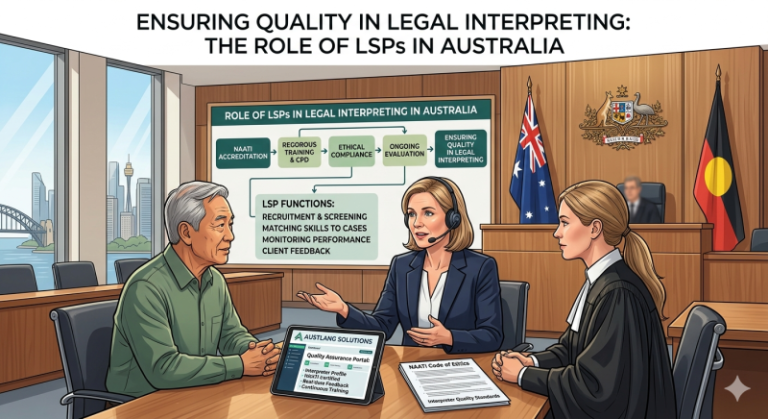
The Evolving Role of Language Service Providers in Ensuring the Quality of Legal Interpreting in Australia
Author: Griroek Gruaythong
21 April 2026, Bangkok –This article examines the role of Language Service Providers (LSPs) in addressing the limitations of interpreter training, particularly in legal and court settings in Australia’s highly multilingual context. Drawing on in-depth interviews with management representatives from eight major LSPs, the study reveals significant inconsistencies in approaches to interpreter training, screening, and quality assurance. Although LSPs are not formal educational institutions, several have expanded their functions to include capacity building and quasi-training roles in order to mitigate risks associated with inadequate interpreter competence. However, these initiatives remain uneven and structurally constrained, limiting their effectiveness in meeting the demands of the legal sector. The findings highlight the need for systematic collaboration between LSPs, educational institutions, and professional associations to enhance interpreter professionalisation and ensure sustainable quality standards.
Keywords
Language Service Providers (LSPs); legal interpreting; court interpreting; professional development; accreditation; training; quality assurance; new and emerging languages
Introduction
The demand for professional interpreting in legal settings in Australia has increased significantly in recent decades, particularly in courts and tribunals, while the supply of qualified interpreters has remained limited. This challenge is especially pronounced in new and emerging (N&E) languages and Aboriginal languages, reflecting broader patterns of superdiversity (Stern, 2018; Vertovec, 2010).
The consequences of inadequate interpreting in legal contexts are substantial, as interpreting quality directly affects case outcomes and access to justice (Hale, 2004; Berk-Seligson, 2002). Although institutions such as the National Accreditation Authority for Translators and Interpreters (NAATI) have introduced certification and professional development requirements, formal training opportunities—particularly in legal interpreting—remain scarce (Stern & Liu, forthcoming).
In this context, Language Service Providers (LSPs) have assumed a central role in recruiting, preparing, and monitoring interpreters. This article investigates how LSPs navigate these challenges and the extent to which they contribute to ensuring interpreting quality in legal settings.
Literature Review
Previous research consistently identifies pre-employment training as a key determinant of interpreting quality in legal contexts (Kalina, 2002; Kelly, 2003). However, in many countries, such training remains unregulated and often occurs outside formal academic frameworks.
International courts and tribunals have developed rigorous models of interpreter recruitment and training. For example, the Nuremberg Trials and subsequent international criminal tribunals implemented structured training, testing, and monitoring systems (Gaiba, 1998; Stern, 2011). These models emphasise prolonged, specialised training as essential to achieving high-quality interpreting.
By contrast, domestic legal systems often rely on short courses or informal training, which have been shown to be insufficient in preparing interpreters for the complexities of courtroom discourse (Mikkelson & Mintz, 1997; Lotriet, 2002; Liu & Hale, 2018).
The literature also highlights the limited but growing role of non-educational institutions, including LSPs, in supporting interpreter professionalisation. While some studies suggest that agencies may contribute to deprofessionalisation by employing untrained interpreters (Katschinka, 2016), others point to their potential role in capacity building (Ozolins, 2010).
Methodology
This study adopts a qualitative research design based on semi-structured interviews with senior management personnel from eight major Australian LSPs, including both government-funded and private providers.
The interviews explored recruitment requirements, screening processes, induction and training practices, quality control mechanisms, and professional development (PD) initiatives. The data were analysed using thematic analysis to identify patterns, similarities, and differences across organisations.
While the study provides valuable insights into organisational perspectives, it is limited by its reliance on management accounts and the absence of triangulation with interpreter or client perspectives.
Findings
1. Recruitment and Screening
Most LSPs require NAATI credentials, tertiary qualifications, and relevant experience. However, in practice, these requirements are often relaxed for languages with limited interpreter supply. Screening processes typically involve interviews assessing language proficiency, communication skills, and familiarity with professional ethics, but rarely include formal testing of interpreting competence.
2. Induction/Orientation and Support
There is considerable variation in induction practices, ranging from brief administrative sessions to extended, training-oriented programmes. This variation reflects differing institutional conceptions of the LSP role.
While most inductions focus on administrative procedures and adherence to the Code of Ethics (CoE), only a minority include substantive legal content. Even where legal components are present, they are often limited to contextual information rather than the development of specialised interpreting skills.
Only a small number of LSPs—primarily those working with N&E and Aboriginal languages—have assumed a training role, offering structured programmes aimed at linguistic and professional empowerment. Mentoring and ongoing support for novice interpreters remain limited.
3. Quality Control
All LSPs express concern about maintaining interpreting quality, particularly in N&E languages. However, direct quality control mechanisms are largely absent. Most LSPs rely on feedback from clients, such as court staff, which tends to focus on professional conduct rather than linguistic accuracy.
This reliance on a single source of evaluation raises concerns about reliability, as clients may lack the expertise to assess interpreting quality. Some LSPs have attempted to diversify feedback mechanisms or use positive feedback as a tool for professional improvement.
4. Professional Development
All LSPs recognise the importance of PD, particularly in contexts where formal training is limited. Approaches to PD vary, with some providers offering in-house training, others promoting external opportunities, and some combining both.
However, participation in PD is generally not incentivised or linked to job allocation. Moreover, there is limited evidence that PD initiatives have significantly improved interpreters’ qualifications or professional competence.
Discussion
The findings reveal a fundamental tension between normative expectations of professional competence and the practical constraints of the interpreting market. While LSPs acknowledge the importance of high-quality interpreting, they must operate within a system characterised by limited training opportunities and a shortage of qualified interpreters.
In response, some LSPs have expanded their roles to include training and capacity building. This shift reflects an adaptive response to structural gaps but also underscores the limitations of relying on non-educational institutions to fulfil educational functions.
Compared to international courts, where interpreters undergo extensive specialised training and assessment, the initiatives undertaken by Australian LSPs remain fragmented and insufficient to meet the complex demands of legal interpreting (Stern, 2018; Liu & Hale, 2018).
Conclusion
This study demonstrates that LSPs in Australia play a crucial role in ensuring the quality of legal interpreting in the absence of comprehensive formal training systems. Some providers have taken proactive steps to support interpreter development, including assuming quasi-training roles and promoting professional development.
Nevertheless, these efforts are constrained by structural limitations and cannot fully compensate for the lack of systematic training and certification pathways. The findings highlight the need for coordinated efforts among LSPs, educational institutions, and professional associations to establish sustainable mechanisms for interpreter training, accreditation, and quality assurance.
Such collaboration is essential to advancing the professionalisation of legal interpreting and ensuring equitable access to justice in multilingual societies.
References
- Abraham, D., & Oda, M. (2000). The cultural/community interpreter in the Domestic Violence Court – A pilot project. In R. Roberts et al. (Eds.), The Critical Link 2 (pp. 165–189). John Benjamins.
- Bajčić, M., & Dobrić Basaneže, K. (2016). Towards the professionalization of legal translators and court interpreters in the EU. Cambridge Scholars Publishing.
- Berk-Seligson, S. (2002). The bilingual courtroom. University of Chicago Press.
- Gaiba, F. (1998). The origins of simultaneous interpretation. University of Ottawa Press.
- Hale, S. (2004). The discourse of court interpreting. John Benjamins.
- Hale, S. (2006). Themes and methodological issues in court interpreting research. Linguistica Antverpiensia, 5, 205–228.
- Hale, S. (2011). Interpreter policies, practices and protocols in Australian courts. AIJA.
- Hale, S., & Ozolins, U. (2014). Monolingual short courses for language-specific accreditation. The Interpreter and Translator Trainer, 8(2), 217–239.
- Kalina, S. (2002). Interpreters as professionals. Across Languages and Cultures, 3(2), 169–187.
- Kelly, A. (2003). Court interpreters in the USA. Traduire, 199, 125–136.
- Liu, X. (2018). Talking like a lawyer. Jilin University Press.
- Liu, X., & Hale, S. (2018). Achieving accuracy in a bilingual courtroom. The Interpreter and Translator Trainer, 12(3), 299–321.
- Lotriet, A. (2002). Can short interpreter training be effective? In E. Hung (Ed.), Teaching Translation and Interpreting 4 (pp. 83–98). John Benjamins.
- Mikkelson, H., & Mintz, H. (1997). Orientation workshops for interpreters. In S. Carr et al. (Eds.), The Critical Link (pp. 55–63). John Benjamins.
- Ozolins, U. (2010). Factors that determine public service interpreting. Journal of Specialised Translation, 14, 194–215.
- Stern, L. (2011). Courtroom interpreting. In K. Malmkjær & K. Windle (Eds.), The Oxford Handbook of Translation Studies. Oxford University Press.
- Stern, L. (2018). Legal interpreting in domestic and international courts. In A. Creese & A. Blackledge (Eds.), The Routledge Handbook on Language and Superdiversity (pp. 396–411). Routledge.
- Vertovec, S. (2010). Super-diversity and its implications. Routledge.
บทบาทที่เปลี่ยนแปลงของผู้ให้บริการภาษา (LSPs) ต่อการประกันคุณภาพล่ามในบริบทกฎหมายของออสเตรเลีย
ผู้แต่ง: ไกรฤกษ์ กรวยทอง
21 เมษายน 2569, กรุงเทพมหานคร – บทความนี้มุ่งศึกษาบทบาทของผู้ให้บริการภาษา (Language Service Providers: LSPs) ในการรับมือกับข้อจำกัดด้านการฝึกอบรมล่าม โดยเฉพาะในบริบทกฎหมายและศาลของประเทศออสเตรเลีย ซึ่งมีความหลากหลายทางภาษาในระดับสูง การวิจัยอาศัยการสัมภาษณ์เชิงลึกผู้บริหารจาก LSPs จำนวนแปดแห่ง พบว่ามีความไม่สม่ำเสมอในการดำเนินมาตรการด้านการฝึกอบรม การคัดกรอง และการประกันคุณภาพล่าม แม้ LSPs จะมิใช่สถาบันการศึกษาโดยตรง แต่หลายแห่งได้ขยายบทบาทไปสู่การพัฒนาศักยภาพล่ามในลักษณะ “ผู้ฝึกอบรมกึ่งทางการ” เพื่อลดความเสี่ยงด้านคุณภาพ อย่างไรก็ตาม มาตรการดังกล่าวยังมีข้อจำกัดเชิงโครงสร้างและไม่เพียงพอที่จะตอบสนองความต้องการของภาคกฎหมายได้อย่างเต็มที่ ผลการศึกษาชี้ให้เห็นถึงความจำเป็นของความร่วมมือระหว่าง LSPs สถาบันการศึกษา และองค์กรวิชาชีพ เพื่อยกระดับมาตรฐานวิชาชีพล่ามในระยะยาว
คำสำคัญ:
ผู้ให้บริการด้านภาษา (Language Service Providers: LSPs); การล่ามทางกฎหมาย; การล่ามในศาล; การพัฒนาวิชาชีพ; การรับรองคุณวุฒิ; การฝึกอบรม; การประกันคุณภาพ; ภาษาใหม่และภาษาที่กำลังเกิดขึ้น
บทนำ
ความต้องการล่ามในบริบทกฎหมายในออสเตรเลียเพิ่มสูงขึ้นอย่างต่อเนื่อง ท่ามกลางข้อจำกัดด้านจำนวนล่ามที่มีคุณสมบัติเหมาะสม โดยเฉพาะในภาษาของชุมชนผู้อพยพใหม่และภาษาพื้นเมือง (สเติร์น, 2561; เวอร์โทเวค, 2553) สถานการณ์ดังกล่าวส่งผลให้เกิดความเสี่ยงต่อความเป็นธรรมในกระบวนการยุติธรรม เนื่องจากคุณภาพการล่ามมีผลโดยตรงต่อผลลัพธ์ของคดี (เฮล, 2547; เบิร์ก-เซลิกสัน, 2545)
แม้ว่าหน่วยงานอย่างหน่วยงานรับรองมาตรฐานนักแปลและล่ามของประเทศออสเตรเลียจะกำหนดมาตรฐานด้านการรับรองและการพัฒนาวิชาชีพ แต่โอกาสในการฝึกอบรมล่าม โดยเฉพาะด้านกฎหมาย ยังคงมีจำกัด (สเติร์น และ หลิว, กำลังจะตีพิมพ์) ส่งผลให้ผู้ให้บริการภาษา (LSPs) ต้องรับบทบาทเพิ่มเติมในการคัดกรอง พัฒนา และควบคุมคุณภาพล่ามในทางปฏิบัติ
การทบทวนวรรณกรรม
งานวิจัยก่อนหน้าแสดงให้เห็นว่าการฝึกอบรมล่ามในบริบทกฎหมายเป็นปัจจัยสำคัญต่อคุณภาพการปฏิบัติงาน (คาลินา, 2545; เคลลี่, 2546) อย่างไรก็ตาม ในหลายประเทศ การฝึกอบรมยังขาดการกำกับดูแลอย่างเป็นระบบ
ในระดับนานาชาติ องค์กรศาลระหว่างประเทศ เช่น ศาลนูเรมเบิร์ก และศาลอาญาระหว่างประเทศ ได้พัฒนารูปแบบการฝึกอบรมล่ามอย่างเข้มข้นและมีระบบประเมินผล (ไกบา, 2541; สเติร์น, 2554) ในทางตรงกันข้าม ศาลภายในประเทศส่วนใหญ่ยังขาดกลไกดังกล่าว
นอกจากนี้หลักฐานจากงานวิจัยยังชี้ให้เห็นว่าหลักสูตรระยะสั้น แม้จะมีประโยชน์ แต่ไม่เพียงพอในการเตรียมความพร้อมล่ามสำหรับการทำงานในชั้นศาล (มิคเคลสัน และ มินทซ์, 2540; ล็อตเรียต, 2545; หลิว และ เฮล, 2561)
ระเบียบวิธีวิจัย
การศึกษานี้ใช้วิธีการสัมภาษณ์เชิงลึกแบบกึ่งโครงสร้างกับผู้บริหาร LSPs จำนวนแปดแห่ง ทั้งภาครัฐและเอกชน โดยมุ่งสำรวจแนวทางด้านการคัดเลือก การฝึกอบรม การประกันคุณภาพ และการพัฒนาวิชาชีพ
ข้อมูลที่ได้ถูกวิเคราะห์เชิงธีม (thematic analysis) เพื่อระบุรูปแบบ แนวโน้ม และความแตกต่างของแนวปฏิบัติในแต่ละองค์กร
สิ่งที่ค้นพบ
1. การคัดเลือกและการคัดกรอง
LSPs ส่วนใหญ่กำหนดให้ผู้สมัครต้องมีคุณวุฒิ NAATI ประสบการณ์ และทักษะภาษา อย่างไรก็ตาม ในภาษาที่ขาดแคลน มาตรฐานดังกล่าวถูกปรับลดลงอย่างหลีกเลี่ยงไม่ได้ การคัดกรองส่วนใหญ่ดำเนินผ่านการสัมภาษณ์ โดยไม่มีการทดสอบทักษะล่ามโดยตรง
2. การปฐมนิเทศและการสนับสนุน
แนวทางการปฐมนิเทศมีความแตกต่างอย่างมาก ตั้งแต่ระยะเวลาสั้นเพียงหนึ่งชั่วโมง ไปจนถึงโปรแกรมฝึกอบรมหลายเดือน ความไม่สม่ำเสมอดังกล่าวสะท้อนมุมมองของ LSPs ต่อบทบาทของตนเอง บางแห่งจำกัดบทบาทไว้ที่การให้ข้อมูลพื้นฐาน ขณะที่บางแห่งขยายบทบาทไปสู่การฝึกอบรมล่าม
เนื้อหาการปฐมนิเทศส่วนใหญ่เน้นจรรยาบรรณ (Code of Ethics) และการปฏิบัติวิชาชีพ ขณะที่เนื้อหาด้านกฎหมายมีความไม่สม่ำเสมอ และมักจำกัดอยู่เพียงความรู้เชิงบริบท มีเพียงส่วนน้อยที่พัฒนาทักษะภาษากฎหมายอย่างเป็นระบบ
การให้คำปรึกษา มีจำกัด โดยมีเพียงสององค์กรที่ดำเนินการอย่างเป็นรูปธรรม
3. การควบคุมคุณภาพ
แม้ LSPs จะตระหนักถึงความสำคัญของการควบคุมคุณภาพ แต่กลไกที่ใช้ส่วนใหญ่พึ่งพาความเห็นจากผู้ใช้บริการ เช่น เจ้าหน้าที่ศาล ซึ่งมักประเมินได้เพียงพฤติกรรมวิชาชีพ ไม่สามารถประเมินความถูกต้องทางภาษาได้อย่างแท้จริง ส่งผลให้ความน่าเชื่อถือของระบบประเมินมีข้อจำกัด
มีเพียงบางองค์กรที่พยายามพัฒนาระบบประเมินแบบหลายมิติ รวมถึงการใช้ข้อเสนอแนะเชิงบวกเพื่อส่งเสริมมาตรฐานวิชาชีพ
4. การพัฒนาวิชาชีพ (PD)
LSPs ทุกแห่งยอมรับความสำคัญของ PD แต่แนวทางการดำเนินการแตกต่างกัน บางแห่งจัดอบรมภายใน ขณะที่บางแห่งส่งเสริมให้เข้าร่วมกิจกรรมภายนอก
อย่างไรก็ตาม ไม่มีองค์กรใดเชื่อมโยง PD กับการจัดสรรงาน หรือใช้เป็นแรงจูงใจเชิงโครงสร้าง อีกทั้งหลักฐานยังไม่ชี้ชัดว่า PD ส่งผลต่อการยกระดับคุณวุฒิของล่ามอย่างมีนัยสำคัญ
การอภิปราย
ผลการศึกษาชี้ให้เห็นความตึงเครียดระหว่างมาตรฐานเชิงอุดมคติและข้อจำกัดเชิงปฏิบัติ LSPs ต่างตระหนักถึงความจำเป็นของการมีล่ามที่มีคุณภาพสูง แต่ต้องปรับตัวตามข้อจำกัดของตลาดแรงงานและโครงสร้างการฝึกอบรม
การที่บาง LSPs รับบทเป็น “ผู้ฝึกอบรม” สะท้อนการเปลี่ยนแปลงเชิงบทบาทในอุตสาหกรรม อย่างไรก็ตาม บทบาทดังกล่าวยังไม่สามารถทดแทนสถาบันการศึกษาได้อย่างเต็มที่
เมื่อเปรียบเทียบกับองค์กรระหว่างประเทศ เช่น ICC ซึ่งมีระบบฝึกอบรมระยะยาวและการประเมินอย่างเป็นระบบ ความพยายามของ LSPs ในออสเตรเลียยังอยู่ในระดับจำกัด และไม่เพียงพอต่อความต้องการของภาคกฎหมาย (สเติร์น, 2561; หลิว และ เฮล, 2561)
สรุป
การศึกษานี้แสดงให้เห็นว่า LSPs ในออสเตรเลียมีบทบาทสำคัญในการประกันคุณภาพล่ามในบริบทกฎหมาย ท่ามกลางข้อจำกัดด้านการฝึกอบรมอย่างเป็นทางการ โดยบางองค์กรได้ขยายบทบาทไปสู่การพัฒนาศักยภาพล่ามในลักษณะกึ่งสถาบันการศึกษา
แม้ความพยายามดังกล่าวสะท้อนความตั้งใจในการยกระดับมาตรฐานวิชาชีพ แต่ยังมีข้อจำกัดทั้งด้านทรัพยากร โครงสร้าง และความเชี่ยวชาญ จึงไม่สามารถตอบสนองความต้องการของระบบยุติธรรมได้อย่างครบถ้วน
ข้อค้นพบนี้ชี้ให้เห็นถึงความจำเป็นของความร่วมมือเชิงระบบระหว่าง LSPs สถาบันการศึกษา และองค์กรวิชาชีพ เพื่อพัฒนากลไกการฝึกอบรม การรับรอง และการประกันคุณภาพล่ามอย่างยั่งยืน
บรรณานุกรม
- Abraham, D., & Oda, M. (2000). The cultural/community interpreter in the Domestic Violence Court – A pilot project. In R. Roberts et al. (Eds.), The Critical Link 2 (pp. 165–189). John Benjamins.
- Bajčić, M., & Dobrić Basaneže, K. (2016). Towards the professionalization of legal translators and court interpreters in the EU. Cambridge Scholars Publishing.
- Berk-Seligson, S. (2002). The bilingual courtroom. University of Chicago Press.
- Gaiba, F. (1998). The origins of simultaneous interpretation. University of Ottawa Press.
- Hale, S. (2004). The discourse of court interpreting. John Benjamins.
- Hale, S. (2006). Themes and methodological issues in court interpreting research. Linguistica Antverpiensia, 5, 205–228.
- Hale, S. (2011). Interpreter policies, practices and protocols in Australian courts. AIJA.
- Hale, S., & Ozolins, U. (2014). Monolingual short courses for language-specific accreditation. The Interpreter and Translator Trainer, 8(2), 217–239.
- Kalina, S. (2002). Interpreters as professionals. Across Languages and Cultures, 3(2), 169–187.
- Kelly, A. (2003). Court interpreters in the USA. Traduire, 199, 125–136.
- Liu, X. (2018). Talking like a lawyer. Jilin University Press.
- Liu, X., & Hale, S. (2018). Achieving accuracy in a bilingual courtroom. The Interpreter and Translator Trainer, 12(3), 299–321.
- Lotriet, A. (2002). Can short interpreter training be effective? John Benjamins.
- Mikkelson, H., & Mintz, H. (1997). Orientation workshops for interpreters. John Benjamins.
- Ozolins, U. (2010). Factors that determine public service interpreting. Journal of Specialised Translation, 14, 194–215.
- Stern, L. (2011). Courtroom interpreting. In The Oxford Handbook of Translation Studies. Oxford University Press.
- Stern, L. (2018). Legal interpreting in domestic and international courts. Routledge.
- Vertovec, S. (2010). Super-diversity and its implications. Routledge.
ติดต่อขอใช้บริการนักวิชาชีพของสมาคมได้ที่: https://www.seaproti.org/practitioners/
สมาคมวิชาชีพนักแปลและล่ามแห่งเอเชียตะวันออกเฉียงใต้ (SEAProTI) ได้ประกาศหลักเกณฑ์และคุณสมบัติของผู้ที่ขึ้นทะเบียนเป็น “นักแปลรับรอง (Certified Translators) และผู้รับรองการแปล (Translation Certification Providers) และล่ามรับรอง (Certified Interpreters)” ของสมาคม หมวดที่ 9 และหมวดที่ 10 ในราชกิจจานุเบกษา ของสำนักเลขาธิการคณะรัฐมนตรี ในสำนักนายกรัฐมนตรี แห่งราชอาณาจักรไทย ลงวันที่ 25 ก.ค. 2567 เล่มที่ 141 ตอนที่ 66 ง หน้า 100 อ่านฉบับเต็มได้ที่: นักแปลรับรอง ผู้รับรองการแปล และล่ามรับรอง
สำนักคณะกรรมการกฤษฎีกาเสนอให้ตราเป็นพระราชกฤษฎีกา โดยกำหนดให้นักแปลที่ขึ้นทะเบียน รวมถึงผู้รับรองการแปลจากสมาคมวิชาชีพหรือสถาบันสอนภาษาที่มีการอบรมและขึ้นทะเบียน สามารถรับรองคำแปลได้ (จดหมายถึงสมาคม SEAProTI ลงวันที่ 28 เม.ย. 2568)
สมาคมวิชาชีพนักแปลและล่ามแห่งเอเชียตะวันออกเฉียงใต้เป็นสมาคมวิชาชีพแห่งแรกและแห่งเดียวในประเทศไทยและภูมิภาคเอเชียตะวันออกเฉียงใต้ที่มีระบบรับรองนักแปลรับรอง ผู้รับรองการแปล และล่ามรับรอง
สำนักงานใหญ่: อาคารบ้านราชครู เลขที่ 33 ห้อง 402 ซอยพหลโยธิน 5 ถนนพหลโยธิน แขวงพญาไท เขตพญาไท กรุงเทพมหานคร 10400 ประเทศไทย
อีเมล: hello@seaproti.com โทรศัพท์: (+66) 2-114-3128 (เวลาทำการ: วันจันทร์–วันศุกร์ เวลา 09.00–17.00 น.)