



Elevating Localization to the Mainstream of Translation Studies: An Academic Analysis
of Localization in Translation by Jiménez-Crespo (2024)
Author: Phakaporn Tanjararak
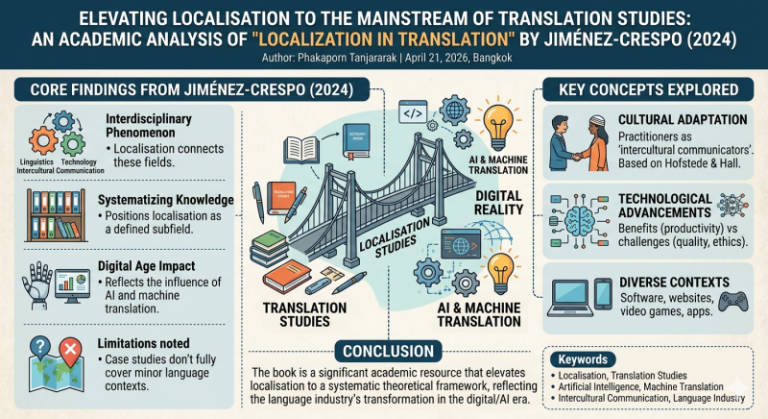
April 21,2026, Bangkok – This article aims to analyze the role and significance of the concept of localisation within the framework of Translation Studies (TS), drawing on a critical examination of Localization in Translation by Jiménez-Crespo (2024) as the basis for discussion. The study demonstrates that localisation has evolved into an interdisciplinary phenomenon that interconnects linguistics, technology, and intercultural communication. The findings indicate that the book plays a crucial role in systematizing knowledge and proposing a new conceptual framework that positions localisation as a clearly defined subfield within Translation Studies. Furthermore, it reflects the impact of artificial intelligence and machine translation on the transformation of the language industry in the digital age. Nevertheless, certain limitations remain, particularly in the presentation of case studies that do not fully encompass the contexts of minor languages. This article concludes that Jiménez-Crespo’s work constitutes a significant academic resource for both research and practice in contemporary localisation and translation.
Keywords: Localisation; Translation Studies; Artificial Intelligence; Machine Translation; Intercultural Communication; Language Industry
Introduction
Over the past decade, the language industry has expanded rapidly under the influence of globalization and digital technologies, particularly the rapid advancement of artificial intelligence and machine translation. These developments have necessitated continuous reconsideration of concepts and theoretical frameworks within Translation Studies (Jiménez-Crespo, 2024). One of the key concepts that has gained increasing attention is “localisation,” which extends beyond the mere translation of text to encompass the adaptation of content to align with cultural, technological, and end-user contexts.
Despite its importance, localisation has historically been positioned at the periphery of both Translation Studies and computer science, often being examined in isolation within each discipline (O’Hagan & Ashworth, 2003; Pym, 2010; Munday, 2016). This situation reflects the lack of a comprehensive framework capable of fully explaining localisation as an interdisciplinary phenomenon.
Literature Review
Previous research has attempted to explain translation and localisation from various perspectives. O’Hagan and Ashworth (2003) emphasize the role of translation-mediated communication in the digital world, while Pym (2010) analyzes localization within the framework of translation theory, and Munday (2016) highlights the integration of localisation into core concepts of Translation Studies. However, these works still lack a systematic synthesis of knowledge that encompasses both theoretical and practical dimensions. The work of Jiménez-Crespo (2024) represents a significant turning point, as it proposes “Localisation Studies” as a new subfield within Translation Studies and seeks to systematically integrate knowledge from multiple disciplines.
Content Analysis and Findings
The book Localization in Translation presents localisation as a complex and multidimensional process, covering fundamental concepts, operational processes, and contemporary issues such as the application of artificial intelligence and machine translation in translation and localisation practices (Jiménez-Crespo, 2024). In terms of structure, the book consists of 13 chapters designed to function both as a textbook and a professional handbook. It incorporates guiding questions, discussion activities, and case studies to promote critical thinking. While this approach is pedagogically beneficial, the insertion of questions within the text may disrupt the continuity of academic reading.
One of the central issues emphasized in the book is the role of culture in localisation. Drawing on the frameworks of Hofstede (1991) and Hall (1997), the author explains cultural differences and connects them to the concept of the “cultural turn” in Translation Studies. The author further proposes that localisation practitioners should be regarded as “intercultural communicators,” reflecting a transformation in professional roles in the era of globalization (Jiménez-Crespo, 2024).
From a technological perspective, the book provides an in-depth analysis of the impact of artificial intelligence and machine translation on localisation processes, highlighting both opportunities and challenges, such as increased productivity and risks related to quality and ethics. It also discusses trends in crowdsourced translation and user community participation, which are reshaping the structure of the language industry.
Additionally, the book offers a comparative analysis of localisation across various contexts, including software, websites, video games, and mobile applications. This approach enables readers to systematically understand the differences in processes and challenges across different types of localisation (Jiménez-Crespo, 2024).
Discussion
The analysis indicates that localisation has evolved into a central component of Translation Studies and plays a significant role in shaping both research directions and professional practices within the language industry. The introduction of “Localisation Studies” contributes to theoretical clarity and opens new avenues for interdisciplinary research.
However, the book also presents certain limitations, particularly its focus on major languages in case studies, which may not adequately reflect the challenges faced by minor languages with limited technological resources, especially in contexts lacking large language models. This highlights the need for further research in more diverse linguistic contexts.
Conclusion
Localization in Translation by Jiménez-Crespo (2024) represents a significant academic contribution to the development of Translation Studies by elevating localisation from a practical concept to a systematic and comprehensive theoretical framework. It also reflects the ongoing transformation of the language industry in the digital and AI-driven era.
Despite some limitations, the book remains a valuable resource for researchers, students, and practitioners in the fields of translation and localisation, and serves as an essential foundation for future knowledge development.
References
- Hall, E. T. (1997). Representation: Cultural representations and signifying practices. Sage.
- Hofstede, G. (1991). Cultures and organizations: Software of the mind. McGraw-Hill.
- Jiménez-Crespo, M. Á. (2024). Localization in translation. Routledge.
- Munday, J. (2016). Introducing translation studies (3rd ed.). Routledge.
- O’Hagan, M., & Ashworth, D. (2003). Translation-mediated communication in a digital world: Facing the challenges of globalization and localization. Multilingual Matters.
- Pym, A. (2010). Exploring translation theories. Routledge.
การยกระดับการแปลเชิงปรับให้เข้ากับท้องถิ่นสู่กระแสหลักของการแปลศึกษา: การวิเคราะห์เชิงวิชาการจากผลงาน
Localization in Translation ของ Jiménez-Crespo (2024)
ผู้แต่ง: ภคพร ตันจรารักษ์
21 เมษายน 2569, กรุงเทพมหานคร – บทความนี้มีวัตถุประสงค์เพื่อวิเคราะห์บทบาทและความสำคัญของแนวคิดการแปลเชิงปรับให้เข้ากับท้องถิ่น (localisation) ภายใต้กรอบการแปลศึกษา (Translation Studies: TS) โดยอาศัยการวิพากษ์ผลงาน Localization in Translation ของฮิเมเนซ-เครสโป (พ.ศ. 2567) เป็นฐานในการอภิปราย การศึกษานี้ชี้ให้เห็นว่า localisation ได้พัฒนาไปสู่การเป็นปรากฏการณ์เชิงสหวิทยาการที่เชื่อมโยงระหว่างภาษาศาสตร์ เทคโนโลยี และการสื่อสารข้ามวัฒนธรรม ผลการวิเคราะห์พบว่า หนังสือดังกล่าวมีบทบาทสำคัญในการจัดระบบองค์ความรู้และเสนอกรอบแนวคิดใหม่ที่ผลักดันให้การแปลเชิงปรับให้เข้ากับท้องถิ่น กลายเป็นสาขาย่อยที่มีสถานะชัดเจนภายในการแปลศึกษา นอกจากนี้ยังสะท้อนถึงผลกระทบของปัญญาประดิษฐ์และการแปลด้วยเครื่องต่อการเปลี่ยนแปลงของอุตสาหกรรมภาษาในยุคดิจิทัล อย่างไรก็ตาม ยังมีข้อจำกัดบางประการในด้านการนำเสนอกรณีศึกษาที่ยังไม่ครอบคลุมบริบทของภาษาขนาดเล็ก บทความนี้สรุปว่าผลงานของฮิเมเนซ-เครสโป เป็นทรัพยากรเชิงวิชาการที่มีความสำคัญต่อทั้งการวิจัยและการปฏิบัติในสาขาการปรับภาษาให้เข้ากับท้องถิ่นและการแปลร่วมสมัย
คำสำคัญ:
การแปลเชิงปรับให้เข้ากับท้องถิ่น; การแปลศึกษา; ปัญญาประดิษฐ์; การแปลด้วยเครื่อง; การสื่อสารข้ามวัฒนธรรม; อุตสาหกรรมภาษา
บทนำ
ในช่วงทศวรรษที่ผ่านมา อุตสาหกรรมภาษาได้ขยายตัวอย่างรวดเร็วภายใต้อิทธิพลของโลกาภิวัตน์และเทคโนโลยีดิจิทัล โดยเฉพาะการพัฒนาอย่างก้าวกระโดดของปัญญาประดิษฐ์และการแปลด้วยเครื่อง ซึ่งส่งผลให้แนวคิดและกรอบทฤษฎีในสาขาการแปลศึกษาจำเป็นต้องได้รับการทบทวนอย่างต่อเนื่อง (ฮิเมเนซ-เครสโป, 2567) หนึ่งในแนวคิดสำคัญที่ได้รับความสนใจเพิ่มขึ้นคือ “การแปลเชิงปรับให้เข้ากับท้องถิ่น” ซึ่งมิได้จำกัดอยู่เพียงการแปลข้อความ แต่ครอบคลุมถึงการปรับเนื้อหาให้สอดคล้องกับบริบททางวัฒนธรรม เทคโนโลยี และผู้ใช้ปลายทาง แม้การแปลเชิงปรับให้เข้ากับท้องถิ่นจะมีบทบาทสำคัญในอุตสาหกรรมภาษา แต่ในอดีตกลับถูกจัดวางไว้ในสถานะชายขอบของทั้งการแปลศึกษา และวิทยาการคอมพิวเตอร์ โดยมักถูกวิเคราะห์แยกส่วนภายใต้กรอบของแต่ละสาขา (โอเฮแกน และ แอชเวิร์ท, 2546; พิม, 2553; มันเดย์, 2559) สถานการณ์ดังกล่าวสะท้อนถึงการขาดกรอบแนวคิดแบบองค์รวมที่สามารถอธิบายการปรับบริบทให้เข้ากับท้องถิ่นในฐานะปรากฏการณ์สหวิทยาการได้อย่างครบถ้วน
การทบทวนวรรณกรรม
งานวิจัยก่อนหน้ามีความพยายามอธิบายการปรับและการแปลให้เหมาะสมกับท้องถิ่นจากมุมมองที่หลากหลาย โดยโอเฮแกน และแอชเวิร์ท (2546) เน้นบทบาทของการสื่อสารผ่านการแปลในโลกดิจิทัล ขณะที่ พิม (2010) วิเคราะห์การปรับบริบทให้เข้ากับท้องถิ่น ภายใต้กรอบทฤษฎีการแปล และมันเดย์ (2016) ให้ความสำคัญกับการบูรณาการการปรับบริบทให้เข้ากับฉบับแปล ที่เข้ากับแนวคิดหลักในการแปลศึกษา อย่างไรก็ตาม งานเหล่านี้ยังคงขาดการสังเคราะห์องค์ความรู้เชิงระบบที่ครอบคลุมทั้งมิติทางทฤษฎีและการปฏิบัติ
ผลงานของฮิเมเนซ-เครสโป (2567) จึงถือเป็นจุดเปลี่ยนสำคัญ เนื่องจากเสนอให้ “การปรับให้เข้ากับท้องถิ่นศึกษา“ (Localisation Studies) เป็นสาขาย่อยใหม่ภายในการแปลศึกษา และพยายามบูรณาการองค์ความรู้จากหลายสาขาเข้าด้วยกันอย่างเป็นระบบ
การวิเคราะห์เนื้อหาและข้อค้นพบ
หนังสือ Localization in Translation นำเสนอการปรับภาษาให้เข้ากับท้องถิ่น ในฐานะกระบวนการที่มีความซับซ้อนและมีหลายมิติ ครอบคลุมตั้งแต่แนวคิดพื้นฐาน กระบวนการดำเนินงาน ไปจนถึงประเด็นร่วมสมัย เช่น การใช้ปัญญาประดิษฐ์และการแปลด้วยเครื่อง ในงานการแปลและการปรับเนื้อหาให้เหมาะกับท้องถิ่น (ฮิเมเนซ-เครสโป, 2567)
ในด้านโครงสร้าง หนังสือประกอบด้วย 13 บท ซึ่งออกแบบให้สามารถใช้เป็นทั้งตำราเรียนและคู่มือวิชาชีพ โดยมีการใช้คำถามนำ กิจกรรมอภิปราย และกรณีศึกษาเพื่อส่งเสริมการคิดเชิงวิพากษ์ แม้แนวทางดังกล่าวจะมีประโยชน์ในเชิงการเรียนรู้ แต่การแทรกคำถามภายในเนื้อหาอาจส่งผลต่อความต่อเนื่องของการอ่านในเชิงวิชาการ หนึ่งในประเด็นสำคัญที่หนังสือเน้นคือบทบาทของวัฒนธรรมในการปรับภาษาให้เข้ากับท้องถิ่น โดยอาศัยกรอบแนวคิดของฮอฟสเตด (2534) และ ฮอลล์ (2540) เพื่ออธิบายความแตกต่างทางวัฒนธรรม และเชื่อมโยงกับแนวคิด “การหันสู่มิติทางวัฒนธรรม” ในสาขาการศึกษาการแปล ผู้เขียนเสนอให้ผู้ปฏิบัติงานด้านการปรับเนื้อหาให้เหมาะกับท้องถิ่น ถูกมองในฐานะ “ผู้สื่อสารข้ามวัฒนธรรม” ซึ่งสะท้อนการเปลี่ยนแปลงของบทบาทวิชาชีพในยุคโลกาภิวัตน์ (ฮิเมเนซ-เครสโป, 2567)
ในด้านเทคโนโลยี หนังสือได้วิเคราะห์ผลกระทบของปัญญาประดิษฐ์และการแปลด้วยเครื่อง ต่อกระบวนการการปรับให้เข้ากับท้องถิ่น อย่างลึกซึ้ง โดยชี้ให้เห็นทั้งโอกาสและความท้าทาย เช่น การเพิ่มประสิทธิภาพการผลิตงานแปล และความเสี่ยงด้านคุณภาพและจริยธรรม นอกจากนี้ ยังกล่าวถึงแนวโน้มของการแปลแบบ การระดมความร่วมมือจากมวลชนและการมีส่วนร่วมของชุมชนผู้ใช้ ซึ่งกำลังเปลี่ยนแปลงโครงสร้างของอุตสาหกรรมภาษา
หนังสือยังนำเสนอการวิเคราะห์เชิงเปรียบเทียบของการปรับภาษาให้เข้ากับวัฒนธรรมท้องถิ่นในบริบทต่าง ๆ ได้แก่ ซอฟต์แวร์ เว็บไซต์ วิดีโอเกม และแอปพลิเคชันมือถือ ซึ่งช่วยให้ผู้อ่านเข้าใจความแตกต่างของกระบวนการและความท้าทายในแต่ละประเภทอย่างเป็นระบบ (ฮิเมเนซ-เครสโป, 2567)
การอภิปราย
ผลการวิเคราะห์ชี้ให้เห็นว่าการปรับภาษาให้เข้ากับท้องถิ่น ได้พัฒนาไปสู่การเป็นแกนกลางของ การแปลศึกษา และมีบทบาทสำคัญในการกำหนดทิศทางของการวิจัยและการปฏิบัติในอุตสาหกรรมภาษา การเสนอแนวคิด “การศึกษาการปรับเนื้อหาให้เหมาะกับท้องถิ่น” ช่วยสร้างความชัดเจนเชิงทฤษฎีและเปิดพื้นที่สำหรับการวิจัยเชิงสหวิทยาการ อย่างไรก็ตาม หนังสือยังมีข้อจำกัดบางประการ เช่น การนำเสนอกรณีศึกษาที่เน้นภาษาหลัก ซึ่งอาจไม่สะท้อนความท้าทายของภาษาขนาดเล็กที่ขาดทรัพยากรทางเทคโนโลยี โดยเฉพาะในบริบทที่ไม่มีแบบจำลองภาษาขนาดใหญ่รองรับ ประเด็นนี้ชี้ให้เห็นถึงความจำเป็นของการวิจัยเพิ่มเติมในบริบทที่หลากหลาย
สรุป
ผลงาน Localization in Translation ของ ฮิเมเนซ-เครสโป (2567) เป็นการมีส่วนร่วมเชิงวิชาการที่สำคัญในการพัฒนาสาขาการแปลศึกษา โดยช่วยยกระดับการปรับและการแปลภาษาให้เข้ากับท้องถิ่น จากแนวคิดเชิงปฏิบัติไปสู่กรอบทฤษฎีที่เป็นระบบและครอบคลุม นอกจากนี้ยังสะท้อนถึงการเปลี่ยนแปลงของอุตสาหกรรมภาษาในยุคดิจิทัลและปัญญาประดิษฐ์ แม้จะมีข้อจำกัดบางประการ แต่หนังสือเล่มนี้ยังคงเป็นแหล่งข้อมูลที่มีคุณค่าสำหรับนักวิจัย นักศึกษา และผู้ปฏิบัติงานในสาขาการแปลและการปรับภาษาให้เหมาะสมกับท้องถิ่น อีกทั้งเป็นพื้นฐานสำคัญสำหรับการพัฒนาองค์ความรู้ในอนาคต
บรรณานุกรม
- Hall, E. T. (1997). Representation: Cultural representations and signifying practices. Sage.
- Hofstede, G. (1991). Cultures and organizations: Software of the mind. McGraw-Hill.
- Jiménez-Crespo, M. Á. (2024). Localization in translation. Routledge.
- Munday, J. (2016). Introducing translation studies (3rd ed.). Routledge.
- O’Hagan, M., & Ashworth, D. (2003). Translation-mediated communication in a digital world: Facing the challenges of globalization and localization. Multilingual Matters.
- Pym, A. (2010). Exploring translation theories. Routledge.
ติดต่อขอใช้บริการนักวิชาชีพของสมาคมได้ที่: https://www.seaproti.org/practitioners/
สมาคมวิชาชีพนักแปลและล่ามแห่งเอเชียตะวันออกเฉียงใต้ (SEAProTI) ได้ประกาศหลักเกณฑ์และคุณสมบัติของผู้ที่ขึ้นทะเบียนเป็น “นักแปลรับรอง (Certified Translators) และผู้รับรองการแปล (Translation Certification Providers) และล่ามรับรอง (Certified Interpreters)” ของสมาคม หมวดที่ 9 และหมวดที่ 10 ในราชกิจจานุเบกษา ของสำนักเลขาธิการคณะรัฐมนตรี ในสำนักนายกรัฐมนตรี แห่งราชอาณาจักรไทย ลงวันที่ 25 ก.ค. 2567 เล่มที่ 141 ตอนที่ 66 ง หน้า 100 อ่านฉบับเต็มได้ที่: นักแปลรับรอง ผู้รับรองการแปล และล่ามรับรอง
สำนักคณะกรรมการกฤษฎีกาเสนอให้ตราเป็นพระราชกฤษฎีกา โดยกำหนดให้นักแปลที่ขึ้นทะเบียน รวมถึงผู้รับรองการแปลจากสมาคมวิชาชีพหรือสถาบันสอนภาษาที่มีการอบรมและขึ้นทะเบียน สามารถรับรองคำแปลได้ (จดหมายถึงสมาคม SEAProTI ลงวันที่ 28 เม.ย. 2568)
สมาคมวิชาชีพนักแปลและล่ามแห่งเอเชียตะวันออกเฉียงใต้เป็นสมาคมวิชาชีพแห่งแรกและแห่งเดียวในประเทศไทยและภูมิภาคเอเชียตะวันออกเฉียงใต้ที่มีระบบรับรองนักแปลรับรอง ผู้รับรองการแปล และล่ามรับรอง
สำนักงานใหญ่: อาคารบ้านราชครู เลขที่ 33 ห้อง 402 ซอยพหลโยธิน 5 ถนนพหลโยธิน แขวงพญาไท เขตพญาไท กรุงเทพมหานคร 10400 ประเทศไทย
อีเมล: hello@seaproti.com โทรศัพท์: (+66) 2-114-3128 (เวลาทำการ: วันจันทร์–วันศุกร์ เวลา 09.00–17.00 น.)