



Sports Interpreting: Mapping the Field to Even the Score by Franz Pöchhacker (2026)
Author: Petra Bordt
May 01, 2026, Bangkok – This article aims to analyze the role and status of sports interpreting within Translation and Interpreting Studies (TIS), drawing on the scoping review “Sports Interpreting: Mapping the Field to Even the Score” by Franz Pöchhacker (2026). The study demonstrates that sports interpreting is a multifaceted field extending from highly professional international conference interpreting to non-professional language assistance in community settings. The findings indicate that while sports interpreting is ubiquitous in practice, it remains significantly under-researched and is largely absent from major academic reference volumes. Furthermore, the article highlights the critical role of media interpreting, particularly in televised press conferences, as a primary setting for investigation. This analysis concludes that Pöchhacker’s work provides a foundational “map” to overcome research fragmentation and expand on key themes relevant to interpreting studies at large.
Keywords: Sports; Media interpreting; Non-professional interpreting; Press conferences; Football; Baseball
Introduction
While interpreting has a long history in social settings such as trade and diplomacy, its role in sports was historically limited due to the physical nature of ancient competitions. However, the modern globalization and mediatization of sports have transformed it into a multi-billion dollar industry requiring extensive multilingual communication. Despite this prominence, sports interpreting has remained “invisible” within the academic discipline of translation and interpreting studies, often overlooked by major encyclopedias and handbooks. This scoping review seeks to map where, for whom, and by whom sports interpreting is performed.
Literature Review
Previous scholarly attention to sports has primarily focused on communication and business interests, yet human interpreting as a real-time communication access tool has been underexplored. Pöchhacker (2026) notes that the field’s major reference publications, such as the Routledge handbooks, contain virtually no entries for “sports” or “sports interpreting”. Systematic searches in specialized databases like the Translation Studies Bibliography (TSB) and the Bibliography of Interpreting and Translation (BITRA) revealed a core corpus of only fourteen relevant publications, showing a worrying lack of consistency in indexing this subfield. The integration of additional searches in Scopus and the mining of references eventually expanded this corpus to thirty items, reflecting the “patchy” nature of current research.
Content Analysis and Findings
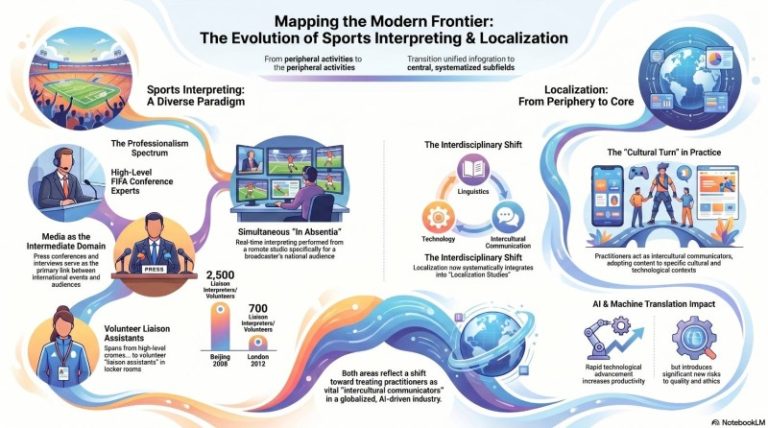
The analysis reveals that sports interpreting spans a wide spectrum of professionalism and settings. In international organizations like the IOC and FIFA, highly trained conference interpreters provide simultaneous interpreting for official meetings. Conversely, “liaison” or dialogue interpreting is frequently performed by non-professionals, such as teammates or volunteers at mega-events like the Olympics.
One of the most salient subjects identified is media interpreting in press conferences. Pioneered by Straniero Sergio (2003) and expanded by Sandrelli, research in this area often focuses on televised events like Formula 1 or football, where interpreters use “emergency strategies” to handle fast-paced interactions. The study also highlights the value of Master’s (MA) theses as a source of empirical data, covering diverse sports from tennis to angling and exploring themes like quality, strategy use, and the role of “para-professional” journalist-interpreters.
Discussion
The findings suggest that sports interpreting should be viewed as a “paradigm case” for interpreting studies, as it encapsulates the full range of settings—from international to intra-social—and varying levels of professionalism. The proposed conceptual framework helps clarify the intermediate role of media interpreting, which sits between conference and community settings. However, the current reliance on readily available audio-visual data means that many sports and individual stakeholder needs remain underexplored.
Conclusion
“Sports Interpreting: Mapping the Field to Even the Score” by Pöchhacker (2026) constitutes a vital step in legitimizing sports interpreting as a field of study. By providing a systematic bibliometric foundation and a conceptual map, it invites future research to venture beyond high-profile mega-events toward less visible areas, such as deaf sports and the impact of AI-powered translation tools. This work serves as an essential resource for establishing a comprehensive research program in an era of rapid digital and technological transformation.
References
- Albl-Mikasa, M., & Tiselius, E. (Eds.) (2022). The Routledge handbook of conference interpreting. Routledge.
- Alonso Araguás, I., & Zapatero Santos, P. (2019). La interpretación en competiciones de fútbol internacionales. Un estudio de caso: la UEFA. Sendebar, 30, 245–271.
- Antonini, R., & Bucaria, C. (2016). NPIT in the media: An overview of the field and main issues. In R. Antonini & C. Bucaria (Eds.), Non-professional interpreting and translation in the media (pp. 7–20). Peter Lang.
- Axisa, M. (2024). Shohei Ohtani interpreter scandal: Money allegedly stolen was funneled through casinos. CBS Sports.
- Baines, R. (2012). The journalist, the translator, the player and his agent: Games of (mis)representation and (mis)translation in British media reports about non-anglophone football players. In R. Wilson & B. Maher (Eds.), Words, images and performances in translation (pp. 100–118). Bloomsbury.
- Baines, R. (2013). Translation, globalization and the elite migrant athlete. The Translator, 19(2), 207–228.
- Baines, R. (2018). Translation and interpreting for the media in the English Premier League. In S. Baumgarten & J. Cornellà-Detrell (Eds.), Translation and global spaces of power (pp. 179–193). Multilingual Matters.
- Baker, M., & Saldanha, G. (Eds.) (2020). Routledge encyclopedia of translation studies. Third edition. Routledge.
- Bulut, A. (2016). Sports interpreting and favouritism: Manipulators or scapegoats? RumeliDE Journal of Language and Literature Studies, 6 (Special issue 2), 1–14.
- Butterworth, M. L. (Ed.) (2021). Communication and sport. De Gruyter.
- Cronin, M. (2014). Sport: A very short introduction. Oxford University Press.
- Crowther, N. B. (2007). Sport in Ancient times. Praeger.
- Declercq, C., & van Egdom, G.-W. (2024). Call for papers for a special issue: Sport(s) translation / translating sport(s). JoSTrans.
- Demiray Akbulut, F., & Saba, H. K. (2023). An overview of football interpreting in Turkey and interpreters’ views. Turkish Journal of Sport and Exercise, 25(2), 175–180.
- Diriker, E. (2003). Simultaneous conference interpreting in the Turkish printed and electronic media 1988-2003. The Interpreters’ Newsletter, 12, 231–243.
- Eftekhar, E., Ferdowsi, S., & Baniasad Azad, S. (2024). Exploring expectations of Iranian audiences in terms of consecutive interpreting: A reception study. Cadernos de Tradução, 44(1), e96718, 1–30.
- Falbo, C. (2022). Media conference interpreting. In M. Albl-Mikasa & E. Tiselius (Eds.), The Routledge handbook of conference interpreting (pp. 90–103). Routledge.
- Fiorito, A. (2017). Sprecherwechsel beim Simultandolmetschen von Formel 1-Interviews. Master’s thesis, University of Vienna.
- Gambier, Y., & van Doorslaer, L. (Eds.) (2021). Translation studies bibliography. Benjamins.
- Gavioli, L., & Wadensjö, C. (Eds.) (2023). The Routledge handbook of public service interpreting. Routledge.
- Geens, R. (2009). Live subtitling through respeaking: A new discipline in interpretation? In I. Kemble (Ed.), The changing face of translation (pp. 100–109). University of Portsmouth.
- Ghignoli, A., & Torres Díaz, M. G. (2016). Interpreting performed by professionals of other fields: The case of sports commentators. In R. Antonini & C. Bucaria (Eds.), Non-professional interpreting and translation in the media (pp. 193–210). Peter Lang.
- Giera, I., et al. (2008). The globalized football team: A research project on multilingual communication. In E. Lavric, et al. (Eds.), The linguistics of football (pp. 375–390). Gunter Narr.
- Giulianotti, R., & Robertson, R. (Eds.) (2007). Globalization and sport. Blackwell.
- Grbić, N. (2015). Settings. In F. Pöchhacker (Ed.), Routledge encyclopedia of interpreting studies (pp. 370–371). Routledge.
- Harris, B. (2017). Unprofessional translation: A blog-based overview. In R. Antonini, et al. (Eds.), Non-professional interpreting and translation (pp. 29–43). John Benjamins.
- Itaya, H. (2021). The sports interpreter’s role and interpreting strategies: A case study of Japanese professional baseball interpreters. In M. L. Butterworth (Ed.), Communication and sport (pp. 137–159). De Gruyter.
- Jiménez Serrano, Ó. (2011). Backstage conditions and interpreter’s performance in live television interpreting: Quality, visibility and exposure. The Interpreters’ Newsletter, 16, 115–136.
- Kootz, T. (2014). Dolmetschen im Sport. Eine empirisch gestützte Bestandsaufnahme. Master’s thesis, University of Leipzig.
- Kraudinger, V. (2024). Strategien beim Simultandolmetschen von Formel 1-Interviews im ORF. Master’s thesis, University of Vienna.
- Lavric, E., & Steiner, J. (2012). Football: le défi de la diversité linguistique. Bulletin Suisse de Linguistique Appliquée, 95, 15–33.
- Lavric, E., & Steiner, J. (2017). Personal assistants, community interpreting, and other communication strategies in multilingual (European) football teams. In D. Caldwell, et al. (Eds.), The discourse of sport (pp. 56–70). Routledge.
- Locker McKee, R., & Napier, J. (2002). Interpreting into International Sign Pidgin: An analysis. Sign Language & Linguistics, 5(1), 27–54.
- Lorca Antón, J. A. (2015). Interpretación deportiva: Estudio sobre el mercado laboral en España. Master’s thesis, University of Alicante.
- Maselli, S. (2013). Interpretare il calcio. Analisi di conferenze stampa mediate da interprete. Master’s thesis, UNINT Rome.
- Mikkelson, H., & Jourdenais, R. (Eds.) (2015). The Routledge handbook of interpreting. Routledge.
- Müllebner, T. (2017). Dolmetschen bei den Special Olympics Worlds Winter Games 2017. Master’s thesis, University of Vienna.
- Munn, Z., et al. (2018). Systematic review or scoping review? Guidance for authors. BMC Medical Research Methodology, 18:143, 1–7.
- Nußbaum, D. (2018). Dolmetschen bei Formel-1-Übertragungen des ORF. Master’s thesis, University of Vienna.
- Okyayuz, A. Ş., & Erkazanci Durmuş, H. (2022). Deaf sports and identity formation: A pilot project proposal for sign language interpreters. In S. Sancaktaroğlu-Bozkurt & T. E. Taşdan-Doğan (Eds.), Translation studies (pp. 19–40). Peter Lang.
- Oreški, J. (2016). Der Status der DolmetscherInnen bei internationalen Sportveranstaltungen. Master’s thesis, University of Graz.
- Pfaller, C. (2020). Highspeed-Bedingungen: Dolmetschen an der Rennstrecke. Master’s thesis, University of Vienna.
- Pignataro, C. (2011). Skill-based and knowledge-based strategies in television interpreting. The Interpreters’ Newsletter, 16, 81–98.
- Pöchhacker, F. (2010). Media interpreting. In Y. Gambier & L. van Doorslaer (Eds.), Handbook of Translation Studies. Vol. 1 (pp. 224–226). John Benjamins.
- Pöchhacker, F. (Ed.) (2015). Routledge encyclopedia of interpreting studies. Routledge.
- Pöchhacker, F. (2022a). Interpreters and interpreting – shifting the balance? The Translator, 28(2), 148–161.
- Pöchhacker, F. (2022b). Introducing interpreting studies. Third edition. Routledge.
- Sandrelli, A. (2012a). Interpreting football press conferences: The FOOTIE corpus. In C. J. Kellett Bidoli (Ed.), Interpreting across genres (pp. 78–101). E.U.T.
- Sandrelli, A. (2012b). Introducing FOOTIE: Simultaneous interpreting at football press conferences. In F. Straniero Sergio & C. Falbo (Eds.), Breaking ground in corpus-based interpreting studies (pp. 119–153). Peter Lang.
- Sandrelli, A. (2015). “And maybe you can translate also what I say”: Interpreters in football press conferences. The Interpreters’ Newsletter, 20, 87–105.
- Sandrelli, A. (2017). Simultaneous dialogue interpreting: Coordinating interaction in football press conferences. Journal of Pragmatics, 107, 178–194.
- Sandrelli, A. (2022). Conference interpreting at press conferences. In M. Albl-Mikasa & E. Tiselius (Eds.), The Routledge handbook of conference interpreting (pp. 80–89). Routledge.
- Schmol, S. (2021). Mediendolmetschen im Leistungssport Tennis. Master’s thesis, University of Vienna.
- Seeber, K. G., et al. (2019). Expectations vs. experience: Attitudes towards video remote conference interpreting. Interpreting, 19(2), 270–304.
- Straniero Sergio, F. (2003). Norms and quality in media interpreting: The case of Formula One press conferences. The Interpreters’ Newsletter, 12, 135–165.
- Suarez Lovelle, G. (2024). Interpretación simultánea en las ruedas de prensa de la EURO 2020. inTRAlinea, 26, 2654, 1–14.
- Uyanık, G. B. (2017). Translation and interpreting in sports contexts. In A. Angı (Ed.), Translating and interpreting specific fields: Current practices in Turkey (pp. 101–114). Peter Lang.
- Wang, L., & Zhang, J. (2011). Community interpreting in China since the Beijing Olympics 2008. In C. Kainz, et al. (Eds.), Modelling the field of community interpreting (pp. 263–279). LIT-Verlag.
- Wolfbauer, C. (2018). Delegation Liaison Assistants (DAL) als TranslatorInnen? Master’s thesis, University of Graz.
For professional services, please visit: https://www.seaproti.org/practitioners/
About certified translators, translation certifiers, and certified interpreters associated with SEAProTI. The Southeast Asian Association of Professional Translators and Interpreters (SEAProTI) has officially shared the qualifications and requirements for becoming Certified Translators, Translation Certification Providers, and Certified Interpreters in Sections 9 and 10 of the Royal Gazette, which was published by the Prime Minister’s Office in Thailand on July 25, 2024. Certified Translators, Translation Certification Providers, and Certified Interpreters
The Council of State has proposed the enactment of a Royal Decree, granting registered translators and recognised translation certifiers from professional associations or accredited language institutions the authority to provide legally valid translation certification (Letter to SEAProTI dated April 28, 2025)
SEAProTI is the first professional association in Thailand and Southeast Asia to implement a comprehensive certification system for translators, certifiers, and interpreters.
Head Office: Baan Ratchakru Building, No. 33, Room 402, Soi Phahonyothin 5, Phahonyothin Road, Phaya Thai District, Bangkok 10400, Thailand
Email: hello@seaproti.com | Tel.: (+66) 2-114-3128 (Office hours: Mon–Fri, 09:00–17:00).
การสำรวจภูมิทัศน์ของล่ามกีฬา: การวิเคราะห์เชิงวิชาการ
ผู้แต่ง: เภตรา โบรด
01 พฤษภาคม 2569, กรุงเทพมหานคร – บทความนี้มีวัตถุประสงค์เพื่อวิเคราะห์บทบาทและสถานะของการล่ามกีฬาภายในขอบข่ายของการแปลและล่ามศึกษา โดยอาศัยการทบทวนวรรณกรรมเชิงขอบเขตจากงานวิจัย “Sports Interpreting: Mapping the Field to Even the Score” โดย ฟรานซ์ เพอชแฮคเกอร์ (พ.ศ. 2569) การศึกษานี้ชี้ให้เห็นว่าการล่ามกีฬาเป็นสาขาที่มีหลายมิติ ครอบคลุมตั้งแต่การล่ามในการประชุมนานาชาติระดับมืออาชีพ ไปจนถึงการให้ความช่วยเหลือด้านภาษาโดยผู้ที่ไม่ใช่ล่ามอาชีพในบริบทชุมชน ผลการวิเคราะห์พบว่า แม้การล่ามกีฬาจะเป็นสิ่งที่พบเห็นได้ทั่วไปในการปฏิบัติจริง แต่กลับยังมีการศึกษาวิจัยน้อยอย่างมีนัยสำคัญ และมักไม่ปรากฏในสิ่งพิมพ์อ้างอิงหลักทางวิชาการ นอกจากนี้ บทความยังเน้นย้ำถึงบทบาทสำคัญของการล่ามผ่านสื่อ โดยเฉพาะในการแถลงข่าวที่มีการถ่ายทอดสด ซึ่งเป็นบริบทหลักในการสืบเสาะข้อมูล บทสรุปของการวิเคราะห์นี้ระบุว่าผลงานของเพอชแฮคเกอร์ได้สร้าง “แผนที่” พื้นฐานเพื่อเอาชนะความกระจัดกระจายของการวิจัยและขยายประเด็นสำคัญที่เกี่ยวข้องกับการล่ามศึกษาในภาพรวม
คำสำคัญ: กีฬา, การล่ามผ่านสื่อ, การล่ามโดยผู้ที่ไม่ใช่ล่ามอาชีพ, การแถลงข่าว, ฟุตบอล, เบสบอล
บทนำ
แม้ว่าการล่ามจะมีประวัติศาสตร์ยาวนานในบริบททางสังคม เช่น การค้าและการทูต แต่บทบาทในการกีฬาในอดีตนั้นมีจำกัดเนื่องจากลักษณะของการแข่งขันสมัยโบราณที่เน้นการใช้กำลังกาย อย่างไรก็ตาม โลกาภิวัตน์และการเปลี่ยนผ่านสู่สื่อสมัยใหม่ได้ทำให้กีฬากลายเป็นอุตสาหกรรมที่มีมูลค่ามหาศาล ซึ่งต้องการการสื่อสารหลายภาษาอย่างกว้างขวาง แม้จะมีความสำคัญดังกล่าว แต่การล่ามกีฬายังคง “ถูกมองข้าม” ภายในสาขาวิชาการแปลและล่ามศึกษา โดยมักถูกละเลยจากสารานุกรมและหนังสือคู่มือหลัก ๆ การทบทวนวรรณกรรมเชิงขอบเขตนี้จึงมุ่งหวังที่จะกำหนดขอบเขตว่าการล่ามกีฬาเกิดขึ้นที่ไหน เพื่อใคร และโดยใคร
การทบทวนวรรณกรรม
งานวิจัยก่อนหน้านี้ในด้านกีฬามักมุ่งเน้นไปที่การสื่อสารและผลประโยชน์ทางธุรกิจ แต่การล่ามโดยมนุษย์ในฐานะเครื่องมือเข้าถึงการสื่อสารแบบเรียลไทม์กลับยังไม่ได้รับการศึกษาเพียงพอ เพอชแฮคเกอร์ (2026) ตั้งข้อสังเกตว่าสิ่งพิมพ์อ้างอิงหลักในสาขานี้ เช่น หนังสือคู่มือ Routledge แทบไม่มีหัวข้อเกี่ยวกับ “กีฬา” หรือ “การล่ามกีฬา” เลย การค้นหาอย่างเป็นระบบในฐานข้อมูลเฉพาะทาง เช่น Translation Studies Bibliography (TSB) และ Bibliography of Interpreting and Translation (BITRA) พบผลงานวิจัยที่เกี่ยวข้องเพียง 14 รายการ ซึ่งสะท้อนถึงความไม่สอดคล้องในการจัดทำดัชนีของสาขาย่อยนี้ การบูรณาการการค้นหาเพิ่มเติมใน Scopus และการสืบค้นจากเอกสารอ้างอิงช่วยขยายฐานข้อมูลงานวิจัยเป็น 30 รายการ ซึ่งสะท้อนถึง “การจับฉ่าย” ของงานวิจัยในปัจจุบัน
การวิเคราะห์เนื้อหาและข้อค้นพบ
การวิเคราะห์เผยให้เห็นว่าการล่ามกีฬานั้นครอบคลุมระดับความเป็นมืออาชีพและบริบทที่หลากหลาย ในองค์กรระหว่างประเทศอย่าง IOC และ FIFA ล่ามการประชุมที่ได้รับการฝึกฝนมาอย่างดีจะทำหน้าที่ล่ามฉับพลันสำหรับการประชุมอย่างเป็นทางการ ในทางกลับกัน “การล่ามแบบสื่อสารสัมพันธ์” หรือการล่ามแบบสนทนามักดำเนินการโดยผู้ที่ไม่ใช่ล่ามอาชีพ เช่น เพื่อนร่วมทีม หรืออาสาสมัครในงานมหกรรมกีฬาขนาดใหญ่ เช่น โอลิมปิก
ประเด็นที่โดดเด่นที่สุดอย่างหนึ่งคือการล่ามผ่านสื่อในการแถลงข่าว ซึ่งบุกเบิกโดย สตรานิเอโร เซอร์จิโอ (2003) และขยายผลโดยแซนเดรลลี งานวิจัยในส่วนนี้มักมุ่งเน้นไปที่เหตุการณ์ที่มีการถ่ายทอดสด เช่น ฟอร์มูล่าวัน หรือฟุตบอล ซึ่งล่ามต้องใช้ “กลยุทธ์ฉุกเฉิน” เพื่อจัดการกับการโต้ตอบที่รวดเร็ว นอกจากนี้ การศึกษายังเน้นย้ำถึงคุณค่าของวิทยานิพนธ์ระดับปริญญาโท ในฐานะแหล่งข้อมูลเชิงประจักษ์ ซึ่งครอบคลุมกีฬาที่หลากหลายตั้งแต่เทนนิสไปจนถึงการตกปลา และสำรวจประเด็นต่าง ๆ เช่น คุณภาพ การใช้กลยุทธ์ และบทบาทของนักข่าวที่เป็นล่ามแบบกึ่งอาชีพ
การอภิปราย
ข้อค้นพบชี้ให้เห็นว่าการล่ามกีฬาควรถูกมองว่าเป็น “กรณีตัวอย่างที่เป็นต้นแบบ” สำหรับการล่ามศึกษา เนื่องจากมันรวบรวมบริบทที่ครอบคลุมตั้งแต่ระดับนานาชาติไปจนถึงระดับสังคมภายใน และมีระดับความเป็นมืออาชีพที่หลากหลาย กรอบแนวคิดที่นำเสนอช่วยสร้างความชัดเจนให้กับบทบาทตัวกลางของการล่ามผ่านสื่อ ซึ่งอยู่กึ่งกลางระหว่างบริบทการประชุมและบริบทชุมชน อย่างไรก็ตาม การพึ่งพาข้อมูลภาพและเสียงที่หาได้ง่ายในปัจจุบันหมายความว่าความต้องการของนักกีฬาและประเภทกีฬาอีกจำนวนมากยังไม่ได้รับการศึกษาอย่างทั่วถึง
สรุป
“Sports Interpreting: Mapping the Field to Even the Score” โดย เพอชแฮคเกอร์ (2569) ถือเป็นก้าวสำคัญในการสร้างความชอบธรรมให้กับการล่ามกีฬาในฐานะสาขาการศึกษา ด้วยการสร้างรากฐานทางบรรณมิติที่เป็นระบบและแผนที่เชิงแนวคิด งานชิ้นนี้ได้เชิญชวนให้การวิจัยในอนาคตก้าวพ้นไปจากเหตุการณ์ขนาดใหญ่ที่มีชื่อเสียง ไปสู่พื้นที่ที่ถูกมองเห็นน้อยกว่า เช่น กีฬาสำหรับผู้พิการทางการได้ยิน และผลกระทบของเครื่องมือแปลที่ขับเคลื่อนด้วยปัญญาประดิษฐ์ ผลงานนี้ถือเป็นทรัพยากรที่จำเป็นสำหรับการสร้างโปรแกรมการวิจัยที่ครอบคลุมในยุคที่มีการเปลี่ยนแปลงทางดิจิทัลและเทคโนโลยีอย่างรวดเร็ว
บรรณานุกรม
- อัลบ์ล-มิคาซา, เอ็ม., และ ทิเซลิอุส, อี. (บ.ก.) (2022). คู่มือราวต์เลดจ์ด้านการล่ามประชุม. Routledge.
- อลอนโซ อารากวัส, ไอ., และ ซาปาเตโร ซานโตส, พี. (2019). การล่ามในการแข่งขันฟุตบอลนานาชาติ: กรณีศึกษา UEFA. Sendebar, 30, 245–271.
- อันโตนินี, อาร์., และ บูคาเรีย, ซี. (2016). การล่ามและการแปลแบบไม่เป็นมืออาชีพในสื่อ: ภาพรวมของสาขาและประเด็นหลัก. ใน R. Antonini & C. Bucaria (บ.ก.), การล่ามและการแปลโดยไม่เป็นมืออาชีพในสื่อ (น. 7–20). Peter Lang.
- อักซิซา, เอ็ม. (2024). คดีอื้อฉาวล่ามของโชเฮ โอทานิ: เงินที่ถูกขโมยถูกส่งผ่านคาสิโน. CBS Sports.
- เบนส์, อาร์. (2012). นักข่าว นักแปล นักกีฬา และเอเยนต์: เกมของการนำเสนอ (ผิด) และการแปล (ผิด) ในสื่ออังกฤษเกี่ยวกับนักฟุตบอลที่ไม่ใช้ภาษาอังกฤษ. ใน R. Wilson & B. Maher (บ.ก.), คำ ภาพ และการแสดงในการแปล (น. 100–118). Bloomsbury.
- เบนส์, อาร์. (2013). การแปล โลกาภิวัตน์ และนักกีฬาย้ายถิ่นระดับสูง. The Translator, 19(2), 207–228.
- เบนส์, อาร์. (2018). การแปลและการล่ามสำหรับสื่อในพรีเมียร์ลีกอังกฤษ. ใน S. Baumgarten & J. Cornellà-Detrell (บ.ก.), การแปลและพื้นที่อำนาจระดับโลก (น. 179–193). Multilingual Matters.
- เบเกอร์, เอ็ม., และ ซัลดันญา, จี. (บ.ก.) (2020). สารานุกรมราวต์เลดจ์ด้านการศึกษาการแปล (ฉบับที่ 3). Routledge.
- บูลุต, เอ. (2016). การล่ามกีฬาและความลำเอียง: ผู้บงการหรือแพะรับบาป RumeliDE Journal, 6, 1–14.
- บัตเตอร์เวิร์ธ, เอ็ม. แอล. (บ.ก.) (2021). การสื่อสารและกีฬา. De Gruyter.
- โครนิน, เอ็ม. (2014). กีฬา: บทนำอย่างย่อ. Oxford University Press.
- โครว์เธอร์, เอ็น. บี. (2007). กีฬาในสมัยโบราณ. Praeger.
- เดอแคลร์ก, ซี., และ ฟาน เอ็กดอม, จี.-ดับเบิลยู. (2024). ประกาศรับบทความ: การแปลกีฬา. JoSTrans.
- เดมิเรย์ อักบูลุต, เอฟ., และ ซาบา, เอช. เค. (2023). ภาพรวมการล่ามฟุตบอลในตุรกีและมุมมองของล่าม. Turkish Journal of Sport and Exercise, 25(2), 175–180.
- ดิริเคอร์, อี. (2003). การล่ามพร้อมกันในสื่อสิ่งพิมพ์และสื่ออิเล็กทรอนิกส์ของตุรกี 1988–2003. The Interpreters’ Newsletter, 12, 231–243.
- เอฟเตคฮาร์, อี., เฟอร์โดว์ซี, เอส., และ บาเนียซาด อาซาด, เอส. (2024). การสำรวจความคาดหวังของผู้ชมอิหร่านต่อการล่ามต่อเนื่อง. Cadernos de Tradução, 44(1), 1–30.
- ฟัลโบ, ซี. (2022). การล่ามการประชุมในสื่อ. ใน M. Albl-Mikasa & E. Tiselius (บ.ก.), คู่มือราวต์เลดจ์ด้านการล่ามประชุม (น. 90–103). Routledge.
- ฟิออริโต, เอ. (2017). การสลับผู้พูดในการล่ามพร้อมกันของการสัมภาษณฟอร์มูลาวัน. วิทยานิพนธ์มหาบัณฑิต, มหาวิทยาลัยเวียนนา.
- แกมเบียร์, วาย., และ ฟาน ดอร์สเลอร์, แอล. (บ.ก.) (2021). บรรณานุกรมการศึกษาการแปล. Benjamins.
- กาวิโอลี, แอล., และ วาเดนเชอ, ซี. (บ.ก.) (2023). คู่มือราวต์เลดจ์ด้านการล่ามบริการสาธารณะ. Routledge.
- กีนส์, อาร์. (2009). ซับไตเติลสดผ่านการพูดซ้ำ: สาขาใหม่ของการล่าม? ใน I. Kemble (บ.ก.), โฉมหน้าที่เปลี่ยนไปของการแปล (น. 100–109).
- กิกโนลี, เอ., และ ตอร์เรส ดิอาซ, เอ็ม. จี. (2016). การล่ามโดยผู้เชี่ยวชาญจากสาขาอื่น: กรณีนักพากย์กีฬา.
- กีเอรา, ไอ., และคณะ (2008). ทีมฟุตบอลในยุคโลกาภิวัตน์: โครงการวิจัยว่าด้วยการสื่อสารหลายภาษา. ใน E. Lavric และคณะ (บ.ก.), ภาษาศาสตร์ของฟุตบอล (น. 375–390). Gunter Narr.
- จูเลียโนตติ, อาร์., และ โรเบิร์ตสัน, อาร์. (บ.ก.) (2007). โลกาภิวัตน์และกีฬา. Blackwell.
- เกอร์บิช, เอ็น. (2015). บริบท (Settings). ใน F. Pöchhacker (บ.ก.), สารานุกรมราวต์เลดจ์ด้านการศึกษาการล่าม (น. 370–371). Routledge.
- แฮร์ริส, บี. (2017). การแปลแบบไม่เป็นมืออาชีพ: ภาพรวมผ่านบล็อก. ใน R. Antonini และคณะ (บ.ก.), การล่ามและการแปลแบบไม่เป็นมืออาชีพ (น. 29–43). John Benjamins.
- อิตายะ, เอช. (2021). บทบาทของล่ามกีฬาและกลยุทธ์การล่าม: กรณีศึกษาล่ามเบสบอลอาชีพญี่ปุ่น. ใน M. L. Butterworth (บ.ก.), การสื่อสารและกีฬา (น. 137–159). De Gruyter.
- ฮิเมเนซ เซร์ราโน, โอ. (2011). เงื่อนไขเบื้องหลังและประสิทธิภาพของล่ามในการล่ามโทรทัศน์สด: คุณภาพ การมองเห็น และการเปิดเผยตัว. The Interpreters’ Newsletter, 16, 115–136.
- คูทซ์, ที. (2014). การล่ามในกีฬา: การสำรวจเชิงประจักษ์. วิทยานิพนธ์มหาบัณฑิต, มหาวิทยาลัยไลพ์ซิก.
- เคราดิงเงอร์, วี. (2024). กลยุทธ์ในการล่ามพร้อมกันของการสัมภาษณ์ฟอร์มูลาวันใน ORF. วิทยานิพนธ์มหาบัณฑิต, มหาวิทยาลัยเวียนนา.
- ลาฟริช, อี., และ สไตเนอร์, เจ. (2012). ฟุตบอล: ความท้าทายของความหลากหลายทางภาษา. Bulletin Suisse de Linguistique Appliquée, 95, 15–33.
- ลาฟริช, อี., และ สไตเนอร์, เจ. (2017). ผู้ช่วยส่วนตัว การล่ามชุมชน และกลยุทธ์การสื่อสารอื่น ๆ ในทีมฟุตบอลยุโรปหลายภาษา. ใน D. Caldwell และคณะ (บ.ก.), วาทกรรมของกีฬา (น. 56–70). Routledge.
- ล็อกเกอร์ แมคคี, อาร์., และ เนเปียร์, เจ. (2002). การล่ามสู่ภาษามือพิดจินนานาชาติ: การวิเคราะห์. Sign Language & Linguistics, 5(1), 27–54.
- ลอร์กา อันตอน, เจ. เอ. (2015). การล่ามกีฬา: การศึกษาตลาดแรงงานในสเปน. วิทยานิพนธ์มหาบัณฑิต, มหาวิทยาลัยอาลิกันเต.
- มาเซลลี, เอส. (2013). การล่ามฟุตบอล: การวิเคราะห์การแถลงข่าวที่มีล่ามเป็นสื่อกลาง. วิทยานิพนธ์มหาบัณฑิต, UNINT โรม.
- มิคเคลสัน, เอช., และ จูร์ดเนส์, อาร์. (บ.ก.) (2015). คู่มือราวต์เลดจ์ด้านการล่าม. Routledge.
- มึลเลบเนอร์, ที. (2017). การล่ามในมหกรรม Special Olympics World Winter Games 2017. วิทยานิพนธ์มหาบัณฑิต, มหาวิทยาลัยเวียนนา.
- มันน์, แซด., และคณะ (2018). Systematic review หรือ scoping review แนวทางสำหรับผู้เขียน. BMC Medical Research Methodology, 18:143, 1–7.
- นุสบาว์ม, ดี. (2018). การล่ามในการถ่ายทอดฟอร์มูลาวันของ ORF. วิทยานิพนธ์มหาบัณฑิต, มหาวิทยาลัยเวียนนา.
- โอกยายูซ, เอ. ช., และ เออร์คาซันจี ดูร์มุช, เอช. (2022). กีฬาคนหูหนวกและการก่อรูปอัตลักษณ์: ข้อเสนอโครงการนำร่องสำหรับล่ามภาษามือ. ใน S. Sancaktaroğlu-Bozkurt & T. E. Taşdan-Doğan (บ.ก.), การศึกษาการแปล (น. 19–40). Peter Lang.
- โอเรชกี, เจ. (2016). สถานะของล่ามในการแข่งขันกีฬานานาชาติ. วิทยานิพนธ์มหาบัณฑิต, มหาวิทยาลัยกราซ.
- ฟฟัลเลอร์, ซี. (2020). สภาพแวดล้อมความเร็วสูง: การล่ามข้างสนามแข่ง. วิทยานิพนธ์มหาบัณฑิต, มหาวิทยาลัยเวียนนา.
- ปิญญาตาโร, ซี. (2011). กลยุทธ์เชิงทักษะและเชิงความรู้ในการล่ามโทรทัศน์. The Interpreters’ Newsletter, 16, 81–98.
- เพิคฮัคเคอร์, เอฟ. (2010). การล่ามในสื่อ. ใน Y. Gambier & L. van Doorslaer (บ.ก.), คู่มือการศึกษาการแปล (เล่ม 1, น. 224–226). John Benjamins.
- เพิคฮัคเคอร์, เอฟ. (บ.ก.) (2015). สารานุกรมราวต์เลดจ์ด้านการศึกษาการล่าม. Routledge.
- เพิคฮัคเคอร์, เอฟ. (2022a). ล่ามและการล่าม—สมดุลที่เปลี่ยนไป? The Translator, 28(2), 148–161.
- เพิคฮัคเคอร์, เอฟ. (2022b). บทนำสู่การศึกษาการล่าม (ฉบับที่ 3). Routledge.
- ซานเดรลลี, เอ. (2012a). การล่ามการแถลงข่าวฟุตบอล: คอร์ปัส FOOTIE. ใน C. J. Kellett Bidoli (บ.ก.), การล่ามข้ามประเภท (น. 78–101). E.U.T.
- ซานเดรลลี, เอ. (2012b). แนะนำ FOOTIE: การล่ามพร้อมกันในการแถลงข่าวฟุตบอล.
- ซานเดรลลี, เอ. (2015). “และบางทีคุณก็แปลสิ่งที่ฉันพูดได้ด้วย”: ล่ามในการแถลงข่าวฟุตบอล. The Interpreters’ Newsletter, 20, 87–105.
- ซานเดรลลี, เอ. (2017). การล่ามบทสนทนาพร้อมกัน: การประสานปฏิสัมพันธ์ในการแถลงข่าวฟุตบอล. Journal of Pragmatics, 107, 178–194.
- ซานเดรลลี, เอ. (2022). การล่ามประชุมในการแถลงข่าว. ใน M. Albl-Mikasa & E. Tiselius (บ.ก.), คู่มือราวต์เลดจ์ด้านการล่ามประชุม (น. 80–89). Routledge.
- ชโมล, เอส. (2021). การล่ามสื่อในกีฬาเทนนิสระดับแข่งขัน. วิทยานิพนธ์มหาบัณฑิต, มหาวิทยาลัยเวียนนา.
- ซีเบอร์, เค. จี., และคณะ (2019). ความคาดหวังเทียบกับประสบการณ์: ทัศนคติต่อการล่ามประชุมทางไกลผ่านวิดีโอ. Interpreting, 19(2), 270–304.
- สตรานิเอโร เซร์โจ, เอฟ. (2003). บรรทัดฐานและคุณภาพในการล่ามสื่อ: กรณีการแถลงข่าวฟอร์มูลาวัน. The Interpreters’ Newsletter, 12, 135–165.
- ซัวเรซ โลเวลเล, จี. (2024). การล่ามพร้อมกันในการแถลงข่าว EURO 2020. inTRAlinea, 26, 1–14.
- อูยานึก, จี. บี. (2017). การแปลและการล่ามในบริบทกีฬา. ใน A. Angı (บ.ก.), การแปลและการล่ามในสาขาเฉพาะทาง (น. 101–114). Peter Lang.
- หวัง, แอล., และ จาง, เจ. (2011). การล่ามชุมชนในจีนหลังโอลิมปิกปักกิ่ง 2008.
- วูล์ฟเบาเออร์, ซี. (2018). ผู้ช่วยประสานงานคณะผู้แทน (DAL) ในฐานะนักแปล? วิทยานิพนธ์มหาบัณฑิต, มหาวิทยาลัยกราซ.
ขอใช้บริการนักวิชาชีพของสมาคมได้ที่:https://www.seaproti.org/practitioners/
สมาคมวิชาชีพนักแปลและล่ามแห่งเอเชียตะวันออกเฉียงใต้ (SEAProTI) ได้ประกาศหลักเกณฑ์และคุณสมบัติของผู้ที่ขึ้นทะเบียนเป็น “นักแปลรับรอง (Certified Translators) และผู้รับรองการแปล (Translation Certification Providers) และล่ามรับรอง (Certified Interpreters)” ของสมาคม หมวดที่ 9 และหมวดที่ 10 ในราชกิจจานุเบกษา ของสำนักเลขาธิการคณะรัฐมนตรี ในสำนักนายกรัฐมนตรี แห่งราชอาณาจักรไทย ลงวันที่ 25 ก.ค. 2567 เล่มที่ 141 ตอนที่ 66 ง หน้า 100 อ่านฉบับเต็มได้ที่: นักแปลรับรอง ผู้รับรองการแปล และล่ามรับรอง
สำนักคณะกรรมการกฤษฎีกาเสนอให้ตราเป็นพระราชกฤษฎีกา โดยกำหนดให้นักแปลที่ขึ้นทะเบียน รวมถึงผู้รับรองการแปลจากสมาคมวิชาชีพหรือสถาบันสอนภาษาที่มีการอบรมและขึ้นทะเบียน สามารถรับรองคำแปลได้ (จดหมายถึงสมาคม SEAProTI ลงวันที่ 28 เม.ย. 2568)
สมาคมวิชาชีพนักแปลและล่ามแห่งเอเชียตะวันออกเฉียงใต้เป็นสมาคมวิชาชีพแห่งแรกและแห่งเดียวในประเทศไทยและภูมิภาคเอเชียตะวันออกเฉียงใต้ที่มีระบบรับรองนักแปลรับรอง ผู้รับรองการแปล และล่ามรับรอง
สำนักงานใหญ่: อาคารบ้านราชครู เลขที่ 33 ห้อง 402 ซอยพหลโยธิน 5 ถนนพหลโยธิน แขวงพญาไท เขตพญาไท กรุงเทพมหานคร 10400 ประเทศไทย