


Approaching Machine Translation in Medical and Health Translation: A Qualitative Exploratory Study
Author: Griroek Gruaythong
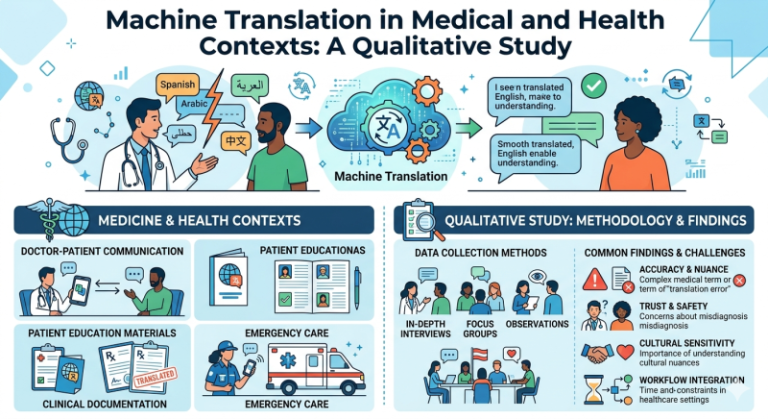
30 April 2026, Bangkok – This article presents the findings of a qualitative exploratory study examining the use of machine translation (MT) among freelance and in-house medical translators working with the English–Spanish language pair. Drawing on semi-structured interviews with ten professional translators, the study investigates how and why MT is integrated into translation workflows, the perceived quality of MT output and its determining factors, and the extent to which MT reshapes translation processes, professional roles, and competences.
The findings reveal that MT is widely adopted, primarily due to productivity gains and client requirements, although its effectiveness varies significantly depending on text genre, domain specificity, and system training. While neural machine translation (NMT) is perceived as producing fluent output, it also introduces risks, particularly the difficulty of detecting subtle errors in safety-critical contexts. The results further indicate a reconfiguration of translators’ roles, with increasing emphasis on post-editing, domain expertise, and advisory functions.
The study highlights the need for enhanced training in linguistic competence, critical and ethical use of technology, and thematic expertise. It also underscores the continued centrality of human translators in medical and health communication, particularly in contexts requiring accuracy, clarity, and ethical responsibility.
Keywords: machine translation, post-editing, medical translation, translator competence, qualitative research
Introduction
Machine translation (MT) has become a central component of contemporary translation practice. Advances in neural machine translation (NMT) have led to significant improvements in output quality, prompting widespread adoption among both freelance translators and language service providers, often in combination with post-editing (PE) to increase productivity and meet tighter deadlines (Collantes Fraile et al., 2018). International organisations have also integrated MT into their workflows, as exemplified by institutional systems designed to handle large volumes of multilingual content.
This technological shift has generated a growing body of research addressing MT from multiple perspectives, including comparative evaluations of MT and human translation (Briva-Iglesias, 2021; Jia & Sun, 2022; Popović et al., 2021), stakeholder perceptions (Cadwell et al., 2018; Nitzke et al., 2024), competence modelling (Konttinen et al., 2020; Robert et al., 2022), and implications for translator training (Guerberof-Arenas & Moorkens, 2019; Kenny, 2020). Increasing attention has also been paid to domain-specific applications, recognising that MT performance varies considerably across text types and language pairs (Toral et al., 2023).
Medical and health translation constitutes a particularly critical domain due to its classification as a safety-critical field, in which translation errors may have serious consequences for end users (Canfora & Ottmann, 2020). Although research has begun to explore the use of MT in healthcare settings, existing studies have predominantly focused on system performance rather than on the perspectives of practising translators. Consequently, there remains a need to investigate how MT affects translators’ workflows, competences, and professional identities.
This study addresses this gap by exploring the experiences of medical translators working with MT. It seeks to examine the extent of MT usage, the factors influencing its adoption, and its impact on professional practice and training.
Machine Translation in Medical and Health Translation
Medical and health translation encompasses a broad range of genres and communicative contexts, from highly specialised biomedical texts to public health communication aimed at lay audiences (Montalt, 2021). This dual dimension entails significant challenges, including terminological complexity, audience diversity, and cultural differences, all of which require a high level of precision and adaptability (Montalt et al., 2024; Navarro, 1997).
Research on MT in this domain has demonstrated both its potential and its limitations. On the one hand, MT can facilitate access to multilingual health information and support communication in contexts where professional translation resources are limited (Haddow et al., 2021). On the other hand, concerns persist regarding accuracy, reliability, and ethical implications, particularly in safety-critical scenarios (Khoong & Rodriguez, 2022). Studies consistently show that MT output quality depends on factors such as text genre, domain specificity, and training data, with recurrent errors including mistranslation of specialised terminology and lack of register adaptation (Neves et al., 2023).
Importantly, most research has focused on the evaluation of MT output rather than on the experiences of professional translators. Although some studies have examined translators’ perceptions (Vidrequin, 2022, 2023), further research is needed to understand how MT influences professional practice, competences, and training.
Methods
This study adopts a qualitative exploratory design based on semi-structured interviews, allowing for in-depth investigation of participants’ experiences while maintaining a degree of comparability across responses (Saldanha & O’Brien, 2014).
Participants were selected using maximum variation sampling to capture diversity in professional profiles, including differences in educational background and employment status (Moser & Korstjens, 2018). The sample consisted of ten medical translators working with the English–Spanish language pair, including both freelancers and in-house translators.
Data were collected through online interviews conducted in Spanish and subsequently transcribed for analysis. The interview protocol covered three main areas: socio-professional background, experience with MT and post-editing, and competences and training needs.
The data were analysed thematically, combining deductive coding based on the research questions with inductive identification of emerging themes. This approach enabled a comprehensive understanding of translators’ perspectives on MT and its implications for their work.
Results
The findings reveal widespread use of MT among participants, although usage patterns vary depending on employment status and professional context. Freelancers tend to adopt a more selective approach, often using MT as a complementary tool, whereas in-house translators frequently work within integrated systems that incorporate MT into standard workflows.
Participants generally perceive the quality of NMT output as high, particularly in standardised and less complex text genres. However, they emphasise that the apparent fluency of MT output can obscure underlying errors, making them more difficult to detect. This issue is particularly critical in medical translation, where even minor inaccuracies may have serious consequences.
The suitability of MT is strongly influenced by text genre. Highly conventionalised texts with predictable structures are considered well-suited to MT, whereas texts requiring creativity, empathy, or extensive domain-specific knowledge pose greater challenges. Participants also highlight the importance of system training and language pair characteristics in determining output quality.
Regarding the translation process, MT is perceived as shifting the initial cognitive effort from the translator to the machine, although core translation steps remain largely unchanged. While MT may reduce certain types of documentary research, translators emphasise the continued need for careful verification of output.
Participants identify both advantages and drawbacks of MT. Advantages include increased productivity, reduced physical effort, and improved terminological consistency. However, drawbacks include the risk of undetected errors, reduced creativity, and potential negative impacts on working conditions, particularly for freelancers facing lower rates and tighter deadlines.
In terms of competences, participants emphasise that traditional translation skills remain essential but require greater emphasis on editing, critical evaluation, technological literacy, and domain knowledge. Ethical considerations also emerge as a key competence, particularly in relation to confidentiality and responsible use of technology.
Discussion
The findings confirm that MT is becoming an integral component of medical translation practice, while also highlighting its limitations in a safety-critical domain. The variability of MT performance across text genres and contexts underscores the importance of domain-specific expertise and the ability to assess the suitability of MT for a given task.
The study also points to a shift in translators’ roles, with increasing emphasis on post-editing and advisory functions. This evolution aligns with broader discussions on translator competence in the age of artificial intelligence (Prieto-Ramos, 2024). Translators are no longer solely responsible for producing translations but are increasingly involved in evaluating, refining, and managing MT output.
The concept of MT literacy emerges as particularly relevant, encompassing not only technical knowledge but also the ability to critically and ethically engage with MT systems (Ehrensberger-Dow et al., 2023). Developing this competence is essential for ensuring that MT is used effectively and responsibly in professional practice.
Conclusions, Limitations, and Future Research
This study provides an exploratory insight into the integration of MT in medical translation practice, highlighting both its benefits and its challenges. While MT offers significant productivity gains, its use in a safety-critical domain requires careful management and high levels of expertise.
Several limitations must be acknowledged. The small sample size and exploratory design limit the generalisability of the findings. In addition, the focus on a single language pair restricts the applicability of the results to other linguistic contexts.
Future research should adopt a mixed-methods approach to examine MT use on a larger scale and across different language pairs. Further studies should also investigate the impact of emerging technologies, including generative artificial intelligence, on translation practice and training.
Overall, the study underscores the continued importance of human translators in medical and health communication and highlights the need for training programmes that integrate technological competence with strong linguistic and domain-specific expertise.
References
- Cadwell, P., O’Brien, S., & Teixeira, C. (2018). Resistance and accommodation: Factors for the (non)adoption of machine translation among professional translators. Perspectives, 26(3), 301–321.
- Canfora, C., & Ottmann, A. (2020). Risks in neural machine translation. Translation Spaces, 9(1), 58–77.
- Collantes Fraile, C., Mallo Martínez, J., Parra Escartín, C., Quiñones Tapia, H., & Serrano Rudilla, R. (2018). Pásate al lado oscuro: Ventajas de la traducción automática para el traductor profesional. La Linterna del Traductor, 17, 33–39.
- Montalt, V. (2021). Medical humanities and translation. In Ş. Susam-Saraeva & E. Spišiaková (Eds.), The Routledge handbook of translation and health (pp. 130–148). Routledge.
- Zappatore, M., & Ruggieri, G. (2024). Adopting machine translation in the healthcare sector: A methodological multi-criteria review. Computer Speech & Language, 84, 101582.
- Nitzke, J., Hansen-Schirra, S., & Canfora, C. (2019). Risk management and post-editing competence. The Journal of Specialised Translation, 31, 239–259.
- Trujillos-Yébenes, L., & Muñoz-Miquel, A. (2022). La traducción automática y la posedición en el ámbito médico. Revista Tradumàtica. Tecnologies de la Traducció, 20, 57–76.
For professional services, please visit: https://www.seaproti.org/practitioners/
About certified translators, translation certifiers, and certified interpreters associated with SEAProTI.
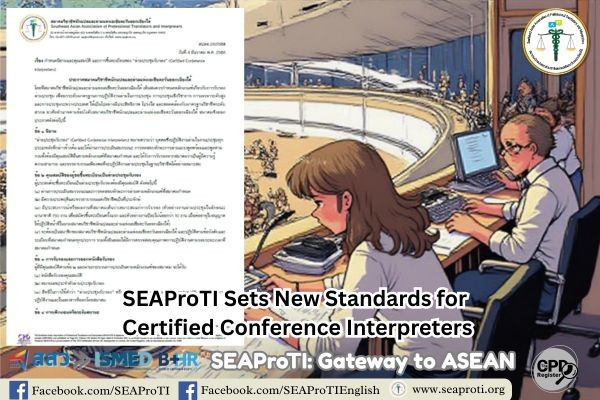
The Southeast Asian Association of Professional Translators and Interpreters (SEAProTI) has officially shared the qualifications and requirements for becoming Certified Translators, Translation Certification Providers, and Certified Interpreters in Sections 9 and 10 of the Royal Gazette, which was published by the Prime Minister’s Office in Thailand on July 25, 2024. Certified Translators, Translation Certification Providers, and Certified Interpreters
The Council of State has proposed the enactment of a Royal Decree, granting registered translators and recognised translation certifiers from professional associations or accredited language institutions the authority to provide legally valid translation certification (Letter to SEAProTI dated April 28, 2025)
SEAProTI is the first professional association in Thailand and Southeast Asia to implement a comprehensive certification system for translators, certifiers, and interpreters.
Head Office: Baan Ratchakru Building, No. 33, Room 402, Soi Phahonyothin 5, Phahonyothin Road, Phaya Thai District, Bangkok 10400, Thailand
Email: hello@seaproti.com | Tel.: (+66) 2-114-3128 (Office hours: Mon–Fri, 09:00–17:00).
การเข้าถึงการแปลด้วยเครื่องในบริบทการแพทย์และสาธารณสุข: การศึกษาเชิงสำรวจ
ผู้เขียน: ไกรฤกษ์ กรวยทอง
30 เมษายน 2569, กรุงเทพมหานคร – บทความนี้นำเสนอผลการศึกษาเชิงคุณภาพแบบสำรวจ ซึ่งใช้การสัมภาษณ์นักแปลด้านการแพทย์ทั้งแบบอิสระและประจำองค์กรที่ทำงานในคู่ภาษาอังกฤษ–สเปน เพื่อสำรวจการใช้เทคโนโลยีการแปลด้วยเครื่อง (machine translation: MT) ในกระบวนการทำงาน โดยมุ่งพิจารณาว่านักแปลนำเทคโนโลยีดังกล่าวมาใช้ด้วยเหตุผลใด คุณภาพของผลลัพธ์ MT ขึ้นอยู่กับปัจจัยใด เทคโนโลยีนี้ส่งผลต่อแนวทางการแปลอย่างไร ตลอดจนผลกระทบต่อบทบาทวิชาชีพ ภารกิจงาน และสมรรถนะที่จำเป็นของนักแปล
ผลการศึกษาชี้ให้เห็นว่า MT ได้เข้ามามีบทบาทอย่างมีนัยสำคัญในวิชาชีพการแปลด้านการแพทย์ แต่ยังคงต้องพึ่งพาการตรวจแก้โดยมนุษย์อย่างเข้มข้น โดยเฉพาะในบริบทที่มีความเสี่ยงสูงต่อความปลอดภัยของผู้ใช้ นอกจากนี้ การศึกษายังสะท้อนแนวโน้มการนิยามบทบาทนักแปลใหม่ ทั้งในฐานะผู้เชี่ยวชาญเฉพาะด้านและที่ปรึกษาด้านภาษา ตลอดจนความจำเป็นในการพัฒนาทักษะด้านภาษา การคิดเชิงวิพากษ์ การใช้เทคโนโลยีอย่างมีจริยธรรม และความรู้เฉพาะทาง
คำสำคัญ: การแปลด้วยเครื่อง, การแก้ไขภายหลังการแปล, การแปลทางการแพทย์, การวิจัยเชิงคุณภาพ, นักแปลทางการแพทย์
บทนำ
การแปลด้วยเครื่องได้กลายเป็นองค์ประกอบสำคัญในอุตสาหกรรมการแปล โดยเฉพาะอย่างยิ่งหลังการพัฒนาเทคโนโลยีการแปลด้วยเครื่องแบบประสาท (neural machine translation: NMT) ซึ่งช่วยเพิ่มประสิทธิภาพและความเร็วในการทำงานอย่างมีนัยสำคัญ (คอลลันเตส เฟรเล และคณะ, 2561) องค์กรระหว่างประเทศจำนวนมากได้นำ MT มาใช้เพื่อรองรับปริมาณงานแปลที่เพิ่มขึ้น
งานวิจัยที่ผ่านมาได้ศึกษาประเด็นต่าง ๆ เช่น การเปรียบเทียบคุณภาพระหว่าง MT กับการแปลโดยมนุษย์ การรับรู้ของผู้มีส่วนได้ส่วนเสีย และผลกระทบต่อการฝึกอบรมนักแปล (แคดเวลล์ และคณะ, 2561; เคนนี, 2563) อย่างไรก็ตาม งานวิจัยที่มุ่งเน้นมุมมองของนักแปลมืออาชีพในสาขาการแพทย์ยังมีจำกัด
การแปลทางการแพทย์ถือเป็นสาขาที่มีความอ่อนไหวสูง เนื่องจากข้อผิดพลาดอาจส่งผลกระทบร้ายแรงต่อผู้ใช้ปลายทาง (แคนฟอรา และ ออตต์มันน์, 2563) จึงจำเป็นต้องศึกษาบทบาทของ MT ในบริบทนี้อย่างเฉพาะเจาะจง
บทความนี้มีวัตถุประสงค์เพื่อสำรวจการใช้ MT ของนักแปลทางการแพทย์ ผลกระทบต่อกระบวนการทำงาน สมรรถนะที่จำเป็น และแนวโน้มการเปลี่ยนแปลงของวิชาชีพ
การแปลด้วยเครื่องในบริบทการแพทย์และสาธารณสุข
การแปลทางการแพทย์มีลักษณะเฉพาะ ได้แก่ ความเป็นสหสาขาวิชา การใช้คำศัพท์เฉพาะจำนวนมาก และความหลากหลายของประเภทข้อความ (มอนตาลต์, 2564) ปัจจัยเหล่านี้ก่อให้เกิดความท้าทาย เช่น ความแม่นยำของคำศัพท์ ความแตกต่างทางวัฒนธรรม และความจำเป็นในการปรับระดับภาษาให้เหมาะสมกับกลุ่มผู้อ่าน
งานวิจัยจำนวนมากชี้ว่า MT สามารถช่วยเพิ่มการเข้าถึงข้อมูลทางการแพทย์ แต่ยังไม่สามารถทดแทนผู้เชี่ยวชาญได้ เนื่องจากปัญหาความคลาดเคลื่อนทางความหมายและข้อจำกัดด้านบริบท (ซัปปาโตเร และ รุกจีเอรี, 2567)
นอกจากนี้ ยังพบข้อผิดพลาดซ้ำ ๆ เช่น การแปลคำย่อผิด ความไม่สอดคล้องของสำนวน และการใช้โครงสร้างภาษาที่ไม่เป็นธรรมชาติ (เนเวส และคณะ, 2566) ซึ่งยิ่งตอกย้ำความจำเป็นของการตรวจแก้โดยมนุษย์
ระเบียบวิธีวิจัย
การศึกษานี้ใช้การสัมภาษณ์แบบกึ่งโครงสร้างกับนักแปลทางการแพทย์จำนวน 10 คน โดยคัดเลือกด้วยวิธีความแปรผันสูงสุด เพื่อให้ครอบคลุมความหลากหลายของประสบการณ์และภูมิหลัง (โมเซอร์ และ คอร์สท์เยนส์, 2561)
ผู้ให้ข้อมูลประกอบด้วยทั้งนักแปลอิสระและนักแปลประจำองค์กร มีประสบการณ์การใช้ MT แตกต่างกัน การวิเคราะห์ข้อมูลใช้วิธีการวิเคราะห์เชิงธีมตามคำถามวิจัย
ผลการวิจัย
1. การใช้ MT และคุณภาพผลลัพธ์
นักแปลส่วนใหญ่ใช้ MT เป็นประจำ โดยเฉพาะเมื่อมีข้อกำหนดจากลูกค้าหรือเพื่อเพิ่มประสิทธิภาพการทำงาน อย่างไรก็ตาม มีบางส่วนที่หลีกเลี่ยงการใช้ เนื่องจากมองว่าการแก้ไขหลังการแปลลดความสร้างสรรค์
คุณภาพของ MT ถูกประเมินว่าอยู่ในระดับดีถึงดีมาก โดยเฉพาะในข้อความที่มีโครงสร้างมาตรฐาน เช่น เอกสารวิชาการหรือคำแนะนำการใช้ยา แต่ยังมีข้อจำกัดในข้อความที่ต้องใช้ภาษาสร้างสรรค์หรือเน้นความเห็นอกเห็นใจ เช่น เอกสารสำหรับผู้ป่วย
2. ข้อผิดพลาดและกระบวนการแก้ไข
ข้อผิดพลาดที่พบบ่อย ได้แก่ การแปลคำศัพท์เฉพาะผิด การใช้โครงสร้างภาษาไม่เหมาะสม และการตีความผิด ความท้าทายสำคัญคือข้อผิดพลาดของ NMT มักตรวจจับได้ยาก เนื่องจากข้อความมีความลื่นไหล
3. ผลกระทบต่อกระบวนการทำงาน
MT เปลี่ยนกระบวนการแปลโดยลดภาระการสร้างข้อความตั้งต้น แต่ไม่ลดความจำเป็นในการค้นคว้าข้อมูล นักแปลยังคงต้องตรวจสอบความถูกต้องอย่างละเอียด
ในด้านสภาพการทำงาน นักแปลอิสระรายงานถึงค่าตอบแทนที่ลดลงและกำหนดเวลาที่เข้มงวดขึ้น ขณะที่นักแปลประจำองค์กรได้รับผลกระทบน้อยกว่า
อภิปรายผล
ผลการศึกษายืนยันว่า MT เป็นเครื่องมือเสริมที่มีประโยชน์ แต่ไม่สามารถทดแทนนักแปลได้ โดยเฉพาะในสาขาที่มีความเสี่ยงสูงอย่างการแพทย์ สอดคล้องกับงานวิจัยก่อนหน้า (ทรูฆิลโลส-เยเบเนส และ มูญอซ-มิเกล, 2565; ซัปปาโตเร และ รุกจีเอรี, 2567)
นักแปลจำเป็นต้องพัฒนาทักษะใหม่ เช่น ความรู้ด้านเทคโนโลยี การคิดเชิงวิพากษ์ และการประเมินความเสี่ยงของข้อความ (นิทซ์เค และคณะ, 2562) นอกจากนี้ บทบาทของนักแปลกำลังขยายไปสู่การเป็นที่ปรึกษาด้านภาษาและผู้มีส่วนร่วมในการพัฒนา MT
สรุป ข้อจำกัด และแนวทางวิจัยในอนาคต
การศึกษานี้ให้ข้อมูลเชิงลึกเกี่ยวกับการใช้ MT ในการแปลทางการแพทย์ แต่มีข้อจำกัดด้านขนาดตัวอย่างและการมุ่งเน้นเพียงคู่ภาษาเดียว จึงไม่สามารถสรุปทั่วไปได้
การวิจัยในอนาคตควรใช้วิธีผสมผสาน (mixed methods) และขยายไปยังคู่ภาษาอื่น รวมถึงศึกษาบทบาทของปัญญาประดิษฐ์เชิงกำเนิด (GenAI) ซึ่งกำลังมีอิทธิพลต่อวิชาชีพอย่างรวดเร็ว
เอกสารอ้างอิง
- แคดเวลล์, พี., โอ’ไบรอัน, เอส., และ เตเซรา, ซี. (2561). การต่อต้านและการยอมรับการแปลด้วยเครื่องในหมู่นักแปลมืออาชีพ. Perspectives, 26(3), 301–321.
- แคนฟอรา, ซี., และ ออตต์มันน์, เอ. (2563). ความเสี่ยงในการแปลด้วยเครื่องแบบประสาท. Translation Spaces, 9(1), 58–77.
- คอลลันเตส เฟรเล, ซี., และคณะ. (2561). ข้อดีของการแปลด้วยเครื่องสำหรับนักแปลมืออาชีพ. La Linterna del Traductor, 17, 33–39.
- มอนตาลต์, วี. (2564). การแปลทางการแพทย์และมนุษยศาสตร์. ใน The Routledge Handbook of Translation and Health.
- ซัปปาโตเร, เอ็ม., และ รุกจีเอรี, จี. (2567). การนำการแปลด้วยเครื่องมาใช้ในภาคสาธารณสุข: การทบทวนเชิงวิธีวิทยา. Computer Speech & Language, 84.
- นิทซ์เค, เจ., และคณะ. (2562). การจัดการความเสี่ยงและสมรรถนะการแก้ไขภายหลังการแปล. The Journal of Specialised Translation, 31, 239–259.
- ทรูฆิลโลส-เยเบเนส, แอล., และ มูญอซ-มิเกล, เอ. (2565). การแปลด้วยเครื่องและการแก้ไขในบริบทการแพทย์. Revista Tradumàtica, 20, 57–76.
ติดต่อขอใช้บริการนักวิชาชีพของสมาคมได้ที่:https://www.seaproti.org/practitioners/
สมาคมวิชาชีพนักแปลและล่ามแห่งเอเชียตะวันออกเฉียงใต้ (SEAProTI) ได้ประกาศหลักเกณฑ์และคุณสมบัติของผู้ที่ขึ้นทะเบียนเป็น “นักแปลรับรอง (Certified Translators) และผู้รับรองการแปล (Translation Certification Providers) และล่ามรับรอง (Certified Interpreters)” ของสมาคม หมวดที่ 9 และหมวดที่ 10 ในราชกิจจานุเบกษา ของสำนักเลขาธิการคณะรัฐมนตรี ในสำนักนายกรัฐมนตรี แห่งราชอาณาจักรไทย ลงวันที่ 25 ก.ค. 2567 เล่มที่ 141 ตอนที่ 66 ง หน้า 100 อ่านฉบับเต็มได้ที่: นักแปลรับรอง ผู้รับรองการแปล และล่ามรับรอง
สำนักคณะกรรมการกฤษฎีกาเสนอให้ตราเป็นพระราชกฤษฎีกา โดยกำหนดให้นักแปลที่ขึ้นทะเบียน รวมถึงผู้รับรองการแปลจากสมาคมวิชาชีพหรือสถาบันสอนภาษาที่มีการอบรมและขึ้นทะเบียน สามารถรับรองคำแปลได้ (จดหมายถึงสมาคม SEAProTI ลงวันที่ 28 เม.ย. 2568)
สมาคมวิชาชีพนักแปลและล่ามแห่งเอเชียตะวันออกเฉียงใต้เป็นสมาคมวิชาชีพแห่งแรกและแห่งเดียวในประเทศไทยและภูมิภาคเอเชียตะวันออกเฉียงใต้ที่มีระบบรับรองนักแปลรับรอง ผู้รับรองการแปล และล่ามรับรอง
สำนักงานใหญ่: อาคารบ้านราชครู เลขที่ 33 ห้อง 402 ซอยพหลโยธิน 5 ถนนพหลโยธิน แขวงพญาไท เขตพญาไท กรุงเทพมหานคร 10400 ประเทศไทย
อีเมล: hello@seaproti.com โทรศัพท์: (+66) 2-114-3128(เวลาทำการ: วันจันทร์–วันศุกร์ เวลา 09.00–17.00 น.)