



The Thailand ED Plus Visa (Non-Immigrant ED Plus): Policy Innovation, Mobility Governance, and the Role of Certified Language Professionals
Author: Griroek Gruaythong
30 April 2026, Bangkok – In June 2024, the Thai Cabinet introduced a suite of new visa categories aimed at enhancing Thailand’s attractiveness as a regional hub for education, investment, and skilled migration. Among these, the Thailand ED Plus Visa (Non-Immigrant ED Plus) represents a targeted policy intervention designed to support international students enrolled in higher education institutions. This article examines the legal and administrative features of the ED Plus Visa in comparison with the conventional Education (ED) Visa, with particular attention to post-study mobility, labor market transition, and regulatory compliance. It further analyses the critical role played by certified translators, translation certification providers, and certified interpreters—particularly those affiliated with the Southeast Asian Association of Professional Translators and Interpreters—in facilitating visa processing, ensuring documentary legitimacy, and supporting transnational legal communication. Drawing on policy analysis and existing literature on migration governance and language mediation, the article argues that language professionals constitute an essential yet under-recognized component of Thailand’s evolving visa regime.
Keywords: Thailand ED Plus Visa, migration policy, international students, translation certification, interpreting, language professionals
Introduction
The internationalization of higher education has increasingly intersected with migration governance, prompting states to design visa regimes that attract and retain foreign students while maintaining regulatory oversight (Findlay et al., 2017). Thailand’s introduction of the ED Plus Visa in 2024 reflects this global trend, positioning the country as a competitive destination for tertiary education in Southeast Asia. Unlike the conventional Non-Immigrant ED Visa, which primarily facilitates short-term study, the ED Plus Visa integrates post-graduation mobility options and flexible travel provisions.
While policy discussions often focus on legal frameworks and economic outcomes, less attention has been paid to the infrastructural role of language mediation in visa systems. This article addresses this gap by situating certified translators and interpreters as key actors in the implementation of Thailand’s education visa policies.
Literature Review
Research on student migration highlights the growing importance of post-study work opportunities in shaping destination choice (Czaika & de Haas, 2013). Visa policies that enable labor market transition are seen as instruments of “talent retention” within knowledge economies. In parallel, studies in translation and interpreting have emphasized the role of language professionals in legal and institutional contexts, particularly in ensuring accuracy, compliance, and cross-cultural intelligibility (Mossop, 2019; Remael, 2001).
Jakobson’s (1959) concept of interlingual translation remains foundational in understanding how meaning is transferred across legal systems, while more recent scholarship underscores the institutional authority of certified translations in administrative processes (Neelsen, 2021). However, the intersection between migration policy and language certification practices remains underexplored, especially in Southeast Asia.
Methodology
This study adopts a qualitative policy analysis approach, examining official descriptions of the ED Plus Visa and related administrative requirements. The analysis is complemented by a review of secondary literature on migration policy and translation studies. Particular attention is given to documentation requirements and procedural steps where language professionals play a role.
The Thailand ED Plus Visa: Features and Policy Rationale
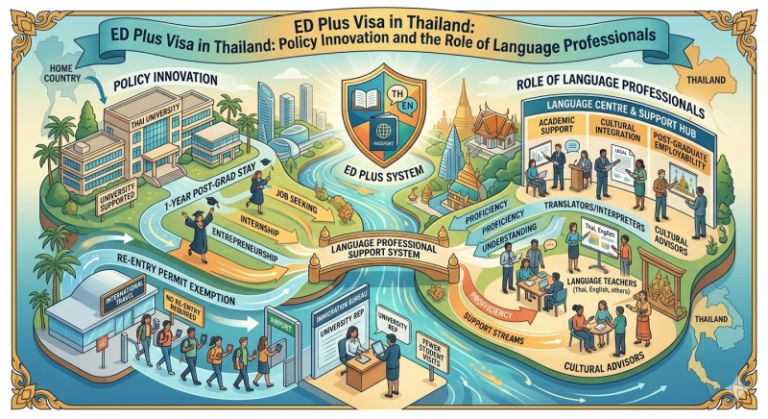
The ED Plus Visa is a non-immigrant visa category available exclusively to international students enrolled in bachelor’s degree programs or higher at accredited Thai institutions. This distinguishes it from the standard ED Visa, which accommodates a broader range of educational activities, including language courses and short-term training.
A defining feature of the ED Plus Visa is its provision for a one-year extension following graduation, enabling visa holders to seek employment, travel, or engage in other lawful activities within Thailand. This extension is contingent upon institutional sponsorship, reflecting a hybrid governance model in which universities act as intermediaries between graduates and immigration authorities.
Additionally, the ED Plus Visa allows multiple entries without the need for re-entry permits, thereby reducing administrative burdens and facilitating transnational mobility. In contrast, holders of the standard ED Visa must obtain re-entry permits to maintain visa validity when traveling abroad. Despite these differences, both visa categories require periodic reporting to immigration authorities, typically every 90 days.
Documentary Requirements and Legal-Linguistic Mediation
Applicants for the ED Plus Visa must submit a range of documents, including proof of enrollment, financial statements, identification documents, and, in some cases, police clearance certificates. Crucially, all documentation must be in Thai or English, or otherwise translated and certified.
This requirement foregrounds the role of certified translators and translation certification providers, who ensure that documents meet legal and institutional standards. Certified translations are not merely linguistic conversions but function as legally recognized instruments that attest to the accuracy and completeness of the original content (Mossop, 2019). Errors or inconsistencies in translation can result in delays, rejections, or legal complications, underscoring the high stakes involved.
The Role of Certified Translators and Interpreters
Certified translators affiliated with professional bodies such as the Southeast Asian Association of Professional Translators and Interpreters play a pivotal role in the ED Plus Visa ecosystem. Their responsibilities extend beyond translation to include document authentication, adherence to standardized terminology, and compliance with jurisdiction-specific requirements.
Translation certification providers act as institutional guarantors of quality, issuing certifications that validate translated documents for official use. These certifications are often required by embassies, consulates, and immigration offices, thereby embedding translation practices within formal governance structures.
Certified interpreters, meanwhile, facilitate oral communication between applicants and authorities during interviews, legal consultations, or administrative proceedings. Their role is particularly in ensuring procedural fairness and preventing miscommunication in high-stakes contexts such as visa applications or compliance reporting.
From a sociological perspective, these language professionals function as “gatekeepers” of mobility, enabling or constraining access to migration pathways through their mediation of linguistic and legal knowledge (Remael, 2001).
Discussion
The ED Plus Visa reflects Thailand’s strategic effort to align its education and migration policies with global trends in talent mobility. By offering post-study opportunities and flexible travel conditions, the policy enhances the country’s attractiveness to international students. However, its successful implementation depends not only on legal provisions but also on the reliability of supporting infrastructures, including language services.
The involvement of certified translators and interpreters highlights the interdependence between migration governance and linguistic expertise. As visa processes become more complex and documentation requirements more stringent, the demand for professional language mediation is likely to increase. This underscores the need for standardized certification frameworks and greater recognition of language professionals within policy design.
Conclusion
The Thailand ED Plus Visa represents a significant development in the country’s migration and education policy landscape, offering enhanced opportunities for international students while maintaining regulatory oversight. This article has argued that certified translators, translation certification providers, and certified interpreters are integral to the functioning of this system, ensuring the accuracy, legality, and efficiency of visa processes.
Future research should further explore the institutionalization of language services within migration regimes and examine how professional associations can contribute to policy development and implementation.
References
- Czaika, M., & de Haas, H. (2013). The effectiveness of immigration policies. Population and Development Review, 39(3), 487–508.
- Findlay, A. M., King, R., Smith, F. M., Geddes, A., & Skeldon, R. (2017). World class? An investigation of globalisation, difference and international student mobility. Transactions of the Institute of British Geographers, 42(1), 118–131.
- Jakobson, R. (1959). On linguistic aspects of translation. In R. A. Brower (Ed.), On translation (pp. 232–239). Harvard University Press.
- Mossop, B. (2019). Revising and editing for translators (4th ed.). Routledge.
- Neelsen, S. (2021). Certified translation and institutional trust. Translation Studies, 14(2), 145–162.
- Remael, A. (2001). Some thoughts on the study of multimodal and multimedia translation. Journal of Specialised Translation, 6, 1–14.
For professional services, please visit: https://www.seaproti.org/practitioners/
About certified translators, translation certifiers, and certified interpreters associated with SEAProTI.
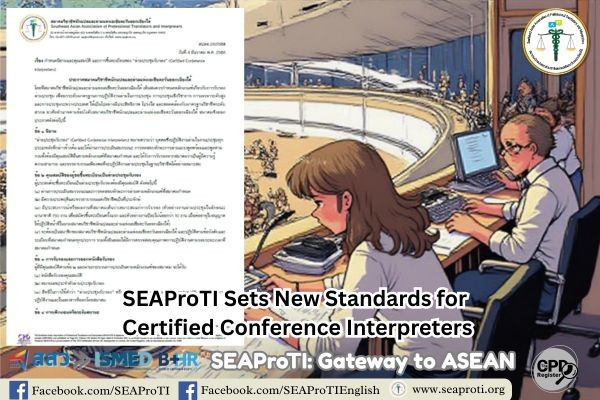
The Southeast Asian Association of Professional Translators and Interpreters (SEAProTI) has officially shared the qualifications and requirements for becoming Certified Translators, Translation Certification Providers, and Certified Interpreters in Sections 9 and 10 of the Royal Gazette, which was published by the Prime Minister’s Office in Thailand on July 25, 2024. Certified Translators, Translation Certification Providers, and Certified Interpreters
The Council of State has proposed the enactment of a Royal Decree, granting registered translators and recognised translation certifiers from professional associations or accredited language institutions the authority to provide legally valid translation certification (Letter to SEAProTI dated April 28, 2025)
SEAProTI is the first professional association in Thailand and Southeast Asia to implement a comprehensive certification system for translators, certifiers, and interpreters.
Head Office: Baan Ratchakru Building, No. 33, Room 402, Soi Phahonyothin 5, Phahonyothin Road, Phaya Thai District, Bangkok 10400, Thailand
Email: hello@seaproti.com | Tel.: (+66) 2-114-3128 (Office hours: Mon–Fri, 09:00–17:00).
วีซ่าการศึกษาไทยแบบ ED Plus (Non-Immigrant ED Plus): นวัตกรรมนโยบาย การกำกับดูแลการเคลื่อนย้าย และบทบาทของผู้เชี่ยวชาญด้านภาษา
ผู้เขียน: ไกรฤกษ์ กรวยทอง
30 เมษายน 2569, กรุงเทพมหานคร – ในเดือนมิถุนายน พ.ศ. 2567 คณะรัฐมนตรีไทยได้ประกาศใช้มาตรการวีซ่าชุดใหม่เพื่อยกระดับศักยภาพของประเทศไทยในฐานะศูนย์กลางด้านการศึกษา การลงทุน และแรงงานทักษะในภูมิภาคเอเชียตะวันออกเฉียงใต้ หนึ่งในนั้นคือวีซ่า ED Plus ซึ่งออกแบบมาเฉพาะสำหรับนักศึกษาต่างชาติที่ศึกษาในระดับอุดมศึกษา บทความนี้มุ่งวิเคราะห์ลักษณะทางกฎหมายและการบริหารของวีซ่า ED Plus เปรียบเทียบกับวีซ่าการศึกษา (ED) แบบดั้งเดิม โดยให้ความสำคัญกับมิติของการเคลื่อนย้ายหลังสำเร็จการศึกษา การเปลี่ยนผ่านเข้าสู่ตลาดแรงงาน และการปฏิบัติตามกฎระเบียบ นอกจากนี้ บทความยังวิเคราะห์บทบาทของนักแปลรับรอง ผู้ให้บริการรับรองการแปล และล่ามรับรอง โดยเฉพาะผู้ที่สังกัด Southeast Asian Association of Professional Translators and Interpreters ในการสนับสนุนกระบวนการขอวีซ่า การรับรองความถูกต้องของเอกสาร และการสื่อสารทางกฎหมายข้ามภาษา โดยอาศัยการวิเคราะห์เชิงนโยบายและวรรณกรรมที่เกี่ยวข้อง บทความเสนอว่าผู้เชี่ยวชาญด้านภาษาเป็นองค์ประกอบสำคัญที่ยังไม่ได้รับการตระหนักอย่างเพียงพอในระบบวีซ่าของไทย
คำสำคัญ: วีซ่า ED Plus, นโยบายการย้ายถิ่น, นักศึกษาต่างชาติ, การรับรองการแปล, การล่าม, ผู้เชี่ยวชาญด้านภาษา
บทนำ
กระบวนการนานาชาติของการศึกษาในระดับอุดมศึกษาได้เชื่อมโยงอย่างใกล้ชิดกับการกำกับดูแลการย้ายถิ่น ส่งผลให้รัฐต่าง ๆ ต้องออกแบบนโยบายวีซ่าที่สามารถดึงดูดและรักษานักศึกษาต่างชาติไว้ได้ ขณะเดียวกันก็ยังคงรักษาการควบคุมเชิงกฎระเบียบ (ฟินด์เลย์ และคณะ, 2560) การเปิดตัววีซ่า ED Plus ของประเทศไทยในปี พ.ศ. 2567 สะท้อนแนวโน้มดังกล่าว โดยมีเป้าหมายเพื่อเสริมสร้างความสามารถในการแข่งขันของประเทศในฐานะจุดหมายปลายทางด้านการศึกษาในภูมิภาค
แม้ว่างานวิจัยส่วนใหญ่จะให้ความสำคัญกับกรอบกฎหมายและผลลัพธ์ทางเศรษฐกิจ แต่มิติด้านโครงสร้างพื้นฐานทางภาษา โดยเฉพาะบทบาทของนักแปลและล่ามในกระบวนการวีซ่า ยังไม่ได้รับการศึกษาอย่างเพียงพอ บทความนี้จึงมุ่งเติมเต็มช่องว่างดังกล่าว
ทบทวนวรรณกรรม
งานวิจัยด้านการย้ายถิ่นของนักศึกษาชี้ให้เห็นว่าปัจจัยสำคัญที่มีผลต่อการเลือกประเทศปลายทางคือโอกาสในการทำงานหลังสำเร็จการศึกษา (ชไคกา และ เดอ ฮาส, 2556) นโยบายวีซ่าที่เอื้อต่อการเปลี่ยนผ่านเข้าสู่ตลาดแรงงานจึงถูกมองว่าเป็นเครื่องมือในการรักษาทรัพยากรมนุษย์ที่มีศักยภาพ
ในอีกด้านหนึ่ง งานศึกษาด้านการแปลและการล่ามเน้นถึงบทบาทของผู้เชี่ยวชาญด้านภาษาในบริบททางกฎหมายและสถาบัน โดยเฉพาะการสร้างความถูกต้อง ความน่าเชื่อถือ และความเข้าใจข้ามวัฒนธรรม (มอสซอป, 2562; เรมาล, 2544) แนวคิดการแปลระหว่างภาษา (interlingual translation) ของจาค็อบสัน (2502) ยังคงเป็นพื้นฐานสำคัญในการอธิบายการถ่ายทอดความหมายระหว่างระบบกฎหมาย ขณะที่งานวิจัยร่วมสมัยได้ชี้ให้เห็นถึงบทบาทของการแปลรับรองในฐานะเครื่องมือสร้างความเชื่อมั่นเชิงสถาบัน (นีลเซน, 2564) อย่างไรก็ตาม ความเชื่อมโยงระหว่างนโยบายการย้ายถิ่นกับการรับรองการแปลยังคงเป็นประเด็นที่ได้รับการศึกษาน้อย
ระเบียบวิธีวิจัย
การศึกษานี้ใช้วิธีการวิเคราะห์เชิงนโยบาย โดยพิจารณาข้อมูลเกี่ยวกับวีซ่า ED Plus และข้อกำหนดด้านเอกสารที่เกี่ยวข้อง ร่วมกับการทบทวนวรรณกรรมด้านนโยบายการย้ายถิ่นและการแปลศึกษา โดยเน้นการวิเคราะห์จุดที่ผู้เชี่ยวชาญด้านภาษาเข้ามามีบทบาทในกระบวนการ
วีซ่า ED Plus: ลักษณะสำคัญและเหตุผลเชิงนโยบาย
วีซ่า ED Plus เป็นวีซ่าประเภทคนอยู่ชั่วคราว (Non-Immigrant) ที่ออกให้เฉพาะนักศึกษาต่างชาติที่ศึกษาในระดับปริญญาตรีขึ้นไปในสถาบันที่ได้รับการรับรองในประเทศไทย ซึ่งแตกต่างจากวีซ่า ED แบบดั้งเดิมที่รองรับการศึกษาหลากหลายระดับ
จุดเด่นสำคัญของวีซ่านี้คือการอนุญาตให้ขยายระยะเวลาได้ 1 ปีหลังสำเร็จการศึกษา เพื่อค้นหางาน เดินทาง หรือทำกิจกรรมอื่น ๆ อย่างถูกกฎหมายในประเทศไทย โดยการขยายเวลาต้องดำเนินการผ่านสถาบันการศึกษา นอกจากนี้ วีซ่ายังอนุญาตให้เดินทางเข้า-ออกประเทศได้หลายครั้งโดยไม่ต้องขอใบอนุญาตกลับเข้าประเทศ (re-entry permit) ซึ่งช่วยลดภาระทางการบริหาร
อย่างไรก็ตาม ผู้ถือวีซ่าทั้งสองประเภทยังคงต้องรายงานตัวต่อสำนักงานตรวจคนเข้าเมืองทุก 90 วันตามข้อกำหนด
ข้อกำหนดด้านเอกสารและการไกล่เกลี่ยทางภาษา-กฎหมาย
การยื่นขอวีซ่า ED Plus จำเป็นต้องใช้เอกสารหลายประเภท เช่น หนังสือรับรองการศึกษา หลักฐานทางการเงิน และเอกสารยืนยันตัวตน โดยเอกสารทั้งหมดต้องจัดทำเป็นภาษาไทยหรือภาษาอังกฤษ หรือผ่านการแปลและรับรองอย่างถูกต้อง
ในบริบทนี้ นักแปลรับรองและผู้ให้บริการรับรองการแปลมีบทบาทสำคัญในการทำให้เอกสารมีสถานะทางกฎหมาย การแปลรับรองมิใช่เพียงการถ่ายทอดภาษา แต่เป็นกระบวนการรับรองความถูกต้องและความครบถ้วนของเนื้อหา (มอสซอป, 2562) ความผิดพลาดในการแปลอาจนำไปสู่การปฏิเสธคำขอหรือความล่าช้าในการดำเนินการ
บทบาทของนักแปลและล่ามรับรอง
นักแปลรับรองที่สังกัดองค์กรวิชาชีพ เช่น Southeast Asian Association of Professional Translators and Interpreters มีบทบาทสำคัญในระบบวีซ่า ED Plus โดยทำหน้าที่ทั้งด้านการแปลเอกสาร การตรวจสอบความถูกต้อง และการปฏิบัติตามมาตรฐานวิชาชีพ
ผู้ให้บริการรับรองการแปลทำหน้าที่ออกเอกสารรับรองซึ่งเป็นที่ยอมรับของหน่วยงานรัฐและสถานทูต ขณะที่ล่ามรับรองมีบทบาทในการสื่อสารด้วยวาจาในกระบวนการสัมภาษณ์หรือการดำเนินการทางกฎหมาย เพื่อป้องกันความคลาดเคลื่อนในการสื่อสาร
ในเชิงสังคมวิทยา ผู้เชี่ยวชาญด้านภาษาเหล่านี้สามารถถูกมองว่าเป็น “ผู้คัดกรอง” การเข้าถึงโอกาสในการย้ายถิ่น เนื่องจากบทบาทของพวกเขามีผลโดยตรงต่อความสำเร็จของกระบวนการขอวีซ่า (เรมาล, 2544)
อภิปรายผล
วีซ่า ED Plus สะท้อนความพยายามของประเทศไทยในการปรับนโยบายให้สอดคล้องกับการแข่งขันระดับโลกด้านการดึงดูดนักศึกษาต่างชาติ อย่างไรก็ตาม ความสำเร็จของนโยบายดังกล่าวขึ้นอยู่กับโครงสร้างสนับสนุนที่มีประสิทธิภาพ ซึ่งรวมถึงบริการด้านภาษา
การเพิ่มขึ้นของข้อกำหนดด้านเอกสารและความซับซ้อนของกระบวนการวีซ่าทำให้ความต้องการผู้เชี่ยวชาญด้านภาษาเพิ่มสูงขึ้น ดังนั้น การพัฒนามาตรฐานการรับรองและการยอมรับวิชาชีพจึงเป็นประเด็นสำคัญในอนาคต
บทสรุป
วีซ่า ED Plus ถือเป็นนวัตกรรมสำคัญในนโยบายการศึกษาและการย้ายถิ่นของประเทศไทย โดยเปิดโอกาสให้นักศึกษาต่างชาติมีเส้นทางสู่ตลาดแรงงานมากขึ้น บทความนี้ชี้ให้เห็นว่าผู้เชี่ยวชาญด้านภาษา ได้แก่ นักแปลรับรอง ผู้ให้บริการรับรองการแปล และล่ามรับรอง เป็นกลไกสำคัญที่ช่วยให้ระบบวีซ่าดำเนินไปอย่างมีประสิทธิภาพ
การวิจัยในอนาคตควรให้ความสำคัญกับการบูรณาการบริการด้านภาษาเข้ากับการออกแบบนโยบาย เพื่อยกระดับประสิทธิภาพของระบบการย้ายถิ่นในระดับสากล
เอกสารอ้างอิง
- ชไคกา, เอ็ม., และ เดอ ฮาส, เอช. (2556). ประสิทธิผลของนโยบายการย้ายถิ่น. Population and Development Review, 39(3), 487–508.
- ฟินด์เลย์, เอ. เอ็ม., คิง, อาร์., สมิธ, เอฟ. เอ็ม., เกดเดส, เอ., และ สเกลดอน, อาร์. (2560). ระดับโลกจริงหรือ? โลกาภิวัตน์ ความแตกต่าง และการเคลื่อนย้ายนักศึกษาระหว่างประเทศ. Transactions of the Institute of British Geographers, 42(1), 118–131.
- จาค็อบสัน, อาร์. (2502). แง่มุมทางภาษาศาสตร์ของการแปล. ใน R. A. Brower (บ.ก.), On Translation (น. 232–239). Harvard University Press.
- มอสซอป, บี. (2562). การตรวจแก้และบรรณาธิการสำหรับนักแปล (พิมพ์ครั้งที่ 4). Routledge.
- นีลเซน, เอส. (2564). การแปลรับรองและความเชื่อมั่นเชิงสถาบัน. Translation Studies, 14(2), 145–162.
- เรมาล, เอ. (2544). ข้อพิจารณาบางประการเกี่ยวกับการศึกษาการแปลพหุสื่อ. Journal of Specialised Translation, 6, 1–14.
ติดต่อขอใช้บริการนักวิชาชีพของสมาคมได้ที่:https://www.seaproti.org/practitioners/
สมาคมวิชาชีพนักแปลและล่ามแห่งเอเชียตะวันออกเฉียงใต้ (SEAProTI) ได้ประกาศหลักเกณฑ์และคุณสมบัติของผู้ที่ขึ้นทะเบียนเป็น “นักแปลรับรอง (Certified Translators) และผู้รับรองการแปล (Translation Certification Providers) และล่ามรับรอง (Certified Interpreters)” ของสมาคม หมวดที่ 9 และหมวดที่ 10 ในราชกิจจานุเบกษา ของสำนักเลขาธิการคณะรัฐมนตรี ในสำนักนายกรัฐมนตรี แห่งราชอาณาจักรไทย ลงวันที่ 25 ก.ค. 2567 เล่มที่ 141 ตอนที่ 66 ง หน้า 100 อ่านฉบับเต็มได้ที่: นักแปลรับรอง ผู้รับรองการแปล และล่ามรับรอง
สำนักคณะกรรมการกฤษฎีกาเสนอให้ตราเป็นพระราชกฤษฎีกา โดยกำหนดให้นักแปลที่ขึ้นทะเบียน รวมถึงผู้รับรองการแปลจากสมาคมวิชาชีพหรือสถาบันสอนภาษาที่มีการอบรมและขึ้นทะเบียน สามารถรับรองคำแปลได้ (จดหมายถึงสมาคม SEAProTI ลงวันที่ 28 เม.ย. 2568)
สมาคมวิชาชีพนักแปลและล่ามแห่งเอเชียตะวันออกเฉียงใต้เป็นสมาคมวิชาชีพแห่งแรกและแห่งเดียวในประเทศไทยและภูมิภาคเอเชียตะวันออกเฉียงใต้ที่มีระบบรับรองนักแปลรับรอง ผู้รับรองการแปล และล่ามรับรอง
สำนักงานใหญ่: อาคารบ้านราชครู เลขที่ 33 ห้อง 402 ซอยพหลโยธิน 5 ถนนพหลโยธิน แขวงพญาไท เขตพญาไท กรุงเทพมหานคร 10400 ประเทศไทย
อีเมล: hello@seaproti.com โทรศัพท์: (+66) 2-114-3128(เวลาทำการ: วันจันทร์–วันศุกร์ เวลา 09.00–17.00 น.)