


An Assessment of Listening Comprehension and Rendition Ability in Japanese–Thai Interpreting
Author: Wanitcha Sumanat
President, Southeast Asian Association of Translators and Interpreters; Arbitrator; Mediator; Forensic Linguist
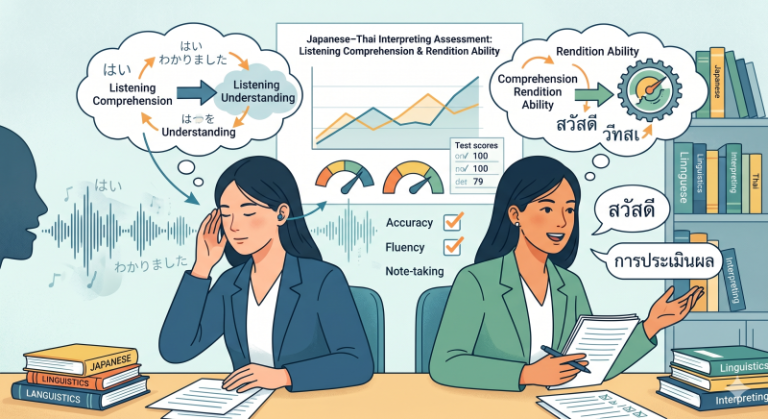
21 April 2026, Bangkok—Interpreting from Japanese into Thai involves not only the ability to listen and comprehend the source language, but also the ability to accurately and naturally render meaning into the target language (Moser-Mercer, 2000). Even when interpreters demonstrate a high level of comprehension, the primary challenge often lies in the stage of rendition rather than comprehension (Gile, 2009).
Listening Comprehension
Based on general assessment, experienced interpreters are able to understand approximately 85–95 percent of the source-language input. However, this level of comprehension may decrease to around 70–85 percent when dealing with highly specialized topics, rapid speech, or unfamiliar accents (Gile, 2009).
Therefore, a self-assessed comprehension level of approximately 95 percent can be considered relatively high compared to general professional standards.
Common Issues in Rendition
Despite a high level of comprehension, common challenges arise during the process of rendering meaning into the target language. These can be categorized as follows:
- Overly literal translation, resulting in sentence structures that reflect Japanese syntax
- Use of vocabulary that is not natural or commonly used in Thai
- Word order that follows the source language rather than the target language
- Accurate transfer of meaning but lacking naturalness in expression
As a result, Thai listeners may find the output difficult to understand or perceive it as unnatural (Newmark, 1988).
Error Awareness in Interpreting
Interpreters are generally able to recognize their own errors to a certain extent, particularly in the following situations:
- When the delivery feels disfluent
- When uncertain vocabulary is used
- When an appropriate expression in the target language cannot be retrieved
- When the meaning is correct, but the expression feels unnatural
However, there are also cases in which interpreters fail to recognize their errors or only sense that something is incorrect without being able to identify the exact issue (Gile, 2009).
Overall Competency Assessment
The overall interpreting competence can be summarized as follows:
- Listening comprehension: 90–95%
- Accuracy of rendition: 80–90%
- Naturalness of expression: 60–80%
It is evident that the aspect requiring the most improvement is naturalness in the target language, which is a crucial factor in effective communication.
Developmental Approach
Advanced interpreting development should focus on shifting from word-for-word translation toward sense-based rendering. The essential process can be described as follows:
Listen → Understand → Reformulate in Thai → Deliver
This approach aligns with the sense theory of translation, which emphasizes conveying meaning rather than preserving linguistic form (Seleskovitch & Lederer, 1989).
Conclusion
Although interpreters may possess a high level of listening comprehension, the true challenge lies in producing natural and effective target-language output. Awareness of one’s limitations and the continuous development of Thai language reformulation skills are key to achieving professional-level interpreting competence.
References
- Gile, D. (2009). Basic concepts and models for interpreter and translator training (Rev. ed.). John Benjamins.
- Moser-Mercer, B. (2000). Simultaneous interpreting: Cognitive potential and limitations. Interpreting, 5(2), 83–94.
- Newmark, P. (1988). A textbook of translation. Prentice Hall.
- Seleskovitch, D., & Lederer, M. (1989). A systematic approach to teaching interpretation. Didier Erudition.
For professional services, please visit: https://www.seaproti.org/practitioners/
About certified translators, translation certifiers, and certified interpreters associated with SEAProTI.
The Southeast Asian Association of Professional Translators and Interpreters (SEAProTI) has officially shared the qualifications and requirements for becoming Certified Translators, Translation Certification Providers, and Certified Interpreters in Sections 9 and 10 of the Royal Gazette, which was published by the Prime Minister’s Office in Thailand on July 25, 2024. Certified Translators, Translation Certification Providers, and Certified Interpreters
The Council of State has proposed the enactment of a Royal Decree, granting registered translators and recognised translation certifiers from professional associations or accredited language institutions the authority to provide legally valid translation certification (Letter to SEAProTI dated April 28, 2025)
SEAProTI is the first professional association in Thailand and Southeast Asia to implement a comprehensive certification system for translators, certifiers, and interpreters.
Head Office: Baan Ratchakru Building, No. 33, Room 402, Soi Phahonyothin 5, Phahonyothin Road, Phaya Thai District, Bangkok 10400, Thailand
Email: hello@seaproti.com | Tel.: (+66) 2-114-3128 (Office hours: Mon–Fri, 09:00–17:00).
การประเมินความสามารถในการฟังและการถ่ายทอดความหมายของล่ามภาษาญี่ปุ่นสู่ภาษาไทย
ระดับการฟังเข้าใจ (Listening Comprehension)
จากการประเมินโดยทั่วไป ล่ามที่มีประสบการณ์สามารถเข้าใจภาษาต้นทางได้ประมาณร้อยละ 85–95 ของเนื้อหาทั้งหมด อย่างไรก็ตาม ระดับความเข้าใจนี้อาจลดลงเหลือร้อยละ 70–85 ในกรณีที่เนื้อหามีความเฉพาะทางสูง ความเร็วในการพูดมาก หรือมีสำเนียงที่ไม่คุ้นเคย (Gile, 2009)
ดังนั้น การประเมินตนเองว่ามีความสามารถในการฟังเข้าใจประมาณร้อยละ 95 จึงถือว่าอยู่ในระดับสูงเมื่อเทียบกับมาตรฐานทั่วไปของล่ามมืออาชีพ
ปัญหาที่พบในการถ่ายทอดความหมาย
แม้ว่าล่ามจะสามารถเข้าใจเนื้อหาได้ในระดับสูง แต่ปัญหาที่พบบ่อยเกิดขึ้นในกระบวนการถ่ายทอดความหมายไปยังภาษาปลายทาง โดยสามารถจำแนกได้ดังนี้:
- การแปลตรงตัวเกินไป ส่งผลให้โครงสร้างประโยคยังคงลักษณะของภาษาญี่ปุ่น
- การใช้คำศัพท์ที่ไม่สอดคล้องกับการใช้จริงในภาษาไทย
- การเรียงลำดับคำตามรูปแบบภาษาต้นทาง
- การถ่ายทอดความหมายได้ถูกต้อง แต่ขาดความเป็นธรรมชาติในเชิงภาษา
การรับรู้ข้อผิดพลาดของล่าม
ล่ามส่วนใหญ่สามารถรับรู้ข้อผิดพลาดของตนเองได้ในระดับหนึ่ง โดยเฉพาะในกรณีต่อไปนี้:
- เมื่อการถ่ายทอดไม่ลื่นไหล
- เมื่อใช้คำศัพท์ที่ไม่มั่นใจ
- เมื่อไม่สามารถหาคำที่เหมาะสมในภาษาปลายทางได้
- เมื่อรับรู้ว่าประโยคมีความถูกต้องเชิงความหมาย แต่ไม่เหมาะสมเชิงการใช้ภาษา
การประเมินระดับความสามารถโดยรวม
จากการวิเคราะห์สามารถสรุประดับความสามารถของล่ามได้ดังนี้:
- ความสามารถในการฟังเข้าใจ: ร้อยละ 90–95
- ความถูกต้องในการถ่ายทอดความหมาย: ร้อยละ 80–90
- ความเป็นธรรมชาติของภาษา: ร้อยละ 60–80
แนวทางการพัฒนา
การพัฒนาทักษะการล่ามในระดับสูงควรมุ่งเน้นไปที่การปรับโครงสร้างความคิดจากการแปลแบบคำต่อคำ (word-for-word translation) ไปสู่การถ่ายทอดความหมายเชิงแนวคิด (sense-based translation) โดยมีขั้นตอนสำคัญดังนี้:
ฟัง → เข้าใจ → เรียบเรียงใหม่ในภาษาไทย → ถ่ายทอด
แนวทางนี้สอดคล้องกับทฤษฎีการแปลเชิงความหมาย (sense theory) ซึ่งเน้นการถ่ายทอด “ความหมาย” มากกว่ารูปแบบของภาษา (Seleskovitch & Lederer, 1989)
บทสรุป
แม้ว่าล่ามจะมีความสามารถในการฟังเข้าใจในระดับสูง แต่ความท้าทายที่แท้จริงอยู่ที่การถ่ายทอดความหมายให้เป็นภาษาปลายทางที่เป็นธรรมชาติ การตระหนักรู้ถึงข้อจำกัดของตนเองและการพัฒนาทักษะการเรียบเรียงภาษาไทยจึงเป็นกุญแจสำคัญในการยกระดับความสามารถของล่ามสู่ระดับมืออาชีพ
เอกสารอ้างอิง (References)
- Gile, D. (2009). Basic concepts and models for interpreter and translator training (Rev. ed.). John Benjamins.
- Moser-Mercer, B. (2000). Simultaneous interpreting: Cognitive potential and limitations. Interpreting, 5(2), 83–94.
- Newmark, P. (1988). A textbook of translation. Prentice Hall.
- Seleskovitch, D., & Lederer, M. (1989). A systematic approach to teaching interpretation. Didier Erudition.
สมาคมวิชาชีพนักแปลและล่ามแห่งเอเชียตะวันออกเฉียงใต้ (SEAProTI) ได้ประกาศหลักเกณฑ์และคุณสมบัติของผู้ที่ขึ้นทะเบียนเป็น “นักแปลรับรอง (Certified Translators) และผู้รับรองการแปล (Translation Certification Providers) และล่ามรับรอง (Certified Interpreters)” ของสมาคม หมวดที่ 9 และหมวดที่ 10 ในราชกิจจานุเบกษา ของสำนักเลขาธิการคณะรัฐมนตรี ในสำนักนายกรัฐมนตรี แห่งราชอาณาจักรไทย ลงวันที่ 25 ก.ค. 2567 เล่มที่ 141 ตอนที่ 66 ง หน้า 100 อ่านฉบับเต็มได้ที่: นักแปลรับรอง ผู้รับรองการแปล และล่ามรับรอง
สำนักคณะกรรมการกฤษฎีกาเสนอให้ตราเป็นพระราชกฤษฎีกา โดยกำหนดให้นักแปลที่ขึ้นทะเบียน รวมถึงผู้รับรองการแปลจากสมาคมวิชาชีพหรือสถาบันสอนภาษาที่มีการอบรมและขึ้นทะเบียน สามารถรับรองคำแปลได้ (จดหมายถึงสมาคม SEAProTI ลงวันที่ 28 เม.ย. 2568)
สมาคมวิชาชีพนักแปลและล่ามแห่งเอเชียตะวันออกเฉียงใต้เป็นสมาคมวิชาชีพแห่งแรกและแห่งเดียวในประเทศไทยและภูมิภาคเอเชียตะวันออกเฉียงใต้ที่มีระบบรับรองนักแปลรับรอง ผู้รับรองการแปล และล่ามรับรอง
สำนักงานใหญ่: อาคารบ้านราชครู เลขที่ 33 ห้อง 402 ซอยพหลโยธิน 5 ถนนพหลโยธิน แขวงพญาไท เขตพญาไท กรุงเทพมหานคร 10400 ประเทศไทย
อีเมล: hello@seaproti.com โทรศัพท์: (+66) 2-114-3128 (เวลาทำการ: วันจันทร์–วันศุกร์ เวลา 09.00–17.00 น.