



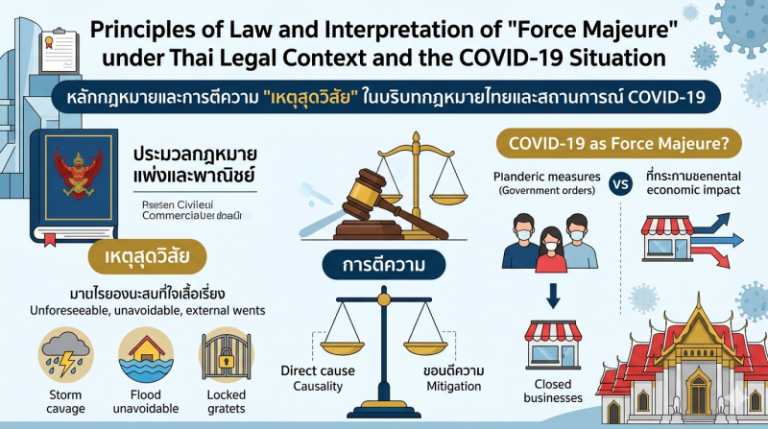
Principles of Law and Interpretation of “Force Majeure”
under Thai Legal Context and the COVID-19 Situation
Author: Griroek Gruaythong
20 April 2026, Bangkok – “Force majeure” refers to legal concepts involving external events beyond the control of contracting parties, which render contractual performance impossible or significantly difficult. Such events are often described as “acts of God,” including natural disasters like earthquakes and floods, as well as social and economic disruptions such as pandemics and government lockdowns. The inclusion of force majeure clauses in contracts helps protect parties from liability when they are unable to fulfill obligations through no fault of their own.
2. Legal Principles of Force Majeure under Thai Civil and Commercial Law
Under the Thai Civil and Commercial Code, Section 8 broadly defines force majeure as “an event which cannot be prevented even by a person against whom it happens, despite the exercise of appropriate care as may be expected under such circumstances and conditions.”
Additionally, Section 219 provides that “a debtor is released from the obligation if performance becomes impossible due to an event arising after the obligation is created, and the debtor is not responsible for that event.” This principle serves as a key legal basis for Thai courts when considering cases involving non-performance due to force majeure.
A party invoking force majeure bears the burden of proving that such an event actually occurred and that it directly or indirectly caused the inability to perform contractual obligations. If performance remains possible but merely more difficult or costly, courts generally do not recognize it as force majeure.
3. COVID-19 as Force Majeure
The COVID-19 pandemic has had profound impacts on economies and contractual relationships worldwide. The Thai government declared a state of emergency on 26 March 2020, marking the implementation of measures such as travel restrictions and business closures. This declaration effectively acknowledged COVID-19 as a force majeure event in the context of government contracts.
In the labor sector, the Ministry of Labour classified COVID-19 as a force majeure event under the Social Security Act, enabling affected employees to receive unemployment compensation. However, termination of employment must still comply with labor protection laws; otherwise, it may be deemed unfair dismissal.
4. Interpretation and Practical Considerations
When applying force majeure clauses, courts and contracting parties generally consider two main issues:
- Whether the contract explicitly defines the event as falling within the scope of force majeure; and
- How the event impacts the party’s ability to perform contractual obligations.
If a clear causal link cannot be established, the claim of force majeure is unlikely to be accepted.
Transparent and continuous communication between parties is crucial in minimizing disputes. Renegotiating contract terms or amending agreements can help reduce litigation risks and allow business operations to continue more sustainably.
5. The Role of Certified Translators, Translation Certification Providers, and Certified Interpreters
In the context of international contracts, accurate understanding and interpretation of legal provisions are essential. Certified translators and interpreters—particularly those accredited by professional associations in Southeast Asia—play a vital role in ensuring precise legal communication.
Certified translators are responsible for translating contracts and legal documents between Thai and foreign languages while preserving the original legal meaning, including provisions such as Sections 8 and 219. This helps prevent misunderstandings that could affect contractual rights and obligations. Certification by translation providers ensures that documents carry legal weight and are admissible in court or before government authorities.
Certified interpreters, on the other hand, facilitate communication during meetings, negotiations, mediation, and court proceedings involving cross-border disputes. Accurate interpretation ensures that all parties—and the court—can rely on a correct understanding of facts and legal intent.
Thus, the role of translators and interpreters extends beyond language; they are integral to the justice system, safeguarding rights, transparency, and fairness in international legal processes.
6. Conclusion
Force majeure under Thai law serves as a principle to ensure fairness between contracting parties when uncontrollable events occur. The COVID-19 pandemic presents a significant example that challenges both interpretation and application of this doctrine.
The roles of certified translators, translation certifiers, and certified interpreters are crucial in enhancing legal clarity and reducing cross-border disputes. Upholding professional standards and linguistic accuracy in legal translation is therefore fundamental to modern business cooperation and the administration of justice.
References
- ASEAN Translators and Interpreters Professional Association. (2022). Professional standards for certified translators and interpreters in Southeast Asia. Bangkok: ASEAN Secretariat.
- Chen, L. (2021). Contractual risk management after COVID-19: Lessons from force majeure litigation. Journal of Comparative Commercial Law, 14(2), 55–76.
- Department of Legal Affairs. (2019). Thai Civil and Commercial Code. Bangkok: Ministry of Justice.
- Ministry of Labour. (2020). Announcement on COVID-19 as a force majeure event under the Social Security Act. Bangkok: Labour Gazette.
- Siam Legal International. (n.d.). Introduction to Force Majeure: Civil and Commercial Law in Thailand.
Thai Committee for Government Procurement and Supplies Management. (2020). Guidelines on contract administration during the COVID-19 pandemic. Bangkok: Government Gazette.
หลักกฎหมายและการตีความเรื่อง “เหตุสุดวิสัย” ภายใต้บริบทกฎหมายไทยและสถานการณ์โควิด-19
ผู้แต่ง: ไกรฤกษ์ กรวยทอง
20 เมษายน 2569, กรุงเทพมหานคร – บทความนี้มีวัตถุประสงค์เพื่อศึกษาแนวคิดและหลักกฎหมายของ “เหตุสุดวิสัย” (Force Majeure) ภายใต้กฎหมายแพ่งและพาณิชย์ไทย รวมถึงวิเคราะห์บทบาทของนักแปลรับรอง (Certified Translators) ผู้รับรองการแปล (Translation Certification Providers) และล่ามรับรอง (Certified Interpreters) ในบริบทของการทำสัญญาและการตีความทางกฎหมายระหว่างประเทศ โดยเฉพาะภายใต้สถานการณ์การแพร่ระบาดของโควิด-19 ซึ่งส่งผลกระทบต่อความสามารถในการปฏิบัติตามสัญญาของคู่สัญญาทั่วโลก การศึกษานี้มุ่งให้ความเข้าใจเชิงลึกเกี่ยวกับการใช้ข้อกำหนดเหตุสุดวิสัย การตีความบทบัญญัติทางกฎหมาย และความสำคัญของการสื่อสารข้ามภาษาในการบริหารความเสี่ยงทางกฎหมาย เพื่อให้เกิดความเป็นธรรมและสมดุลในทางปฏิบัติ
1. บทนำ
“เหตุสุดวิสัย” (Force Majeure) เป็นแนวคิดทางกฎหมายที่อ้างถึงเหตุการณ์ภายนอกอันอยู่นอกเหนือการควบคุมของคู่สัญญา ซึ่งทำให้การปฏิบัติตามสัญญาเป็นไปไม่ได้หรือเป็นไปโดยยาก (Siam Legal International, n.d.). เหตุสุดวิสัยมักถูกเรียกว่า “Act of God” หรือเหตุการณ์ตามธรรมชาติ เช่น แผ่นดินไหว น้ำท่วม หรือสงคราม รวมถึงสถานการณ์ทางสังคมและเศรษฐกิจ เช่น ภาวะโรคระบาดและการปิดประเทศ การมีข้อกำหนดดังกล่าวในสัญญาช่วยคุ้มครองคู่สัญญาจากความรับผิดในกรณีที่ไม่สามารถดำเนินการตามข้อผูกพันได้โดยไม่ใช่ความผิดของตน
2. หลักกฎหมายเหตุสุดวิสัยภายใต้กฎหมายแพ่งและพาณิชย์ไทย
ตามประมวลกฎหมายแพ่งและพาณิชย์ มาตรา 8 เหตุสุดวิสัยถูกนิยามไว้อย่างกว้างว่าเป็น “เหตุการณ์อันบุคคลผู้ซึ่งต้องรับผิดชอบจะป้องกันมิได้ แม้จะได้ใช้ความระมัดระวังตามสมควรในพฤติการณ์และฐานะเช่นนั้นแล้ว” (Department of Legal Affairs, 2019). ส่วนมาตรา 219 กำหนดไว้เพิ่มเติมว่า “ลูกหนี้พ้นจากการต้องชำระหนี้ ถ้าหนี้นั้นไม่อาจชำระได้เพราะเหตุการณ์ซึ่งเกิดขึ้นภายหลังจากการก่อหนี้และลูกหนี้ไม่ต้องรับผิดในเหตุการณ์นั้น” ซึ่งเป็นหลักสำคัญที่ศาลไทยใช้พิจารณากรณีที่ไม่สามารถปฏิบัติตามสัญญาได้เนื่องจากเหตุสุดวิสัย
ในการอ้างเหตุสุดวิสัย คู่สัญญาฝ่ายที่อ้างต้องมีภาระพิสูจน์ว่ามีเหตุการณ์เกิดขึ้นจริงและเหตุการณ์นั้นเป็นสาเหตุโดยตรงหรือโดยอ้อมที่ทำให้ไม่สามารถปฏิบัติตามสัญญาได้ ทั้งนี้ หากการปฏิบัติยังสามารถทำได้แต่เพียงยากลำบากขึ้นหรือมีค่าใช้จ่ายสูงขึ้น ศาลมักไม่ยอมรับว่าเป็นเหตุสุดวิสัย (Siam Legal International, n.d.).
3. โควิด-19 ในฐานะเหตุสุดวิสัย
การแพร่ระบาดของโควิด-19 ส่งผลกระทบอย่างลึกซึ้งต่อระบบเศรษฐกิจและการทำสัญญาทั่วโลก รัฐบาลไทยได้ประกาศสถานการณ์ฉุกเฉินเมื่อวันที่ 26 มีนาคม 2563 ซึ่งถือเป็นช่วงเวลาที่เริ่มต้นการบังคับใช้มาตรการจำกัดการเดินทางและการดำเนินธุรกิจ (Thai Committee for Government Procurement, 2020). การประกาศดังกล่าวถือเป็นการรับรองโดยรัฐว่าโควิด-19 เป็นเหตุสุดวิสัยในการบริหารจัดการสัญญาระหว่างหน่วยงานรัฐกับเอกชน
ในกรณีแรงงาน กระทรวงแรงงานได้ประกาศให้โควิด-19 เป็นเหตุสุดวิสัยตามพระราชบัญญัติประกันสังคม เพื่อให้ลูกจ้างที่ได้รับผลกระทบสามารถรับเงินทดแทนการว่างงานได้ (Ministry of Labour, 2020). อย่างไรก็ตาม การเลิกจ้างพนักงานยังต้องเป็นไปตามพระราชบัญญัติคุ้มครองแรงงาน มิฉะนั้นจะถือเป็นการเลิกจ้างไม่เป็นธรรม
4. การตีความและข้อพิจารณาในทางปฏิบัติ
ในการใช้ข้อกำหนดเหตุสุดวิสัย ศาลและคู่สัญญามักพิจารณาในสองประเด็นหลัก ได้แก่ (1) ข้อกำหนดในสัญญาระบุชัดเจนหรือไม่ว่าเหตุการณ์ที่เกิดขึ้นอยู่ในขอบเขตของเหตุสุดวิสัย และ (2) เหตุการณ์นั้นส่งผลต่อความสามารถในการปฏิบัติตามหน้าที่ของคู่สัญญาอย่างไร หากไม่สามารถพิสูจน์ความเชื่อมโยงที่ชัดเจนได้ การอ้างเหตุสุดวิสัยมักไม่ได้รับการยอมรับ (Siam Legal International, n.d.).
การสื่อสารที่เปิดเผยและต่อเนื่องระหว่างคู่สัญญาเป็นปัจจัยสำคัญในการลดข้อพิพาท การแก้ไขสัญญาหรือการเจรจาปรับเงื่อนไขร่วมกันสามารถลดการถูกฟ้องร้องและช่วยให้ธุรกิจยังคงดำเนินต่อไปได้อย่างสมดุล (Chen, 2021).
5. บทบาทของนักแปลรับรอง ล่ามรับรอง และผู้รับรองการแปลในบริบทเหตุสุดวิสัย
ในยุคของการทำสัญญาระหว่างประเทศ การเข้าใจและตีความข้อกำหนดทางกฎหมายอย่างถูกต้องเป็นสิ่งจำเป็นอย่างยิ่ง นักแปลรับรอง (Certified Translators) และล่ามรับรอง (Certified Interpreters) ที่ได้รับการรับรองจากสมาคมวิชาชีพนักแปลและล่ามแห่งเอเชียตะวันออกเฉียงใต้ (Southeast Asian Translators and Interpreters Association) มีบทบาทสำคัญในด้านการถ่ายทอดความหมายทางกฎหมายอย่างถูกต้องครบถ้วน
นักแปลรับรองทำหน้าที่ถ่ายทอดสัญญาและเอกสารทางกฎหมายจากภาษาไทยไปยังภาษาต่างประเทศและในทางกลับกัน โดยต้องรักษาความหมายทางกฎหมายดั้งเดิมของข้อกำหนด เช่น ข้อความในมาตรา 8 และมาตรา 219 เพื่อป้องกันความเข้าใจคลาดเคลื่อนที่อาจส่งผลต่อสิทธิและหน้าที่ของคู่สัญญา การรับรองโดยผู้รับรองการแปล (Translation Certification Providers) ทำให้เอกสารมีน้ำหนักทางกฎหมายและสามารถใช้ยื่นต่อศาลหรือหน่วยงานราชการได้
ในขณะเดียวกัน ล่ามรับรองมีบทบาทในการประชุม การไกล่เกลี่ย หรือการพิจารณาคดีที่เกี่ยวข้องกับข้อพิพาททางสัญญาในบริบทของเหตุสุดวิสัย โดยเฉพาะคดีที่มีคู่สัญญาจากต่างประเทศ การถอดเสียงและถ่ายทอดความหมายระหว่างภาษาอย่างแม่นยำช่วยให้คู่สัญญาและศาลสามารถตัดสินบนพื้นฐานข้อเท็จจริงและเจตนาที่ถูกต้องตามกฎหมาย
ดังนั้น บทบาทของนักแปลและล่ามรับรองจึงไม่ใช่เพียงด้านภาษา แต่ยังเป็นส่วนหนึ่งของกระบวนการยุติธรรมที่รับรองสิทธิ ความโปร่งใส และความเที่ยงธรรมของคู่สัญญาในระดับนานาชาติ (ASEAN Translators and Interpreters Professional Association, 2022).
6. สรุป
เหตุสุดวิสัยภายใต้กฎหมายไทยเป็นหลักกฎหมายที่มุ่งสร้างความเป็นธรรมระหว่างคู่สัญญาในกรณีที่เกิดเหตุการณ์ที่ไม่อาจควบคุมได้ โควิด-19 เป็นตัวอย่างสำคัญที่ท้าทายการตีความและการบังคับใช้ข้อกำหนดนี้ บทบาทของนักแปลรับรอง ผู้รับรองการแปล และล่ามรับรองในบริบทนี้มีความสำคัญอย่างยิ่งต่อการสร้างความชัดเจนทางกฎหมายและลดความขัดแย้งระหว่างประเทศ การให้ความสำคัญต่อมาตรฐานวิชาชีพและความถูกต้องทางภาษาในการแปลเอกสารทางกฎหมายจึงเป็นหัวใจหลักของความร่วมมือทางธุรกิจและกระบวนการยุติธรรมสมัยใหม่
เอกสารอ้างอิง
- ASEAN Translators and Interpreters Professional Association. (2022). Professional standards for certified translators and interpreters in Southeast Asia. Bangkok: ASEAN Secretariat.
- Chen, L. (2021). Contractual risk management after COVID-19: Lessons from force majeure litigation. Journal of Comparative Commercial Law, 14(2), 55–76.
- Department of Legal Affairs. (2019). Thai Civil and Commercial Code. Bangkok: Ministry of Justice.
- Ministry of Labour. (2020). Announcement on COVID-19 as a force majeure event under the Social Security Act. Bangkok: Labour Gazette.
- Siam Legal International. (n.d.). Introduction to Force Majeure: Civil and Commercial Law in Thailand. Retrieved from
- Thai Committee for Government Procurement and Supplies Management. (2020). Guidelines on contract administration during the COVID-19 pandemic. Bangkok: Government Gazette.
ติดต่อขอใช้บริการนักวิชาชีพของสมาคมได้ที่: https://www.seaproti.org/practitioners/
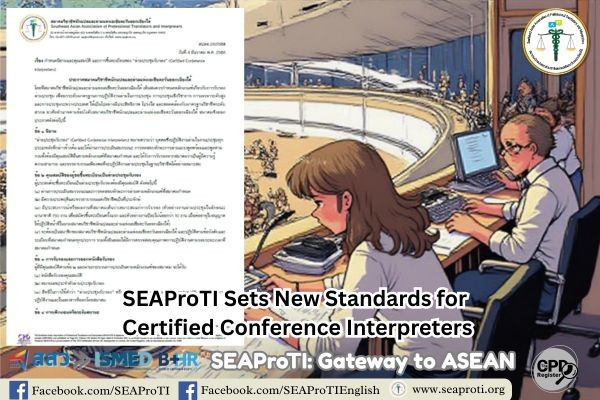
สมาคมวิชาชีพนักแปลและล่ามแห่งเอเชียตะวันออกเฉียงใต้ (SEAProTI) ได้ประกาศหลักเกณฑ์และคุณสมบัติของผู้ที่ขึ้นทะเบียนเป็น “นักแปลรับรอง (Certified Translators) และผู้รับรองการแปล (Translation Certification Providers) และล่ามรับรอง (Certified Interpreters)” ของสมาคม หมวดที่ 9 และหมวดที่ 10 ในราชกิจจานุเบกษา ของสำนักเลขาธิการคณะรัฐมนตรี ในสำนักนายกรัฐมนตรี แห่งราชอาณาจักรไทย ลงวันที่ 25 ก.ค. 2567 เล่มที่ 141 ตอนที่ 66 ง หน้า 100 อ่านฉบับเต็มได้ที่: นักแปลรับรอง ผู้รับรองการแปล และล่ามรับรอง
สำนักคณะกรรมการกฤษฎีกาเสนอให้ตราเป็นพระราชกฤษฎีกา โดยกำหนดให้นักแปลที่ขึ้นทะเบียน รวมถึงผู้รับรองการแปลจากสมาคมวิชาชีพหรือสถาบันสอนภาษาที่มีการอบรมและขึ้นทะเบียน สามารถรับรองคำแปลได้ (จดหมายถึงสมาคม SEAProTI ลงวันที่ 28 เม.ย. 2568)
สมาคมวิชาชีพนักแปลและล่ามแห่งเอเชียตะวันออกเฉียงใต้เป็นสมาคมวิชาชีพแห่งแรกและแห่งเดียวในประเทศไทยและภูมิภาคเอเชียตะวันออกเฉียงใต้ที่มีระบบรับรองนักแปลรับรอง ผู้รับรองการแปล และล่ามรับรอง
สำนักงานใหญ่: อาคารบ้านราชครู เลขที่ 33 ห้อง 402 ซอยพหลโยธิน 5 ถนนพหลโยธิน แขวงพญาไท เขตพญาไท กรุงเทพมหานคร 10400 ประเทศไทย
อีเมล: hello@seaproti.com โทรศัพท์: (+66) 2-114-3128 (เวลาทำการ: วันจันทร์–วันศุกร์ เวลา 09.00–17.00 น.