


The Problem of Interpreter Quality in the Thai Justice System under the Criminal Procedure Code, Section 13: Impacts on Human Rights and Non-Compliance with the ICCPR
April 18, 2026, Bangkok – This article aims to analyze the role and limitations of interpreters in Thailand’s criminal justice process under Section 13 of the Criminal Procedure Code, emphasizing that the requirement to “provide an interpreter” does not necessarily mean that suspects, defendants, or witnesses will truly have their rights protected if there is a lack of standards regarding quality, neutrality, and professional competence of interpreters. This article also highlights the inconsistency between Thailand’s practices and its international obligations under the International Covenant on Civil and Political Rights (ICCPR), particularly concerning the right to a fair trial.
1. Introduction
Section 13 of the Criminal Procedure Code stipulates that when an investigation, inquiry, or trial requires translation, state officials, namely inquiry officials, prosecutors, or courts, must provide an interpreter without delay to ensure that suspects, witnesses, or defendants who do not understand Thai can appropriately participate in the justice process. It further requires that interpreters must take an oath or affirmation to perform their duties honestly, without adding to or omitting any content, and must sign to certify the translation. However, although this provision is intended to protect the right to defense, it does not clearly establish standards regarding the quality of interpreters, resulting in practical problems that may affect fairness in the justice process.
2. Limitations of Section 13 and the Problem of Interpreter Quality
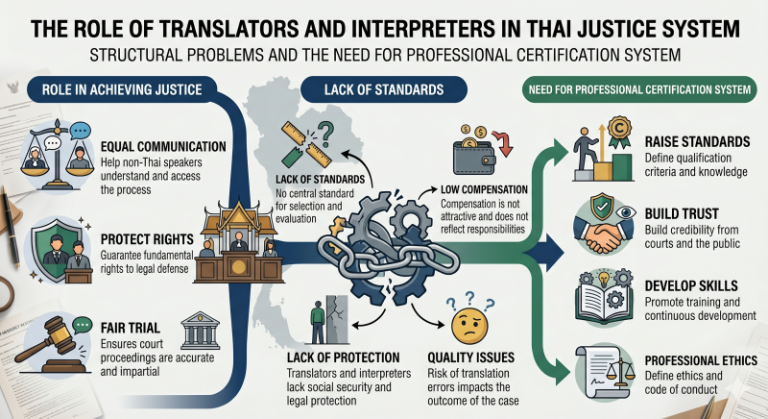
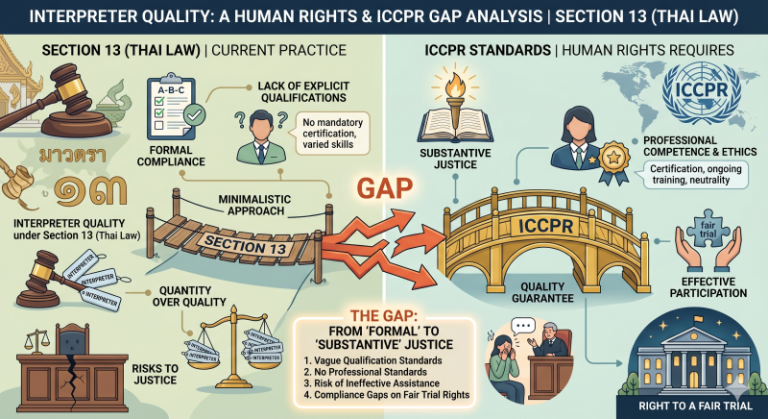
Section 13 allows any person with the ability to translate languages to act as an interpreter, without requiring a license or professional certification in the legal field. The absence of such requirements leads to uncertainty in the standards of interpreters in the justice system and may result in risks of inaccurate, incomplete, or biased translation. Even minor translation errors can significantly affect the substance of testimonies or evidence, which are essential elements in criminal adjudication.
Although the law requires interpreters to take an oath before performing their duties, such an oath is merely an ethical mechanism and does not guarantee professional competence or independence from the influence of state officials. In practice, some interpreters may have close relationships with state agencies or lack understanding of legal terminology, resulting in translations that do not reflect the true intent of the speaker.
3. Impacts on Human Rights
The issue of interpreter quality directly affects the human rights of suspects and defendants, particularly the right to clearly understand the charges against them. If the translation is inaccurate, the suspect may not fully comprehend the accusations they face, undermining the fundamental right to self-defense. Furthermore, the right to effectively defend oneself may also be violated when testimonies or questioning are conveyed through incomplete or distorted translations.
Moreover, this issue relates to the principle of equality before the law, as individuals who do not understand Thai may be placed at a structural disadvantage compared to those who are fluent in Thai, resulting in the justice process being unable to truly ensure equality.
4. Non-Compliance with the ICCPR
Thailand is a party to the International Covenant on Civil and Political Rights (ICCPR), which establishes minimum standards for the protection of individual rights in the justice process, particularly Article 14(3)(f), which guarantees the right of a person to have the free assistance of an interpreter if they cannot understand or speak the language used in court.
The interpretation by the United Nations Human Rights Committee has clarified that the right to an interpreter includes the right to receive translation of sufficient quality so that individuals can genuinely understand and participate in the trial process. If the interpreter lacks adequate competence or the translation is inaccurate, this constitutes a violation of the right to a fair trial.
When compared with Thai law, it is evident that Section 13 emphasizes only the formal provision of an interpreter, without clearly establishing quality standards or monitoring mechanisms, resulting in Thailand’s practices potentially not complying with ICCPR obligations in substance.
5. Critical Analysis
Although Thailand has legal provisions recognizing the right to an interpreter, the absence of a professional certification system and quality control mechanisms renders such protection merely formal compliance rather than substantive protection of rights. The distinction between “having an interpreter” and “having a qualified interpreter” is a key issue reflecting the gap between domestic law and international standards.
In practice, this problem may lead to the use of inaccurate evidence or testimonies that do not reflect reality, thereby affecting the credibility of the justice system as a whole and potentially resulting in unjust judicial decisions.
6. Recommendations
To align with international human rights standards, Thailand should consider reforming its interpreter system in the justice process by establishing professional standards, creating an interpreter certification system, providing specialized legal training, and developing systematic mechanisms to monitor translation quality. In addition, interpreter independence should be promoted to prevent influence from state officials.
7. Conclusion
The provision of an interpreter under Section 13 of the Criminal Procedure Code is merely a minimum measure to protect individual rights in the justice process. Without appropriate quality standards and control mechanisms, it cannot truly guarantee fairness. This issue not only affects individual human rights but also reflects Thailand’s non-compliance with its obligations under the ICCPR, which emphasizes substantive protection of rights rather than mere formal adherence.
References
- Human Rights Committee. (2007). General Comment No. 32: Right to equality before courts and tribunals and to a fair trial (Article 14). United Nations.
- International Covenant on Civil and Political Rights (ICCPR), December 16, 1966, 999 U.N.T.S. 171.
- Criminal Procedure Code, Section 13.
- Peesiri Law. (n.d.). Key principles of interpreters under Section 13. Retrieved from http://www.peesirilaw.com
For professional services, please visit: https://www.seaproti.org/practitioners/
About certified translators, translation certifiers, and certified interpreters associated with SEAProTI.
The Southeast Asian Association of Professional Translators and Interpreters (SEAProTI) has officially shared the qualifications and requirements for becoming Certified Translators, Translation Certification Providers, and Certified Interpreters in Sections 9 and 10 of the Royal Gazette, which was published by the Prime Minister’s Office in Thailand on July 25, 2024. Certified Translators, Translation Certification Providers, and Certified Interpreters
The Council of State has proposed the enactment of a Royal Decree, granting registered translators and recognised translation certifiers from professional associations or accredited language institutions the authority to provide legally valid translation certification (Letter to SEAProTI dated April 28, 2025)
SEAProTI is the first professional association in Thailand and Southeast Asia to implement a comprehensive certification system for translators, certifiers, and interpreters.
Head Office: Baan Ratchakru Building, No. 33, Room 402, Soi Phahonyothin 5, Phahonyothin Road, Phaya Thai District, Bangkok 10400, Thailand
Email: hello@seaproti.com | Tel.: (+66) 2-114-3128 (Office hours: Mon–Fri, 09:00–17:00).
ปัญหาคุณภาพล่ามในกระบวนการยุติธรรมไทยภายใต้ประมวลกฎหมายวิธีพิจารณาความอาญา มาตรา 13:
ผลกระทบต่อสิทธิมนุษยชนและความไม่สอดคล้องกับ ICCPR
18 เมษายน 2569, กรุงเทพมหานคร – บทความนี้มุ่งวิเคราะห์บทบาทและข้อจำกัดของล่ามในกระบวนการยุติธรรมทางอาญาของประเทศไทยตามประมวลกฎหมายวิธีพิจารณาความอาญา มาตรา 13 โดยเน้นให้เห็นว่าการกำหนดให้ “มีล่าม” ไม่ได้หมายความว่าผู้ต้องหา จำเลย หรือพยานจะได้รับการคุ้มครองสิทธิอย่างแท้จริง หากปราศจากมาตรฐานด้านคุณภาพ ความเป็นกลาง และความสามารถทางวิชาชีพของล่าม บทความนี้ยังชี้ให้เห็นถึงความไม่สอดคล้องระหว่างการปฏิบัติของไทยกับพันธกรณีระหว่างประเทศภายใต้กติการะหว่างประเทศว่าด้วยสิทธิพลเมืองและสิทธิทางการเมือง (ICCPR) โดยเฉพาะในประเด็นสิทธิในการได้รับการพิจารณาคดีอย่างเป็นธรรม
1. บทนำ
ประมวลกฎหมายวิธีพิจารณาความอาญา มาตรา 13 กำหนดให้เมื่อมีการสอบสวน ไต่สวน หรือพิจารณาคดีที่จำเป็นต้องแปลภาษา เจ้าหน้าที่ของรัฐ ได้แก่ พนักงานสอบสวน อัยการ หรือศาล ต้องจัดหาล่ามให้โดยมิชักช้า เพื่อให้ผู้ต้องหา พยาน หรือจำเลยที่ไม่เข้าใจภาษาไทยสามารถมีส่วนร่วมในกระบวนการยุติธรรมได้อย่างเหมาะสม อีกทั้งยังบัญญัติให้ล่ามต้องสาบานหรือปฏิญาณตนว่าจะทำหน้าที่โดยสุจริต ไม่เพิ่มเติมหรือตัดทอนข้อความ และต้องลงลายมือชื่อรับรองคำแปล อย่างไรก็ตาม แม้บทบัญญัติดังกล่าวจะมีเจตนารมณ์เพื่อคุ้มครองสิทธิในการต่อสู้คดี แต่กลับไม่ได้กำหนดมาตรฐานด้านคุณภาพของล่ามอย่างชัดเจน ส่งผลให้เกิดปัญหาในเชิงปฏิบัติที่อาจกระทบต่อความเป็นธรรมในกระบวนการยุติธรรม
2. ข้อจำกัดของมาตรา 13 และปัญหาคุณภาพล่าม
มาตรา 13 เปิดโอกาสให้บุคคลใดก็ได้ที่มีความสามารถในการแปลภาษาเข้ามาทำหน้าที่ล่าม โดยไม่จำเป็นต้องมีใบอนุญาตหรือผ่านการรับรองวิชาชีพเฉพาะด้านกฎหมาย การขาดข้อกำหนดดังกล่าวทำให้มาตรฐานของล่ามในกระบวนการยุติธรรมมีความไม่แน่นอน และอาจนำไปสู่ความเสี่ยงในการแปลความที่คลาดเคลื่อน ไม่ครบถ้วน หรือมีอคติ การแปลที่ผิดพลาดเพียงเล็กน้อยอาจส่งผลกระทบอย่างมีนัยสำคัญต่อเนื้อหาของคำให้การหรือพยานหลักฐาน ซึ่งเป็นองค์ประกอบสำคัญในการวินิจฉัยคดีอาญา
แม้ว่ากฎหมายจะกำหนดให้ล่ามต้องสาบานตนก่อนปฏิบัติหน้าที่ แต่การสาบานตนเป็นเพียงกลไกเชิงจริยธรรม มิได้เป็นหลักประกันด้านความสามารถทางวิชาชีพหรือความเป็นอิสระจากอิทธิพลของเจ้าหน้าที่รัฐ ในทางปฏิบัติ ล่ามบางรายอาจมีความสัมพันธ์ใกล้ชิดกับหน่วยงานของรัฐ หรือขาดความเข้าใจในศัพท์เฉพาะทางกฎหมาย ส่งผลให้การแปลไม่สะท้อนเจตนาที่แท้จริงของผู้ให้การ
3. ผลกระทบต่อสิทธิมนุษยชน
ปัญหาคุณภาพของล่ามส่งผลกระทบโดยตรงต่อสิทธิมนุษยชนของผู้ต้องหาและจำเลย โดยเฉพาะสิทธิในการรับรู้ข้อกล่าวหาอย่างชัดเจน หากการแปลไม่ถูกต้อง ผู้ต้องหาอาจไม่เข้าใจข้อกล่าวหาที่ตนเผชิญ ซึ่งเป็นการบั่นทอนสิทธิขั้นพื้นฐานในการป้องกันตนเอง นอกจากนี้ สิทธิในการต่อสู้คดีอย่างมีประสิทธิภาพยังอาจถูกละเมิด เมื่อคำให้การหรือการซักถามถูกถ่ายทอดผ่านการแปลที่ไม่ครบถ้วนหรือบิดเบือน
ยิ่งไปกว่านั้น ปัญหาดังกล่าวยังเกี่ยวข้องกับหลักความเสมอภาคต่อหน้ากฎหมาย เนื่องจากบุคคลที่ไม่เข้าใจภาษาไทยอาจตกอยู่ในสถานะเสียเปรียบเชิงโครงสร้างเมื่อเทียบกับบุคคลที่ใช้ภาษาไทยได้อย่างคล่องแคล่ว ส่งผลให้กระบวนการยุติธรรมไม่สามารถรับรองความเท่าเทียมได้อย่างแท้จริง
4. ความไม่สอดคล้องกับ ICCPR
ประเทศไทยเป็นภาคีของกติการะหว่างประเทศว่าด้วยสิทธิพลเมืองและสิทธิทางการเมือง (ICCPR) ซึ่งกำหนดมาตรฐานขั้นต่ำในการคุ้มครองสิทธิของบุคคลในกระบวนการยุติธรรม โดยเฉพาะมาตรา 14 วรรคสาม (f) ที่รับรองสิทธิของบุคคลในการได้รับความช่วยเหลือจากล่ามโดยไม่เสียค่าใช้จ่าย หากบุคคลนั้นไม่เข้าใจหรือไม่สามารถใช้ภาษาที่ใช้ในศาลได้
การตีความของคณะกรรมการสิทธิมนุษยชนแห่งสหประชาชาติได้ขยายความว่า สิทธิในการมีล่ามต้องรวมถึงการได้รับการแปลที่มีคุณภาพเพียงพอ เพื่อให้บุคคลสามารถเข้าใจและมีส่วนร่วมในกระบวนการพิจารณาคดีได้อย่างแท้จริง หากล่ามไม่มีความสามารถเพียงพอ หรือการแปลไม่ถูกต้อง ย่อมถือเป็นการละเมิดสิทธิในการได้รับการพิจารณาคดีอย่างเป็นธรรม
เมื่อเปรียบเทียบกับกฎหมายไทย จะเห็นได้ว่ามาตรา 13 เน้นเพียงการจัดให้มีล่ามในเชิงรูปแบบ โดยไม่ได้กำหนดมาตรฐานด้านคุณภาพหรือกลไกตรวจสอบที่ชัดเจน ส่งผลให้การปฏิบัติของไทยอาจยังไม่สอดคล้องกับพันธกรณีตาม ICCPR ในเชิงเนื้อหา
5. การวิเคราะห์เชิงวิพากษ์
แม้ว่าประเทศไทยจะมีกฎหมายรองรับสิทธิในการมีล่าม แต่การขาดระบบรับรองวิชาชีพและการควบคุมคุณภาพทำให้การคุ้มครองสิทธิดังกล่าวเป็นเพียงการปฏิบัติตามรูปแบบ มากกว่าการคุ้มครองสิทธิในสาระสำคัญ ความแตกต่างระหว่าง “การมีล่าม” กับ “การมีล่ามที่มีคุณภาพ” เป็นประเด็นสำคัญที่สะท้อนถึงช่องว่างระหว่างกฎหมายภายในกับมาตรฐานสากล
ในทางปฏิบัติ ปัญหานี้อาจนำไปสู่การใช้พยานหลักฐานที่ไม่ถูกต้อง หรือคำให้การที่ไม่สะท้อนความเป็นจริง ซึ่งส่งผลต่อความน่าเชื่อถือของกระบวนการยุติธรรมโดยรวม และอาจนำไปสู่การตัดสินคดีที่ไม่เป็นธรรม
6. ข้อเสนอแนะ
เพื่อให้สอดคล้องกับมาตรฐานสิทธิมนุษยชนระหว่างประเทศ ประเทศไทยควรพิจารณาปรับปรุงระบบล่ามในกระบวนการยุติธรรม โดยการกำหนดมาตรฐานวิชาชีพ การจัดตั้งระบบรับรองล่าม การฝึกอบรมเฉพาะด้านกฎหมาย และการสร้างกลไกตรวจสอบคุณภาพการแปลอย่างเป็นระบบ นอกจากนี้ ควรส่งเสริมความเป็นอิสระของล่ามเพื่อป้องกันอิทธิพลจากเจ้าหน้าที่รัฐ
7. บทสรุป
การมีล่ามตามมาตรา 13 แห่งประมวลกฎหมายวิธีพิจารณาความอาญาเป็นเพียงมาตรการขั้นต่ำในการคุ้มครองสิทธิของบุคคลในกระบวนการยุติธรรม หากปราศจากมาตรฐานด้านคุณภาพและกลไกควบคุมที่เหมาะสม ย่อมไม่สามารถรับประกันความเป็นธรรมได้อย่างแท้จริง ปัญหานี้ไม่เพียงแต่กระทบต่อสิทธิมนุษยชนของบุคคลเท่านั้น แต่ยังสะท้อนถึงความไม่สอดคล้องของประเทศไทยกับพันธกรณีภายใต้ ICCPR ซึ่งเน้นการคุ้มครองสิทธิในเชิงสาระมากกว่าการปฏิบัติตามรูปแบบ
เอกสารอ้างอิง
- Human Rights Committee. (2007). General Comment No. 32: Right to equality before courts and tribunals and to a fair trial (Article 14). United Nations.
- International Covenant on Civil and Political Rights (ICCPR), December 16, 1966, 999 U.N.T.S. 171.
- ประมวลกฎหมายวิธีพิจารณาความอาญา มาตรา 13.
- Peesiri Law. (n.d.). สาระสำคัญของล่ามตามมาตรา 13. สืบค้นจาก http://www.peesirilaw.com
ติดต่อขอใช้บริการนักวิชาชีพของสมาคมได้ที่: https://www.seaproti.org/practitioners/
สมาคมวิชาชีพนักแปลและล่ามแห่งเอเชียตะวันออกเฉียงใต้ (SEAProTI) ได้ประกาศหลักเกณฑ์และคุณสมบัติของผู้ที่ขึ้นทะเบียนเป็น “นักแปลรับรอง (Certified Translators) และผู้รับรองการแปล (Translation Certification Providers) และล่ามรับรอง (Certified Interpreters)” ของสมาคม หมวดที่ 9 และหมวดที่ 10 ในราชกิจจานุเบกษา ของสำนักเลขาธิการคณะรัฐมนตรี ในสำนักนายกรัฐมนตรี แห่งราชอาณาจักรไทย ลงวันที่ 25 ก.ค. 2567 เล่มที่ 141 ตอนที่ 66 ง หน้า 100 อ่านฉบับเต็มได้ที่: นักแปลรับรอง ผู้รับรองการแปล และล่ามรับรอง
สำนักคณะกรรมการกฤษฎีกาเสนอให้ตราเป็นพระราชกฤษฎีกา โดยกำหนดให้นักแปลที่ขึ้นทะเบียน รวมถึงผู้รับรองการแปลจากสมาคมวิชาชีพหรือสถาบันสอนภาษาที่มีการอบรมและขึ้นทะเบียน สามารถรับรองคำแปลได้ (จดหมายถึงสมาคม SEAProTI ลงวันที่ 28 เม.ย. 2568)
สมาคมวิชาชีพนักแปลและล่ามแห่งเอเชียตะวันออกเฉียงใต้เป็นสมาคมวิชาชีพแห่งแรกและแห่งเดียวในประเทศไทยและภูมิภาคเอเชียตะวันออกเฉียงใต้ที่มีระบบรับรองนักแปลรับรอง ผู้รับรองการแปล และล่ามรับรอง
สำนักงานใหญ่: อาคารบ้านราชครู เลขที่ 33 ห้อง 402 ซอยพหลโยธิน 5 ถนนพหลโยธิน แขวงพญาไท เขตพญาไท กรุงเทพมหานคร 10400 ประเทศไทย
อีเมล: hello@seaproti.com โทรศัพท์: (+66) 2-114-3128 (เวลาทำการ: วันจันทร์–วันศุกร์ เวลา 09.00–17.00 น.