



Good Faith Complaints and the Interpretation of Defamation:
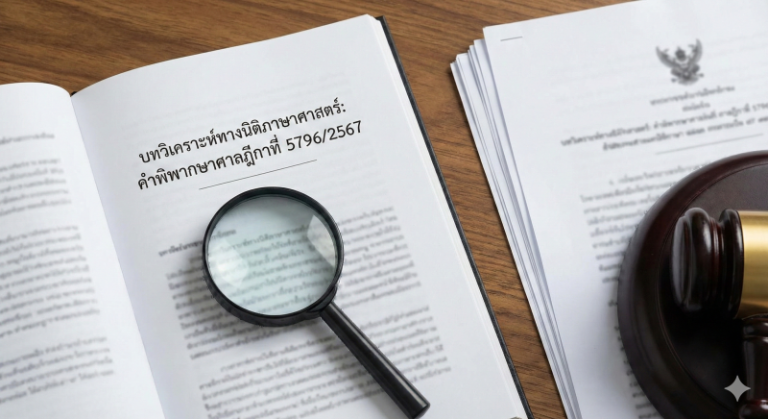
A Forensic Linguistic Analysis of Supreme Court Judgment No. 5796/2567
Author: Wanitcha Sumanat, president of the Southeast Asian Association of Professional Translators and Interpreters (SEAProTI) and registered forensic linguist.
This article analyzes Supreme Court Judgment No. 5796/2567 through a forensic linguistic framework, focusing on the relationship between language, context, and intent in determining criminal liability for false statements to public officials and defamation under Sections 137, 172, 173, and 326 of the Thai Penal Code. The central issue in the case was not merely whether certain factual inaccuracies appeared in the complaint letter, but whether the overall communicative intent demonstrated malicious fabrication or a good faith request for investigation. The Supreme Court held that the defendants acted to protect their concession rights in good faith and did not intend to falsely accuse or defame the plaintiff. This article argues that the judgment reflects a core forensic linguistic principle: criminal liability for defamation must be assessed holistically, taking into account discourse structure, communicative purpose, and contextual meaning rather than isolated excerpts.
Introduction
Offenses relating to false statements to public officials and defamation under Sections 137, 172, 173, and 326 of the Thai Penal Code are intent-based crimes. Criminal liability arises only where the accused knowingly makes a false statement and intends to cause legal or reputational harm. In practice, however, courts frequently confront the difficult task of distinguishing between a malicious accusation and a good faith complaint aimed at protecting one’s lawful interests. Supreme Court Judgment No. 5796/2567 presents a significant example of how linguistic reasoning assists in resolving this distinction.
Facts and Legal Issues
In brief, the defendants submitted complaint letters to relevant authorities requesting investigation into sand dredging activities that allegedly affected their concession rights. Certain passages in the letters referred to the conduct of a customs official (the plaintiff). The plaintiff argued that these statements constituted false reporting and defamation. The Court of First Instance found the defendants guilty, but the Court of Appeal Region 4 reversed the judgment and dismissed the charges. The Supreme Court affirmed the appellate decision, holding that the defendants lacked criminal intent.
The primary legal issue concerned whether the statements in the complaint letter amounted to knowingly false assertions intended to accuse the plaintiff of criminal wrongdoing, or whether they constituted a good faith request for fact-finding and administrative review.
The Forensic Linguistic Framework
Forensic linguistics examines the interface between language and law, particularly how meaning, intention, and interpretation function in legal settings. Speech Act Theory (Austin, 1962; Searle, 1969) provides a foundational lens for this case. Utterances do not merely describe reality; they perform actions. A statement may function as an accusation, a report, a request, or a complaint. Determining its illocutionary force is critical to assessing legal responsibility.
Pragmatics further teaches that meaning cannot be separated from context. The sequence of events, the relationship between the parties, the institutional setting, and the expressed purpose of the communication all shape interpretation. Evaluating criminal intent therefore requires holistic discourse analysis rather than reliance on isolated sentences.
Linguistic Analysis of the Complaint Letter
A close reading of the complaint letter reveals that its structure was primarily narrative. The defendants described the sequence of events: the discovery of dredging vessels, communication with local authorities, and subsequent requests for customs verification. The discourse resembled a report combined with a request for investigation rather than a categorical criminal accusation.
Although the letter included references suggesting that officials had failed to take enforcement action, its concluding section explicitly requested the appointment of an investigative committee and disciplinary review. It did not directly demand criminal prosecution of the plaintiff. Such language functions as an “intent marker,” signaling that the communicative purpose was to seek clarification and administrative accountability, not to fabricate a criminal charge.
From a forensic linguistic perspective, factual misattribution—for example, confusion over which authority first identified the dredging vessels—does not automatically equate to deliberate fabrication. The distinction between misunderstanding and intentional falsification is central. The Supreme Court recognized that minor inaccuracies, when made in good faith and within a broader context of legitimate concern, do not satisfy the mens rea requirement for false reporting or defamation.
Assessment of Defamation Elements
Defamation under Section 326 requires an imputation of fact communicated to a third party in a manner likely to harm reputation. Linguistically, this involves determining whether the text contains categorical assertions of wrongdoing or whether it presents allegations framed as concerns requiring investigation.
The complaint letter, when analyzed as a whole, reflected suspicion and a request for verification rather than definitive statements of criminal guilt. When contextualized within the defendants’ efforts to protect concession rights and their prior administrative correspondence, the discourse lacked the malicious character necessary for criminal defamation.
The Court’s reasoning underscores the principle of strict interpretation in criminal law. Criminal liability cannot be based solely on isolated phrases detached from their pragmatic and discursive context.
Conclusion
Supreme Court Judgment No. 5796/2567 illustrates the importance of forensic linguistic reasoning in defamation and false reporting cases. The Court did not confine its analysis to whether certain words were inaccurate. Instead, it examined what the language was doing within its broader communicative framework and whether the defendants possessed the requisite criminal intent.
The dismissal of charges affirms protection for good faith complaints and reinforces the principle that criminal liability cannot rest on linguistic imperfection alone. In theoretical terms, the case demonstrates that language in legal disputes is both evidence and interpretive terrain. Meaning and intent reside not in isolated sentences but within the totality of discourse, which must be read carefully, contextually, and fairly.
References
- Austin, J. L. (1962). How to do things with words. Oxford University Press.
- Searle, J. R. (1969). Speech acts: An essay in the philosophy of language. Cambridge University Press.
- Shuy, R. W. (1993). Language crimes: The use and abuse of language evidence in the courtroom. Blackwell.
- Tiersma, P. M. (1999). Legal language. University of Chicago Press.
- Thai Penal Code, Sections 137, 172, 173, 326.
- Supreme Court of Thailand. (2024). Supreme Court Judgment No. 5796/2567. Supreme Court Reports.
This section provides information about certified translators, translation certifiers, and certified interpreters associated with SEAProTI.
The Southeast Asian Association of Professional Translators and Interpreters (SEAProTI) has officially shared the qualifications and requirements for becoming Certified Translators, Translation Certification Providers, and Certified Interpreters in Sections 9 and 10 of the Royal Gazette, which was published by the Prime Minister’s Office in Thailand on July 25, 2024. Certified Translators, Translation Certification Providers, and Certified Interpreters
The Council of State has proposed the enactment of a Royal Decree, granting registered translators and recognised translation certifiers from professional associations or accredited language institutions the authority to provide legally valid translation certification (Letter to SEAProTI dated April 28, 2025)
SEAProTI is the first professional association in Thailand and Southeast Asia to implement a comprehensive certification system for translators, certifiers, and interpreters.
Head Office: Baan Ratchakru Building, No. 33, Room 402, Soi Phahonyothin 5, Phahonyothin Road, Phaya Thai District, Bangkok 10400, Thailand
Email: hello@seaproti.com | Tel.: (+66) 2-114-3128 (Office hours: Mon–Fri, 09:00–17:00)
การร้องเรียนโดยสุจริตกับการตีความองค์ประกอบความผิดฐานหมิ่นประมาท: การวิเคราะห์เชิงนิติภาษาศาสตร์คำพิพากษาศาลฎีกาที่ 5796/2567
ผู้แต่ง วณิชชา สุมานัส นายกสมาคมวิชาชีพนักแปลและล่ามแห่งเอเชียตะวันออกเฉียงใต้ (SEAProTI) และนักนิติภาษาศาสตร์วิชาชีพ
18 กุมภาพันธ์ 2569, กรุงเทพมหานคร – บทความนี้มุ่งวิเคราะห์คำพิพากษาศาลฎีกาที่ 5796/2567 ด้วยกรอบแนวคิดนิติภาษาศาสตร์ โดยศึกษาความสัมพันธ์ระหว่าง “ถ้อยคำ” “บริบท” และ “เจตนา” ในการกำหนดความรับผิดทางอาญาฐานแจ้งข้อความอันเป็นเท็จแก่เจ้าพนักงานและหมิ่นประมาท ประเด็นสำคัญของคดีมิได้อยู่ที่ความคลาดเคลื่อนของข้อเท็จจริงบางส่วนในหนังสือร้องเรียน หากแต่อยู่ที่การตีความเจตนาการสื่อสารโดยรวม ศาลฎีกาวินิจฉัยว่าจำเลยกระทำไปเพื่อปกป้องสิทธิในสัมปทานโดยสุจริต มิได้มีเจตนากลั่นแกล้งหรือใส่ความให้ต้องรับโทษทางอาญา บทความนี้เสนอว่าคำพิพากษาดังกล่าวสะท้อนหลักการสำคัญของนิติภาษาศาสตร์ว่าการวิเคราะห์ความผิดฐานหมิ่นประมาทจำต้องพิจารณาถ้อยคำในบริบททั้งระบบ มิใช่ตัดตอนเพียงบางประโยค
บทนำ
ความผิดฐานหมิ่นประมาทและแจ้งความอาญาอันเป็นเท็จตามประมวลกฎหมายอาญา มาตรา 137, 172, 173 และ 326 มีลักษณะเป็นความผิดที่ตั้งอยู่บนองค์ประกอบด้านเจตนาอย่างชัดเจน กล่าวคือ ผู้กระทำต้องรู้ถึงความเท็จและมุ่งหมายให้เกิดผลเสียหายต่อบุคคลอื่น อย่างไรก็ตาม ในทางปฏิบัติ ปัญหาที่เกิดขึ้นบ่อยครั้งคือการแยกแยะระหว่างการร้องเรียนโดยสุจริตเพื่อปกป้องสิทธิของตนกับการใส่ความโดยมุ่งร้าย คำพิพากษาศาลฎีกาที่ 5796/2567 เป็นกรณีศึกษาสำคัญที่สะท้อนการใช้เหตุผลเชิงภาษาศาสตร์ในการประเมินองค์ประกอบความผิดดังกล่าว
ข้อเท็จจริงและประเด็นข้อกฎหมาย
ข้อเท็จจริงโดยสังเขปคือ จำเลยทั้งสามมีหนังสือร้องเรียนต่อหน่วยงานที่เกี่ยวข้องเพื่อขอให้ตรวจสอบการดูดทรายที่อาจกระทบสิทธิสัมปทานของตน โดยมีข้อความบางส่วนพาดพิงถึงการปฏิบัติหน้าที่ของเจ้าพนักงานศุลกากร โจทก์เห็นว่าถ้อยคำดังกล่าวเป็นการแจ้งความเท็จและใส่ความหมิ่นประมาท ศาลชั้นต้นพิพากษาว่าจำเลยมีความผิด แต่ศาลอุทธรณ์ภาค 4 กลับคำพิพากษาให้ยกฟ้อง และศาลฎีกายืนตามศาลอุทธรณ์ โดยเห็นว่าไม่ปรากฏเจตนากลั่นแกล้งหรือใส่ความให้ต้องรับโทษทางอาญา
ประเด็นสำคัญจึงอยู่ที่การประเมินว่าเนื้อหาของหนังสือร้องเรียนมีลักษณะเป็นการยืนยันข้อเท็จจริงอันเป็นเท็จโดยเจตนาหรือเป็นเพียงการตั้งข้อสงสัยและขอให้มีการตรวจสอบข้อเท็จจริง
กรอบแนวคิดนิติภาษาศาสตร์
นิติภาษาศาสตร์มุ่งศึกษาความสัมพันธ์ระหว่างภาษาและกฎหมาย โดยเฉพาะการวิเคราะห์ถ้อยคำในบริบททางกฎหมาย ทฤษฎีการกระทำทางภาษา (Speech Act Theory) อธิบายว่าการสื่อสารมิใช่เพียงการถ่ายทอดข้อมูล หากแต่เป็นการกระทำบางอย่างผ่านถ้อยคำ เช่น การกล่าวหา การร้องเรียน หรือการขอให้ตรวจสอบ การจำแนกประเภทของการกระทำทางภาษา (illocutionary force) จึงมีความสำคัญต่อการวินิจฉัยว่าเป็นการใส่ความหรือไม่
นอกจากนี้ แนวคิดด้านปริบทนิยม (pragmatics) ชี้ว่าความหมายของถ้อยคำไม่อาจแยกออกจากบริบทของเหตุการณ์ ลำดับเหตุการณ์ก่อนหน้า วัตถุประสงค์ของผู้พูด และผู้รับสาร การประเมินเจตนาทางอาญาจึงต้องอาศัยการอ่านถ้อยคำอย่างองค์รวม มิใช่การตัดตอนประโยคบางส่วนออกจากโครงสร้างวาทกรรมทั้งหมด
การวิเคราะห์ถ้อยคำในหนังสือร้องเรียน
เมื่อพิจารณาลักษณะการใช้ภาษาในหนังสือร้องเรียนของจำเลย จะเห็นได้ว่าโครงสร้างข้อความเป็นการบรรยายเหตุการณ์ตามลำดับขั้นตอน ตั้งแต่การพบเรือดูดทราย การประสานงานกับฝ่ายปกครอง ไปจนถึงการขอให้ด่านศุลกากรตรวจสอบ ข้อความมีลักษณะเป็นการรายงานและร้องขอให้ตรวจสอบ มากกว่าการยืนยันข้อเท็จจริงเชิงเด็ดขาดว่ามีการกระทำความผิดเกิดขึ้น
แม้จะมีข้อความพาดพิงถึงการปฏิบัติหน้าที่ของเจ้าพนักงานในทำนองว่าไม่ดำเนินการตามกฎหมาย แต่ตอนท้ายของหนังสือร้องเรียนกลับระบุชัดเจนว่าขอให้ตั้งคณะกรรมการตรวจสอบข้อเท็จจริงและดำเนินการทางวินัย มิได้ร้องขอให้ดำเนินคดีอาญาต่อโจทก์โดยตรง ถ้อยคำดังกล่าวมีนัยเป็นตัวบ่งชี้เจตนา (intent marker) ว่าจุดมุ่งหมายอยู่ที่การตรวจสอบข้อเท็จจริง มิใช่การใส่ความให้รับโทษ
ในเชิงนิติภาษาศาสตร์ ความคลาดเคลื่อนบางประการ เช่น การระบุว่าใครเป็นผู้ตรวจพบเรือดูดทราย มิได้เท่ากับการสร้างข้อเท็จจริงเท็จโดยเจตนา หากปรากฏว่าผู้เขียนมีเหตุอันควรเชื่อโดยสุจริต ความแตกต่างระหว่าง “ความเข้าใจคลาดเคลื่อน” กับ “การสร้างเรื่องเท็จโดยเจตนา” เป็นเส้นแบ่งสำคัญของคดีนี้
การประเมินองค์ประกอบความผิดฐานหมิ่นประมาท
องค์ประกอบสำคัญของความผิดฐานหมิ่นประมาทคือการใส่ความต่อบุคคลที่สามโดยประการที่น่าจะทำให้เสียชื่อเสียง การวิเคราะห์ในเชิงภาษาแสดงให้เห็นว่าหนังสือร้องเรียนมีลักษณะเป็นการตั้งข้อสงสัยและขอให้ตรวจสอบ มากกว่าการกล่าวยืนยันข้อเท็จจริงในเชิงกล่าวหาอย่างเด็ดขาด เมื่อพิจารณาร่วมกับพฤติการณ์แวดล้อมทั้งหมด ศาลจึงเห็นว่าไม่อาจรับฟังได้ว่าจำเลยมีเจตนาทำลายชื่อเสียงของโจทก์
คำวินิจฉัยดังกล่าวสะท้อนหลักการว่าความผิดทางอาญาต้องตีความโดยเคร่งครัดและต้องพิสูจน์เจตนาอย่างชัดแจ้ง การอ่านถ้อยคำโดยตัดขาดจากบริบทอาจนำไปสู่การขยายความรับผิดเกินสมควร
บทสรุป
คำพิพากษาศาลฎีกาที่ 5796/2567 เป็นตัวอย่างสำคัญของการประยุกต์เหตุผลเชิงนิติภาษาศาสตร์ในการวินิจฉัยคดีหมิ่นประมาทและแจ้งความเท็จ ศาลมิได้พิจารณาเพียงว่ามีข้อความใดคลาดเคลื่อน หากแต่พิเคราะห์ว่าถ้อยคำดังกล่าวทำหน้าที่ใดในบริบทการสื่อสาร และผู้เขียนมีเจตนาเช่นใด ผลการวินิจฉัยที่ยกฟ้องจำเลยสะท้อนหลักคุ้มครองการร้องเรียนโดยสุจริตและยืนยันว่าความรับผิดทางอาญาไม่อาจตั้งอยู่บนความคลาดเคลื่อนทางภาษาเพียงลำพัง หากปราศจากเจตนากลั่นแกล้งหรือใส่ความโดยรู้ถึงความเท็จ
ในมิติทางทฤษฎี คดีนี้ตอกย้ำบทบาทของนิติภาษาศาสตร์ในการอธิบายว่า ภาษาเป็นทั้งพยานหลักฐานและพื้นที่แห่งการตีความ ความหมายและเจตนามิได้อยู่ที่ถ้อยคำเพียงประโยคเดียว หากแต่อยู่ในโครงสร้างวาทกรรมทั้งหมดที่ต้องอ่านอย่างรอบด้านและเป็นธรรม
เอกสารอ้างอิง
- Austin, J. L. (1962). How to do things with words. Oxford University Press.
- Searle, J. R. (1969). Speech acts: An essay in the philosophy of language. Cambridge University Press.
- Shuy, R. W. (1993). Language crimes: The use and abuse of language evidence in the courtroom. Blackwell.
- Tiersma, P. M. (1999). Legal language. University of Chicago Press.
- ประมวลกฎหมายอาญา มาตรา 137, 172, 173, 326.
- ศาลฎีกา. (2567). คำพิพากษาศาลฎีกาที่ 5796/2567. หนังสือคำพิพากษาศาลฎีกา.
สมาคมวิชาชีพนักแปลและล่ามแห่งเอเชียตะวันออกเฉียงใต้ (SEAProTI) ได้ประกาศหลักเกณฑ์และคุณสมบัติของผู้ที่ขึ้นทะเบียนเป็น “นักแปลรับรอง (Certified Translators) และผู้รับรองการแปล (Translation Certification Providers) และล่ามรับรอง (Certified Interpreters)” ของสมาคม หมวดที่ 9 และหมวดที่ 10 ในราชกิจจานุเบกษา ของสำนักเลขาธิการคณะรัฐมนตรี ในสำนักนายกรัฐมนตรี แห่งราชอาณาจักรไทย ลงวันที่ 25 ก.ค. 2567 เล่มที่ 141 ตอนที่ 66 ง หน้า 100 อ่านฉบับเต็มได้ที่: นักแปลรับรอง ผู้รับรองการแปล และล่ามรับรอง
สำนักคณะกรรมการกฤษฎีกาเสนอให้ตราเป็นพระราชกฤษฎีกา โดยกำหนดให้นักแปลที่ขึ้นทะเบียน รวมถึงผู้รับรองการแปลจากสมาคมวิชาชีพหรือสถาบันสอนภาษาที่มีการอบรมและขึ้นทะเบียน สามารถรับรองคำแปลได้ (จดหมายถึงสมาคม SEAProTI ลงวันที่ 28 เม.ย. 2568)
สมาคมวิชาชีพนักแปลและล่ามแห่งเอเชียตะวันออกเฉียงใต้เป็นสมาคมวิชาชีพแห่งแรกและแห่งเดียวในประเทศไทยและภูมิภาคเอเชียตะวันออกเฉียงใต้ที่มีระบบรับรองนักแปลรับรอง ผู้รับรองการแปล และล่ามรับรอง
สำนักงานใหญ่: อาคารบ้านราชครู เลขที่ 33 ห้อง 402 ซอยพหลโยธิน 5 ถนนพหลโยธิน แขวงพญาไท เขตพญาไท กรุงเทพมหานคร 10400 ประเทศไทย
อีเมล: hello@seaproti.com โทรศัพท์: (+66) 2-114-3128 (เวลาทำการ: วันจันทร์–วันศุกร์ เวลา 09.00–17.00 น.