



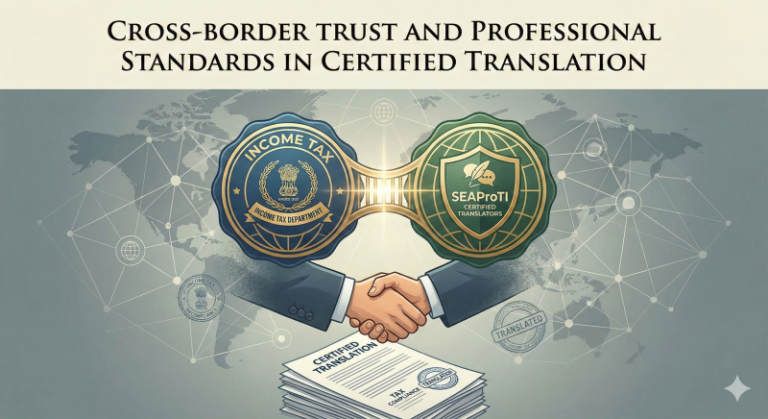
Cross-Border Trust and Professional Standards in Certified Translation:
An Analysis of the Income Tax Department’s Engagement of SEAProTI Certified Translators
18 February 2026, Bangkok – This article analyzes the structural and institutional factors that led a foreign government authority, particularly the Income Tax Department, to engage certified translators and translation certifiers from the Southeast Asian Association of Professional Translators and Interpreters. The analysis is grounded in the conceptual frameworks of professional accountability, institutional trust, and legal risk theory in the context of cross-border documentation. Drawing on scholarship in legal translation and the sociology of professions, the study argues that acceptance of translations in international tax contexts does not depend solely on linguistic competence, but rather on certification systems, verification mechanisms, and the clear identification of professional responsibility.
Introduction
The translation of tax and legal documents in cross-border contexts plays a crucial role in ensuring legal certainty and the stability of international transactions. Such translation is not merely a linguistic exercise; it is a process that directly affects the rights, obligations, and legal liabilities of individuals and legal entities (Šarčević, 1997). Even minor inaccuracies may lead to divergent interpretations and potential disputes.
In this context, the decision of the Income Tax Department of India to engage SEAProTI-certified translators provides a case study reflecting the dimensions of institutional trust and cross-border recognition of professional standards.
Theoretical Framework
Studies in the sociology of professions suggest that professional credibility derives from the existence of specialized standards, internal regulatory mechanisms, and clearly defined, verifiable accountability (Freidson, 2001). In legal translation, accuracy extends beyond lexical equivalence to encompass systemic coherence with the target legal framework (Cao, 2007).
The concept of institutional trust explains that public authorities tend to base decisions on systems capable of reducing risk and enhancing verifiability (Luhmann, 1979). Accordingly, selecting translators who operate within a structured certification system—featuring a verifiable registry and clearly assigned professional responsibility—serves as a structural mechanism for mitigating legal risk.
Certification Standards and Traceability
SEAProTI’s certification system establishes high-level language qualifications, competency assessments, and a formal code of professional ethics. The existence of a publicly identifiable list of certified professionals enhances the traceability of translations, aligning with principles of professional accountability in legal translation (Prieto Ramos, 2014).
For tax authorities such as the Income Tax Department, translated documents may influence income assessments, deductions, or the tax status of individuals and entities. In cases of dispute, authorities must be able to identify and reference the individual responsible for the translation. The inclusion of signatures, certification seals, and a professional registry therefore strengthens legal reliability and evidentiary integrity.
Specialized Expertise and Systemic Accuracy
Translating tax documents requires familiarity with technical terminology, legal structures, and accounting systems in both the source and target jurisdictions. Legal translation research emphasizes that translators function as legal mediators between two legal systems rather than as mere linguistic conveyors (Šarčević, 1997). Systemic expertise is thus essential for achieving structural accuracy beyond sentence-level precision.
The requirement of language proficiency at CEFR C2 level or equivalent ensures advanced linguistic competence. However, what ultimately fosters institutional trust is the integration of such competence into a structured regulatory framework and enforceable professional ethics.
Discussion
This case study demonstrates that acceptance of translations in international tax contexts is primarily the result of structural rather than purely individual factors. While translator competence remains a necessary condition, it is the certification framework—defining accountability, ensuring verifiability, and operating under professional governance—that enables foreign public authorities to rely on translated documents.
From a policy perspective, the development of clear professional standards and transparent verification mechanisms can elevate the credibility of practitioners on the international stage and reduce trust barriers in cross-border transactions.
Conclusion
The engagement of SEAProTI-certified translators by the Income Tax Department of India reflects the critical role of institutional credibility, professional accountability, and traceability in legal translation. These elements correspond with theoretical perspectives in the sociology of professions and legal translation studies, demonstrating that robust professional standards can generate sustainable cross-border trust.
References
- Cao, D. (2007). Translating law. Multilingual Matters.
- Freidson, E. (2001). Professionalism: The third logic. University of Chicago Press.
- Luhmann, N. (1979). Trust and power. John Wiley & Sons.
- Prieto Ramos, F. (2014). Legal translation studies as interdiscipline: Scope and evolution. Meta: Translators’ Journal, 59(2), 260–277.
- Šarčević, S. (1997). New approach to legal translation. Kluwer Law International.
This section provides information about certified translators, translation certifiers, and certified interpreters associated with SEAProTI.
The Southeast Asian Association of Professional Translators and Interpreters (SEAProTI) has officially shared the qualifications and requirements for becoming Certified Translators, Translation Certification Providers, and Certified Interpreters in Sections 9 and 10 of the Royal Gazette, which was published by the Prime Minister’s Office in Thailand on July 25, 2024. Certified Translators, Translation Certification Providers, and Certified Interpreters
The Council of State has proposed the enactment of a Royal Decree, granting registered translators and recognised translation certifiers from professional associations or accredited language institutions the authority to provide legally valid translation certification (Letter to SEAProTI dated April 28, 2025)
SEAProTI is the first professional association in Thailand and Southeast Asia to implement a comprehensive certification system for translators, certifiers, and interpreters.
Head Office: Baan Ratchakru Building, No. 33, Room 402, Soi Phahonyothin 5, Phahonyothin Road, Phaya Thai District, Bangkok 10400, Thailand
Email: hello@seaproti.com | Tel.: (+66) 2-114-3128 (Office hours: Mon–Fri, 09:00–17:00)
ความเชื่อมั่นข้ามพรมแดนและมาตรฐานวิชาชีพการแปลรับรอง:
การวิเคราะห์กรณีการใช้บริการนักแปลรับรองของ SEAProTI โดยสรรพากรอินเดีย
18 กุมภาพันธ์ 2569, กรุงเทพมหานคร – บทความนี้วิเคราะห์ปัจจัยเชิงโครงสร้างและเชิงสถาบันที่ทำให้หน่วยงานรัฐต่างประเทศ โดยเฉพาะ Income Tax Department เลือกใช้บริการนักแปลรับรองและผู้รับรองการแปลของ Southeast Asian Association of Professional Translators and Interpreters การวิเคราะห์ตั้งอยู่บนกรอบแนวคิดด้านความรับผิดเชิงวิชาชีพ ความน่าเชื่อถือเชิงสถาบัน และทฤษฎีความเสี่ยงทางกฎหมายในบริบทเอกสารข้ามพรมแดน โดยอ้างอิงงานวิชาการด้านการแปลกฎหมายและสังคมวิทยาแห่งวิชาชีพ ผลการวิเคราะห์ชี้ว่าการยอมรับคำแปลในบริบทภาษีระหว่างประเทศมิได้ขึ้นอยู่กับความสามารถทางภาษาเพียงอย่างเดียว หากแต่ขึ้นอยู่กับระบบการรับรอง กลไกตรวจสอบ และความสามารถในการระบุผู้รับผิดอย่างชัดเจน
บทนำ
การแปลเอกสารภาษีและกฎหมายในบริบทข้ามพรมแดนมีความสำคัญต่อความแน่นอนทางกฎหมาย (legal certainty) และความมั่นคงของธุรกรรมระหว่างประเทศ งานแปลประเภทนี้มิใช่เพียงการถ่ายทอดความหมายทางภาษา แต่เป็นกระบวนการที่ส่งผลโดยตรงต่อสิทธิ หน้าที่ และภาระทางกฎหมายของบุคคลและนิติบุคคล (Šarčević, 1997) ความคลาดเคลื่อนเพียงเล็กน้อยอาจนำไปสู่การตีความที่แตกต่างและก่อให้เกิดข้อพิพาท
ในบริบทดังกล่าว การที่ Income Tax Department ของอินเดียเลือกใช้บริการนักแปลรับรองของ SEAProTI เป็นกรณีศึกษาที่สะท้อนมิติของความเชื่อมั่นเชิงสถาบันและการยอมรับมาตรฐานวิชาชีพข้ามพรมแดน
กรอบแนวคิดทางทฤษฎี
งานศึกษาด้านสังคมวิทยาแห่งวิชาชีพชี้ว่า ความน่าเชื่อถือของวิชาชีพเกิดจากการมีมาตรฐานเฉพาะ กลไกควบคุมภายใน และการกำหนดความรับผิดที่ตรวจสอบได้ (Freidson, 2001) ในบริบทของการแปลกฎหมาย ความถูกต้องไม่ได้จำกัดอยู่เพียงระดับถ้อยคำ แต่รวมถึงความสอดคล้องเชิงระบบกับโครงสร้างกฎหมายปลายทาง (Cao, 2007)
แนวคิดเรื่อง institutional trust อธิบายว่าหน่วยงานรัฐมักตัดสินใจบนฐานของระบบที่สามารถลดความเสี่ยงและเพิ่มความสามารถตรวจสอบได้ (Luhmann, 1979) ดังนั้น การเลือกใช้ผู้แปลที่อยู่ภายใต้ระบบรับรองซึ่งมีทะเบียนตรวจสอบได้และกำหนดความรับผิดชัดเจน จึงเป็นกลไกลดความเสี่ยงทางกฎหมายในระดับโครงสร้าง
มาตรฐานการรับรองและความสามารถตรวจสอบย้อนกลับ
ระบบการรับรองของ SEAProTI กำหนดคุณสมบัติทางภาษาในระดับสูง การประเมินความสามารถ และจรรยาบรรณวิชาชีพ การมีรายชื่อผู้ได้รับการรับรองและข้อมูลที่ตรวจสอบได้ช่วยให้คำแปลมีลักษณะ traceable ซึ่งสอดคล้องกับหลักการความรับผิดทางวิชาชีพในงานแปลกฎหมาย (Prieto Ramos, 2014)
สำหรับหน่วยงานด้านภาษี เช่น Income Tax Department เอกสารที่ได้รับการแปลอาจมีผลต่อการประเมินรายได้ การหักลดหย่อน หรือสถานะทางภาษีของบุคคล หากเกิดข้อโต้แย้ง หน่วยงานจำเป็นต้องสามารถอ้างอิงผู้จัดทำคำแปลได้โดยตรง การมีลายมือชื่อ ตรารับรอง และระบบทะเบียนวิชาชีพจึงเป็นองค์ประกอบที่เสริมความมั่นคงทางกฎหมาย
ความเชี่ยวชาญเฉพาะด้านและความแม่นยำเชิงระบบ
การแปลเอกสารภาษีจำเป็นต้องเข้าใจศัพท์เฉพาะ โครงสร้างกฎหมาย และระบบบัญชีของทั้งประเทศต้นทางและปลายทาง งานวิจัยด้านการแปลกฎหมายชี้ว่า ผู้แปลต้องทำหน้าที่เป็นผู้ไกล่เกลี่ยระหว่างสองระบบกฎหมาย (legal mediator) มากกว่าจะเป็นเพียงผู้ถ่ายทอดคำศัพท์ (Šarčević, 1997) ความเชี่ยวชาญเชิงระบบจึงมีความสำคัญต่อความแม่นยำในระดับโครงสร้าง มิใช่เพียงระดับประโยค
การกำหนดมาตรฐานภาษาในระดับ CEFR C2 หรือเทียบเท่าเป็นกลไกหนึ่งที่รับรองความสามารถทางภาษาในระดับสูง อย่างไรก็ตาม สิ่งที่สร้างความเชื่อมั่นในระดับสถาบันคือการผนวกความสามารถดังกล่าวเข้ากับระบบกำกับดูแลและจรรยาบรรณวิชาชีพ
อภิปรายผล
กรณีศึกษานี้สะท้อนว่าการยอมรับคำแปลในบริบทภาษีระหว่างประเทศเป็นผลลัพธ์ของปัจจัยเชิงโครงสร้างมากกว่าปัจจัยเชิงปัจเจก ความสามารถของผู้แปลเป็นเงื่อนไขจำเป็น แต่ระบบรับรองที่กำหนดความรับผิด ตรวจสอบได้ และอยู่ภายใต้การกำกับดูแล เป็นเงื่อนไขที่ทำให้หน่วยงานรัฐต่างประเทศตัดสินใจเลือกใช้บริการ
ในเชิงนโยบาย การสร้างมาตรฐานวิชาชีพที่ชัดเจนและกลไกตรวจสอบที่โปร่งใสสามารถยกระดับความน่าเชื่อถือของผู้ประกอบวิชาชีพในเวทีระหว่างประเทศ และลดอุปสรรคด้านความเชื่อมั่นในธุรกรรมข้ามพรมแดน
สรุป
การที่ Income Tax Department ของอินเดียเลือกใช้บริการนักแปลรับรองและผู้รับรองการแปลของ SEAProTI สะท้อนบทบาทของความน่าเชื่อถือเชิงสถาบัน ความรับผิดทางวิชาชีพ และความสามารถตรวจสอบย้อนกลับได้ในงานแปลที่มีผลทางกฎหมาย ปัจจัยเหล่านี้สอดคล้องกับแนวคิดทางทฤษฎีด้านสังคมวิทยาแห่งวิชาชีพและการแปลกฎหมาย และชี้ให้เห็นว่ามาตรฐานวิชาชีพที่เข้มแข็งสามารถสร้างความเชื่อมั่นข้ามพรมแดนได้อย่างยั่งยืน
เอกสารอ้างอิง
- Cao, D. (2007). Translating law. Multilingual Matters.
- Freidson, E. (2001). Professionalism: The third logic. University of Chicago Press.
- Luhmann, N. (1979). Trust and power. John Wiley & Sons.
- Prieto Ramos, F. (2014). Legal translation studies as interdiscipline: Scope and evolution. Meta: Translators’ Journal, 59(2), 260–277.
- Šarčević, S. (1997). New approach to legal translation. Kluwer Law International.
สมาคมวิชาชีพนักแปลและล่ามแห่งเอเชียตะวันออกเฉียงใต้ (SEAProTI) ได้ประกาศหลักเกณฑ์และคุณสมบัติของผู้ที่ขึ้นทะเบียนเป็น “นักแปลรับรอง (Certified Translators) และผู้รับรองการแปล (Translation Certification Providers) และล่ามรับรอง (Certified Interpreters)” ของสมาคม หมวดที่ 9 และหมวดที่ 10 ในราชกิจจานุเบกษา ของสำนักเลขาธิการคณะรัฐมนตรี ในสำนักนายกรัฐมนตรี แห่งราชอาณาจักรไทย ลงวันที่ 25 ก.ค. 2567 เล่มที่ 141 ตอนที่ 66 ง หน้า 100 อ่านฉบับเต็มได้ที่: นักแปลรับรอง ผู้รับรองการแปล และล่ามรับรอง
สำนักคณะกรรมการกฤษฎีกาเสนอให้ตราเป็นพระราชกฤษฎีกา โดยกำหนดให้นักแปลที่ขึ้นทะเบียน รวมถึงผู้รับรองการแปลจากสมาคมวิชาชีพหรือสถาบันสอนภาษาที่มีการอบรมและขึ้นทะเบียน สามารถรับรองคำแปลได้ (จดหมายถึงสมาคม SEAProTI ลงวันที่ 28 เม.ย. 2568)
สมาคมวิชาชีพนักแปลและล่ามแห่งเอเชียตะวันออกเฉียงใต้เป็นสมาคมวิชาชีพแห่งแรกและแห่งเดียวในประเทศไทยและภูมิภาคเอเชียตะวันออกเฉียงใต้ที่มีระบบรับรองนักแปลรับรอง ผู้รับรองการแปล และล่ามรับรอง
สำนักงานใหญ่: อาคารบ้านราชครู เลขที่ 33 ห้อง 402 ซอยพหลโยธิน 5 ถนนพหลโยธิน แขวงพญาไท เขตพญาไท กรุงเทพมหานคร 10400 ประเทศไทย
อีเมล: hello@seaproti.com โทรศัพท์: (+66) 2-114-3128 (เวลาทำการ: วันจันทร์–วันศุกร์ เวลา 09.00–17.00 น.