


Problems in the Use of Interpreters in Thai Courts and the Justice System:
Implications for the Right to a Fair Trial under International Obligations
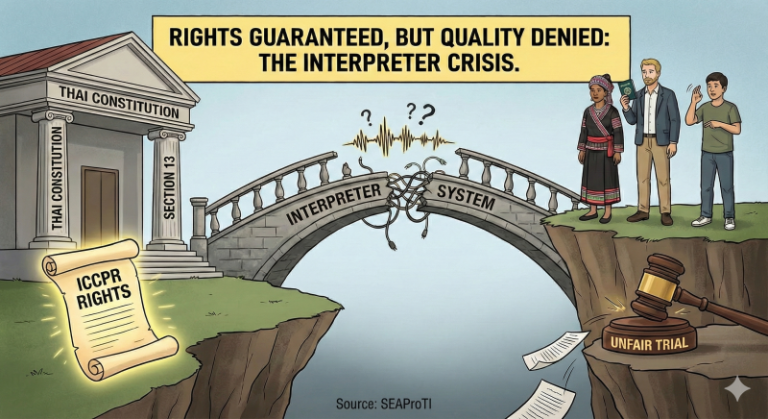
20 January 2025, Bangkok — The provision of interpreters in the justice system is a fundamental mechanism for protecting the rights of individuals who are unable to effectively use standard Thai, including foreign nationals, ethnic minorities, indigenous peoples, and deaf persons. Thai law, in particular Section 13 of the Criminal Procedure Code, expressly guarantees the right to an interpreter. However, in practice, the persistent problem lies not in the existence of interpreters, but in the quality, professional standards, and enforcement of the interpreting system within the Thai justice process. These shortcomings directly affect the right to a fair trial as guaranteed by the Constitution of the Kingdom of Thailand and Thailand’s international obligations under the International Covenant on Civil and Political Rights (ICCPR).
Problems of Interpretation Quality and Accuracy
The most frequently observed problem concerns distortions in message transmission. Some interpreters mistranslate meanings, omit portions of statements, summarize instead of interpreting, or insert personal opinions into the interpretation. Common errors include over-translation, omission, misuse of legal terminology, and failure to preserve register, tone, or speaker intent. Such deficiencies may lead judges, investigators, defendants, or witnesses to misunderstand material facts and may directly affect judicial outcomes and the fundamental rights and liberties of individuals.
Lack of Professional Standards and Court Interpreter Certification
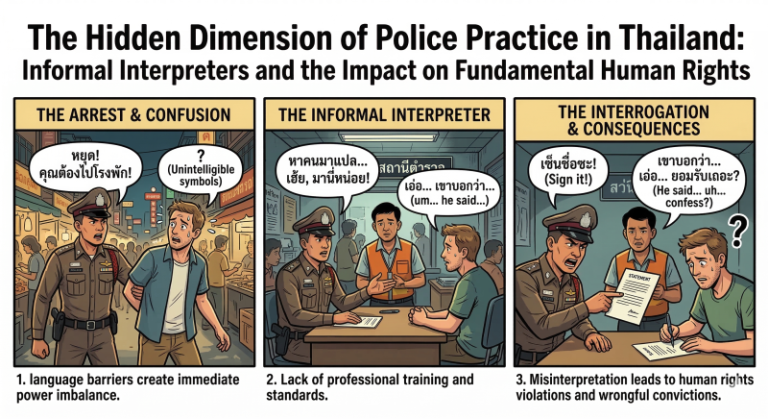
Thailand does not yet have a nationally enforced and comprehensive court interpreter certification system. A significant number of interpreters lack specialized training in law or professional ethics. At the investigative stage, police authorities often select interpreters based on availability or cost rather than competence. As a result, the notification of rights, interrogations, and recorded statements are vulnerable to inaccuracies from the outset, undermining due process and internationally recognized human rights standards.
Shortage of Interpreters in High-Demand Languages
Languages most frequently required in Thai courts include Chinese, Russian, Korean, Myanmar (Burmese), and Cambodian (Khmer), as well as languages spoken by ethnic groups such as Karen and Hmong. In addition, Thai Sign Language interpreters for deaf persons are extremely scarce, and many lack specialized legal training. This shortage significantly limits equitable access to justice for vulnerable populations.
Issues Affecting Vulnerable Groups
Ethnic minorities and indigenous peoples often rely on “community interpreters,” who may have personal ties to the parties and lack neutrality. Deaf persons face constraints related to the number of qualified sign language interpreters, interpreting techniques, and courtroom positioning. For foreign nationals involved in transnational criminal cases, such as drug trafficking or human trafficking, interpretation errors may result in confessions or factual admissions made without genuine understanding, constituting serious violations of the right to a fair trial.
Budgetary and Bureaucratic Constraints
Budget limitations lead some courts to employ low-cost or easily available interpreters, thereby compromising overall interpretation quality. Moreover, access to audio or video recordings of interpreted hearings is sometimes restricted, adversely affecting the ability of parties to prepare appeals or petitions to the Supreme Court.
Evidence from Recent Research and Reports (2025–2026)
Research on Thai–Chinese court interpreting has identified systemic deficiencies in legal terminology resources and cultural contextual understanding. Courtroom observations conducted in 2025 revealed incomplete interpretations and systematic misuse of legal terminology. In 2026, academics and human rights organizations continued to express concern that Thailand’s interpreting system may still fall short of ICCPR standards, exposing the country to repeated international scrutiny.
Policy and Structural Reform Proposals
Scholarly consensus highlights the need to establish a unified national court interpreter certification system, mandatory continuing legal and ethical training, and strict adherence to verbatim interpreting standards prohibiting summarization or personal commentary. Additional proposals include increasing budgets and interpreter numbers for high-demand languages, developing remote interpreting systems for rare languages, and amending legislation to clearly regulate interpreting standards at both investigative and trial stages.
Conclusion
Although Thai law formally guarantees the right to an interpreter, the principal weakness of the Thai justice system lies in the quality, standards, and enforcement of interpreting practices. Without serious structural reform, these deficiencies will continue to undermine the credibility of the justice system and may result in systematic violations of human rights.
References
- United Nations. (1966). International Covenant on Civil and Political Rights. United Nations Treaty Series.
- Hale, S. B. (2004). The discourse of court interpreting. John Benjamins Publishing.
- Mikkelson, H. (2010). Introduction to court interpreting (2nd ed.). Routledge.
- Pöchhacker, F. (2016). Introducing interpreting studies (2nd ed.). Routledge.
Thai Legal Footnotes
¹ Criminal Procedure Code, Section 13
Provides that where an accused or defendant is unable to understand or communicate in Thai, the court or investigating officer must provide an interpreter free of charge, enabling the individual to understand the charges, procedural actions, and to fully exercise their rights. This provision constitutes a core element of procedural justice.
² Constitution of the Kingdom of Thailand (2017), Sections 27 and 29
Section 27 guarantees equality before the law and non-discrimination, while Section 29 guarantees due process and the right to a fair criminal trial. The provision of competent interpreters is a crucial mechanism for realizing these rights for persons who are not proficient in Thai.
³ Criminal Procedure Code, Sections 134/1 and 134/4
Impose a duty on investigating officers to clearly inform suspects of their rights. Where a suspect does not understand Thai, an interpreter must be provided. Inaccurate or incomplete interpretation at this stage may render the investigation unlawful and undermine the credibility of evidence at trial.
⁴ Act on the Organization of Courts of Justice B.E. 2543 (2000)
Defines the authority of courts to manage proceedings in an orderly and fair manner, including oversight of interpreters in the courtroom. While broad judicial discretion exists, the Act lacks specific provisions establishing professional standards for court interpreters.
⁵ Regulations of the Office of the Judiciary on Interpreter Remuneration
Prescribe interpreter fees for court proceedings, which in practice are often lower than professional market rates. This limits the recruitment of interpreters with specialized legal expertise, particularly in rare languages.
⁶ Persons with Disabilities Empowerment Act B.E. 2550 (2007), as amended
Guarantees the rights of persons with disabilities, including deaf persons, to equal access to justice and public services. The absence of legally trained sign language interpreters constitutes a structural barrier contrary to the objectives of this legislation.
⁷ Thailand’s Obligations under ICCPR, Article 14
Thailand is internationally obligated to guarantee the right to a fair trial, including the right to free assistance of an interpreter where the accused cannot understand or speak the language used in court. Domestic practices inconsistent with these standards may lead to observations or criticism by the UN Human Rights Committee.
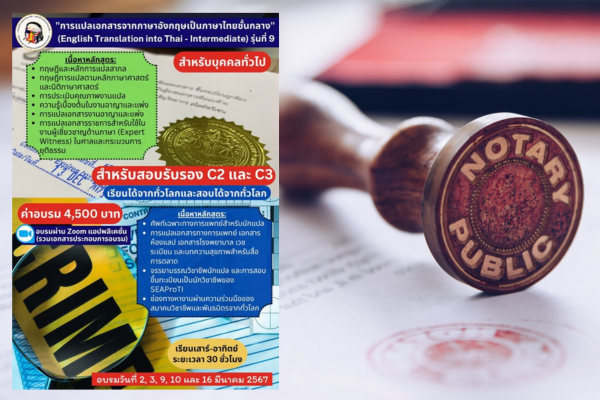
About Certified Translators, Translation Certifiers, and Certified Interpreters of SEAProTI
The Southeast Asian Association of Professional Translators and Interpreters (SEAProTI) has officially shared the qualifications and requirements for becoming Certified Translators, Translation Certification Providers, and Certified Interpreters in Sections 9 and 10 of the Royal Gazette, which was published by the Prime Minister’s Office in Thailand on July 25, 2024. Certified Translators, Translation Certification Providers, and Certified Interpreters
The Council of State has proposed the enactment of a Royal Decree, granting registered translators and recognised translation certifiers from professional associations or accredited language institutions the authority to provide legally valid translation certification (Letter to SEAProTI dated April 28, 2025)
SEAProTI is the first professional association in Thailand and Southeast Asia to implement a comprehensive certification system for translators, certifiers, and interpreters.
Head Office: Baan Ratchakru Building, No. 33, Room 402, Soi Phahonyothin 5, Phahonyothin Road, Phaya Thai District, Bangkok 10400, Thailand
Email: hello@seaproti.com | Tel.: (+66) 2-114-3128 (Office hours: Mon–Fri, 09:00–17:00)
ปัญหาการใช้ล่ามในศาลไทยและกระบวนการยุติธรรม: ผลกระทบต่อสิทธิในการพิจารณาคดีอย่างเป็นธรรมภายใต้พันธกรณีระหว่างประเทศ
20 มกราคม 2568, กรุงเทพมหานคร – การจัดให้มีล่าม (interpreter) ในกระบวนการยุติธรรมเป็นกลไกพื้นฐานในการคุ้มครองสิทธิของบุคคลที่ไม่สามารถใช้ภาษาไทยมาตรฐานได้อย่างมีประสิทธิภาพ ไม่ว่าจะเป็นชาวต่างชาติ ชนกลุ่มน้อย ชนเผ่าพื้นเมือง หรือคนหูหนวก กฎหมายไทย โดยเฉพาะประมวลกฎหมายวิธีพิจารณาความอาญา มาตรา 13 รับรองสิทธิในการมีล่ามไว้โดยชัดแจ้ง อย่างไรก็ตาม ในทางปฏิบัติ ปัญหาที่เกิดขึ้นอย่างต่อเนื่องมิได้อยู่ที่ “การมีล่าม” หากแต่อยู่ที่ “คุณภาพ มาตรฐาน และการบังคับใช้” ของระบบล่ามในกระบวนการยุติธรรมไทย ซึ่งส่งผลกระทบโดยตรงต่อสิทธิในการต่อสู้คดีอย่างเป็นธรรม (fair trial) ตามรัฐธรรมนูญและพันธกรณีระหว่างประเทศของไทยภายใต้ International Covenant on Civil and Political Rights (ICCPR)
ปัญหาด้านคุณภาพและความถูกต้องของการแปล
ปัญหาที่พบได้บ่อยที่สุดคือความคลาดเคลื่อนของการถ่ายทอดสาร ล่ามบางรายแปลผิดความหมาย ตัดทอนเนื้อหา สรุปแทนการแปล หรือเพิ่มความเห็นส่วนตัวเข้าไปในคำแปล ลักษณะความผิดพลาดดังกล่าวรวมถึงการแปลเกิน (over-translation) การแปลตก (omission) การใช้ศัพท์กฎหมายผิด และการไม่รักษาระดับถ้อยคำ น้ำเสียง หรือเจตนาของผู้พูด ปัญหาเหล่านี้ส่งผลให้ศาล พนักงานสอบสวน จำเลย หรือพยานเข้าใจข้อเท็จจริงคลาดเคลื่อน และอาจนำไปสู่คำพิพากษาที่กระทบต่อสิทธิและเสรีภาพของบุคคลโดยตรง
การขาดมาตรฐานวิชาชีพและระบบรับรองล่ามศาล
ประเทศไทยยังไม่มีระบบการรับรองล่ามศาลที่มีผลบังคับใช้ทั่วประเทศอย่างเข้มงวด ล่ามจำนวนหนึ่งไม่ได้ผ่านการอบรมเฉพาะทางด้านกฎหมายหรือจริยธรรมวิชาชีพ ในชั้นสอบสวนของตำรวจ มักมีการเลือกใช้ล่ามที่หาได้ใกล้ตัวหรือมีต้นทุนต่ำมากกว่าความเชี่ยวชาญ ส่งผลให้การแจ้งสิทธิ การสอบปากคำ และการบันทึกคำให้การมีความเสี่ยงต่อความคลาดเคลื่อนตั้งแต่ต้นทาง ซึ่งขัดกับหลัก due process และมาตรฐานสากลด้านสิทธิมนุษยชน
ปัญหาการขาดแคลนล่ามในภาษาที่มีความต้องการสูง
ภาษาที่พบความต้องการสูงในศาลไทย ได้แก่ ภาษาจีน รัสเซีย เกาหลี เมียนมา กัมพูชา รวมถึงภาษาของชนเผ่าต่าง ๆ เช่น กะเหรี่ยงและม้ง นอกจากนี้ ล่ามภาษามือไทยสำหรับคนหูหนวกมีจำนวนจำกัดอย่างยิ่ง และส่วนใหญ่ไม่ได้รับการอบรมเฉพาะทางด้านกฎหมาย การขาดแคลนดังกล่าวทำให้การเข้าถึงความยุติธรรมของกลุ่มเปราะบางเป็นไปอย่างจำกัดและไม่เท่าเทียม
ปัญหาเฉพาะกลุ่มเปราะบาง
ชนกลุ่มน้อยและชนเผ่าพื้นเมืองมักต้องพึ่งพา “ล่ามชุมชน” ซึ่งอาจมีความสัมพันธ์ส่วนตัวกับคู่ความและขาดความเป็นกลาง ขณะที่คนหูหนวกต้องเผชิญข้อจำกัดทั้งด้านจำนวนล่ามภาษามือ เทคนิคการแปล และการจัดวางในห้องพิจารณาคดี สำหรับชาวต่างชาติในคดีอาญาข้ามชาติ เช่น คดียาเสพติดหรือการค้ามนุษย์ ความผิดพลาดในการแปลอาจนำไปสู่การรับสารภาพหรือการยอมรับข้อเท็จจริงโดยไม่เข้าใจอย่างแท้จริง ซึ่งเป็นการละเมิดหลักการพิจารณาคดีอย่างเป็นธรรมอย่างร้ายแรง
ปัญหาด้านงบประมาณและระบบราชการ
ข้อจำกัดด้านงบประมาณทำให้ศาลบางแห่งเลือกใช้ล่ามที่มีค่าตอบแทนต่ำหรือหาได้ง่าย ส่งผลต่อคุณภาพโดยรวมของการแปล อีกทั้งการเข้าถึงบันทึกวิดีโอหรือเสียงของการพิจารณาคดีที่มีการใช้ล่ามยังเป็นไปได้ยากในบางกรณี ซึ่งกระทบต่อสิทธิของคู่ความในการเตรียมการอุทธรณ์หรือฎีกา
หลักฐานจากงานวิจัยและรายงานล่าสุด (พ.ศ. 2568–2569)
งานวิจัยด้านการแปลภาษาไทย–จีนในศาลชี้ให้เห็นปัญหาการขาดคลังศัพท์กฎหมายและความเข้าใจบริบทวัฒนธรรม การสังเกตการณ์คดีจริงในปี 2568 พบการแปลไม่ครบถ้วนและการใช้ศัพท์กฎหมายผิดอย่างเป็นระบบ ขณะที่ในปี 2569 นักวิชาการและองค์กรสิทธิมนุษยชนยังคงแสดงความกังวลว่าระบบล่ามของไทยอาจยังไม่เป็นไปตามมาตรฐาน ICCPR ซึ่งทำให้ประเทศไทยเสี่ยงต่อการถูกตรวจสอบซ้ำในเวทีระหว่างประเทศ
แนวทางการแก้ไขเชิงนโยบายและเชิงระบบ
ข้อเสนอที่ปรากฏอย่างสอดคล้องกันในงานวิชาการ ได้แก่ การจัดตั้งระบบรับรองวิชาชีพล่ามศาลที่มีมาตรฐานเดียวกันทั่วประเทศ การอบรมต่อเนื่องด้านกฎหมายและจริยธรรม การกำหนดมาตรฐานการแปลแบบ verbatim โดยห้ามสรุปหรือแทรกความคิดเห็น การเพิ่มงบประมาณและจำนวนล่ามในภาษาที่ขาดแคลน การพัฒนาระบบล่ามระยะไกลสำหรับภาษาหายาก และการปรับปรุงกฎหมายให้ครอบคลุมทั้งชั้นสอบสวนและชั้นศาลอย่างชัดเจน
บทสรุป
แม้กฎหมายไทยจะรับรองสิทธิในการมีล่ามไว้แล้ว แต่จุดอ่อนสำคัญของกระบวนการยุติธรรมไทยยังคงอยู่ที่คุณภาพ มาตรฐาน และการบังคับใช้ของระบบล่าม หากไม่มีการปฏิรูปเชิงโครงสร้างอย่างจริงจัง ปัญหานี้จะยังคงบ่อนทำลายความน่าเชื่อถือของกระบวนการยุติธรรม และอาจนำไปสู่การละเมิดสิทธิมนุษยชนอย่างเป็นระบบต่อไป
เอกสารอ้างอิง
- United Nations. (1966). International Covenant on Civil and Political Rights. United Nations Treaty Series.
- Hale, S. B. (2004). The discourse of court interpreting. John Benjamins Publishing.
- Mikkelson, H. (2010). Introduction to court interpreting (2nd ed.). Routledge.
- Pöchhacker, F. (2016). Introducing interpreting studies (2nd ed.). Routledge.
เชิงอรรถกฎหมายไทย
¹ ประมวลกฎหมายวิธีพิจารณาความอาญา มาตรา 13
บัญญัติว่า ในกรณีที่จำเลยหรือผู้ต้องหาไม่สามารถเข้าใจหรือสื่อสารภาษาไทยได้ ศาลหรือพนักงานสอบสวนต้องจัดให้มีล่ามโดยไม่คิดค่าใช้จ่าย เพื่อให้บุคคลดังกล่าวสามารถเข้าใจข้อกล่าวหา การดำเนินกระบวนพิจารณา และใช้สิทธิของตนได้อย่างครบถ้วน หลักการดังกล่าวถือเป็นส่วนหนึ่งของสิทธิในกระบวนการยุติธรรม (procedural rights)
² รัฐธรรมนูญแห่งราชอาณาจักรไทย พุทธศักราช 2560 มาตรา 27 และมาตรา 29
มาตรา 27 รับรองหลักความเสมอภาคและการไม่เลือกปฏิบัติ ส่วนมาตรา 29 รับรองสิทธิในกระบวนการยุติธรรมทางอาญา รวมถึงสิทธิในการได้รับการพิจารณาคดีอย่างเป็นธรรม ซึ่งการจัดให้มีล่ามที่มีคุณภาพเป็นกลไกสำคัญในการทำให้สิทธิดังกล่าวเกิดขึ้นได้จริงสำหรับผู้ที่ไม่ถนัดภาษาไทย
³ ประมวลกฎหมายวิธีพิจารณาความอาญา มาตรา 134/1 และ 134/4
บัญญัติหน้าที่ของพนักงานสอบสวนในการแจ้งสิทธิแก่ผู้ต้องหาอย่างชัดเจน หากผู้ต้องหาไม่เข้าใจภาษาไทย ต้องจัดให้มีล่าม การแปลที่ไม่ครบถ้วนหรือคลาดเคลื่อนในขั้นตอนนี้อาจทำให้การสอบสวนไม่ชอบด้วยกฎหมาย และส่งผลกระทบต่อความน่าเชื่อถือของพยานหลักฐานในชั้นศาล
⁴ พระราชบัญญัติศาลยุติธรรม พ.ศ. 2543
กำหนดอำนาจหน้าที่ของศาลในการจัดกระบวนพิจารณาให้เป็นไปโดยเรียบร้อยและเป็นธรรม ซึ่งรวมถึงการควบคุมการทำหน้าที่ของล่ามในห้องพิจารณา แม้กฎหมายจะให้อำนาจศาลไว้กว้าง แต่ยังไม่มีบทบัญญัติเฉพาะเกี่ยวกับมาตรฐานวิชาชีพล่ามศาลอย่างเป็นระบบ
⁵ ระเบียบสำนักงานศาลยุติธรรมว่าด้วยการจ่ายค่าตอบแทนล่าม
กำหนดอัตราค่าตอบแทนล่ามในกระบวนการศาล ซึ่งในทางปฏิบัติมักต่ำกว่าค่าตอบแทนในตลาดวิชาชีพ ส่งผลให้การดึงดูดล่ามที่มีความเชี่ยวชาญเฉพาะทาง โดยเฉพาะด้านกฎหมายและภาษาหายาก เป็นไปอย่างจำกัด
⁶ พระราชบัญญัติส่งเสริมและพัฒนาคุณภาพชีวิตคนพิการ พ.ศ. 2550 และที่แก้ไขเพิ่มเติม
รับรองสิทธิของคนพิการ รวมถึงคนหูหนวก ในการเข้าถึงกระบวนการยุติธรรมและบริการของรัฐอย่างเท่าเทียม การขาดล่ามภาษามือที่มีความรู้ด้านกฎหมายอาจถือเป็นอุปสรรคเชิงโครงสร้างที่ขัดต่อเจตนารมณ์ของกฎหมายฉบับนี้
⁷ พันธกรณีของประเทศไทยภายใต้ ICCPR มาตรา 14
ประเทศไทยมีพันธกรณีระหว่างประเทศในการรับรองสิทธิในการพิจารณาคดีอย่างเป็นธรรม รวมถึงสิทธิในการได้รับความช่วยเหลือจากล่ามโดยไม่เสียค่าใช้จ่าย หากไม่เข้าใจหรือไม่สามารถใช้ภาษาที่ใช้ในศาลได้ การบังคับใช้กฎหมายภายในที่ไม่สอดคล้องกับมาตรฐานดังกล่าวอาจนำไปสู่การถูกตั้งข้อสังเกตโดยคณะกรรมการสิทธิมนุษยชนแห่งสหประชาชาติ
เกี่ยวกับนักแปลรับรอง ผู้รับรองการแปล และล่ามรับรองของสมาคมวิชาชีพนักแปลและล่ามแห่งเอเชียตะวันออกเฉียงใต้
สมาคมวิชาชีพนักแปลและล่ามแห่งเอเชียตะวันออกเฉียงใต้ (SEAProTI) ได้ประกาศหลักเกณฑ์และคุณสมบัติของผู้ที่ขึ้นทะเบียนเป็น “นักแปลรับรอง (Certified Translators) และผู้รับรองการแปล (Translation Certification Providers) และล่ามรับรอง (Certified Interpreters)” ของสมาคม หมวดที่ 9 และหมวดที่ 10 ในราชกิจจานุเบกษา ของสำนักเลขาธิการคณะรัฐมนตรี ในสำนักนายกรัฐมนตรี แห่งราชอาณาจักรไทย ลงวันที่ 25 ก.ค. 2567 เล่มที่ 141 ตอนที่ 66 ง หน้า 100 อ่านฉบับเต็มได้ที่: นักแปลรับรอง ผู้รับรองการแปล และล่ามรับรอง
สำนักคณะกรรมการกฤษฎีกาเสนอให้ตราเป็นพระราชกฤษฎีกา โดยกำหนดให้นักแปลที่ขึ้นทะเบียน รวมถึงผู้รับรองการแปลจากสมาคมวิชาชีพหรือสถาบันสอนภาษาที่มีการอบรมและขึ้นทะเบียน สามารถรับรองคำแปลได้ (จดหมายถึงสมาคม SEAProTI ลงวันที่ 28 เม.ย. 2568)
สมาคมวิชาชีพนักแปลและล่ามแห่งเอเชียตะวันออกเฉียงใต้ เป็นสมาคมวิชาชีพแห่งแรกและแห่งเดียวในประเทศไทยและภูมิภาคเอเชียตะวันออกเฉียงใต้ที่มีระบบรับรองนักแปลรับรอง ผู้รับรองการแปล และล่ามรับรอง
สำนักงานใหญ่: อาคารบ้านราชครู เลขที่ 33 ห้อง 402 ซอยพหลโยธิน 5 ถนนพหลโยธิน แขวงพญาไท เขตพญาไท กรุงเทพมหานคร 10400 ประเทศไทย
อีเมล: hello@seaproti.com โทรศัพท์: (+66) 2-114-3128 (เวลาทำการ: วันจันทร์–วันศุกร์ เวลา 09.00–17.00 น.