


The Certified Correct Translation Standard: An Academic Analysis of Translation Practice, International Standards, and Professional Ethics
30 December 2025, Bangkok – In the context of globalisation and interstate relations, the translation of legally binding, administrative, and international economic documents requires reliable quality assurance mechanisms capable of establishing trust among document users. The “Certified Correct Translation” stamp functions as a critical professional instrument for affirming the accuracy, completeness, and ethical responsibility of translated texts. This article aims to analyse the conceptual foundations, guiding principles, and structural components of certified translation stamps from both theoretical and practical perspectives. Drawing on frameworks of translation quality assessment, professional ethics, and institutional certification, the study employs the standards established by the Southeast Asian Association of Professional Translators and Interpreters (SEAProTI) as a case study. The article argues that certified translation stamps are not merely documentary symbols but formal attestations of process integrity, professional competence, and accountability in international translation practice.
Keywords: certified translation, Certified Correct Translation, translation standards, translator ethics, professional certification
Translation is a linguistic and social activity that directly affects rights, obligations, and relationships among individuals, institutions, and states. This is particularly evident in legal, administrative, and international documents, where inaccuracies in translation may result in misinterpretation, improper legal enforcement, or cross-border disputes (Hale, 2015). As a result, the translation profession has developed mechanisms to ensure the reliability and credibility of translated documents. One of the most significant mechanisms is the use of the “Certified Correct Translation” stamp.
In many jurisdictions, translation certification does not take the form of direct state authorisation but instead operates as a form of professional certification. In such systems, professional associations establish standards, monitor quality, and enforce ethical conduct among translators (Pym, 2012). This article examines how certified translation stamps function as institutional tools and explains why clearly defined components and procedures are essential for maintaining international credibility.
Concept and Definition of Certified Correct Translation
The term “Certified Correct Translation” refers to the formal attestation that a translated document accurately and fully represents the source text and effectively conveys its substance, intent, and legal consequences. From a theoretical perspective, this concept aligns with established frameworks of translation quality assessment, which emphasise accuracy, functional adequacy, and usability within the target context (House, 2015).
Importantly, certification does not imply linguistic perfection. Rather, it signifies that the translation has undergone a systematic verification process and that the translator formally accepts professional responsibility for the work produced (Chesterman, 2001). Certification thus functions as an assurance of procedural integrity rather than stylistic idealism.
Principles Governing the Use of Certification Stamps
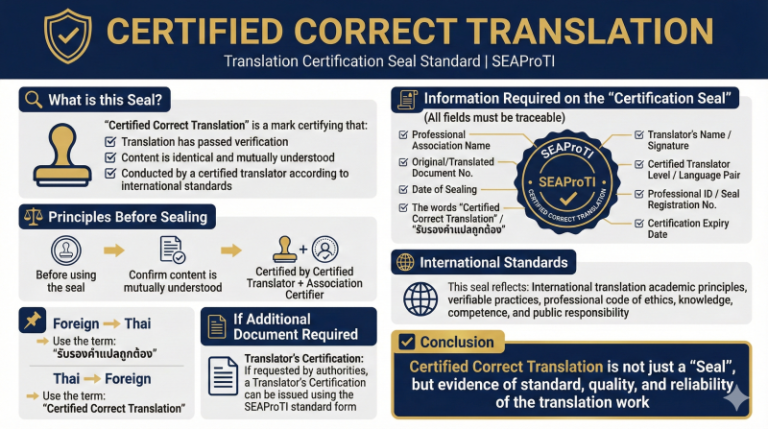
International best practice dictates that certified translation stamps must be applied only after compliance with three core principles.
Verification with Stakeholders
The translated document should be reviewed in coordination with the document user or relevant stakeholders to ensure that it fulfils its intended purpose, whether submission to governmental authorities, courts, or international organisations.
Confirmation of Shared Understanding
Translators and certifying authorities must confirm that the source and target texts convey equivalent meaning and intent. This principle reflects the theory of functional equivalence, which prioritises communicative purpose over literal correspondence (Nord, 2018).
Certification by Qualified Professionals
Certification must be performed by translators who meet professional qualification standards set by recognised associations. In many systems, an additional certifying authority is required to enhance professional oversight and accountability.
Linguistic Direction and Certification Terminology
In practice, certification terminology varies depending on the language direction. Translations into Thai typically employ the phrase “รับรองคำแปลถูกต้อง” (Certified Correct Translation in Thai), while translations from Thai into foreign languages use the English designation “Certified Correct Translation.”
This distinction is not merely linguistic but pragmatic. Certification language must correspond to the expectations and institutional norms of the receiving authority to ensure effective legal and administrative recognition (House, 2015).
Translator’s Certification as a Supplementary Instrument
Beyond certification stamps, many legal systems recognise a “Translator’s Certification,” a formal declaration in which the translator personally affirms the accuracy of the translation. Such documents are commonly required in the United States, the European Union, and mixed legal systems (González, 2014).
Translator’s Certifications complement certification stamps by emphasising individual professional responsibility and may serve as evidentiary documents in cases involving disputes over translation accuracy.
Structural Components of Certified Translation Stamps
A standardised certified translation stamp must include traceable and verifiable elements, including:
- The name of the professional association in both the local language and English
- Source document and translated document reference numbers
- Date of certification
- Translator’s full name, certification level, and authorised language pair
- Professional identification number and stamp registration number
- Certification expiration date
- Translator’s signature
These components transform the stamp from a symbolic marker into an institutional mechanism for quality assurance and professional accountability (Pym, 2012).
Certified Translation and Professional Ethics
The use of certified translation stamps is inseparable from translator ethics, particularly principles of honesty, competence, and public responsibility (Chesterman, 2001). By applying a certification stamp, translators formally assume ethical and professional liability for their work. Negligence or misrepresentation may therefore result in professional or legal consequences.
SEAProTI as a Case Study in Regional Standardisation
The standards developed by the Southeast Asian Association of Professional Translators and Interpreters (SEAProTI) illustrate the practical application of international translation principles within a regional context. SEAProTI defines certification procedures, stamp components, and traceability requirements through a centralised database system. This institutional framework enhances professional credibility and clarifies the distinction between professional certification and ad hoc registration for specific assignments.
Conclusion
The “Certified Correct Translation” stamp functions as a vital link between translation quality, professional ethics, and public trust. This article demonstrates that certification is not merely an administrative formality but a comprehensive attestation of process integrity, professional competence, and ethical responsibility. The establishment of transparent, verifiable, and academically grounded standards—such as those adopted by SEAProTI—plays a crucial role in advancing the translation profession in an increasingly interconnected world.
References
- Chesterman, A. (2001). Proposal for a hierarchy of translator ethics. The Translator, 7(2), 139–154. https://doi.org/10.1080/13556509.2001.10799104
- González, R. D. (2014). Fundamentals of court interpretation. Carolina Academic Press.
- Hale, S. (2015). The discourse of court interpreting. John Benjamins.
- House, J. (2015). Translation quality assessment: Past and present. Routledge.
- Nord, C. (2018). Translating as a purposeful activity: Functionalist approaches explained (2nd ed.). Routledge.
- Pym, A. (2012). On translator ethics: Principles for mediation between cultures. John Benjamins.
About Certified Translators, Translation Certifiers, and Certified Interpreters of SEAProTI
The Southeast Asian Association of Professional Translators and Interpreters (SEAProTI) has formally announced the qualifications and requirements for registration of Certified Translators, Translation Certification Providers, and Certified Interpreters in Sections 9 and 10 of the Royal Gazette, published by the Secretariat of the Cabinet, Office of the Prime Minister of Thailand, on 25 July 2024 (Vol. 141, Part 66 Ng, p. 100). Certified Translators, Translation Certification Providers, and Certified Interpreters
The Council of State has proposed the enactment of a Royal Decree, granting registered translators and recognised translation certifiers from professional associations or accredited language institutions the authority to provide legally valid translation certification (Letter to SEAProTI dated April 28, 2025)
SEAProTI is the first professional association in Thailand and Southeast Asia to implement a comprehensive certification system for translators, certifiers, and interpreters.
Head Office: Baan Ratchakru Building, No. 33, Room 402, Soi Phahonyothin 5, Phahonyothin Road, Phaya Thai District, Bangkok 10400, Thailand
Email: hello@seaproti.com | Tel.: (+66) 2-114-3128 (Office hours: Mon–Fri, 09:00–17:00)
มาตรฐานตราประทับรับรองคำแปล (Certified Correct Translation): การวิเคราะห์เชิงวิชาการด้านการแปล มาตรฐานสากล และจรรยาบรรณวิชาชีพ
30 ธันวาคม 2568, กรุงเทพมหานคร – ในบริบทของโลกาภิวัตน์และการติดต่อระหว่างรัฐ การแปลเอกสารที่มีผลผูกพันทางกฎหมาย การปกครอง และเศรษฐกิจระหว่างประเทศ จำเป็นต้องอาศัยกลไกการรับรองคุณภาพที่สามารถสร้างความเชื่อมั่นแก่ผู้ใช้เอกสารได้ ตราประทับ “รับรองคำแปลถูกต้อง” หรือ “Certified Correct Translation” จึงทำหน้าที่เป็นเครื่องมือสำคัญในการยืนยันความถูกต้อง ความครบถ้วน และความรับผิดชอบเชิงวิชาชีพของงานแปล บทความนี้มีวัตถุประสงค์เพื่อวิเคราะห์แนวคิด หลักการ และองค์ประกอบของตราประทับรับรองคำแปลในเชิงทฤษฎีและเชิงปฏิบัติ โดยอาศัยกรอบแนวคิดด้านคุณภาพการแปล (translation quality assessment) จรรยาบรรณวิชาชีพ และการรับรองเชิงสถาบัน (institutional certification) พร้อมยกกรณีศึกษาการกำหนดมาตรฐานของสมาคมวิชาชีพนักแปลและล่ามแห่งเอเชียตะวันออกเฉียงใต้ (SEAProTI) เป็นตัวอย่างในการอธิบาย บทความชี้ให้เห็นว่าตราประทับรับรองคำแปลไม่ใช่เพียงสัญลักษณ์ทางเอกสาร หากแต่เป็นการรับรองกระบวนการ ความรู้ ความสามารถ และความรับผิดชอบของนักแปลในระดับสากล
คำสำคัญ: การรับรองคำแปล, Certified Correct Translation, มาตรฐานงานแปล, จรรยาบรรณนักแปล, การรับรองวิชาชีพ
การแปลเอกสารเป็นกิจกรรมทางภาษาและสังคมที่มีผลกระทบโดยตรงต่อสิทธิ หน้าที่ และความสัมพันธ์ระหว่างบุคคล องค์กร และรัฐ โดยเฉพาะอย่างยิ่งเอกสารทางกฎหมาย เอกสารราชการ และเอกสารที่ใช้ในการติดต่อระหว่างประเทศ ความคลาดเคลื่อนในการแปลอาจนำไปสู่การตีความผิด การบังคับใช้กฎหมายที่ไม่ถูกต้อง หรือข้อพิพาทระหว่างประเทศได้ (Hale, 2015) ด้วยเหตุนี้ สังคมวิชาชีพด้านการแปลจึงพัฒนากลไกในการรับรองคุณภาพของงานแปลขึ้น หนึ่งในกลไกที่สำคัญที่สุดคือการใช้ตราประทับ “Certified Correct Translation”
ในหลายประเทศ การรับรองคำแปลไม่ได้อยู่ในรูปแบบของการรับรองโดยรัฐโดยตรง หากแต่เป็นการรับรองเชิงวิชาชีพ (professional certification) ซึ่งอาศัยองค์กรวิชาชีพเป็นผู้กำหนดมาตรฐาน ควบคุมคุณภาพ และกำกับจรรยาบรรณของนักแปล (Pym, 2012) บทความนี้มุ่งอธิบายว่าตราประทับรับรองคำแปลทำหน้าที่อย่างไรในฐานะเครื่องมือเชิงสถาบัน และเหตุใดการกำหนดองค์ประกอบและกระบวนการที่ชัดเจนจึงมีความสำคัญต่อความน่าเชื่อถือของงานแปลในระดับสากล
แนวคิดและความหมายของ Certified Correct Translation
คำว่า “Certified Correct Translation” หมายถึงการรับรองว่าเอกสารฉบับแปลมีความถูกต้องครบถ้วนเมื่อเทียบกับต้นฉบับ และสามารถถ่ายทอดสาระสำคัญ เจตนารมณ์ และผลทางกฎหมายของต้นฉบับได้อย่างเทียบเท่า ในเชิงทฤษฎี แนวคิดนี้สอดคล้องกับกรอบการประเมินคุณภาพการแปล (translation quality assessment) ซึ่งเน้นความถูกต้อง ความเหมาะสมเชิงหน้าที่ (functional adequacy) และความสามารถในการใช้งานจริงในบริบทเป้าหมาย (House, 2015)
สิ่งสำคัญคือ การรับรองคำแปลไม่ได้หมายความว่างานแปลนั้น “สมบูรณ์แบบ” ในเชิงภาษาศาสตร์ หากแต่หมายถึง งานแปลดังกล่าวผ่านกระบวนการตรวจสอบอย่างเป็นระบบ และนักแปลยอมรับความรับผิดชอบเชิงวิชาชีพต่อผลงานของตน (Chesterman, 2001)
หลักการก่อนการประทับตรารับรอง
การประทับตรารับรองคำแปลตามมาตรฐานสากลต้องตั้งอยู่บนหลักการสำคัญสามประการ ได้แก่ การตรวจสอบร่วมกับผู้มีส่วนได้เสีย การตรวจสอบคำแปลควรดำเนินการร่วมกับผู้ใช้เอกสารหรือผู้มีส่วนได้เสีย เพื่อยืนยันว่าคำแปลสามารถตอบสนองวัตถุประสงค์ของการใช้งานได้จริง ไม่ว่าจะเป็นการยื่นต่อหน่วยงานรัฐ ศาล หรือองค์กรระหว่างประเทศ
การยืนยันความเข้าใจตรงกัน
นักแปลและผู้รับรองต้องยืนยันว่า “เนื้อความเข้าใจตรงกัน” ระหว่างต้นฉบับและฉบับแปล หลักการนี้สะท้อนแนวคิด functional equivalence ซึ่งให้ความสำคัญกับหน้าที่ของข้อความมากกว่าการถอดคำแบบตรงตัว (Nord, 2018)
การรับรองโดยผู้มีคุณสมบัติตามมาตรฐานวิชาชีพ
การรับรองต้องดำเนินการโดยนักแปลที่ผ่านการรับรองตามเกณฑ์ขององค์กรวิชาชีพ และในหลายกรณีต้องมีผู้รับรองการแปลเพิ่มเติมเพื่อเพิ่มระดับการกำกับดูแล
ความแตกต่างเชิงภาษากับการใช้ตราประทับ
ในทางปฏิบัติ การใช้ถ้อยคำในการรับรองคำแปลมีความแตกต่างตามทิศทางของภาษา โดยทั่วไป กรณีแปลจากภาษาต่างประเทศเป็นภาษาไทยจะใช้คำว่า “รับรองคำแปลถูกต้อง” ขณะที่กรณีแปลจากภาษาไทยเป็นภาษาต่างประเทศจะใช้คำว่า “Certified Correct Translation” ความแตกต่างนี้ไม่ใช่เพียงประเด็นทางภาษา แต่เป็นประเด็นเชิงปฏิบัติ (pragmatics) เพื่อให้เอกสารสามารถสื่อสารกับหน่วยงานเป้าหมายได้อย่างมีประสิทธิภาพ (House, 2015)
หนังสือรับรองการแปล (Translator’s Certification)
นอกเหนือจากตราประทับรับรองแล้ว หลายระบบกฎหมายยังยอมรับ “หนังสือรับรองการแปลจากนักแปล” หรือ Translator’s Certification ซึ่งเป็นเอกสารคำรับรองที่นักแปลแสดงตนยืนยันความถูกต้องของงานแปลอย่างเป็นทางการ เอกสารลักษณะนี้พบได้บ่อยในสหรัฐอเมริกา สหภาพยุโรป และประเทศที่ใช้ระบบกฎหมายผสม (González, 2014)
หนังสือรับรองการแปลทำหน้าที่เสริมตราประทับ โดยเน้นการรับผิดชอบส่วนบุคคลของนักแปล และสามารถใช้เป็นหลักฐานในกรณีเกิดข้อพิพาทเกี่ยวกับความถูกต้องของคำแปล
องค์ประกอบของตราประทับรับรองคำแปล
ตราประทับรับรองคำแปลที่มีมาตรฐานต้องมีองค์ประกอบที่สามารถตรวจสอบย้อนกลับได้ (traceability) ได้แก่ ชื่อองค์กรวิชาชีพทั้งภาษาไทยและภาษาอังกฤษ เลขเอกสารต้นฉบับและเลขเอกสารคำแปล วันที่ประทับตรา ชื่อ–นามสกุลนักแปล ระดับการรับรอง และคู่ภาษาที่ได้รับอนุญาต เลขประจำตัวนักวิชาชีพ เลขทะเบียนตราประทับ และวันหมดอำนาจการรับรอง และลายมือชื่อของนักแปล องค์ประกอบเหล่านี้ทำให้ตราประทับเป็นมากกว่าสัญลักษณ์ แต่เป็นกลไกเชิงสถาบันในการกำกับดูแลคุณภาพและความรับผิดชอบ (Pym, 2012)
ตราประทับกับจรรยาบรรณวิชาชีพนักแปล
การใช้ตราประทับรับรองคำแปลเชื่อมโยงโดยตรงกับจรรยาบรรณวิชาชีพนักแปล โดยเฉพาะหลักความซื่อสัตย์ ความสามารถ และความรับผิดชอบต่อสาธารณะ (Chesterman, 2001) นักแปลที่ประทับตรารับรองย่อมต้องยอมรับผลทางวิชาชีพและจริยธรรม หากคำแปลก่อให้เกิดความเสียหายจากความประมาทหรือการบิดเบือนเนื้อหา
กรณีศึกษาการกำหนดมาตรฐานของ SEAProTI
แนวปฏิบัติของสมาคมวิชาชีพนักแปลและล่ามแห่งเอเชียตะวันออกเฉียงใต้ (SEAProTI) แสดงให้เห็นถึงการนำหลักวิชาการสากลมาปรับใช้ในบริบทภูมิภาค โดยกำหนดทั้งกระบวนการรับรอง องค์ประกอบของตราประทับ และการตรวจสอบย้อนกลับผ่านระบบฐานข้อมูล กลไกดังกล่าวช่วยยกระดับความน่าเชื่อถือของงานแปล และลดความสับสนระหว่าง “การรับรองวิชาชีพ” กับ “การขึ้นทะเบียนเพื่อใช้งานเฉพาะกรณี”
บทสรุป (Conclusion)
ตราประทับ “Certified Correct Translation” เป็นกลไกสำคัญในการเชื่อมโยงระหว่างคุณภาพงานแปล จรรยาบรรณวิชาชีพ และความเชื่อมั่นของสาธารณะ บทความนี้ชี้ให้เห็นว่าการรับรองคำแปลไม่ใช่เพียงการประทับตราบนเอกสาร หากแต่เป็นการรับรองกระบวนการ ความรู้ และความรับผิดชอบของนักแปลในระดับสากล การกำหนดมาตรฐานที่ชัดเจน ตรวจสอบได้ และสอดคล้องกับหลักวิชาการ เป็นปัจจัยสำคัญในการยกระดับวิชาชีพการแปลในโลกยุคปัจจุบัน
เอกสารอ้างอิง
- Chesterman, A. (2001). Proposal for a hierarchy of translator ethics. The Translator, 7(2), 139–154. https://doi.org/10.1080/13556509.2001.10799104
- González, R. D. (2014). Fundamentals of court interpretation. Carolina Academic Press.
- Hale, S. (2015). The discourse of court interpreting. John Benjamins.
- House, J. (2015). Translation quality assessment: Past and present. Routledge.
- Nord, C. (2018). Translating as a purposeful activity: Functionalist approaches explained (2nd ed.). Routledge.Pym, A. (2012). On translator ethics: Principles for mediation between cultures. John Benjamins.
เกี่ยวกับนักแปลรับรอง ผู้รับรองการแปล และล่ามรับรองของสมาคมวิชาชีพนักแปลและล่ามแห่งเอเชียตะวันออกเฉียงใต้
สมาคมวิชาชีพนักแปลและล่ามแห่งเอเชียตะวันออกเฉียงใต้ (SEAProTI) ได้ประกาศหลักเกณฑ์และคุณสมบัติผู้ที่ขึ้นทะเบียนเป็น “นักแปลรับรอง (Certified Translators) และผู้รับรองการแปล (Translation Certification Providers) และล่ามรับรอง (Certified Interpreters)” ของสมาคม หมวดที่ 9 และหมวดที่ 10 ในราชกิจจานุเบกษา ของสำนักเลขาธิการคณะรัฐมนตรี ในสำนักนายกรัฐมนตรี แห่งราชอาณาจักรไทย ลงวันที่ 25 ก.ค. 2567 เล่มที่ 141 ตอนที่ 66 ง หน้า 100 อ่านฉบับเต็มได้ที่: นักแปลรับรอง ผู้รับรองการแปล และล่ามรับรอง
สำนักคณะกรรมการกฤษฎีกา เสนอให้ตราเป็นพระราชกฤษฎีกา โดยกำหนดให้นักแปลที่ขึ้นทะเบียน รวมถึงผู้รับรองการแปลจากสมาคมวิชาชีพหรือสถาบันสอนภาษาที่มีการอบรมและขึ้นทะเบียน สามารถรับรองคำแปลได้ (จดหมายถึงสมาคม SEAProTI ลงวันที่ 28 เม.ย. 2568)
สมาคมวิชาชีพนักแปลและล่ามแห่งเอเชียตะวันออกเฉียงใต้ เป็นสมาคมวิชาชีพแห่งแรกและแห่งเดียวในประเทศไทยและภูมิภาคเอเชียตะวันออกเฉียงใต้ที่มีระบบรับรองนักแปลรับรอง ผู้รับรองการแปล และล่ามรับรอง
สำนักงานใหญ่: อาคารบ้านราชครู เลขที่ 33 ห้อง 402 ซอยพหลโยธิน 5 ถนนพหลโยธิน แขวงพญาไท เขตพญาไท กรุงเทพมหานคร 10400 ประเทศไทย
อีเมล: hello@seaproti.com โทรศัพท์: (+66) 2-114-3128 (เวลาทำการ: วันจันทร์–วันศุกร์ เวลา 09.00–17.00 น.