



Vulgar Language and Legal Meaning: A Forensic Linguistic Analysis of Thai Supreme Court Judgment No. 1975/2562
Author: Wanitcha Sumanat, President, Southeast Asian Association of Professional Translators and Interpreters (SEAProTI); Professional Forensic Linguist
Abstract
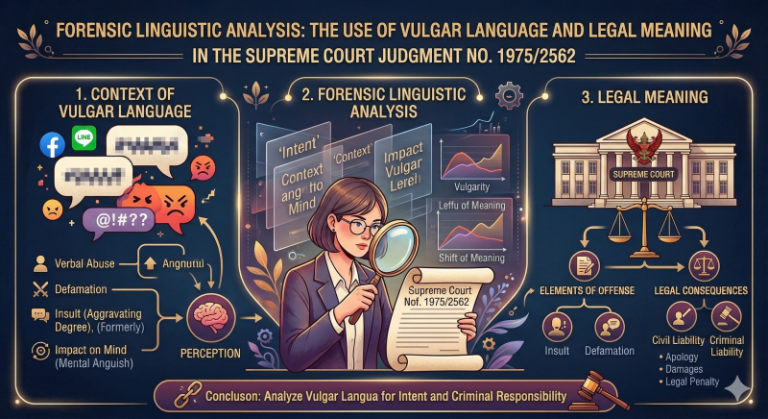
This article aims to analyse Thai Supreme Court Judgment No. 1975/2562 concerning serious defamation under Section 531(2) of the Civil and Commercial Code, through the framework of forensic linguistics. The study examines the relationship between “utterances” and their “legal meaning.” The findings indicate that the Court did not rely solely on the lexical features of the expressions but placed significant emphasis on communicative context (pragmatics), speaker intent, and reputational impact on the alleged victim. Furthermore, the Court underscored the necessity of clearly specifying the disputed expressions in the complaint, reflecting the role of language as structured textual evidence. The study demonstrates that vulgar expressions cannot automatically be construed as defamation in the absence of legally relevant semantic and contextual elements.
Keywords: forensic linguistics, defamation, revocation of gift, legal language, pragmatics
Introduction
The relationship between language and law has long been a central concern in forensic linguistics, particularly in cases where “utterances” constitute the core of the dispute. Thai Supreme Court Judgment No. 1975/2562 serves as a significant case study illustrating the limitations of interpreting language in legal contexts. While certain expressions may be perceived as vulgar or offensive in everyday social interaction, they do not necessarily constitute serious defamation under the law.
The case concerns the revocation of a gift on the grounds of ingratitude under Section 531(2) of the Civil and Commercial Code. The plaintiff alleged that the defendant used offensive and defamatory language. However, the Supreme Court held that the plaintiff’s evidence and pleadings were insufficient to establish the elements of serious defamation. This article, therefore, analyses the judgment through a forensic linguistic lens to explain how the Court transforms “language” into “legally cognizable facts.”
Forensic Linguistic Framework and Interpretation of Utterances
Forensic linguistics is an interdisciplinary field that examines the interaction between language, law, and the justice system, focusing on language as evidence rather than merely as a communicative tool (Coulthard & Johnson, 2010). In defamation cases, determining whether an utterance constitutes an “imputation” requires analysis at multiple levels, including lexical meaning, speaker intention, and social context.
According to Shuy (1993), the interpretation of language in legal disputes cannot be separated from its communicative context. Meaning does not reside solely in words but emerges from the interaction between speaker, listener, and situational context. Consequently, vulgar or insulting language may function merely as “emotive language,” which does not necessarily carry legal consequences.
Analysis of the Judgment: Vulgarity and the Elements of Defamation
In this case, the plaintiff alleged that the defendant used vulgar expressions such as “e-hia” (a highly offensive insult in Thai) and “Do you know whose land this is?” The Supreme Court, however, found that such expressions were insufficient to constitute serious defamation due to the absence of essential legal elements.
First, from a linguistic perspective, the term “e-hia” constitutes non-propositional content, meaning that it does not assert a verifiable fact capable of being proven true or false. As such, it does not meet the legal requirement of an imputation. The use of such language reflects emotional expression rather than a factual allegation that could damage reputation in a legally cognizable sense.
Second, the Court emphasised the communicative context. The incident occurred during a family dispute over water usage and land, a setting characterised by emotional tension. In forensic linguistic terms, such interactions are classified as “conflict discourse,” where strong language is commonly used without the intention of causing reputational harm in the broader social sphere.
Third, the Court considered the speaker’s intent and the audience. It found that certain statements were not directed at the plaintiff but at another individual, thereby failing to satisfy the requirement that defamatory statements be communicated to a third party in a manner that harms the plaintiff’s reputation.
The Role of Pleadings: Language as Textual Evidence
A critical issue in this judgment is the Court’s finding that the plaintiff’s complaint lacked specificity. The plaintiff failed to clearly identify the exact words, time, and audience of the alleged defamatory statements. This reflects a fundamental principle in forensic linguistics: language in legal proceedings must function as verifiable textual evidence.
The plaintiff’s attempt to introduce specific expressions, such as “e-hia,” during trial without having included them in the original complaint was deemed inadmissible as evidence outside the pleadings, pursuant to Section 87(1) of the Civil Procedure Code. This demonstrates that, in legal contexts, meaning cannot be constructed retroactively; it must be precisely articulated and fixed within the initial textual framework of the complaint.
Interpreting “Serious Defamation” under Section 531(2)
The Supreme Court further clarified the interpretation of “serious” defamation under Section 531(2), requiring conduct of a grave nature that clearly damages reputation. Mere use of vulgar language in a private dispute does not meet this threshold.
This interpretation aligns with forensic linguistic distinctions between “face-threatening acts” and “defamation” (Gibbons, 2003). While the former may harm an individual’s feelings or dignity, it does not necessarily constitute reputational harm in a legal sense.
Discussion
This judgment highlights the gap between “everyday language” and “legal language.” In ordinary social contexts, vulgar expressions may be perceived as highly offensive. However, in law, defamation requires a structured set of elements, including propositional content, intent, and demonstrable reputational harm.
The case also underscores the importance of drafting pleadings as a process of linguistic transformation, whereby real-life events must be translated into precise legal narratives. Any lack of linguistic precision in this transformation process may undermine the ability to establish legal claims.
Conclusion
Thai Supreme Court Judgment No. 1975/2562 exemplifies the application of forensic linguistic principles in judicial reasoning. The Court systematically distinguished between vulgar language and defamation, emphasising the importance of context, intent, and textual precision in legal interpretation. The key lesson from this case is that language does not carry legal meaning inherently; rather, it must undergo rigorous interpretation within the framework of both law and linguistics.
References
- Coulthard, M., & Johnson, A. (2010). An introduction to forensic linguistics: Language in evidence. Routledge.
- Gibbons, J. (2003). Forensic linguistics: An introduction to language in the justice system. Blackwell.
- Shuy, R. W. (1993). Language crimes: The use and abuse of language evidence in the courtroom. Blackwell.
- Civil and Commercial Code, Section 531.
- Civil Procedure Code, Section 87.
- Thai Supreme Court Judgment No. 1975/2562.
About certified translators, translation certifiers, and certified interpreters associated with SEAProTI.
The Southeast Asian Association of Professional Translators and Interpreters (SEAProTI) has officially shared the qualifications and requirements for becoming Certified Translators, Translation Certification Providers, and Certified Interpreters in Sections 9 and 10 of the Royal Gazette, which was published by the Prime Minister’s Office in Thailand on July 25, 2024. Certified Translators, Translation Certification Providers, and Certified Interpreters
The Council of State has proposed the enactment of a Royal Decree, granting registered translators and recognised translation certifiers from professional associations or accredited language institutions the authority to provide legally valid translation certification (Letter to SEAProTI dated April 28, 2025)
SEAProTI is the first professional association in Thailand and Southeast Asia to implement a comprehensive certification system for translators, certifiers, and interpreters.
Head Office: Baan Ratchakru Building, No. 33, Room 402, Soi Phahonyothin 5, Phahonyothin Road, Phaya Thai District, Bangkok 10400, Thailand
Email: hello@seaproti.com | Tel.: (+66) 2-114-3128 (Office hours: Mon–Fri, 09:00–17:00).
คำหยาบกับความหมายทางกฎหมาย: การวิเคราะห์คำพิพากษาศาลฎีกาที่ 1975/2562 ผ่านกรอบนิติภาษาศาสตร์
ผู้แต่ง วณิชชา สุมานัส นายกสมาคมวิชาชีพนักแปลและล่ามแห่งเอเชียตะวันออกเฉียงใต้ และนักนิติภาษาศาสตร์วิชาชีพ
บทคัดย่อ
บทความนี้มีวัตถุประสงค์เพื่อวิเคราะห์คำพิพากษาศาลฎีกาที่ 1975/2562 ในประเด็นการหมิ่นประมาทอย่างร้ายแรงตามประมวลกฎหมายแพ่งและพาณิชย์ มาตรา 531 (2) โดยใช้กรอบแนวคิดนิติภาษาศาสตร์ (forensic linguistics) เพื่ออธิบายความสัมพันธ์ระหว่าง “ถ้อยคำ” กับ “ความหมายทางกฎหมาย” ผลการวิเคราะห์พบว่า ศาลมิได้พิจารณาเพียงลักษณะของคำพูดในเชิงถ้อยคำ (lexical level) แต่ให้ความสำคัญกับบริบทการสื่อสาร (pragmatics) เจตนาของผู้พูด และผลกระทบต่อชื่อเสียงของผู้ถูกกล่าวถึง นอกจากนี้ ศาลยังวางหลักสำคัญเกี่ยวกับความจำเป็นในการระบุถ้อยคำอย่างชัดเจนในคำฟ้อง ซึ่งสะท้อนบทบาทของภาษาในฐานะพยานหลักฐานเชิงโครงสร้าง (textual evidence) บทความนี้ชี้ให้เห็นว่า คำหยาบไม่อาจตีความเป็นการหมิ่นประมาทโดยอัตโนมัติ หากขาดองค์ประกอบเชิงความหมายและบริบทที่กฎหมายกำหนด
คำสำคัญ: นิติภาษาศาสตร์, หมิ่นประมาท, การถอนคืนการให้, ภาษากฎหมาย, ความหมายเชิงปฏิบัติ
บทนำ
ความสัมพันธ์ระหว่างภาษาและกฎหมายเป็นประเด็นที่ได้รับความสนใจอย่างกว้างขวางในศาสตร์นิติภาษาศาสตร์ โดยเฉพาะในคดีที่ “ถ้อยคำ” เป็นหัวใจของข้อพิพาท คำพิพากษาศาลฎีกาที่ 1975/2562 เป็นกรณีศึกษาที่สำคัญซึ่งสะท้อนให้เห็นถึงข้อจำกัดของการตีความคำพูดในเชิงกฎหมาย กล่าวคือ แม้ถ้อยคำบางคำจะมีลักษณะหยาบคายหรือรุนแรงในเชิงสังคม แต่ก็ไม่ได้หมายความว่าจะเข้าข่ายเป็นการหมิ่นประมาทอย่างร้ายแรงในทางกฎหมายเสมอไป
คดีนี้เกี่ยวข้องกับการเรียกถอนคืนการให้โดยอ้างเหตุผู้รับประพฤติเนรคุณตามประมวลกฎหมายแพ่งและพาณิชย์ มาตรา 531 (2) โดยโจทก์อ้างว่าจำเลยใช้ถ้อยคำหยาบคายและหมิ่นประมาท อย่างไรก็ตาม ศาลฎีกาวินิจฉัยว่า พยานหลักฐานและคำฟ้องของโจทก์ยังไม่เพียงพอที่จะพิสูจน์องค์ประกอบของการหมิ่นประมาทอย่างร้ายแรง บทความนี้จึงมุ่งวิเคราะห์คำพิพากษาดังกล่าวผ่านมิติของนิติภาษาศาสตร์ เพื่ออธิบายว่าศาลใช้เกณฑ์ใดในการตีความ “ภาษา” ให้กลายเป็น “ข้อเท็จจริงทางกฎหมาย”
กรอบแนวคิดนิติภาษาศาสตร์และการตีความถ้อยคำ
นิติภาษาศาสตร์เป็นสาขาวิชาที่ศึกษาความสัมพันธ์ระหว่างภาษา กฎหมาย และกระบวนการยุติธรรม โดยเน้นการวิเคราะห์ภาษาในฐานะพยานหลักฐาน (evidence) มากกว่าการมองภาษาเป็นเพียงเครื่องมือสื่อสาร (Coulthard & Johnson, 2010) ในบริบทของคดีหมิ่นประมาท การพิจารณาว่าถ้อยคำใดเป็นการ “ใส่ความ” จำเป็นต้องอาศัยการวิเคราะห์หลายระดับ ได้แก่ ระดับคำศัพท์ (lexical analysis) ระดับเจตนา (intentionality) และระดับบริบททางสังคม (pragmatics)
ในแนวคิดของ Shuy (1993) การตีความถ้อยคำในคดีความไม่สามารถแยกออกจากบริบทของการสื่อสารได้ เนื่องจากความหมายของคำไม่ได้อยู่ที่ตัวคำเพียงอย่างเดียว แต่เกิดจากปฏิสัมพันธ์ระหว่างผู้พูด ผู้ฟัง และสถานการณ์แวดล้อม ดังนั้น คำหยาบหรือคำด่าจึงอาจมีสถานะเป็นเพียง “ภาษาทางอารมณ์” (emotive language) ซึ่งไม่จำเป็นต้องมีผลในทางกฎหมาย
การวิเคราะห์คำพิพากษา: คำหยาบกับองค์ประกอบของการหมิ่นประมาท
จากข้อเท็จจริงในคดี โจทก์อ้างว่าจำเลยใช้ถ้อยคำหยาบ เช่น “อีเหี้ย” และ “มึงรู้ไหมว่าที่ดินนี้เป็นของใคร” อย่างไรก็ตาม ศาลฎีกาเห็นว่า ถ้อยคำดังกล่าวยังไม่เพียงพอที่จะถือเป็นการหมิ่นประมาทอย่างร้ายแรง เนื่องจากขาดองค์ประกอบสำคัญในหลายประการ
ประการแรก ในเชิงภาษาศาสตร์ คำว่า “อีเหี้ย” เป็นคำด่าที่ไม่มีเนื้อหาข้อเท็จจริง (non-propositional content) กล่าวคือ ไม่สามารถพิสูจน์ความจริงหรือความเท็จได้ จึงไม่เข้าลักษณะของการ “ใส่ความ” ตามความหมายของการหมิ่นประมาทในทางกฎหมาย การใช้คำดังกล่าวจึงเป็นเพียงการแสดงอารมณ์มากกว่าการกล่าวหาที่มีผลต่อชื่อเสียง
ประการที่สอง ศาลให้ความสำคัญกับบริบทของการสื่อสาร โดยเห็นว่าเหตุการณ์เกิดขึ้นในระหว่างการโต้เถียงในครอบครัวเกี่ยวกับเรื่องการใช้น้ำและที่ดิน ซึ่งเป็นสถานการณ์ที่มีความตึงเครียดและอารมณ์เข้ามาเกี่ยวข้อง ในมิติของนิติภาษาศาสตร์ การสื่อสารในบริบทเช่นนี้มักถูกจัดอยู่ในประเภทของ “conflict discourse” ซึ่งมีลักษณะเฉพาะคือการใช้ถ้อยคำรุนแรงโดยไม่ได้มุ่งสร้างผลกระทบทางชื่อเสียงในสังคม
ประการที่สาม ศาลพิจารณาเจตนาของผู้พูดและผู้รับสาร โดยพบว่าถ้อยคำบางส่วนอาจมิได้กล่าวต่อโจทก์โดยตรง แต่กล่าวต่อบุคคลอื่น ทำให้ไม่เข้าองค์ประกอบของการหมิ่นประมาทที่ต้องมีการสื่อสารต่อบุคคลที่สามเพื่อให้เกิดความเสียหายต่อชื่อเสียง
บทบาทของคำฟ้อง: ภาษาในฐานะพยานหลักฐาน
ประเด็นสำคัญอีกประการหนึ่งในคำพิพากษานี้คือ การที่ศาลวินิจฉัยว่าคำฟ้องของโจทก์ “ไม่แจ้งชัด” เนื่องจากไม่ระบุถ้อยคำ วันเวลา และบุคคลที่เกี่ยวข้องอย่างเฉพาะเจาะจง ประเด็นนี้สะท้อนหลักการสำคัญในนิติภาษาศาสตร์ที่ว่า ภาษาในกระบวนการยุติธรรมต้องมีลักษณะเป็น “ข้อความที่ตรวจสอบได้” (verifiable text)
การที่โจทก์นำถ้อยคำเฉพาะ เช่น “อีเหี้ย” มาอ้างในชั้นพิจารณา ทั้งที่ไม่ได้ระบุไว้ในคำฟ้องตั้งแต่ต้น ศาลจึงถือว่าเป็นการนำสืบนอกฟ้อง ซึ่งไม่อาจรับฟังได้ตามกฎหมายวิธีพิจารณาความแพ่ง มาตรา 87 (1) หลักการดังกล่าวชี้ให้เห็นว่า ในทางกฎหมาย ความหมายของถ้อยคำไม่ได้เกิดจากการเล่าเพิ่มเติมภายหลัง แต่ต้องถูกกำหนดและ “ตรึงไว้” ตั้งแต่ในคำฟ้อง
การตีความคำว่า “หมิ่นประมาทอย่างร้ายแรง”
ศาลฎีกายังได้วางแนวทางการตีความคำว่า “อย่างร้ายแรง” ในมาตรา 531 (2) โดยกำหนดให้ต้องเป็นการกระทำที่มีลักษณะรุนแรงและส่งผลกระทบต่อชื่อเสียงอย่างชัดเจน มิใช่เพียงการใช้ถ้อยคำหยาบในสถานการณ์ขัดแย้งส่วนตัว การตีความดังกล่าวสอดคล้องกับแนวคิดในนิติภาษาศาสตร์ที่แยกความแตกต่างระหว่าง “face-threatening acts” กับ “defamation” กล่าวคือ การกระทบกระเทือนความรู้สึกส่วนบุคคลไม่จำเป็นต้องเท่ากับการทำลายชื่อเสียงในเชิงสังคม (Gibbons, 2003)
อภิปรายผลและข้อสังเกตเชิงวิชาการ
คำพิพากษานี้สะท้อนให้เห็นถึงช่องว่างระหว่าง “ภาษาชีวิตจริง” กับ “ภาษากฎหมาย” ในชีวิตประจำวัน คำหยาบอาจถูกมองว่าเป็นการดูหมิ่นอย่างรุนแรง แต่ในทางกฎหมาย การจะถือว่าเป็นการหมิ่นประมาทต้องมีองค์ประกอบเชิงโครงสร้างที่ชัดเจน ทั้งในด้านเนื้อหา เจตนา และผลกระทบ
นอกจากนี้ คดียังชี้ให้เห็นถึงบทบาทสำคัญของการเขียนคำฟ้องในฐานะกระบวนการ “แปลงภาษา” (linguistic transformation) จากประสบการณ์จริงให้กลายเป็นข้อเท็จจริงทางกฎหมาย หากกระบวนการนี้ขาดความแม่นยำ ย่อมส่งผลต่อความสามารถในการพิสูจน์คดี
บทสรุป
คำพิพากษาศาลฎีกาที่ 1975/2562 เป็นตัวอย่างที่ชัดเจนของการประยุกต์ใช้หลักนิติภาษาศาสตร์ในการวินิจฉัยคดี โดยศาลได้แยกความแตกต่างระหว่าง “คำหยาบ” กับ “การหมิ่นประมาท” อย่างเป็นระบบ และเน้นย้ำถึงความสำคัญของบริบท เจตนา และโครงสร้างของภาษาในกระบวนการยุติธรรม บทเรียนสำคัญจากคดีนี้คือ ภาษาไม่ได้มีความหมายทางกฎหมายโดยอัตโนมัติ แต่ต้องผ่านกระบวนการตีความที่เข้มงวดตามหลักกฎหมายและภาษาศาสตร์
เอกสารอ้างอิง
- Coulthard, M., & Johnson, A. (2010). An introduction to forensic linguistics: Language in evidence. Routledge.
- Gibbons, J. (2003). Forensic linguistics: An introduction to language in the justice system. Blackwell.
- Shuy, R. W. (1993). Language crimes: The use and abuse of language evidence in the courtroom. Blackwell.
- ประมวลกฎหมายแพ่งและพาณิชย์ มาตรา 531.
- ประมวลกฎหมายวิธีพิจารณาความแพ่ง มาตรา 87.
- คำพิพากษาศาลฎีกาที่ 1975/2562.
สมาคมวิชาชีพนักแปลและล่ามแห่งเอเชียตะวันออกเฉียงใต้ (SEAProTI) ได้ประกาศหลักเกณฑ์และคุณสมบัติของผู้ที่ขึ้นทะเบียนเป็น “นักแปลรับรอง (Certified Translators) และผู้รับรองการแปล (Translation Certification Providers) และล่ามรับรอง (Certified Interpreters)” ของสมาคม หมวดที่ 9 และหมวดที่ 10 ในราชกิจจานุเบกษา ของสำนักเลขาธิการคณะรัฐมนตรี ในสำนักนายกรัฐมนตรี แห่งราชอาณาจักรไทย ลงวันที่ 25 ก.ค. 2567 เล่มที่ 141 ตอนที่ 66 ง หน้า 100 อ่านฉบับเต็มได้ที่: นักแปลรับรอง ผู้รับรองการแปล และล่ามรับรอง
สำนักคณะกรรมการกฤษฎีกาเสนอให้ตราเป็นพระราชกฤษฎีกา โดยกำหนดให้นักแปลที่ขึ้นทะเบียน รวมถึงผู้รับรองการแปลจากสมาคมวิชาชีพหรือสถาบันสอนภาษาที่มีการอบรมและขึ้นทะเบียน สามารถรับรองคำแปลได้ (จดหมายถึงสมาคม SEAProTI ลงวันที่ 28 เม.ย. 2568)
สมาคมวิชาชีพนักแปลและล่ามแห่งเอเชียตะวันออกเฉียงใต้เป็นสมาคมวิชาชีพแห่งแรกและแห่งเดียวในประเทศไทยและภูมิภาคเอเชียตะวันออกเฉียงใต้ที่มีระบบรับรองนักแปลรับรอง ผู้รับรองการแปล และล่ามรับรอง
สำนักงานใหญ่: อาคารบ้านราชครู เลขที่ 33 ห้อง 402 ซอยพหลโยธิน 5 ถนนพหลโยธิน แขวงพญาไท เขตพญาไท กรุงเทพมหานคร 10400 ประเทศไทย
อีเมล: hello@seaproti.com โทรศัพท์: (+66) 2-114-3128 (เวลาทำการ: วันจันทร์–วันศุกร์ เวลา 09.00–17.00 น.