



Diplomatic Translation as Discursive Power
A Critical Discourse Analysis of Thai and Cambodian Statements on the Thailand–Cambodia Border Situation
4 January 2026, Bangkok—This article examines diplomatic translation as a form of discursive power through a Critical Discourse Analysis (CDA) of official statements issued by Thailand and Cambodia concerning the Thailand–Cambodia border situation in January 2026. Focusing on the original Thai text and its English translation, the study argues that diplomatic translation is not a neutral act of linguistic transfer but a strategic intervention that constructs legitimacy, manages international perception, and regulates conflict escalation. By comparing discursive strategies, agency construction, and strategic silence (omission), the article demonstrates how translation functions as a tool of foreign policy and international positioning rather than mere bilingual communication.
Keywords: diplomatic translation, critical discourse analysis, legitimacy, strategic silence, Thailand–Cambodia relations
In international diplomacy, language operates not only as a medium of communication but also as a mechanism of power. Official statements issued by states during conflicts are carefully crafted texts designed to influence interpretation, legitimacy, and alignment within the international community. When such statements are translated, particularly into English as the dominant diplomatic lingua franca, translation becomes a politically consequential act.
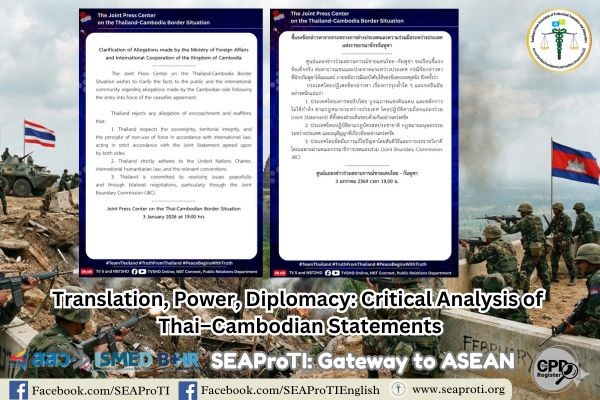
This article explores diplomatic translation as discursive power, using the case of the Thailand–Cambodia border situation in January 2026. By analyzing the Thai-language statement issued by the Joint Press Center on the Thailand–Cambodia Border Situation and its official English translation and comparing it with the discursive tendencies of Cambodian statements, this study demonstrates how translation functions as a form of strategic discourse management rather than a neutral linguistic process.
Theoretical Framework: Critical Discourse Analysis and Power
This study adopts Critical Discourse Analysis (CDA) as its analytical framework, drawing primarily on the work of Fairclough (1995, 2013) and van Dijk (2008). CDA conceptualizes language as a social practice embedded in relations of power, ideology, and institutional authority. In diplomatic contexts, discourse does not merely describe reality but actively constructs political meaning and legitimacy.
Three CDA dimensions are particularly relevant here:
- Agency construction—how actors are positioned as responsible, passive, or authoritative.
- Legitimation strategies—how actions or positions are justified through legal, moral, or institutional references.
- Silence and omission—what is strategically left unsaid to shape interpretation and manage conflict.
Data and Methodology
The data analyzed consist of:
- The official Thai-language statement was issued on 3 January 2026.
- Its official English translation was released simultaneously.
- Publicly disseminated Cambodian statements concerning the same border situation (analyzed comparatively at the discursive level).
- The analysis focuses on lexical choice, modality, transitivity, and intertextual references to international law and institutions.
Comparative CDA: Thai and Cambodian Discursive Strategies
Agency and Attribution of Responsibility
Cambodian statements, as reflected in their public diplomatic discourse, tend to employ direct agency attribution, positioning Thailand as an active violator through verbs such as “encroach,” “violate,” or “breach.” This strategy frames the dispute as a matter of wrongdoing requiring accountability.
In contrast, the English translation of the Thai statement avoids reciprocal accusation:
“Thailand rejects any allegation of encroachment and reaffirms that…”
The use of “allegation” reclassifies Cambodian claims as unverified assertions rather than established facts. The verb reaffirms Thailand’s position as a stable, principled actor reiterating long-standing commitments rather than reacting defensively.
From a CDA perspective, this shift relocates the discourse from event-based blame to principle-based legitimacy.
Strategic Silence and Discursive Omission
What Thailand Deliberately Does Not Say
The Thai statement and its English translation exhibit notable omissions:
- No reference to specific incidents, locations, or timelines.
- No direct naming or condemnation of Cambodia as an aggressor.
- No emotive or evaluative language such as “false,” “baseless,” or “provocative.”
Instead, the text foregrounds:
- International law
- The United Nations Charter
- The Joint Statement
- The Joint Boundary Commission (JBC)
This strategic silence functions as a form of de-escalation, preventing the dispute from being framed as an emotional or bilateral confrontation while maintaining legal and moral authority.
Cambodian Omission in Contrast
Conversely, Cambodian discourse tends to underemphasize or omit sustained references to bilateral mechanisms such as the JBC, thereby discursively opening space for internationalization of the dispute. This omission is significant, as it contrasts sharply with Thailand’s repeated framing of the issue as one resolvable through established bilateral institutions.
Translation as Conflict Management
The English version of the Thai statement is not a literal translation of the Thai original. Expressions such as “ปฏิเสธอย่างหนักแน่น” are rendered in a restrained, legalistic register (rejects any allegation). This shift illustrates what can be described as discursive de-escalation through translation.
The translation is oriented toward an international audience, diplomats, multilateral institutions, and foreign media, rather than domestic constituencies. In this sense, the translator (or translation team) acts as a discursive mediator, shaping how the state is perceived externally.
Diplomatic Translation as Discursive Power
This case study demonstrates that diplomatic translation operates as a form of soft power. Lexical choices such as “rejects,” “allegation,” and “strictly adheres and is committed to” are not neutral equivalents but carefully selected tools that position Thailand as:
- Law-abiding
- Institutionally aligned
- Rational and restrained
Translation thus becomes a mechanism of legitimacy production, reinforcing Thailand’s preferred narrative within the international order.
Conclusion
The analysis confirms that diplomatic translation is not merely an auxiliary linguistic activity but a strategic political practice. Through selective emphasis, legal framing, and calculated silence, the English translation of Thailand’s statement performs crucial diplomatic work: it stabilizes state identity, manages conflict escalation, and secures discursive legitimacy.
In contemporary international relations, where perception often outweighs physical force, the power of translation lies not in what is said alone, but in how—and whether. It is not said at all.
References
Fairclough, N. (1995). Critical discourse analysis: The critical study of language. Longman.
Fairclough, N. (2013). Critical discourse analysis and critical policy studies. Critical Policy Studies, 7(2), 177–197. https://doi.org/10.1080/19460171.2013.798239
van Dijk, T. A. (2008). Discourse and power. Palgrave Macmillan.
Baker, M. (2006). Translation and conflict: A narrative account. Routledge.
Schäffner, C. (2004). Political discourse analysis from the point of view of translation studies. Journal of Language and Politics, 3(1), 117–150. https://doi.org/10.1075/jlp.3.1.09sch
About Certified Translators, Translation Certifiers, and Certified Interpreters of SEAProTI
The Southeast Asian Association of Professional Translators and Interpreters (SEAProTI) has formally announced the qualifications and requirements for registration of Certified Translators, Translation Certification Providers, and Certified Interpreters in Sections 9 and 10 of the Royal Gazette, published by the Secretariat of the Cabinet, Office of the Prime Minister of Thailand, on 25 July 2024 (Vol. 141, Part 66 Ng, p. 100). Certified Translators, Translation Certification Providers, and Certified Interpreters
The Council of State has proposed the enactment of a Royal Decree, granting registered translators and recognised translation certifiers from professional associations or accredited language institutions the authority to provide legally valid translation certification (Letter to SEAProTI dated April 28, 2025)
SEAProTI is the first professional association in Thailand and Southeast Asia to implement a comprehensive certification system for translators, certifiers, and interpreters.
Head Office: Baan Ratchakru Building, No. 33, Room 402, Soi Phahonyothin 5, Phahonyothin Road, Phaya Thai District, Bangkok 10400, Thailand
Email: hello@seaproti.com | Tel.: (+66) 2-114-3128 (Office hours: Mon–Fri, 09:00–17:00)
การแปลทางการทูตในฐานะอำนาจเชิงวาทกรรม
การวิเคราะห์วาทกรรมเชิงวิพากษ์ของแถลงการณ์ไทยและกัมพูชา ต่อสถานการณ์ชายแดนไทย–กัมพูชา
4 มกราคม 2568, กรุงเทพมหานคร – บทความนี้ศึกษา การแปลทางการทูต ในฐานะรูปแบบหนึ่งของอำนาจเชิงวาทกรรม ผ่านการวิเคราะห์วาทกรรมเชิงวิพากษ์ (Critical Discourse Analysis: CDA) ของแถลงการณ์อย่างเป็นทางการที่ออกโดยประเทศไทยและกัมพูชาเกี่ยวกับสถานการณ์ชายแดนไทย–กัมพูชาในเดือนมกราคม พ.ศ. 2569 โดยมุ่งเน้นการวิเคราะห์ต้นฉบับภาษาไทยและฉบับแปลภาษาอังกฤษของฝ่ายไทย งานวิจัยนี้เสนอว่า การแปลทางการทูตมิใช่การถ่ายทอดภาษาที่เป็นกลาง หากแต่เป็นการแทรกแซงเชิงกลยุทธ์ที่มีบทบาทในการสร้างความชอบธรรม การกำกับการรับรู้ของประชาคมระหว่างประเทศ และการควบคุมระดับความตึงเครียดของความขัดแย้ง
จากการเปรียบเทียบกลยุทธ์ทางวาทกรรม การจัดวางตัวกระทำ (agency) และความเงียบเชิงกลยุทธ์ (strategic silence / omission) บทความนี้แสดงให้เห็นว่า การแปลทำหน้าที่เป็นเครื่องมือทางนโยบายต่างประเทศและการกำหนดจุดยืนในเวทีระหว่างประเทศ มากกว่าจะเป็นเพียงการสื่อสารสองภาษา
คำสำคัญ: การแปลทางการทูต, การวิเคราะห์วาทกรรมเชิงวิพากษ์, ความชอบธรรม, ความเงียบเชิงกลยุทธ์, ความสัมพันธ์ไทย–กัมพูชา
ในบริบทของการทูตระหว่างประเทศ ภาษาไม่ได้ทำหน้าที่เป็นเพียงสื่อกลางของการสื่อสารเท่านั้น หากแต่เป็นกลไกแห่งอำนาจ แถลงการณ์อย่างเป็นทางการที่รัฐออกในช่วงสถานการณ์ความขัดแย้ง ล้วนเป็นข้อความที่ถูกออกแบบอย่างรอบคอบเพื่อกำหนดกรอบการตีความ ความชอบธรรม และการจัดแนวทางการรับรู้ของประชาคมระหว่างประเทศ
เมื่อแถลงการณ์เหล่านี้ถูกแปล โดยเฉพาะอย่างยิ่งเป็นภาษาอังกฤษซึ่งทำหน้าที่เป็นภาษากลางทางการทูต การแปลจึงกลายเป็นการกระทำที่มีนัยทางการเมืองอย่างหลีกเลี่ยงไม่ได้ บทความนี้มุ่งสำรวจการแปลทางการทูตในฐานะอำนาจเชิงวาทกรรม ผ่านกรณีศึกษาสถานการณ์ชายแดนไทย–กัมพูชาในเดือนมกราคม พ.ศ. 2569 โดยการวิเคราะห์แถลงการณ์ภาษาไทยของศูนย์แถลงข่าวสถานการณ์ชายแดนไทย–กัมพูชา ฉบับแปลภาษาอังกฤษอย่างเป็นทางการ และเปรียบเทียบกับลักษณะวาทกรรมของแถลงการณ์ฝ่ายกัมพูชา
การศึกษานี้แสดงให้เห็นว่า การแปลทำหน้าที่เป็นกระบวนการจัดการวาทกรรมเชิงกลยุทธ์ มากกว่าการถ่ายทอดภาษาอย่างเป็นกลาง
กรอบทฤษฎี: การวิเคราะห์วาทกรรมเชิงวิพากษ์และอำนาจ
การศึกษานี้ใช้กรอบการวิเคราะห์วาทกรรมเชิงวิพากษ์ (CDA) โดยอ้างอิงแนวคิดหลักของ Fairclough (1995, 2013) และ van Dijk (2008) ซึ่งมองว่าภาษาเป็นการปฏิบัติทางสังคมที่ฝังตัวอยู่ในความสัมพันธ์เชิงอำนาจ อุดมการณ์ และอำนาจสถาบัน ในบริบททางการทูต วาทกรรมไม่ได้เป็นเพียงการบรรยายความจริง หากแต่เป็นเครื่องมือในการสร้างความหมายทางการเมืองและความชอบธรรม
การวิเคราะห์มุ่งเน้นสามมิติหลัก ได้แก่
- การจัดวางตัวกระทำ (Agency construction) – การวางตำแหน่งผู้กระทำให้เป็นฝ่ายรับผิด ฝ่ายตั้งรับ หรือฝ่ายมีอำนาจ
- กลยุทธ์การสร้างความชอบธรรม (Legitimation strategies) – การอ้างอิงกฎหมาย คุณค่าทางศีลธรรม หรือสถาบัน
- ความเงียบและการละเว้น (Silence and omission) – สิ่งที่ถูกละไว้โดยเจตนาเพื่อกำกับการตีความและการจัดการความขัดแย้ง
ข้อมูลและระเบียบวิธีวิจัย
ข้อมูลที่ใช้ในการวิเคราะห์ประกอบด้วย
- แถลงการณ์ภาษาไทยอย่างเป็นทางการที่ออกเมื่อวันที่ 3 มกราคม พ.ศ. 2569
- ฉบับแปลภาษาอังกฤษที่เผยแพร่พร้อมกัน
- แถลงการณ์ของฝ่ายกัมพูชาที่เผยแพร่ต่อสาธารณะเกี่ยวกับสถานการณ์เดียวกัน (วิเคราะห์เชิงเปรียบเทียบในระดับวาทกรรม)
- การวิเคราะห์มุ่งเน้นการเลือกคำ (lexical choice) การใช้มอดาลิตี (modality) โครงสร้างการกระทำ (transitivity) และการอ้างอิงเชิงสหบท (intertextuality) ต่อกฎหมายและสถาบันระหว่างประเทศ
การวิเคราะห์เปรียบเทียบวาทกรรมไทยและกัมพูชา
- ตัวกระทำและการกำหนดความรับผิด
- แถลงการณ์ของกัมพูชาโดยทั่วไปมีแนวโน้มใช้การระบุผู้กระทำอย่างตรงไปตรงมา โดยวางตำแหน่งประเทศไทยเป็นฝ่ายละเมิด ผ่านคำกริยาเช่น encroach, violate,หรือ breach กลยุทธ์ดังกล่าวสร้างกรอบความหมายของข้อพิพาทในฐานะการกระทำผิดที่ต้องมีความรับผิด
ในทางตรงกันข้าม แถลงการณ์ภาษาอังกฤษของฝ่ายไทยหลีกเลี่ยงการกล่าวโทษแบบตอบโต้ ดังปรากฏในถ้อยคำว่า
“Thailand rejects any allegation of encroachment and reaffirms that…”
คำว่า allegation ทำหน้าที่ลดสถานะของข้อกล่าวอ้างจากข้อเท็จจริงที่ยืนยันแล้ว ให้เป็นเพียงคำกล่าวอ้างที่ยังไม่ผ่านการพิสูจน์ ขณะที่คำว่า reaffirms วางตำแหน่งประเทศไทยเป็นรัฐที่มั่นคง ยึดมั่นในหลักการ และยืนยันจุดยืนเดิมอย่างต่อเนื่อง
ในเชิง CDA การเลือกถ้อยคำดังกล่าวเป็นการเคลื่อนย้ายวาทกรรมจากการกล่าวโทษเชิงเหตุการณ์ ไปสู่การยืนยันความชอบธรรมเชิงหลักการ
ความเงียบเชิงกลยุทธ์และการละเว้นทางวาทกรรม
สิ่งที่ฝ่ายไทยเลือกไม่กล่าวถึง แถลงการณ์ของฝ่ายไทย ทั้งต้นฉบับและฉบับแปล แสดงให้เห็นการละเว้นอย่างมีนัยสำคัญ ได้แก่
- ไม่กล่าวถึงเหตุการณ์ จุดเกิดเหตุ หรือกรอบเวลาอย่างเฉพาะเจาะจง
- ไม่ระบุชื่อหรือกล่าวประณามกัมพูชาในฐานะฝ่ายรุกราน
- ไม่ใช้ถ้อยคำเชิงอารมณ์หรือประเมินค่า เช่น false, baseless, หรือ provocative
ในทางกลับกัน ข้อความเน้นไปที่
- กฎหมายระหว่างประเทศ
- กฎบัตรสหประชาชาติ
- แถลงการณ์ร่วม
คณะกรรมาธิการเขตแดนร่วม (JBC)
ความเงียบเชิงกลยุทธ์นี้ทำหน้าที่ลดระดับความตึงเครียดของวาทกรรม ป้องกันไม่ให้ข้อพิพาทถูกกรอบความหมายเป็นความขัดแย้งเชิงอารมณ์หรือการเผชิญหน้าโดยตรง ขณะเดียวกันยังคงรักษาอำนาจทางศีลธรรมและกฎหมาย
การละเว้นของฝ่ายกัมพูชาในเชิงเปรียบเทียบ
ในทางตรงกันข้าม วาทกรรมของกัมพูชามักลดน้ำหนักหรือไม่เน้นการอ้างอิงกลไกทวิภาคีอย่าง JBC อย่างต่อเนื่อง การละเว้นนี้เปิดพื้นที่เชิงวาทกรรมให้กับการทำให้ข้อพิพาทเป็นประเด็นระดับนานาชาติ ซึ่งแตกต่างอย่างชัดเจนจากการวางกรอบของฝ่ายไทยที่ย้ำว่าปัญหานี้สามารถแก้ไขได้ผ่านกลไกทวิภาคีที่มีอยู่แล้ว
การแปลในฐานะการจัดการความขัดแย้ง
ฉบับภาษาอังกฤษของแถลงการณ์ไทยมิได้เป็นการแปลตามตัวอักษรจากต้นฉบับภาษาไทย ถ้อยคำอย่าง “ปฏิเสธอย่างหนักแน่น” ถูกถ่ายทอดเป็นภาษาที่มีลักษณะสุขุม เป็นทางกฎหมาย และไม่เร้าอารมณ์ (rejects any allegation) การเปลี่ยนระดับน้ำเสียงนี้สะท้อนสิ่งที่อาจเรียกว่า “การลดระดับวาทกรรมผ่านการแปล”
การแปลฉบับนี้มุ่งสู่ผู้รับสารในเวทีระหว่างประเทศ ไม่ใช่สาธารณชนภายในประเทศ ดังนั้น ผู้แปลหรือคณะผู้แปลจึงทำหน้าที่เป็นผู้ไกล่เกลี่ยเชิงวาทกรรม กำหนดภาพลักษณ์ของรัฐในสายตาภายนอก
การแปลทางการทูตในฐานะอำนาจเชิงวาทกรรม
กรณีศึกษานี้แสดงให้เห็นว่า การแปลทางการทูตทำหน้าที่เป็นรูปแบบหนึ่งของอำนาจละมุน (soft power) การเลือกใช้คำ เช่น rejects, allegation, strictly adheres, และ is committed to มิใช่คำเทียบที่เป็นกลาง หากแต่เป็นเครื่องมือทางวาทกรรมที่วางตำแหน่งประเทศไทยให้เป็นรัฐที่ เคารพกฎหมาย ยึดโยงกับสถาบันระหว่างประเทศ มีเหตุผลและยับยั้งชั่งใจ การแปลจึงเป็นกลไกสำคัญในการผลิตความชอบธรรมและเสริมสร้างเรื่องเล่าที่รัฐต้องการสื่อสารในระเบียบโลก
บทสรุป
การวิเคราะห์นี้ยืนยันว่า การแปลทางการทูตมิใช่กิจกรรมทางภาษาเสริม หากแต่เป็นการปฏิบัติทางการเมืองเชิงกลยุทธ์ ผ่านการเลือกเน้น การวางกรอบทางกฎหมาย และความเงียบที่คำนวณมาแล้ว ฉบับแปลภาษาอังกฤษของแถลงการณ์ไทยทำหน้าที่ทางการทูตอย่างสำคัญ ได้แก่ การสร้างเสถียรภาพให้กับอัตลักษณ์ของรัฐ การควบคุมการยกระดับความขัดแย้ง และการรักษาความชอบธรรมในเชิงวาทกรรม
ในโลกการเมืองระหว่างประเทศร่วมสมัย ที่การรับรู้มีพลังไม่ยิ่งหย่อนไปกว่ากำลังทางทหาร อำนาจของการแปลจึงไม่ได้อยู่ที่สิ่งที่ถูกกล่าวเท่านั้น หากแต่อยู่ที่ “วิธีการกล่าว” และ “สิ่งที่เลือกจะไม่กล่าว” ด้วยเช่นกัน
เอกสารอ้างอิง
- Fairclough, N. (1995). Critical discourse analysis: The critical study of language. Longman.
- Fairclough, N. (2013). Critical discourse analysis and critical policy studies. Critical Policy Studies, 7(2), 177–197. https://doi.org/10.1080/19460171.2013.798239
- van Dijk, T. A. (2008). Discourse and power. Palgrave Macmillan.
- Baker, M. (2006). Translation and conflict: A narrative account. Routledge.
- Schäffner, C. (2004). Political discourse analysis from the point of view of translation studies. Journal of Language and Politics, 3(1), 117–150. https://doi.org/10.1075/jlp.3.1.09sch
เกี่ยวกับนักแปลรับรอง ผู้รับรองการแปล และล่ามรับรองของสมาคมวิชาชีพนักแปลและล่ามแห่งเอเชียตะวันออกเฉียงใต้
สมาคมวิชาชีพนักแปลและล่ามแห่งเอเชียตะวันออกเฉียงใต้ (SEAProTI) ได้ประกาศหลักเกณฑ์และคุณสมบัติผู้ที่ขึ้นทะเบียนเป็น “นักแปลรับรอง (Certified Translators) และผู้รับรองการแปล (Translation Certification Providers) และล่ามรับรอง (Certified Interpreters)” ของสมาคม หมวดที่ 9 และหมวดที่ 10 ในราชกิจจานุเบกษา ของสำนักเลขาธิการคณะรัฐมนตรี ในสำนักนายกรัฐมนตรี แห่งราชอาณาจักรไทย ลงวันที่ 25 ก.ค. 2567 เล่มที่ 141 ตอนที่ 66 ง หน้า 100 อ่านฉบับเต็มได้ที่: นักแปลรับรอง ผู้รับรองการแปล และล่ามรับรอง
สำนักคณะกรรมการกฤษฎีกา เสนอให้ตราเป็นพระราชกฤษฎีกา โดยกำหนดให้นักแปลที่ขึ้นทะเบียน รวมถึงผู้รับรองการแปลจากสมาคมวิชาชีพหรือสถาบันสอนภาษาที่มีการอบรมและขึ้นทะเบียน สามารถรับรองคำแปลได้ (จดหมายถึงสมาคม SEAProTI ลงวันที่ 28 เม.ย. 2568)
สมาคมวิชาชีพนักแปลและล่ามแห่งเอเชียตะวันออกเฉียงใต้ เป็นสมาคมวิชาชีพแห่งแรกและแห่งเดียวในประเทศไทยและภูมิภาคเอเชียตะวันออกเฉียงใต้ที่มีระบบรับรองนักแปลรับรอง ผู้รับรองการแปล และล่ามรับรอง
สำนักงานใหญ่: อาคารบ้านราชครู เลขที่ 33 ห้อง 402 ซอยพหลโยธิน 5 ถนนพหลโยธิน แขวงพญาไท เขตพญาไท กรุงเทพมหานคร 10400 ประเทศไทย
อีเมล: hello@seaproti.com โทรศัพท์: (+66) 2-114-3128 (เวลาทำการ: วันจันทร์–วันศุกร์ เวลา 09.00–17.00 น.