


The Future of the Translation Profession in 2026:
Human Expertise, Artificial Intelligence, and the Reconfiguration of Professional Roles
Writer: Wanitcha Sumanat, President of the Southeast Asian Association of Professional Translators and Interpreters (SEAProTI)
31 December 2025, Bangkok—The translation profession is undergoing a profound transformation driven by rapid advances in artificial intelligence (AI), machine translation (MT), and digital content production. As 2026 approaches, translators are increasingly required to redefine their professional identity beyond traditional text-to-text transfer. This article examines the evolving role of translators in the context of AI-assisted workflows, the growing importance of specialization, and the emergence of hybrid competencies combining linguistic, technological, and cultural expertise. It argues that while automation reshapes production processes, human translators remain indispensable as meaning-makers, cultural mediators, and quality authorities.
Introduction
Translation has historically been understood as the interlingual transfer of meaning from a source language to a target language (Jakobson, 1959). However, the integration of neural machine translation and AI-driven language technologies has significantly altered professional practices. By 2026, translation is no longer defined solely by manual linguistic conversion but by human–machine collaboration, where translators operate within technologically mediated ecosystems.
This article explores how these changes affect the professional landscape, focusing on (1) AI as an enabling tool, (2) the increasing value of specialization, and (3) the reconfiguration of translators’ skills and responsibilities.
Artificial Intelligence as an Assistive Technology
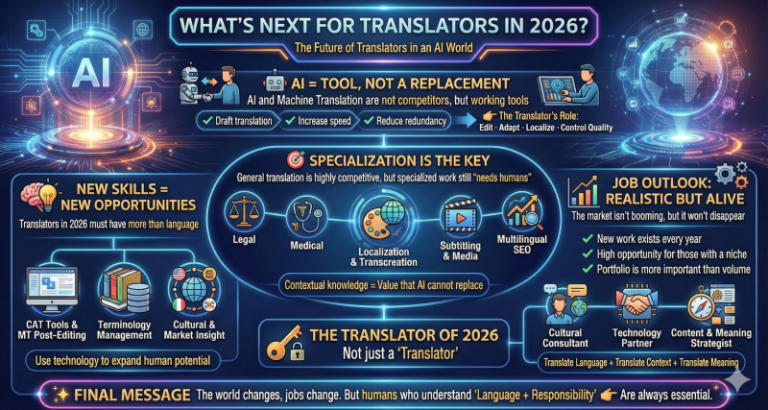
AI-based machine translation systems have achieved substantial improvements in fluency and speed, leading to widespread adoption in professional workflows (Kenny & Doherty, 2014). In many domains, AI now produces initial drafts that are subsequently refined through machine translation post-editing (MTPE).
Rather than replacing translators, these systems have shifted the locus of human labor. Translators increasingly act as editors, reviewers, and quality controllers, responsible for ensuring semantic accuracy, contextual appropriateness, and pragmatic effectiveness (Pym, 2021). This transformation underscores a fundamental distinction between linguistic output and communicative responsibility, the latter remaining firmly within the human domain.
The Rising Importance of Specialization
While general translation tasks have become more competitive and, in some cases, economically devalued, specialized domains continue to demand high levels of human expertise. Legal, medical, technical, financial, and marketing localization require not only linguistic competence but also domain knowledge, ethical judgment, and risk awareness (Prieto Ramos, 2014).
In such fields, translation errors may lead to legal liability, medical harm, or reputational damage—areas where AI lacks accountability and interpretive judgment. Consequently, specialization functions as a protective mechanism for professional relevance, reinforcing the translator’s role as a knowledge-based expert rather than a replaceable language worker.
Expanding Skill Sets and Hybrid Competencies
The translator of 2026 must possess competencies extending beyond language proficiency. These include technological literacy (e.g., CAT tools, terminology management systems), familiarity with AI-assisted workflows, and cultural–market awareness (O’Hagan, 2016).
Such hybrid skill sets position translators as intermediaries between technology and human communication. Instead of competing with machines, translators leverage technology to enhance consistency, efficiency, and scalability while retaining responsibility for meaning, tone, and ethical integrity.
Employment Outlook and Professional Sustainability
Labor statistics in multiple jurisdictions indicate moderate growth or stagnation in overall translation employment; however, consistent demand persists for specialized and highly skilled professionals (U.S. Bureau of Labor Statistics, 2023). This suggests a bifurcation of the profession: routine tasks are increasingly automated, while expert-driven services retain value.
Professional sustainability in 2026 therefore depends less on volume-based productivity and more on expertise, adaptability, and professional credibility, often demonstrated through portfolios, certifications, and domain specialization.
Conclusion
The translator of 2026 cannot be adequately described as a mere language converter. Instead, translators function as cultural consultants, technology partners, and meaning strategists, operating at the intersection of language, technology, and society.
While AI continues to transform translation workflows, it does not eliminate the need for human judgment, responsibility, and cultural sensitivity. On the contrary, these human attributes become more critical as automated systems proliferate. The future of translation, therefore, lies not in resistance to technology but in the strategic integration of human expertise within AI-enhanced environments.
References
- Jakobson, R. (1959). On linguistic aspects of translation. In R. A. Brower (Ed.), On translation (pp. 232–239). Harvard University Press.
- Kenny, D., & Doherty, S. (2014). Statistical machine translation in the translation curriculum: Overcoming obstacles and empowering translators. The Interpreter and Translator Trainer, 8(2), 276–294.
https://doi.org/10.1080/1750399X.2014.936112 - O’Hagan, M. (2016). Massively open translation: Unpacking the relationship between technology and translation in the 21st century. International Journal of Communication, 10, 929–946.
- Prieto Ramos, F. (2014). Legal translation studies as an interdisciplinary field: Scope and evolution. Meta, 59(2), 260–277.
https://doi.org/10.7202/1027475ar - Pym, A. (2021). Translation skill sets in a machine-translation age. Meta, 66(2), 339–360.
https://doi.org/10.7202/1080338ar - U.S. Bureau of Labor Statistics. (2023). Interpreters and translators: Occupational outlook handbook.
https://www.bls.gov/ooh/media-and-communication/interpreters-and-translators.htm
About Certified Translators, Translation Certifiers, and Certified Interpreters of SEAProTI
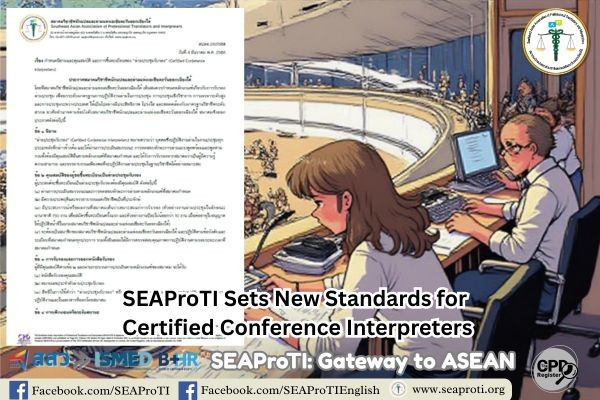
The Southeast Asian Association of Professional Translators and Interpreters (SEAProTI) has formally announced the qualifications and requirements for registration of Certified Translators, Translation Certification Providers, and Certified Interpreters in Sections 9 and 10 of the Royal Gazette, published by the Secretariat of the Cabinet, Office of the Prime Minister of Thailand, on 25 July 2024 (Vol. 141, Part 66 Ng, p. 100). Certified Translators, Translation Certification Providers, and Certified Interpreters
The Council of State has proposed the enactment of a Royal Decree, granting registered translators and recognised translation certifiers from professional associations or accredited language institutions the authority to provide legally valid translation certification (Letter to SEAProTI dated April 28, 2025)
SEAProTI is the first professional association in Thailand and Southeast Asia to implement a comprehensive certification system for translators, certifiers, and interpreters.
Head Office: Baan Ratchakru Building, No. 33, Room 402, Soi Phahonyothin 5, Phahonyothin Road, Phaya Thai District, Bangkok 10400, Thailand
Email: hello@seaproti.com | Tel.: (+66) 2-114-3128 (Office hours: Mon–Fri, 09:00–17:00)
อนาคตของวิชาชีพการแปลในปี 2026:
ความเชี่ยวชาญของมนุษย์ ปัญญาประดิษฐ์ และการปรับโครงสร้างบทบาททางวิชาชีพ
ผู้เขียน: วณิชชา สุมานัส นายกสมาคมวิชาชีพนักแปลและล่ามแห่งเอเชียตะวันออกเฉียงใต้ (SEAProTI)
31 ธันวาคม 2568, กรุงเทพมหานคร — วิชาชีพการแปลกำลังเผชิญกับการเปลี่ยนแปลงเชิงโครงสร้างอย่างลึกซึ้ง อันเป็นผลมาจากความก้าวหน้าอย่างรวดเร็วของปัญญาประดิษฐ์ (Artificial Intelligence: AI) ระบบแปลอัตโนมัติ (Machine Translation: MT) และกระบวนการผลิตเนื้อหาดิจิทัล ในห้วงเวลาที่โลกกำลังก้าวเข้าสู่ปี 2026 นักแปลจำนวนมากจำเป็นต้องทบทวนและนิยามอัตลักษณ์ทางวิชาชีพของตนใหม่ ให้ก้าวพ้นจากความเข้าใจแบบดั้งเดิมที่มองการแปลเป็นเพียงการถ่ายโอนข้อความจากภาษาหนึ่งไปสู่อีกภาษาหนึ่ง
บทความนี้มีวัตถุประสงค์เพื่อวิเคราะห์การเปลี่ยนแปลงของบทบาทนักแปลภายใต้บริบทของการทำงานร่วมกับ AI ความสำคัญที่เพิ่มขึ้นของความเชี่ยวชาญเฉพาะด้าน และการเกิดขึ้นของสมรรถนะเชิงผสมผสานระหว่างทักษะทางภาษา เทคโนโลยี และวัฒนธรรม โดยเสนอข้อโต้แย้งว่า แม้ระบบอัตโนมัติจะเข้ามาปรับเปลี่ยนกระบวนการผลิตงานแปลอย่างมีนัยสำคัญ แต่นักแปลมนุษย์ยังคงมีบทบาทที่ไม่อาจทดแทนได้ในฐานะผู้สร้างความหมาย ผู้ไกล่เกลี่ยทางวัฒนธรรม และผู้รับผิดชอบคุณภาพของการสื่อสาร
บทนำ
โดยนัยทางทฤษฎี การแปลเคยถูกอธิบายว่าเป็นกระบวนการถ่ายโอนความหมายระหว่างภาษา (interlingual transfer) จากภาษาต้นทางไปสู่ภาษาปลายทาง (Jakobson, 1959) อย่างไรก็ตาม การบูรณาการของระบบแปลด้วยโครงข่ายประสาทเทียม (Neural Machine Translation) และเทคโนโลยีภาษาเชิง AI ได้เปลี่ยนแปลงแนวปฏิบัติทางวิชาชีพอย่างมีนัยสำคัญ
เมื่อเข้าสู่ปี 2026 การแปลไม่อาจนิยามได้อีกต่อไปว่าเป็นเพียงการแปลงภาษาด้วยแรงงานมนุษย์ หากแต่เป็นกระบวนการทำงานร่วมกันระหว่างมนุษย์และเครื่องจักร ซึ่งนักแปลต้องปฏิบัติงานภายในระบบนิเวศทางเทคโนโลยีที่ซับซ้อนและมีตัวกลางดิจิทัลเป็นแกนกลาง
บทความนี้จึงมุ่งวิเคราะห์ผลกระทบของการเปลี่ยนแปลงดังกล่าวต่อภูมิทัศน์ของวิชาชีพ โดยเน้น (1) บทบาทของ AI ในฐานะเครื่องมือสนับสนุน (2) คุณค่าที่เพิ่มขึ้นของความเชี่ยวชาญเฉพาะด้าน และ (3) การปรับโครงสร้างทักษะและความรับผิดชอบของนักแปลในยุคใหม่
ปัญญาประดิษฐ์ในฐานะเทคโนโลยีสนับสนุนการแปล
ระบบแปลอัตโนมัติที่ขับเคลื่อนด้วย AI มีพัฒนาการอย่างก้าวกระโดดทั้งในด้านความคล่องแคล่วของภาษาและความรวดเร็ว ส่งผลให้ถูกนำมาใช้อย่างแพร่หลายในกระบวนการทำงานของนักแปลมืออาชีพ (Kenny & Doherty, 2014) ในหลายสาขา ระบบ AI ทำหน้าที่สร้างร่างคำแปลเบื้องต้น ซึ่งต่อมาถูกปรับปรุง แก้ไข และตรวจสอบโดยมนุษย์ผ่านกระบวนการที่เรียกว่า machine translation post-editing (MTPE)
แทนที่ AI จะเข้ามาแทนที่นักแปล เทคโนโลยีดังกล่าวกลับเปลี่ยน “จุดศูนย์กลางของแรงงานมนุษย์” ไปสู่งานด้านการตรวจสอบ การตัดสินใจ และการรับรองคุณภาพ นักแปลจึงทำหน้าที่เป็นบรรณาธิการ ผู้ประเมิน และผู้ควบคุมคุณภาพของความหมาย ความเหมาะสมตามบริบท และประสิทธิผลเชิงปฏิบัติของการสื่อสาร (Pym, 2021)
การเปลี่ยนแปลงนี้สะท้อนความแตกต่างอย่างชัดเจนระหว่าง “ผลผลิตทางภาษา” กับ “ความรับผิดชอบเชิงการสื่อสาร” ซึ่งประการหลังยังคงเป็นหน้าที่ของมนุษย์อย่างไม่อาจโอนย้ายให้เครื่องจักรได้
ความสำคัญที่เพิ่มขึ้นของความเชี่ยวชาญเฉพาะด้าน
ในขณะที่งานแปลทั่วไปมีการแข่งขันสูงขึ้นและในบางกรณีมูลค่าทางเศรษฐกิจลดลง งานแปลเฉพาะด้านกลับยังคงต้องการความเชี่ยวชาญของมนุษย์ในระดับสูง ไม่ว่าจะเป็นงานแปลกฎหมาย การแพทย์ เทคนิค การเงิน หรือการทำ localization ทางการตลาด ซึ่งล้วนต้องอาศัยไม่เพียงทักษะทางภาษา แต่รวมถึงความรู้เชิงสาขา จริยธรรมทางวิชาชีพ และการตระหนักถึงความเสี่ยง (Prieto Ramos, 2014)
ในสาขาเหล่านี้ ความผิดพลาดในการแปลอาจนำไปสู่ความรับผิดทางกฎหมาย อันตรายต่อสุขภาพ หรือความเสียหายต่อชื่อเสียงขององค์กร ซึ่งเป็นบริบทที่ AI ยังขาดความสามารถในการตัดสินใจเชิงจริยธรรมและการรับผิดชอบต่อผลลัพธ์ ดังนั้น ความเชี่ยวชาญเฉพาะด้านจึงทำหน้าที่เป็นกลไกคุ้มครองคุณค่าและสถานะของนักแปลในฐานะผู้เชี่ยวชาญที่ไม่อาจทดแทนได้ง่าย
การขยายชุดทักษะและสมรรถนะเชิงผสมผสาน
นักแปลในปี 2026 จำเป็นต้องมีสมรรถนะที่ก้าวข้ามความสามารถทางภาษาเพียงอย่างเดียว ทักษะที่สำคัญ ได้แก่ ความรู้ด้านเทคโนโลยีการแปล (เช่น CAT tools และระบบจัดการคำศัพท์) ความเข้าใจการทำงานร่วมกับ AI และความตระหนักรู้ด้านวัฒนธรรมและตลาดเป้าหมาย (O’Hagan, 2016)
สมรรถนะเชิงผสมผสานเหล่านี้ทำให้นักแปลทำหน้าที่เป็นตัวกลางระหว่างเทคโนโลยีกับการสื่อสารของมนุษย์ แทนที่จะแข่งขันกับเครื่องจักร นักแปลใช้เทคโนโลยีเพื่อเพิ่มความสม่ำเสมอ ประสิทธิภาพ และการขยายขนาดของงาน ขณะเดียวกันยังคงรับผิดชอบต่อความหมาย น้ำเสียง และความถูกต้องเชิงจริยธรรมของข้อความ
แนวโน้มการจ้างงานและความยั่งยืนทางวิชาชีพ
ข้อมูลสถิติแรงงานจากหลายประเทศชี้ให้เห็นว่า อัตราการเติบโตโดยรวมของอาชีพนักแปลอาจอยู่ในระดับปานกลางหรือคงที่ อย่างไรก็ตาม ความต้องการนักแปลที่มีความเชี่ยวชาญสูงยังคงมีอยู่อย่างต่อเนื่อง (U.S. Bureau of Labor Statistics, 2023) ภาพรวมดังกล่าวสะท้อนการแยกตัวของตลาดแรงงานออกเป็นสองส่วน คือ งานเชิงปริมาณที่ถูกทำให้เป็นอัตโนมัติมากขึ้น และงานเชิงผู้เชี่ยวชาญที่ยังคงมีมูลค่า
ความยั่งยืนทางวิชาชีพในปี 2026 จึงขึ้นอยู่กับความเชี่ยวชาญ ความสามารถในการปรับตัว และความน่าเชื่อถือทางวิชาชีพ ซึ่งมักสะท้อนผ่านผลงาน การรับรอง และความเชี่ยวชาญเฉพาะด้าน มากกว่าปริมาณงานที่ผลิตได้
บทสรุป
นักแปลในปี 2026 ไม่อาจถูกอธิบายได้ว่าเป็นเพียง “ผู้แปลงภาษา” อีกต่อไป หากแต่เป็นที่ปรึกษาด้านวัฒนธรรม พันธมิตรด้านเทคโนโลยี และนักยุทธศาสตร์ด้านความหมาย ซึ่งทำงานอยู่บนจุดตัดระหว่างภาษา เทคโนโลยี และสังคม
แม้ AI จะเข้ามาปรับเปลี่ยนกระบวนการแปลอย่างต่อเนื่อง แต่ไม่ได้ลดทอนความจำเป็นของการตัดสินใจ ความรับผิดชอบ และความอ่อนไหวทางวัฒนธรรมของมนุษย์ ตรงกันข้าม คุณลักษณะเหล่านี้กลับยิ่งมีความสำคัญมากขึ้นในยุคของระบบอัตโนมัติ อนาคตของวิชาชีพการแปลจึงไม่ได้อยู่ที่การต่อต้านเทคโนโลยี หากแต่อยู่ที่การบูรณาการความเชี่ยวชาญของมนุษย์เข้ากับระบบที่ขับเคลื่อนด้วย AI อย่างมีกลยุทธ์และมีจริยธรรม
เอกสารอ้างอิง
- Jakobson, R. (1959). On linguistic aspects of translation. In R. A. Brower (Ed.), On translation (pp. 232–239). Harvard University Press.
- Kenny, D., & Doherty, S. (2014). Statistical machine translation in the translation curriculum: Overcoming obstacles and empowering translators. The Interpreter and Translator Trainer, 8(2), 276–294. https://doi.org/10.1080/1750399X.2014.936112
- O’Hagan, M. (2016). Massively open translation: Unpacking the relationship between technology and translation in the 21st century. International Journal of Communication, 10, 929–946.
- Prieto Ramos, F. (2014). Legal translation studies as an interdisciplinary field: Scope and evolution. Meta, 59(2), 260–277. https://doi.org/10.7202/1027475ar
- Pym, A. (2021). Translation skill sets in a machine-translation age. Meta, 66(2), 339–360. https://doi.org/10.7202/1080338ar
- U.S. Bureau of Labor Statistics. (2023). Interpreters and translators: Occupational outlook handbook. https://www.bls.gov/ooh/media-and-communication/interpreters-and-translators.htm
เกี่ยวกับนักแปลรับรอง ผู้รับรองการแปล และล่ามรับรองของสมาคมวิชาชีพนักแปลและล่ามแห่งเอเชียตะวันออกเฉียงใต้
สมาคมวิชาชีพนักแปลและล่ามแห่งเอเชียตะวันออกเฉียงใต้ (SEAProTI) ได้ประกาศหลักเกณฑ์และคุณสมบัติผู้ที่ขึ้นทะเบียนเป็น “นักแปลรับรอง (Certified Translators) และผู้รับรองการแปล (Translation Certification Providers) และล่ามรับรอง (Certified Interpreters)” ของสมาคม หมวดที่ 9 และหมวดที่ 10 ในราชกิจจานุเบกษา ของสำนักเลขาธิการคณะรัฐมนตรี ในสำนักนายกรัฐมนตรี แห่งราชอาณาจักรไทย ลงวันที่ 25 ก.ค. 2567 เล่มที่ 141 ตอนที่ 66 ง หน้า 100 อ่านฉบับเต็มได้ที่: นักแปลรับรอง ผู้รับรองการแปล และล่ามรับรอง
สำนักคณะกรรมการกฤษฎีกา เสนอให้ตราเป็นพระราชกฤษฎีกา โดยกำหนดให้นักแปลที่ขึ้นทะเบียน รวมถึงผู้รับรองการแปลจากสมาคมวิชาชีพหรือสถาบันสอนภาษาที่มีการอบรมและขึ้นทะเบียน สามารถรับรองคำแปลได้ (จดหมายถึงสมาคม SEAProTI ลงวันที่ 28 เม.ย. 2568)
สมาคมวิชาชีพนักแปลและล่ามแห่งเอเชียตะวันออกเฉียงใต้ เป็นสมาคมวิชาชีพแห่งแรกและแห่งเดียวในประเทศไทยและภูมิภาคเอเชียตะวันออกเฉียงใต้ที่มีระบบรับรองนักแปลรับรอง ผู้รับรองการแปล และล่ามรับรอง
สำนักงานใหญ่: อาคารบ้านราชครู เลขที่ 33 ห้อง 402 ซอยพหลโยธิน 5 ถนนพหลโยธิน แขวงพญาไท เขตพญาไท กรุงเทพมหานคร 10400 ประเทศไทย
อีเมล: hello@seaproti.com โทรศัพท์: (+66) 2-114-3128 (เวลาทำการ: วันจันทร์–วันศุกร์ เวลา 09.00–17.00 น.