


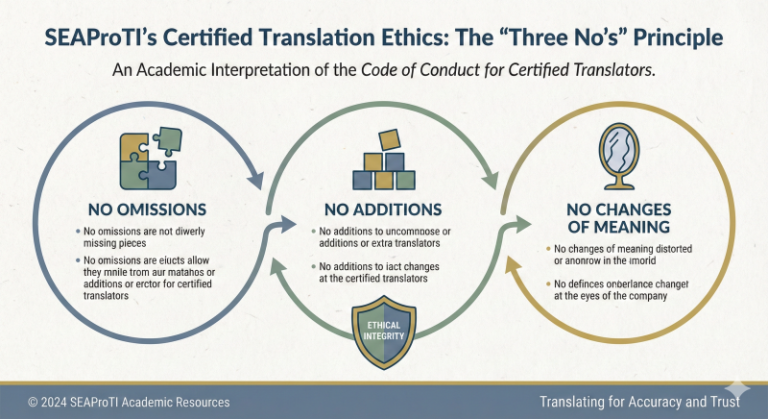
The Ethical Principle of “No Omissions; No Additions, and No Changes of Meaning”
An Academic Interpretation of the Code of Conduct for Certified Translators and Translation Certifiers of SEAProTI
14 January 2025, Bangkok — This article explains the theoretical and practical meaning of the three core ethical principles of translation—no omissions, no additions, and no changes of meaning—which constitute the heart of the Code of Conduct for certified translators and translation certifiers of SEAProTI. The discussion draws on linguistic theory, legal reasoning, and professional ethics, with illustrative examples from legal and official document translation.
Introduction: Why the Three Principles Matter
Certified translation is not merely the transfer of language; it is the transfer of legal effects from the source text into another linguistic context. Even minor inaccuracies may affect an individual’s rights, obligations, or legal status. The principles of “no omissions, no additions, and no changes of meaning” therefore function as guarantees of fidelity and credibility in certified translation.
No Omissions: Substantive Completeness
Conceptual Meaning
“No omissions” requires the translator to render all components of the source text without neglecting any text, phrases, numbers, conditions, notes, footnotes, seals, stamps, or marginal content that may carry legal significance.
Legal and Ethical Rationale
Omitting information may alter the factual basis of the document.
It may disrupt the cause-and-effect relationships embedded in legal provisions.
It risks distorting the original intent of the document.
Practical Examples
Omitting the phrase “except as otherwise provided by law” removes the scope of legal exceptions.
Omitting a note on the effective date may lead to erroneous temporal interpretation.
Acceptable exceptions: Marking unreadable portions as [illegible], [blank], or [stamp illegible] when the source text cannot be deciphered—provided this is done honestly and without conjecture.
No Additions: Restraining the Authorial Role
Conceptual Meaning
“No additions” means refraining from inserting information, explanations, opinions, elaborations, or personal interpretations not present in the source text.
Ethical Rationale
A certified translator is not the drafter of the document.
Adding information inserts the translator’s “voice” into the text, undermining neutrality.
Practical Examples
Do not add parenthetical explanations such as “(meaning …)” unless they appear in the original.
Do not narrow a broad term by adding qualifiers or conditions.
Proper approach: When clarification is necessary for comprehension, provide it in a translator’s note, clearly separated and explicitly identified as not part of the translated content.
No Changes of Meaning: Functional Equivalence
Conceptual Meaning
“No changes of meaning” requires preserving the meaning, intent, and legal effect of the source text in the target language, even where linguistic structures differ.
Linguistic and Legal Dimensions
Attention must be paid to semantic equivalence (meaning) and functional equivalence (legal or practical effect).
Particular care is required with legally loaded terms (e.g., shall, may, must, subject to).
Practical Examples
Translate “shall” consistently as “shall” or “must,” ensuring that its mandatory force is not weakened.
Do not translate the word “may” as “must,” because doing so would improperly elevate the level of obligation.
The Interrelationship of the Three Principles
The three principles operate collectively, not in isolation:
No omissions = completeness
No additions = neutrality
No changes of meaning = equivalence
If any one principle is violated, the credibility of the certified translation is immediately compromised.
Implications for the Role of SEAProTI Certified Translators
Strict adherence to this Code of Conduct demonstrates that SEAProTI-certified translators and translation certifiers:
Act as conduits of meaning, not as substitute interpreters for the parties;
Assume responsibility for the legal consequences of their translations; and
Uphold a verifiable professional standard trusted by government agencies, courts, and embassies.
Conclusion
The principles of “no omissions, no additions, and no changes of meaning” are not merely technical rules; they constitute the core ethical foundation of certified translation, linking language to justice. Rigorous compliance is therefore both a professional duty and a social responsibility of every certified translator and translation certifier.
About Certified Translators, Translation Certifiers, and Certified Interpreters of SEAProTI
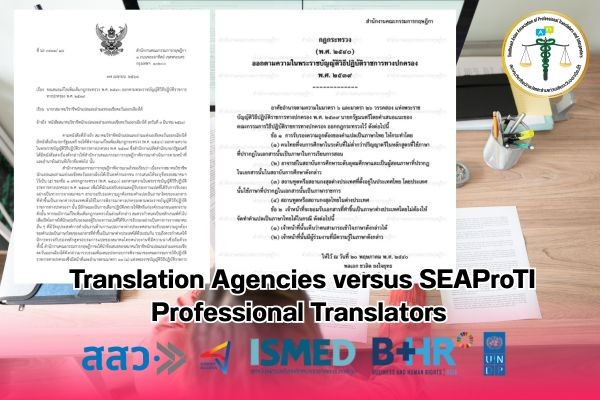
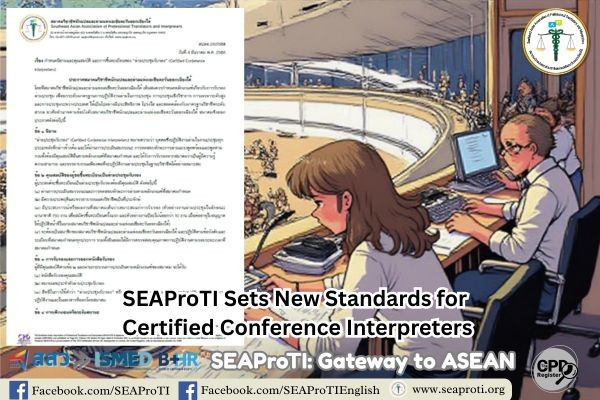
The Southeast Asian Association of Professional Translators and Interpreters (SEAProTI) has officially shared the qualifications and requirements for becoming Certified Translators, Translation Certification Providers, and Certified Interpreters in Sections 9 and 10 of the Royal Gazette, which was published by the Prime Minister’s Office in Thailand on July 25, 2024. Certified Translators, Translation Certification Providers, and Certified Interpreters
The Council of State has proposed the enactment of a Royal Decree, granting registered translators and recognised translation certifiers from professional associations or accredited language institutions the authority to provide legally valid translation certification (Letter to SEAProTI dated April 28, 2025)
SEAProTI is the first professional association in Thailand and Southeast Asia to implement a comprehensive certification system for translators, certifiers, and interpreters.
Head Office: Baan Ratchakru Building, No. 33, Room 402, Soi Phahonyothin 5, Phahonyothin Road, Phaya Thai District, Bangkok 10400, Thailand
Email: hello@seaproti.com | Tel.: (+66) 2-114-3128 (Office hours: Mon–Fri, 09:00–17:00)
หลักจริยธรรม “แปลไม่ตัด–ไม่เติม–ไม่เปลี่ยนความหมาย”
การตีความเชิงวิชาการของ Code of Conduct สำหรับนักแปลรับรองและผู้รับรองการแปลของ SEAProTI
14 มกราคม 2568, กรุงเทพมหานคร – บทความนี้อธิบายความหมายเชิงหลักการและเชิงปฏิบัติของแนวทางจริยธรรมการแปล 3 ประการ ได้แก่ แปลไม่ตัด (No omissions), แปลไม่เติม (No additions) และ แปลไม่เปลี่ยนแปลงความหมาย (No changes of meanings) ซึ่งเป็นหัวใจของ Code of Conduct สำหรับนักแปลรับรองและผู้รับรองการแปลของ SEAProTI โดยวิเคราะห์ฐานคิดทางภาษาศาสตร์ กฎหมาย และจริยธรรมวิชาชีพ พร้อมยกตัวอย่างบริบทการใช้งานจริงในงานแปลเอกสารทางกฎหมายและเอกสารราชการ
บทนำ: เหตุใดหลัก 3 ประการจึงสำคัญ
การแปลรับรอง (certified translation) มิใช่เพียงการถ่ายทอดภาษา หากแต่เป็น การถ่ายทอดผลทางกฎหมาย ของข้อความต้นฉบับไปยังบริบทภาษาอื่น ความคลาดเคลื่อนเพียงเล็กน้อยอาจกระทบสิทธิ หน้าที่ หรือสถานะทางกฎหมายของบุคคล หลัก “ไม่ตัด–ไม่เติม–ไม่เปลี่ยนความหมาย” จึงทำหน้าที่เป็น หลักประกันความเที่ยงตรง (fidelity) และ ความน่าเชื่อถือ (credibility) ของงานแปลรับรอง
แปลไม่ตัด (No omissions): ความครบถ้วนเชิงสาระ
ความหมายเชิงหลักการ
การแปลไม่ตัด หมายถึง การถ่ายทอด ข้อมูลทุกส่วน ของต้นฉบับโดยไม่ละเลยข้อความ วลี ตัวเลข เงื่อนไข หมายเหตุ เชิงอรรถ ตราประทับ หรือข้อความขอบเอกสารที่มีนัยสำคัญ
เหตุผลเชิงกฎหมายและจริยธรรม
การ “ตัด” ข้อมูลอาจเปลี่ยนฐานข้อเท็จจริง (facts)
อาจทำให้ความสัมพันธ์เชิงเหตุ–ผลของข้อกำหนดเสียหาย
เสี่ยงต่อการบิดเบือนเจตนารมณ์ของเอกสาร
ตัวอย่างเชิงปฏิบัติ
ตัดคำว่า “except as otherwise provided by law” ออก ย่อมทำให้ขอบเขตข้อยกเว้นหายไป
ตัดหมายเหตุเรื่องวันมีผลบังคับใช้ อาจทำให้การตีความเวลาเกิดผลผิดพลาด
ข้อยกเว้นที่ยอมรับได้: การทำเครื่องหมาย [illegible], [blank], หรือ [stamp illegible] เมื่อข้อความต้นฉบับอ่านไม่ได้ โดยต้องระบุอย่างซื่อสัตย์ ไม่ใช่คาดเดา
แปลไม่เติม (No additions): การยับยั้งบทบาทผู้เขียน
ความหมายเชิงหลักการ
การแปลไม่เติม คือ การไม่เพิ่มข้อมูล คำอธิบาย ความเห็น การขยายความ หรือการตีความส่วนตัวที่ ไม่มีอยู่ในต้นฉบับ
เหตุผลเชิงจริยธรรม
นักแปลรับรอง ไม่ใช่ผู้ร่างเอกสาร
การเติมข้อมูลเท่ากับแทรก “เสียง” ของนักแปลลงในเอกสาร ซึ่งขัดต่อความเป็นกลาง
ตัวอย่างเชิงปฏิบัติ
ห้ามเพิ่มคำอธิบายวงเล็บ เช่น (หมายถึง…) หากต้นฉบับไม่ระบุ
ห้ามแปลงคำกว้างให้แคบลงโดยการเติมคุณศัพท์หรือเงื่อนไข
แนวทางที่ถูกต้อง: หากต้องอธิบายเพื่อความเข้าใจ ให้ใช้ Translator’s Note แยกต่างหาก และระบุชัดเจนว่าไม่ใช่ส่วนหนึ่งของเนื้อหาแปล
แปลไม่เปลี่ยนแปลงความหมาย (No changes of meanings): ความเทียบเท่าเชิงหน้าที่
ความหมายเชิงหลักการ
ไม่เปลี่ยนความหมาย หมายถึง การรักษา ความหมาย เจตนา และผลทางกฎหมาย ของต้นฉบับให้เทียบเท่าในภาษาปลายทาง แม้โครงสร้างภาษาจะแตกต่าง
มิติทางภาษาศาสตร์และกฎหมาย
ต้องคำนึงถึง semantic equivalence (ความหมาย) และ functional equivalence (ผลการใช้งาน)
ระวังคำที่มีนัยกฎหมายเฉพาะ (shall, may, must, subject to)
ตัวอย่างเชิงปฏิบัติ
แปล shall เป็น “พึง” หรือ “ต้อง” อย่างสม่ำเสมอ ไม่ลดระดับบังคับ
ไม่แปลง may เป็น “ต้อง” ซึ่งจะยกระดับพันธะโดยมิชอบ
ความสัมพันธ์ของหลักทั้งสาม
หลักทั้งสามทำงาน ร่วมกัน ไม่ใช่แยกส่วน
ไม่ตัด = ครบถ้วน
ไม่เติม = เป็นกลาง
ไม่เปลี่ยนความหมาย = เทียบเท่า
เมื่อขาดหลักใดหลักหนึ่ง ความน่าเชื่อถือของงานแปลรับรองย่อมลดลงทันที
นัยต่อบทบาทนักแปลรับรองของ SEAProTI
การยึดถือ Code of Conduct ดังกล่าวสะท้อนว่า นักแปลรับรองของ SEAProTI
ปฏิบัติหน้าที่ในฐานะ ผู้ถ่ายทอดสาร ไม่ใช่ผู้ตีความแทนคู่ความ
รับผิดชอบต่อผลทางกฎหมายของงานแปล
สร้างมาตรฐานวิชาชีพที่ตรวจสอบได้ และได้รับความเชื่อถือจากหน่วยงานรัฐ ศาล และสถานทูต
บทสรุป
หลัก “แปลไม่ตัด–ไม่เติม–ไม่เปลี่ยนความหมาย” มิใช่เพียงกฎเชิงเทคนิค หากแต่เป็น จริยธรรมแกนกลาง ของการแปลรับรองที่เชื่อมโยงภาษาเข้ากับความยุติธรรม การปฏิบัติตามอย่างเคร่งครัดจึงเป็นทั้งหน้าที่ทางวิชาชีพและความรับผิดชอบต่อสังคมของนักแปลรับรองและผู้รับรองการแปลทุกคน
เกี่ยวกับนักแปลรับรอง ผู้รับรองการแปล และล่ามรับรองของสมาคมวิชาชีพนักแปลและล่ามแห่งเอเชียตะวันออกเฉียงใต้
สมาคมวิชาชีพนักแปลและล่ามแห่งเอเชียตะวันออกเฉียงใต้ (SEAProTI) ได้ประกาศหลักเกณฑ์และคุณสมบัติผู้ที่ขึ้นทะเบียนเป็น “นักแปลรับรอง (Certified Translators) และผู้รับรองการแปล (Translation Certification Providers) และล่ามรับรอง (Certified Interpreters)” ของสมาคม หมวดที่ 9 และหมวดที่ 10 ในราชกิจจานุเบกษา ของสำนักเลขาธิการคณะรัฐมนตรี ในสำนักนายกรัฐมนตรี แห่งราชอาณาจักรไทย ลงวันที่ 25 ก.ค. 2567 เล่มที่ 141 ตอนที่ 66 ง หน้า 100 อ่านฉบับเต็มได้ที่: นักแปลรับรอง ผู้รับรองการแปล และล่ามรับรอง
สำนักคณะกรรมการกฤษฎีกา เสนอให้ตราเป็นพระราชกฤษฎีกา โดยกำหนดให้นักแปลที่ขึ้นทะเบียน รวมถึงผู้รับรองการแปลจากสมาคมวิชาชีพหรือสถาบันสอนภาษาที่มีการอบรมและขึ้นทะเบียน สามารถรับรองคำแปลได้ (จดหมายถึงสมาคม SEAProTI ลงวันที่ 28 เม.ย. 2568)
สมาคมวิชาชีพนักแปลและล่ามแห่งเอเชียตะวันออกเฉียงใต้ เป็นสมาคมวิชาชีพแห่งแรกและแห่งเดียวในประเทศไทยและภูมิภาคเอเชียตะวันออกเฉียงใต้ที่มีระบบรับรองนักแปลรับรอง ผู้รับรองการแปล และล่ามรับรอง
สำนักงานใหญ่: อาคารบ้านราชครู เลขที่ 33 ห้อง 402 ซอยพหลโยธิน 5 ถนนพหลโยธิน แขวงพญาไท เขตพญาไท กรุงเทพมหานคร 10400 ประเทศไทย
อีเมล: hello@seaproti.com โทรศัพท์: (+66) 2-114-3128 (เวลาทำการ: วันจันทร์–วันศุกร์ เวลา 09.00–17.00 น.