



The Brain of a Simultaneous Interpreter: A Neuro-scientific and Psycholinguistic Analysis of Real-Time Language Processing
Author: Wanitcha Sumanat, President of the Southeast Asian Association of Professional Translators and Interpreters, and Forensic Linguistics
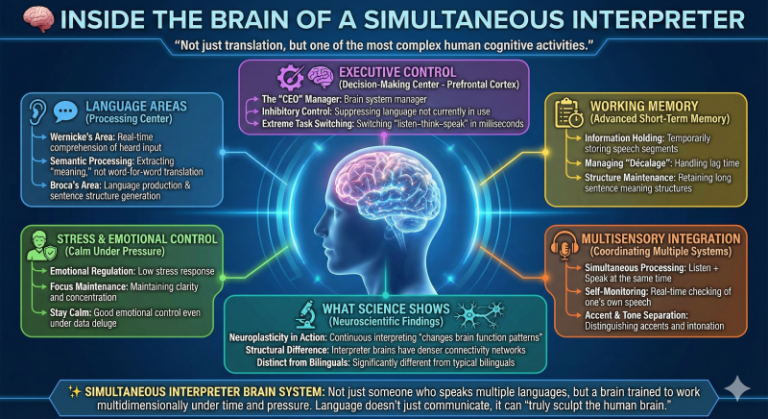
3 January 2025, Bangkok—Simultaneous interpreting has long been recognized in the fields of neuroscience and psycholinguistics as one of the most cognitively demanding human activities. Practitioners must receive linguistic input, process meaning, and produce output in another language simultaneously, all under strict time constraints and significant social pressure. Research conducted over the past two decades has demonstrated convincingly that the brains of simultaneous interpreters exhibit patterns of functioning and neural connectivity that differ significantly from those of general bilingual speakers.
From the perspective of language systems, simultaneous interpreting requires intense and continuous cooperation among brain regions responsible for language production and comprehension, particularly those involved in syntactic structuring, semantic understanding, and higher-level meaning processing. These processes do not occur in a linear sequence; rather, they operate in parallel, requiring the interpreter to maintain a delicate balance between incoming linguistic information and outgoing speech production. Functional neuroimaging studies have shown that language networks in interpreters display higher levels of concurrent activation and more efficient coordination than those observed in bilingual individuals without interpreting training.
Beyond language-specific systems, executive control mechanisms play a crucial role in simultaneous interpreting. The prefrontal cortex, in particular, is heavily involved in decision-making, inhibitory control, and rapid task switching. Simultaneous interpreters must suppress the non-target language while continuously shifting attention between listening, processing, and speaking within fractions of a second. This capacity reflects a highly trained and finely tuned executive control system developed through sustained professional practice.
Working memory constitutes another essential component of the interpreting process. Interpreters must temporarily store segments of speech or sentence structures while managing the temporal lag between comprehension and production, commonly referred to as décalage. Neuroscientific evidence indicates that interpreters possess an enhanced ability to update, reorganize, and clear working memory contents efficiently, preventing previously processed information from interfering with new incoming data. This capacity distinguishes them markedly from non-interpreter bilinguals.
With regard to stress and emotional regulation, simultaneous interpreting is performed under conditions of high cognitive and psychological pressure, stemming from time constraints, audience expectations, and the potential consequences of error. Nevertheless, physiological studies suggest that professional interpreters exhibit more regulated stress responses than might be expected. They demonstrate effective modulation of stress-related hormonal activity and maintain cognitive clarity and focus even under heavy cognitive load. This stability reflects long-term adaptations within the autonomic nervous system and emotional regulation networks.
Another defining feature of simultaneous interpreting is the integration of multiple sensory and cognitive systems. Interpreters must listen and speak simultaneously, decode accents, intonation, and speaker intent, and monitor their own linguistic output in real-time. The interaction among auditory processing, speech production, and self-monitoring systems creates a closed-loop neural process characterized by continuous feedback, a hallmark of simultaneous interpreting as a cognitive activity.
In conclusion, evidence from neuroscience and psycholinguistics strongly supports the view that simultaneous interpreters are not merely individuals with advanced language proficiency. Rather, they are professionals whose sustained training reshapes both the structure and functioning of the brain over time. Continuous engagement in simultaneous interpreting fosters neural networks capable of managing multidimensional processing under severe temporal and cognitive constraints. The brain of the simultaneous interpreter thus serves as a compelling example of human neuroplasticity, demonstrating that language is not only a tool for communication but also a powerful force capable of transforming the organization and operation of the human brain in measurable scientific terms.
About Certified Translators, Translation Certifiers, and Certified Interpreters of SEAProTI
The Southeast Asian Association of Professional Translators and Interpreters (SEAProTI) has formally announced the qualifications and requirements for registration of Certified Translators, Translation Certification Providers, and Certified Interpreters in Sections 9 and 10 of the Royal Gazette, published by the Secretariat of the Cabinet, Office of the Prime Minister of Thailand, on 25 July 2024 (Vol. 141, Part 66 Ng, p. 100). Certified Translators, Translation Certification Providers, and Certified Interpreters
The Council of State has proposed the enactment of a Royal Decree, granting registered translators and recognised translation certifiers from professional associations or accredited language institutions the authority to provide legally valid translation certification (Letter to SEAProTI dated April 28, 2025)
SEAProTI is the first professional association in Thailand and Southeast Asia to implement a comprehensive certification system for translators, certifiers, and interpreters.
Head Office: Baan Ratchakru Building, No. 33, Room 402, Soi Phahonyothin 5, Phahonyothin Road, Phaya Thai District, Bangkok 10400, Thailand
Email: hello@seaproti.com | Tel.: (+66) 2-114-3128 (Office hours: Mon–Fri, 09:00–17:00)
สมองของล่ามพูดพร้อม: การวิเคราะห์เชิงประสาทวิทยาและจิตภาษาศาสตร์ของการประมวลผลภาษาแบบเรียลไทม์
ผู้แต่ง: วณิชชา สุมานัส นายกสมาคมวิชาชีพนักแปลและล่ามแห่งเอเชียตะวันออกเฉียงใต้ และนักนิติภาษาศาสตร์
3 มกราคม 2568, กรุงเทพมหานคร – การล่ามพูดพร้อม (simultaneous interpreting) ได้รับการยอมรับอย่างกว้างขวางในวงการประสาทวิทยาและจิตภาษาศาสตร์ว่าเป็นหนึ่งในกิจกรรมทางปัญญาที่ซับซ้อนที่สุดของมนุษย์ เนื่องจากผู้ปฏิบัติงานต้องรับข้อมูลทางภาษา ประมวลผลความหมาย และถ่ายทอดสารในอีกภาษาหนึ่งพร้อมกัน ภายใต้ข้อจำกัดด้านเวลาและแรงกดดันทางสังคม งานวิจัยในช่วงกว่าสองทศวรรษที่ผ่านมาได้ชี้ให้เห็นอย่างชัดเจนว่า สมองของล่ามพูดพร้อมมีรูปแบบการทำงานและโครงสร้างการเชื่อมต่อที่แตกต่างจากผู้ใช้สองภาษา (bilingual speakers) ทั่วไปอย่างมีนัยสำคัญ
จากมุมมองด้านระบบภาษา การล่ามพูดพร้อมต้องอาศัยการทำงานร่วมกันอย่างเข้มข้นของพื้นที่สมองที่เกี่ยวข้องกับการผลิตและการเข้าใจภาษา โดยเฉพาะบริเวณที่รับผิดชอบต่อการสร้างโครงสร้างประโยค การเข้าใจความหมาย และการประมวลผลเชิงอรรถศาสตร์ การทำงานของระบบเหล่านี้ไม่ได้เกิดขึ้นตามลำดับเชิงเส้น แต่เป็นกระบวนการคู่ขนานที่ต้องรักษาสมดุลระหว่างการรับข้อมูลใหม่กับการส่งออกภาษาอย่างต่อเนื่อง งานวิจัยด้วยเทคโนโลยีภาพถ่ายสมองเชิงหน้าที่พบว่า เครือข่ายภาษาในสมองของล่ามมีการกระตุ้นพร้อมกันในระดับสูง และมีการประสานงานที่มีประสิทธิภาพมากกว่ากลุ่มผู้ใช้สองภาษาที่ไม่ได้ผ่านการฝึกการล่าม
นอกจากระบบภาษาแล้ว สมองส่วนควบคุมการทำงานระดับสูงหรือระบบ executive control มีบทบาทสำคัญอย่างยิ่งในการล่ามพูดพร้อม โดยเฉพาะบริเวณ prefrontal cortex ซึ่งทำหน้าที่ควบคุมการตัดสินใจ การยับยั้งการตอบสนองที่ไม่เกี่ยวข้อง และการสลับภารกิจอย่างรวดเร็ว ล่ามพูดพร้อมต้องยับยั้งภาษาที่ไม่ได้ใช้งานในขณะนั้น พร้อมกับเปลี่ยนจุดสนใจระหว่างการฟัง การคิด และการพูดภายในเวลาเพียงเสี้ยววินาที ความสามารถดังกล่าวสะท้อนถึงการทำงานของกลไกการควบคุมเชิงบริหารที่ได้รับการฝึกฝนอย่างเข้มข้นและต่อเนื่อง
ระบบความจำใช้งานหรือ working memory เป็นอีกองค์ประกอบหนึ่งที่มีความสำคัญอย่างยิ่งในกระบวนการล่ามพูดพร้อม ล่ามจำเป็นต้องเก็บรักษาส่วนของถ้อยคำหรือโครงสร้างประโยคไว้ชั่วคราว ขณะเดียวกันก็ต้องจัดการกับช่วงหน่วงระหว่างการฟังและการพูด หรือที่เรียกว่า décalage งานวิจัยเชิงประสาทวิทยาชี้ให้เห็นว่า ล่ามมีความสามารถในการอัปเดตและจัดลำดับข้อมูลใน working memory ได้อย่างมีประสิทธิภาพสูง โดยไม่ทำให้ข้อมูลเก่ารบกวนการประมวลผลข้อมูลใหม่ ซึ่งเป็นคุณสมบัติที่แตกต่างจากผู้ใช้สองภาษาทั่วไปอย่างชัดเจน
ในด้านการควบคุมความเครียดและอารมณ์ การล่ามพูดพร้อมเป็นกิจกรรมที่เกิดขึ้นภายใต้แรงกดดันสูง ทั้งจากข้อจำกัดด้านเวลา ความคาดหวังของผู้ฟัง และผลกระทบของความผิดพลาดที่อาจเกิดขึ้น อย่างไรก็ตาม งานวิจัยทางสรีรวิทยาพบว่า ล่ามมืออาชีพมีรูปแบบการตอบสนองต่อความเครียดที่ถูกควบคุมได้ดีกว่าที่คาด โดยมีการจัดการระดับฮอร์โมนความเครียดและการคงไว้ซึ่งความชัดเจนทางความคิดได้อย่างมีเสถียรภาพ ความสามารถในการรักษาสมาธิและความแม่นยำภายใต้ภาระงานสูงสะท้อนถึงการปรับตัวของระบบประสาทอัตโนมัติและระบบควบคุมอารมณ์ในระยะยาว
อีกประเด็นหนึ่งที่โดดเด่นคือการบูรณาการข้อมูลจากหลายประสาทสัมผัสพร้อมกัน ล่ามพูดพร้อมต้องฟังและพูดในเวลาเดียวกัน ต้องถอดรหัสสำเนียง น้ำเสียง และเจตนาของผู้พูด ขณะเดียวกันก็ต้องตรวจสอบผลลัพธ์ทางภาษาของตนเองแบบเรียลไทม์ การทำงานร่วมกันของระบบการได้ยิน การผลิตภาษา และการตรวจสอบตนเองนี้ทำให้สมองของล่ามทำงานในลักษณะวงจรปิดที่มีการป้อนกลับอย่างต่อเนื่อง ซึ่งเป็นลักษณะเฉพาะของกิจกรรมการล่ามพูดพร้อม
โดยสรุป หลักฐานจากงานวิจัยทางประสาทวิทยาและจิตภาษาศาสตร์สนับสนุนอย่างชัดเจนว่า ล่ามพูดพร้อมไม่ใช่เพียงผู้ที่มีความสามารถทางภาษาในระดับสูง แต่เป็นผู้ที่ผ่านกระบวนการฝึกฝนซึ่งส่งผลต่อโครงสร้างและการทำงานของสมองในระยะยาว การล่ามอย่างต่อเนื่องสามารถหล่อหลอมเครือข่ายประสาทให้รองรับการประมวลผลหลายมิติภายใต้ข้อจำกัดด้านเวลาและแรงกดดันได้อย่างมีประสิทธิภาพ สมองของล่ามพูดพร้อมจึงเป็นตัวอย่างที่ชัดเจนของความยืดหยุ่นของสมองมนุษย์ และแสดงให้เห็นว่าภาษาไม่ได้เป็นเพียงเครื่องมือสื่อสาร หากแต่เป็นปัจจัยสำคัญที่สามารถเปลี่ยนแปลงรูปแบบการทำงานของสมองได้อย่างแท้จริงในเชิงวิทยาศาสตร์
เกี่ยวกับนักแปลรับรอง ผู้รับรองการแปล และล่ามรับรองของสมาคมวิชาชีพนักแปลและล่ามแห่งเอเชียตะวันออกเฉียงใต้
สมาคมวิชาชีพนักแปลและล่ามแห่งเอเชียตะวันออกเฉียงใต้ (SEAProTI) ได้ประกาศหลักเกณฑ์และคุณสมบัติผู้ที่ขึ้นทะเบียนเป็น “นักแปลรับรอง (Certified Translators) และผู้รับรองการแปล (Translation Certification Providers) และล่ามรับรอง (Certified Interpreters)” ของสมาคม หมวดที่ 9 และหมวดที่ 10 ในราชกิจจานุเบกษา ของสำนักเลขาธิการคณะรัฐมนตรี ในสำนักนายกรัฐมนตรี แห่งราชอาณาจักรไทย ลงวันที่ 25 ก.ค. 2567 เล่มที่ 141 ตอนที่ 66 ง หน้า 100 อ่านฉบับเต็มได้ที่: นักแปลรับรอง ผู้รับรองการแปล และล่ามรับรอง
สำนักคณะกรรมการกฤษฎีกา เสนอให้ตราเป็นพระราชกฤษฎีกา โดยกำหนดให้นักแปลที่ขึ้นทะเบียน รวมถึงผู้รับรองการแปลจากสมาคมวิชาชีพหรือสถาบันสอนภาษาที่มีการอบรมและขึ้นทะเบียน สามารถรับรองคำแปลได้ (จดหมายถึงสมาคม SEAProTI ลงวันที่ 28 เม.ย. 2568)
สมาคมวิชาชีพนักแปลและล่ามแห่งเอเชียตะวันออกเฉียงใต้ เป็นสมาคมวิชาชีพแห่งแรกและแห่งเดียวในประเทศไทยและภูมิภาคเอเชียตะวันออกเฉียงใต้ที่มีระบบรับรองนักแปลรับรอง ผู้รับรองการแปล และล่ามรับรอง
สำนักงานใหญ่: อาคารบ้านราชครู เลขที่ 33 ห้อง 402 ซอยพหลโยธิน 5 ถนนพหลโยธิน แขวงพญาไท เขตพญาไท กรุงเทพมหานคร 10400 ประเทศไทย
อีเมล: hello@seaproti.com โทรศัพท์: (+66) 2-114-3128 (เวลาทำการ: วันจันทร์–วันศุกร์ เวลา 09.00–17.00 น.