



Thai Statutory Translation in Pseudo-Common-Law English: A Conceptual Framework for Understanding Hybrid Legal Translation
4 January 2026, Bangkok—This article conceptualizes and critically examines the phenomenon referred to as Thai statutory translation in pseudo-common-law English. It argues that English translations of Thai statutes constitute a hybrid genre that borrows the vocabulary of common-law legal English while retaining the structural logic, procedural assumptions, and institutional framework of the Thai codified legal system. While such translations achieve high levels of textual fidelity, they generate systemic non-equivalence and pose risks of misinterpretation when read through a common-law lens. Drawing on theories of legal translation and comparative law, this article situates pseudo-common-law English within broader debates on system-bound legal concepts, expository translation, and legal transplants.
Keywords: legal translation, statutory translation, comparative law, pseudo-common-law English, Thai law
Sample Text from Exam-Oriented Legal English: Thai statutory/pseudo-common-law English
According to Section 44/1 of the Criminal Procedure Code, in a case in which a public prosecutor is the plaintiff, if the injured person is entitled to claim compensation for injury caused to his or her life, body, mind or prejudice caused to his or her freedom of body or reputation, or damage caused to his or her property as a result of the defendant’s commission of an offence, the injured person may file a motion with the court before which the criminal case is being tried to enforce the defendant to pay compensation to him or her. However, such motion must not be in conflict or inconsistent with the plaint of the criminal case in which the public prosecutor is the plaintiff.
Introduction
English has emerged as the dominant medium for cross-border legal communication, comparative legal scholarship, and international legal cooperation. However, the increasing use of English in non-common-law jurisdictions has given rise to forms of legal English that diverge significantly from the drafting conventions and institutional logic of common-law systems. One such form can be observed in the English translations of Thai statutes and judicial texts.
This article introduces the analytical concept of Thai statutory translation in pseudo-common-law English, a term used to describe English legal texts that appear to conform to common-law language conventions but, in fact, operate entirely within the conceptual and procedural framework of Thai law. The article argues that this phenomenon constitutes a distinct genre of legal translation and should be analyzed as such to avoid doctrinal and interpretive confusion.
Legal Translation and System-Bound Concepts
Legal translation differs fundamentally from other forms of specialized translation because legal meaning is inseparable from the legal system that produces it. As Šarčević (1997) observes, legal terms are system-bound, meaning that apparent lexical equivalence does not guarantee functional equivalence across jurisdictions.
In the context of Thai statutory translation, English legal terminology is frequently employed to render concepts derived from a civil-law-influenced, codified system. The resulting text may be linguistically intelligible to common-law readers while remaining institutionally incompatible with their legal expectations. This tension lies at the core of pseudo-common-law English.
Defining “Pseudo-Common-Law English”
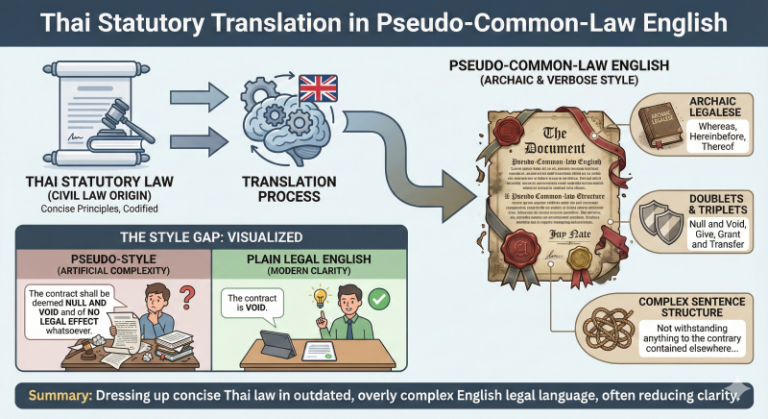
The prefix “pseudo-” denotes resemblance without identity. In legal translation, pseudo-common-law English refers to legal English that borrows terminology associated with common-law systems without importing their procedural structure, doctrinal assumptions, or institutional context.
In Thai statutory translations, terms such as “plaintiff,” “motion,” “compensation,” and “enforcement” are often used. While these terms exist in common-law discourse, their functional meaning within Thai law differs significantly. English, in this context, serves as a descriptive and explanatory medium rather than a constitutive legal language.
Structural Features of Thai Statutory English
Civil-Law Drafting Logic in English Form
Thai statutory translations typically preserve core features of civil-law drafting, including long periodic sentences, dense conditional structures, and extensive nominalization. These features reflect the logic of codified law, in which legal norms are exhaustively articulated within a single provision.
Unlike UK or US statutes, which often segment provisions into subsections and emphasize judicial discretion through modal verbs, Thai statutory English prioritizes textual completeness and internal coherence. The result is an English text that mirrors the architecture of the Thai original rather than adapting to common-law drafting conventions.
Terminological Borrowing Without Functional Transfer
A defining characteristic of pseudo-common-law English is the use of familiar legal vocabulary detached from its original institutional setting. For example, the term “motion” may be used to translate a Thai คำร้อง, despite the absence of adversarial motion practice in Thai criminal procedure. Similarly, “plaintiff” may be employed to refer to a public prosecutor, even though the term is associated with civil litigation in common-law systems.
These choices illustrate what comparative law scholars describe as formal equivalence without functional equivalence (Cao, 2007). The terminology appears recognizable, but the underlying legal operation remains distinct.
Expository Rather Than Operative Translation
A crucial distinction in legal translation theory lies between operative and expository translations. Operative translations produce binding legal effects within the target legal system, whereas expository translations merely explain foreign law (Šarčević, 1997).
Thai statutory translations in English are unequivocally expository. They do not create enforceable rights or obligations in common-law jurisdictions, nor are they intended to be applied by foreign courts. Their function is informational: to communicate the content of Thai law to non-Thai audiences, including scholars, diplomats, and international organizations.
Risks of Misinterpretation in Comparative Contexts
The principal risk posed by pseudo-common-law English arises when readers assume functional equivalence based on terminological familiarity. Common-law lawyers may incorrectly interpret Thai procedural mechanisms as analogous to civil motions, private prosecutions, or damages claims as understood in their own systems.
Such misinterpretation can have serious consequences in comparative research, international arbitration, and transnational legal practice. Without explicit contextualization, pseudo-common-law English may obscure rather than clarify the distinctive features of Thai law.
Conclusion
Thai statutory translation in pseudo-common-law English represents a distinct and analytically significant genre within legal translation. It reflects a strategic compromise between fidelity to the source legal system and accessibility to an international audience. While this approach preserves doctrinal accuracy, it also necessitates heightened interpretive caution.
Recognizing pseudo-common-law English as a hybrid form allows scholars and practitioners to engage with translated Thai legal texts more critically and more accurately. In an era of increasing legal globalization, such awareness is essential to responsible comparative legal analysis.
References
- Cao, D. (2007). Translating law. Multilingual Matters.
- Garner, B. A. (2011). Garner’s dictionary of legal usage (3rd ed.). Oxford University Press.
- Šarčević, S. (1997). New approach to legal translation. Kluwer Law International.
- Watson, A. (1974). Legal transplants: An approach to comparative law. University of Georgia Press.
About Certified Translators, Translation Certifiers, and Certified Interpreters of SEAProTI
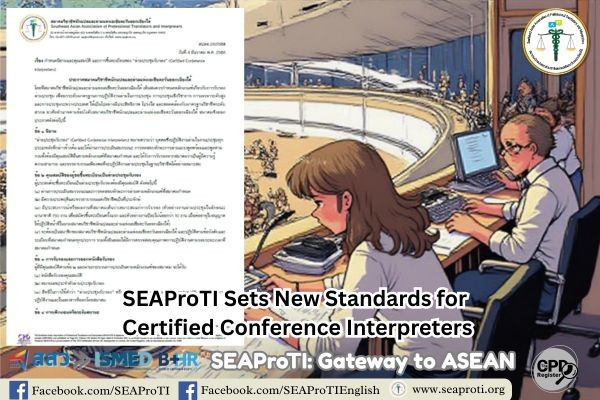
The Southeast Asian Association of Professional Translators and Interpreters (SEAProTI) has formally announced the qualifications and requirements for registration of Certified Translators, Translation Certification Providers, and Certified Interpreters in Sections 9 and 10 of the Royal Gazette, published by the Secretariat of the Cabinet, Office of the Prime Minister of Thailand, on 25 July 2024 (Vol. 141, Part 66 Ng, p. 100). Certified Translators, Translation Certification Providers, and Certified Interpreters
The Council of State has proposed the enactment of a Royal Decree, granting registered translators and recognised translation certifiers from professional associations or accredited language institutions the authority to provide legally valid translation certification (Letter to SEAProTI dated April 28, 2025)
SEAProTI is the first professional association in Thailand and Southeast Asia to implement a comprehensive certification system for translators, certifiers, and interpreters.
Head Office: Baan Ratchakru Building, No. 33, Room 402, Soi Phahonyothin 5, Phahonyothin Road, Phaya Thai District, Bangkok 10400, Thailand
Email: hello@seaproti.com | Tel.: (+66) 2-114-3128 (Office hours: Mon–Fri, 09:00–17:00)
การแปลกฎหมายไทยเป็นภาษาอังกฤษแบบกึ่งคอมมอนลอว์: กรอบแนวคิดเพื่อทำความเข้าใจการแปลกฎหมายเชิงลูกผสม
4 มกราคม 2569, กรุงเทพมหานคร — บทความนี้มุ่งเสนอกรอบแนวคิดและการวิเคราะห์เชิงวิพากษ์ของปรากฏการณ์ที่เรียกว่า การแปลกฎหมายไทยเป็นภาษาอังกฤษแบบกึ่งคอมมอนลอว์ (Thai statutory translation in pseudo-common-law English) โดยชี้ให้เห็นว่า คำแปลกฎหมายไทยเป็นภาษาอังกฤษจำนวนมากมีลักษณะเป็นงานแปลเชิงลูกผสม กล่าวคือ ใช้ศัพท์กฎหมายของระบบคอมมอนลอว์ แต่ยังคงโครงสร้างเชิงระบบ ตรรกะทางกระบวนพิจารณา และกรอบสถาบันของระบบกฎหมายไทยซึ่งเป็นกฎหมายลายลักษณ์อักษร (codified law)
แม้งานแปลลักษณะนี้จะมีความซื่อตรงต่อตัวบทต้นฉบับในระดับสูง แต่กลับก่อให้เกิดภาวะ ความไม่สมมูลเชิงระบบ (systemic non-equivalence) และมีความเสี่ยงต่อการถูกตีความคลาดเคลื่อน หากผู้อ่านใช้กรอบความเข้าใจแบบกฎหมายคอมมอนลอว์ บทความนี้อาศัยทฤษฎีการแปลกฎหมายและกฎหมายเปรียบเทียบเพื่อจัดวางแนวคิด pseudo-common-law English ไว้ภายใต้การถกเถียงที่กว้างขึ้นว่าด้วยแนวคิดกฎหมายที่ผูกติดกับระบบ (system-bound legal concepts) การแปลเชิงอธิบาย (expository translation) และการถ่ายโอนแนวคิดกฎหมาย (legal transplants)
คำสำคัญ: การแปลกฎหมาย, การแปลกฎหมายลายลักษณ์อักษร, กฎหมายเปรียบเทียบ, ภาษาอังกฤษกึ่งคอมมอนลอว์, กฎหมายไทย
ตัวอย่างข้อความจากภาษาอังกฤษเชิงข้อสอบ (Exam-Oriented Legal English):
การแปลกฎหมายไทยแบบ statutory / pseudo-common-law English
ตามมาตรา 44/1 แห่งประมวลกฎหมายวิธีพิจารณาความอาญา ในคดีที่พนักงานอัยการเป็นโจทก์ ถ้าผู้เสียหายมีสิทธิที่จะเรียกเอาค่าสินไหมทดแทนเพราะเหตุได้รับอันตรายแก่ชีวิต ร่างกาย จิตใจ หรือได้รับความเสื่อมเสียต่อเสรีภาพในร่างกาย ชื่อเสียง หรือได้รับความเสียหายในทางทรัพย์สินอันเนื่องมาจากการกระทำความผิดของจำเลย ผู้เสียหายจะยื่นคำร้องต่อศาลที่พิจารณาคดีอาญาขอให้บังคับจำเลยชดใช้ค่าสินไหมทดแทนแก่ตนก็ได้ แต่คำร้องดังกล่าวจะต้องไม่ขัดหรือแย้งกับคำฟ้องในคดีอาญาที่พนักงานอัยการเป็นโจทก์
(หมายเหตุ: ตัวอย่างนี้สะท้อนลักษณะภาษาอังกฤษกฎหมายแบบกึ่งคอมมอนลอว์ที่พบได้บ่อยในเฉลยข้อสอบกฎหมายและคำแปลทางการของไทย)
บทนำ
ภาษาอังกฤษได้กลายเป็นสื่อกลางหลักของการสื่อสารทางกฎหมายระหว่างประเทศ งานวิชาการด้านกฎหมายเปรียบเทียบ และความร่วมมือทางกฎหมายในระดับสากล อย่างไรก็ดี การใช้ภาษาอังกฤษในประเทศที่มิได้อยู่ภายใต้ระบบคอมมอนลอว์ ได้ก่อให้เกิดรูปแบบของภาษาอังกฤษทางกฎหมายที่แตกต่างอย่างมีนัยสำคัญจากหลักการร่างกฎหมายและตรรกะเชิงสถาบันของระบบคอมมอนลอว์
หนึ่งในรูปแบบดังกล่าวสามารถพบได้อย่างชัดเจนในคำแปลภาษาอังกฤษของกฎหมายและคำพิพากษาไทย บทความนี้จึงเสนอแนวคิดเชิงวิเคราะห์ที่เรียกว่า การแปลกฎหมายไทยเป็นภาษาอังกฤษแบบกึ่งคอมมอนลอว์ เพื่อใช้อธิบายลักษณะของข้อความกฎหมายภาษาอังกฤษที่ดูเผิน ๆ คล้ายสำนวนกฎหมายคอมมอนลอว์ แต่แท้จริงแล้วดำเนินการอยู่ภายใต้กรอบแนวคิดและกระบวนพิจารณาของกฎหมายไทยโดยสมบูรณ์
การแปลกฎหมายและแนวคิดที่ผูกติดกับระบบกฎหมาย
การแปลกฎหมายแตกต่างจากการแปลเฉพาะทางแขนงอื่นโดยพื้นฐาน เนื่องจาก “ความหมายทางกฎหมาย” ไม่สามารถแยกออกจากระบบกฎหมายที่ผลิตความหมายนั้นได้ ดังที่ Šarčević (1997) ชี้ให้เห็นว่า ศัพท์กฎหมายเป็น แนวคิดที่ผูกติดกับระบบ กล่าวคือ การที่คำศัพท์ดูเหมือนเทียบเท่ากันในเชิงภาษา มิได้หมายความว่าจะเทียบเท่ากันในเชิงหน้าที่ทางกฎหมาย
ในบริบทของการแปลกฎหมายไทย คำศัพท์กฎหมายภาษาอังกฤษมักถูกนำมาใช้เพื่อถ่ายทอดแนวคิดจากระบบกฎหมายลายลักษณ์อักษรที่ได้รับอิทธิพลจากกฎหมายภาคพื้นทวีป ส่งผลให้ข้อความที่ได้อาจอ่านเข้าใจได้ในเชิงภาษา แต่ไม่สอดคล้องกับความคาดหวังเชิงสถาบันของผู้อ่านจากระบบคอมมอนลอว์ ความตึงเครียดนี้คือหัวใจของภาษาอังกฤษแบบกึ่งคอมมอนลอว์
การนิยาม “ภาษาอังกฤษกึ่งคอมมอนลอว์”
คำนำหน้า pseudo- หมายถึง ความคล้ายคลึงที่มิใช่ความเป็นสิ่งเดียวกัน ในทางการแปลกฎหมาย pseudo-common-law English หมายถึง ภาษาอังกฤษทางกฎหมายที่ยืมศัพท์จากระบบคอมมอนลอว์มาใช้ แต่ไม่ได้ถ่ายโอนโครงสร้างกระบวนพิจารณา สมมติฐานเชิงนิติปรัชญา หรือบริบทเชิงสถาบันของระบบนั้นมาด้วย
ในคำแปลกฎหมายไทย มักพบการใช้คำอย่าง plaintiff, motion, compensation และ enforcement แม้คำเหล่านี้จะมีอยู่จริงในระบบคอมมอนลอว์ แต่หน้าที่ทางกฎหมายของคำเหล่านี้ในกฎหมายไทยกลับแตกต่างอย่างมีนัยสำคัญ ภาษาอังกฤษในที่นี้จึงทำหน้าที่เป็นเพียงเครื่องมือเชิงพรรณนาและอธิบาย ไม่ใช่ภาษาที่ก่อให้เกิดผลทางกฎหมายโดยตัวมันเอง
ลักษณะเชิงโครงสร้างของภาษาอังกฤษในกฎหมายไทย
ตรรกะการร่างกฎหมายแบบกฎหมายลายลักษณ์อักษรในรูปภาษาอังกฤษ
การแปลกฎหมายไทยเป็นภาษาอังกฤษมักคงลักษณะสำคัญของการร่างกฎหมายแบบกฎหมายลายลักษณ์อักษรไว้ ได้แก่ ประโยคยาวแบบเป็นช่วง (periodic sentences) โครงสร้างเงื่อนไขซ้อนหลายชั้น และการใช้คำนามเชิงนามธรรมอย่างหนาแน่น ลักษณะเหล่านี้สะท้อนแนวคิดของกฎหมายที่มุ่งบัญญัติกฎเกณฑ์ให้ครบถ้วนภายในบทเดียว
แตกต่างจากกฎหมายอังกฤษหรือสหรัฐอเมริกา ซึ่งมักแบ่งบทบัญญัติเป็นวรรคย่อยและเน้นดุลพินิจของศาลผ่านคำกริยาช่วยเชิงโมดัล ภาษาอังกฤษของกฎหมายไทยให้ความสำคัญกับความครบถ้วนและความสอดคล้องภายในตัวบท ส่งผลให้โครงสร้างภาษาอังกฤษที่ได้สะท้อนสถาปัตยกรรมของต้นฉบับภาษาไทยมากกว่าการปรับให้เข้ากับขนบการร่างกฎหมายคอมมอนลอว์
การยืมศัพท์โดยไม่ถ่ายโอนหน้าที่เชิงระบบ
ลักษณะเด่นประการหนึ่งของภาษาอังกฤษกึ่งคอมมอนลอว์คือการใช้ศัพท์กฎหมายที่คุ้นเคย แต่ถูกตัดขาดจากบริบทเชิงสถาบันเดิม ตัวอย่างเช่น การใช้คำว่า motion เพื่อแปลคำว่า “คำร้อง” ทั้งที่ระบบกฎหมายไทยไม่มีการพิจารณาคำร้องที่ไม่สอดคล้องกับความหมายแบบคอมมอนลอว์ หรือการใช้คำว่า plaintiff แทนพนักงานอัยการในคดีอาญา
ปรากฏการณ์นี้สะท้อนสิ่งที่นักกฎหมายเปรียบเทียบเรียกว่า “ความสมมูลเชิงรูปแบบโดยปราศจากความสมมูลเชิงหน้าที่” (Cao, 2007) กล่าวคือ ศัพท์ดูคุ้นเคย แต่กลไกทางกฎหมายที่รองรับกลับแตกต่างอย่างสิ้นเชิง
การแปลเชิงอธิบาย ไม่ใช่การแปลเชิงบังคับใช้
ทฤษฎีการแปลกฎหมายแยกความแตกต่างระหว่างการแปลเชิงบังคับใช้ (operative translation) กับการแปลเชิงอธิบาย (expository translation) โดยการแปลเชิงบังคับใช้ก่อให้เกิดผลผูกพันทางกฎหมายในระบบปลายทาง ส่วนการแปลเชิงอธิบายมีหน้าที่เพียงถ่ายทอดความหมายของกฎหมายต่างระบบ (Šarčević, 1997)
คำแปลกฎหมายไทยเป็นภาษาอังกฤษจัดอยู่ในกลุ่มหลังอย่างชัดเจน มิได้มีวัตถุประสงค์ให้ศาลต่างประเทศนำไปใช้บังคับ หากแต่ใช้เพื่อสื่อสารสาระของกฎหมายไทยแก่ผู้อ่านที่มิได้ใช้ภาษาไทย เช่น นักวิชาการ นักการทูต และองค์กรระหว่างประเทศ
ความเสี่ยงของการตีความคลาดเคลื่อนในบริบทกฎหมายเปรียบเทียบ
ความเสี่ยงสำคัญของภาษาอังกฤษกึ่งคอมมอนลอว์เกิดขึ้นเมื่อผู้อ่านสันนิษฐานถึงความสมมูลเชิงหน้าที่จากความคุ้นเคยของศัพท์กฎหมาย นักกฎหมายจากระบบคอมมอนลอว์อาจเข้าใจผิดว่ากลไกทางกฎหมายของไทยสอดคล้องกับการยื่น motion ทางแพ่ง การฟ้องคดีโดยเอกชน หรือการเรียกค่าเสียหายในความหมายของระบบตน
การตีความเช่นนี้อาจก่อให้เกิดผลกระทบร้ายแรงในงานวิชาการกฎหมายเปรียบเทียบ การอนุญาโตตุลาการระหว่างประเทศ และการปฏิบัติงานกฎหมายข้ามพรมแดน หากไม่มีการอธิบายบริบทอย่างชัดเจน ภาษาอังกฤษกึ่งคอมมอนลอว์อาจทำให้ความแตกต่างของกฎหมายไทยถูกกลบเกลื่อนมากกว่าถูกทำให้กระจ่าง
บทสรุป
การแปลกฎหมายไทยเป็นภาษาอังกฤษแบบกึ่งคอมมอนลอว์เป็นรูปแบบการแปลที่มีนัยสำคัญทางวิชาการ สะท้อนการประนีประนอมเชิงกลยุทธ์ระหว่างความซื่อตรงต่อระบบกฎหมายต้นทางกับความจำเป็นในการเข้าถึงผู้อ่านนานาชาติ แม้แนวทางนี้จะช่วยรักษาความถูกต้องเชิงหลักการ แต่ก็จำเป็นต้องใช้ความระมัดระวังในการตีความอย่างสูง
การตระหนักถึงภาษาอังกฤษกึ่งคอมมอนลอว์ในฐานะรูปแบบลูกผสม ช่วยให้นักวิชาการและผู้ปฏิบัติงานกฎหมายสามารถอ่านและใช้คำแปลกฎหมายไทยได้อย่างวิพากษ์และแม่นยำยิ่งขึ้น ในยุคของโลกาภิวัตน์ทางกฎหมาย ความตระหนักเช่นนี้เป็นเงื่อนไขสำคัญของการศึกษากฎหมายเปรียบเทียบอย่างมีความรับผิดชอบ
เอกสารอ้างอิง
- Cao, D. (2007). Translating law. Multilingual Matters.
- Garner, B. A. (2011). Garner’s dictionary of legal usage (3rd ed.). Oxford University Press.
- Šarčević, S. (1997). New approach to legal translation. Kluwer Law International.
- Watson, A. (1974). Legal transplants: An approach to comparative law. University of Georgia Press.
เกี่ยวกับนักแปลรับรอง ผู้รับรองการแปล และล่ามรับรองของสมาคมวิชาชีพนักแปลและล่ามแห่งเอเชียตะวันออกเฉียงใต้
สมาคมวิชาชีพนักแปลและล่ามแห่งเอเชียตะวันออกเฉียงใต้ (SEAProTI) ได้ประกาศหลักเกณฑ์และคุณสมบัติผู้ที่ขึ้นทะเบียนเป็น “นักแปลรับรอง (Certified Translators) และผู้รับรองการแปล (Translation Certification Providers) และล่ามรับรอง (Certified Interpreters)” ของสมาคม หมวดที่ 9 และหมวดที่ 10 ในราชกิจจานุเบกษา ของสำนักเลขาธิการคณะรัฐมนตรี ในสำนักนายกรัฐมนตรี แห่งราชอาณาจักรไทย ลงวันที่ 25 ก.ค. 2567 เล่มที่ 141 ตอนที่ 66 ง หน้า 100 อ่านฉบับเต็มได้ที่: นักแปลรับรอง ผู้รับรองการแปล และล่ามรับรอง
สำนักคณะกรรมการกฤษฎีกา เสนอให้ตราเป็นพระราชกฤษฎีกา โดยกำหนดให้นักแปลที่ขึ้นทะเบียน รวมถึงผู้รับรองการแปลจากสมาคมวิชาชีพหรือสถาบันสอนภาษาที่มีการอบรมและขึ้นทะเบียน สามารถรับรองคำแปลได้ (จดหมายถึงสมาคม SEAProTI ลงวันที่ 28 เม.ย. 2568)
สมาคมวิชาชีพนักแปลและล่ามแห่งเอเชียตะวันออกเฉียงใต้ เป็นสมาคมวิชาชีพแห่งแรกและแห่งเดียวในประเทศไทยและภูมิภาคเอเชียตะวันออกเฉียงใต้ที่มีระบบรับรองนักแปลรับรอง ผู้รับรองการแปล และล่ามรับรอง
สำนักงานใหญ่: อาคารบ้านราชครู เลขที่ 33 ห้อง 402 ซอยพหลโยธิน 5 ถนนพหลโยธิน แขวงพญาไท เขตพญาไท กรุงเทพมหานคร 10400 ประเทศไทย
อีเมล: hello@seaproti.com โทรศัพท์: (+66) 2-114-3128 (เวลาทำการ: วันจันทร์–วันศุกร์ เวลา 09.00–17.00 น.