



The DOPA Handbook:
Standardized Administrative English and Its Role in Public Sector Communication in Thailand
In the context of contemporary public administration, effective communication with citizens and foreign nationals has become a core responsibility of state authorities. Language accuracy—particularly in English—plays a critical role in ensuring transparency, legal certainty, and service efficiency. In Thailand, administrative communication often involves sensitive legal domains such as civil registration, licensing, firearms control, and regulatory enforcement. As a result, the use of standardized and contextually appropriate English terminology is not merely a linguistic concern, but an institutional necessity.
To address this need, the Department of Provincial Administration (DOPA) has produced the English Handbook for Administrative Communication, commonly referred to as the DOPA Handbook. This publication serves as the primary reference for English terminology and expressions used in Thai administrative practice.
Scope and Purpose of the DOPA Handbook
The DOPA Handbook was developed with the explicit objective of improving the English proficiency of administrative personnel under DOPA’s supervision and enhancing the quality of public service delivery. Unlike general-purpose dictionaries or translation manuals, the handbook focuses on terminology and phraseology actually used in Thai administrative procedures.
Its scope covers major areas of administrative responsibility, including but not limited to:
- Civil registration and household registration
- Firearms licensing and regulatory control
- Issuance of permits and administrative approvals
- Administrative enforcement and legal procedures
A key strength of the handbook lies in its emphasis on functional equivalence rather than literal translation. Terms are selected and explained in a way that reflects Thai legal concepts and administrative structures, thereby reducing the risk of misinterpretation when communicating with foreign nationals.
Frequently Used Administrative Terminology
The handbook provides standardized English equivalents for commonly used administrative terms, accompanied by contextual explanations and sample usage. Examples include:
- Registration, as used in House Registration or Residence Registration
- License, such as a license to possess firearms
- Fine, referring to monetary penalties
- Imprison, denoting deprivation of liberty by legal authority
- Criminal Database, indicating official records of criminal information
The consistent use of such standardized terminology contributes to clarity, predictability, and legal coherence, particularly in cross-language administrative communication where ambiguity may lead to procedural or legal consequences.
Supplementary Lexical Resources and Terminological Verification
While the DOPA Handbook functions as the principal reference, effective administrative translation and communication often require consultation of supplementary resources. Official and semi-official lexical databases—such as those maintained by the Royal Society of Thailand or reputable bilingual legal dictionaries—are frequently used to verify technical terms or internationally variable concepts.
For example, terms like Personal Identification Number (PIN) or Residence Registration may carry different legal or administrative implications across jurisdictions. Cross-referencing multiple authoritative sources allows practitioners to ensure terminological accuracy while remaining aligned with Thai administrative practice.
Implications for Translation and Interpreting Practice
From a professional translation and interpreting perspective, the DOPA Handbook represents more than a language-learning tool. It embodies the state’s institutionalized interpretation of administrative terminology and, by extension, its expectations regarding how Thai administrative concepts should be represented in English.
For translators and interpreters working with administrative, legal, or quasi-legal documents, familiarity with this handbook is essential. Using non-standard or foreign-derived terminology—even if linguistically acceptable—may result in documents being rejected by authorities or misunderstood by end users. Consequently, adherence to DOPA-sanctioned terminology supports both professional accountability and procedural compliance.
Conclusion
The English Handbook for Administrative Communication published by the Department of Provincial Administration plays a pivotal role in standardizing administrative English in Thailand. By aligning language use with actual administrative practice and legal concepts, the handbook enhances clarity, reduces interpretive risk, and supports effective public service delivery.
In the broader context of legal and administrative translation, the handbook serves as a critical reference point for understanding how the Thai state conceptualizes and communicates its administrative functions in English. Its use, particularly when combined with supplementary authoritative resources, contributes to a more consistent, accurate, and institutionally grounded approach to cross-language administrative communication.
References
- Department of Provincial Administration. (n.d.). English handbook for administrative communication. Ministry of Interior, Thailand.
- Royal Society of Thailand. (n.d.). Thai–English lexical and terminological databases.
About Certified Translators, Translation Certifiers, and Certified Interpreters of SEAProTI
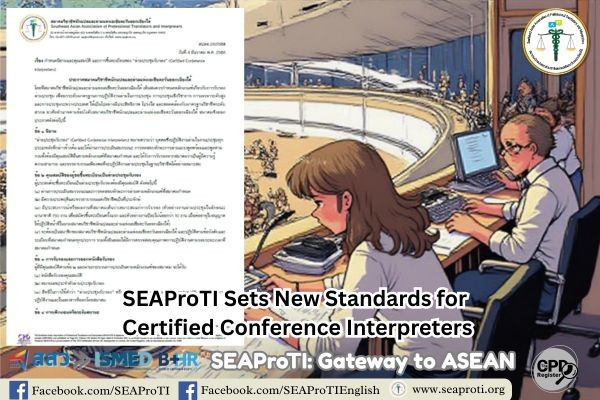
The Southeast Asian Association of Professional Translators and Interpreters (SEAProTI) has formally announced the qualifications and requirements for registration of Certified Translators, Translation Certification Providers, and Certified Interpreters in Sections 9 and 10 of the Royal Gazette, published by the Secretariat of the Cabinet, Office of the Prime Minister of Thailand, on 25 July 2024 (Vol. 141, Part 66 Ng, p. 100). Certified Translators, Translation Certification Providers, and Certified Interpreters
The Council of State has proposed the enactment of a Royal Decree, granting registered translators and recognised translation certifiers from professional associations or accredited language institutions the authority to provide legally valid translation certification (Letter to SEAProTI dated April 28, 2025)
SEAProTI is the first professional association in Thailand and Southeast Asia to implement a comprehensive certification system for translators, certifiers, and interpreters.
Head Office: Baan Ratchakru Building, No. 33, Room 402, Soi Phahonyothin 5, Phahonyothin Road, Phaya Thai District, Bangkok 10400, Thailand
Email: hello@seaproti.com | Tel.: (+66) 2-114-3128 (Office hours: Mon–Fri, 09:00–17:00)
คู่มือภาษาอังกฤษเพื่อการสื่อสารงานปกครองของกรมการปกครอง:
บทบาทของศัพท์ราชการมาตรฐานในการสื่อสารกับประชาชนและชาวต่างชาติ
ในบริบทของการบริหารราชการแผ่นดินสมัยใหม่ หน่วยงานภาครัฐของไทยมีภารกิจสำคัญในการให้บริการประชาชนและผู้ติดต่อราชการจากต่างประเทศอย่างมีประสิทธิภาพ หนึ่งในปัจจัยสำคัญที่ส่งผลต่อคุณภาพการให้บริการคือ การสื่อสารภาษาอังกฤษที่ถูกต้อง ตรงบริบท และสอดคล้องกับการใช้จริงในระบบราชการไทย โดยเฉพาะในงานด้านการทะเบียนราษฎร งานอาวุธปืน งานใบอนุญาต และงานด้านกฎหมายปกครอง
เพื่อตอบสนองต่อความจำเป็นดังกล่าว กรมการปกครอง ได้จัดทำ คู่มือภาษาอังกฤษเพื่อการสื่อสารงานปกครอง (DOPA Handbook) ซึ่งถือเป็นแหล่งอ้างอิงหลักสำหรับคำศัพท์และสำนวนภาษาอังกฤษที่ใช้จริงในงานปกครองของไทย
ลักษณะและขอบเขตของคู่มือ DOPA Handbook
คู่มือภาษาอังกฤษเพื่อการสื่อสารงานปกครองของกรมการปกครองถูกออกแบบมาเพื่อใช้เป็นเครื่องมือพัฒนาทักษะภาษาอังกฤษของบุคลากรในสังกัด และเพื่อเพิ่มประสิทธิภาพในการให้บริการประชาชน โดยเนื้อหาครอบคลุมคำศัพท์ สำนวน และตัวอย่างประโยคที่เกี่ยวข้องกับภารกิจหลักของงานปกครอง เช่น
- งานทะเบียนบ้านและทะเบียนราษฎร
- งานอาวุธปืนและวัตถุระเบิด
- งานการออกใบอนุญาตและการกำกับดูแล
- งานด้านกฎหมายและการบังคับใช้กฎหมายทางปกครอง
จุดเด่นของคู่มือฉบับนี้คือการเลือกใช้คำศัพท์ภาษาอังกฤษที่สะท้อน แนวคิดทางกฎหมายและการปฏิบัติราชการของไทย มากกว่าการแปลแบบตรงตัวจากพจนานุกรมทั่วไป ทำให้สามารถนำไปใช้ในการสื่อสารกับชาวต่างชาติได้อย่างเหมาะสมและลดความคลาดเคลื่อนเชิงความหมาย
คำศัพท์ราชการที่พบบ่อยและการใช้ในบริบทงานปกครอง
คู่มือ DOPA Handbook รวบรวมคำศัพท์ที่ใช้เป็นประจำในงานปกครอง พร้อมคำแปลและบริบทการใช้งาน ตัวอย่างคำศัพท์ที่สำคัญ ได้แก่
- Registration หมายถึง การทะเบียน เช่น House Registration หรือ Residence Registration
- License ใช้ในความหมายของใบอนุญาต เช่น a license to possess firearms
- Fine หมายถึง การปรับเงิน
- Imprison หมายถึง การจำคุก
- Criminal Database หมายถึง ฐานข้อมูลอาชญากรรม
การใช้คำศัพท์เหล่านี้อย่างสม่ำเสมอและเป็นมาตรฐานช่วยให้การสื่อสารทางราชการมีความชัดเจน ลดความเสี่ยงในการตีความผิด โดยเฉพาะเมื่อเกี่ยวข้องกับสิทธิ หน้าที่ และความรับผิดทางกฎหมาย
การใช้แหล่งข้อมูลเสริม: พจนานุกรมและฐานข้อมูลศัพท์ราชการ
แม้คู่มือ DOPA Handbook จะเป็นแหล่งข้อมูลหลัก แต่การทำงานด้านภาษาในบริบทงานปกครองยังจำเป็นต้องอาศัยแหล่งข้อมูลเสริม เช่น พจนานุกรมออนไลน์ของราชบัณฑิตยสถาน หรือฐานข้อมูลศัพท์กฎหมายและการปกครอง เพื่อยืนยันความหมายของคำศัพท์เฉพาะ ตัวอย่างเช่น คำว่า Personal Identification Number (PIN) หรือแนวคิดเรื่อง Residence Registration ซึ่งอาจมีความแตกต่างจากการใช้ในบริบทของประเทศอื่น
การตรวจสอบข้ามแหล่งข้อมูลช่วยเพิ่มความแม่นยำทางภาษา และลดปัญหาการใช้คำที่แม้จะถูกต้องทางภาษาอังกฤษ แต่ไม่สอดคล้องกับกรอบกฎหมายและการปฏิบัติของไทย
บทสรุป
คู่มือภาษาอังกฤษเพื่อการสื่อสารงานปกครองของกรมการปกครองถือเป็นเครื่องมือสำคัญในการยกระดับมาตรฐานการสื่อสารภาษาอังกฤษของภาครัฐไทย โดยเฉพาะในงานที่เกี่ยวข้องกับทะเบียน กฎหมาย และการให้บริการประชาชน การใช้คู่มือดังกล่าวควบคู่กับแหล่งข้อมูลศัพท์ราชการอื่น ๆ จะช่วยให้การสื่อสารมีความถูกต้อง สอดคล้องกับบริบทไทย และสามารถใช้งานได้จริงในสถานการณ์ราชการและกึ่งกฎหมาย
ในมิติของวิชาชีพการแปลและการล่าม คู่มือฉบับนี้ยังมีคุณค่าในฐานะ แหล่งอ้างอิงเชิงนโยบายและเชิงปฏิบัติ ที่สะท้อนการกำหนดความหมายของคำศัพท์โดยรัฐ ซึ่งผู้ประกอบวิชาชีพควรทำความเข้าใจอย่างลึกซึ้งก่อนนำไปใช้ในเอกสารหรือการสื่อสารข้ามภาษา
อ่านฉบับเต็ม: “คู่มือภาษาอังกฤษเพื่อการสื่อสารงานปกครอง” ของกรมการปกครอง
เอกสารอ้างอิง
- กรมการปกครอง. (ไม่ปรากฏปี). คู่มือภาษาอังกฤษเพื่อการสื่อสารงานปกครอง. กระทรวงมหาดไทย.
- ราชบัณฑิตยสถาน. (ไม่ปรากฏปี). พจนานุกรมและฐานข้อมูลคำศัพท์ภาษาไทย–อังกฤษ.
เกี่ยวกับนักแปลรับรอง ผู้รับรองการแปล และล่ามรับรองของสมาคมวิชาชีพนักแปลและล่ามแห่งเอเชียตะวันออกเฉียงใต้
สมาคมวิชาชีพนักแปลและล่ามแห่งเอเชียตะวันออกเฉียงใต้ (SEAProTI) ได้ประกาศหลักเกณฑ์และคุณสมบัติผู้ที่ขึ้นทะเบียนเป็น “นักแปลรับรอง (Certified Translators) และผู้รับรองการแปล (Translation Certification Providers) และล่ามรับรอง (Certified Interpreters)” ของสมาคม หมวดที่ 9 และหมวดที่ 10 ในราชกิจจานุเบกษา ของสำนักเลขาธิการคณะรัฐมนตรี ในสำนักนายกรัฐมนตรี แห่งราชอาณาจักรไทย ลงวันที่ 25 ก.ค. 2567 เล่มที่ 141 ตอนที่ 66 ง หน้า 100 อ่านฉบับเต็มได้ที่: นักแปลรับรอง ผู้รับรองการแปล และล่ามรับรอง
สำนักคณะกรรมการกฤษฎีกา เสนอให้ตราเป็นพระราชกฤษฎีกา โดยกำหนดให้นักแปลที่ขึ้นทะเบียน รวมถึงผู้รับรองการแปลจากสมาคมวิชาชีพหรือสถาบันสอนภาษาที่มีการอบรมและขึ้นทะเบียน สามารถรับรองคำแปลได้ (จดหมายถึงสมาคม SEAProTI ลงวันที่ 28 เม.ย. 2568)
สมาคมวิชาชีพนักแปลและล่ามแห่งเอเชียตะวันออกเฉียงใต้ เป็นสมาคมวิชาชีพแห่งแรกและแห่งเดียวในประเทศไทยและภูมิภาคเอเชียตะวันออกเฉียงใต้ที่มีระบบรับรองนักแปลรับรอง ผู้รับรองการแปล และล่ามรับรอง
สำนักงานใหญ่: อาคารบ้านราชครู เลขที่ 33 ห้อง 402 ซอยพหลโยธิน 5 ถนนพหลโยธิน แขวงพญาไท เขตพญาไท กรุงเทพมหานคร 10400 ประเทศไทย
อีเมล: hello@seaproti.com โทรศัพท์: (+66) 2-114-3128 (เวลาทำการ: วันจันทร์–วันศุกร์ เวลา 09.00–17.00 น.