


Simultaneous Interpreting in a World That Never Pauses
War, courts, screens, and the enduring question of what only humans can do
Author: Wanitcha Sumanat, President of the Southeast Asian Association of Professional Translators and Interpreters (SEAProTI)
Few professions mirror global change as closely as simultaneous interpreting. Its evolution has never been linear or comfortable; instead, it has advanced in sudden leaps triggered by crisis, technology, and shifting ideas about communication itself. From postwar courtrooms to cloud-based platforms and algorithmic voices, interpreters have repeatedly been forced to redefine how and why they work.
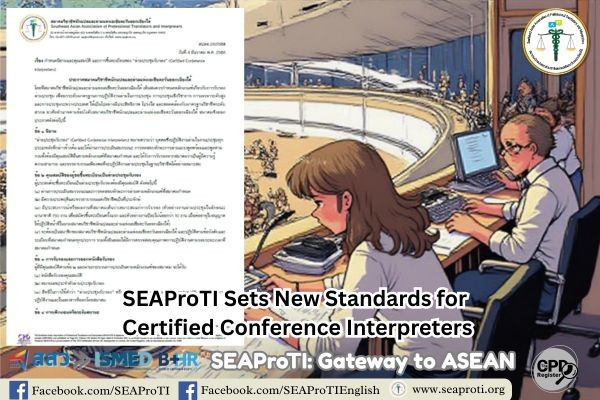
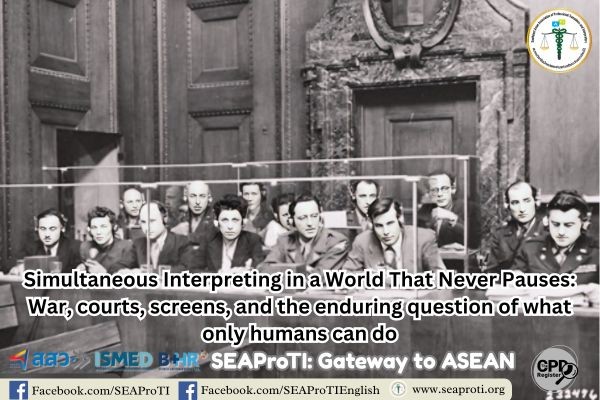
Simultaneous interpreting did not emerge from academic theory or gradual refinement. It was born under pressure, when the world needed justice to move faster than traditional multilingual procedures allowed. In the aftermath of global conflict, international legal proceedings demanded speed, precision, and fairness across multiple languages. Waiting for speakers to finish before rendering their words was no longer an option. Interpreters began listening and speaking at the same time, stepping into uncharted cognitive territory because the situation left no alternative.
Those early practitioners worked without the safeguards that later generations would take for granted. Sound isolation was minimal, workflows were improvised, and emotional strain was immense. Yet from those extreme conditions, a new professional practice took shape—one that soon became indispensable for international cooperation, diplomacy, and multilateral decision-making. Over time, equipment improved, training systems emerged, and professional norms solidified. What began as an emergency solution became a global standard.
For decades, the profession appeared to have reached a stable equilibrium. Physical booths, specialized consoles, team rotation, and clearly defined roles formed a well-understood ecosystem. Interpreters operated at the heart of international institutions and gradually expanded into corporate and commercial settings, adapting their skills to different audiences and communicative goals.
Then the world shifted again.
When the COVID-19 pandemic forced meetings out of conference centers and into digital space, interpreters faced another abrupt transformation. Remote simultaneous interpreting was not simply a change of venue; it dismantled the entire working environment. The booth shrank to a laptop. Technical teams disappeared. Interpreters became responsible not only for meaning but also for sound quality, connectivity, platform navigation, and real-time troubleshooting.
What had once been a carefully balanced division of labor turned into an exercise in constant multitasking. Listening, processing, speaking, monitoring audio levels, managing software, and responding to technical failures all competed for attention. Survival in the profession suddenly depended on adaptability far beyond linguistic skill.
As restrictions eased, remote and hybrid formats did not vanish. Instead, they settled into place, especially in the private sector, where cost efficiency often outweighs considerations of cognitive load or interpretive quality. Remote interpreting can be appropriate for short or low-risk events, but only when technical and professional conditions are respected. Otherwise, it risks recreating the very limitations that early interpreters struggled to overcome decades ago.
At the same time, a new presence entered the scene: artificial intelligence. Automated speech recognition and machine translation systems are increasingly promoted as substitutes for human interpreters. They promise speed, scalability, and reduced expense, and at first glance, they often perform impressively at the level of words.
Yet communication is not built from words alone.
Human speech is fragmented, indirect, and layered with intention. Speakers hesitate, revise their thoughts mid-sentence, rely on irony, soften refusals, and encode meaning through tone as much as through vocabulary. Much of what matters in meetings, especially in politics, finance, diplomacy, and negotiation, is not explicitly stated. It must be inferred, weighed, and rendered with judgment.
This is where machines still falter. Algorithms excel at pattern recognition, but they struggle with ambiguity, contradiction, and the subtle signals that tell a listener when a “yes” means “not yet” or when silence carries more weight than speech. They can translate language, but interpreting meaning remains another matter entirely.
The rise of AI also raises unresolved ethical and professional questions. Voices are recorded, stored, and reused. Interpreters’ output may become training data for systems designed to replace them, often without clear consent or compensation. In a digital economy where boundaries are increasingly blurred, protecting intellectual property, confidentiality, and professional autonomy has become as critical as mastering new tools.
Across its history, from wartime courts to institutional halls, from physical booths to virtual platforms, simultaneous interpreting has never stopped changing. What endures is not a specific technology, but a human function: enabling understanding where misunderstanding would otherwise prevail.
The central question today is not whether technology will continue to advance. It will. The real question is whether communication will be treated as a purely technical process or as a human one that requires responsibility, discernment, and trust.
Every time an interpreter switches on a microphone, they do more than transmit sound across languages. They uphold a space where meaning is negotiated, intentions are clarified, and dialogue remains possible. As long as that space matters, simultaneous interpreting will not disappear—it will continue to adapt, shaped by technology but grounded in humanity.
Further Reading:
- The Origins of Simultaneous Interpretation, Francesca Gaiba
- Nuremberg: Infamy on Trial, Joseph E. Persico
- Interpreting at the United Nations, Jesús Baigorri-Jalón
- Simultaneous Interpreting: Its Origins and Development, Klaus Ziegler
- Distance Interpreting Guidelines and Conference Interpreting Equipment Standards (professional reference documents)
About Certified Translators, Translation Certifiers, and Certified Interpreters of SEAProTI
The Southeast Asian Association of Professional Translators and Interpreters (SEAProTI) has formally announced the qualifications and requirements for registration of Certified Translators, Translation Certification Providers, and Certified Interpreters in Sections 9 and 10 of the Royal Gazette, published by the Secretariat of the Cabinet, Office of the Prime Minister of Thailand, on 25 July 2024 (Vol. 141, Part 66 Ng, p. 100). Certified Translators, Translation Certification Providers, and Certified Interpreters
The Council of State has proposed the enactment of a Royal Decree, granting registered translators and recognised translation certifiers from professional associations or accredited language institutions the authority to provide legally valid translation certification (Letter to SEAProTI dated April 28, 2025)
SEAProTI is the first professional association in Thailand and Southeast Asia to implement a comprehensive certification system for translators, certifiers, and interpreters.
Head Office: Baan Ratchakru Building, No. 33, Room 402, Soi Phahonyothin 5, Phahonyothin Road, Phaya Thai District, Bangkok 10400, Thailand
Email: hello@seaproti.com | Tel.: (+66) 2-114-3128 (Office hours: Mon–Fri, 09:00–17:00)
ล่ามพูดพร้อมในโลกที่ไม่หยุดรอใคร: จากสงคราม ศาล โลกดิจิทัล และคำถามต่อความเป็นมนุษย์
ผู้เขียน: วณิชชา สุมานัส
ตำแหน่ง: นายกสมาคมวิชาชีพนักแปลและล่ามแห่งเอเชียตะวันออกเฉียงใต้ (SEAProTI)
31 ธันวาคม 2568, กรุงเทพมหานคร – หากย้อนมองประวัติศาสตร์การสื่อสารข้ามภาษาในศตวรรษที่ 20 และ 21 วิชาชีพล่ามพูดพร้อมคือหนึ่งในภาพสะท้อนที่ชัดเจนที่สุดของความเปลี่ยนแปลงของโลก เทคโนโลยี การเมือง และความเข้าใจเกี่ยวกับ “มนุษย์” ไม่ได้ค่อย ๆ เปลี่ยนอย่างนุ่มนวล แต่กระโดดข้ามยุคสมัยผ่านเหตุการณ์ใหญ่ที่ไม่มีใครคาดคิด และทุกครั้ง ล่ามคือกลุ่มคนที่ต้องปรับตัวก่อนใคร
จุดเริ่มต้นของการล่ามพูดพร้อมไม่ได้เกิดจากความก้าวหน้าทางวิชาการ หากแต่เกิดจาก “ความจำเป็นเร่งด่วน” โลกหลังสงครามโลกครั้งที่สองต้องเผชิญคำถามด้านความยุติธรรมระดับนานาชาติ การพิจารณาคดีอาชญากรรมสงครามที่มีหลายภาษาไม่อาจพึ่งพาการล่ามพูดตามแบบเดิมได้อีกต่อไป เพราะเวลา ความถูกต้อง และสิทธิของจำเลยไม่เปิดช่องให้ความล่าช้า นั่นคือช่วงเวลาที่มนุษย์เลือกจะฟัง แปล และพูดไปพร้อมกัน แม้ยังไม่รู้ด้วยซ้ำว่าระบบนี้จะยั่งยืนได้หรือไม่
ล่ามยุคบุกเบิกทำงานภายใต้เงื่อนไขที่วันนี้แทบไม่น่าเชื่อ ทั้งเสียงรบกวน ความกดดันทางจิตใจ และเนื้อหาที่กระทบศีลธรรมมนุษย์อย่างรุนแรง แต่จากสถานการณ์สุดขีดนั้นเอง กลับก่อร่างเป็นมาตรฐานใหม่ของการสื่อสารพหุภาษา และค่อย ๆ หลอมรวมเข้าเป็นส่วนหนึ่งของระบบองค์การระหว่างประเทศ การประชุมระดับโลก และในเวลาต่อมา โลกธุรกิจ
หลายทศวรรษผ่านไป วิชาชีพล่ามดูเหมือนจะ “ลงตัว” มีบูธ มีอุปกรณ์ มีทีม มีมาตรฐาน และมีขอบเขตบทบาทที่ชัดเจน จนกระทั่งโลกต้องเผชิญเหตุการณ์ที่ไม่มีใครเตรียมตัว—การระบาดใหญ่ของโรคโควิด-19 ห้องประชุมถูกแทนที่ด้วยหน้าจอ คอนโซลถูกแทนที่ด้วยคอมพิวเตอร์ส่วนตัว และบูธถูกย่อส่วนเหลือเพียงห้องหนึ่งในบ้าน
การล่ามพูดพร้อมทางไกลไม่ใช่แค่การเปลี่ยนสถานที่ทำงาน แต่เป็นการเปลี่ยน “ระบบนิเวศ” ของวิชาชีพ ล่ามต้องดูแลเสียง อินเทอร์เน็ต แพลตฟอร์ม และการแก้ปัญหาเฉพาะหน้าไปพร้อมกับภารกิจหลักคือการถ่ายทอดความหมายอย่างแม่นยำ เส้นแบ่งระหว่างบทบาทล่ามกับบทบาทช่างเทคนิคเริ่มเลือนราง ขณะที่ความคาดหวังของผู้ว่าจ้างกลับเพิ่มขึ้น
เมื่อโลกเริ่มเปิดอีกครั้ง การทำงานแบบผสม บางส่วนอยู่ในห้อง บางส่วนอยู่หลังจอ กลายเป็นเรื่องปกติ และในจังหวะเดียวกัน เทคโนโลยีปัญญาประดิษฐ์ก็ก้าวเข้ามาอย่างเงียบเชียบแต่ทรงพลัง ระบบรู้จำเสียง การแปลอัตโนมัติ และ “ล่ามดิจิทัล” ถูกนำเสนอในฐานะคำตอบของความเร็วและต้นทุน
อย่างไรก็ตาม สิ่งที่ดูเหมือนสมบูรณ์แบบในระดับคำ กลับสะดุดในระดับความหมาย ภาษาไม่ได้ประกอบด้วยโครงสร้างไวยากรณ์เท่านั้น แต่เต็มไปด้วยการเว้นจังหวะ ความลังเล น้ำเสียง การประชด การพูดอ้อม และความไม่สมบูรณ์แบบที่เป็นธรรมชาติของมนุษย์ การสื่อสารจำนวนมากไม่ได้พูดเพื่อ “บอกข้อมูล” อย่างเดียว แต่พูดเพื่อรักษาความสัมพันธ์ ต่อรองอำนาจ หรือส่งสัญญาณบางอย่างที่ไม่ได้อยู่ในถ้อยคำตรงไปตรงมา
นี่คือพื้นที่ที่ล่ามมนุษย์ยังคงยืนอยู่ พื้นที่ของดุลยพินิจ จริยธรรม และความรับผิดชอบ เมื่อการประชุมเกี่ยวข้องกับนโยบาย เศรษฐกิจ ความขัดแย้ง หรือความไว้วางใจ คำถามไม่ได้อยู่ที่ว่า “แปลได้หรือไม่” แต่อยู่ที่ว่า “เข้าใจหรือไม่” และ “ควรถ่ายทอดอย่างไร”
ในขณะเดียวกัน ประเด็นใหม่ที่ท้าทายยิ่งกว่าคือ สิทธิในเสียงและคำพูดของล่าม การบันทึก การนำข้อมูลเสียงไปฝึกระบบ และการใช้ซ้ำโดยไม่แจ้งล่วงหน้า กำลังกลายเป็นเรื่องปกติในโลกดิจิทัล หากไม่มีกรอบคุ้มครองที่ชัดเจน เสียงของล่ามอาจกลายเป็นวัตถุดิบของระบบที่เข้ามาแทนที่ตนเองในอนาคต
ตลอดเส้นทางตั้งแต่ศาลสงคราม ห้องประชุมระหว่างประเทศ หน้าจอออนไลน์ จนถึงยุค AI วิชาชีพล่ามพูดพร้อมไม่เคยหยุดเปลี่ยน แต่สิ่งหนึ่งที่ไม่เคยเปลี่ยนคือ แก่นแท้ของงาน การทำให้มนุษย์เข้าใจกันโดยไม่บิดเบือนสาระและบริบท
คำถามสำคัญในวันนี้จึงไม่ใช่ว่า เทคโนโลยีจะมาแทนล่ามได้หรือไม่ แต่คือ เราจะยอมให้การสื่อสารระดับมนุษย์ถูกลดทอนเหลือเพียงการจับคู่คำหรือไม่ และเราจะรักษาพื้นที่ของความหมาย ความรับผิดชอบ และศักดิ์ศรีในวิชาชีพนี้ไว้อย่างไร
ไมโครโฟนถูกเปิดขึ้นทุกวัน คำพูดไหลผ่านภาษาและวัฒนธรรม และตราบใดที่มนุษย์ยังต้อง “เข้าใจกัน” มากกว่าแค่ “ได้ยินกัน” ล่ามพูดพร้อมก็ยังมีที่ยืน—ไม่ใช่ในฐานะเครื่องมือ แต่ในฐานะมนุษย์อีกคนหนึ่งในกระบวนการสื่อสารของโลก
อ่านเพิ่มเติม
- Francesca Gaiba, The Origins of Simultaneous Interpretation
- Joseph E. Persico, Nuremberg: Infamy on Trial
- Jesús Baigorri-Jalón, Interpreting at the United Nations
- Klaus Ziegler, Simultaneous Interpreting: Its Origins and Development
- แนวปฏิบัติการล่ามทางไกล และมาตรฐานอุปกรณ์การล่าม (เอกสารวิชาชีพ)
เกี่ยวกับนักแปลรับรอง ผู้รับรองการแปล และล่ามรับรองของสมาคมวิชาชีพนักแปลและล่ามแห่งเอเชียตะวันออกเฉียงใต้
สมาคมวิชาชีพนักแปลและล่ามแห่งเอเชียตะวันออกเฉียงใต้ (SEAProTI) ได้ประกาศหลักเกณฑ์และคุณสมบัติผู้ที่ขึ้นทะเบียนเป็น “นักแปลรับรอง (Certified Translators) และผู้รับรองการแปล (Translation Certification Providers) และล่ามรับรอง (Certified Interpreters)” ของสมาคม หมวดที่ 9 และหมวดที่ 10 ในราชกิจจานุเบกษา ของสำนักเลขาธิการคณะรัฐมนตรี ในสำนักนายกรัฐมนตรี แห่งราชอาณาจักรไทย ลงวันที่ 25 ก.ค. 2567 เล่มที่ 141 ตอนที่ 66 ง หน้า 100 อ่านฉบับเต็มได้ที่: นักแปลรับรอง ผู้รับรองการแปล และล่ามรับรอง
สำนักคณะกรรมการกฤษฎีกา เสนอให้ตราเป็นพระราชกฤษฎีกา โดยกำหนดให้นักแปลที่ขึ้นทะเบียน รวมถึงผู้รับรองการแปลจากสมาคมวิชาชีพหรือสถาบันสอนภาษาที่มีการอบรมและขึ้นทะเบียน สามารถรับรองคำแปลได้ (จดหมายถึงสมาคม SEAProTI ลงวันที่ 28 เม.ย. 2568)
สมาคมวิชาชีพนักแปลและล่ามแห่งเอเชียตะวันออกเฉียงใต้ เป็นสมาคมวิชาชีพแห่งแรกและแห่งเดียวในประเทศไทยและภูมิภาคเอเชียตะวันออกเฉียงใต้ที่มีระบบรับรองนักแปลรับรอง ผู้รับรองการแปล และล่ามรับรอง
สำนักงานใหญ่: อาคารบ้านราชครู เลขที่ 33 ห้อง 402 ซอยพหลโยธิน 5 ถนนพหลโยธิน แขวงพญาไท เขตพญาไท กรุงเทพมหานคร 10400 ประเทศไทย
อีเมล: hello@seaproti.com โทรศัพท์: (+66) 2-114-3128 (เวลาทำการ: วันจันทร์–วันศุกร์ เวลา 09.00–17.00 น.