



The “Self-Binding Translation” Principle for Foreign-Language Documentary Evidence:
An Analysis of Supreme Court Decisions Nos. 1663–1664/2529
22 February 2026, Bangkok — Supreme Court Decisions Nos. 1663–1664/2529 articulate a significant procedural principle concerning the status of a Thai translation when a party files a foreign-language document in Thai court proceedings and the court orders that a Thai translation be produced. Once the filing party prepares and submits the Thai translation, the court must adjudicate the case on the basis of that translation, and the filing party may not later argue that the translation is “incorrect” in order to alter the outcome of the case. This principle has important implications for litigation risk management, fact-finding, and the standard of responsibility borne by parties who introduce foreign-language documents into the Thai judicial record.
Facts and issues
The case involved two labour disputes consolidated for adjudication. A central issue concerned the defendant’s workplace regulations (“work rules”), drafted in English and submitted as Exhibit L.1 for the purpose of determining employees’ entitlements. On appeal, the defendant argued in substance that a Thai translation of the regulations had originally existed, but it was later discovered that the Thai translation contained omissions and inaccuracies. According to the defendant, if the translation had been accurate, the interpretation of the regulations should have supported the defendant’s appellate arguments.
Accordingly, the Supreme Court was required to determine, as a matter relating to translation and procedure, whether—after a foreign-language document has been filed and the filing party has submitted a Thai translation pursuant to a court order—the filing party may later challenge the accuracy of that translation. The Court also had to address which language should serve as the operative basis for judicial determination within Thai proceedings.
The governing procedural rule: judicial power to order translation and the binding effect of the filed translation
The Supreme Court reasoned in a manner that squarely reflects procedural logic. Exhibit L.1 was a document submitted to the court by the defendant. Where such a document is in a foreign language and a Thai translation is absent, the court has authority to order the defendant to prepare a Thai translation. However, once the defendant produces and files the Thai translation, that translation must be treated as accurate in accordance with the document; the court therefore must decide on that basis, and the defendant cannot later dispute that the filed translation is incorrect.
The core of the Court’s approach is not a debate about “translation technique” as such, but rather a doctrinal allocation of risk in the introduction of foreign-language documentary evidence. The filing party bears responsibility for what it places before the court, especially because the court and the opposing party must rely on the Thai translation as the accessible and contestable version of the documentary content within Thai-language proceedings. In this sense, the translation becomes the functional vehicle through which the court apprehends the exhibit’s meaning for purposes of adjudication.
Relationship to the bilingual-instrument rule under Civil and Commercial Code section 14
The defendant further contended that the English version of the work rules should control because the defendant was a foreign company, and it attempted to link this argument to the rule on bilingual instruments under section 14 of the Thai Civil and Commercial Code. The Supreme Court, however, drew a clear conceptual boundary. Section 14 applies where an instrument is genuinely executed in two languages and the texts diverge in a manner that makes the parties’ intent uncertain as to which language should govern, in which event Thai is to be applied. In the present case, by contrast, the defendant’s work rules were executed only in English; the Thai version was merely a translation. Consequently, once the defendant filed the Thai translation, the Court adjudicated on the basis of the Thai text as translated by the defendant.
This reasoning underscores a theoretically important distinction between a bilingual instrument in which two language versions have co-original status, and a single-language instrument accompanied by a translation for purposes of use in proceedings. The legal consequences and interpretive standards differ materially. In the latter scenario, the translation is not a rival “original” competing for authority; rather, it functions as the procedural medium that enables the court to access and evaluate the documentary content within the case record.
Procedural implications: stability of the case record and the prohibition on later self-contradiction
From a methodological perspective, the decisions support the principle of stability and certainty of the case record. Adjudication must proceed on the basis of evidence and facts that are properly before the court. If the filing party were allowed to shift its position later by asserting that its own translation was wrong, at least three systemic problems would arise. First, it would be unfair to the opposing party, which must litigate on the basis of the filed translation. Second, it would burden the court’s evidentiary assessment by destabilizing the documentary foundation of the dispute. Third, it would invite the strategic use of “linguistic error” as a litigation tactic.
Accordingly, the “self-binding translation” principle operates as an institutional rule allocating responsibility to the filing party and preventing later self-contradiction that would undermine procedural fairness and efficient adjudication. In practice, the rule is highly relevant to disputes involving foreign documents such as workplace regulations, organizational policies, contracts, manuals, or other instruments that structure the parties’ rights and obligations.
Practical consequences: a “verify before filing” standard and the problem of language incapacity
These decisions effectively establish a practical standard: parties who submit foreign-language documents must implement robust quality control of translations before introducing them into the record. After filing, a party cannot easily invoke claims such as “I do not know the foreign language” or “I only later discovered inaccuracies” as a basis for the court to disregard the earlier translation—particularly where such claims are advanced to reverse an otherwise adverse outcome.
In procedural terms, if a party lacks foreign-language competence, reliance on qualified expertise becomes a minimum duty of care. The risk remains with the party who chooses to file the document; it does not shift to the court or to the opposing party. The critical point is not merely hiring a translator, but establishing a review mechanism sufficient to ensure that the Thai translation accurately captures the original document’s intent and substance, because the court may be required to adjudicate “on that basis” once the translation is filed.
Observations on the claim “I studied it and the translation does not match”: timing and good faith
A claim that “after review, the translation does not match the original” may be factually possible. Nevertheless, these decisions indicate that the weight of such a claim depends on procedural context. If an error is discovered, corrective action should be taken promptly in a manner aimed at preserving the accuracy of the case record, rather than waiting until the filed translation has already served as the basis for litigation positions or judicial reasoning and then disputing it to secure an advantage. In the latter context, the court is likely to treat the objection as incompatible with the governing principle and therefore not persuasive.
Conclusion
Supreme Court Decisions Nos. 1663–1664/2529 constitute a landmark in Thai procedural treatment of foreign-language documentary evidence. In essence, when a party files a foreign-language document and is ordered to produce a Thai translation, the translation it files binds the filing party, and the court must adjudicate on that translation as the operative representation of the document within the record. The party cannot later contest the translation’s accuracy to change the case outcome. The decisions thus elevate the importance of linguistic risk management in litigation and place a clear burden of verification squarely on the party who introduces foreign-language documents into Thai proceedings.
References
- Supreme Court (Labour Division). (1986). Supreme Court Decisions Nos. 1663–1664/2529 (Collected decisions; published compilation). Office of Judicial Affairs Promotion.
- deka.in.th. (n.d.). Supreme Court Decision No. 1663/2529. deka.in.th
This section provides information about certified translators, translation certifiers, and certified interpreters associated with SEAProTI.
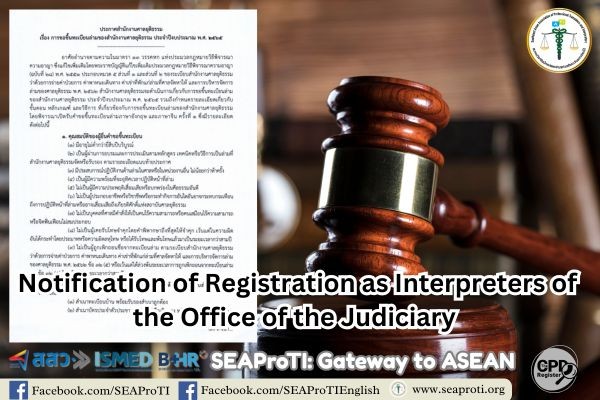
The Southeast Asian Association of Professional Translators and Interpreters (SEAProTI) has officially shared the qualifications and requirements for becoming Certified Translators, Translation Certification Providers, and Certified Interpreters in Sections 9 and 10 of the Royal Gazette, which was published by the Prime Minister’s Office in Thailand on July 25, 2024. Certified Translators, Translation Certification Providers, and Certified Interpreters
The Council of State has proposed the enactment of a Royal Decree, granting registered translators and recognised translation certifiers from professional associations or accredited language institutions the authority to provide legally valid translation certification (Letter to SEAProTI dated April 28, 2025)
SEAProTI is the first professional association in Thailand and Southeast Asia to implement a comprehensive certification system for translators, certifiers, and interpreters.
Head Office: Baan Ratchakru Building, No. 33, Room 402, Soi Phahonyothin 5, Phahonyothin Road, Phaya Thai District, Bangkok 10400, Thailand
Email: hello@seaproti.com | Tel.: (+66) 2-114-3128 (Office hours: Mon–Fri, 09:00–17:00)
หลัก “คำแปลผูกพันผู้ยื่น” ในเอกสารภาษาต่างประเทศ: วิเคราะห์คำพิพากษาศาลฎีกาที่ 1663–1664/2529
22 กุมภาพันธ์ 2569, กรุงเทพมหานคร – คำพิพากษาศาลฎีกาที่ 1663–1664/2529 วางหลักสำคัญว่าด้วยสถานะทางกระบวนพิจารณาของ “คำแปลภาษาไทย” เมื่อคู่ความเป็นผู้ยื่นเอกสารภาษาต่างประเทศเข้าสู่สำนวนคดีแล้วศาลมีคำสั่งให้จัดทำคำแปลภาษาไทย โดยเมื่อคู่ความได้จัดทำและยื่นคำแปลแล้ว ศาลย่อมต้องวินิจฉัยไปตามคำแปลนั้น และคู่ความผู้ยื่นไม่อาจโต้แย้งภายหลังว่า “คำแปลไม่ถูกต้อง” เพื่อให้ผลคดีเปลี่ยนไป หลักดังกล่าวมีนัยสำคัญต่อการบริหารความเสี่ยงทางคดี การพิสูจน์ข้อเท็จจริง และมาตรฐานความรับผิดชอบของคู่ความในการยื่นเอกสารต่างภาษาในศาลไทย
ข้อเท็จจริงและประเด็นแห่งคดี
คดีแรงงานสองสำนวนซึ่งศาลรวมพิจารณา มีประเด็นเกี่ยวกับ “ข้อบังคับเกี่ยวกับการทำงาน” ของจำเลยที่จัดทำเป็นภาษาอังกฤษ และถูกยื่นเป็นเอกสารหมาย ล.1 เพื่อใช้ประกอบการวินิจฉัยสิทธิประโยชน์ของลูกจ้าง โดยจำเลยอุทธรณ์ทำนองว่า ข้อบังคับดังกล่าวเดิมมีการจัดทำคำแปลภาษาไทยไว้ แต่ต่อมาพบว่าคำแปลไทย “ตกหล่นและคลาดเคลื่อน” หากแปลถูกต้อง การตีความควรเป็นไปตามข้ออุทธรณ์ของจำเลย
ประเด็นปัญหาที่ศาลฎีกาต้องวินิจฉัยในส่วนที่เกี่ยวกับงานแปลจึงอยู่ที่ว่า เมื่อเอกสารภาษาต่างประเทศถูกยื่นเข้าสู่สำนวน และมีคำแปลภาษาไทยที่คู่ความยื่นตามคำสั่งศาลแล้ว คู่ความผู้ยื่นสามารถกลับมาโต้แย้งภายหลังว่าคำแปลดังกล่าวไม่ถูกต้องได้หรือไม่ และศาลควรยึดภาษาใดเป็นฐานในการวินิจฉัย
หลักกฎหมายที่ศาลยึดถือ: อำนาจศาลในการสั่งให้แปล และผลผูกพันของคำแปล
ศาลฎีกาวินิจฉัยโดยให้เหตุผลที่มีน้ำหนักเชิงกระบวนพิจารณาอย่างชัดเจนว่า เอกสาร ล.1 เป็นเอกสารที่ “จำเลยเป็นผู้ส่งต่อศาล” หากไม่มีคำแปลภาษาไทย ศาลย่อมมีอำนาจสั่งให้จำเลยจัดทำคำแปลได้ แต่เมื่อจำเลยได้ทำคำแปลภาษาไทยมายื่นแล้ว “ต้องถือว่าถูกต้องตามเอกสารนั้น” ซึ่งศาล “จำต้องวินิจฉัยไปตามนั้น” และจำเลย “จะโต้แย้งภายหลังว่าคำแปลดังกล่าวไม่ถูกต้องไม่ได้”
แก่นของแนววินิจฉัยจึงมิใช่เพียงเรื่อง “เทคนิคการแปล” แต่เป็นการจัดวาง “ภาระความเสี่ยง” (risk allocation) ในการนำพยานเอกสารต่างภาษาเข้าสู่กระบวนพิจารณา กล่าวคือ ผู้ยื่นเอกสารย่อมต้องรับผิดชอบต่อความถูกต้องของสิ่งที่ยื่น โดยเฉพาะเมื่อศาลและคู่ความอีกฝ่ายต้องพึ่งพา “คำแปลภาษาไทย” เป็นฐานการถกเถียงและวินิจฉัยข้อเท็จจริงในคดี
ความสัมพันธ์กับหลักเอกสารสองภาษาใน ป.พ.พ. มาตรา 14
จำเลยยังอ้างต่อไปว่าศาลพึงถือเอาข้อบังคับภาษาอังกฤษ เนื่องจากจำเลยเป็นบริษัทต่างด้าว และพยายามโยงเข้ากับหลักเอกสารสองภาษาตามประมวลกฎหมายแพ่งและพาณิชย์ มาตรา 14 อย่างไรก็ดี ศาลฎีกาวางกรอบตีความที่จำแนกให้ชัดว่า มาตรา 14 ใช้ได้เมื่อ “เอกสารทำขึ้นเป็นสองภาษา” โดยแท้ และข้อความสองภาษาต่างกันจนไม่อาจหยั่งทราบเจตนาคู่กรณีได้ว่าจะใช้ภาษาใดบังคับ จึงให้ถือเอาภาษาไทยบังคับ แต่ในคดีนี้ ข้อบังคับการทำงานของจำเลย “ทำขึ้นเป็นภาษาอังกฤษเพียงภาษาเดียว” ส่วนภาษาไทยเป็น “เพียงคำแปล” ดังนั้นเมื่อจำเลยทำคำแปลไทยมายื่นแล้ว ศาลย่อมวินิจฉัยตามภาษาไทยที่จำเลยแปลมานั้น
ประเด็นนี้สะท้อนการแบ่งแยกเชิงทฤษฎีที่สำคัญระหว่าง “เอกสารสองภาษาในฐานะต้นฉบับร่วม” กับ “เอกสารภาษาเดียวที่มีคำแปลประกอบ” เพราะผลทางกฎหมายและมาตรฐานการตีความไม่เหมือนกัน ในกรณีหลัง คำแปลทำหน้าที่เป็นสื่อกลางให้ศาลรับรู้ข้อเท็จจริงในสำนวน มิใช่การมีสถานะเป็น “ต้นฉบับ” ที่แข่งขันกันสองภาษา
นัยเชิงกระบวนพิจารณา: หลักความมั่นคงของสำนวนและการห้ามกลับคำ
เมื่อพิจารณาในเชิงนิติวิธี คำพิพากษานี้รองรับ “ความมั่นคงแน่นอนของสำนวนคดี” เพราะการพิจารณาพิพากษาต้องอาศัยเอกสารและข้อเท็จจริงที่อยู่ในสำนวนเป็นฐาน หากเปิดช่องให้คู่ความผู้ยื่นสามารถเปลี่ยนจุดยืนภายหลังโดยกล่าวว่าคำแปลของตนผิด ย่อมก่อให้เกิดปัญหาอย่างน้อยสามประการ ได้แก่ ความไม่เป็นธรรมต่ออีกฝ่ายที่ต้องต่อสู้คดีจากคำแปลในสำนวน ความยุ่งยากต่อศาลในการชั่งน้ำหนักพยาน และความเสี่ยงต่อการใช้ “ความผิดพลาดทางภาษา” เป็นกลยุทธ์ทางคดี
ดังนั้น หลัก “คำแปลผูกพันผู้ยื่น” จึงมีลักษณะเป็นกติกาเชิงสถาบันที่จัดความรับผิดชอบให้ตกแก่ผู้ยื่นเอกสารและเป็นกลไกต้านการโต้แย้งแบบย้อนแย้งตนเองในภายหลัง ซึ่งในทางปฏิบัติเป็นเรื่องที่พบได้ในคดีที่เกี่ยวข้องกับเอกสารต่างประเทศ เช่น ข้อบังคับ ระเบียบองค์กร สัญญา คู่มือ หรือเอกสารนโยบายที่มีผลต่อสิทธิหน้าที่ของคู่กรณี
ผลเชิงปฏิบัติ: มาตรฐาน “การตรวจสอบก่อนยื่น” และคำถามเมื่อคู่ความไม่รู้ภาษาต่างประเทศ
คำพิพากษานี้ก่อให้เกิดมาตรฐานทางปฏิบัติที่ชัดเจนว่า คู่ความที่ยื่นเอกสารภาษาต่างประเทศต้องจัดการคุณภาพคำแปลอย่างรัดกุมก่อนนำเข้าสำนวน เพราะเมื่อยื่นแล้วไม่อาจใช้ข้ออ้างว่า “ไม่รู้ภาษา” หรือ “เพิ่งตรวจพบว่าคำแปลคลาดเคลื่อน” เพื่อให้ศาลละทิ้งคำแปลเดิมได้ง่ายนัก โดยเฉพาะเมื่อเหตุผลดังกล่าวถูกใช้เพื่อพลิกผลทางคดี
ในทางนิติวิธี หากคู่ความไม่รู้ภาษาต่างประเทศ การ “อาศัยผู้เชี่ยวชาญ” ย่อมเป็นหน้าที่ทางความระมัดระวังขั้นต่ำ เพราะภาระความเสี่ยงยังคงอยู่ที่ผู้ยื่นเอกสาร ไม่ได้ย้ายไปอยู่ที่ศาลหรือคู่ความฝ่ายตรงข้าม ทั้งนี้ ประเด็นสำคัญมิใช่เพียงการจ้างผู้แปล แต่เป็นการจัดระบบตรวจทานเพื่อให้คำแปลสะท้อนเจตนาและสาระสำคัญของเอกสารเดิมได้ครบถ้วน เนื่องจากคำแปลจะกลายเป็นฐานให้ศาล “จำต้องวินิจฉัยไปตามนั้น”
ข้อสังเกตต่อข้ออ้าง “ศึกษาแล้วแปลไม่ตรงจริง”: เงื่อนไขเรื่องเวลาและความสุจริต
ข้ออ้างว่า “ศึกษาแล้วพบว่าแปลไม่ตรงจริง” อาจมีความเป็นไปได้ในทางข้อเท็จจริง แต่คำพิพากษานี้ชี้ให้เห็นว่าการอ้างดังกล่าวจะมีน้ำหนักหรือไม่ย่อมขึ้นกับบริบททางกระบวนพิจารณา กล่าวคือ หากคู่ความพบข้อผิดพลาด ควรดำเนินการแก้ไขโดยเร็วในลักษณะที่มุ่งรักษาความถูกต้องของสำนวน มิใช่รอจนคำแปลได้ถูกใช้เป็นฐานต่อสู้คดีหรือเป็นฐานวินิจฉัย แล้วจึงย้อนโต้แย้งเพื่อเอื้อประโยชน์แก่ตน เพราะในกรณีหลังศาลย่อมมองว่าเป็นการโต้แย้งที่รับฟังไม่ได้ตามหลักที่วางไว้
บทสรุป
คำพิพากษาศาลฎีกาที่ 1663–1664/2529 เป็นหมุดหมายสำคัญของกฎหมายเชิงกระบวนพิจารณาเกี่ยวกับเอกสารภาษาต่างประเทศในศาลไทย โดยสรุปได้ว่า เมื่อคู่ความเป็นผู้ยื่นเอกสารต่างภาษาและถูกสั่งให้จัดทำคำแปลภาษาไทย คำแปลที่ยื่นย่อมผูกพันผู้ยื่น และศาลย่อมต้องใช้คำแปลนั้นเป็นฐานวินิจฉัย คู่ความจึงไม่อาจโต้แย้งภายหลังว่าคำแปลไม่ถูกต้องเพื่อเปลี่ยนผลคดีได้ หลักดังกล่าวยกระดับความสำคัญของ “การบริหารความเสี่ยงทางภาษา” ในคดี และผลักภาระความระมัดระวังในการตรวจสอบคำแปลให้เป็นหน้าที่ของผู้ยื่นเอกสารอย่างชัดเจน
เอกสารอ้างอิง
- ศาลฎีกาแผนกคดีแรงงาน. (2529). คำพิพากษาศาลฎีกาที่ 1663–1664/2529 (เอกสารรวมคำพิพากษาเผยแพร่). สำนักงานส่งเสริมงานตุลาการ.
deka.in.th. (n.d.). คำพิพากษาศาลฎีกาที่ 1663/2529.
สมาคมวิชาชีพนักแปลและล่ามแห่งเอเชียตะวันออกเฉียงใต้ (SEAProTI) ได้ประกาศหลักเกณฑ์และคุณสมบัติของผู้ที่ขึ้นทะเบียนเป็น “นักแปลรับรอง (Certified Translators) และผู้รับรองการแปล (Translation Certification Providers) และล่ามรับรอง (Certified Interpreters)” ของสมาคม หมวดที่ 9 และหมวดที่ 10 ในราชกิจจานุเบกษา ของสำนักเลขาธิการคณะรัฐมนตรี ในสำนักนายกรัฐมนตรี แห่งราชอาณาจักรไทย ลงวันที่ 25 ก.ค. 2567 เล่มที่ 141 ตอนที่ 66 ง หน้า 100 อ่านฉบับเต็มได้ที่: นักแปลรับรอง ผู้รับรองการแปล และล่ามรับรอง
สำนักคณะกรรมการกฤษฎีกาเสนอให้ตราเป็นพระราชกฤษฎีกา โดยกำหนดให้นักแปลที่ขึ้นทะเบียน รวมถึงผู้รับรองการแปลจากสมาคมวิชาชีพหรือสถาบันสอนภาษาที่มีการอบรมและขึ้นทะเบียน สามารถรับรองคำแปลได้ (จดหมายถึงสมาคม SEAProTI ลงวันที่ 28 เม.ย. 2568)
สมาคมวิชาชีพนักแปลและล่ามแห่งเอเชียตะวันออกเฉียงใต้เป็นสมาคมวิชาชีพแห่งแรกและแห่งเดียวในประเทศไทยและภูมิภาคเอเชียตะวันออกเฉียงใต้ที่มีระบบรับรองนักแปลรับรอง ผู้รับรองการแปล และล่ามรับรอง
สำนักงานใหญ่: อาคารบ้านราชครู เลขที่ 33 ห้อง 402 ซอยพหลโยธิน 5 ถนนพหลโยธิน แขวงพญาไท เขตพญาไท กรุงเทพมหานคร 10400 ประเทศไทย
อีเมล: hello@seaproti.com โทรศัพท์: (+66) 2-114-3128 (เวลาทำการ: วันจันทร์–วันศุกร์ เวลา 09.00–17.00 น.