



The Scope and Status of Translation Certification Stamps Issued by SEAProTI:
An Academic Analysis of Translation Standards and Professional Certification
30 December 2025, Bangkok, Certified translation stamps (Certified Correct Translation) constitute a key mechanism for establishing trust in translated documents, particularly in legal, administrative, and international contexts. In practice, however, significant misunderstandings persist regarding the scope and authority of such certification, especially the frequent conflation of translation certification with document authentication. This article aims to examine the scope of certification provided by the Southeast Asian Association of Professional Translators and Interpreters (SEAProTI) through the lens of translation quality assessment, professional certification, and translator ethics. The study demonstrates that SEAProTI’s certification authority is limited to attesting to the accuracy of translations and the professional qualifications of translators, and does not extend to the authentication of source documents or the legal effects of those documents.
Keywords: translation certification, Certified Correct Translation, translation standards, professional certification, SEAProTI
Document translation plays a critical role in the exercise of rights and the fulfillment of obligations in contemporary society, particularly where documents must operate across languages, jurisdictions, and legal systems. Errors in translation may lead to misinterpretation, improper legal enforcement, or even international disputes (Hale, 2015). Consequently, various quality assurance mechanisms for translation have been developed worldwide, one of the most prominent being certification through professional association stamps.
Within Thailand and the broader Southeast Asian region, the Southeast Asian Association of Professional Translators and Interpreters (SEAProTI) has established a translation certification stamp system to enhance professional standards. Nevertheless, a widespread misconception persists that such stamps constitute legal document certification. This article therefore seeks to clarify, from an academic perspective, the actual scope and status of SEAProTI’s translation certification.
Translation Certification vs. Document Authentication
From a theoretical standpoint, translation certification and document authentication are fundamentally distinct. Translation certification refers to the attestation that a translated text accurately and faithfully conveys the content, intent, and substance of the source document. Document authentication, by contrast, involves confirming the legal validity, authenticity, or legal effects of the original document—functions that fall within the authority of the state or legally empowered professions such as notaries public or consular officials (House, 2015).
SEAProTI operates as a professional association rather than a state authority. Accordingly, the legal force of its certification stamps is confined to the domain of professional translation standards.
Types of Documents Eligible for SEAProTI Certification
In practice, SEAProTI certification stamps may be applied to the translations of documents of all types, provided that the translation is performed by a SEAProTI-certified translator and complies with the association’s standards. Common categories include:
- Civil registration and governmental documents, such as birth certificates, marriage certificates, and passports
- Educational documents, including diplomas and academic transcripts
- Legal documents, such as contracts, court judgments, and powers of attorney
- Business and financial documents, including company certificates and financial statements
- Medical and public health documents, such as medical certificates and examination reports
In all cases, the stamp certifies only that the translation accurately reflects the source text. It does not attest to the authenticity, legality, or validity of the source document itself.
What SEAProTI Certification Confirms
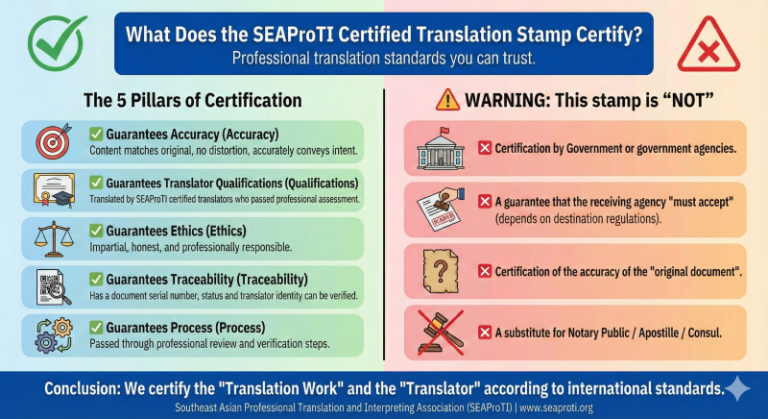
The application of a SEAProTI translation certification stamp constitutes professional attestation in three principal dimensions:
- Accuracy of the translation: The translation faithfully conveys the content and intent of the source document without distortion.
- Professional qualifications of the translator: The translator has been assessed and certified by a recognized professional association.
- Compliance with professional ethics: The translator adheres to standards of honesty, competence, and public responsibility as defined by professional ethics (Chesterman, 2001).
What SEAProTI Certification Does Not Confirm
For clarity, SEAProTI certification does not:
- Authenticate the source document
- Confirm the legal validity or legal effects of the document
- Substitute for the functions of a notary public, consular legalization, or Apostille
- Constitute certification by a state authority
These limitations are consistent with international norms governing professional, rather than governmental, certification systems (Pym, 2012).
Certification and Ethical Responsibility
The use of a translation certification stamp carries ethical implications. By certifying a translation, the translator formally accepts professional responsibility for its accuracy. Should negligence or misrepresentation result in harm, ethical and professional accountability may arise. This principle reflects the broader understanding of certification as a public declaration of responsibility, rather than a purely administrative procedure (Chesterman, 2001).
Conclusion
SEAProTI’s translation certification stamp functions as a professional mechanism that certifies translations and translators, not documents or their legal effects. Clear understanding of this distinction is essential for document users, government agencies, and translators alike. Maintaining a clear boundary between professional certification and state-based authentication enhances transparency, protects users from misunderstanding, and contributes to the advancement of translation standards at the international level.
References
- Chesterman, A. (2001). Proposal for a hierarchy of translator ethics. The Translator, 7(2), 139–154. https://doi.org/10.1080/13556509.2001.10799104
- Hale, S. (2015). The discourse of court interpreting. John Benjamins.
- House, J. (2015). Translation quality assessment: Past and present. Routledge.
- Pym, A. (2012). On translator ethics: Principles for mediation between cultures. John Benjamins.
About Certified Translators, Translation Certifiers, and Certified Interpreters of SEAProTI
The Southeast Asian Association of Professional Translators and Interpreters (SEAProTI) has formally announced the qualifications and requirements for registration of Certified Translators, Translation Certification Providers, and Certified Interpreters in Sections 9 and 10 of the Royal Gazette, published by the Secretariat of the Cabinet, Office of the Prime Minister of Thailand, on 25 July 2024 (Vol. 141, Part 66 Ng, p. 100). Certified Translators, Translation Certification Providers, and Certified Interpreters
The Council of State has proposed the enactment of a Royal Decree, granting registered translators and recognised translation certifiers from professional associations or accredited language institutions the authority to provide legally valid translation certification (Letter to SEAProTI dated April 28, 2025)
SEAProTI is the first professional association in Thailand and Southeast Asia to implement a comprehensive certification system for translators, certifiers, and interpreters.
Head Office: Baan Ratchakru Building, No. 33, Room 402, Soi Phahonyothin 5, Phahonyothin Road, Phaya Thai District, Bangkok 10400, Thailand
Email: hello@seaproti.com | Tel.: (+66) 2-114-3128 (Office hours: Mon–Fri, 09:00–17:00)
ขอบเขตและสถานะของตราประทับรับรองการแปลของสมาคมวิชาชีพนักแปลและล่ามแห่งเอเชียตะวันออกเฉียงใต้: การวิเคราะห์เชิงวิชาการด้านมาตรฐานงานแปลและการรับรองวิชาชีพ
30 ธันวาคม 2568, กรุเทพมหานคร – ตราประทับรับรองการแปล (Certified Correct Translation) เป็นกลไกสำคัญในการสร้างความน่าเชื่อถือให้แก่งานแปล โดยเฉพาะเอกสารที่ใช้ในบริบททางกฎหมาย การปกครอง และการติดต่อระหว่างประเทศ อย่างไรก็ตาม ในทางปฏิบัติยังพบความเข้าใจคลาดเคลื่อนเกี่ยวกับขอบเขตอำนาจของตราประทับดังกล่าว โดยเฉพาะการสับสนระหว่าง “การรับรองคำแปล” กับ “การรับรองเอกสาร” บทความนี้มีวัตถุประสงค์เพื่อวิเคราะห์ขอบเขตการรับรองของตราประทับที่ออกโดยสมาคมวิชาชีพนักแปลและล่ามแห่งเอเชียตะวันออกเฉียงใต้ (SEAProTI) โดยอาศัยกรอบแนวคิดด้านคุณภาพการแปล การรับรองเชิงวิชาชีพ และจรรยาบรรณนักแปล บทความชี้ให้เห็นว่า SEAProTI มีอำนาจรับรองเฉพาะ “ความถูกต้องของคำแปล” และ “คุณสมบัติทางวิชาชีพของผู้แปล” เท่านั้น มิใช่การรับรองเอกสารต้นฉบับหรือผลทางกฎหมายของเอกสารดังกล่าว
คำสำคัญ: การรับรองคำแปล, Certified Correct Translation, มาตรฐานงานแปล, การรับรองวิชาชีพ, SEAProTI
การแปลเอกสารมีบทบาทสำคัญต่อการใช้สิทธิและการปฏิบัติหน้าที่ของบุคคลในสังคมสมัยใหม่ โดยเฉพาะในกรณีที่เอกสารนั้นต้องใช้ข้ามภาษา ข้ามเขตอำนาจรัฐ และข้ามระบบกฎหมาย ความผิดพลาดในการแปลอาจนำไปสู่การตีความที่คลาดเคลื่อน การบังคับใช้กฎหมายที่ไม่ถูกต้อง หรือแม้กระทั่งข้อพิพาทระหว่างประเทศ (Hale, 2015) ด้วยเหตุนี้ กลไกการรับรองคุณภาพของงานแปลจึงถูกพัฒนาขึ้นในหลายประเทศ หนึ่งในกลไกที่ใช้กันอย่างแพร่หลายคือการรับรองคำแปลผ่านตราประทับขององค์กรวิชาชีพ
ในบริบทของประเทศไทยและภูมิภาคเอเชียตะวันออกเฉียงใต้ สมาคมวิชาชีพนักแปลและล่ามแห่งเอเชียตะวันออกเฉียงใต้ (SEAProTI) ได้กำหนดระบบตราประทับรับรองการแปลเพื่อยกระดับมาตรฐานงานแปล อย่างไรก็ตาม ยังมีความเข้าใจผิดอย่างกว้างขวางว่าตราประทับดังกล่าวเป็นการ “รับรองเอกสาร” ในเชิงกฎหมาย บทความนี้จึงมุ่งอธิบายขอบเขตที่แท้จริงของการรับรองดังกล่าวในเชิงวิชาการ
แนวคิดเรื่องการรับรองคำแปลกับการรับรองเอกสาร
ในทางทฤษฎี การรับรองคำแปล (translation certification) แตกต่างจากการรับรองเอกสาร (document authentication) อย่างมีนัยสำคัญ การรับรองคำแปลหมายถึงการยืนยันว่าเอกสารฉบับแปลถ่ายทอดเนื้อหา เจตนารมณ์ และสาระสำคัญของต้นฉบับได้อย่างถูกต้องครบถ้วน ในขณะที่การรับรองเอกสารเป็นการยืนยันสถานะ ความแท้จริง หรือผลทางกฎหมายของเอกสารต้นฉบับ ซึ่งเป็นอำนาจของรัฐหรือผู้มีอำนาจตามกฎหมาย เช่น Notary Public หรือหน่วยงานกงสุล (House, 2015)
SEAProTI จัดอยู่ในกลุ่มองค์กรวิชาชีพ มิใช่หน่วยงานรัฐ ดังนั้น อำนาจของตราประทับที่ออกโดยสมาคมจึงจำกัดอยู่ในขอบเขตของการรับรองเชิงวิชาชีพเท่านั้น
เอกสารประเภทใดที่สามารถใช้ตราประทับ SEAProTI ได้
ในทางปฏิบัติ ตราประทับของ SEAProTI สามารถใช้กับ คำแปลของเอกสารทุกประเภท หากเป็นการแปลโดยนักแปลรับรองและเป็นไปตามมาตรฐานที่สมาคมกำหนด โดยเอกสารที่พบบ่อย ได้แก่
- เอกสารทางราชการและทะเบียนราษฎร เช่น สูติบัตร ทะเบียนสมรส หนังสือเดินทาง
- เอกสารด้านการศึกษา เช่น ปริญญาบัตร ใบแสดงผลการศึกษา
- เอกสารทางกฎหมาย เช่น สัญญา คำพิพากษา หนังสือมอบอำนาจ
- เอกสารทางธุรกิจและการเงิน เช่น หนังสือรับรองบริษัท งบการเงิน
- เอกสารทางการแพทย์และสาธารณสุข เช่น ใบรับรองแพทย์ รายงานผลตรวจ
อย่างไรก็ตาม ตราประทับดังกล่าวรับรองเพียงว่า “คำแปลถูกต้องตามต้นฉบับ” มิได้ยืนยันความถูกต้อง ความแท้จริง หรือความชอบด้วยกฎหมายของเอกสารต้นฉบับ
สิ่งที่ตราประทับ SEAProTI รับรอง
การประทับตรา SEAProTI เป็นการรับรองในสามมิติหลัก ได้แก่
- ความถูกต้องของคำแปล: ยืนยันว่าคำแปลถ่ายทอดเนื้อหาได้ตรงกับต้นฉบับโดยไม่บิดเบือน
- คุณสมบัติของนักแปล: รับรองว่าผู้แปลเป็นนักแปลที่ผ่านการประเมินและได้รับการรับรองจากองค์กรวิชาชีพ
- การปฏิบัติตามจรรยาบรรณวิชาชีพ: นักแปลที่ใช้ตราประทับต้องปฏิบัติตามหลักความซื่อสัตย์ ความสามารถ และความรับผิดชอบต่อสาธารณะ (Chesterman, 2001)
สิ่งที่ตราประทับ SEAProTI ไม่รับรอง
เพื่อความเข้าใจที่ถูกต้อง ตราประทับของ SEAProTI ไม่ได้
- รับรองความถูกต้องของเอกสารต้นฉบับ เพราะเป็นหน้าที่ของวิชาชีพอื่น
- รับรองผลทางกฎหมายของเอกสาร เพราะเป็นหน้าที่ของวิชาชีพอื่น
- ทำหน้าที่แทน Notary Public, การรับรองกงสุล หรือ Apostille
- เป็นการรับรองโดยรัฐ
ข้อจำกัดดังกล่าวเป็นลักษณะปกติของการรับรองเชิงวิชาชีพในระดับสากล (Pym, 2012)
ตราประทับกับความรับผิดชอบทางจริยธรรม
การใช้ตราประทับรับรองคำแปลมีผลผูกพันเชิงจริยธรรม นักแปลต้องยอมรับความรับผิดชอบหากคำแปลก่อให้เกิดความเสียหายจากความประมาทหรือการบิดเบือนเนื้อหา หลักการนี้สอดคล้องกับแนวคิดว่าการรับรองคำแปลเป็นการประกาศความรับผิดชอบต่อสาธารณะ มิใช่เพียงขั้นตอนทางเอกสาร (Chesterman, 2001)
บทสรุป
ตราประทับรับรองการแปลของ SEAProTI เป็นกลไกเชิงวิชาชีพที่ทำหน้าที่รับรอง “คำแปล” และ “นักแปล” ไม่ใช่ “เอกสาร” หรือ “ผลทางกฎหมายของเอกสาร” ความเข้าใจที่ถูกต้องเกี่ยวกับขอบเขตดังกล่าวมีความสำคัญต่อทั้งผู้ใช้เอกสาร หน่วยงานรัฐ และนักแปลเอง การแยกความแตกต่างระหว่างการรับรองเชิงวิชาชีพกับการรับรองโดยรัฐอย่างชัดเจน จะช่วยยกระดับความโปร่งใส ความน่าเชื่อถือ และมาตรฐานของวิชาชีพการแปลในระดับสากล
เอกสารอ้างอิง
- Chesterman, A. (2001). Proposal for a hierarchy of translator ethics. The Translator, 7(2), 139–154. https://doi.org/10.1080/13556509.2001.10799104
- Hale, S. (2015). The discourse of court interpreting. John Benjamins.
- House, J. (2015). Translation quality assessment: Past and present. Routledge.
- Pym, A. (2012). On translator ethics: Principles for mediation between cultures. John Benjamins.
เกี่ยวกับนักแปลรับรอง ผู้รับรองการแปล และล่ามรับรองของสมาคมวิชาชีพนักแปลและล่ามแห่งเอเชียตะวันออกเฉียงใต้
สมาคมวิชาชีพนักแปลและล่ามแห่งเอเชียตะวันออกเฉียงใต้ (SEAProTI) ได้ประกาศหลักเกณฑ์และคุณสมบัติผู้ที่ขึ้นทะเบียนเป็น “นักแปลรับรอง (Certified Translators) และผู้รับรองการแปล (Translation Certification Providers) และล่ามรับรอง (Certified Interpreters)” ของสมาคม หมวดที่ 9 และหมวดที่ 10 ในราชกิจจานุเบกษา ของสำนักเลขาธิการคณะรัฐมนตรี ในสำนักนายกรัฐมนตรี แห่งราชอาณาจักรไทย ลงวันที่ 25 ก.ค. 2567 เล่มที่ 141 ตอนที่ 66 ง หน้า 100 อ่านฉบับเต็มได้ที่: นักแปลรับรอง ผู้รับรองการแปล และล่ามรับรอง
สำนักคณะกรรมการกฤษฎีกา เสนอให้ตราเป็นพระราชกฤษฎีกา โดยกำหนดให้นักแปลที่ขึ้นทะเบียน รวมถึงผู้รับรองการแปลจากสมาคมวิชาชีพหรือสถาบันสอนภาษาที่มีการอบรมและขึ้นทะเบียน สามารถรับรองคำแปลได้ (จดหมายถึงสมาคม SEAProTI ลงวันที่ 28 เม.ย. 2568)
สมาคมวิชาชีพนักแปลและล่ามแห่งเอเชียตะวันออกเฉียงใต้ เป็นสมาคมวิชาชีพแห่งแรกและแห่งเดียวในประเทศไทยและภูมิภาคเอเชียตะวันออกเฉียงใต้ที่มีระบบรับรองนักแปลรับรอง ผู้รับรองการแปล และล่ามรับรอง
สำนักงานใหญ่: อาคารบ้านราชครู เลขที่ 33 ห้อง 402 ซอยพหลโยธิน 5 ถนนพหลโยธิน แขวงพญาไท เขตพญาไท กรุงเทพมหานคร 10400 ประเทศไทย
อีเมล: hello@seaproti.com โทรศัพท์: (+66) 2-114-3128 (เวลาทำการ: วันจันทร์–วันศุกร์ เวลา 09.00–17.00 น.