



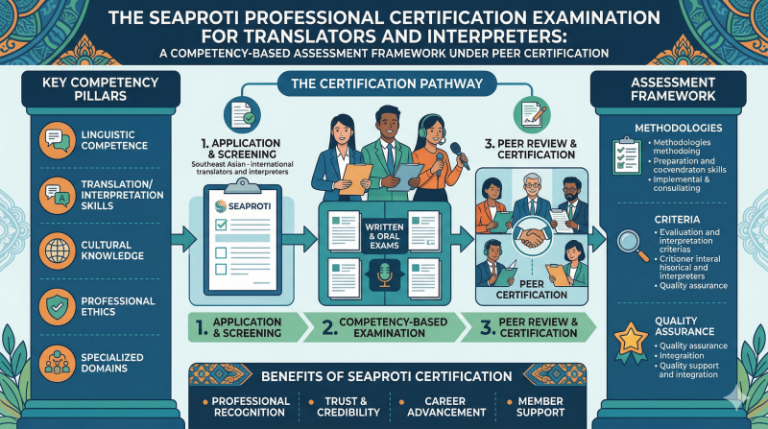
The SEAProTI Professional Certification Examination for Translators and Interpreters:
A Competency-Based Assessment Framework under Peer Certification
10 April 2026, Bangkok – The professionalization of translation and interpreting in a globalized context requires an assessment system that reflects real-world performance rather than merely measuring linguistic proficiency in isolation. The Southeast Asian Association of Professional Translators and Interpreters (SEAProTI) has therefore developed a certification examination framework grounded in the principle of Peer Certification, whereby candidates are evaluated by experts within the same professional community. This approach emphasizes professional standards, accountability, and credibility, aligning with international practices in regulated professions.
The structure of the SEAProTI examination is integrative, combining theoretical knowledge with practical performance. It consists of two principal components: an analytical written examination and a document translation examination. The analytical written component, which accounts for forty percent of the total score, requires candidates to complete a case-based essay within a three-hour timeframe. The content covers general knowledge of translation, professional ethics, and relevant legal frameworks governing translation and interpreting practice. This component is not designed to test rote memorization but rather to assess candidates’ critical thinking abilities and their capacity to apply theoretical knowledge to real professional scenarios. Such competencies are essential for translators who must operate responsibly in high-stakes communicative contexts.
The second component, accounting for sixty percent of the total score, is the document translation examination. Candidates are required to translate texts from one language into another based on prescribed materials. The examination texts are carefully curated to represent a range of professional domains, including civil and criminal law, medicine and public health, labor and business, and intellectual property. Each text does not exceed 150 words, ensuring that the focus remains on translation quality rather than volume. This design reflects SEAProTI’s intention to simulate real-world translation tasks, where professionals must accurately convey meaning across specialized and high-risk subject areas.
SEAProTI employs a competency-based assessment framework that focuses on three core dimensions: comprehension of the source text, accuracy of meaning transfer, and appropriateness of language in the target context. Comprehension is evaluated based on the candidate’s ability to fully and correctly interpret the source text, avoiding overly literal, word-for-word translations that may distort meaning. Accuracy involves the complete and precise transfer of meaning, including both explicit and implicit content, with particular emphasis on avoiding omissions, additions, or semantic distortions. Errors in this dimension are considered critical and carry significant penalties. Appropriateness of language refers to the candidate’s ability to adapt tone, register, and style to suit the purpose of the text and the expectations of the target audience, demonstrating pragmatic and contextual awareness.
A defining feature of the SEAProTI examination is its reliance on peer evaluation by experienced professionals within the field. This approach addresses the limitations of standardized testing models that may fail to capture the complexity of real translation practice. Peer assessment allows for nuanced judgment regarding translation quality and distinguishes clearly between the ability to “translate” and the ability to “translate professionally.” Furthermore, it functions as a mechanism of professional self-regulation, reinforcing standards from within the community and ensuring alignment with international norms.
In conclusion, the SEAProTI certification examination serves not merely as a selection mechanism but as a comprehensive system for establishing and maintaining professional standards in translation and interpreting. By emphasizing competency-based assessment and peer certification, the examination ensures that certified professionals possess not only linguistic proficiency but also the critical judgment, ethical awareness, and contextual sensitivity required in high-stakes environments. In contexts where language can function as evidence and influence legal, economic, and social outcomes, such a rigorous certification system is essential to ensuring accuracy, reliability, and professional accountability in all aspects of linguistic practice.
For professional services, please visit: https://www.seaproti.org/practitioners/
About certified translators, translation certifiers, and certified interpreters associated with SEAProTI.
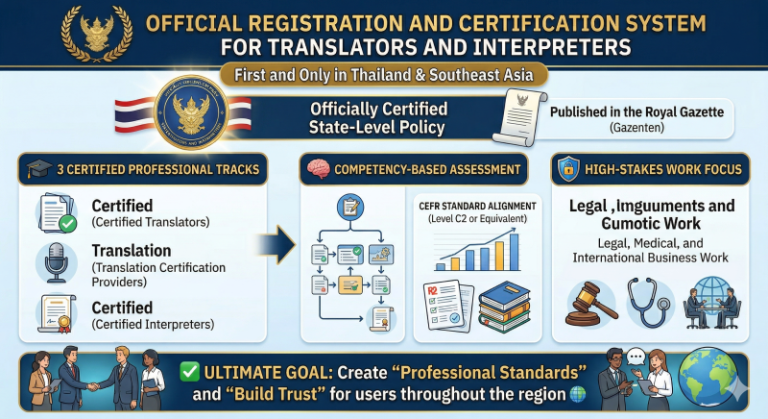
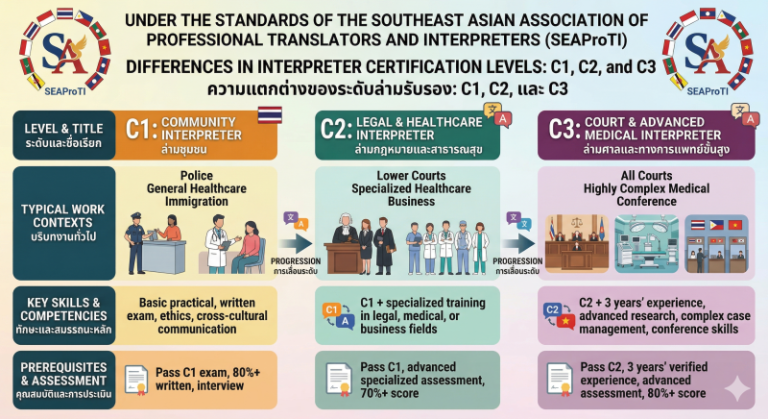
The Southeast Asian Association of Professional Translators and Interpreters (SEAProTI) has officially shared the qualifications and requirements for becoming Certified Translators, Translation Certification Providers, and Certified Interpreters in Sections 9 and 10 of the Royal Gazette, which was published by the Prime Minister’s Office in Thailand on July 25, 2024. Certified Translators, Translation Certification Providers, and Certified Interpreters
The Council of State has proposed the enactment of a Royal Decree, granting registered translators and recognised translation certifiers from professional associations or accredited language institutions the authority to provide legally valid translation certification (Letter to SEAProTI dated April 28, 2025)
SEAProTI is the first professional association in Thailand and Southeast Asia to implement a comprehensive certification system for translators, certifiers, and interpreters.
Head Office: Baan Ratchakru Building, No. 33, Room 402, Soi Phahonyothin 5, Phahonyothin Road, Phaya Thai District, Bangkok 10400, Thailand
Email: hello@seaproti.com | Tel.: (+66) 2-114-3128 (Office hours: Mon–Fri, 09:00–17:00).
การสอบเพื่อการรับรองวิชาชีพนักแปลและล่ามของ SEAProTI: กรอบการประเมินเชิงสมรรถนะภายใต้ระบบ Peer Certification
10 เมษายน 2569, กรุงเทพมหานคร – การยกระดับวิชาชีพนักแปลและล่ามในบริบทสากลจำเป็นต้องอาศัยระบบการประเมินที่สะท้อนความสามารถในการปฏิบัติงานจริงมากกว่าการวัดทักษะทางภาษาเพียงมิติเดียว สมาคมวิชาชีพนักแปลและล่ามแห่งเอเชียตะวันออกเฉียงใต้ (SEAProTI) จึงพัฒนาระบบการสอบเพื่อการขึ้นทะเบียนนักแปลและล่ามวิชาชีพโดยยึดหลักการรับรองคุณวุฒิโดยผู้มีความรู้เสมอกัน (Peer Certification) ซึ่งเป็นแนวทางที่ให้ความสำคัญกับการประเมินโดยผู้เชี่ยวชาญในสายวิชาชีพเดียวกัน อันเป็นกลไกสำคัญในการรักษามาตรฐานและความน่าเชื่อถือของวิชาชีพในระดับสากล
โครงสร้างการสอบของ SEAProTI ถูกออกแบบในลักษณะบูรณาการระหว่างความรู้เชิงทฤษฎีและทักษะเชิงปฏิบัติ โดยแบ่งออกเป็นสองส่วนหลัก ได้แก่ การสอบข้อเขียนเชิงวิเคราะห์และการสอบแปลเอกสาร ในส่วนของข้อเขียนเชิงวิเคราะห์ซึ่งมีสัดส่วนร้อยละสี่สิบของคะแนนรวม ผู้เข้าสอบต้องวิเคราะห์กรณีศึกษาภายใต้กรอบเวลา 3 ชั่วโมง เนื้อหาครอบคลุมองค์ความรู้ทั่วไปเกี่ยวกับการแปล หลักจรรยาบรรณวิชาชีพ ตลอดจนกฎหมายที่เกี่ยวข้องกับงานแปลและล่าม การสอบในส่วนนี้มิได้มุ่งวัดความสามารถในการจดจำข้อมูล หากแต่เน้นการประเมินกระบวนการคิดเชิงวิพากษ์ (critical thinking) และความสามารถในการเชื่อมโยงองค์ความรู้กับบริบทวิชาชีพจริง ซึ่งเป็นคุณลักษณะสำคัญของนักแปลมืออาชีพที่ต้องรับผิดชอบต่อผลลัพธ์ของการสื่อสารในระดับสูง
ในส่วนของการสอบแปลเอกสารซึ่งมีสัดส่วนร้อยละหกสิบ ผู้เข้าสอบจะต้องแปลข้อความจากภาษาหนึ่งไปยังอีกภาษาหนึ่งตามที่กำหนด โดยเนื้อหาที่ใช้ในการสอบถูกออกแบบให้ครอบคลุมหลากหลายสาขาวิชาชีพ อาทิ กฎหมายแพ่งและอาญา การแพทย์และสาธารณสุข แรงงาน ธุรกิจ และทรัพย์สินทางปัญญา ข้อความแต่ละชุดมีความยาวไม่เกิน 150 คำ เพื่อควบคุมตัวแปรด้านเวลาและเน้นการประเมินคุณภาพของการถ่ายทอดความหมายมากกว่าปริมาณงาน การออกแบบข้อสอบในลักษณะนี้สะท้อนให้เห็นถึงความพยายามของ SEAProTI ในการจำลองสถานการณ์การทำงานจริงที่นักแปลต้องเผชิญ ซึ่งมักเกี่ยวข้องกับเนื้อหาที่มีความเฉพาะทางและมีความเสี่ยงสูงต่อความคลาดเคลื่อน
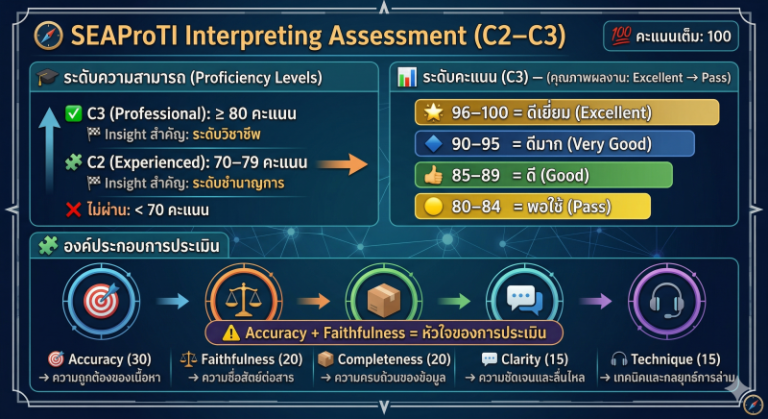
เกณฑ์การประเมินผลของ SEAProTI มีลักษณะเป็นการประเมินเชิงสมรรถนะ (competency-based assessment) โดยมุ่งเน้นสามองค์ประกอบหลัก ได้แก่ ความเข้าใจต้นฉบับ ความถูกต้องในการถ่ายทอดความหมาย และความเหมาะสมของภาษาในบริบทเป้าหมาย ความเข้าใจต้นฉบับถูกพิจารณาในแง่ของความสามารถในการตีความสารอย่างครบถ้วนและถูกต้อง โดยหลีกเลี่ยงการแปลแบบคำต่อคำที่อาจนำไปสู่การบิดเบือนความหมาย ในขณะที่ความถูกต้องในการถ่ายทอดความหมายครอบคลุมทั้งความสมบูรณ์ของเนื้อหาและความเที่ยงตรงเชิงความหมาย ทั้งในระดับถ้อยคำและนัยแฝง ซึ่งข้อผิดพลาดในมิตินี้ถือเป็นความผิดพลาดเชิงวิกฤตที่ส่งผลต่อคะแนนอย่างมีนัยสำคัญ ส่วนความเหมาะสมของภาษาเน้นการใช้ถ้อยคำและโทนภาษาให้สอดคล้องกับวัตถุประสงค์ของข้อความและกลุ่มผู้อ่านเป้าหมาย ซึ่งสะท้อนถึงความสามารถในการปรับใช้ภาษาอย่างมีวิจารณญาณ
ลักษณะเด่นที่สำคัญของการสอบ SEAProTI คือการใช้ระบบการประเมินโดยผู้เชี่ยวชาญในวิชาชีพเดียวกัน ซึ่งช่วยลดข้อจำกัดของการประเมินแบบมาตรฐานทั่วไปที่อาจไม่สามารถสะท้อนความซับซ้อนของงานแปลในสถานการณ์จริงได้ การประเมินโดยผู้เชี่ยวชาญทำให้เกณฑ์การตัดสินมีความละเอียดอ่อนต่อคุณภาพของงาน และสามารถแยกแยะความแตกต่างระหว่าง “การแปลได้” กับ “การแปลเป็น” ได้อย่างชัดเจน นอกจากนี้ยังเป็นการสร้างกลไกการควบคุมคุณภาพภายในวิชาชีพ (professional self-regulation) ที่สอดคล้องกับแนวปฏิบัติในระดับนานาชาติ
กล่าวโดยสรุป การสอบเพื่อการรับรองวิชาชีพของ SEAProTI มิได้เป็นเพียงเครื่องมือในการคัดเลือกบุคลากร แต่เป็นระบบที่ออกแบบมาเพื่อกำหนดมาตรฐานของวิชาชีพนักแปลและล่ามในมิติที่ครอบคลุมทั้งความรู้ ทักษะ และจริยธรรม การเน้นการประเมินเชิงสมรรถนะร่วมกับการใช้กลไก peer certification ทำให้การรับรองดังกล่าวมีความน่าเชื่อถือและสามารถตอบสนองต่อความต้องการของตลาดงานที่มีความซับซ้อนและมีความเสี่ยงสูงได้อย่างมีประสิทธิภาพ ในบริบทที่ภาษาเป็นปัจจัยสำคัญในการตัดสินใจทางกฎหมาย เศรษฐกิจ และสังคม ระบบการสอบลักษณะนี้จึงมีบทบาทอย่างยิ่งในการสร้างความมั่นใจว่าผู้ประกอบวิชาชีพสามารถปฏิบัติงานได้อย่างถูกต้อง แม่นยำ และรับผิดชอบต่อผลกระทบที่อาจเกิดขึ้นจากการใช้ภาษาในทุกระดับของการสื่อสาร
ติดต่อขอใช้บริการนักวิชาชีพของสมาคมได้ที่: https://www.seaproti.org/practitioners/
สมาคมวิชาชีพนักแปลและล่ามแห่งเอเชียตะวันออกเฉียงใต้ (SEAProTI) ได้ประกาศหลักเกณฑ์และคุณสมบัติของผู้ที่ขึ้นทะเบียนเป็น “นักแปลรับรอง (Certified Translators) และผู้รับรองการแปล (Translation Certification Providers) และล่ามรับรอง (Certified Interpreters)” ของสมาคม หมวดที่ 9 และหมวดที่ 10 ในราชกิจจานุเบกษา ของสำนักเลขาธิการคณะรัฐมนตรี ในสำนักนายกรัฐมนตรี แห่งราชอาณาจักรไทย ลงวันที่ 25 ก.ค. 2567 เล่มที่ 141 ตอนที่ 66 ง หน้า 100 อ่านฉบับเต็มได้ที่: นักแปลรับรอง ผู้รับรองการแปล และล่ามรับรอง
สำนักคณะกรรมการกฤษฎีกาเสนอให้ตราเป็นพระราชกฤษฎีกา โดยกำหนดให้นักแปลที่ขึ้นทะเบียน รวมถึงผู้รับรองการแปลจากสมาคมวิชาชีพหรือสถาบันสอนภาษาที่มีการอบรมและขึ้นทะเบียน สามารถรับรองคำแปลได้ (จดหมายถึงสมาคม SEAProTI ลงวันที่ 28 เม.ย. 2568)
สมาคมวิชาชีพนักแปลและล่ามแห่งเอเชียตะวันออกเฉียงใต้เป็นสมาคมวิชาชีพแห่งแรกและแห่งเดียวในประเทศไทยและภูมิภาคเอเชียตะวันออกเฉียงใต้ที่มีระบบรับรองนักแปลรับรอง ผู้รับรองการแปล และล่ามรับรอง
สำนักงานใหญ่: อาคารบ้านราชครู เลขที่ 33 ห้อง 402 ซอยพหลโยธิน 5 ถนนพหลโยธิน แขวงพญาไท เขตพญาไท กรุงเทพมหานคร 10400 ประเทศไทย
อีเมล: hello@seaproti.com โทรศัพท์: (+66) 2-114-3128 (เวลาทำการ: วันจันทร์–วันศุกร์ เวลา 09.00–17.00 น.