


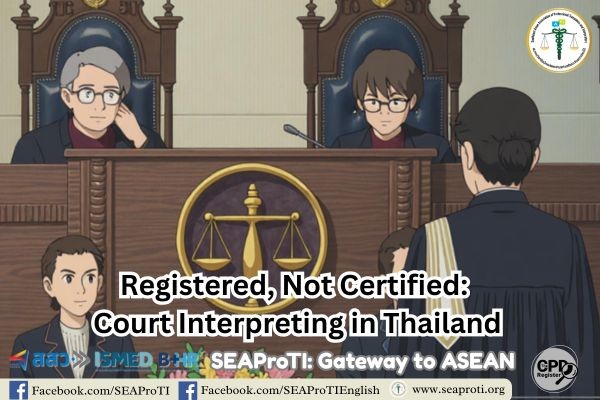
Thailand Has No “Certified Court Interpreters”: A Misconception Undermining Rights and the Justice System
29 December 2025, Bangkok — In judicial proceedings, words are not merely tools of communication; they are mechanisms for safeguarding rights, freedoms, and human dignity. This is particularly evident in cases where parties are unable to use the language of the court effectively. In such contexts, court interpreting is not a technical auxiliary function but a structural component of the rule of law and the principle of due process of law.
However, in Thailand, the term “court interpreter” is frequently used interchangeably with “certified court interpreter.” This usage appears widely in media discourse, institutional communications, and even within the justice system itself. Such terminology creates the impression that Thailand operates a court interpreter certification system aligned with international professional standards. In reality, Thailand has no certification or licensing system for court interpreters in either a legal or institutional sense.
This article aims to clarify the actual status of court interpreters in Thailand, to analyse the structural differences between registered court interpreters and certified court interpreters, and to examine the consequences of terminological misuse for the rights of litigants, the credibility of the justice system, and Thailand’s international human rights obligations.
The Status of Court Interpreters in Thailand: Registration Without Certification
The current court interpreting system in Thailand is based on a mechanism of “registration” with the courts. This entails the courts maintaining a list of individuals who may be called upon to provide interpreting services at the court’s discretion. Such registration is an administrative procedure rather than the issuance of a professional licence, and it does not constitute certification of competence under a nationally standardised competency framework.
Interpreters within this system may vary significantly in background, skill level, professional experience, and ethical awareness. There is no centralised examination system, no systematic professional competency assessment, and no long-term regulatory or disciplinary framework. Consequently, the status of a registered court interpreter amounts merely to being a person whom the court may engage, rather than a professional whose competence has been formally certified by the state according to specialised professional standards.
Certified Court Interpreters: A Framework Absent in Thailand
In jurisdictions that genuinely operate certified court interpreter systems, such as the United States, Australia, and certain European Union member states, the term “certified” carries a precise legal and professional meaning. Court interpreters are required to pass standardised national or state-level examinations, meet clearly defined competency benchmarks in accuracy, impartiality, legal knowledge, and professional ethics, and operate within regulatory frameworks that include complaint mechanisms and the possibility of suspension or revocation for professional misconduct.
These systems reflect institutional recognition that court interpreting is a specialised profession with direct and substantial implications for the protection of procedural rights, rather than a general linguistic skill. As such, the designation “certified court interpreter” represents a legal and institutional status, not merely a qualitative description.
Thailand lacks this structural framework. There is no specific legislation establishing court interpreter standards, no national certification or licensing examinations, and no legally empowered professional body responsible for regulating court interpreters. Accordingly, the use of the term “certified court interpreter” in the Thai context is inconsistent with structural and legal realities.
The Impact of Terminological Misuse on Rights and Justice
Referring to registered court interpreters as “certified” is not simply a linguistic inaccuracy; it generates systemic consequences. First, it misleads litigants and the public into believing that all court interpreters operate under uniform professional standards, when no such certification system exists. Second, it undermines transparency and accountability, as individuals adversely affected by interpreting errors have no clear professional standards or regulatory mechanisms against which to assess responsibility.
Most critically, these consequences pose risks to the principle of due process of law, particularly in criminal proceedings, cases involving foreign nationals, and human rights-related cases. In such proceedings, the right to understand the charges, to participate meaningfully in one’s defence, and to engage effectively in judicial processes constitutes a fundamental right under the International Covenant on Civil and Political Rights.
When the state lacks an internationally compliant court interpreter certification system yet employs terminology that implies its existence, a gap emerges between appearance and reality. This gap exposes Thailand’s justice system to scrutiny by foreign governments, international organisations, and diplomatic missions.
Conclusion
This article demonstrates that Thailand operates only a system of registered court interpreters and does not have certified court interpreters in the legal or professional sense. The use of the term “certified” in reference to Thai court interpreters is therefore inaccurate and has structural implications for litigants’ rights and the credibility of the justice system.
Acknowledging this reality does not diminish the value of court interpreters. Rather, it provides a necessary foundation for transparent, honest, and internationally aligned system development. Only through such recognition can court interpreting function as a genuine mechanism for safeguarding rights, rather than a ceremonial accessory within judicial proceedings.
References
- Hale, S. B. (2007). Community interpreting. Palgrave Macmillan.
- Mikkelson, H. (2016). Introduction to court interpreting (2nd ed.). Routledge.
- Pöchhacker, F. (2016). Introducing interpreting studies (2nd ed.). Routledge.
- United Nations. (1966). International Covenant on Civil and Political Rights. United Nations.
- Wadensjö, C. (1998). Interpreting as interaction. Longman.
- Office of the Judiciary. (2022). Announcement of the Office of the Judiciary on the registration of court interpreters for the Fiscal Year B.E. 2565 (2022).
About Certified Translators, Translation Certifiers, and Certified Interpreters of SEAProTI
The Southeast Asian Association of Professional Translators and Interpreters (SEAProTI) has formally announced the qualifications and requirements for registration of Certified Translators, Translation Certification Providers, and Certified Interpreters in Sections 9 and 10 of the Royal Gazette, published by the Secretariat of the Cabinet, Office of the Prime Minister of Thailand, on 25 July 2024 (Vol. 141, Part 66 Ng, p. 100). Certified Translators, Translation Certification Providers, and Certified Interpreters
The Council of State has proposed the enactment of a Royal Decree, granting registered translators and recognised translation certifiers from professional associations or accredited language institutions the authority to provide legally valid translation certification (Letter to SEAProTI dated April 28, 2025)
SEAProTI is the first professional association in Thailand and Southeast Asia to implement a comprehensive certification system for translators, certifiers, and interpreters.
Head Office: Baan Ratchakru Building, No. 33, Room 402, Soi Phahonyothin 5, Phahonyothin Road, Phaya Thai District, Bangkok 10400, Thailand
Email: hello@seaproti.com | Tel.: (+66) 2-114-3128 (Office hours: Mon–Fri, 09:00–17:00)
ประเทศไทยไม่มี “Certified Court Interpreters” : ความเข้าใจผิดเรื่องล่ามศาลที่กระทบสิทธิและกระบวนการยุติธรรม
29 ธันวาคม 2568, กรุงเทพมหานคร – ในกระบวนการยุติธรรม คำพูดไม่ใช่เพียงเครื่องมือสื่อสาร หากแต่เป็นกลไกในการคุ้มครองสิทธิ เสรีภาพ และศักดิ์ศรีความเป็นมนุษย์ โดยเฉพาะอย่างยิ่งในคดีที่คู่ความไม่สามารถใช้ภาษาของศาลได้อย่างมีประสิทธิภาพ บทบาทของล่ามศาลจึงมิใช่บทบาททางเทคนิค หากแต่เป็นองค์ประกอบเชิงโครงสร้างของหลักนิติธรรม (rule of law) และหลักการพิจารณาคดีอย่างเป็นธรรม (due process of law)
อย่างไรก็ตาม ในบริบทของประเทศไทย คำว่า “ล่ามศาล” มักถูกใช้ควบคู่กับคำว่า “ล่ามรับรอง” หรือ Certified Court Interpreter อย่างแพร่หลาย ทั้งในสื่อ การสื่อสารของหน่วยงาน และแม้แต่ในกระบวนการยุติธรรมเอง ความเข้าใจดังกล่าวสร้างภาพว่าประเทศไทยมีระบบการรับรองล่ามศาลตามมาตรฐานวิชาชีพสากล ทั้งที่ในความเป็นจริง ประเทศไทยยังไม่มีระบบ certification หรือ licensing สำหรับล่ามศาลในความหมายเชิงกฎหมายหรือเชิงสถาบัน
บทความนี้มีวัตถุประสงค์เพื่ออธิบายสถานะที่แท้จริงของล่ามศาลในประเทศไทย วิเคราะห์ความแตกต่างระหว่างระบบ registered court interpreters กับ certified court interpreters ในเชิงโครงสร้าง และพิจารณาผลกระทบของการใช้คำคลาดเคลื่อนต่อสิทธิของคู่ความ ความน่าเชื่อถือของกระบวนการยุติธรรม และพันธกรณีด้านสิทธิมนุษยชนระหว่างประเทศของรัฐไทย
สถานะของล่ามศาลในประเทศไทย: การขึ้นทะเบียนโดยปราศจากการรับรอง
ระบบล่ามศาลของประเทศไทยในปัจจุบันตั้งอยู่บนกลไกการ “ขึ้นทะเบียนรายชื่อ” กับศาล ซึ่งหมายถึงการที่ศาลบันทึกรายชื่อบุคคลที่สามารถเรียกใช้งานเป็นล่ามได้ตามดุลยพินิจของศาล การขึ้นทะเบียนดังกล่าวเป็นกระบวนการเชิงธุรการ มิใช่การออกใบอนุญาตประกอบวิชาชีพ และมิใช่การรับรองความสามารถตามกรอบสมรรถนะที่เป็นมาตรฐานเดียวกันทั่วประเทศ
ล่ามที่อยู่ในระบบนี้อาจมีพื้นฐาน ทักษะ ประสบการณ์ และความเข้าใจด้านจริยธรรมที่แตกต่างกันอย่างมาก โดยไม่มีระบบการสอบกลาง การประเมินความสามารถเชิงวิชาชีพอย่างเป็นระบบ หรือกลไกการกำกับดูแลทางจริยธรรมในระยะยาว สถานะของล่ามศาลในระบบดังกล่าวจึงเป็นเพียง “ผู้ที่ศาลสามารถเรียกใช้ได้” มิใช่ “ผู้ที่รัฐรับรองว่ามีคุณสมบัติตามมาตรฐานวิชาชีพเฉพาะทาง”
Certified Court Interpreters: กรอบแนวคิดที่ประเทศไทยยังไม่มี
ในประเทศที่มีระบบ certified court interpreters อย่างแท้จริง เช่น สหรัฐอเมริกา ออสเตรเลีย หรือบางประเทศในสหภาพยุโรป คำว่า “certified” มีความหมายเฉพาะเจาะจงในเชิงกฎหมายและวิชาชีพ ล่ามศาลต้องผ่านการสอบมาตรฐานระดับชาติหรือระดับรัฐ มีกรอบสมรรถนะที่ชัดเจนด้านความถูกต้อง ความเป็นกลาง ความรู้ทางกฎหมาย และจริยธรรมวิชาชีพ และอยู่ภายใต้ระบบการกำกับดูแล การร้องเรียน และการเพิกถอนสิทธิหากฝ่าฝืนมาตรฐาน
ระบบดังกล่าวสะท้อนการยอมรับว่าการล่ามในศาลเป็นวิชาชีพเฉพาะทางที่มีผลโดยตรงต่อสิทธิในกระบวนการยุติธรรม มิใช่เพียงทักษะทางภาษาโดยทั่วไป ความแตกต่างนี้ทำให้คำว่า certified court interpreter เป็นสถานะทางกฎหมายและสถาบัน ไม่ใช่เพียงคำอธิบายเชิงคุณค่า
ประเทศไทยยังไม่มีโครงสร้างดังกล่าว ไม่มีกฎหมายเฉพาะที่กำหนดมาตรฐานล่ามศาล ไม่มีระบบสอบหรือออกใบอนุญาต และไม่มีองค์กรกำกับดูแลล่ามศาลในฐานะวิชาชีพที่มีอำนาจตามกฎหมาย การใช้คำว่า certified court interpreter กับล่ามศาลในประเทศไทยจึงเป็นการใช้คำที่ไม่สอดคล้องกับข้อเท็จจริงเชิงโครงสร้าง
ผลกระทบของการใช้คำคลาดเคลื่อนต่อสิทธิและความยุติธรรม
การเรียกล่ามศาลที่ขึ้นทะเบียนว่าเป็น “ล่ามรับรอง” หรือ certified ไม่ใช่เพียงความผิดพลาดทางภาษาศาสตร์ หากแต่ก่อให้เกิดผลกระทบเชิงระบบ ประการแรก คือการสร้างความเข้าใจผิดแก่คู่ความและสาธารณชนว่าล่ามทุกคนในศาลมีมาตรฐานเดียวกัน ทั้งที่ในความเป็นจริงไม่มีระบบรับรองความสามารถดังกล่าว ประการที่สอง คือการลดทอนความโปร่งใสและความรับผิดชอบ เมื่อเกิดข้อผิดพลาดในการล่าม ผู้เสียหายไม่สามารถอ้างอิงกรอบมาตรฐานหรือกลไกกำกับดูแลทางวิชาชีพได้อย่างชัดเจน
ที่สำคัญที่สุด ผลกระทบดังกล่าวสะท้อนถึงความเสี่ยงต่อหลัก due process of law โดยเฉพาะในคดีอาญา คดีที่มีชาวต่างชาติเกี่ยวข้อง และคดีด้านสิทธิมนุษยชน ซึ่งสิทธิในการเข้าใจข้อกล่าวหา การต่อสู้คดี และการมีส่วนร่วมอย่างมีความหมายในกระบวนการพิจารณา เป็นสิทธิขั้นพื้นฐานตามกติการะหว่างประเทศว่าด้วยสิทธิพลเมืองและสิทธิทางการเมือง
เมื่อรัฐยังไม่มีระบบรับรองล่ามศาลตามมาตรฐานสากล แต่กลับใช้ถ้อยคำที่สื่อถึงการรับรองดังกล่าวโดยปริยาย ย่อมก่อให้เกิดช่องว่างระหว่างภาพลักษณ์กับความเป็นจริง และทำให้กระบวนการยุติธรรมของไทยตกอยู่ภายใต้การตั้งคำถามจากนานาประเทศ หน่วยงานระหว่างประเทศ และสถานทูตต่างชาติ
บทสรุป
บทความนี้ชี้ให้เห็นอย่างชัดเจนว่า ประเทศไทยมีเพียงระบบ registered court interpreters แต่ยังไม่มี certified court interpreters ในความหมายเชิงกฎหมายและวิชาชีพ การใช้คำว่า “ล่ามรับรอง” หรือ certified กับล่ามศาลไทยจึงเป็นการใช้คำที่คลาดเคลื่อนและมีผลกระทบเชิงโครงสร้างต่อสิทธิของคู่ความและความน่าเชื่อถือของกระบวนการยุติธรรม
การยอมรับข้อเท็จจริงดังกล่าวมิใช่การลดทอนคุณค่าของล่ามศาล หากแต่เป็นจุดเริ่มต้นของการพัฒนาระบบอย่างตรงไปตรงมา โปร่งใส และสอดคล้องกับมาตรฐานสากล เพื่อให้การสื่อสารในศาลทำหน้าที่เป็นกลไกคุ้มครองสิทธิอย่างแท้จริง มิใช่เพียงขั้นตอนประกอบพิธีของกระบวนการยุติธรรม
อ้างอิง:
- Hale, S. B. (2007). Community interpreting. Palgrave Macmillan.
- Mikkelson, H. (2016). Introduction to court interpreting (2nd ed.). Routledge.
- Pöchhacker, F. (2016). Introducing interpreting studies (2nd ed.). Routledge.
- United Nations. (1966). International Covenant on Civil and Political Rights. United Nations.
- Wadensjö, C. (1998). Interpreting as interaction. Longman.
- ประกาศสำนักงานศาลยุติธรรม เรื่อง การขอขึ้นทะเบียนล่ามของสำนักงานศาลยุติธรรม ประจำปีงบประมาณ พ.ศ. ๒๕๖๕
เกี่ยวกับนักแปลรับรอง ผู้รับรองการแปล และล่ามรับรองของสมาคมวิชาชีพนักแปลและล่ามแห่งเอเชียตะวันออกเฉียงใต้
สมาคมวิชาชีพนักแปลและล่ามแห่งเอเชียตะวันออกเฉียงใต้ (SEAProTI) ได้ประกาศหลักเกณฑ์และคุณสมบัติผู้ที่ขึ้นทะเบียนเป็น “นักแปลรับรอง (Certified Translators) และผู้รับรองการแปล (Translation Certification Providers) และล่ามรับรอง (Certified Interpreters)” ของสมาคม หมวดที่ 9 และหมวดที่ 10 ในราชกิจจานุเบกษา ของสำนักเลขาธิการคณะรัฐมนตรี ในสำนักนายกรัฐมนตรี แห่งราชอาณาจักรไทย ลงวันที่ 25 ก.ค. 2567 เล่มที่ 141 ตอนที่ 66 ง หน้า 100 อ่านฉบับเต็มได้ที่: นักแปลรับรอง ผู้รับรองการแปล และล่ามรับรอง
สำนักคณะกรรมการกฤษฎีกา เสนอให้ตราเป็นพระราชกฤษฎีกา โดยกำหนดให้นักแปลที่ขึ้นทะเบียน รวมถึงผู้รับรองการแปลจากสมาคมวิชาชีพหรือสถาบันสอนภาษาที่มีการอบรมและขึ้นทะเบียน สามารถรับรองคำแปลได้ (จดหมายถึงสมาคม SEAProTI ลงวันที่ 28 เม.ย. 2568)
สมาคมวิชาชีพนักแปลและล่ามแห่งเอเชียตะวันออกเฉียงใต้ เป็นสมาคมวิชาชีพแห่งแรกและแห่งเดียวในประเทศไทยและภูมิภาคเอเชียตะวันออกเฉียงใต้ที่มีระบบรับรองนักแปลรับรอง ผู้รับรองการแปล และล่ามรับรอง
สำนักงานใหญ่: อาคารบ้านราชครู เลขที่ 33 ห้อง 402 ซอยพหลโยธิน 5 ถนนพหลโยธิน แขวงพญาไท เขตพญาไท กรุงเทพมหานคร 10400 ประเทศไทย
อีเมล: hello@seaproti.com โทรศัพท์: (+66) 2-114-3128 (เวลาทำการ: วันจันทร์–วันศุกร์ เวลา 09.00–17.00 น.