



Recommended Translation Rates for 2026: A Professional, Labor-Economic, and Ethical Analysis of Freelance Translation Practice
Translation Rates as a Mechanism for Professional Quality Regulation
Translation rates are not merely economic figures. Rather, they function as a structural mechanism that reflects professional standards, levels of responsibility, and the overall quality of translation practice within the contemporary labor market. The establishment of recommended rates for freelance translators who genuinely practice the profession, therefore, plays a crucial role in balancing translation quality, fairness toward practitioners, and the expectations of service users.
The 2026 recommended translation rates are designed within this conceptual framework. Their primary objective is the professional elevation of translation practice, rather than participation in price competition that undermines the value of linguistic labor.
Document Standards: Establishing a Systematic Basis for Comparison
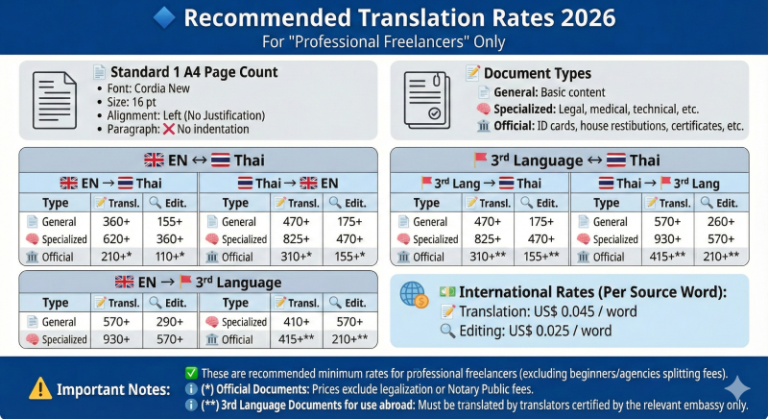
The recommended rates are grounded in a unified document standard in order to avoid ambiguity and interpretive flexibility that may lead to downward price pressure. The standard specification is as follows:
one A4 page, Cordia New font, size 16, no margin compression, and no line spacing reduction.
This technical standard is professionally significant because it ensures that remuneration corresponds to actual workload, rather than to rough estimates or subjective perceptions of effort.
Document Classification: Differentiation in Knowledge and Responsibility
The rate structure classifies documents into three principal categories: general documents, specialized documents, and official/government documents.
This classification is based on an academic assumption that translation difficulty is not determined by language alone, but rather by the level of subject-matter expertise required, legal risk exposure, and the potential consequences of error. Specialized and official documents, therefore, command significantly higher rates.
Rate Differentiation by Language Pair: Language as Human Capital
The structure of the recommended rates reflects labor-economic perspectives that conceptualize language as human capital. Empirical patterns show that Thai-to-English (TH→EN) translation is systematically priced higher than English-to-Thai (EN→TH) translation. Similarly, work involving third languages commands higher rates due to the limited availability of qualified professionals, grammatical and structural complexity, and international usage contexts.
These patterns align with actual labor market conditions and help correct the misconception that all language pairs should be priced identically.
Revision Work: A Professionally Undervalued Role
Revision services are clearly assigned rates separate from translation work, reflecting professional recognition that revision is not a secondary task but a core quality assurance process. Effective revision requires advanced linguistic competence, subject-matter expertise, and ethical responsibility.
Systematic rate-setting for revision helps counter the common misconception that revision is merely a superficial proofreading exercise.
Official Documents: Distinguishing Translation from Certification Processes
The recommended rates for official documents explicitly exclude fees for certification, notarization, or governmental authentication. This distinction is intended to separate the professional role of the translator from administrative or bureaucratic procedures.
Such clarification is critically important from an ethical standpoint, as it prevents client misunderstanding and reduces legal risk for translators.
International Work: Benchmarking Against Global Standards
Recommended rates for international assignments, expressed in U.S. dollars per word, demonstrate an effort to align domestic professional standards with global market benchmarks while preventing the systematic undervaluation of Thai translators in international contexts.
This approach strengthens the bargaining position of freelance translators in the global market and reinforces the professional image of translation as a standards-based occupation.
Scope of Application: Targeted Professional Protection
The recommended rates explicitly apply to freelance translators engaged in professional practice. They exclude beginners and do not cover agencies operating under revenue-sharing business models.
These limitations are not intended as exclusionary measures but rather as mechanisms to protect the professional structure of the field, prevent price distortion, and encourage progressive skill development through clearly defined professional stages.
Conclusion: Translation Rates as a Tool for Professional Advancement
The 2026 recommended translation rates are not merely reference prices. They function as a policy framework for the translation profession, integrating quality, responsibility, and the dignity of linguistic labor.
In a context where technological disruption and price-based competition are intensifying, clearly articulated, systematic, and academically grounded recommended rates represent one of the most important tools for safeguarding the long-term value of the translation profession.
About Certified Translators, Translation Certifiers, and Certified Interpreters of SEAProTI
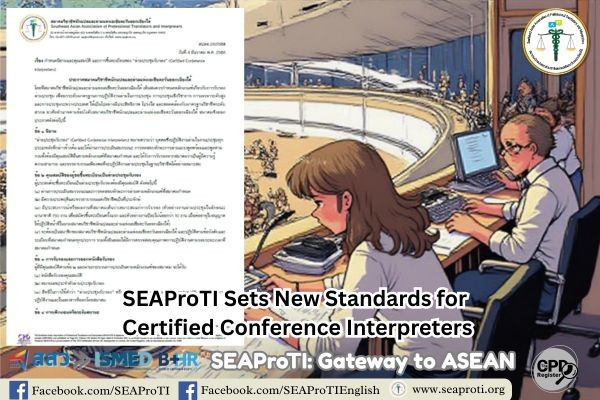
The Southeast Asian Association of Professional Translators and Interpreters (SEAProTI) has formally announced the qualifications and requirements for registration of Certified Translators, Translation Certification Providers, and Certified Interpreters in Sections 9 and 10 of the Royal Gazette, published by the Secretariat of the Cabinet, Office of the Prime Minister of Thailand, on 25 July 2024 (Vol. 141, Part 66 Ng, p. 100). Certified Translators, Translation Certification Providers, and Certified Interpreters
The Council of State has proposed the enactment of a Royal Decree, granting registered translators and recognised translation certifiers from professional associations or accredited language institutions the authority to provide legally valid translation certification (Letter to SEAProTI dated April 28, 2025)
SEAProTI is the first professional association in Thailand and Southeast Asia to implement a comprehensive certification system for translators, certifiers, and interpreters.
Head Office: Baan Ratchakru Building, No. 33, Room 402, Soi Phahonyothin 5, Phahonyothin Road, Phaya Thai District, Bangkok 10400, Thailand
Email: hello@seaproti.com | Tel.: (+66) 2-114-3128 (Office hours: Mon–Fri, 09:00–17:00)
อัตราค่าจ้างงานแปลแนะนำ ปี 2569: การวิเคราะห์เชิงมาตรฐานวิชาชีพ เศรษฐศาสตร์แรงงาน และจริยธรรมของนักแปลฟรีแลนซ์
อัตราค่าจ้างในฐานะ “กลไกกำกับคุณภาพวิชาชีพ”
อัตราค่าจ้างงานแปลมิใช่เพียงตัวเลขทางเศรษฐกิจ หากแต่เป็น กลไกเชิงโครงสร้างที่สะท้อนระดับมาตรฐาน ความรับผิดชอบ และคุณภาพของวิชาชีพการแปล ในระบบตลาดแรงงานสมัยใหม่ การกำหนด “อัตราค่าจ้างแนะนำ” สำหรับนักแปลฟรีแลนซ์ที่ประกอบวิชาชีพอย่างแท้จริง จึงมีบทบาทสำคัญในการสร้างสมดุลระหว่างคุณภาพงาน ความเป็นธรรมต่อผู้ปฏิบัติงาน และความคาดหวังของผู้ใช้บริการ
อัตราค่าจ้างงานแปลแนะนำ ปี 2569 ถูกออกแบบขึ้นภายใต้กรอบคิดดังกล่าว โดยมุ่งเน้นการยกระดับวิชาชีพ มากกว่าการแข่งขันด้านราคาที่ลดทอนคุณค่าแรงงานทางภาษา
หลักเกณฑ์มาตรฐานเอกสาร: การกำหนดฐานเปรียบเทียบอย่างเป็นระบบ
การกำหนดอัตราค่าจ้างแนะนำอาศัย มาตรฐานเอกสารเดียวกัน เพื่อหลีกเลี่ยงความคลุมเครือและการตีความที่เอื้อให้เกิดการกดราคา โดยใช้เกณฑ์ดังนี้
เอกสารขนาด 1 หน้า A4 ตัวอักษร Cordia New ขนาด 16 ไม่ปรับกันหน้า–กันหลัง และไม่ย่อบรรทัด
การกำหนดมาตรฐานเชิงเทคนิคนี้มีความสำคัญในเชิงวิชาชีพ เพราะทำให้อัตราค่าจ้างสัมพันธ์กับ “ปริมาณงานจริง” (actual workload) มากกว่าการประเมินโดยประมาณหรือโดยความรู้สึก
การจำแนกประเภทเอกสาร: ความแตกต่างเชิงความรู้และความรับผิด
อัตราค่าจ้างถูกจำแนกตามประเภทเอกสารออกเป็นสามกลุ่มหลัก ได้แก่ เอกสารทั่วไป เอกสารเฉพาะทาง และเอกสารราชการ
การจำแนกดังกล่าวตั้งอยู่บนสมมติฐานทางวิชาการที่ว่า ความยากของงานแปลมิได้ขึ้นอยู่กับภาษาเพียงอย่างเดียว แต่ขึ้นอยู่กับระดับความรู้เฉพาะทาง ความเสี่ยงทางกฎหมาย และผลกระทบของความผิดพลาด เอกสารเฉพาะทางและเอกสารราชการจึงมีอัตราค่าจ้างที่สูงกว่าอย่างมีนัยสำคัญ
การวิเคราะห์อัตราค่าจ้างตามคู่ภาษา: ภาษาในฐานะทุนมนุษย์ (Human Capital)
โครงสร้างอัตราค่าจ้างสะท้อนแนวคิดด้านเศรษฐศาสตร์แรงงานที่มองภาษาเป็น “ทุนมนุษย์” โดยพบว่า งานแปลจากภาษาไทยเป็นภาษาอังกฤษ (TH→EN) มีอัตราสูงกว่า EN→TH อย่างเป็นระบบ งานที่เกี่ยวข้องกับภาษาที่สาม (Third Language) มีอัตราสูงกว่า เนื่องจากข้อจำกัดของจำนวนผู้เชี่ยวชาญ ความซับซ้อนทางไวยากรณ์ และบริบทการใช้งานระหว่างประเทศ และรูปแบบดังกล่าวสอดคล้องกับตลาดแรงงานจริง และช่วยลดความเข้าใจผิดที่ว่าการแปลทุกคู่ภาษาควรมีราคาเท่ากัน
งานตรวจแก้ (Revision): บทบาทที่มักถูกประเมินต่ำกว่าความเป็นจริง
บทบาทของผู้ตรวจแก้ถูกกำหนดอัตราค่าจ้างแยกจากงานแปลอย่างชัดเจน ซึ่งสะท้อนการยอมรับในเชิงวิชาชีพว่า การตรวจแก้มิใช่งานรอง แต่เป็นกระบวนการประกันคุณภาพ (quality assurance) ที่ต้องอาศัยทักษะระดับสูง ความรู้เฉพาะทาง และความรับผิดชอบเชิงจริยธรรม
การกำหนดอัตราค่าจ้างตรวจแก้อย่างเป็นระบบจึงช่วยลดปัญหาการเหมารวมงานตรวจแก้เป็นเพียง “การอ่านผ่าน”
เอกสารราชการ: เส้นแบ่งระหว่างงานแปลกับกระบวนการรับรอง
อัตราค่าจ้างแนะนำสำหรับเอกสารราชการระบุไว้อย่างชัดเจนว่า ยังไม่รวมค่ารับรองตรา โนตารี หรือการรับรองโดยหน่วยงานรัฐ ทั้งนี้เพื่อแยกบทบาทของนักแปลออกจากกระบวนการทางปกครอง
การระบุเงื่อนไขดังกล่าวมีความสำคัญอย่างยิ่งในเชิงจริยธรรมวิชาชีพ เพราะช่วยป้องกันการเข้าใจผิดของผู้ใช้บริการ และลดความเสี่ยงทางกฎหมายของนักแปล
งานจากต่างประเทศ: การเทียบเคียงมาตรฐานสากล
อัตราค่าจ้างแนะนำสำหรับงานจากต่างประเทศที่กำหนดเป็นดอลลาร์สหรัฐต่อคำ แสดงให้เห็นความพยายามในการ เชื่อมโยงมาตรฐานภายในประเทศเข้ากับตลาดสากล โดยไม่ปล่อยให้นักแปลไทยถูกกดราคาต่ำกว่าค่าเฉลี่ยโลก
แนวทางนี้ช่วยเสริมอำนาจต่อรองของนักแปลฟรีแลนซ์ในเวทีระหว่างประเทศ และสะท้อนภาพลักษณ์ของวิชาชีพที่มีมาตรฐาน
ขอบเขตการใช้: การปกป้องวิชาชีพอย่างมีเป้าหมาย
อัตราค่าจ้างแนะนำนี้ระบุชัดว่า ใช้สำหรับนักแปลฟรีแลนซ์ที่ประกอบวิชาชีพ ไม่รวมผู้เริ่มต้น (beginner) ไม่ครอบคลุมเอเจนซี่ที่มีโครงสร้างแบ่งรายได้
การกำหนดขอบเขตดังกล่าวมิได้เป็นการกีดกัน หากแต่เป็นการ ปกป้องโครงสร้างวิชาชีพจากการบิดเบือนราคา และส่งเสริมการพัฒนาทักษะอย่างมีลำดับขั้น
บทสรุป: อัตราค่าจ้างในฐานะเครื่องมือยกระดับวิชาชีพ
อัตราค่าจ้างงานแปลแนะนำ ปี 2569 มิได้เป็นเพียง “ราคากลาง” หากแต่เป็น กรอบเชิงนโยบายของวิชาชีพการแปล ที่เชื่อมโยงคุณภาพงาน ความรับผิดชอบ และศักดิ์ศรีแรงงานทางภาษาเข้าด้วยกัน
ในบริบทที่เทคโนโลยีและการแข่งขันด้านราคาทวีความรุนแรง การมีอัตราค่าจ้างแนะนำที่ชัดเจน เป็นระบบ และอธิบายได้เชิงวิชาการ จึงเป็นหนึ่งในเครื่องมือสำคัญที่สุดในการรักษาคุณค่าของวิชาชีพนักแปลในระยะยาว
เกี่ยวกับนักแปลรับรอง ผู้รับรองการแปล และล่ามรับรองของสมาคมวิชาชีพนักแปลและล่ามแห่งเอเชียตะวันออกเฉียงใต้
สมาคมวิชาชีพนักแปลและล่ามแห่งเอเชียตะวันออกเฉียงใต้ (SEAProTI) ได้ประกาศหลักเกณฑ์และคุณสมบัติผู้ที่ขึ้นทะเบียนเป็น “นักแปลรับรอง (Certified Translators) และผู้รับรองการแปล (Translation Certification Providers) และล่ามรับรอง (Certified Interpreters)” ของสมาคม หมวดที่ 9 และหมวดที่ 10 ในราชกิจจานุเบกษา ของสำนักเลขาธิการคณะรัฐมนตรี ในสำนักนายกรัฐมนตรี แห่งราชอาณาจักรไทย ลงวันที่ 25 ก.ค. 2567 เล่มที่ 141 ตอนที่ 66 ง หน้า 100 อ่านฉบับเต็มได้ที่: นักแปลรับรอง ผู้รับรองการแปล และล่ามรับรอง
สำนักคณะกรรมการกฤษฎีกา เสนอให้ตราเป็นพระราชกฤษฎีกา โดยกำหนดให้นักแปลที่ขึ้นทะเบียน รวมถึงผู้รับรองการแปลจากสมาคมวิชาชีพหรือสถาบันสอนภาษาที่มีการอบรมและขึ้นทะเบียน สามารถรับรองคำแปลได้ (จดหมายถึงสมาคม SEAProTI ลงวันที่ 28 เม.ย. 2568)
สมาคมวิชาชีพนักแปลและล่ามแห่งเอเชียตะวันออกเฉียงใต้ เป็นสมาคมวิชาชีพแห่งแรกและแห่งเดียวในประเทศไทยและภูมิภาคเอเชียตะวันออกเฉียงใต้ที่มีระบบรับรองนักแปลรับรอง ผู้รับรองการแปล และล่ามรับรอง
สำนักงานใหญ่: อาคารบ้านราชครู เลขที่ 33 ห้อง 402 ซอยพหลโยธิน 5 ถนนพหลโยธิน แขวงพญาไท เขตพญาไท กรุงเทพมหานคร 10400 ประเทศไทย
อีเมล: hello@seaproti.com โทรศัพท์: (+66) 2-114-3128 (เวลาทำการ: วันจันทร์–วันศุกร์ เวลา 09.00–17.00 น.